Sunday, April 17, 2022

Pollinator Garden hardscaping


In 2020 I started a small garden of primarily native plants that support pollinators. It was in a corner of the front yard that was partial sun, partial shade. Since then I’ve been creeping the boundary outwards toward the sunnier part of the front yard bit by bit as I acquired more plants for that small space. 

A couple of months ago out of the blue my wife said “why don’t we just convert half of the front yard to a pollinator garden?” SERIOUSLY!?! 1000 times yes!

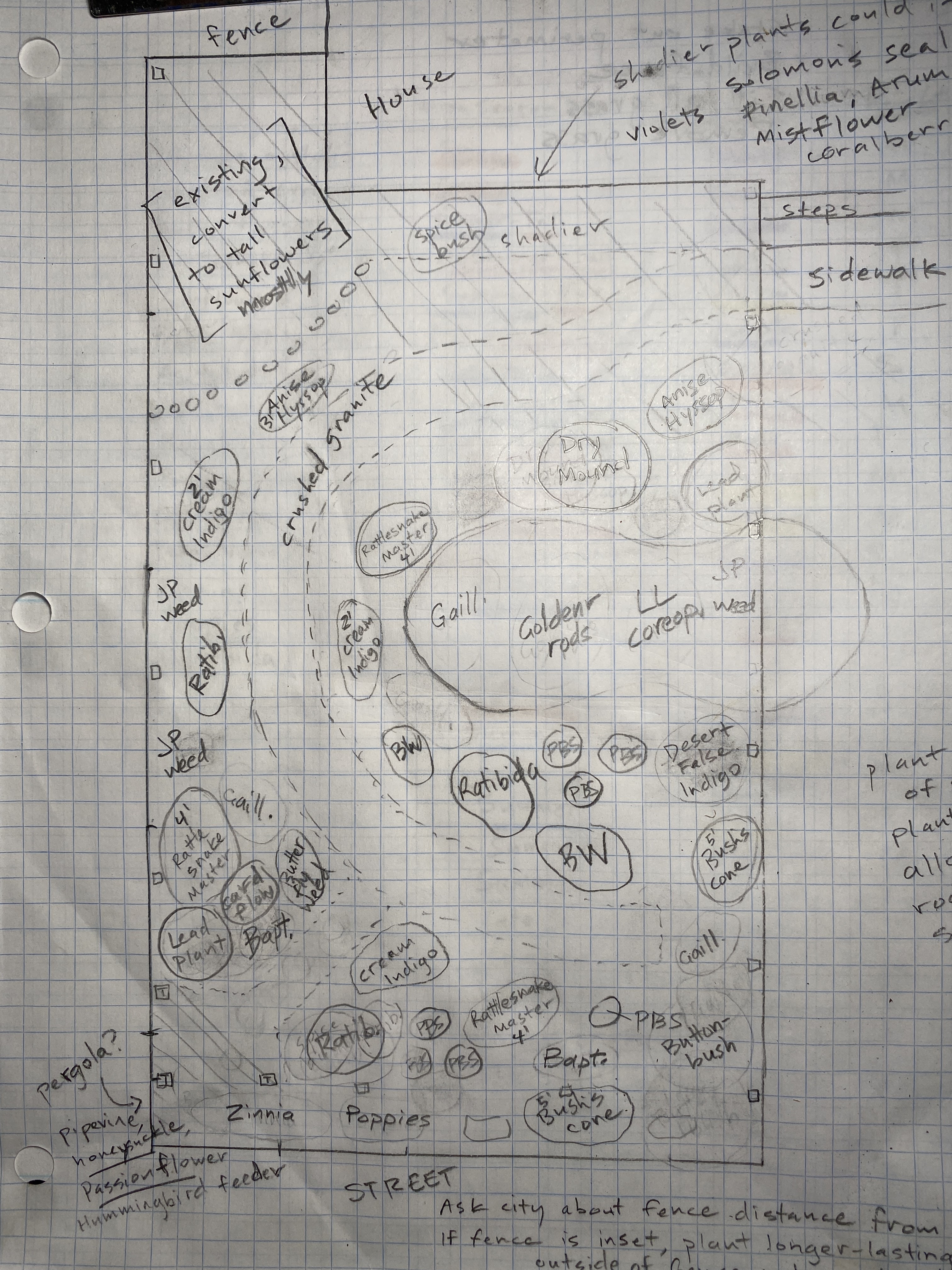
I immediately started sketching a plan and looking at plants I wanted to include. 


I rented a gas tiller and tore up all of the grass in that half of the front yard. I’ve been slowly removing all of that grass and pieces of roots. 


The next step was to get crushed granite screenings and lay the walking path through the garden. 


After the walking path was in place I started building a picket fence around the perimeter. The fence surrounds the garden except for a small entrance and the corner where the bench will sit, which will be covered by a corner arbor. 


The sign means this garden is legit!

I’ll be posting more progress photos and sharing all of the wonderful plants that I’m including. Stay tuned!


Wednesday, September 16, 2020

Greenhouse update

Since I haven't been keeping up with this blog for a while I figured I should provide a little update on my greenhouse. When you have limited growing space (don't we all?) and an ever-growing appetite for plants, it's hard to make space for everything.
Many of my Encyclia orchids are kept together on this top shelf for the brightest light.


Another top shelf is filled with cacti and succulents.

Over the years some plants have been neglected. Some plants get over-watered or under-watered, depending on where they are located and how they are potted. Over the last month I have done the most comprehensive greenhouse cleanup since I first built it. I didn't quite take everything out, but I did go through all 7 shelving units and remove empty pots, sweep out all the leaves from the floor, remove all the junk that was being stored under benches, and repotted plants that were in need of new soil or more space. 

Quite a few plants are hanging in the center of the greenhouse, taking advantage of every bit of available sunlight. It makes for less room to stand in the greenhouse, but that is a secondary consideration.

It was a big undertaking, but I'm really glad I took this on before moving all my plants back into the greenhouse for the winter. Probably a third to half of my plants come out of the greenhouse for the warm part of the year, but have to move back in during the winter to survive our cold weather. 

Wide-angle view to show most of the greenhouse at once.

It's this time of year when I start worrying that I won't be able to fit everything in. This year I think there might be enough room to get my plants in and still have a spot for me to stand to water things. That would be a big win!

This mid-level shelf is more shaded and has tender new seedlings and other plants I need to keep a close eye on over the winter.

During the winter the heater will really dry out the air in the greenhouse, so it's important that I keep a close eye on plants that are sensitive to dry conditions. For this reason I've tried to position some of these plants in positions where I they are front and center when I walk in the greenhouse.

Here's to hoping that the plants are happy over the winter and next spring I have lots of plants to share with friends!
Saturday, September 12, 2020

Seedling of Anthurium lezamae

I've really neglected this blog. I'm going to try to start posting more regularly once again.

Several years ago I visited the Missouri Botanical Gardens and got to tour the living collection of Aroids. I was given permission to collect some berries from a plant marked Anthurium lezamae. This plant was collected by Dewey Fisk from Chiapas, Mexico.


I successfully germinated one of the seeds and my plant has been slowly growing. This summer I repotted it and have been giving it a little extra attention and it has been doing really well. Now it has it's first inflorescence (that I have noticed).


I'm not certain that my plant is the species Anthurium lezamae, and it differs from the parent plant. That could be because my plant is still young, or it could be because the berries were produced from a cross with another plant, making mine a hybrid. Maybe with time I'll be able to tell.


Monday, February 25, 2019

Gomphocarpus from seed

One of several plants I started from seed last year was a milkweed nicknamed Hairy Balls or Balloon Plant (Gomphocarpus physocarpus). The nicknames are from the appearance of the large pods that form when the flowers set seed. This plant is native to southeast Africa, but is a good food source for Monarchs here in the United States. I ended up with two very tall and lanky plants. They did not branch and just continued to grow taller throughout the summer. At one point there were a few small flower buds but they aborted before opening. I don't know if this plant wanted more sunshine or something different. It seemed healthy and grew steadily, but I didn't get any flowers. I read that if you are growing these from seed it is best to start them indoors early because the growing season may not be long enough for flowers and new seed pods. Maybe that's what happened in my case.

My tall and lanky Hairy Ball plants (Gomphocarpus physocarpus) in August of last year.

Thankfully, the plant has stayed happy in my greenhouse this winter so maybe next summer I will get some flowers. Ideally those flowers will set seed pods so that I can start new plants from seed and maybe prune my two existing stalks to get a fuller plant.

Open seed pod of Gomphocarpus physocarpus.
Like many other milkweeds, the seed are attached to a fluffy piece of cotton-like material
that helps them disperse in the wind.

Thursday, February 21, 2019

Milk Jug Germination

Spring will be here before we know it. Already I am seeing a few blooms on my quince bush, buds on our Daffodils, and leaves from our tulips are breaking through the surface of the soil.

I have seeds of several milkweeds that I would like to grow this year, including three native Asclepias and one Calotropis native to Africa and Asia. The American natives all require cold stratification. I have most of the seeds in the refrigerator, but I am starting a few others using a different method. 

I cut open two milk jugs and added soil to the bottom of the jug. I scattered some of my seeds on the top of the soil, watered them in, and then taped the jugs closed. I’ve sat the milk jugs outside on the ledge of my greenhouse. Hopefully they won’t blow over or become dog chew toys there. With any luck, they will experience the requisite cold period and then will germinate in about a month when the temperature begins to climb and the days get longer and they’ll have a head start in their little biodomes. If it doesn’t work, no big deal. I only used part of my seed stash on this experiment.

I did a little more reading on this technique and apparently it's important for the top cap to be removed. I was assuming more of a close greenhouse/terrarium setup was desired, but I will stick to the recommended method and remove my top caps.

Tuesday, January 22, 2019

Treaty Oak update 1

I've been trying to be patient and not disturb my little Treaty Oak seeds. I managed to go a couple of weeks without looking at the pot. Over the weekend I stole about 30 minutes to give my greenhouse a thorough watering and glanced at the Treaty Oak pot to see what was happening.

Seedlings from the Austin Treaty Oak
Texas Live Oak (Quercus fusiformis)
Yes! Four little seedlings have broken the surface and have leaves! Even at this tiny size, the leaves have a unique shape. The stems were growing towards the light, which was coming mostly from one direction, so I snapped a few pictures, rotated the pot, and put it back on the shelf. I am very happy to see that they are doing well. These are Texas Live Oaks (Quercus fusiformis). I plan to give one to my mother-in-law for Mother's Day, since this tree has some special significance to her. I will look for other homes for the other ones. I am not quite sure if they are hardy in central Oklahoma, but I think they will do well in southern Oklahoma, so I could plant some at my parents' lake cabin.

Friday, November 16, 2018

Trip Report: Zilker Botanical Garden

While we were in Austin we visited Zilker Botanical Garden. There was a special event going on while we were there with local vendors with art, plants, and other things for sale. One of the vendors was a local nursery that had some rare plants for sale, including a small Frankincense tree about 6 inches tall, selling for $250! I talked to the owner and he said that it was a cutting from their parent plant, which isn't very large and that the cuttings are difficult to root. I bought a small Curry Tree for $6 for my friend who had been looking for one of these for years.

The sun shines brightly through the canopy,
nearly preventing us from seeing the dino statue across the lotus pond.

Ammonite fossils are used as paving stones by the lotus pond.

Posing in front of a waterfall in the Prehistoric Garden


Alligator Plant (Acanthus montanus)

We really enjoyed the Hartman Prehistoric Garden, which consists of plants from families that have been on earth for millions of years: cycads, ferns, palms. This garden was inspired by dinosaur tracks and an ancient turtle fossil that were found inside the gardens in 1992. At one spot there are paving stones that are actual ammonite fossils, which is really cool. They also have a bronze dinosaur statue in view across a pond.

Southern Dogface (Zerene cesonia) enjoying a Coreopsis

American Snout (Libytheana carinenta) enjoying a Coreopsis

The butterfly garden was rather unkempt looking, but the bushy flowering plants were absolutely covered in butterflies enjoying the nectar. I think most of the plants were Blue Mistflower (Conoclinium coelestinum). We saw at least 10 species, likely a few more: Queens, American Snouts, Sachems, Gulf Fritillaries, Red Admirals, Monarchs, Pipevine Swallowtail, White-striped Longtail, Southern Dogface, and a couple of Skippers I didn't identify.

Queen (Danaus gilippus) butterfly enjoying some nectar
from the Blue Mistflower (Conoclinium coelestinum)

Queen (Danaus gilippus) butterflies enjoying... each other.

A few other quick things to note:

Coral Fungi, probably from the genus Ramaria

This is not a plant, but I have admired photos of Coral Fungi before but not seen one in person. Along the path in one part of the gardens I noticed a bunch of these on the ground. So beautiful!

A real rock turned into an outdoor light along the pathway

The gardens have these really cool lights along the path. They were not illuminated while we were there visiting in the daytime, but I noticed one when I was bent down inspecting the fungi. They are actual rocks - not those fake plastic ones - that have been cut in half and had lights installed in them. What a cool idea!

Thaumatophyllum bipinnatifidum mislabeled as both a Philodendron (almost right) 
and a Monstera (definitely not right).
It's not unusual to find plants mislabeled in a botanic garden, but it still surprises me every time I see it... In all fairness, this plant used to belong to the genus Philodendron and only recently moved to the new genus of Thaumatophyllum. But still, Monstera deliciosa is a very different plant and in a separate genus.

Tuesday, November 13, 2018

Trip Report: Treaty Oak

For my birthday weekend my wife and I went down to Austin for a few days sans kiddos. Our itinerary was mostly made up of places to eat and a few activities sprinkled in between. On Sunday morning we visited a famous tree, Treaty Oak, which my wife remembered having visited when she was young. This oak tree is thought to be about 500 years old and is the only member of a group of 14 trees that once stood in this location in what is today downtown Austin. In 1989 someone poisoned the tree and severely damaged it. That is when my wife traveled with her family to see it. Thankfully the tree pulled through and still stands.

My wife at Treaty Oak in downtown Austin
The plaque reads:
The Caldwell Treat-Oak Park
Estimated to have been a majestic tree of about 100 years when Columbus first landed on North American shores, this live oak tree has been pronounced the most perfect specimen of a tree in North America, and its picture hangs in the Hall of Fame of Forestry at Washington.
Formerly standing as the center of a group of trees called "The Council Oaks," this tree takes its name from its role in the history of the Lone Star State. Stephen F. Austin is reputed to have signed the first boundary line agreement between Indians and whites under the canopy of its branches; battles and important conferences have been planned, pacts signed, and feasts and religious ceremonies celebrated in its shade.
The Treaty Oak was purchased by the City of Austin in 1937 to stand as a living and fitting symbol of the mighty state it has watched develop.
We were both surprised to see how much of the tree lies on the ground. I don't know if this is characteristic of the species (Texas Live Oak, Quercus fusiformis), or if it has more to do with the vandalism, or the age of this particular tree.

Treaty Oak acorns

While we were visiting the tree I noticed some acorn caps on the branches at eye level and realized there must be some dropped acorns nearby. We searched around and found 5 that were brown and "ripe." I brought these home and soaked them in a bowl of water to see if any floated, which means the acorn is not viable. They all sunk and I decided I would plant them the next day. But I forgot.

Treaty Oak acorn beginning to germinate
More than a week passed before I noticed the bowl of acorns! I was worried at first when I saw they looked different, but on closer inspection I realized they were sprouting. I went ahead and potted the five acorns and watered them well (since they were used to being saturated and seemed happy with the situation). If I am successful I will have some offspring from a famous tree, which is kind of fun. Updates to come!

Monday, October 22, 2018

A tree with a view

My good friend Steve gave me a couple of Paw-Paw trees (Asimina triloba) during the summer. I have kept them in the pot until now, wanting to make sure they were kept watered and healthy during the hot season.

Paw-Paw tree (Asimina triloba) with a view of a little pond
Last week I took them out to my in-law's land where there is plenty of room to plant trees and searched for a good spot. I also had some young Persimmon (Diospyros virginiana) trees to plant. My mother-in-law pointed me an area which already had a cluster of Persimmon trees growing. I don't know if the trees were planted together here many years ago (when my wife's ancestors settled the land), or if they grew here naturally. My mother-in-law had shown these to me in the past but I had never seen any fruit on them. This time around I saw a few fruits up on the tall skinny trees and I saw one smaller, squat tree that was absolutely covered in fruit.

Nearby Persimmon (Diospyros virginiana) tree loaded with fruit
We decided that we would go ahead and plant the Paw-Paw trees here with the Persimmon trees. I like that these little trees have such a nice view. By the way, I took advantage of the loaded Persimmon tree.

Persimmon fruits

Persimmon seeds removed from fruit.
There's actually more seed volume than fruit volume and it was a lot of work to separate the two.

Persimmon cookies
I brought about 30 fruits home and laboriously separated the small amount of fruit from the large amount of skin and seeds and made one batch of Persimmon cookies using the recipe I've shared before. I only got 1/3 cup of persimmon out of the fruits I collected, so I had to modify the recipe. The end result was 14 delicious cookies and 110 seeds that I can now plant. Johnny Appleseed, there's a new seed sower in town.

Friday, October 19, 2018

That time of year...

It's once again that time of year when all of the plants have to be moved back into the greenhouse for a long winter slumber in semi-tropical conditions. Most of my plant collection consists of tropical and semi-tropical plants that can't take the cold Oklahoma winter weather. I keep my greenhouse thermostat at 60 Fahrenheit and it does a pretty good job of maintaining that temperature overnight during the winter, only falling lower when the outside temperature is down in the 20s for multiple hours. Prepping the greenhouse and then moving in all of the winter occupants is a pretty big chore which I knock out in two sessions of about two hours each.

BEFORE: Plumbago (Plumbago auriculata) in all it's glory
My greenhouse is pretty small - especially for the hundreds of potted plants I have. So I have to pack everything in tight, and in vertical layers. Some of the larger plants have to be trimmed back. This year our potted Plumbago really took off and was blooming something fierce last week, when I was moving all of the plants into the greenhouse. I saved it for last and finally took out the shears. After it's haircut it fit into the greenhouse pretty well, leaving just one tiny amount of floor space for me to stand in while I try to water all of the captive plants over the next 5 months.

AFTER: Plumbago (Plumbago auriculata) trimmed back and ready to pack into the greenhouse
Every year I make minor modifications to my greenhouse setup and where I place all of my plants. This year I decided to put my cacti and succulents (which can stay pretty dry over the winter) in the hardest to reach places. I think this will really help because it brings more plants which do need to be watered to more accessible locations and prevents me from accidentally watering something that would prefer to be dry. Also, some of those hard to reach places receive a little more light than other places and the cacti and succulents will like that. In previous years I had put my Plumeria plants on one of these high, sunny shelves. Since they drop their leaves over the dry winter, they really don't need to be in sunlight, so I have those scattered around in various places in the greenhouse this year.

Wednesday, October 10, 2018

Cactus rot

It has been a wetter than normal year in most of Oklahoma. My sister just got interested in succulents and cacti recently and has some of her plants out on her front porch for the warm season. When I was at her house a few weeks ago she pointed out one of her new cacti that was in bad shape. I'm afraid this plant was getting a lot of runoff from her roof and was just too wet. She mentioned it was actually her favorite and she was hoping it wasn't a goner.


The central growth had rotted and was just a black mushy clump with spines. However, it looked like there may be some salvageable growth that had not begun to rot - yet.


I gave my sister some instructions on what to do and then asked if she'd like me to do it. She was happy to hand it over. I took it home, donned some gloves, and carefully unpotted it. I separated the healthy green growth from the black mush and threw that away. I was going to set the green growth aside to let it callous before planting it again, but it seems to be without wounds and had roots attached, so I carefully repotted those growths. Important: I did not water the pot and I sat it aside in the greenhouse in a location where it will stay dry.


I will check this pot regularly over the next several weeks and hopefully not see any new rotting. Assuming all is well, I'll add some rocks to the surface of the soil again and take it back to my sister.

Wednesday, September 19, 2018

The Mighty Plumbago

I first became familiar with Plumbago (Plumbago auriculata) several years ago when we were planning our Galveston garden. This is a pretty popular garden plant in that area. It grows into a pretty big bush with time and will be covered in pale periwinkle blue flowers during much of the year (in warm climates).

Plumbago auriculata

We planted one in Galveston and it grew quite large - prior to the brutal winter, which killed it. We have since replaced that bush with a tiny starter, which I expect will take a year or two before it is dominating it's area of the flowerbed.

Plumbago auriculata
This has become my wife's favorite plant. A couple of years ago we ran across a Plumbago in a nice black square pot at a nursery in Oklahoma and decided to get one for our house, even though it's not hardy. We keep the plant in my greenhouse overwinter and it usually looks pretty rough in the spring when we pull it back outside, but it grows pretty quickly and flowers vigorously in the summer. It is putting on quite the show right now. Soon I will have to prune it back and squeeze it into my greenhouse for the cold winter months.

Tuesday, September 18, 2018

Plant Find: Begonia sizemoreae

The title of this post is a bit misleading. I didn't find this plant; it was given to me by my friend Steve. I use the "Plant Find" heading for new plants coming into my collection, regardless of how I obtained them. Steve tells me that it roots very easily from leaf cuttings and he has had to start tossing his cuttings now because he has so much of this plant.

Begonia sizemoreae
Begonia sizemoreae is native to Vietnam and likes humidity. It has been enjoying our wet summer. The leaves and petioles are covered in long bristly hairs.

Begonia sizemoreae

This beautifully patterned Begonia is named after an avid collector named Mary Sizemore. She is well known among Begonia aficionados.

Wednesday, September 12, 2018

Update: Sacred Bodhi Tree

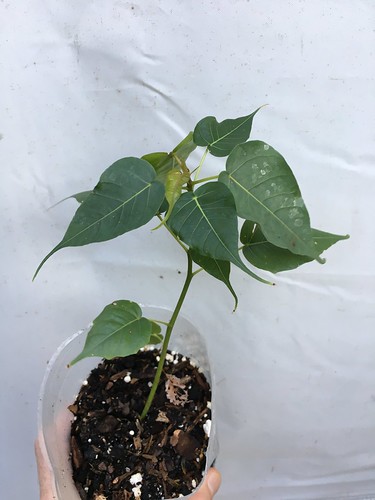
Seven years ago I was gifted some seedling Sacred Bodhi trees (Ficus religiosa) from a friend. Read more about the tree here. I gave one of those seedlings to my mother-in-law for insurance. I'm glad I did because my tree died a couple of years ago when it got too dry in my greenhouse. My mother-in-law's tree goes through a series of phases: rapid growth, scale infestation, dropping all the leaves - repeat. We're not sure why the scale keeps coming back, as it seems completely free of them when it is in it's rapid growth phase. Anyway, it seems to be an established pattern now.

Ficus religiosa
Sacred Bodhi Tree sapling (Ficus religiosa)

I recently took two cuttings of her tree when it was in a rapid growth phase and one of those cuttings has rooted. I started the cutting in pure vermiculite. After I was sure that roots were established I transferred it to potting soil. It's now producing new leaves and seems to be pretty happy. In a humid tropical climate this tree would easily be meters tall by now, but in our temperate Oklahoma climate (and my mother-in-law's plant being grown indoors) it is staying fairly small, almost a bonsai. I'm so thankful to have this little tree back in my collection and will monitor it closely.

Wednesday, September 5, 2018

A couple Huernia blooms

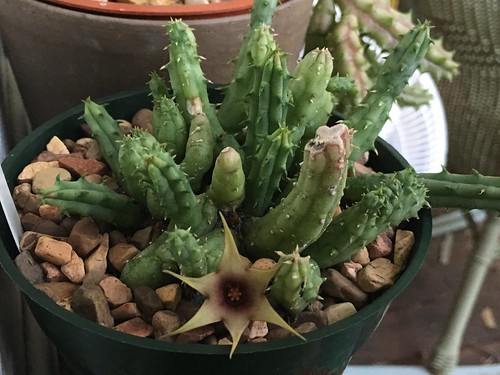
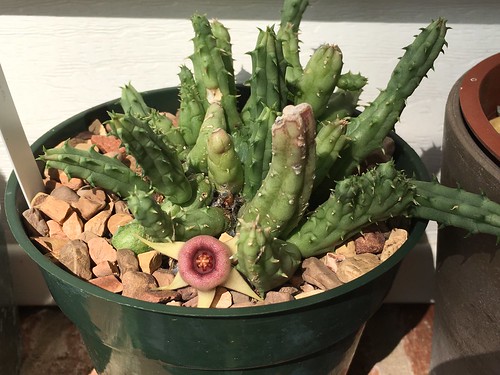
Without a doubt, Huernia is my favorite succulent genus. This genus is in the Stapeliaceae family, closely related to the common carrion flower/starfish plant, Stapelia gigantea. I have amassed a pretty good collection of these plants and always seek them out at the Central Oklahoma Cacti and Succulent Show. This year I purchased a new one that was labeled Huernia sp. The petals of the flower reflex after a day or two, resulting in a different appearance (shown in second photo).

It bloomed not long after the show and I was able to get some help identifying it as either Huernia procumbens or a hybrid of that species.

Huernia procumbens

Huernia procumbens

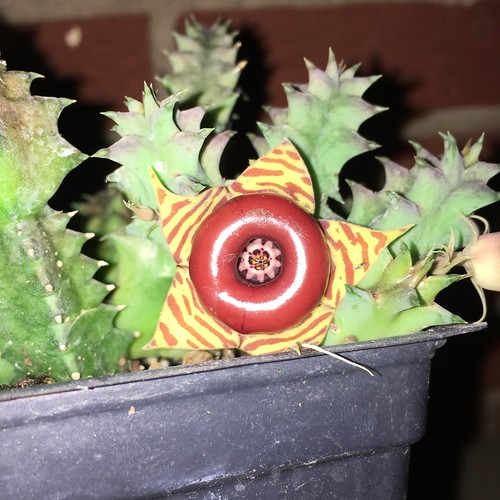
Another Huernia that I picked up recently is Huernia zebrina, which has very distinct yellow and red flowers. This plant is sometimes called the Lifesaver Plant, due to the red ring that forms in the center of the flower, similar to the plant above, but more pronounced and much more colorful. I was delighted when the first flower opened on my plant and have been pleasantly surprised to see this plant flower constantly all summer for me. There have been as many as 5 flowers open on the plant at one time.

Huernia zebrina