Showing posts with label collecting. Show all posts

Wednesday, November 10, 2010

Second round Spiranthes

After I found a Spiranthes growing in my front yard, my mother-in-law was determined to find some of her own.  She found a group of several on a hill on their property.  As an experiment, she dug up all but one of these plants carefully and placed the clumps of soil in four different pots.  She gave two pots to me and kept two for herself.  She also marked the one left in the ground by placing a couple of pieces of scrap wood around it.  In addition, I had potted one Spiranthes I found growing in my neighborhood.

I placed the three pots in my greenhouse and enjoyed the little time left they had of their dainty white blooms.  Then they turned brown and have just sat there.  I've wondered whether bringing them into a year-round warm environment would mess up their natural cycle of seasons they would have otherwise experienced in the ground outdoors.  Recently my two pots from my mother-in-law of dead stalks started to change - green leaves began to emerge from the soil, right next to each deceased stem.  At first I wasn't sure that it had anything to do with the Spiranthes, thinking maybe it was just something else in the soil (maybe even a grass) that was  coming up.  But I realized that the leaves were directly associated with each of my old Spiranthes stems.  And then about a week later a couple of leaves broke through the soil surface in the potted Spiranthes from my neighborhood.
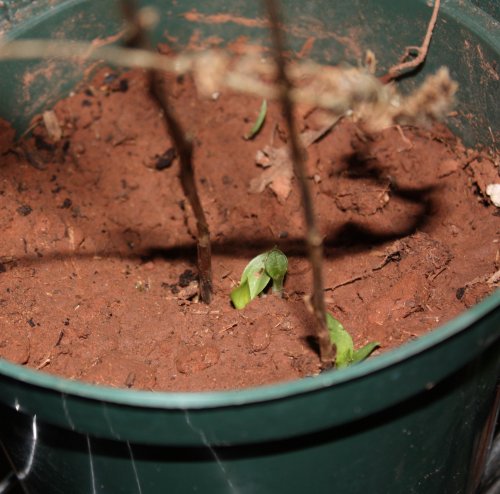
spiranthes_2nd_growth
New leaves emerging from my Spiranthes tubers
Now there is a rosette of 3 or 4 small leaves surrounding each deceased stem and they are coming up from more than one location, making me think the Spiranthes tubers have produced offsets under the soil.  I checked to see if the marked Spiranthes still in the ground at my in-laws house was also producing these leaves and it is not.  Right now my theory is that the potted Spiranthes are taking advantage of what they must consider a warmer than normal Fall and going for another round.  They may or may not send up another flower stem.  They might just be putting up leaves to produce chlorophyll and energy which can be transferred to the tubers as stored energy for next year's growth.  Either way, it's an interesting experiment.  Since Spiranthes are so wide spread in the United States, I'm not at all worried about experimenting with these volunteers that came up in our yards.  Hopefully I'll have something exciting to report in a couple of weeks time.

Friday, October 8, 2010

Endangered Oklahoma orchid

The Oklahoma grass pink orchid (Calopogon oklahomensis) was discovered by Douglas H. Goldman in 1995.  It is a terrestrial orchid native to several states in the central United States, growing in prairies, savannas, woodlands, the fringes of bogs and mowed meadows.  The actual locations where these orchids can be found are patchy.

Distribution map for Calopogon oklahomensis
(source: http://flora.huh.harvard.edu)

Recently this orchid has been listed as endangered in some states and may be protected by the Endangered Species Act (ESA) soon, based on the results of studies from the U.S. Fish and Wildlife Service (USFWS).  As you can see on the map, the actual range is fairly small and some of the locations where it grows wild are being transitioned to other land uses.

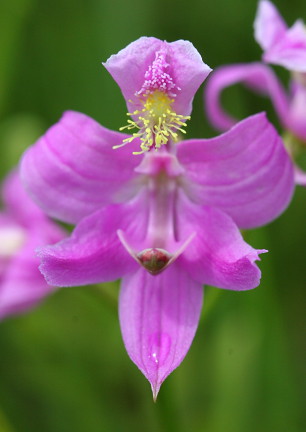
Calopogon oklahomensis pink
Calopogon oklahomensis growing in northwestern Arkansas, May 2009.
(Photo courtesy Steve Marak)

 For a while this orchid was thought to be another species (Calopogon tuberosus), but it flowers at a different time of year and has some distinctive differences when closely examined.  The flowers of this orchid are quite distinct, with color from light pink to darker purple with delicate yellow hairs.

My hope is that someone will make an effort to collect and propagate some of this species before it is listed as protected by the US government.  If it can be cultivated then it could be re-released into protected and suitable habitats if the wild numbers decrease further.

There are some really good pictures of this orchid elsewhere on the internet.  Check on flickr.

Thursday, September 16, 2010

Native Orchid

I was walking around my front yard talking on the phone this week and I reached down and plucked a flower stem off of a "weed" growing in my yard.  As I was walking around I started looking at the flower spike a little more closely and noticed that the flowers were very intricate and attractive, although very tiny.  In fact, they looked a lot like an orchid.

IMG_4144
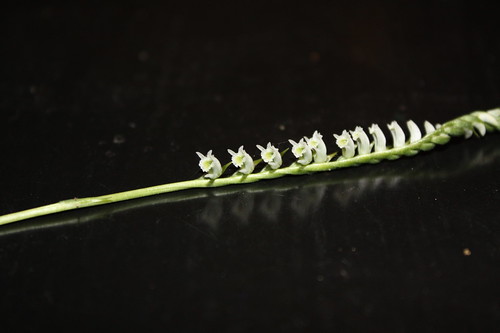
Spiranthes lacera var. gracilis
The flowers spiral up the stem as they open and are all white, except for some yellow in the "throat."  I emailed a picture to my orchid friend, Steve, who lives in Arkansas.  He knows a lot about miniature orchids and natives, so I thought he might be able to give me some guidance.  He was familiar with my plant and told me it is called "Nodding Ladies' tresses" from the genus Spiranthes, possibly Spiranthes cernua.  There are a couple of other species that look very similar, as well.

[2010-09-24 Update:  I got a positive species identification on this plant.  It is Spiranthes lacera var. gracilis.  Thanks to the Native Orchid Conference mailing list for the ID help!]

Steve said that he has seen these in his yard before too and that he is amazed by their hardiness and survivability in mowed lawns.  Since I plucked mine before realizing what it was, I don't really know where I grabbed it or what the rest of the plant looks like, but Steve tells me it is a very non-descript grass like plant.  I'll keep my eyes peeled for more flower stems.

The USDA website shows that this plant is native to much of central and eastern North America.

Wednesday, May 19, 2010

Clovers from seed

I couldn't have grown these intentionally...

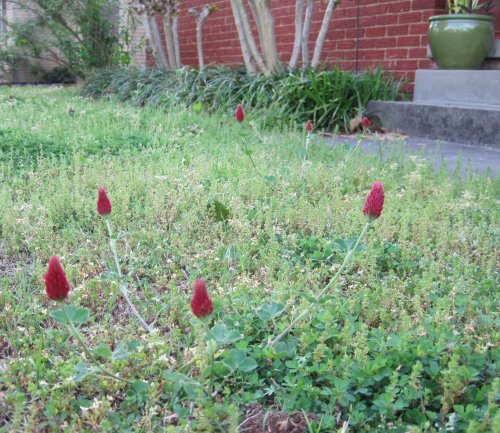
crimson_clover_volunteers_2010
Crimson clover (Trifolium incarnatum) blooming in our yard.
Remember the beautiful red clovers that I found growing on the side of the highways across Oklahoma last year?  Remember how I brought a small clump home and planted them in a pot on my front porch?  Well, they didn't last long very long in the pot.

However, the seeds must have blown from the porch into our yard and managed to germinate this spring.  Thanks to our vacation to St. Louis a couple of weeks ago and our busy schedule when we got home, we didn't have time to mow the grass weeds for almost 2 weeks.  This gave our little clover seedlings just long enough to produce some blooms before I plowed them over.  I'm glad we weren't going to get around to mowing to give them a chance to flower!

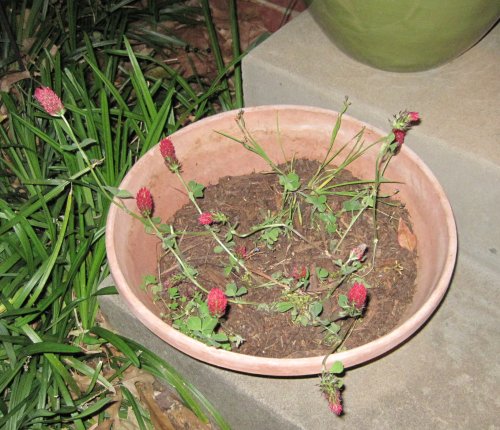
potted_clover
Crimson clover contained once more.
I have removed the little plants from our lawn and moved them to a pot.  This year maybe I will try to collect some of the seeds and scatter them in an area where I would like to see them next year.  Think I'll be as successful as Mother Nature was?

Wednesday, November 18, 2009

Passionflowers in the wild

My family heads down to Lake Texoma (on Oklahoma's southern border) on the weekends during the Summer, to ride around the lake on our boat and waterski.  There is a nearby area we like to call "Jurassic Park" because of its thick vegetation.  We drive in on a golf cart and forget that we are in the central United States.  You almost feel like you are in a South American jungle, unless you look closely at the type of plants growing.  Looking at the vegetation, I never saw anything spectacular (in the tropical sense).  That is, until recently.

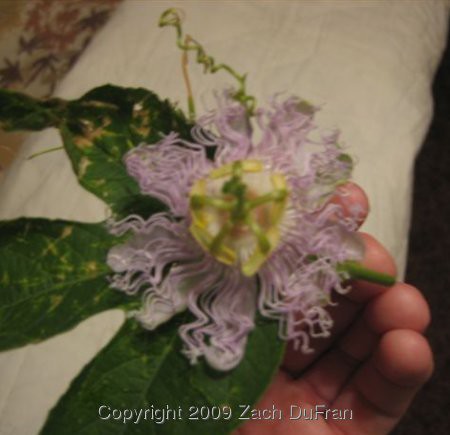
The picture below is of a Passionflower bloom that I cut off of a plant growing wild in "Jurassic Park," about 100 yards from the waters of Lake Texoma.  It is unlikely that this plant was growing there natively, but it is also unlikely that it was planted.  My guess is that somewhere nearby this plant is in someone's garden and a bird ate from the fruit and deposited the seed in this location.

buncombe_passionflower
Passiflora incarnata bloom, cut from plants growing wild in southern Oklahoma
I have heard people talk about how hardy Passionflowers can be very invasive in our climate.  The first year the plant is beautiful and robust and the next year there are plants coming up everywhere.  But I hadn't seen this in person, so, like Thomas, I doubted.  Now I have seen some of this Passionflower growing wild in a very unexpected location.  This area was the last place I expected to see a beautiful flower that looks so tropical.  The plants were covering much of the undergrowth and were bearing fruits in many areas.  Once you saw one, you would see tens of them.  Your eyes just had to be attuned.

I immediately wanted to bring some of this plant home with me.  First, I tried digging up some of the smaller plants and bringing them home with me, but it was very difficult to dig up the plants and bring the roots along.  The plants died within a matter of days.  To add injury to insult, I ended up covered in poison ivy that lasted for several weeks.  It was miserable.

A couple of weeks later, against the recommendations of all of my family members, I went back to take cuttings of these plants.  This time I was very wary of the poison ivy and stayed free of it.  The cuttings stayed green for a couple of weeks and I held out hope that they would produce roots, but none of them did and eventually the cuttings withered and died.

If you happen to have a tip for taking cuttings of Passionflowers, I would love to hear it.

Monday, August 31, 2009

Native grass bouquets

Over the last couple of weeks, I have noticed many different grasses going to seed along the side of the highways and interstates in Oklahoma.  There is one specific grass that has really cool, red seed heads.  I have said to Christie several times that we should stop and snip some to make a bouquet.  Yesterday, we snipped the tops off of two different grass types to make some really nice, simple bouquets.

native_white_grass
Bouquet of native white grass seed sitting on our TV
Grasses have been receiving more landscaping attention over the last couple of years.  People are beginning to include grasses as highlights in their flowerbeds, rather than just vast green lawns.  I recently read that growers are looking at more and more native grasses in Oklahoma for potential landscape focus.  Many of these grasses are well suited for xeriscape landscaping, since they can survive the hot and often very dry summers in Oklahoma.

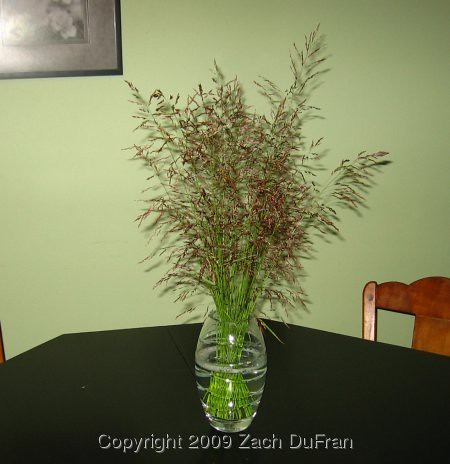
native_red_grass
Bouquet of native red grass seed on our dining table
I wouldn't mind having some of this red grass planted in one of our flowerbeds!