Showing posts with label Ethiopia. Show all posts

Friday, January 27, 2017

Trip Report: Gulele Botanic Garden in Ethiopia

Christie and I spent the month of July last year in Ethiopia, while we were finalizing the adoption of our son, Merek.

Untitled
Yep, he's adorable!
A while back I heard about a botanic garden in Addis Ababa and I was excited about visiting during our time in Ethiopia.  There is very little information on the internet about this place and no one seems to know about it around town.  (There is a new website that has some good information here.)  At the time the best I could do was find a phone number and called and talked to someone, who seemed a little surprised that we wanted to come and visit.

IMG_9717
Cute little flower growing on the grounds of Gulele
We hired a taxi to drive us to the area near the garden and when we got close the driver started asking people along the street if they knew where we should go.  I brought the phone number with me and had the taxi driver call and talk to the people at the garden.  He brought me to an office building and Christie, Merek, and I went inside to meet some of the garden staff.

We visited for a short time in their office and then the Director of Education (I think his name was Solomon) got in a separate car and asked us to follow him to the garden in our taxi.  We drove up the mountain a little distance and pulled in the gate, where a staff of 5 or 6 people were tending to the garden.

Untitled
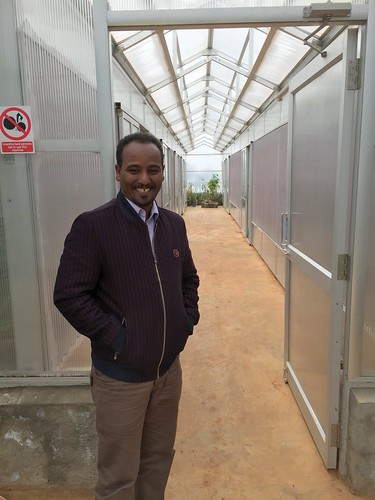
Director of Education standing in front of the greenhouses

Solomon was very happy to show me around the garden.  He told me about their vision for the place, which has been developing slowly over the last 5 years.  They envision this being a place where people come to go walking or jogging or just to enjoy nature.  (It was a good area for birding!  I recorded my 500th life bird while here: Rufous-breasted Sparrowhawk)  They aim to collect plant species from throughout the country and grow them on site, as well as to sponsor conservation efforts throughout Ethiopia.  They have rows of plants arranged almost like crops and two nice greenhouses.
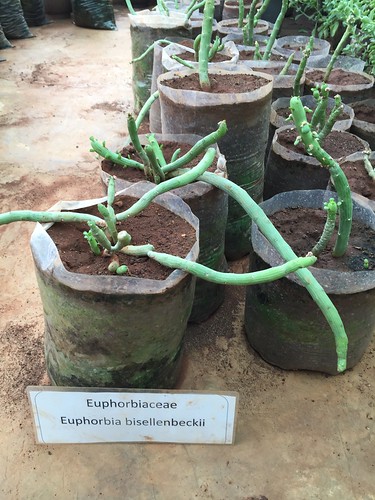
The greenhouses are sectioned into rooms coming off of a main corridor that runs down the middle.  We ventured inside and talked about the various plants they are growing.  Many of the plants are native to Ethiopia, but not all.  Solomon said it is challenging to meet the growing conditions of all of these plants from the many different climates across Ethiopia, so they are trying to simulate different climates in different rooms. Most of the plants are growing in plastic bags.  It wasn't clear to me if these are temporary or long-term.

Euphorbia bisellenbeckii
I told Solomon that I grow a lot of tropical plants, primarily Aroids and Orchids.  He wasn't very familiar with the Aroid (Araceae) family, so I tried to give him some examples.  Finally we came across one aroid in his greenhouses, which looked like a Sauromatum.  He showed me a group of native orchids, but they were not in bloom and I would have never guessed they were orchids.  Their leaves looked similar to the leaves of a day lily.  The orchid family is quite diverse and I remembered that my Field Guide to Ethiopian Orchids had a lot of genera that I was not familiar with before reading that book.

Untitled
Boys swimming in an artificial pool formed around a natural waterfall flowing by the side of the path up the mountain.
After touring the greenhouses we went outside and found Christie, who had been walking around with Merek, taking pictures of birds for me.  We walked even farther up the steep hill and ventured to some other parts of the garden that I would not have guessed were the same property.  Along the way we passed several different habitats that the staff has been working to create, including a marshy area formed by damming up a natural creek that flows down the hillside.

Untitled
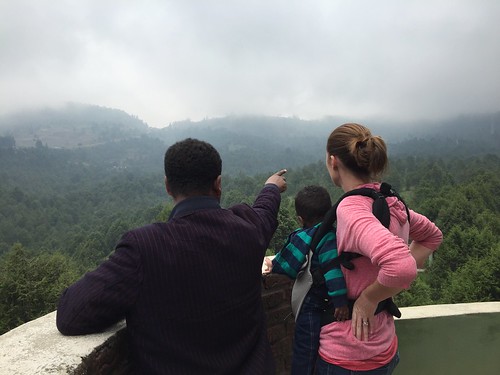
Solomon pointing out the rough property line of the botanic garden
Near the top of the hill there was a flatter area and a path that led to a lookout tower.  We stood on top and took in the view of the countryside and city below us.  Merek slept in his carrier for a little bit, but when he woke up he was kind of ready to get out and do something else.

I regret that I didn't get a good picture of the garden as a whole, showing the rows of plants and such.  I was focused on individual birds and plants.  We really enjoyed our outing and will visit again on one of our return trips to see how the garden matures.

Gulele Botanic Garden
Click above to see the complete album.

Friday, September 9, 2011

Orchid gifts

My parents-in-law were out of town for a month while my father-in-law was cycling from Seattle to Los Angeles.  While they were away, we were in charge of keeping their pups and orchids alive.  Mission successful: all survived.

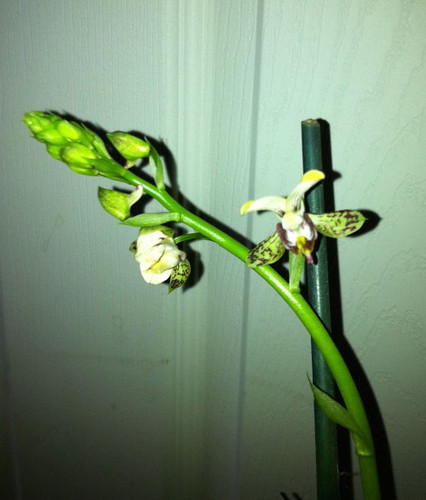
One of the orchids came into bloom just before they came home, Eulophia streptopetala.  My mother-in-law bought this orchid while she was in California last year at Santa Barbara Orchid Estate.  She purchased this particular orchid because of it is native to Ethiopia, the country from which we are adopting.

Eulophia_streptopetala
Eulophia streptopetala first blooms.  Sorry the picture is out of focus. Once again, this is on my camera phone and I couldn't tell it missed the focus point.

While I was excited about the orchid blooming for the first time, they were back at the Santa Barbara Orchid Estate again.  They brought home three new orchids, two for me, in thanks for taking care of the orchids!

Lockhartia oerstedii


Lockhartia oerstedii_spent_blooms
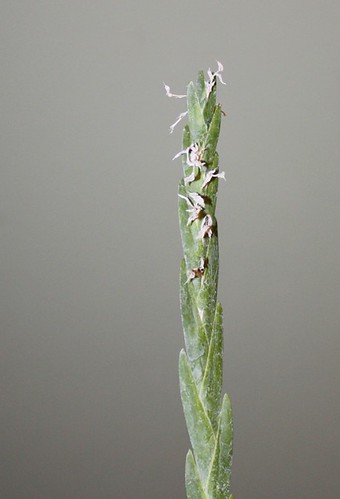
Lockhartia oerstedii spent blooms

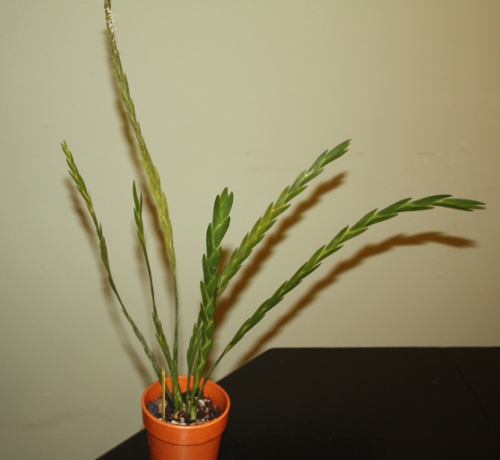
The first orchid has a really unique growth habit.  It is a species orchid, Lockhartia oerstedii, from central America.  When I looked up the description of this plant I learned a couple new botanical vocabulary words.  The first is imbricate, which refers to the overlapping leaves which look like roof shingles or reptile scales.  A second word is caespitose, which means densely clumped.

Cirrhopetalum makoyanum

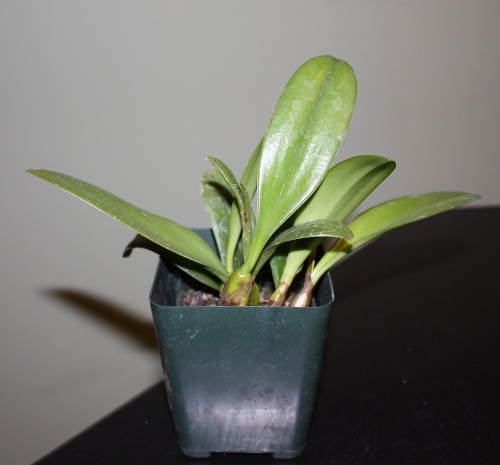
The second orchid is the species Cirrhopetalum makoyanum.  The Cirrhopetalum genus is closely related to the Bulbophyllum genus, and many of the plants are still labeled with that genus name.  It has a very distinct inflorescence, which is made up of several flowers arranged in a semi-circular pattern that look like half to 3/4 of a daisy.  You can see a picture here.

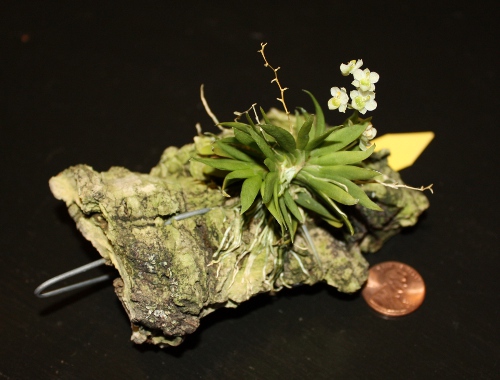
Ornithocephalis iridifolius x Zygostatus alleniana
My mother-in-law's tiny hybrid orchid.  Notice the size compared to the penny!

The last orchid is one that my mother-in-law bought for herself.  It is a tiny miniature (Yes, I think it is appropriate to use both words) mounted on cork bark.  And it's even in bloom.  Check out the penny for size comparison.  Pretty incredible, isn't it?  I'm really liking these little mounted orchids.  They are easy to care for - assuming you don't mind watering them regularly.  You don't have to worry about the roots rotting.  And since everything is right there on display, you can tell if the roots are healthy or not.  Also, it's more appealing to me than a plant in a pot.  And you can hang them in all sorts of places.  The list goes on and on.  Can you tell I like these things?  I have a post on my mounted miniatures coming soon.  This hybrid is known as a "primary hybrid," which means both parents of this plant are pure species.  Anyway, if you've read through this entire paragraph hoping to learn the name of this plant, here's your reward: Ornithocephalis iridifolius x Zygostatus alleniana.  If you were reading the paragraph hoping for some other reward: sorry, that's all you get.

Friday, April 8, 2011

Five new orchids

One of my best Christmas gifts this last year was a gift certificate to Oak Hill Gardens. I made up a list of the orchids I wanted to order, but waited until the weather was reasonably frost-free before ordering them. Two weeks ago, it was quite warm here in central Oklahoma and I had to leave my greenhouse door open to keep the temperature below 100 F. Of course, as soon as I placed my order for the orchids, a cold front moved through and sent the overnight lows near freezing again. Thankfully my orchids got here safe and sound.

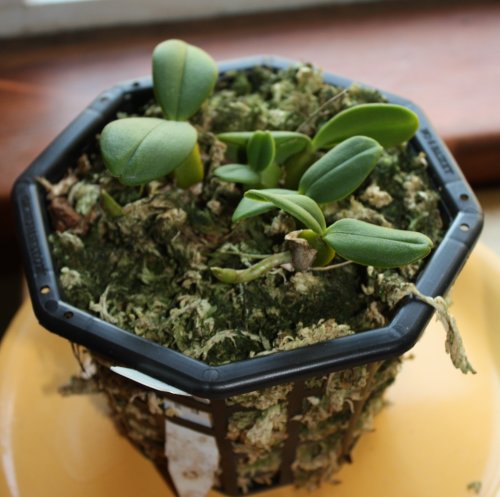
bulbophyllum_scaberulum
Bulbophyllum scaberulum
I used my “Field Guide to Ethiopian Orchids” (also a Christmas gift) to cross-reference the plants available from Oak Hill Gardens and found a couple of neat Ethiopian orchids to purchase. One is Bulbophyllum scaberulum, which came in a 6” basket (pictured above). This is a really neat orchid, whose pseudobulbs form along a creeping root. The blooms of this plant are very strange. There is a tall maroon-purple bract that is quite thick that more-or-less covers and obscures the little red, yellow and white flowers, which later peek out of the scabbard. I think the species name scaberulum refers to something else (not scabbard), but it seems appropriate for the blooming bract, too.  You can see a picture of a blooming plant here.

polystachya_paniculata
Polystachya paniculata
The other Ethiopian orchid that I ordered is Polystachya paniculata (above). This one has a post impressive blooming bract, which is paniculate, which is to say that it has a branched blooming bract (not just a single straight stem) with lots of blooms. It’s like an upwards pointing chandelier of blooms.  You can see a picture of a blooming plant here.

sedirea_japonica
Sedirea japonica
This mounted orchid (above) is Sedirea japonica. I had admired the blooms of this plant before when I had thumbed through the Oak Hill Gardens catalog, but then I recently read about it in “Bizarre Botanicals,” and it is apparently one of the best smelling (sweet) plants on the planet. I don’t typically collect plants for their scent, but combining the fragrance with the cool flowers, it makes for a very interesting plant. The blooms hang beneath the plant, like those of Gongora or Stanhopea, so it is mounted to allow the blooms to fall from the plant freely. They are creamy white in color with bands of purple on the lower petals and pink splashed on the tongue.  You can see a picture of a blooming plant here.

dendro_stratiotes
Dendrobium stratiotes
I have several Dendrobiums in my orchid collection and so I feel pretty good about my ability to grow them. I added one more with Dendrobium stratiotes (above). This Dendro has a super-cool bloom, with petals that spiral upwards like ram’s horns. Check out the picture of a blooming plant here.

encyclia_polybulbon
Encyclia polybulbon
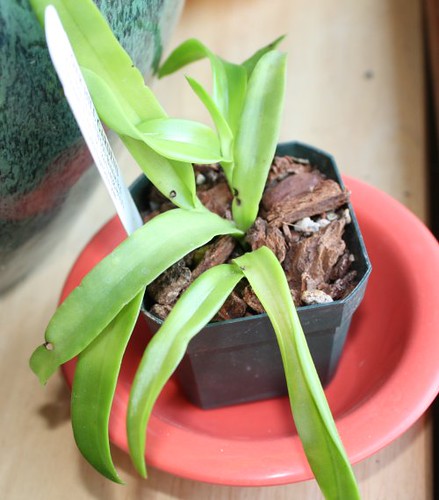
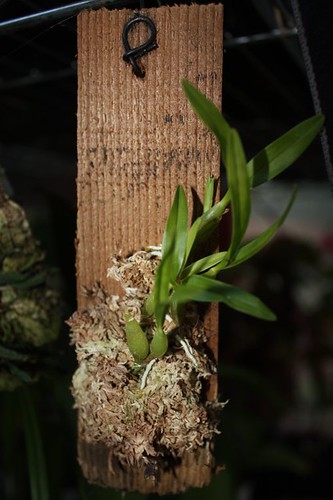
My last little orchid is Encyclia polybulbon, which is also a mounted plant (above). This plant will produce really neat looking flowers that are kind of burnt-yellow stars with a white lip. You can see a picture of a blooming plant here. This is actually the second Encyclia in my collection. The other one I added a month or two back, but haven’t posted on my blog yet because I was hoping to get a bloom soon and show pictures. If I don’t get something soon, I’ll just go ahead and post pictures of the plant as-is. First, I am going to try moving my plant into some brighter light to see if that encourages a bloom stalk.

How do you like my new orchids?

Tuesday, July 6, 2010

My new favorite Iris: the Fornight Lily

While on our recent vacation to the Pacific Northwest, we visited the Volunteer Park Conservatory in Seattle, Washington. It was such a cool conservatory with so many interesting plants that it felt like I had been in charge of acquisitions! I plan to write 5+ posts on this little conservatory alone. You can look forward to posts talking about about the Marantaceae (Ctenanthe, Calathea, Maranta, Stromanthe), Carnivorous plants (Sarracenia and Nepenthes), Fuchsias, Bromeliads (including Tillandsias), Orchid Cacti (Epiphyllums), Euphorbias, and some oddballs (like Dischidia and Hydnophytum).

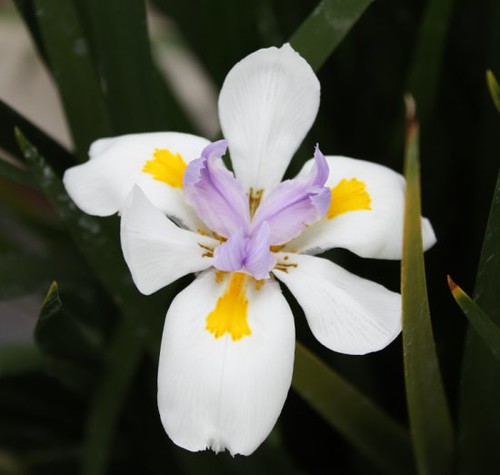
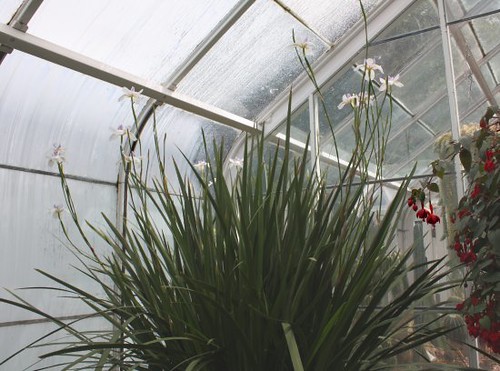
However, this post is about one single Iris plant - Dietes iridioides. This beautiful plant from the Iridaceae (Iris) family has very rigid leaves with the firmness of a Yucca. The plant stands tall at about 4 feet and forms a thick clump in any and all available space. It was apparent that the plant like its environment in the conservatory and since coming home I have learned that it is considered mildly invasive in the areas where it is hardy - zone 8a or greater.
dietes_bloom
Dietes iridioides bloom
I am tempted to talk my parents-in-law into buying some of these plants to use for landscaping their new property in Denton, TX, as I think it would be hardy there. Regardless, I've got to get some for myself and will keep it in a pot in my greenhouse. Seeds are very easy (and cheap) to come by on ebay, but I'm still not really confident in my seed-rearing abilities. Maybe this a plant worth the cheap experiment.
dietes_plant
Dietes iridioides
The plant is called "Fortnight Lily," "African Iris," "Cape Iris" or simply "Wild Iris" as a common name. But I imagine there are probably a good 20-30 different Iris that go by that name. The genus Dietes is native to southern and eastern Africa (including Ethiopia!), and consists of four to six species - one of which occurs outside of Africa, on an island off the coast of Australia.  This particular plant (Dietes iridioides), was formerly placed in the genus Moraea, but was moved to Dietes because it is rhizomatous (it has a rhizome).  I had to get help from a staff worker at the conservatory to finally find a label on one of the plants and it read "Dietes vegeta - Fortnight Lily."  The wikipedia article on Dietes tells me that this plant is really Dietes iridioides and I confirmed that information with Tropicos.

There are so many different types (genera) of Iris.  For a long time the only type of Iris with which I was familiar was a bearded Iris - a very common flowerbed plant in this part of the country.  I've always thought they were very nice flowers.  But then I discovered Dutch Iris (Iris x hollandica), which my grandmother was growing.  With more slender leaves and flowers, and a deep royal blue bloom, this quickly became my favorite Iris.  Just a couple of years ago I discovered Apostle Plants, or Walking Iris (Neomarica gracilis).  And again my favorite Iris was trumped!

I find that every new Iris I discover quickly becomes a favorite plant of mine.  Plants that are in the Iris genus are more familiar, but the "fringe" genera within the Iridaceae family are so much more interesting and beautiful to me.  The Iridaceae family consists of more than 2000 unique species from 66 genera, including some not as obviously related to the common bearded Iris, like the Crocus genus.  Many of these plants grow in sub-Saharan Africa (south of the Sahara desert) and quite a few in the Americas.

Tuesday, May 4, 2010

My little collection of Ethiopian plants

This week my wife and I announced some very exciting news to all of our family and friends: We are adopting our first child from Ethiopia!  We're 3 months into an 18-month process.  Lots of waiting ahead.

In the meantime, we have been learning a lot about parenting, about adoptive parenting and about Ethiopian culture.  As you might imagine, I couldn't pass up the chance to learn about (and purchase) some new plants.  The wonderful Bustani Plant Farm, which I discovered last Spring, has a great selection of rare plants from Africa.  Before going to Bustani this year, I did some research on several plants that were labeled "East African" in their catalog.  I discovered that at least three different plants they had for sale grow natively in Ethiopia.  Is it important that my children grow up around plants from their home country?  Probably not.  But I like them! :)

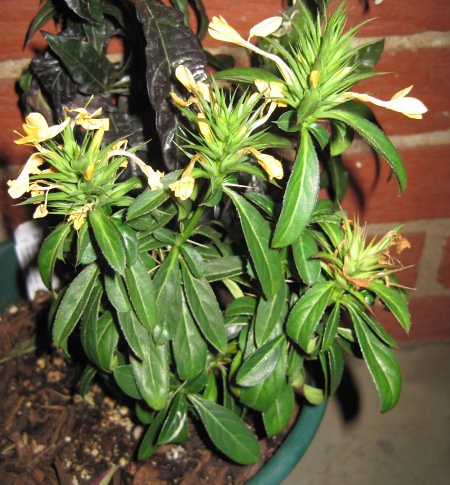
Barleria eranthemoides

barleria_eranthemoides
Barleria eranthemoides
The owners of Bustani collected this plant in coastal Kenya in 2002.  It has bracts of salmon-orange blooms.  The bracts look similar to my Justicia shrimp plants before the blooms emerge.  The foliage is dark and very attractive.  The stems are covered in spines that are quite prickly but not very noticeable to the eye.  I forgot about these when I was repotting it and grabbed the plant in a way that I would not have if I had remembered about the spines.

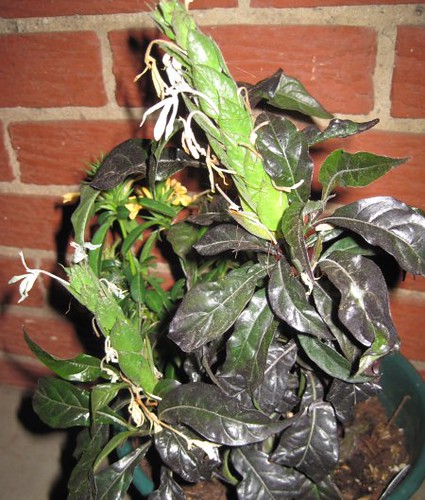
Ecbolium viride

ecbolium_viride
Ecbolium viride
This plant was also collected in coastal Kenya in 2002 and has blooming bracts that look similar to my Justicia shrimp plants.  Indeed, both of these plants are in the same family (Acanthaceae).  The blooms of these plants have the most awesome color.  I tried to photograph them at Bustani and just got frustrated because they came out white!  They are a really cool teal that glows.  It is the same color as the Jade vine (Strongylodon macrobotrys), if you've ever seen one of those in bloom.  If you haven't, finish reading this blog post and then go and do a google search on "Jade vine."  The blooms of this plant have the same teal color.

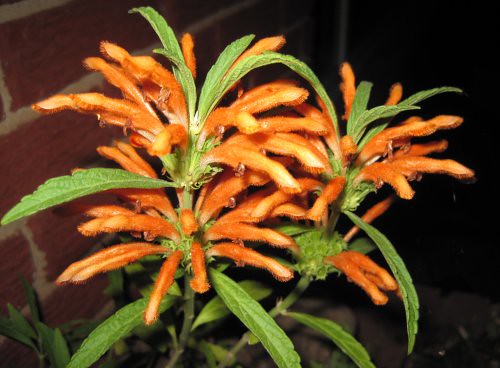
Leonotis leonurus, commonly called Lion's Ears or Lion's Tail

leonotis_leonurus
Leonotis leonurus
This is really the only plant with a common name, since the others aren't grown very often in the horticultural world.  [I mean, it's the only one that has a real common name.  I don't consider Green Ecbolium to really be different from Ecbolium viride.]  It's not surprising that this plant has been used in gardens for some time.  The blooms are very unique, bright orange and fuzzy.  Apparently this plant has some medicinal and "recreational" properties and is used for treating a variety of ailments in southern Africa.  What I mean by "recreational" is that wikipedia says some people smoke the leaves when there's not any marijuana around.  It is also found in California, Hawaii and Australia - though I don't believe it is native to all of those places.

These three plants will all have to be moved into the greenhouse over the winter, as they are only hardy to zones 9 and 10.

What do you think of my little Ethiopian collection?