Showing posts with label Propagation. Show all posts

Wednesday, September 16, 2020

Greenhouse update

Since I haven't been keeping up with this blog for a while I figured I should provide a little update on my greenhouse. When you have limited growing space (don't we all?) and an ever-growing appetite for plants, it's hard to make space for everything.
Many of my Encyclia orchids are kept together on this top shelf for the brightest light.


Another top shelf is filled with cacti and succulents.

Over the years some plants have been neglected. Some plants get over-watered or under-watered, depending on where they are located and how they are potted. Over the last month I have done the most comprehensive greenhouse cleanup since I first built it. I didn't quite take everything out, but I did go through all 7 shelving units and remove empty pots, sweep out all the leaves from the floor, remove all the junk that was being stored under benches, and repotted plants that were in need of new soil or more space. 

Quite a few plants are hanging in the center of the greenhouse, taking advantage of every bit of available sunlight. It makes for less room to stand in the greenhouse, but that is a secondary consideration.

It was a big undertaking, but I'm really glad I took this on before moving all my plants back into the greenhouse for the winter. Probably a third to half of my plants come out of the greenhouse for the warm part of the year, but have to move back in during the winter to survive our cold weather. 

Wide-angle view to show most of the greenhouse at once.

It's this time of year when I start worrying that I won't be able to fit everything in. This year I think there might be enough room to get my plants in and still have a spot for me to stand to water things. That would be a big win!

This mid-level shelf is more shaded and has tender new seedlings and other plants I need to keep a close eye on over the winter.

During the winter the heater will really dry out the air in the greenhouse, so it's important that I keep a close eye on plants that are sensitive to dry conditions. For this reason I've tried to position some of these plants in positions where I they are front and center when I walk in the greenhouse.

Here's to hoping that the plants are happy over the winter and next spring I have lots of plants to share with friends!

Saturday, September 12, 2020

Seedling of Anthurium lezamae

I've really neglected this blog. I'm going to try to start posting more regularly once again.

Several years ago I visited the Missouri Botanical Gardens and got to tour the living collection of Aroids. I was given permission to collect some berries from a plant marked Anthurium lezamae. This plant was collected by Dewey Fisk from Chiapas, Mexico.


I successfully germinated one of the seeds and my plant has been slowly growing. This summer I repotted it and have been giving it a little extra attention and it has been doing really well. Now it has it's first inflorescence (that I have noticed).


I'm not certain that my plant is the species Anthurium lezamae, and it differs from the parent plant. That could be because my plant is still young, or it could be because the berries were produced from a cross with another plant, making mine a hybrid. Maybe with time I'll be able to tell.


Monday, February 25, 2019

Gomphocarpus from seed

One of several plants I started from seed last year was a milkweed nicknamed Hairy Balls or Balloon Plant (Gomphocarpus physocarpus). The nicknames are from the appearance of the large pods that form when the flowers set seed. This plant is native to southeast Africa, but is a good food source for Monarchs here in the United States. I ended up with two very tall and lanky plants. They did not branch and just continued to grow taller throughout the summer. At one point there were a few small flower buds but they aborted before opening. I don't know if this plant wanted more sunshine or something different. It seemed healthy and grew steadily, but I didn't get any flowers. I read that if you are growing these from seed it is best to start them indoors early because the growing season may not be long enough for flowers and new seed pods. Maybe that's what happened in my case.

My tall and lanky Hairy Ball plants (Gomphocarpus physocarpus) in August of last year.

Thankfully, the plant has stayed happy in my greenhouse this winter so maybe next summer I will get some flowers. Ideally those flowers will set seed pods so that I can start new plants from seed and maybe prune my two existing stalks to get a fuller plant.

Open seed pod of Gomphocarpus physocarpus.
Like many other milkweeds, the seed are attached to a fluffy piece of cotton-like material
that helps them disperse in the wind.

Thursday, February 21, 2019

Milk Jug Germination

Spring will be here before we know it. Already I am seeing a few blooms on my quince bush, buds on our Daffodils, and leaves from our tulips are breaking through the surface of the soil.

I have seeds of several milkweeds that I would like to grow this year, including three native Asclepias and one Calotropis native to Africa and Asia. The American natives all require cold stratification. I have most of the seeds in the refrigerator, but I am starting a few others using a different method. 

I cut open two milk jugs and added soil to the bottom of the jug. I scattered some of my seeds on the top of the soil, watered them in, and then taped the jugs closed. I’ve sat the milk jugs outside on the ledge of my greenhouse. Hopefully they won’t blow over or become dog chew toys there. With any luck, they will experience the requisite cold period and then will germinate in about a month when the temperature begins to climb and the days get longer and they’ll have a head start in their little biodomes. If it doesn’t work, no big deal. I only used part of my seed stash on this experiment.

I did a little more reading on this technique and apparently it's important for the top cap to be removed. I was assuming more of a close greenhouse/terrarium setup was desired, but I will stick to the recommended method and remove my top caps.

Tuesday, January 22, 2019

Treaty Oak update 1

I've been trying to be patient and not disturb my little Treaty Oak seeds. I managed to go a couple of weeks without looking at the pot. Over the weekend I stole about 30 minutes to give my greenhouse a thorough watering and glanced at the Treaty Oak pot to see what was happening.

Seedlings from the Austin Treaty Oak
Texas Live Oak (Quercus fusiformis)
Yes! Four little seedlings have broken the surface and have leaves! Even at this tiny size, the leaves have a unique shape. The stems were growing towards the light, which was coming mostly from one direction, so I snapped a few pictures, rotated the pot, and put it back on the shelf. I am very happy to see that they are doing well. These are Texas Live Oaks (Quercus fusiformis). I plan to give one to my mother-in-law for Mother's Day, since this tree has some special significance to her. I will look for other homes for the other ones. I am not quite sure if they are hardy in central Oklahoma, but I think they will do well in southern Oklahoma, so I could plant some at my parents' lake cabin.

Tuesday, November 13, 2018

Trip Report: Treaty Oak

For my birthday weekend my wife and I went down to Austin for a few days sans kiddos. Our itinerary was mostly made up of places to eat and a few activities sprinkled in between. On Sunday morning we visited a famous tree, Treaty Oak, which my wife remembered having visited when she was young. This oak tree is thought to be about 500 years old and is the only member of a group of 14 trees that once stood in this location in what is today downtown Austin. In 1989 someone poisoned the tree and severely damaged it. That is when my wife traveled with her family to see it. Thankfully the tree pulled through and still stands.

My wife at Treaty Oak in downtown Austin
The plaque reads:
The Caldwell Treat-Oak Park
Estimated to have been a majestic tree of about 100 years when Columbus first landed on North American shores, this live oak tree has been pronounced the most perfect specimen of a tree in North America, and its picture hangs in the Hall of Fame of Forestry at Washington.
Formerly standing as the center of a group of trees called "The Council Oaks," this tree takes its name from its role in the history of the Lone Star State. Stephen F. Austin is reputed to have signed the first boundary line agreement between Indians and whites under the canopy of its branches; battles and important conferences have been planned, pacts signed, and feasts and religious ceremonies celebrated in its shade.
The Treaty Oak was purchased by the City of Austin in 1937 to stand as a living and fitting symbol of the mighty state it has watched develop.
We were both surprised to see how much of the tree lies on the ground. I don't know if this is characteristic of the species (Texas Live Oak, Quercus fusiformis), or if it has more to do with the vandalism, or the age of this particular tree.

Treaty Oak acorns

While we were visiting the tree I noticed some acorn caps on the branches at eye level and realized there must be some dropped acorns nearby. We searched around and found 5 that were brown and "ripe." I brought these home and soaked them in a bowl of water to see if any floated, which means the acorn is not viable. They all sunk and I decided I would plant them the next day. But I forgot.

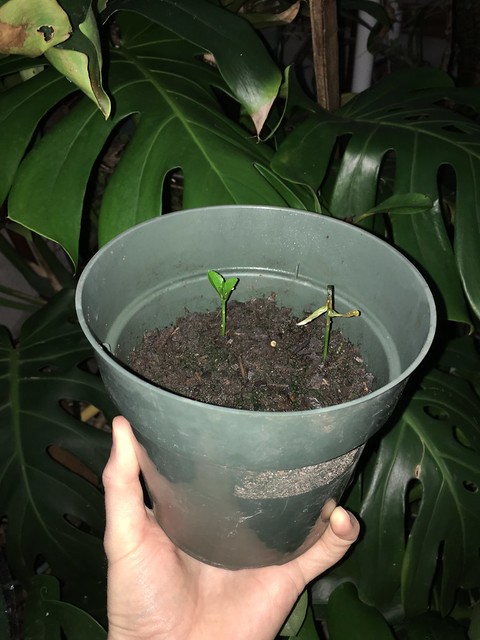
Treaty Oak acorn beginning to germinate
More than a week passed before I noticed the bowl of acorns! I was worried at first when I saw they looked different, but on closer inspection I realized they were sprouting. I went ahead and potted the five acorns and watered them well (since they were used to being saturated and seemed happy with the situation). If I am successful I will have some offspring from a famous tree, which is kind of fun. Updates to come!

Wednesday, September 12, 2018

Update: Sacred Bodhi Tree

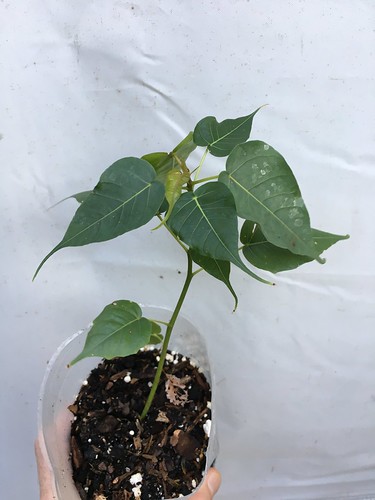
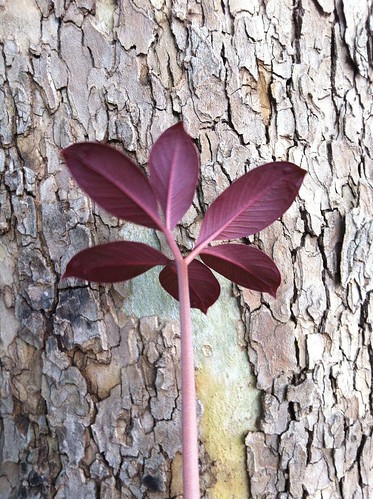
Seven years ago I was gifted some seedling Sacred Bodhi trees (Ficus religiosa) from a friend. Read more about the tree here. I gave one of those seedlings to my mother-in-law for insurance. I'm glad I did because my tree died a couple of years ago when it got too dry in my greenhouse. My mother-in-law's tree goes through a series of phases: rapid growth, scale infestation, dropping all the leaves - repeat. We're not sure why the scale keeps coming back, as it seems completely free of them when it is in it's rapid growth phase. Anyway, it seems to be an established pattern now.

Ficus religiosa
Sacred Bodhi Tree sapling (Ficus religiosa)

I recently took two cuttings of her tree when it was in a rapid growth phase and one of those cuttings has rooted. I started the cutting in pure vermiculite. After I was sure that roots were established I transferred it to potting soil. It's now producing new leaves and seems to be pretty happy. In a humid tropical climate this tree would easily be meters tall by now, but in our temperate Oklahoma climate (and my mother-in-law's plant being grown indoors) it is staying fairly small, almost a bonsai. I'm so thankful to have this little tree back in my collection and will monitor it closely.

Tuesday, May 22, 2018

Update: Native persimmons

You may recall that last year I collected a wild persimmon and planted the seeds. I put these in a pot outdoors and just let them be - no water, no attention whatsoever. I figured the less I messed with them, the more likely they would be to germinate.

Persimmon tree (Diospyros virginiana)
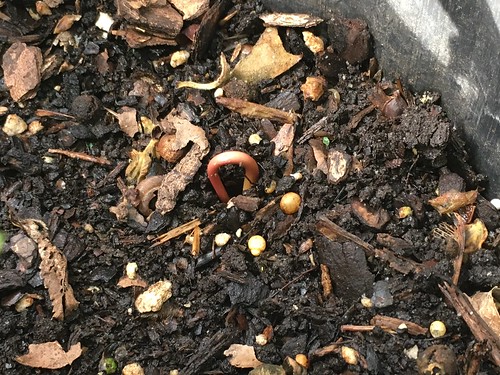
Persimmon tree (Diospyros virginiana) beginning to sprout from the soil.
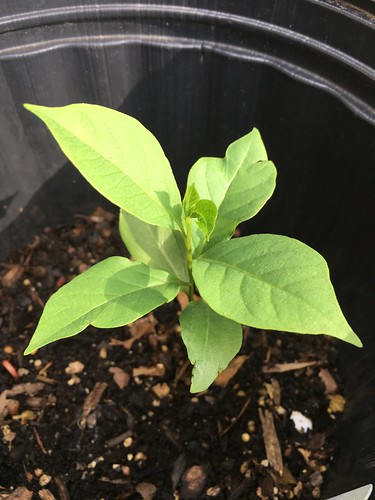
It appears my gambit worked! I have one little tree that sprouted from the soil in late March or early April and another one is breaking through the soil now. (And I'm pretty sure it's not a pecan or oak tree planted by a neighborhood squirrel, which is what usually comes up in my pots that sit outdoors...)

Persimmon tree (Diospyros virginiana)
Persimmon tree (Diospyros virginiana) growing quickly.
The funny thing is that just a week before the first tree sprouted I placed an order from a plant catalog and included two small persimmon trees, so it looks like I may soon have persimmon trees coming out my ears and I don't really have a plan for where to plant them!

I know my mom would love to be able to pick persimmons from her own yard, but I also know that these native persimmons are not the ideal candidates for cooking. And I also realize it will be years before the trees are large enough to bear fruit...

I do have access to land where I can plant these, so maybe I'll start a little grove there.

Thursday, April 26, 2018

Update: Plant all the seeds!
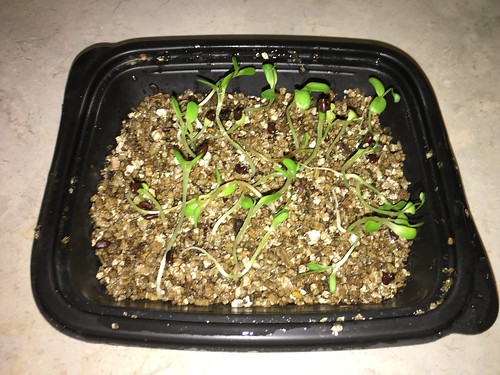
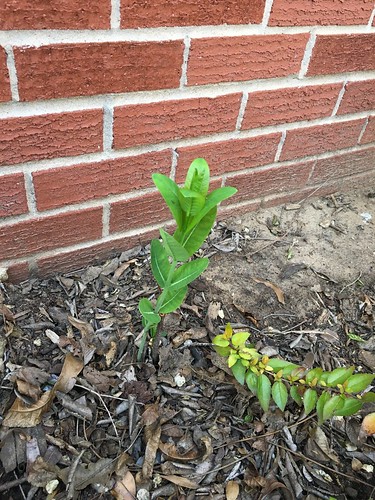
A little more than a month ago I planted a bunch of seeds and it looks like I've had good results with most, if not all, of them.

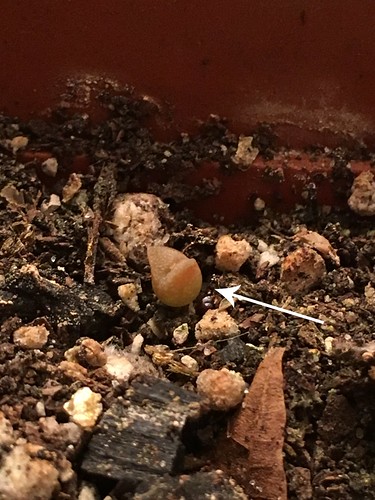
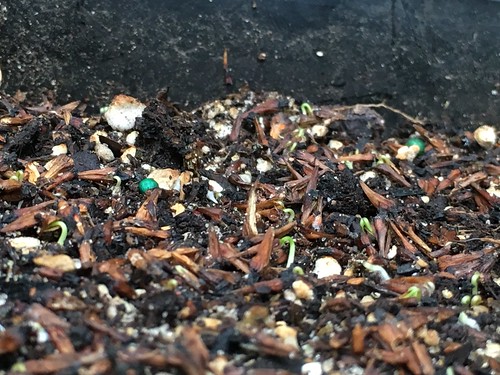
From the pots of mixed cacti seeds, I can see some funny little forms rising from the soil. The germination percentage is low at this point - just three little seedlings. It's quite possible that these three seedlings are just the species with the quickest germination period and others will come up over time. Hard to say for sure at this point. I wonder how long it will be before these little seedlings are recognizable.

Unknown cactus seedling
First signs of life in the mixed cacti pots.
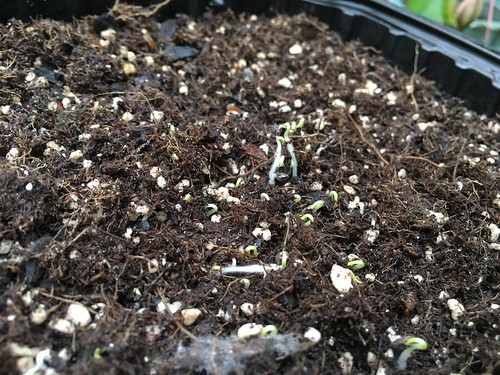
My native butterfly-attracting Common Buttonbush (Cephalanthus occidentalis) seeds are beginning to sprout!

Common Buttonbush (Cephalanthus occidentalis) seedlings

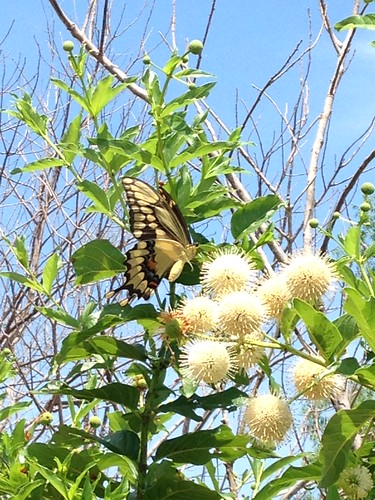
Eastern Giant Swallowtail (Papilio cresphontes) on Common Buttonbush (Cephalanthus occidentalis)
Eastern Giant Swallowtail (Papilio cresphontes)
on Common Buttonbush (Cephalanthus occidentalis)
at Lake Texoma (July 2016)
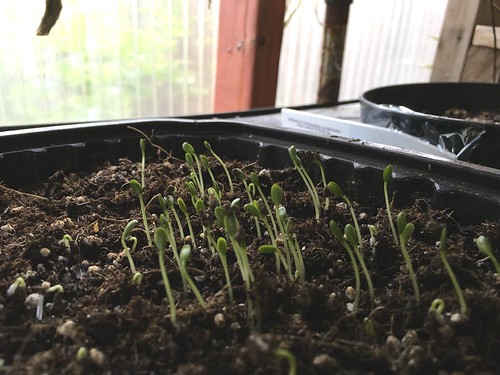
My non-native (south African) butterfly-attracting Hairy Balls (Gomphocarpus physocarpus) have sprouted and are off to the races! Check out the fast growth over just 30 hours!
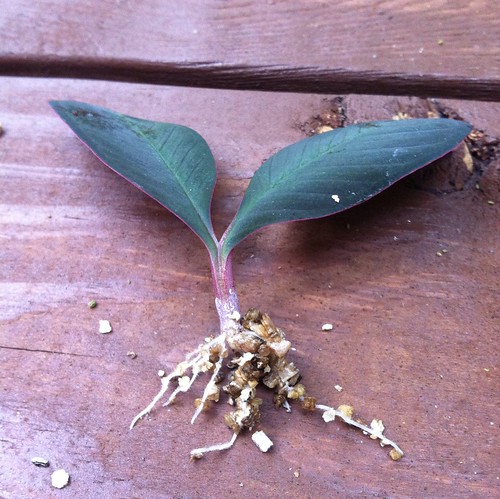
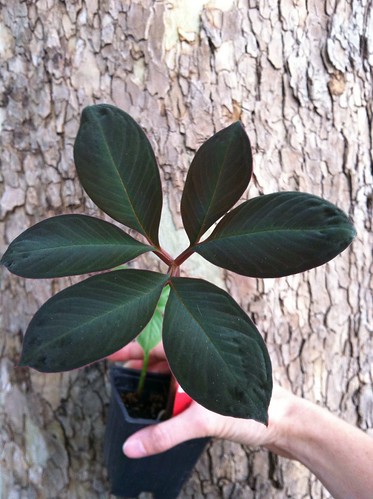
Gomphocarpus physocarpus seedlings
Gomphocarpus physocarpus 6 days after planting

Gomphocarpus physocarpus seedlings
Gomphocarpus physocarpus 7 days after planting

The other seeds I planted were some Bauhinia (Orchid Tree) and Dietes (Fortnight Lily/Iris) that I collected in Los Angeles in March. I have had luck germinating each of these before, so I am hopeful in both cases, but haven't seen any action yet with this batch. The Bauhinia trees that I grew from seed previously are now about 5' tall and ready to be planted outdoors in an appropriate climate (not central Oklahoma). Unfortunately my previous encounter with Dietes didn't end well. After the two seeds germinated and sprouted tiny plants, they didn't survive long. I'm hoping to do better this time and, with luck, I'll have more seedlings and can experiment a little more with lighting, humidity, and soil moisture.

Tuesday, April 24, 2018

Update: Native Asclepias

Last year I transplanted some native Asclepias from some family property where they were growing wild into my own flowerbed. A couple of them stayed green for the remainder of the summer, so I was hopeful that they were establishing. At least one other appeared to have dropped dead.

Asclepias amplexicaulis (transplant)
Asclepias amplexicaulis emerging about 9 months after the transplant
I was really surprised to see the one that looked the least likely to have survived sprung up first this Spring! It is also one of the less common species in this area, so I am really happy it survived the transplant. I have confidence I can keep it alive (even with little to no care) now, considering it is an ideal plant for our hot Oklahoma summers and cold winters.

I don't know about all of the transplants yet, but I can see that at least one other plant, Asclepias tuberosa, is beginning to emerge. I'm very excited about having these native, butterfly-attracting plants established in our flowerbed.

Friday, March 23, 2018

Plant all the seeds!

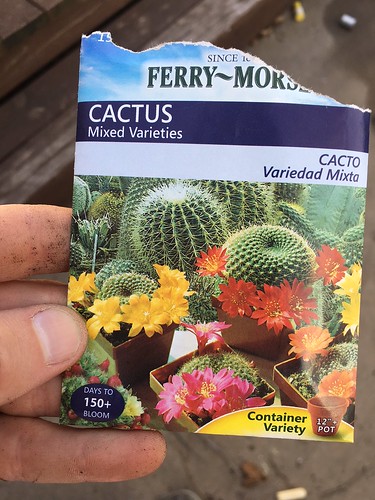
In my life of botanical interest, I have waffled back and forth on whether it was worth my effort to try to grow plants from seed. I'll try and have limited success, followed by a few failures, and then give up for a while. A few weeks ago I had to go to Lowe's to get something or other and the kids and I picked out some summer squash seeds to try growing. I germinated a couple of squash seeds last year and then planted them outdoors only to see them wither. While I was looking at the available seeds I saw some Asclepias seeds and also a curious package labeled "Cactus Mixed Varieties." I purchased one of each of those just to give them a shot.

IMG_8255

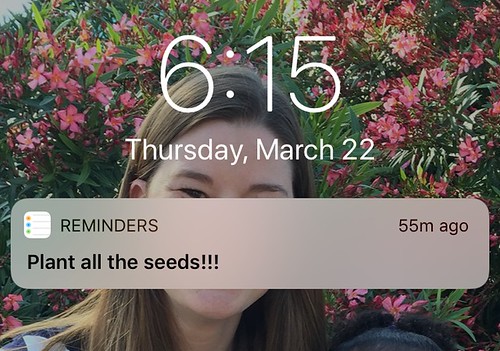
While on vacation last week I remembered that it was getting to be warm enough to plant my seeds so I put a reminder on my phone to plant the seeds when I got back from my trip.

IMG_8260

I think I have a pretty good setup for the squash plants. I hope they do well for me this year, as the kids will really enjoy watching us grow our own food and we love to cook squash when it's in season.

IMG_8256

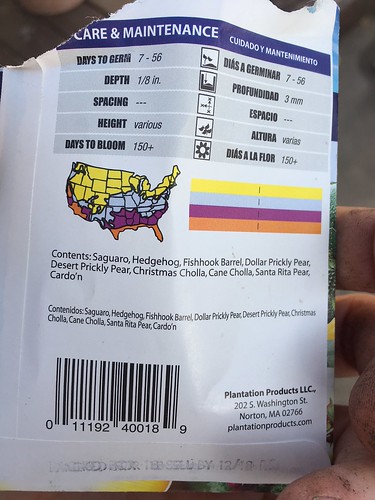
I'm really curious about the cactus seeds. The back of the package mentions several different species(Saguaro, Hedgehog, Fishhook Barrel, Dollar Prickly Pear, Desert Prickly Pear, Christmas Cholla, Cane Cholla, Santa Rita Pear, and Cardo’n) but I suspect the package is dominated by one or two species that are the cheapest/most easily obtained. The contents of the package reveals some variety in seed size so I think I got at least 2 or 3 species. If I am lucky enough to get some of these seeds to germinate it could be quite a while before I am able to identify what they are.

Thursday, March 22, 2018

Mandarin update

We just got back from vacation in Los Angeles, where it was actually cooler and cloudier than in Oklahoma. Here at home spring has sprung and our yard is filled with color where there has just been brown for months. We spent some time in the backyard after dinner this evening and I checked on the greenhouse. Much to my surprise, there was finally some action in the mandarin seed pot!

Mandarin seedlings

It looks like two seeds germinated and one of them reached the clear plastic lid and the starter leaves have died. That could mean doom for that seedling. I don’t know for sure. The other seedling looks vigorous and in good spirits. Given that we planted the seeds at the very end of January, I think the germination period was probably about 6 weeks. My daughter was really excited when I showed the pot to her. She may be a bit overly optimistic about our prospects of a bushel of mandarins, but we’ll give it our best shot. 

Wednesday, January 31, 2018

Mandarin seeds

We have been eating a lot of small citrus fruits this winter. Mostly we have been getting those small seedless mandarin clementines branded as Cuties or Halos. They are really sweet and delicious, although we’ve found the shelf life is limited to about a week. After that they start to dry out inside the fruit.

This week my wife wasn’t able to find any of those tiny clementines at the grocery store, so she bought some larger mandarins, which regrettably aren’t as sweet. The bonus? They have seeds. As I was eating the second fruit I started spitting out the seeds in my hand and was considering whether to try germinating them. My grandfather, a very good gardener, could grow citrus trees from seed and did so regularly. As I was considering this my daughter saw the seeds in my hand and got really excited and asked if we could plant them, and grow a orange tree and pick the oranges and eat them and never have to spend money on oranges again!?! Yes, these were her words. And you can guess that made up my mind.


Remembering what my granddad had told me, I nicked each seed with a knife (not sure how deep, so I could have screwed it up right off the bat). Then I soaked the seeds in water for 24 hours. My daughter, with the great memory, asked me at dinner if we get to plant them now. Yes, thanks for remembering when I forgot!


We planted the 4 seeds 1/2” deep, moistened the soil, and covered the pot in plastic wrap. Here goes nothin!

Wednesday, October 25, 2017

Plant Find: Bauhinia galpinii

From the moment I first saw one, I have loved Orchid Trees (Bauhinia).  Bauhinia is a genus of more than 500 species of tropical flowering plants, many of them trees, but some are more shrubs and some are even vines.  They are found throughout the world in tropical regions and I have seen them growing in the wild, as well as cultivated in yards in the southern US.  In Galveston, there are several Bauhinia variegata growing in front yards and flowering with their beautiful pink or white blooms.

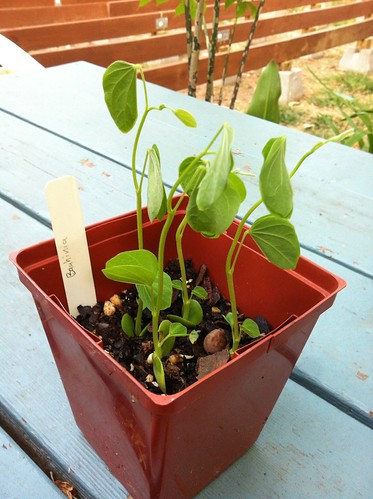
Bauhinia variegata seedlings
A few years ago I collected some seeds from a tree in Galveston and was able to germinate those seeds. I tried planting a few of the young seedlings to the Galveston yard, but they didn't make it. I don't know if their sunlight was choked out by their more aggressive neighbors, or something else happened. I have a few saplings now that have gotten to a decent size and I plan to plant in the Galveston yard when they get even a little bit larger.

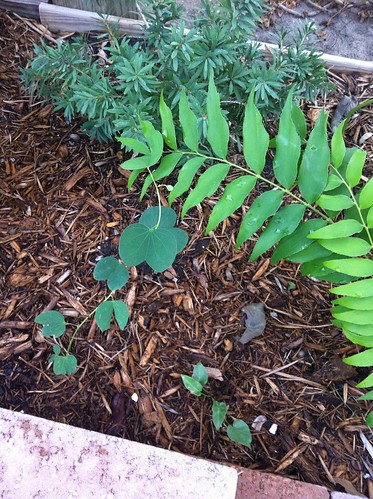
Bauhinia variegata (orchid tree)
Young Bauhinia variegata seedlings that I transplanted to Galveston garden.
As beautiful as the blooms are, the leaves are every bit as stunning.  They unfold like a set of hands asking for a piece of bread.  I read that Linnaeus named this genus after a set of twin botanists, which is fitting due to the symmetric, two lobed leaf.

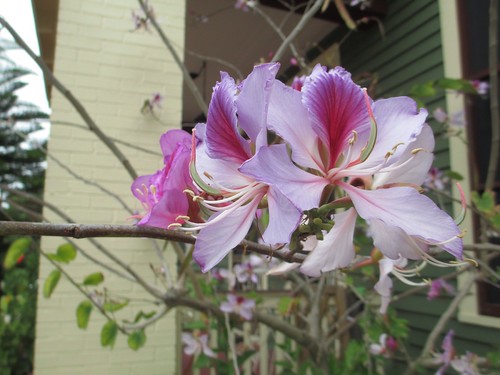
Bauhinia variegata
Bauhinia variegata flowers on a tree in Galveston

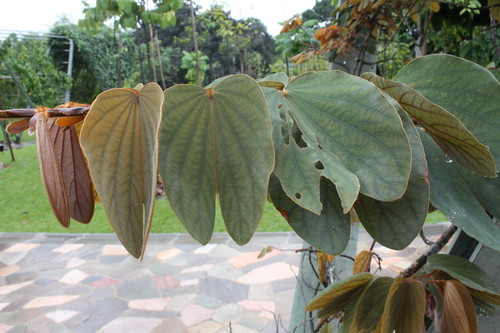
I mentioned that there are some species of Bauhinia that are vining.  I saw one of these species at the Singapore Botanic Gardens a few years ago (photo below).  The stems are woody and there is a fuzzy brown sheath that covers the new leaves as they emerge.  The emergent leaves are sort of red and bronze, turning to a medium green with dark veins. 

Bauhinia semibifida
Bauhinia semibifida at Singapore Botanic Gardens
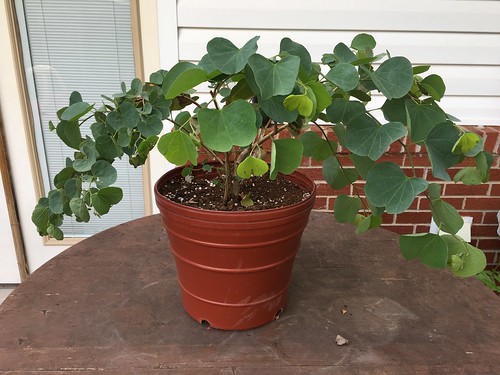
On my most recent trip to Galveston I visited a nursery and came across a beautiful miniature Bauhinia in a pot that I assume is meant to stay a miniature.  It is Bauhinia galpinii and it is so cute. 

Bauhinia galpinii
Bauhinia galpinii

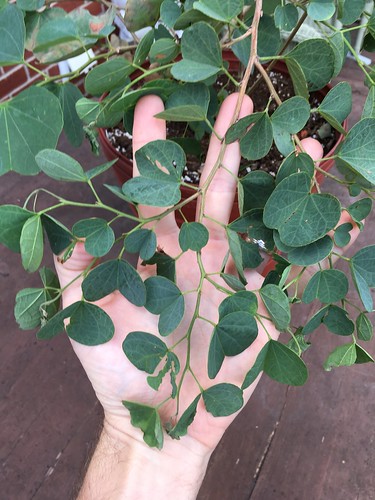
There are actually two small trees in the pot and one of them has much smaller leaves than the other.  Since I have grown Bauhinia variegata from seed and know that the leaves are large from a young age, I do believe this is actually going to retain the small leaves.

Bauhinia galpinii
Tiny leaves of Bauhinia galpinii

My plant is not yet blooming, but I found photos of the flowers online.  They are salmon red and petite compared to B. variegata, but of the same shape.  I hope I can keep this plant happy in the greenhouse over the winter and then I have the perfect place for it next spring when it is warm enough to move my plants outdoors.

Friday, September 29, 2017

New seeds

I don't have a lot of experience growing native plants from seed*, but I have a lot of stock to practice with over the next year.  I purchased some Asclepias humistrata (Sandhill Milkweed) seeds from eBay and the seller sent me two other packets of seeds to try - Cosmos and Ipomoea purpurea (Candy Cane Morning Glories).

Eleven packets of seeds for me to plant
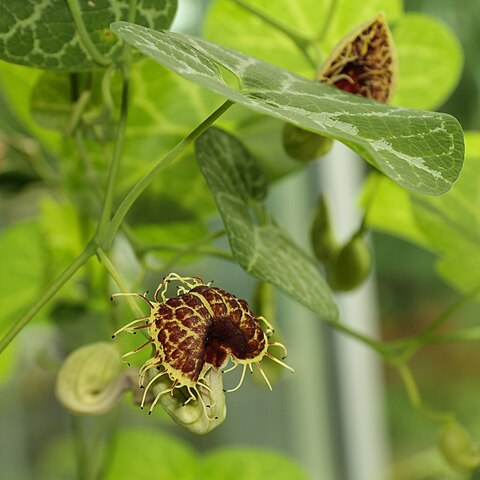
I have also been looking into growing some more native plants that host or attract birds and butterflies.  I came across a group on Facebook where one member was offering seeds to anyone who would pay for the postage.  She kindly sent me two envelopes full of seeds of butterfly host plants, including Maurandella antirrhiniflora (Snapdragon Vine), Asclepias asperula (Antelopehorn Milkweed), Phyla nodiflora (Frogfruit), Verbena bonariensis (Brazilian Verbena), Polanisia dodecandra (Clammyweed), Echinacea Cheyenne Spirit (Coneflower), Aristolochia fimbriata (White-veined Dutchman's Pipe), and Zinnia Zowie. 

Sandhill Milkweed (Asclepias humistrata) - courtesy of discoverlife.org

As I've mentioned before, I really like Asclepias, so I'm very excited about the prospect of growing these two species (A. asperula and A. humistrata) from seed.  The humistrata species (above) is not native to Oklahoma, but I think it will do well in my climate.  The Dutchman's pipe has some really funky flowers (below).  It would be cool to get this growing on my back fence.

White-veined Dutchman's Pipe (Aristolochia fimbriata) - courtesy of Wikimedia

Now I just need to find good places to plant them all!

* This is sort of funny because I have one and only peer-reviewed journal publication to my name and it is titled "Experiences growing aroids from seed."  I have had success growing aroids, but haven't tried many plants from other families from seed.

Monday, August 7, 2017

Baptisia seedlings

In late June I participated in the Butterfly Count for Cleveland County, Oklahoma with some of my birding friends. We came across some large Baptisia australis (Blue False Indigo) plants that were covered in seed pods.  I collected some of the pods, took them home and soaked them in water for 24 hours.  I filled an old plastic to-go food container with moist vermiculite and then scattered the seeds in the container and covered them with a thin layer of more moist vermiculite.

Baptisia seedlings
Baptisia australis seedlings

Baptisia seedlings
Baptisia australis seedlings
I put the container out in the greenhouse in indirect light and left it alone.  After a few weeks I had a bunch of seedlings.  I didn't count planted seeds and sprouted seedlings but it appears the germination rate was pretty high.  As with my past experience, the easy part is done and maturing these little plants from their fragile seedling state is the real challenge.  I hope I am successful.  This is such a beautiful native plant.

Friday, July 26, 2013

An update on my batch of lemonade

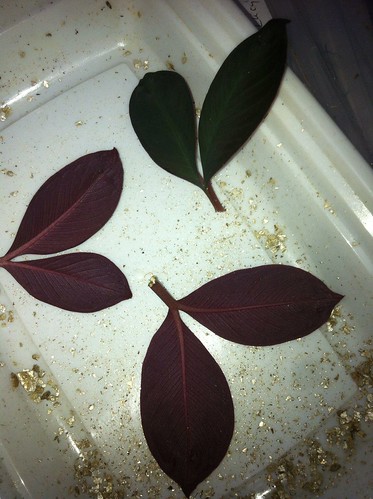
In my last post I talked about trying to make lemonade out of my broken Amorphophallus atroviridis leaf.  Last night I impatiently opened the container, checked the leaves, and then gently brushed aside the vermiculite to see if there was anything at the end of the leaf cutting.

Amorphophallus atroviridis
Rooted Amorphophallus atroviridis leaf cutting
I was ecstatic to find several roots growing there.  I snapped a quick picture and returned the cutting to the container, gently pushing the media back in place.  I didn't want to disturb the two other cuttings.  I have a feeling all three of them have rooted because none of the leaves have wilted.  At this pace I imagine I will have some tubers forming in the next month and then maybe a new leaf will emerge from each of those tubers in a couple of months after that.

Friday, June 28, 2013

Making Amorphophallus lemonade

Last week my Amorphophallus atroviridis arose from its winter-long slumber and burst from the ground with the prettiest leaves you've ever seen in your life.  I was taking photos of both surfaces of the leaves when the unthinkable happened.  One moment the plant was fine; the next moment the petiole was broken off at the surface.  That second moment was not a good moment.

Amorphophallus atroviridis
Amorphophallus atroviridis - adaxial leaf surface
Amorphophallus atroviridis
Amorphophallus atroviridis - abaxial leaf surface

So what did I do?

I cried.  (I bet you thought I was going to say I made lemonade.)

What did I do next?

I cried some more.

But after that?

Are you kidding?  I was still crying.

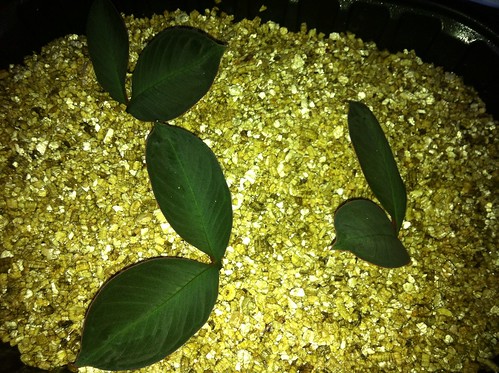
Eventually I got my life back together and decided to do something with the beautiful leaf that used to be a plant.  I stuck it in a vase of water and sent an email to my friends, asking if they had tried rooting Amorphophallus from leaf cuttings before.  I was pretty sure I had heard this was possible, and I had already successfully done this with Zamioculcuas, another tuberous aroid.  Yes, some of them had!  Their suggestions were along the lines of how I normally treat plant cuttings.  Prepare a container with a good rooting media, thoroughly moisten the media, use a little rooting hormone (or crushed Advil) on the cut end of your stem, make a divot in your media, insert the cutting, pack media around the stem so it is stationary, seal the environment to maintain high humidity.

Untitled
Amorphophallus atroviridis leaf cuttings

The media can be perlite, vermiculite, soil or other things.  I used vermiculite because that is what I had on hand and because it has worked well for me for other types of cuttings.

Untitled
Cuttings inserted in the media

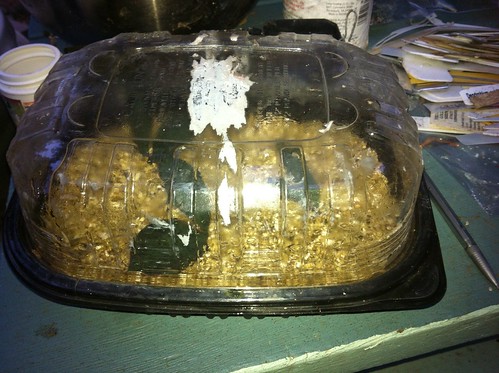
Many people will put their cuttings in pots and then put the pot in a Ziplock bag.  I like to use take-out containers.

Untitled
Sealed in their rooting environment

With time and patience, the tip of the cutting will eventually form roots and a new tuber.  The leaf will probably die back and new growth will emerge.  That's if all goes well.  If all doesn't go well, the leaves will perish, leaving no tuber or roots behind.  Today I read an article on success rates of rooting different species of Amorphophallus from leaf cuttings.  The success rate is very low for this particular species.  I hope that I am lucky and get at least one tuber out of this experiment.  If so, I will have made lemonade.

Wednesday, September 5, 2012

A tale of two cuttings

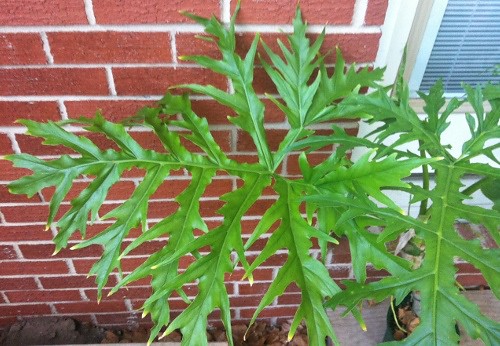
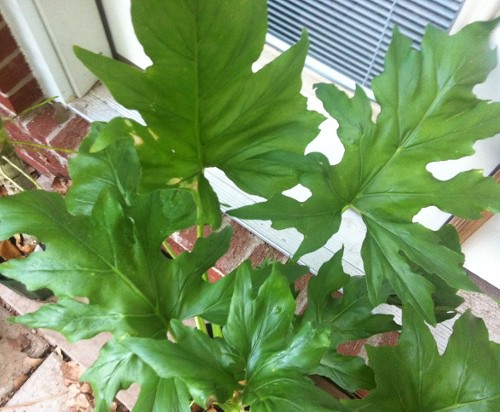
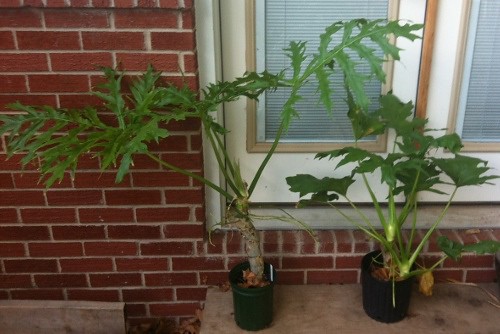
My friend Leland has sent me many wonderful plants over the last couple of years.  In April I received some very large cuttings of Philodendron warscewiczii.  The cuttings were about 12-15 inches long and 2-3 inches in diameter.  Seriously, they were like logs.  I wasn't sure what the best method would be for getting new growth from the cuttings, so I tried putting one cutting in a vase of water and the other directly into a chunky, loose mix of soil, bark, and charcoal and kept it pretty well watered.

warscewiczii_07
Cuttings started in water (left) and soil (right), back in early June.
The cutting which was started in water was the first one out of the gate, sprouting leaves and roots from two growth points.  After a couple of weeks of growth in water, I decided to go ahead and plant this cutting in soil as well.  The cutting that was started in soil did not show any progress for several more weeks.  Finally I noticed a root emerging from one of the drainage holes at the bottom of the pot (see image above).  At this point there were still not any leaves.  A month or two down the road and my potted cutting began to sprout a new leaf from the tip.  When the leaf finally unfurled I noticed this leaf was a mature warscewiczii leaf, while the leaves on my other cuttings were the juvenile form, with less divisions in the leaf.  It seemed counter-intuitive, at first, that this cutting which had just produced it's first leaf had a more mature leaf than my cutting which had two growth points with several leaves already.

warscewiczii_02
Mature leaf of tip cutting started in soil
warscewiczii_03
Juvenile leaves of center cutting started in water
The more I thought about this, I realized that my "late bloomer" cutting had a key difference that was most likely the reason for this difference.  This cutting was a tip cutting and the leaf was emerging from the end, where new leaves were developing prior to the plant being dissected and sent across the ocean to me.  The cutting which sprouted the two new growths and lots of leaves was, in a sense, starting from scratch, while this other cutting was continuing growth that had been going on for many years.

warscewiczii_01
Tip cutting started in soil (left). Center cutting started in water (right).
Now my slower cutting is about to unfurl a fourth leaf and my fast cutting has unfurled something like its 12th.  Both are pretty plants, but the tip cutting has produced beautiful mature leaves that are much more appealing and more warscewiczii-ish than the many leaves of the other cutting.