Showing posts with label profile. Show all posts

Monday, December 19, 2011

The Sacred Bodhi Tree

As legend has it, the founder of the Buddhist faith, Siddhartha Gautama, gained his enlightenment after meditating for 49 days underneath a tree.  That tree, for obvious reasons, has been sacred to the Buddhist faith ever since.  In many ways it is equivalent to the cross on which Christ was crucified.  Some old Christian churches claim to have pieces of the original cross and those pieces are considered holy relics.

The Bodhi tree is unique in that it is a living relic, so it continues to spread throughout the world over time.  The Bodhi tree has been given many names including "Bo tree" and "pipal tree."  These names are used in reference to the original tree, as well as all trees of that species.  The Latin for this species is Ficus religiosa.  It is a large Banyan, fig tree.  The original tree was located in northeastern India, near the border with Nepal.  Since then, the tree has been propagated to several different locations, resulting in a chain of highly-revered trees which have a tie to world history.  One of the famous propagated trees is in the Foster Botanical Gardens in Honolulu, Hawaii.  Christie and I visited that garden in May 2009 and saw the gigantic Buddha tree.

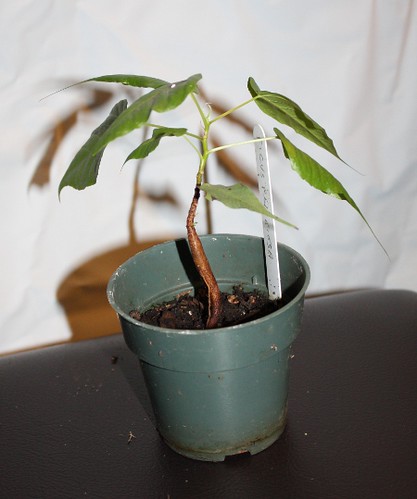
Recently the tree growing in the Foster Botanical Garden began to set seed.  In Hawaii, this is worthy of concern, as the tree could become invasive, if the seedlings are not removed while they are small.  My good friend, Leland, who has ties to the Foster Botanical Garden, obtained some of these seedlings and sent them to me.

Ficus religiosa
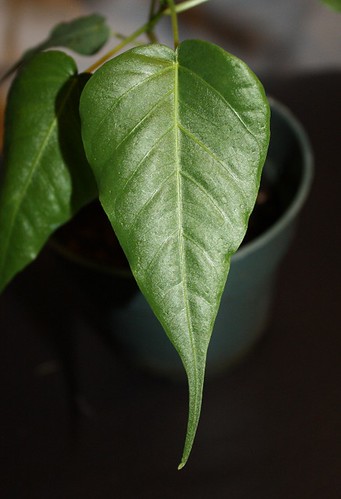
Ficus religiosa leaf


The leaves of this tree are beautiful: cordate with an extended tip, giving them an unmistakable appearance.

Ficus religiosa
Ficus religiosa sapling

Wednesday, May 20, 2009

Euphorbia - the gigantic genus!

The more I learn about plant taxonomy, the more I learn about plant taxonomy.  That may sound simple, but it's true.  Generally, my lessons in plant taxonomy consist of learning a new botanical name.  I'm slowly building this big dictionary of names that encompasses all of the plants on the planet!  The real learning comes in all of the connections that I see - sometimes with my eyes, other times with the names.

I have been fascinated to find plants whose botanical names indicate that they are related, either in the same Genus or by Family, when I cannot see any resemblances in the related plants.  Probably the most obvious example of this scenario is with the genus Euphorbia.

The genus Euphorbia contains more than 2000 unique species of plants, and probably well over 10,000 hybrids and cultivars.  Can you believe that!?!  I mean, as a little kid, that's probably the number you would guess for how many plants are in the world.  But no, that's just how many species of Euphorbias there are!

Euphorbias range from very severe cactus-looking plants to more soft and fuzzy herbaceous-looking plants.  Some are insular, which means they are endemic to an island.  Here's an idea of the contrast of the Euphorbia genus:

Poinsettia
Poinsettia (Euphorbia pulcherrima) - photo courtesy Flickr user Carlin

img_9436
Euphorbia virosa at the OKC Myriad Gardens
What!?!  Those two plants are in the same genus?  You might as well tell me that this dainty little plant (below) is also a Euphorbia!

diamond_frost
Euphorbia 'Diamond Frost' planted at the Fort Worth Botanic Gardens.
This is a new hybrid plant that was introduced in 2007.
Oh, it is!

I don't really know what the qualifications are for putting plants in the same genus.  The plants are supposed to follow the same family rules as those we use for our own families - they are supposed to claim the same ancestors.  [I'm related to my sister and my 1st cousin because of common ancestors - parents and grandparents, respectively.]  So, the two plants pictured above are supposed to have descended from the same plant at some point.  It would be interesting to study what environmental conditions led to such different species attributes.  I'm sure someone has studied that.  Euphorbia is a pretty well-known, popular genus.

Currently DNA studies are still pretty costly (time and money) and I don't know how much work has been done on the genus Euphorbia.  Another criterion for putting plants into genera is to create reasonable compactness.  The word "reasonable" is an ambiguous measure, but I would say that the Euphorbia genus is overly-large in comparison with 95% of other plant genera.

I wouldn't be surprised if a couple years down the road I hear that the Euphorbia genus is going to be ripped into two, three or even 15 pieces.  I'm sure all the little children of the world will be in shock, kind of like when Czechoslovakia became two countries or when Pluto was informed that it was no longer a planet.

The one attribute of which I am aware that all Euphorbias have is the milky sap inside the plants.  I don't suggest snapping any of your Euphorbias apart to see, but most people have seen the white sap when a Poinsettia leaf breaks off the plant.  This sap is supposedly present in all Euphorbias.

Many Euphorbias have very similar inflorescences.  They are little bell shapes borne on tall stems, with leaves right up to the blooms.  You'll see the similarities in the pictures below.

The Perennial Shrubs

I'm just becoming familiar with the group of Euphorbias that are grown outdoors in the mid-latitudes gardens.  They are commonly called Spurges, but usually called by one of their cultivar names, such as 'Chameleon,' 'Tiny Tim,' or 'Blackbird.'  I have one of these plants ('Excalibur') planted in my corner garden and pictured lower in this post.

Euphorbia dulcis Chameleon - photo courtesty Flickr user Sigrid Frensen
Euphorbia (dulcis or purpureum) 'Chameleon' - photo courtesty Flickr user Sigrid Frensen

Euphorbia x martinii Rudolph - photo courtesy Flickr user The County Clerk.  I assume the red centers have something to do with the name of this cultivar.
Euphorbia x martinii 'Rudolph' - photo courtesy Wayside Gardens.
This cultivar is threatening to replace the Poinsettia as the official plant of Christmas.

Euphorbia mellifera (Honey Spurge) - photo courtesy Flickr user pomphorhynchus

Euphorbia characias Glacier Blue - photo courtesy Flickr user Liashi
Euphorbia characias 'Glacier Blue' (Mediterranean Spurge) - photo courtesy Flickr user Liashi

Euphorbia characias wulfenii - photo courtesy Flickr user jim-sf
Euphorbia characias wulfenii - photo courtesy Flickr user J.G. in S.F.
These are really neat shrubs because of the color contrast in their foliage.  And even though these plants grow in similar conditions in the garden as Azaleas and other tough shrubs, they still have a succulent aspect to them.  I don't generally picture succulents stuck in between Irises and Barberry bushes.

Euphorbia Blackbird - photo courtesy of Flickr user peganum
Euphorbia 'Blackbird' - photo courtesy of Flickr user peganum

Euphorbia (Yellow cushion Spurge) - photo courtesy Flickr user njchow82
Euphorbia epithymoides (Yellow cushion Spurge) - photo courtesy Flickr user njchow82

Euphorbia continifolia (Copper plant) - photo courtesy Flickr user Sh@ist@
Euphorbia continifolia 'Atropurpurea' (Caribbean Copper plant) - photo courtesy Flickr user Sh@ist@

Euphorbia Helenas Blush - photo courtesy Flickr user mediagrrl
Euphorbia 'Helena's Blush' - photo courtesy Flickr user mediagrrl

Euphorbia 'Tiny Tim' - photo courtesy Blue Stone Perennials

The Succulents

I don't know for sure, but I would guess that the majority of Euphorbias are considered succulents.  Many of these have the characteristic spikiness that we generally call a "cactus" and have only small leaves that quickly fall away.  The stems themselves do the photosynthesis, in these cases.

Euphorbia aeruginosa - photo courtesy Flickr user dadoobe

Euphorbia columnaris - photo courtesy Flickr user asac_cactus

Euphorbia abdelkuri - photo courtesy Flickr user sftrajan

Euphorbia greenwayi - photo courtesy Flickr user poppy2323

There is an interesting distinction between Euphorbias and Cacti, though.  Cacti are from the Western Hemisphere and Euphorbias are from the Eastern Hemisphere.  I haven't determined whether the names are applied due to their location of origin, or if they are actually different, as well as being from different sources.

Euphorbia obsesa - photo courtesy Flickr user sqecial

Euphorbia Sticks on Fire - photo from Flickr user markbtall
Euphorbia 'Sticks on Fire' - photo from Flickr user markbtall

img_8886
Crown of Thorns (Euphorbia milii) in bloom at the OKC Myriad Gardens.
This is one of the few Euphorbia succulents which keeps it's leaves for extended periods of time.
img_9438
Euphorbia lactea at the OKC Myriad Gardens
I have to admit that I am not a big fan of cacti-looking plants, but some of these would be hard to pass by if I saw one for sale.  I am a big fan of E. greenwayi and E. aeruginosa.  It looks like I'll need to invest in a really good pair of gloves before I get either of those, though.

My own collection

I'm not sure that "collection" is the best word to use when describing my Euphorbia plants, seeing that I don't have very many.  I think the word "collection" could be applied to my dream set of Euphorbias, though.  The more plants I see from this genus, the more I want to try growing.

e_lactea_mine
Euphorbia lactea in my "cactus garden"
euphorbia_planted
Euphorbia longifolia 'Excalibur' planted in my corner garden.
This is what it looked like before Pippa decided to step on it.
I bought a Caribbean Copper plant (Euphorbia cotinifolia pictured earlier in the "Perennial Shrubs" section of this post) at the Bustani Plant Farm earlier this summer.  I had planned to put this plant in a pot with my Euphorbia 'Diamond Frost' for contrasting foliage size and color, but the plant I bought is a little more leggy than I had expected.  For now I have the plant growing solo in a pot.  Maybe with a little pruning I can encourage a more dense growth habit.

I have a couple of 'Diamond Frost' Euphorbias (pictured at the top of this post) planted in pots around our house.  They are one of the coolest container plants I have seen!

On Monday I posted about some new plants I received recently, including a variegated Pedilanthus tithymaloides, which is in the same family as the Euphorbia genus (Euphorbiaceae) and has the synonym of Euphorbia tithymaloides.

Of course, I also have a couple of Poinsettias, such as the white one pictured at the top of this post.

Others

There are tons of different Euphorbias, including some that grow into trees.  I have seen the Jamaican Poinsettia Tree in bloom at the OKC Myriad Gardens and it was pretty spectacular.

img_8835
My wife, Christie, in front of the Jamaican Poinsettia Tree (Euphorbia punicea) at the OKC Myriad Gardens
img_8834
Jamaican Poinsettia Tree bloom (Euphorbia punicea) at the OKC Myriad Gardens
What Euphorbias have you grown?
Wednesday, February 25, 2009

Plant Find: Philodendron 'pincushion'

About a month ago I was surfing the internet and decided I should look around on eBay to see if there were any interesting plants for sale.  That was a bad idea, because of course, there were.

I came across a very attractive Philodendron hybrid that I had never seen before.  It was labeled Philodendron 'pincushion.'  Its primary catchiness comes from its small, tight-nit growth habit.  The leaves measure about an inch in length at their largest and the plant will form a small clump of leaves that look like a pincushion as it matures.  Many Philodendrons have leaves that change shape as the plant grows into a more mature specimen, but this particular hybrid stays petite for its entire life.  The foliage is a really nice glossy dark green with prominent red stems.  When I purchased the plant it was being marketed as a holiday plant since it was red and green.

I wasn't sure if the name Philodendron 'pincushion' was a valid botanical name for my plant, so I sent a couple of pictures to the Aroid-L mailing list and had several members confirm that the name was valid.  I also found the name listed on the International Aroid Society's list of registered hybrid names (Aroid Cultivar Registry).  You can see that list here.

The plant arrived in less than advertised condition.  I really should have expected as much since I ordered the plant in December, but the seller had convinced me they knew how to keep their plants free from the elements.  I have to give them credit for packaging the plant well - in damp peat moss inside a well insulated Styrofoam container.  The heat pack was even warm when I received the plant, but somehow it had still gotten nipped.  Either that, or it had gotten burnt by the heat pack.  It's hard to say.  About half of the leaves had turned yellow and orange.

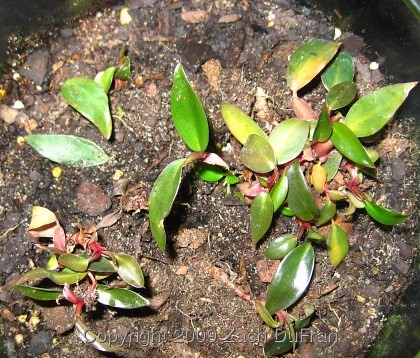
pincushion_new
My Philodendron 'pincushion' upon arrival and transplanting
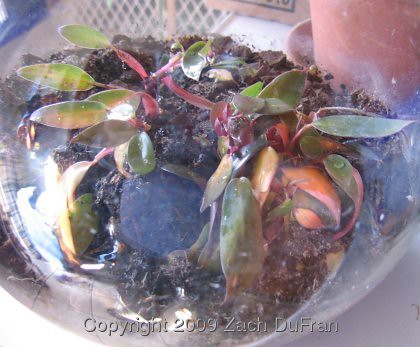
I divided the plant into a couple of clumps, putting one clump in a small spherical terrarium that had been emptied of its previous occupants and put the other clump in a small pot.  I'm really glad I divided the plant, because after just a couple weeks it was obvious that the terrarium was a preferable growing environment.  I went ahead and transplanted all of the plant to the terrarium, where it is doing much better than I expected.

philo_pincushion
My Philodendron 'Pincushion' as it looks now
New, glossy green leaves have emerged and I have removed the old leaves that died.  I'm hoping that this little Philodendron will fill the terrarium and I can occasionally take some cuttings to transplant to other locations.  This would make a really interesting "groundcover" in some of my larger container plants.  Maybe I could get some cuttings to take root in the soil surface of my Philodendron bipinnatifidum...

philo_selloum
My Philodendron bipinnatifidum (tree philodendron)
Now that my plant has recovered I have some hope that it could one day serve as a ground cover in some of my larger pots.  It is a rather slow grower though, so I will have to be patient for it to fill out the area.

Thursday, February 12, 2009

Book Review: Toki No Hana

Doesn't that title just draw you in?  No?

Well, maybe that explains why everyone was rolling their eyes when I opened this Christmas present from my parents (which I had requested, by the way).  The Japanese book "Toki No Hana" is a 45 page monograph (book with one subject) with 480 photographs of plants from the genus Asarum.

toki_cover
Toki No Hana cover
Although I have only grown one species from this genus, I greatly admire the genus and I have plans to start a small collection.  In the United States, Asarum are grown most often as groundcovers in woodland shade gardens in the north.  There are a couple of species native to North America.  You might run across their mottled foliage in the woods of the northern states and in Canada.

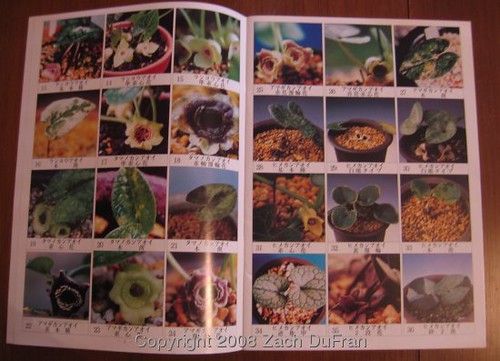
In southeast Asia, it's a completely different matter.  For thousands of years, the Japanese have cultivated different varieties for their variable foliage and subtle, but beautiful blooms.  The foliage can be anywhere from solid green to almost completely silver.  The blooms vary from yellow with red centers to solid purple.  They are treasured plants, grown in small pots where they can show off their blooms most easily.  You see, the inflorescence of an Asarum is at the base of them stem, literally lying on the surface of the soil (or pebbles in the pictures below).  One of the most recognized blooms looks like a little panda bear, being white and a deep purple that looks black.
toki_pics
Asarum pictures from Toki No Hana
The book was compiled by the Japanese Asarum Preservation Society and is a collection of pictures of all of the different varieties that have been cultivated there.  It is fascinating to see the variation.  Some are stunning and others are... well, not so pretty.  After all of the pictures are several pages of notes on the identification and origin of the different species and cultivars presented in the pictures.  Of course, the notes are in Japanese:


toki_japanese
Notes on Asarum species - did you get all that?
Thankfully, my parents purchased this book from a US source (Asiatica Nursery) that had grabbed a bunch of these books in Japan and translated the notes to English.

toki_eng
Ah, much better. Asarum notes translated from Japanese to English by Barry Yinger.
This Spring I will be checking the Atwoods store here in town where I have purchased Asarum splendens in the past.  I will probably get three or four plants to start with.  Since Asarum are actually a cool climate plant and will do very well in dimly lit, cool rooms, my plan is to start my collection in earnest this Fall by purchasing several more varieties from Asiatica Nursery, an online retailer that specializes in Asarum.  They usually have about 70 different varieties available.  I already have a short list of the plants I plan to purchase:


  • Asarum kiusianum var. tubulosum - solid white flowers, low clumping leaves


  • Asarum maximum Green panda wild ginger - one of the most famous species


  • Asarum splendens Chinese wild ginger - the variety I will buy at Atwood's in town


  • Asarum subglobosum - pink/beige flowers, green leaves have center white stripe


  • Asarum takaoi ‘Ginba’ - solid silver leaves


  • Asarum wulingense

  • It will be great fun to watch my plants mature into specimens as beautiful as those pictured in Toki No Hana and to see my plants produce some of these amazing inflorescences.

    Stay tuned for pictures of my plants as I collect them!

    Tuesday, January 6, 2009

    My LA Olive

    My father-in-law is an amateur bicyclist who has taken on a couple of tough cycling challenges.  During the fall of 2007, he decided to bike across the country, starting on an Atlantic beach in Virginia and finishing on a Pacific beach in Los Angeles, California 45ish days later.  He also biked part of the Tour de France, but this post is not about that trip.

    While my father-in-law was biking across the country, my mother-in-law spent each day driving their RV to their next stop.  She would pave the way and setup camp for the night.  When my father-in-law arrived at the campsite, he would eat, crash (sleep) and then get up to do it all over again.  [Of course, on a cross-country cycling trip, there were a couple of non-sleeping crashes too.   At least one of those left a mark.]  At some point, he actually reached water again in California.

    My wife, her brother, his girlfriend and I flew to California as a surprise, to see my father-in-law finish his cross-country expedition.  We greeted him at the Santa Monica pier when he arrived on his bike the final day.  We stayed a couple of extra days in LA at my wife's uncle's house so as to make a little trip of the outing.  Living in LA, he has all sorts of great things growing in his yard that simply cannot be grown year-round outdoors in Oklahoma.

    There are a number of Bird of Paradise planted along his house and a beautiful olive tree in the front yard.  He also has orchids sitting out on his porch in the shade.  They apparently love the weather and are very low maintenance for him.  [I have never dared to put any of my orchids outside.]  Before leaving I noticed there were some young saplings coming up around his olive tree.  My mother-in-law and I dug up a couple of them and she brought them back home to Oklahoma in the RV.  They were each about 8 inches tall I would say.

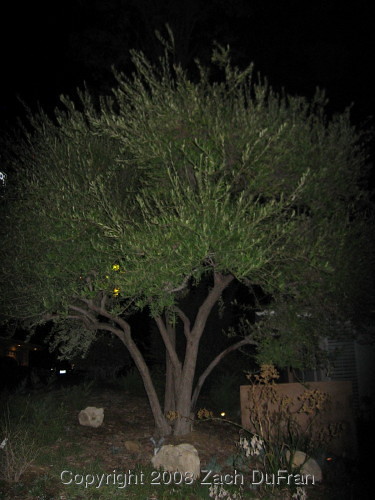
    olive_dad
    The parent tree to my little olive.  I took this picture on a different trip to LA, remembering that I needed a picture of the "daddy" tree.  Unfortunately I was only there at night, so this lousy picture will have to do for my sapling's inspiration for now.
    So now I have a celebrity olive tree.  Why a celebrity?  Well, because it's from LA.  I feel like I should knock before entering the room where I keep it.  And I probably should water it a little more frequently.  In fact, for a celebrity, it should have a much fancier pot.  Okay, forget the whole celebrity thing - it's just an olive tree.

    After traveling to Italy during the summer of 2007, I have had great admiration for olive trees and their splendidly silver leaves.  I had been thinking that I would like to have a specimen of my own.  I knew I would have to keep mine in a pot, since it would freeze out here in the winter.  But I figured I could grow it the way that many people grow ficus trees as specimen trees in pots.  At some point it would reach about 6 foot in height and look really nice.  I never imagined I would dig up a little olive tree for free.

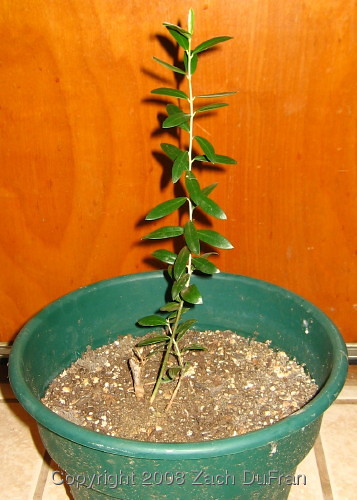
    However, my promising little olive tree has not grown very quickly.  I think maybe olive trees are normally slow growers, but I'll be well into my 40's before my specimen reaches a respectable (non-embarrassing) height.  [By the way, I'm currently 26.]  For now I will just have to post his puny picture on the internet so that anyone in the world can see him and laugh at his puniness.  How's that for motivation!?!

    olive_small
    My puny little olive sapling.  The short, wide stem to the left is the original plant.  It promptly died and new shoots arrived from the roots.
    One day (crossing my fingers) he will become large and strong like his father (the top pictured olive tree, not me) - and hopefully not be lopsided. :)

    Monday, January 5, 2009

    Plant find: Anthurium

    I have admired the genus Anthurium for quite a while.  I remember the first one I saw and thought that it must be a peace lily with a magenta bloom.  Little did I know, this wasn't one of those painted plants like the glittery blue or purple Poinsettias you sometimes see around Christmas.  It didn't take long before I started seeing Anthuriums everywhere.  I've found most plants to be that way.

    There seems to always be several of these plants at Lowe's, but they are usually priced near $10 and because of their persistent availability, I have kept them on my "to-purchase-one-day" list, rather than my "must-buy-today" list.  I think I officially became an Aroid collector in October, when my collection grew to more than 40 plants.  With Anthuriums being one of the Aroid genera, it would only be a matter of time before I would own one... or two... or three...

    Recently I made a return at Lowe's and received a giftcard with about $12 credit.  I promptly went to see what plants would be coming home with me.  Lowe's had the usual 2" houseplants from Angel Brand (which I really enjoy).  They also had some great orchids in bloom, but I haven't had much luck with orchids lately.  And, as usual, they had 4 or 5 Anthuriums in bloom (for about $8).  I took a look at them and decided - today is the day!

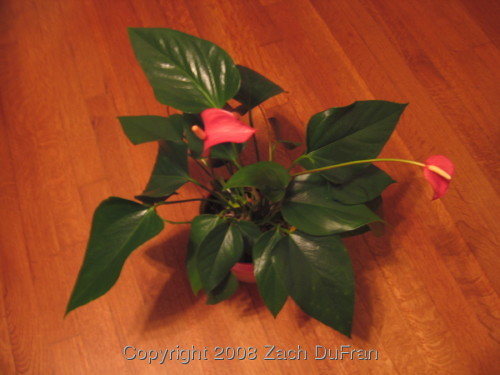
    anthurium_full
    My new Anthurium
    My Anthurium is marked as Anthurium amnicola. [Update: The label was incorrect, as this is not the species A. amnicola.] It has magenta colored inflorescences and shiny dark green leaves.

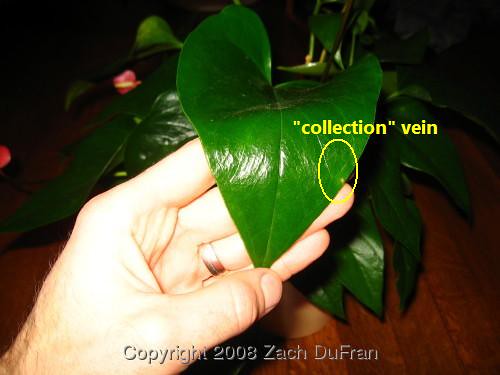
    I have been reading Deni Brown's book "Aroids: Plants of the Arum Family," in which there was a good overview of the variation of vein patterns (venation) of Aroid leaves.  At one point, it was mentioned that in some particular genera, the veins do not reach from the primary vein (midrib) to the edge of the leaf.  Instead, there is a separate vein that runs parallel to the leaf edge that "catches" all of the veins from the midrib.  My new Anthurium demonstrates this unique venation. [Here is a really good guide for leaf characteristics.  And more information here.]

    anthurium_veins
    Anthurium venation
    "Is this rare?" you ask.

    No, I don't think so.  In fact, there are some very common plants and trees that have this "collection" vein.

    "Does it have a purpose?"

    I don't know.  Probably.  I can't imagine that it wouldn't have a purpose.

    "Well, why did you mention it?"

    I don't know.  But it is an interesting subtlety of this plant that I observed and thought I would pass it along.


    Now that I have one species of Anthurium, I have to get more.  It's the official law of collectors.  One is not enough.  I already have my eyes set on another species, which I saw at the Oklahoma City Myriad Gardens.  [Check out all of these color varieties.]

    img_8794
    Pale purple Anthurium at the OKC Myriad Gardens

    Wednesday, December 17, 2008

    Christmas cacti in bloom

    This blog post marks my first update on a particular plant.  Last year I posted some information on seasonal plants and some pictures of my seasonals in bloom, including my Amaryllis and "Christmas Cactus."  Once again, it is that time of year and my cactus is covered in tiny buds.

    christmas_buds
    My Christmas cactus buds
    As you can see, my cactus doesn't look too good this year.  I sat it outside a little early in the Spring and I think it actually froze one night, but was able to hang on.

    About a year ago, a friend of mine left for Ireland to live for a year or two.  She left her plants behind with me (which is fun) and her big, healthy Christmas Cactus is also blooming.  Hers looks much better than mine:

    christmas_blooms
    My friend's Christmas cactus in bloom
    Identification

    I would be remiss if I didn't talk a little about  this plant and its correct identification here.  The Christmas/Thanksgiving/Easter/Holiday Cactus has been called lots of names.  And there are actually about four or five different species from the genus Schlumbergera that are labeled with this common name.  Two other genera are commonly called Name-Your-Holiday Cactus - Hatiora and Rhipsalis, both of which are less common.  Both of my plants are from the genus Schlumbergera, although I have not tried too hard to identify which species.  I wouldn't be surprised if they are two different species, but they might be the same one.

    General Care

    They are very easy to care for and very easy to bring to bloom.  Last year, my wife read some information about bringing them to bloom - putting the plant in a cold room (our garage), allowing it about 12 hours sunlight, 12 hours dark, and putting a glass of water next to it to increase the humidity slightly.  It worked great.  This year I think both plants beat us to the punch, putting out buds before I remembered to put them in the garage.

    During the summer I leave them both on my back porch, which receives dappled sunlight most of the day and water them infrequently - about once a week or less.

    They are also very easy to propagate.  Simply pinch off a section of plant and put it in dirt.  Viola - You have a new plant!

    christmas_start
    A Christmas cactus I started

    Friday, December 5, 2008

    Lipstick plant 'Black Pagoda' in bloom

    I have had my Lipstick plant (Aeschynanthus longicaulis) for at least a year and a half now.  Over the long holiday weekend I was picking out some of the dead leaves that had collected in the dense stems arching out of its hanging basket when I noticed a couple of small buds.


    small_bud
    New buds on Aeschynanthus longicaulis (lipstick plant) 'Black Pagoda'.  Also, notice the foliage on top and bottom of leaves.
    I was pretty excited, not having seen my plant flower before.  I knew that some species of Lipstick plant have bright red blooms (see some here), hence the common name.  My particular species of Aeschynanthus is A. longicaulis 'Black Pagoda.'  It has beautiful foliage - dark and light green stripes on the top of the leaves and purply-red and green on the undersides.

    I searched the plant for more of the inconspicuous buds and found that the plant is covered in them.  Looking around on the Dave's Garden website, I discovered a variety of lipstick plant that looks much like mine with a nice orange inflorescence.  You can see it here.  There are over 185 species of Aeschynanthus in the wild.  I read a comment by someone else saying that their 'Black Pagoda' has green blooms.

    large_bud
    Large buds on Aeschynanthus longicaulis (lipstick plant) 'Black Pagoda'.
    When I did a google image search for "Aeschynanthus longicaulis" all of the inflorescence pictures were green.  With my largest buds about to open and still no sign of color, I resigned myself to the fact that my blooms would stay green, not the colorful red or orange I had seen from some other species of Aeschynanthus.  I believe the lipstick plant with orange blooms is actually Aeschynanthus parasiticus.

    open_bloom
    Open inflorescence on Aeschynanthus longicaulis (lipstick plant) 'Black Pagoda'.  Notice the stamens extruding from the tubular calyx on the lower bloom.
    Even if the blooms are not very colorful on my plant, you just can't beat the mottled foliage of this species.

    full_foliage
    Aeschynanthus longicaulis 'Black Pagoda' (lipstick plant)
    Maybe it will win me a prize in the houseplant picture contest from the Life on the Balcony blog!  :)  We'll see.

    My plant has sent out a runner from one of the drainage holes on the bottom of the hanging pot.  I hope that I will be able to repot this plant in the spring and pull the runner back through the hole and pot it separately.  I might just have to do the repotting soon though, to avoid damaging the plant or having to cut into the pot.

    runner
    Aeschynanthus longicaulis runner from pot drainage hole
    More Information

    The Aeschynanthus genus contains about 150 species, most of which are considered epiphytes.  Some are actually considered lithophytic, though.  There is more information and some good pictures of the Aeschynanthus genus here and here.

    Monday, December 1, 2008

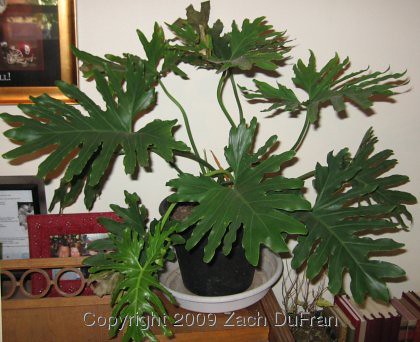
    Philodendron 'Xanadu'

    Almost a year ago I bought a large Philodendron 'Xanadu' from Home Depot or Lowes - I don't remember which.  It was on a huge discount (less than $5 with tax) because it wasn't doing so well.  I figured that the garden people had overwatered it or it had gotten too much sun.  I figured it was a Philodendron, so it would require about the same care as my other Philos.

    philo_xanadu
    My original Philodendron 'Xanadu' with brown leaves showing
    The problem with my Xanadu was that it had been overwatered and had probably already started to rot.  When I bought it several of the leaves had already turned brown (as you can see in the picture above) and the others were soon to follow.  Plants Are the Strangest People has a good post on Philodendron 'Xanadu' and how they react to water - by melting.  It wasn't long before all of my leaves had turned to mush at the base and fallen off.  I held out some hope that new stems would rise from the base, but after a couple of months I pitched it.

    Having read a little more about Philodendron 'Xanadu' since my catastrophe, I was determined to try out another one.  It really is an attractive plant, and I am now a bit of an Aroid collector.  Last week I ventured over to Home Depot, hoping to find some tropical plants that they would be overjoyed to get off their hands now that we're having freezing temperatures overnight in Oklahoma.

    I was right!  There weren't a lot of tropical plants, but the few they had, they were trying to get rid of.  They had 4 Philodendron 'Xanadu's marked at an unbelievably low price of $3.98.  I picked out the nicest looking one - this time showing no signs of rot - and took it to the cashier.  Since the label had been saturated in water, it had started to deteriorate and would not scan.  The cashier tried to find another plant of the same value, but couldn't, so he rung it up as $2.67!  Needless to say, I walked away very happy.

    xanadu_new
    My new Philodendron 'Xanadu'
    Here's my new 'Xanadu.'  This time I am going to keep a close watch on my plant and be sure not to overwater this one, knowing how sensitive it can be.

    xanadu_new_leaf
    Philodendron 'Xanadu' - Notice the beautiful red mid vein