Showing posts with label Jakarta. Show all posts

Thursday, July 19, 2012

Trip Report: Botanical statues of Jakarta

Jakarta is the capital of the diverse islands (more than 17,000 of them) of Indonesia.  At one time, Indonesia was ruled by the Netherlands.  They won their freedom once more on August 17, 1945.  Their historical struggles and ultimate victory are remembered with the National Monument (Monas) in Jakarta.

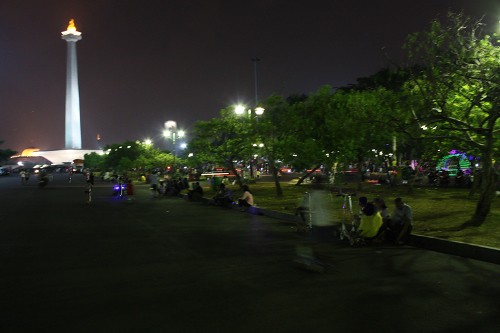
monas_at_night
The night scene around the Monas
This monument includes a 433 foot spire, capped in gold foil, a wall of bas relief carvings telling the history of Indonesia, and a museum.  This is all surrounded by a large park that is well-utilized by the people of Jakarta. On my daytime visit there were hundreds of people around, marching, jogging, and exercising in groups.  On my evening visit there were even more people present.  Mostly they were families with small children riding scooters or flying light-up helicopters, but there were also teenagers hanging out, doing what teenagers do, and vendors selling interesting things like mini-bajaj toys.  Yes, I bought one.  Yes, it is my coolest souvenir.

bajaj
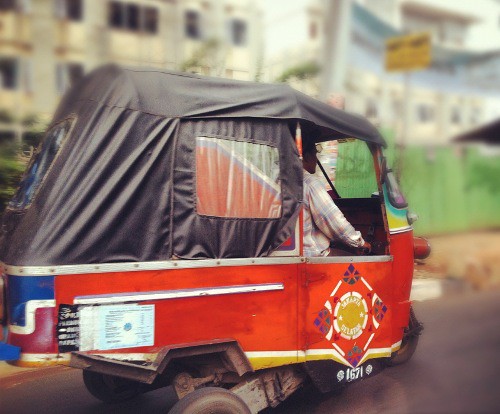
Bajaj on the streets of Jakarta
bajaj_toy
My toy bajaj that makes the authentic tut-tut sound when you pull it by a string
The gardens surrounding the bas relief wall at the center of the monument contain some rather curious tributes to the natural wonders of Indonesia.  In terms of Guinness World Records, Indonesia wins several prizes for botanical marvels.  The "largest flower" prize can be broken into at least three different categories, and Indonesia gets to claim two of them.

Amorphophallus titanum
Amorphophallus titanum - photo courtesy wikipedia
Amorphophallus titanum - also known as the Titan Arum, Carrion Flower or Corpse Flower - is the largest unbranched inflorescence in the known world.  It is not a single flower, but hundreds of flowers, all contained on that one large spadix.  "Inflorescence" means a collection of flowers.  "Unbranched" means that the flowers are all contained on the same structure.  These plants are native only to western Sumatra, the largest island of Indonesia.  [For the record, the largest branched inflorescence belongs to a palm tree, which occurs in India and Sri Lanka.]

a_titanum_statue
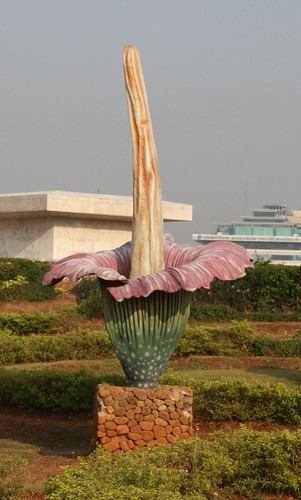
Amorphophallus titanum statue
The gardens around the monument contain 28 statues of the Amorphophallus titanum and they are all to scale.

Rafflesia arnoldii
Rafflesia arnoldii - photo courtesy wikipedia. Author: ma_suska
Rafflesia arnoldii - also known as the Corpse Flower - is the largest single flower in the known world.  It occurs only in western Sumatra as well.  Just like the Titan Arum, it derives its common name by smelling like a decomposing body to attract corpse flies.

rafflesia
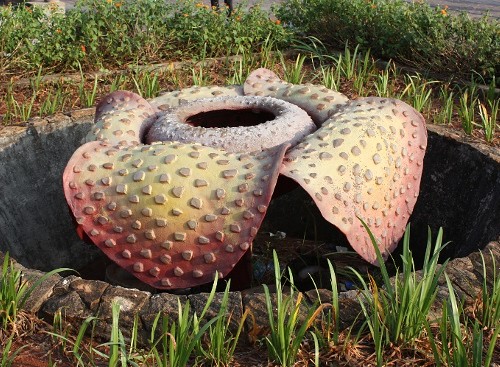
Rafflesia glass sculpture
The gardens contain 8 glass sculptures of the interesting Rafflesia flowers.

a_titanum_4_statues
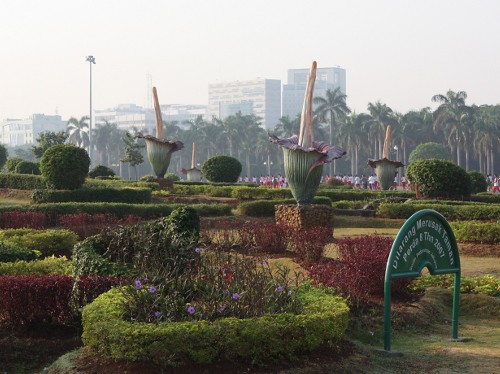
Four Amorphophallus titanum statues in view
So here's to art and to honoring your botanical marvels!

Thursday, July 12, 2012

Trip Report: Indonesian fruits

Here in Jakarta I have gotten to try lots of different foods.  Since I am restricting this blog to plant-related subjects only, I will share the more planty food I have eaten here on my trip.

Salak
Salak


The coolest fruit by far is Salak, which is the fruit of the Salacca zalacca palm. It is also called snake fruit because of the scaly skin. It is amazing how much the skin is like a snake skin!

salak_peeling
Peeling the salak.  Here you can see the separated fruits inside.


The fruit inside is hard and divided into sections like garlic cloves. It is not juicy and contains a large hard seed, but the fruit is pretty good.

salak_seed
Salak with seed exposed


One fruit is particularly famous around southeast Asia for being loved by the locals and hated by western visitors. It is durian and it smells god awful. Truly. I actually haven't had a chance to taste a pure durian fruit (yet), but I did buy a durian pudding and eat a good 5 or 6 spoon fulls. I was actually surprised that it wasn't as bad as I expected. I wouldn't say I liked it, but I will say that the smell was worse than the taste.

durian pudding
Durian pudding


I am planning to try a durian and also a dragon fruit (hopefully) in Singapore, before I head home.  I also need to try one of these starfruits!

starfruit, Carambola
Carambola (or starfruit)


Fruit juices are very popular here, especially with lunch. I have now tried at least 6 different kinds, including strawberry, lychee, guava, the two pictured below (from fruits I had never heard of), and sirsak (two pictures down). The lychee fruit comes from the Litchi chinensis tree. I haven't actually seen any lychee fruits, but I looked up some information on them and they are very similar to longan (below).

fruit_juices
Two fruit juices, popular to drink with meals


Sirsak juice is made from the "soursop" fruit of the Annona muricata. It is my favorite juice that I've had here. It was pretty thick and really tasted like a virgin pina colada. Does it get any better than that?

sirsak juice
Sirsak juice


Before you peel off the woody skin, the Longan fruit looks like a tiny potato. This fruit comes from the Dimocarpus longan tree.

longan
Longan


Once the skin is peeled away you can see the milky translucent fruit, which is a lot like a grape with the skin peeled away. It is juicy and has a good taste, although I can't think of anything that it tastes like. There is a large seed inside. The name longan means "dragon's eye" in Chinese, due to the appearance of the fruit and seed inside. I liked this fruit pretty well.

Longan
The exposed inside of the Longan


The Markisa fruit is from one of the edible species of Passionflower, Passiflora edulis. It looks a lot like an orange on the outside, but it's a whole different ball game inside.

markisa
Markisa (passion fruit)


When you peel the skin away you find lots of seeds that are basically encased in a small amount of sticky fruit that is really not worth the trouble. It doesn't taste great and the fruit to seed ratio is about 1:1. That's a lot of spitting and very little to show for it. I read on wikipedia that the orange-skinned variety (like mine) is usually not eaten but the fruit juices are strained out and used for various recipes.

markisa_inside
Inside of the Markisa (passion fruit)


Well, that's all for now. Off to taste some more fruits!
Wednesday, July 11, 2012

Trip Report: Plants along the streets of Jakarta

Yesterday I went for a walk.  Along the way I took a lot of pictures of plants growing along the sidewalk.  Jakarta is not a particularly pretty place, but there are some neat tropical plants growing wherever they can take hold.  For purposes of this blog, I'll be showing you those pictures.

polyathia
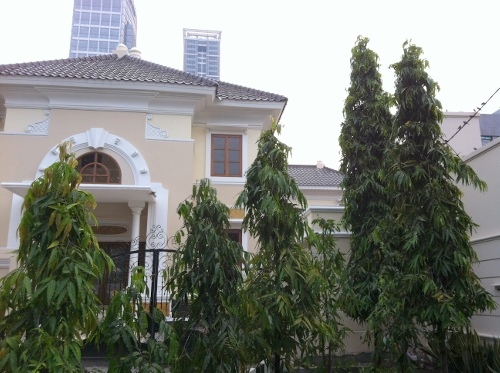
Polyathia longifolia in front of a nice house in Jakarta
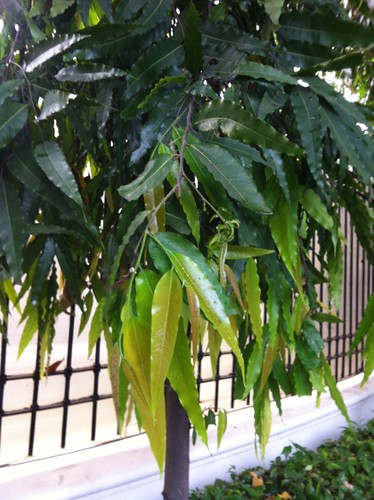
One of the more common trees here in Jakarta is the Polyathia longifolia, which is usually growing tall and skinny like an Italian cypress tree. It has long shiny leaves with undulate margins (wavy edges).

polyathia_leaves
Leaves of Polyathia longifolia
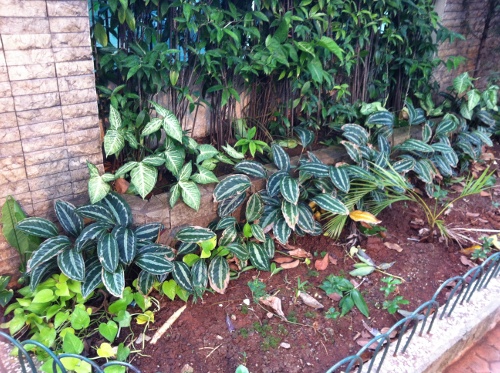
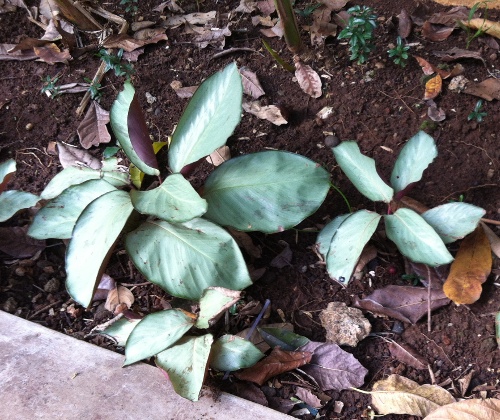
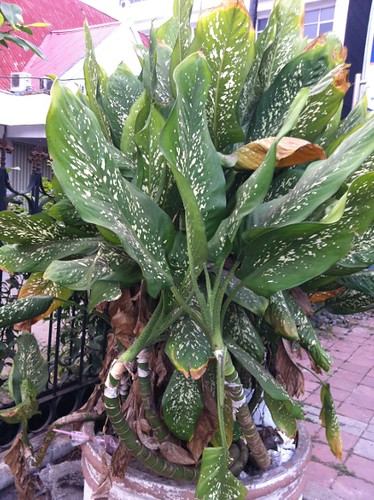
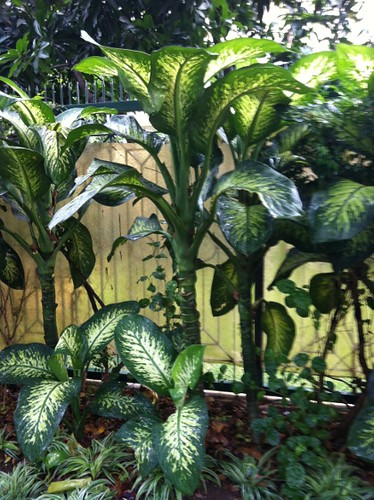
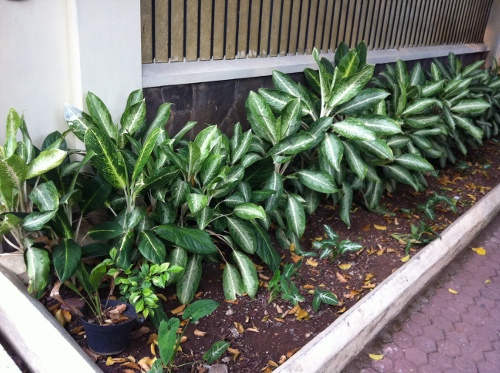
Some of my favorite plants (Aglaonema, Dieffenbachia, and Calathea) are growing everywhere here.

dark_calathea
Calathea

silver_calathea
Calathea

crowded_dieffenbachia
A pot full of Dieffenbachia
giant_dieffenbachia
Really large Dieffenbachia
aglaonema
Aglaonema, maybe

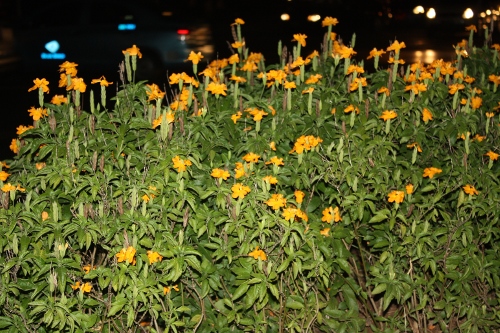
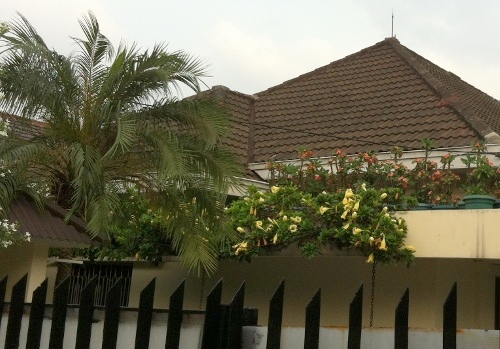
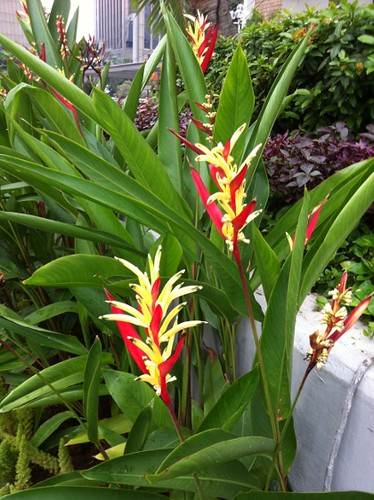
There are also lots of colorful flowering plants around: Bougainvillea, Plumeria, Heliconia, Canna and things I have never seen before.

acanthaceae
Some sort of Acanthaceae, possibly Crossandra

solanum
Solandra

heliconia
Heliconia

neat_flowers
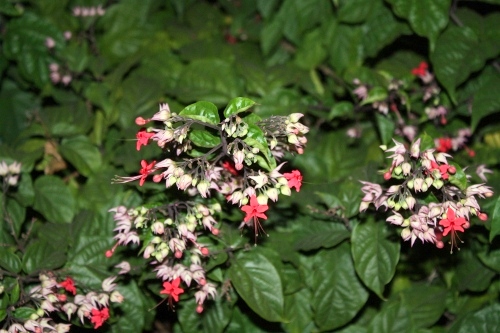
Do you know what this is?
(Update: mr_subjunctive and peaches identified this as Clerodendron thomsoniae)

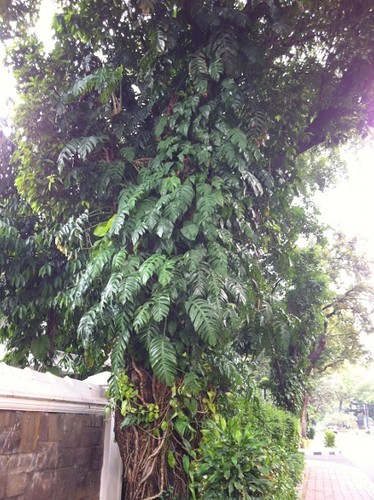
There were some other nice Aroids (besides the Dieffenbachia and Aglaonema) growing here and there...

climbing_aroid
An aroid climbing a tree. Perhaps Epipremnum or Rhaphidophora.

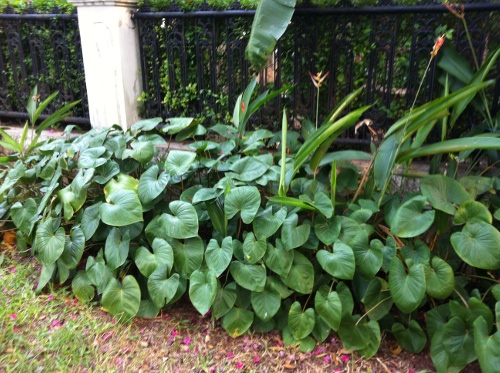
homalomena
Homalomena

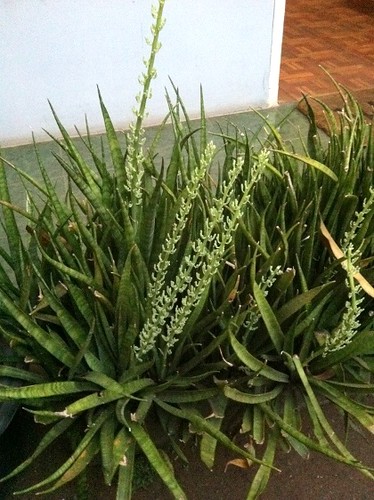
There are Sansevieria growing everywhere. I noticed one in particular that was in bloom.

sansevieria
Sansevieria in bloom

When I finished my leisurely walk, I came back to the hotel, where is some more formal landscaping out front.

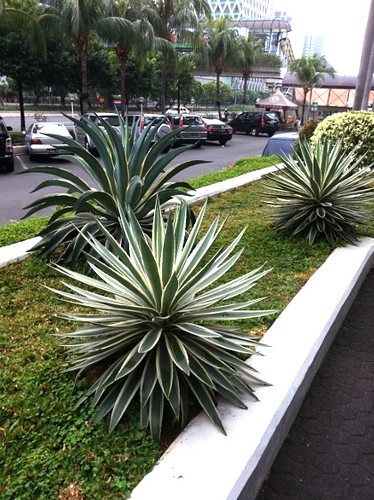
hotel_cacti
Agave in front of the hotel

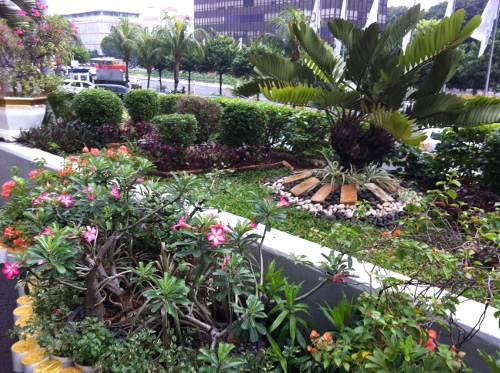
hotel_garden
Adenium (foreground) and Cycad (back right) in garden at hotel entrance
My walk took me to a park about a mile away from the hotel.  I'll post pictures from there in a separate post.  Stay tuned!