Showing posts with label Marantaceae. Show all posts

Wednesday, September 28, 2011

Meeting plant friends in person

Being a person with a relatively uncommon passion, I have friends that are spread far and wide.  Very few of my plant friends live near me, with the exception of people in the Oklahoma Orchid Society.  My friends that have a passion for aroids live in different corners of the country, and also outside of the US.

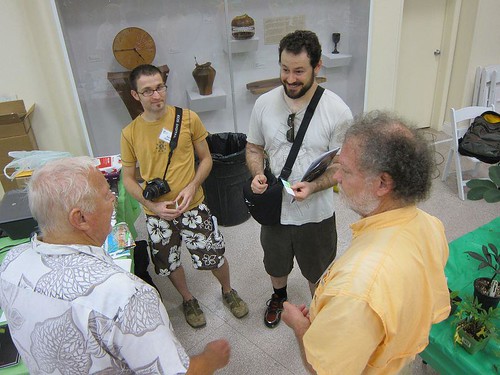
At the IAS show last week, I got the opportunity to see some of my aroid friends that I had previously only corresponded with through email.  Not only did I get to see these people in person, but we got to wander around in the IAS show and look at all of the amazing plants together, siphon through the pots and decide what we were going to buy, walk through the amazing Fairchild Tropical Botanical Gardens and point out everything we saw with people who were genuinely as interested as we were.

derek_me_taylor
Derek, me and Taylor at the IAS banquet
banta_me_derek_ron
Banta, me, Derek and Ron Weeks
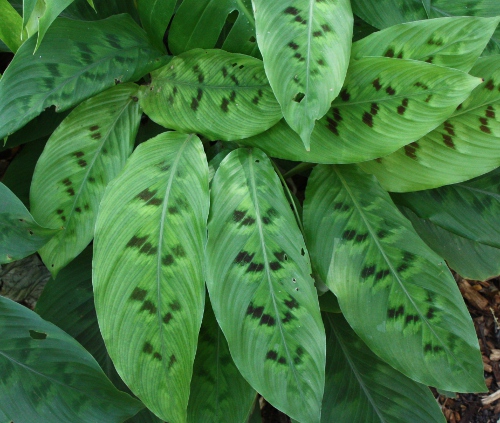
calathea_pavonii
Calathea pavonii that Banta showed me
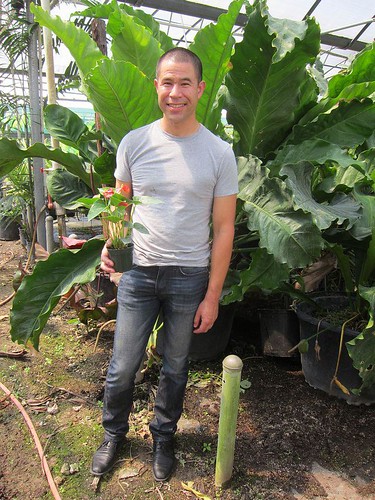
albert
Albert among the Anthuriums


Taylor Holzer and I have traded plants and emails for a couple of years now and we have a lot of passions in common: aroids (Philodendrons, Anthuriums and many more), prayer plants (Calathea, Maranta, Ctenanthe, etc.), orchids, aquarium fish (especially cichlids), aquatic plants.  Taylor is a great guy and it was really cool to chat plants with him in person.  I'm glad that we both made it to the show this year.  Taylor attended the show last year, but this was my first time.

Derek Powazek is a new friend to me.  We have traded plants and emails for the past 6 months or so.  He is a fellow blogger and lover of a wide variety of plants, including aroids and orchids.  He is also a really great photographer.  He lives in San Francisco and made the very long trek (flight) to Miami for the show this year - also his first IAS show.

John Banta (known simply as Banta, to aroid folks) is a legend in the IAS.  He and I spent a short time chatting about our shared love of Calatheas and we took a walk through the gardens to find Calathea pavonii, which he has graciously offered to share with me, from his own collection of Marantaceae.  John led one of the talks on Saturday afternoon, which dealt with a project that Banta is leading a new project to collect data on the viability of aroid pollen with age.  If we collect pollen from our plants for use in pollinating other plants, how long can we store it before it is no longer any good?

Albert Huntington is the current Vice President of the IAS and does a ton of the legwork of the society.  He is in charge of the website and does a really great job.  Albert is always the first person I go to when I have questions about the IAS and, in this instance, when and where to be and all that good stuff for the IAS show this year.  During the show he was running around taking pictures, helping at the cash register, recording the auction sales and doing who knows what the whole time, making sure everything went off without a hitch.  We got to have dinner with Albert and discuss all sorts of fun things.

There were many others that I have emailed and finally got a chance to talk with at the meeting.  It was a great time and I am so glad I got to go this year.

Tuesday, November 23, 2010

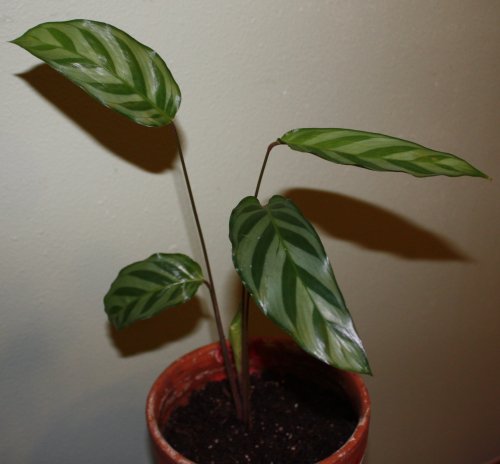
New Calatheas

One of my favorite plant families is the "Prayer plants" from the botanical family Marantaceae.  These include the genera Calathea, Ctenanthe, Stromanthe, and Maranta.  I don't have a lot of plants from this family, but I added two new Calatheas recently through plant trades.  I was able to share my Ctenanthes with two friends and they each shared a Calathea with me.  Plant trading is so much fun because the only money spent or exchanged is to pay for shipping and you get "free" plants in the mail.

c_concinna
Calathea concinna
The leaves of Calathea concinna are marked much like those of Ctenanthe burle-marxii, but there are some distinct differences.  Ctenanthe burle-marxii has rectangular leaves with a point at the end, while Calathea concinna has ovate leaves.

c_musaica
Calathea musaica
The foliage is of Calathea musaica is unlike any of my other Calatheas.  In fact, it is unlike any other Calathea in existence - quite unique!

Thursday, November 18, 2010

Trip Report: MidAmerica meeting photo album

I have created a photo album of my pictures from the 3rd meeting of the MidAmerica chapter of the IAS.  The meeting was held October 30 at the Fort Worth Botanic Gardens.

Enjoy!

photo album here

Friday, October 22, 2010

Trip Report: Prayer plants in the Climatron

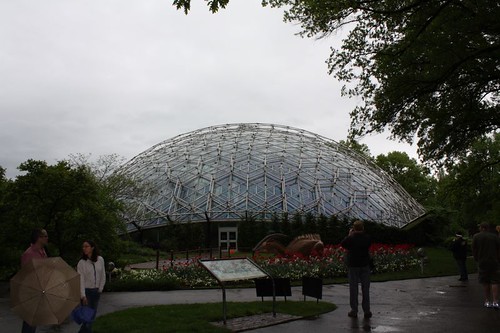
The Climatron is a 50-year old geodesic dome that serves as a tropical greenhouse at the Missouri Botanical Gardens (MoBot).  During our Aroid meeting at the MoBot (back in April) the Climatron was closed as they were setting up a dinosaur exhibit for the next weekend.  Thankfully we got "back stage passes" into the Climatron with our staff escorts!

outside_climatron
Outside of the Climatron
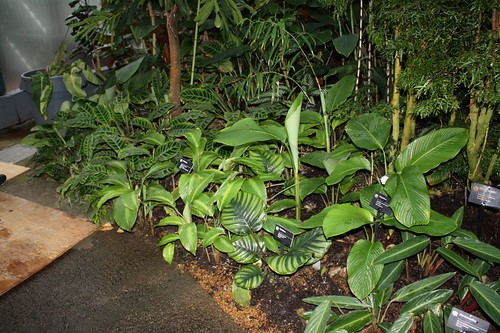
The Climatron is much like the Myriad Botanical Gardens in Oklahoma City, with which I have become very familiar.  The center is at a height of 70 feet and by my calculations, the ground space is about 24 thousand square feet.  The Climatron has many of their plant families grouped together that are more scattered in the Myriad Gardens.  For instance, there are two areas in the Climatron devoted only to Begonias and to prayer plants (Marantaceae family), respectively.  The only other venue where I have seen as many Marantaceae would be the Foster Botanical Gardens in Honolulu, Hawaii.

marantaceaes
Some of the Marantaceae in the Climatron.
I was really excited to see this dedicated area for prayer plants, since they are my second favorite family of plants.  The greatest thing was that almost all of them were in bloom and I have only seen blooms on these plants on a couple of rare occasions.

c_albertii_group
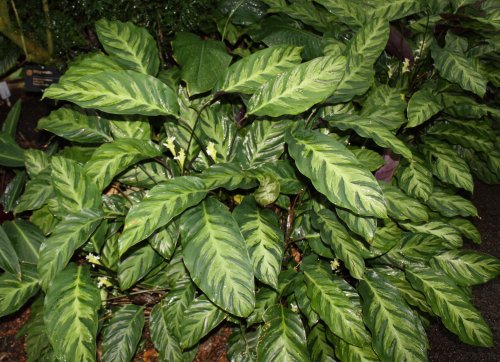
Healthy group of Calathea albertii
The impressive species display was the Calathea albertii grouping (above and below).  These plants are obviously very happy in this growing environment, having spread out quite a bit and blooming like crazy.  I was ever so tempted to ask for an offset.

c_albertii_bloom
Calathea albertii in bloom
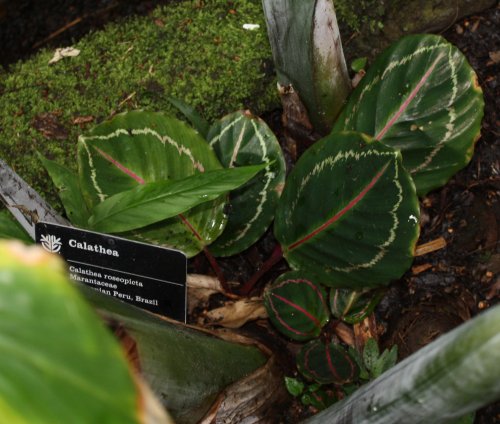
There are many colorful hybrid Calatheas sold as houseplants at Lowe's nowadays.  I think most of these are variations or hybrids based on the Calathea roseopicta species (below), which has pretty stunning color as a naturally-occurring species.

c_roseopicta
Calathea roseopicta
c_burle_marxii
Calathea burle-marxii in bloom
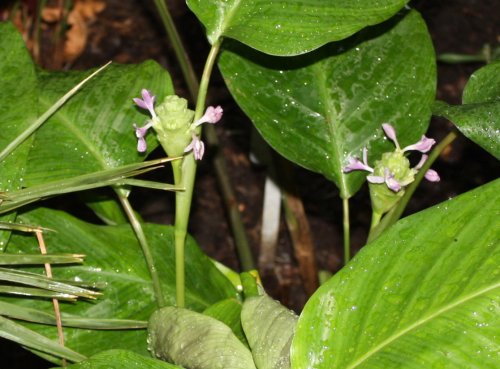
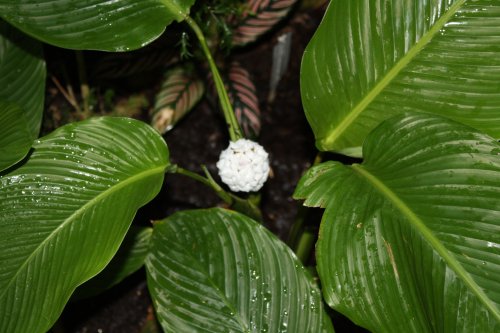
Calathea burle-marxii (above) is the species that I have had the best success growing in my greenhouse.  My plants haven't bloomed before, but it looks like I wasn't missing out on much.  Small white flower petals emerge from an otherwise boring green bract that kind of resembles some Bromeliad bloom bracts.

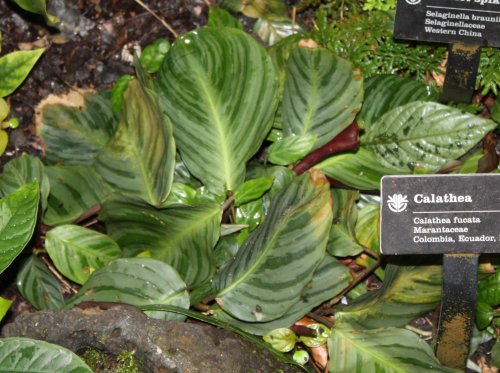
c_fucata
Calathea fucata
Calathea fucata (above) was one of the few species that was not in bloom.  It leaves me all the more curious about what it's blooms might look like.  I guess I'll just have to go back for another visit sometime...

c_violacea
Calathea violacea in bloom
The plant below puzzles me a little bit.  I didn't get an ID on the plant, but comparing the leaves, it is very similar to the identified Calathea violacea (pictured above).  The blooms look different, but I am wondering if I just caught the blooms at different stages and it is the same species.  I'll try to recruit some expert Calathea help to get that question answered.

c_noid
Calathea violacea? in bloom
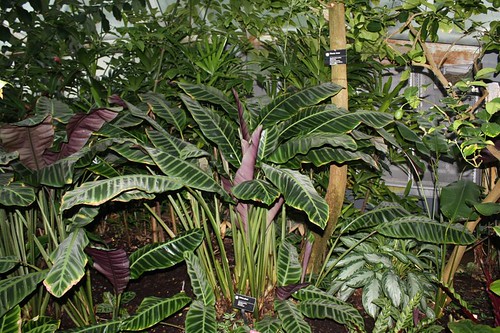
Now Calathea zebrina (below) is one of my favorite species.  I have seen this plant a couple of times in person.  There were some beautiful specimens at the Foster Botanic Gardens that were in bloom while we were there.  The plants in the Climatron seemed monstrous in comparison, though.  The zebrina species has very velvety textured leaves with solid purple undersides.  The thick stems of these plants almost reminded me of banana trees.

c_zebrina_forest
Forest of tall Calathea zebrina - the tallest being 6 feet or more.
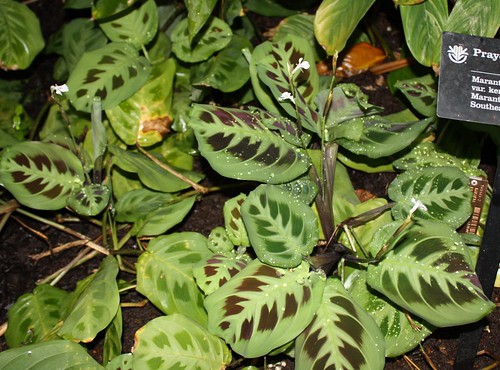
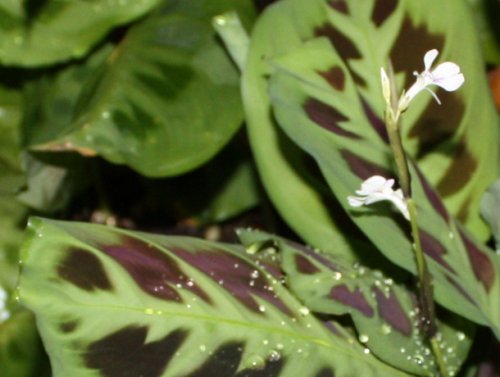
One of the most common "prayer plants" is Maranata leuconeura v. kerchoveana (below).  Okay, so it's not the easiest name, but it is one of the more common house plants from this family.  But you don't very often get to see these plants blooming in the house setting.  Obviously these plants are grown for their striking foliage, but I think the blooms are pretty neat, anyway.  Look at the closeup below.

m_leuconeura
Maranta leuconeura v. kerchoveana in bloom
m_leuconeura_bloom
Maranta leuconeura v. kerchoveana bloom closeup

Tuesday, July 20, 2010

Trip Report: The Prayer Plants of Volunteer Park

When I say "Prayer Plants" I am referring to the Marantaceae family, which is one of my favorite families of plants.  Like, it's in my top 3 favorites.

I've written some posts about this family before, if you're interested in viewing those:

Actually, I have been meaning to write a much more thorough blog post about this plant family, using some pictures I took at three different botanic gardens: the Foster Botanic Gardens in Honolulu, Hawaii; The Climatron at the Missouri Botanical Garden in St. Louis, Missouri; and the Myriad Gardens in Oklahoma City.  But I haven't gotten around to that yet, so I guess I will just keep writing these short reports as I encounter new plants and see them in different phases of growth.

The Volunteer Park Conservatory in Seattle, Washington has a great collection of Marantaceaes in the center glasshouse.  One plant (Calathea warscewiczii) was in bloom and some others I had never seen before.  Here are the highlights:

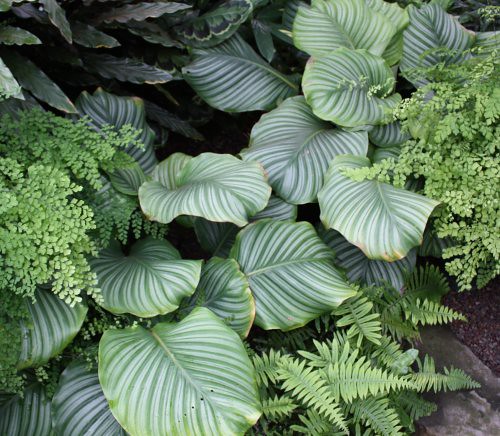
Calathea orbiculata

cal_orbiculata
Calathea orbiculata
Calathea lancifolia

I was already familiar with this plant, having admired it for a while, bought one myself, admired my own for several months, and then mourned its untimely passing.  Calatheas, like most other plants from this family, like moist soil and somewhat shady conditions.  I'm afraid low humidity has been the cause for almost all of my losses.

cal_lancifolia
Calathea lancifolia
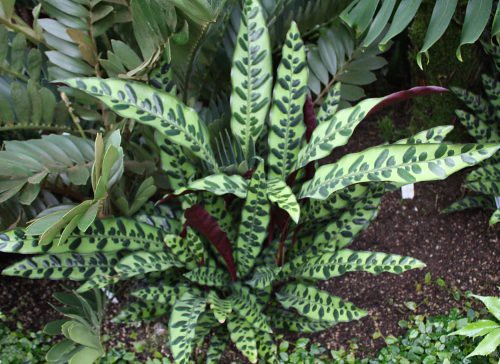
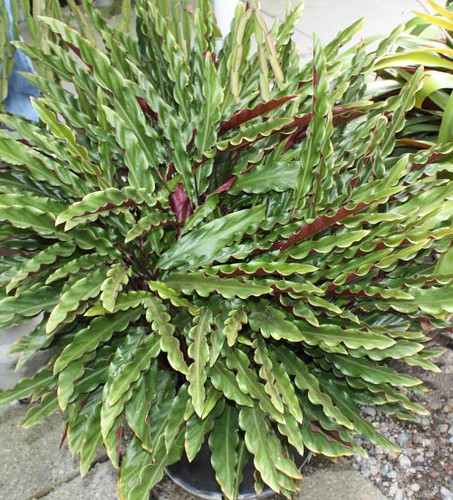
Calathea rufibarba 'Furry Feathers'

I have seen this plant online a good bit, but not from any easily accessible vendors.  One wholesale vendor had it for sale.  However, while it's a beautiful plant, I don't think I want 250 of them!  On second thought, I wouldn't at all mind 250 of them, but I couldn't afford that or have a place to put them all.

cal_rufibarba
Calathea rufibarba 'Furry Feathers'
I don't know if the 'Furry Feathers' name is a true cultivar or not, but you can definitely see how the name was chosen when you look closely at the leaves.  Several other prayer plants have these furry leaves, including both of my Ctenanthes.

cal_rufi_close
Calathea rufibarba 'Furry Feathers' - here you can see why it has the name it does
Calathea NOID

This Calathea didn't have any ID on it.  That's what NOID means.  I have seen some other Calatheas similar to this one and several have names like "Peacock," but I can't put a sure tag on this one.

cal_noid
Calathea NOID
Ctenanthe NOID

I think Ctenanthe is probably my favorite genus in the prayer plant family.  I have only seen 3 or 4 species, but every one of them has been very cool.  I mean, look at that awesome foliage!  This plant might be C. amabilis, which is pictured on Tropicos.

cte_noid
Ctenanthe NOID, likely C. amabilis
Calathea warscewiczii

Many of the plants weren't labeled, or at least not very clearly.  I had to dig around a bit before finding tags around many of them.  This particular plant had a tag, but I'm second guessing the identification.  I think the plant might actually be Calathea zebrina.  I have seen C. zebrina other places before and my pictures match that plant much better on Tropicos than C. warscewiczii.

cal_warsc
Calathea warscewiczii or C. zebrine?
The blooms help in the identification process, but I don't have a great baseline to compare this plant to the two species in question.  Does anyone know for sure what species this plant is?

warsc_bloom
Calathea warscewiczii or C. zebrina in bloom

Tuesday, June 9, 2009

Trip Report: Foster Botanical Garden in Honolulu, Hawaii

While on vacation in Hawaii this May, my wife and I visited the Foster Botanical Garden in Honolulu.  In Oklahoma, a tropical botanical garden would necessarily reside in an enclosed structure.  Not so in Hawaii.  The only enclosed structure on the grounds of the Foster garden is to keep a group of hybrid orchids in a pristine environment, where they will not spread into the wild or cross with naturally occurring species.

The Foster Botanical Garden has a long history, dating back to 1853.  [You can read about the history here.]  The garden includes areas dedicated to orchids, hybrid orchids, Cycads, palms, bromeliads, Aroids, gingers, and Heliconias.  Unfortunately I wasn't able to see the Hybrid Orchid greenhouse because I took too long in other parts of the garden and the garden closed before I got there.

I would like to just give a run down of the specific sections of the garden and then point you to my photo album, which I'm sure you will enjoy! :)

Exceptional Trees

The Foster Botanical Garden has a wonderful collection of 24 "Exceptional Trees."  Exceptional Trees are those that have been designated as trees which are to be protected and cannot be cut down.  According to the legend, one of these trees is the offspring of the tree under which Buddha sat when he gained his knowledge.  You can see pictures of many of the very large trees in my photo album.  A couple of the exceptional trees are palms, of which the Foster BG has more than 100 different species.

Palms

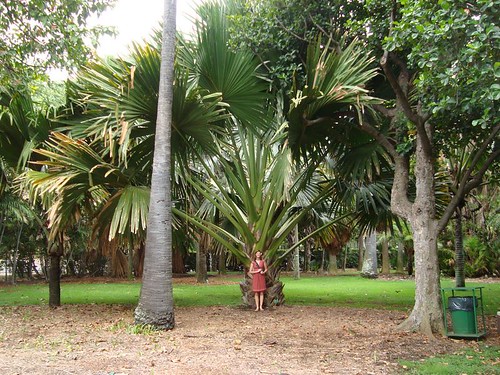
There are literally hundreds, if not thousands, of palm trees in this relatively small botanical garden.  Not being a connoisseur of palm trees, many of them look the same to me.  However, there were about 10 different species that really stuck out, including the Double Coconut Palm and the Grugru Palm.  The palm trees ranged in size from about 8 feet tall to well over 80 feet tall.  Their trunks varied from smooth to covered in spines (the Grugru palm).
dsc03433_35329767132_o
Christie standing in front of a huge palm tree with spreading fronds
Cycads

On first glance, many cycads look like members of the palm family.  But they are a very different family of plants, and can grown into the subtropical and temperate zones, including Oklahoma.  These plants are displayed in the "Prehistoric Glen" of the Foster Botanical Garden.  Cycads are among the oldest trees in the world.  The individual trees themselves are not the oldest plants, but the species have been found in the fossil records dating back to the age of the dinosaurs!

Heliconias, Gingers and Marantas

The botanical order Zingiberales contains the families Heliconiaceae, Zingiberaceae and Marantaceae - which were all featured in the center terraces of the Foster BG.  Of course, I am a huge fan of plants from the Marantaceae family.  I was surprised to find many plants from this family were labeled with incomplete signs, such as "Calathea plant, Calathea sp."  It was as if they had tried to determine the species and had been unable.  I have had this problem quite often with this family of plants.  It is surprising to me that for such a beautiful group of plants, the names are not more widely known.
dsc03529_34686860533_o
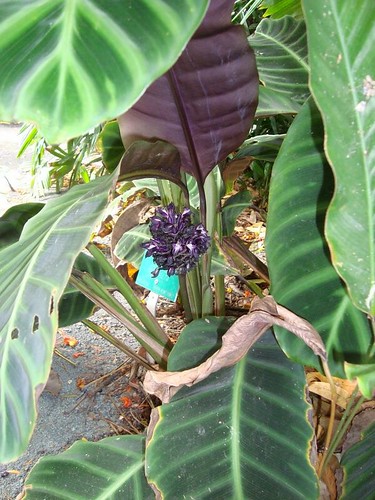
Calathea picturata inflorescence
There was a beautiful flowering specimen of Calathea picturata and many flowering Heliconia.  Unfortunately, many of the Gingers were not in bloom while I was there.  I did see them blooming in other parts of Hawaii though - and I brought back 5 different varieties to grow at home.

Orchids

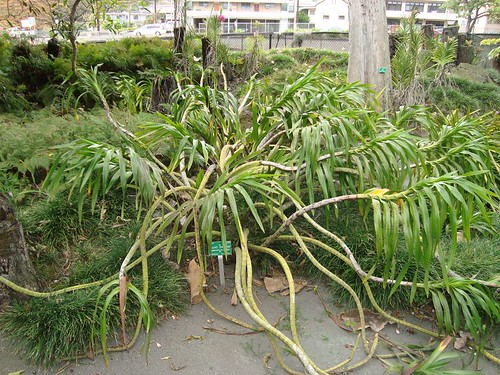
There is a great collection of orchids, mounted on stumps and tree trunks and planted in the ground.  One of them is appropriately named "The Giant Orchid" (Grammatophyllum speciosum).  It has long, wandering stems that arch towards the ground and was probably a good 8-10 feet in diameter!
dsc03410_34655723694_o
Giant orchid (Grammatophyllum speciosum)
It's simply amazing to see these plants growing outdoors.  I would never think of putting one of mine outdoors.

Odds and Ends

There are certainly some oddball plants at the Foster BG.  One of these was the Cannonball Tree (Couroupita guianensis), which has tendrils growing down it's trunk that are covered in blooms that look like orchids.  Later, very large nuts form on these tendrils that look like a large, round coconut (or a cannonball).  As they mature, they begin falling from the tree.  Weighing somewhere around 20 pounds, these large nuts can be dangerous to someone not paying attention!

dsc03560_35366022551_o
Warning sign under the Cannonball Tree (Couroupita guianensis)
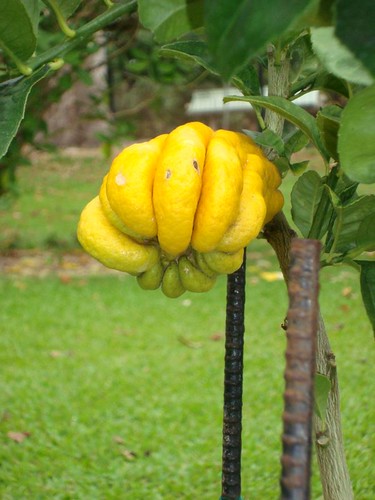
Another odd specimen at the garden was the Buddha's hand citrus tree (Citrus medica var. sarcodactylus).  I had seen pictures of these truly odd fruits before, but not seen one in person until I was here.
dsc03607_35110137400_o
Fruit of the Buddha's-hand Citron (Citrus medica var. sarcodactylus)
To see all of my pictures from the garden (289 of them) click on the image below. Enjoy!

Foster Botanic Gardens

Wednesday, May 13, 2009

Ctenanthes showing off

I have two different species of Ctenanthes in my collection - both of which are showing off right now.  One of them (C. lubbersiana) is blooming and the other (C. setosa) just produced it's first leaf.

I hope you're not too excited about seeing a lavish bloom, because Ctenanthes don't do that kind of thing.  Nevertheless, I am really happy to see my C. lubbersiana plant blooming.  It has been sitting in less than ideal conditions for the past couple months and still put out new growth and a flowering bract before being taken outside into the warm sunshine.

ctenanthe_tall
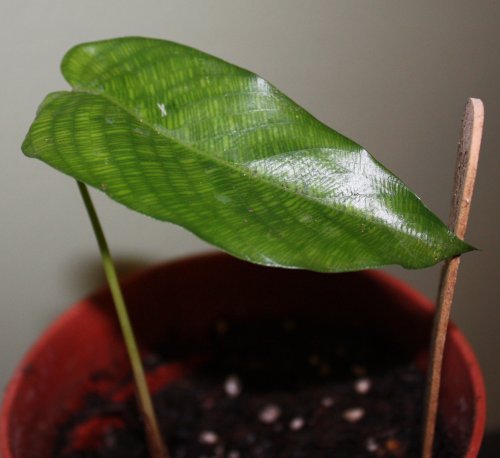
Ctenanthe lubbersiana with tall (blooming) stem.  The brown thing that looks like a stick is just that.  I stuck it down in the pot to hold up the top-heavy branch.
When I bought this plant in the Fall, it was root bound in the small pot in which it was planted and had pretty much pushed all of the soil out of the top of the pot.  When I finally removed the plant from the pot it was almost entirely roots.  I used a pair of scissors and cut the plant in two and put each half in a pot larger than the original pot that was containing the whole plant.  I also split off a single stem and roots and potted it up for my mom.  Both of the divisions that I kept continued to grow well throughout the Winter.  The one in the larger of the two pots is sending up more new stems and has the one really long stem (pictured above), which produced the inflorescence (pictured below).

ctenanthe_bloom
Ctenanthe lubbersiana inflorescence
This plant is a vigorous grower in the couple of months that I have had it and I will enjoy continuing to divide it.  It's always nice to have a plant that you can share freely, without worrying that you will lose your original plant.

You might remember me receiving a very special package from Australia just over a month ago.  That package contained 5 rooted stems of Ctenanthe setosa 'Grey Star,' which had been cut off just above ground level.  I planted the stems immediately and the first stem appeared last week, producing a leaf just a couple of days later. The stem below the leaf is only about 3 inches tall.  In the same pot, there are two other stems just breaking through the soil surface.

first_setosa_leaf
First leaf on the first stem of Ctenanthe setosa 'Grey Star'
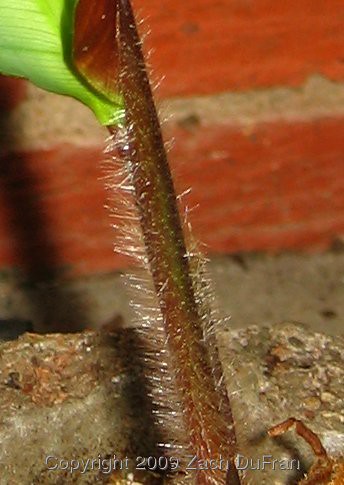
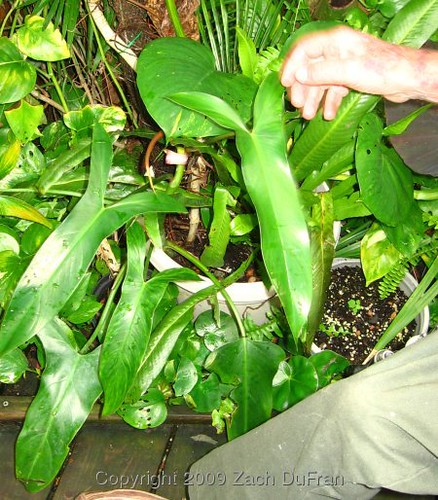
In my introductory post for this plant, I discussed the species name "setosa," which means "bristly or hairy."  Look at the picture below to see that name in action!
setosa_fur
Ctenanthe setosa 'Grey Star' pubescence (fur) along the stem.
The "fur" feature is called pubescence on a plant.  The pubescence on my Ctenanthe almost looks prickly, like a cactus, but it is actually soft to the touch.

Besides having some really cool foliage, Ctenanthes are a good fit for me - enjoying the increased humidity that my house seems to have over the winter and they do fairly well in low light conditions.

Friday, May 1, 2009

Trip Report: Exotic Rainforest in Siloam Springs, AR

You might think I've fallen off my rocker with that title, but it's true!  There is an exotic rainforest in Siloam Springs, Arkansas.

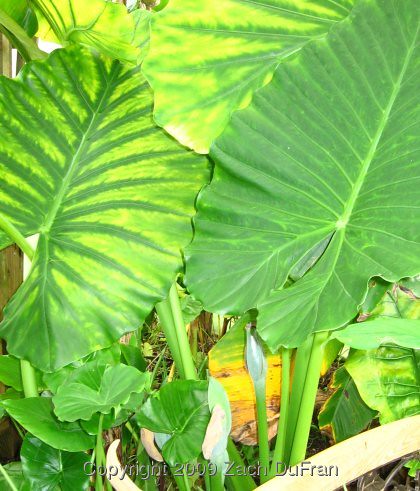
alocasia
Large Alocasia growing in the Exotic Rainforest.  Notice the multiple inflorescences in the lower half of the picture.
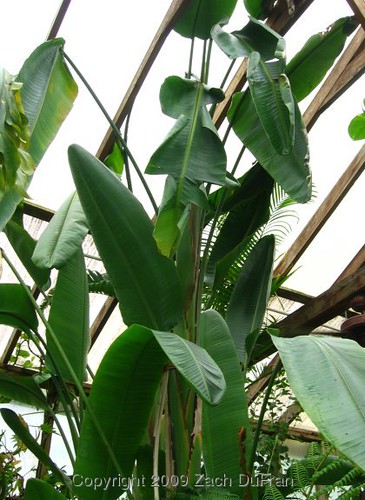
bird_of_paradise
White Bird of Paradise (Strelitzia nicolai) reaching the upper limits of the atrium.
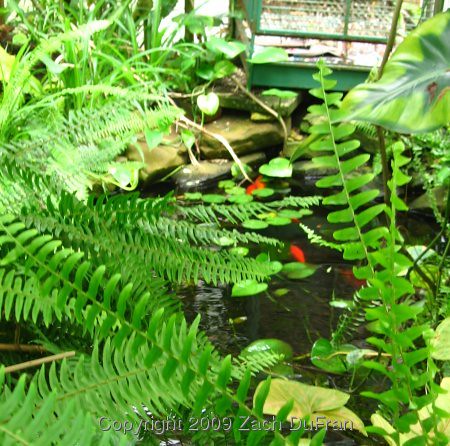
The "rainforest" is contained in a 24' by 24' atrium that is built onto the back of the private home of Aroid collector Steve Lucas.  Steve lived in Florida for a number of years, amassing a large collection of tropical plants which covered the grounds around his house.  When he decided to move to Arkansas, he was determined to continue his hobby of growing tropical plants and take what he could with him.  Others thought he was crazy, but he built a large greenhouse and turned it into a tropical paradise.  It contains somewhere on the order of 300 species of Aroids, a lot of orchids, a blue and gold Macaw, tree frogs, a waterfall and a pond stocked with fish!

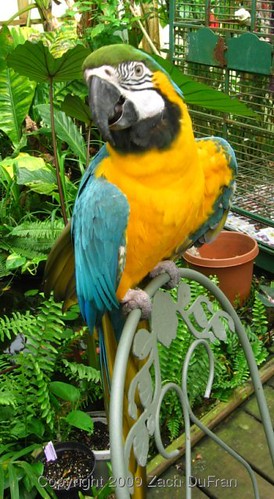
wizard
Wizard, the blue and gold Macaw
pond
Pond in the rainforest atrium
tree_frog
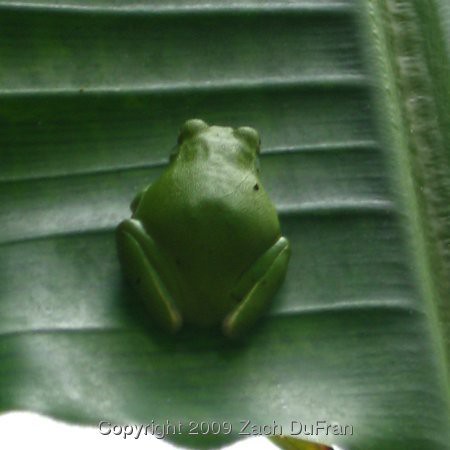
Tree frog perched on a leaf of the Bird of Paradise.
Our trip to Steve's house was something I have been looking forward to for about 6 months now.  Steve is an amateur botanist, though only "amateur" in that his professional training is in another subject.  Steve collaborates on a regular basis with many of the leading researchers focused on the Aroid (Araceae) family, and has a working knowledge of Aroids greater than anyone I know.  It was great to finally meet him after seeing lots of his pictures on his website and reading his passionate descriptions and discussions of Aroids.  Steve took me through his collection, telling me about each plant - the botanical name, commonly mistaken identities, key features, locations where it is found in nature and the story of his particular plant.

mexicanum
Steve showing me his Philodendron mexicanum (of which he gave me a cutting)
Steve has some plants in his collection with particularly interesting stories.  The plant pictured below was one of two plants used by Julius Boos and Drs. Tom Croat and Simon Mayo to write the scientific description of Philodendron xanadu.  Julius Boos gave the plant to Steve as a gift.  That's a pretty special plant!

xanadu
Philodendron xanadu plant used for formal description
Steve also has a Philodendron that is currently unnamed.  He is carefully documenting all new growth and changes that he sees and communicating that information to one of the world's leading Aroid experts, Dr. Tom Croat of the Missouri Botanical Gardens.  His hope is to have the plant produce an inflorescence this year and soon the plant will be determined to be a distinct species that had not yet been discovered.

noid
Steve's prize plant, an unidentified (and potentially undocumented) Philodendron species.
I have grown some Aroids for 3 or 4 years, but my collecting of Aroids really just began last Fall.  Steve had loads of information to share with me and was kind enough to give me cuttings of several of his plants.  Any plant that had enough stem to cut away he was willing to share.

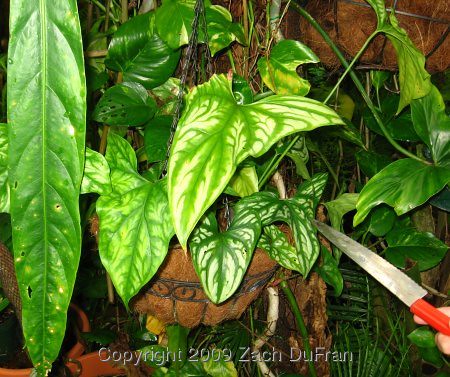
cercestis
Cercestis mirabilis. The big red knife is what Steve used to make cuttings of several of his plants for me.
Because of his generosity, I have added six new Philodendrons, one Alocasia and one Tillandsia (from the Bromeliad family) to my collection: P. atabapoense, P. billietiae, P. erubescens, P. mayoi, P. mexicanum, P. 69686, A. gageana and T. albida.

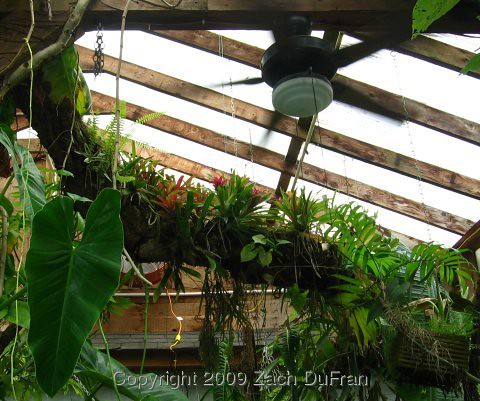
Steve has installed an artificial log wrapped in growing medium and mounted with epiphytic plants - ferns, Bromeliads, Orchids and Aroids.  As Steve says, in the rainforest, there are more plants growing on the trees than on the ground.

epiphyte_log
Artificial log mounted with various epiphytic plants - ferns, Orchids, Bromeliads and Aroids.
There is a wealth of information on his website concerning Aroids, orchids and tropical greenhouses.  He also has some wonderful pictures.  Check it out!  www.exoticrainforest.com

Thursday, April 2, 2009

Plant Finds: Three new Calatheas

Last week I bid on some plants on eBay.  This was kind of a first for me and I am very satisfied with the quality of the plants and the speed in which I received them.  The auctions ended on Sunday and the plants arrived on my doorstep on Tuesday at lunchtime!

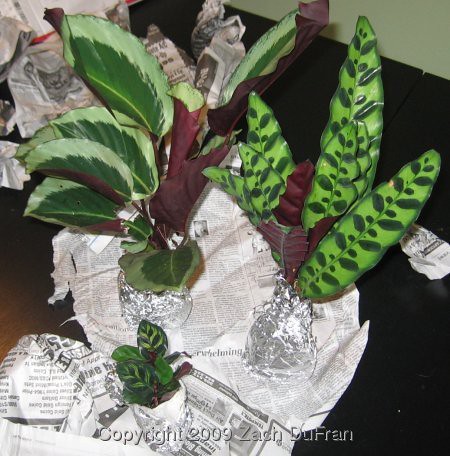
calathea_arrivals
My three new Calatheas. Clockwise from top left: Calathea roseopicta 'Mia', Calathea lancifolia, Calathea makoyana.
The three plants I bought are all from the Calathea genus (commonly called Peacock plants), from the Marantaceae family (commonly called the Prayer Plants).  Since I am running low on pots, I potted the largest two species together in one medium sized pot.  I think they look pretty neat together and will look even better as they each fill out.

calatheas_mia_lancifolia
Calathea roseopicta 'Mia' and Calathea lancifolia jointly potted
Calathea lancifolia had been on my "to acquire" list for quite a while and I am really glad that I bought such a nice looking specimen.  It seems very healthy and happy.  The plant which was sold as Calathea 'Mia' looks to me like a variation of the species C. roseopicta.  I have another color variation of roseopicta, which is called 'Saturn' and has the opposite coloring on top of the leaf.  Saturn has light green center and a dark green band around the edge.

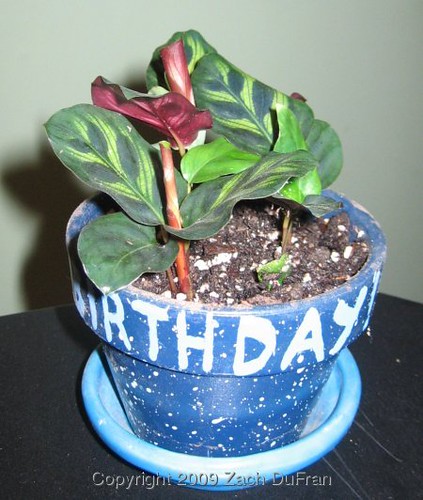
The smallest little critter I planted separately in this little pot I found in the garage.  Apparently I painted it for my wife a while back.  It says "Happy Birthday" and is a little bit too much color (in my opinion) for this plant.  I would prefer a simple pot, not to overshadow the colorful foliage of this little plant.  Anyway, that's where he will stay for now.  Maybe this summer I will move some things around and he will get a new pot.

makoyana_potted
Calathea makoyana potted
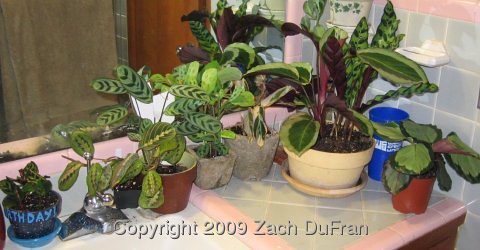
My collection of plants from the Marantaceae family is growing!  I now have plants from a total of 10 species - 4 Calathea, 3 Ctenanthe, 2 Maranta, and 1 Stromanthe species.  I moved pots around in the house this morning (it's still too cold to let them get some fresh air outdoors) and decided to move all of these plants to the bathroom counter, where most of them were already.  With the exception of my two large Ctenanthe species, all of Marantaceae plants are sitting together now.  I decided they should probably have a family portrait.

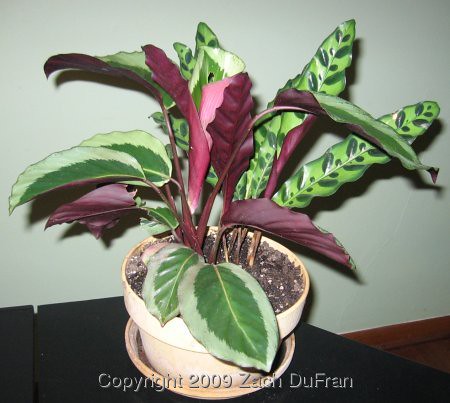
family_portrait
Marantaceae family portrait. Left to right: Calathea makoyana, Maranta leuconeura erythroneuro, Ctenenthe burle-marxii, Maranta leuconeura, Stromanthe sanguinea 'Triostar', Calathea roseopicta 'Mia', Calathea lancifolia, Calathea roseopicta 'Saturn'. [Not pictured: Ctenanthe lubbersiana 'Brazilian Snow' and Ctenanthe setosa 'Grey Star'
If you missed my other posts concerning Marantaceaes, you can see them here: