Showing posts with label Dendrobium. Show all posts

Monday, May 13, 2013

Local orchid show

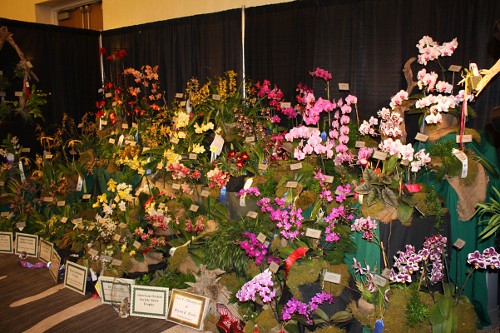
My local orchid club, Oklahoma Orchid Society, held our annual show and sale on Mother's Day weekend.  I took off work on Friday to help set up and then ventured back on Saturday with Christie and Myla to enjoy the show.  It was a small show, as usual, but nice.

my girls
Enjoying her first orchid show, laughing with mommy.


I carried Myla around while Christie took photos for me.  First, I'll show off the Dendrobium.

Dendrobium lawesii
Dendrobium lawesii being sold at one of the vendor tables.


Dendrobium lawesii
Dendrobium lawesii - different color variant - also being sold.


Dendrobium Aridang x Burana Sundae


Miniature, deciduous, upright Dendrobium


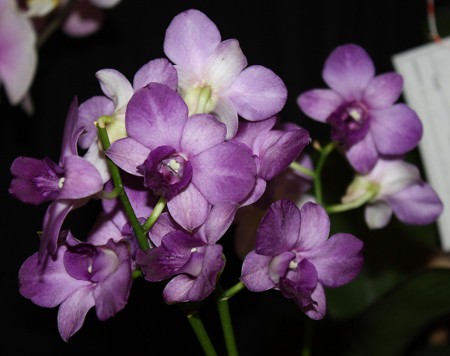
Dendrobium
Nice purple Dendrobium


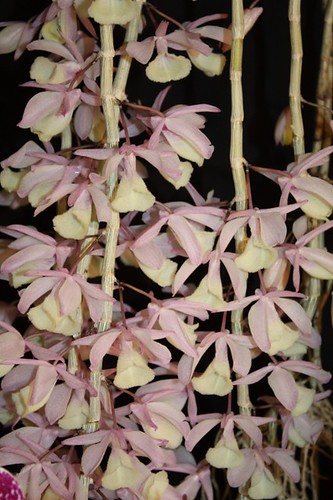
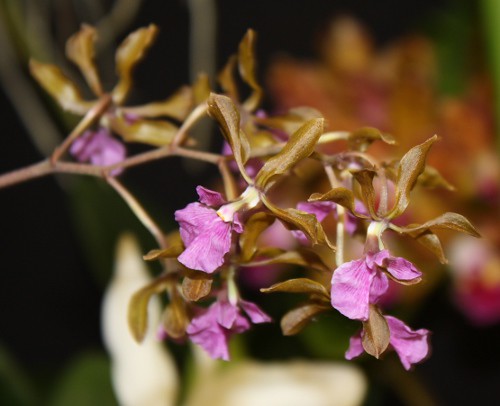
pendant, deciduous Dendrobium
Nice pendant, deciduous Dendrobium, profusely blooming


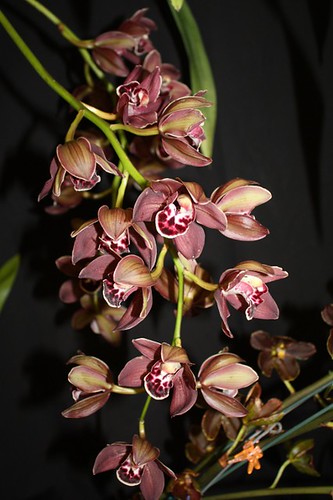
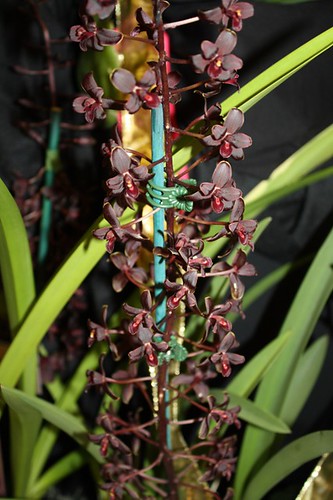
A couple of nice Cymbidium.

Cymbidium unregistered hybrid
An unregistered cascading hybrid Cymbidium


Cymbidium Little Black Sambo
Cymbidium Little Black Sambo, upright and very dark


Miscellaneous other plants.

Laelia
Laelia hybrid. I love this color and the faint pattern on the lip.


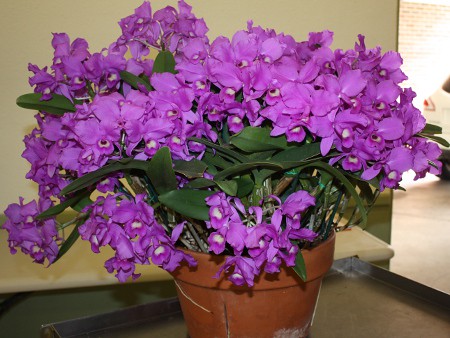
huge Cattleya
Very happy Cattleya


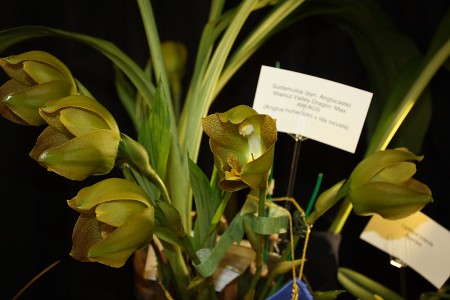
Anguloa hohenlohii x Ida locusta
Anguloa hohenlohii x Ida locusta. Very interesting primary intergeneric hybrid.


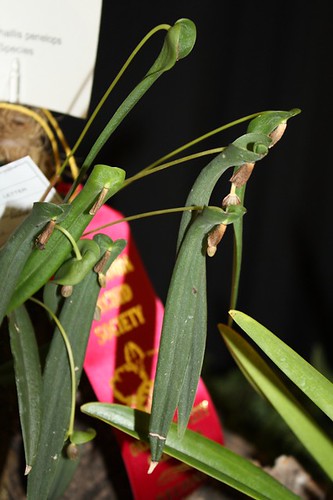
Pleurothallis penelops
Pleurothallis penelops. Awesome species that looks very similar to Pleurothallis dilemma.


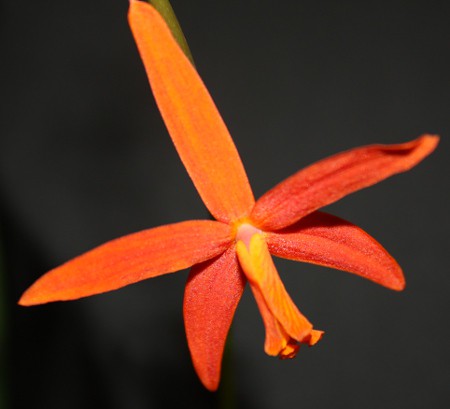
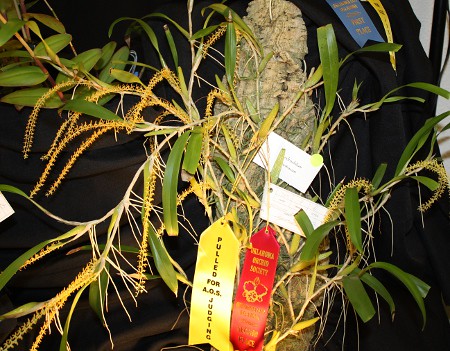
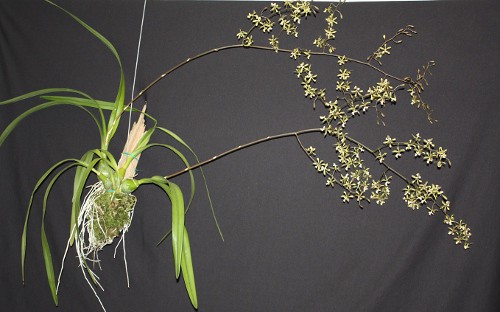
Dendrochilum aurantiacum
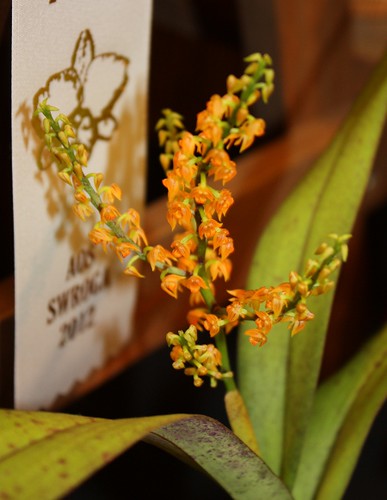
Large, mounted specimen of Dendrochilum aurantiacum


There were a total of eleven plants pulled out for AOS judging (including the one pictured above).  One of those eleven plants (a Paphiopedium) was awarded an HCC.

Wednesday, September 12, 2012

Dockrillia wassellii in bloom

It is always exciting to see a plant bloom for the first time. I have seen pictures of Dockrillia wassellii blooms, but this is the first time that my plant has put out a bloom spike.

dock_wassellii_full
Dockrillia wassellii
The flowers are quite small, but they have really beautiful intricate details.

dock_wassellii_blooms
Dockrillia wassellii blooms
I purchased my plant at the beginning of the year, mounted on cork bark. It hasn't really grown since I got it, but it hasn't lost any of its leaves and has seemed happy. The blooms are good confirmation of that.  When it has finished blooming I will move the plant from its current location onto the mounted orchid rack.

Monday, May 28, 2012

Dendrobium pachyphyllum in bloom

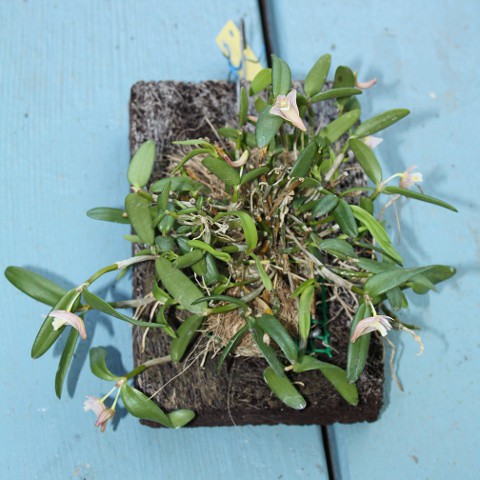
I have had this little mounted miniature Dendrobium for 10 months, so this is the first time that it has bloomed for me.  There are about 20 flowers that are smaller than a penny.

den_pachyphyllum_full
Dendrobium pachyphyllum
When you look at them up close you can see how neat they are, even though they are tiny.  They are also really pleasantly fragrant.  Christie said they smelled a little like honeysuckle.  I was thinking I smelled some mint.

den_pachyphyllum_bloom
Dendrobium pachyphyllum bloom detail

Thursday, May 24, 2012

Trip Report: OKC Orchid Show, part 2

I have already posted about a dozen photos from the OKC Orchid Show, so check those out, if you haven't already.

ryncholaeliacattleya_waianea_leopard_ching_hua
Blc. Waianea Leopard 'Ching Hua'
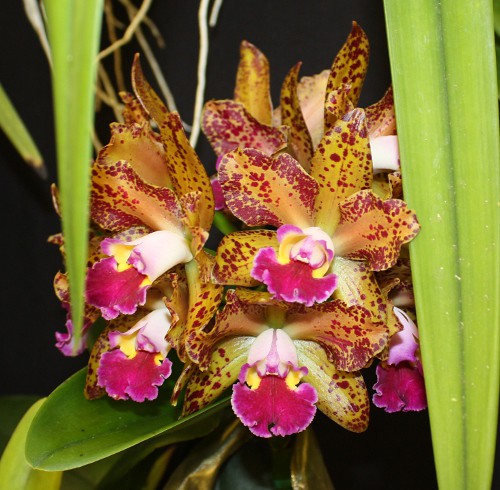
Just like there are "Vanda People" and "Slipper People," there are "Catt(leya) People." I have to say that I am not one of those people. Cattleyas tend to be large flowers that are kind of frilly like bearded Irises, and they just don't appeal to me that much. That being said, I do enjoy some Cattleyas, mainly the spotted ones, and I am posting photos of those.

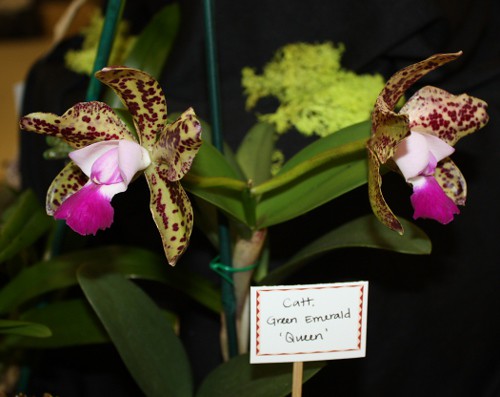
catt_green_emerald_queen
Cattleya Green Emerald 'Queen'
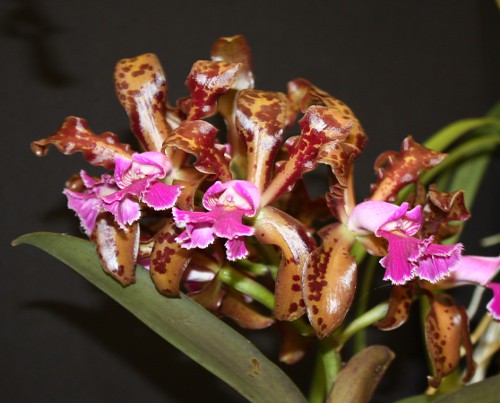
catt_schilleriana
Cattleya schilleriana
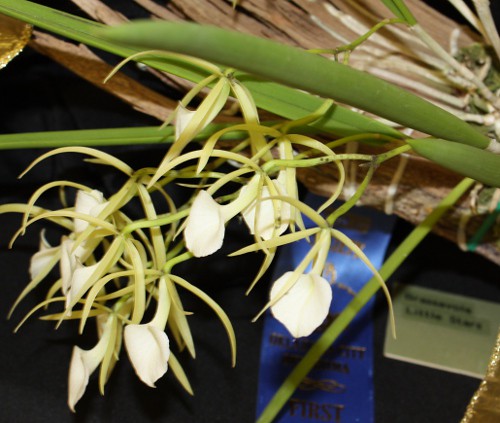
Brassavola nodosa is a popular orchid that is known for its fragrance, but only in the evening. There are several cultivars or hybrids made with this species, including Brassavola Little Stars (below).

brassavola_little_stars
Brassavola Little Stars
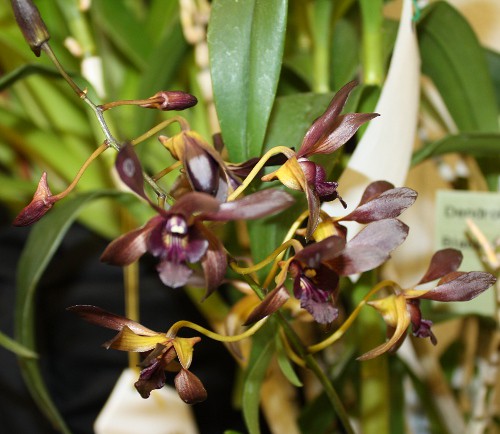
By far the coolest thing I saw at the show was the Dendrobium Black Spider. I haven't ever seen a black Dendrobium, or really anything close to this dark. When I was helping tear down the exhibits on Sunday I complimented the grower on her black Dendrobium and she kind of shrugged and didn't say anything. I guess some people are less interested in discussing their plants than others. Or maybe she was just tired from the weekend...

den_black_spider
Dendrobium Black Spider
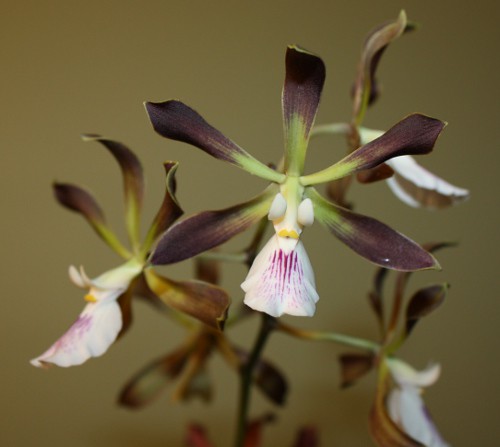
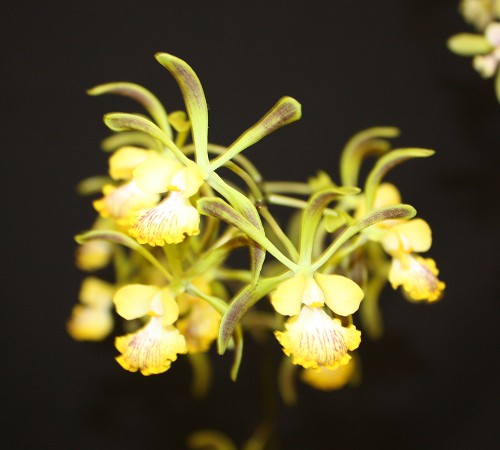
I don't know whether Encyclias are more popular around here than I had previously thought, or if I am just paying more attention to them this year, or if this is just a really good blooming year for them. Whatever the case, there were many Encyclias on display in Wichita and in Oklahoma City.

enc_alata
Encyclia alata
The plant above is the species Encyclia alata and the plant below is a primary hybrid of Encyclia alata and Encyclia mooreana. Both are awesome plants.

enc_alata_x_mooreana
Encyclia alata x mooreana
The large primary hybrid above and the species below were both featured as the centerpiece of their respective displays. In fact, that photo above was taken before any of the rest of the plants were in place. (I wouldn't have been able to get such a picture of just this plant once the exhibit was assembled, because many other plants were crowded around it.

enc_alatum_majus
Encyclia alatum majus
Don't you just love the colors of the Encyclia hanburii (below)?  Just awesome!

enc_hanburii
Encyclia hanburii
The odd ball Encyclia at the show is one of those that keeps getting shuffled around taxonomically.  It has been in several different genera, including Encyclia, Anacheilium, Prosthechea and, of course, the original catch-all genus Epidendrum.  According to orchidspecies.com, which is what I normally consider the authority, it is currently classified as Anacheilium radiata.

enc_radiata
Encylia radiata
I hope you enjoyed your virtual participation in the Oklahoma Orchid Society show.  If you're in the area, you should try to attend in person next year.  We always have our show on Mother's Day weekend at the Will Rogers Garden Center in Oklahoma City.

Tuesday, May 8, 2012

Trip Report: Orchid Show in Wichita, Dendrobiums and Encyclias

This is part 3 of the 5 part series known as "Orchid Show in Wichita."  If you missed the first or second post, check them out here and here.

First, you might be wondering what Dendrobiums and Encyclias have to do with one another.*  The truth is just that these are two of my favorite orchid genera.  There were lots of plants from these two genera at the show and I took lots of photos of them.  So they grouped themselves well for a blog post.  Now you know.
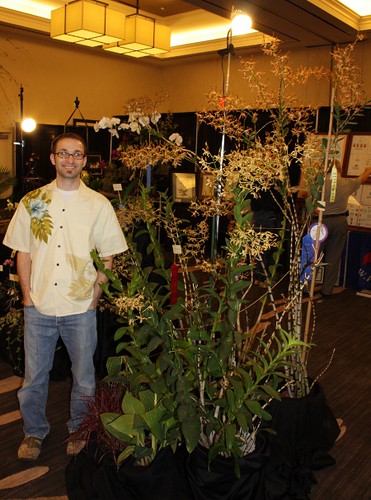
zach_dendrobiums
Me standing beside the really tall Dendrobium
Sarah Pratt is the owner of Timbucktoo Orchids and has come to speak to our Oklahoma Orchid Society in the past year.  She had a large, walk-through exhibit that featured four different very tall Dendrobiums from section Spatulata, which means they have the tall "antlers" or "antennae."  I know that I'm not a very tall guy, but still!  Those plants (above) are sitting on the ground and easily two or three feet taller than I am.  The sheer size of the plants can be overwhelming such that you miss how cool the individual blooms are.  But I took the time to stop and
smell the rosesphotograph the flowers (below), for your enjoyment.
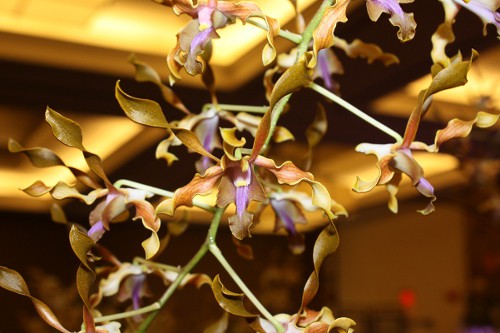
dend_spatulata1
Dendrobium Exotic's Spiral
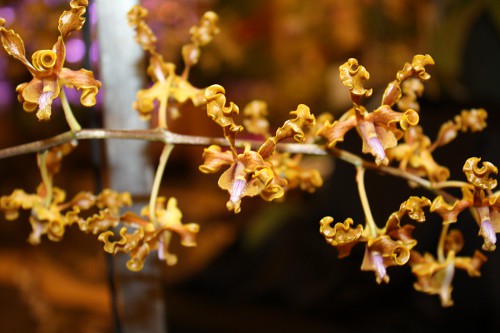
I didn't see the labels on these two orchids (below and above).  The one above could possibly be Dendrobium aries.  It might also be a hybrid with or without D. aries as a parent.  The one below is almost definitely the species Dendrobium discolor.  [Update: I contacted the owner of these plants and got both of the names.  The plant above is Dendrobium Exotic's Spiral, which is D. Palolo Rainbow x D. strebloceras.  The one below is what I was thinking, the species Dendrobium discolor.]
dend_spatulata2
Dendrobium discolor
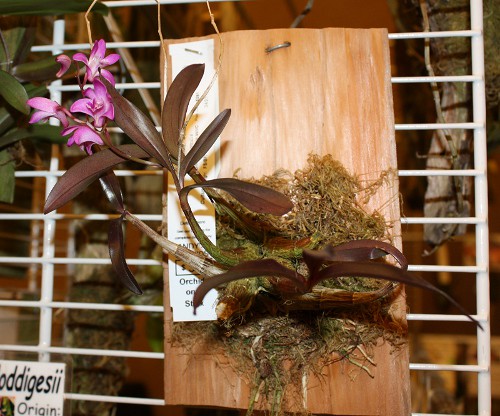
I recently bought a Dendrobium kingianum.  My plant is a little clump of green.  This one (below) that was for sale at the Andy's Orchids table has very dark leaves of a purple/red shade.  It is a really nice little plant.
dend_kingianum
Dendronium kingianum for sale at Andy's Orchids booth
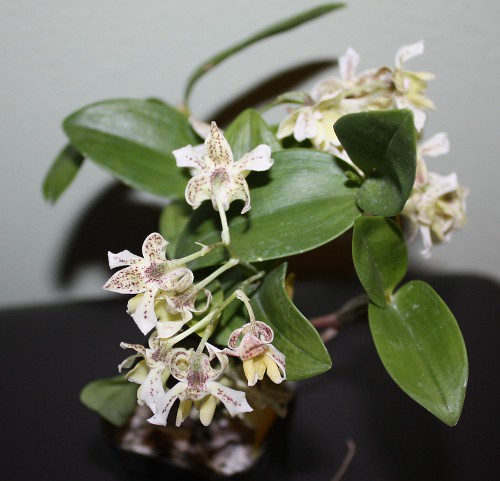
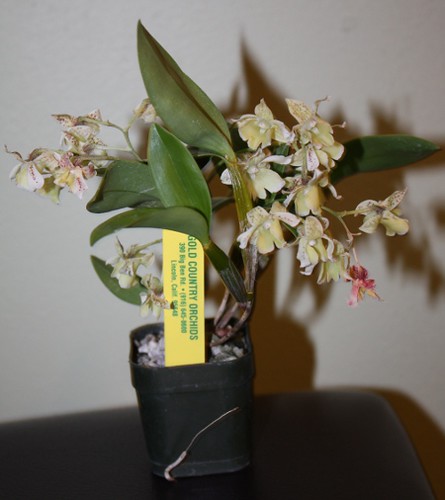
I purchased a really nice miniature Dendrobium Micro Chip,
also known as Dendrobium Aussie Chip, because apparently there was something invalid about the name "Micro Chip."  [Correction: The hybrid Dendrobium Aussie Chip is a cross between Den. aberrans and Den. atroviolaceum.]  Micro Chip is a primary hybrid of Den. aberrans x Den. normanbyense.  It is covered in little white flowers that are peppered with black specks.
den_microchip
Dendrobium Micro Chip
den_microchip_birdseye
Dendrobium Micro Chip - Birdseye view so you can see the peppering
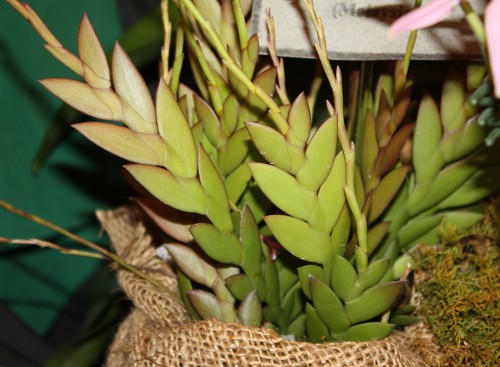
There are several species of Dendrobium that are similar to my Dendrobium anceps that bloomed recently.  One of these has dark pink blooms that are much more attractive than my little green blooms.  That species (Dendrobium rosellum) also has more coloration in the leaves themselves.  There was a nice specimen (shown above) in the gigantic display at the show.
dend_rosellum
Dendrobium rosellum
When I walk into an orchid show I am in shock for a couple of minutes.  I hope that as long as I live, and as many orchid shows that I attend, I never get to the point where I don't have that experience when I first walk into one of these shows.  When we got to this show, I paused momentarily and tried to get my bearings, before diving right in to look as closely as I could at the vendor tables, trying to not miss anything important.  On the first table we looked at there was a large and flowering Encyclia that smelled wonderful.  It was priced so reasonably we immediately agreed that it would be going home with us.  But seeing as it was the first table of plants, we were patient and decided to just keep an eye on it while we scoped out the other vendors.  We ended up going back to buy it not long after, before even finishing looking at the other vendors.

christie_with_anniversary_encyclia
Christie with Encyclia Gay Rabbit
enc_gay_rabbit_flowers
Encyclia Gay Rabbit closeup (Do you see the rabbit ears?)
Christie carried this orchid around with us for most of the show.  It was a bit heavy since it was a large plant, potted in a clay pot, so I joked that she was my orchid pack mule.  She was a pretty happy pack mule though, because we had this awesome aroma following us around as we looked at the plants.  I would relieve her for a little bit and carry the plant while pointing at plants that I wanted her to photograph for me.  The plant is Encyclia Gay Rabbit, which is a 2nd generation hybrid, including E. cordigera and E. alata.
enc_bractescens_x
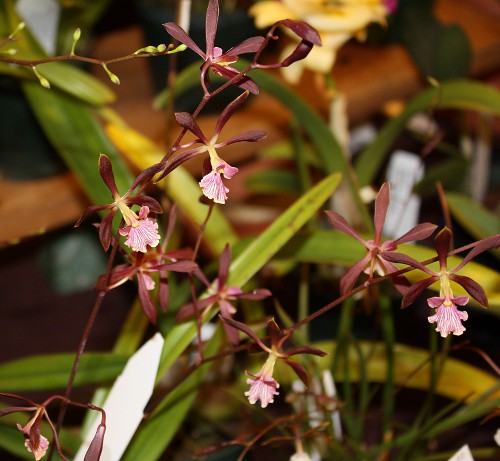
Encyclia primary hybrid, with Enc. bractescens as one parent.
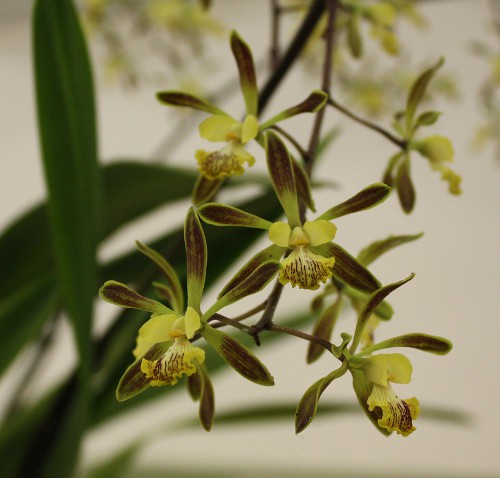
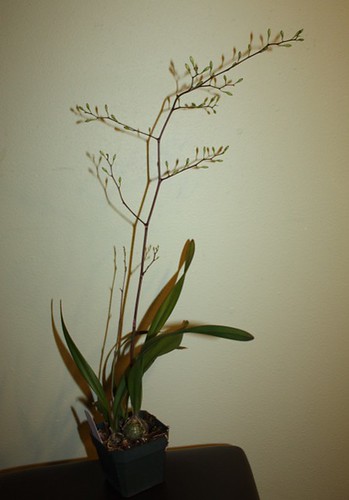
I was tempted to purchase one of these hybrids with bractescens parentage, but I got another one from Michel (below).  It is Encyclia profusa x E. fowlei.  The species E. profusa has been on my want list and I also really like E. fowlei.  It should be neat to see what this plant looks like when it blooms, and I shouldn't have to wait too long since it is in bud.  E. profusa has dainty, creamy white flowers with a little bit of pink on the lip.  E. fowlei has a creamy yellow flower with some brown streaks.  The petals of fowlei flare out a little, so there will probably be some variation in the form of the flowers.  The color could be anything from white to brown, possibly with some pink on the column or lip.
enc_profusa_x_fowlei
My Encyclia profusa x fowlei in bud
Michel Orchids had a lot of primary hybrids of Encyclias and other interesting plants.  The plant pictured above was one of these.  I can't remember what the other parent was for this particular hybrid, but the Enc. bractescens is pretty apparent with these tiny flowers and the thin leaves.
enc_hybrid_noid
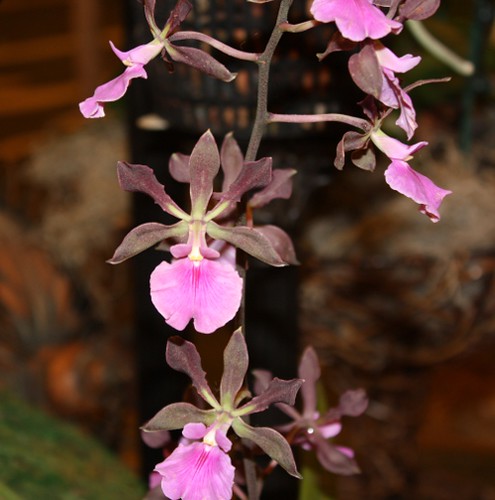
Encyclia (possibly cordigera v. rosea)
The plant above is probably Encyclia cordigera v. rosea, but I didn't take a picture of the label so I can't be sure.  Either way, it's a nice orchid with fragrant flowers.

enc_hereford_jewel
Encyclia Hereford Jewel (Enc. cordigera x Enc. bractescens)
The plant above is another primary hybrid that was on display and had received several awards.  It is obviously being grown well considering the number of flowers.

* If you're curious about how closely related the Dendrobium and Encyclia genera are, they are both within the same subfamily, Epidendroideae.  That doesn't say too much though, considering there are only five subfamilies in the Orchid family, which is hugely diverse.  Also, the Epidendroideae subfamily is the largest with 576 genera and more than 15,000 species.
Wednesday, May 2, 2012

Trip Report: Orchid Show in Wichita, Exceptional Exhibits

Over the weekend, we traveled to Wichita, Kansas for the Kansas Orchid Society's annual show, which was in conjunction with the spring meeting of the American Orchid Society.  Whenever the AOS meeting coincides with a regional show, it is a big affair, with more plants on exhibit and more vendors present.  Some of my good plant friends from neighboring states converged on Wichita, so I got to spend time with plants and friends, which made for a really fun weekend.

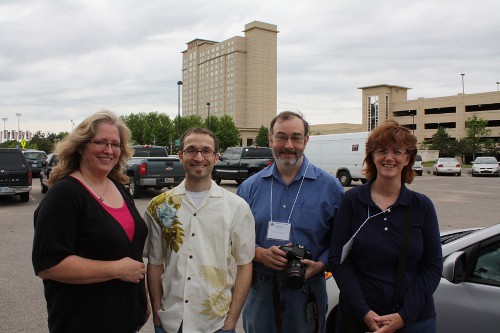
leslie_zach_steve_cathy
Some of my good plant friends.
We're all members of the International Aroid Society, as well as local orchid societies.
Since I have so many pictures and so much to talk about, I am going to split this post into a several different posts, the first concentrating on the exhibit highlights.

award_orchids
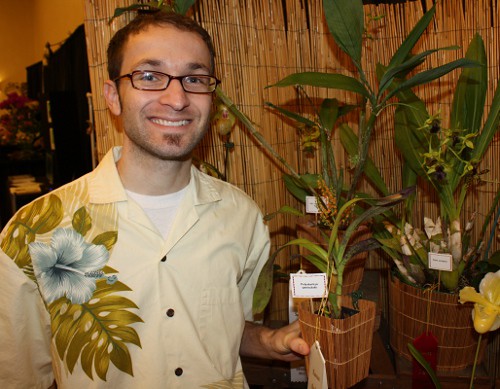
Me with my two award winners, Polystachya paniculata (in hand) and Dendrobium Little Green Apples (on upper right)
For the first time, I sent a couple of my blooming orchids for inclusion in the Oklahoma Orchid Society's exhibit.  Both of my orchids (Dendrobium Little Green Apples and Polystachya paniculata) were given 3rd place ribbons, so that was encouraging.

polystachya_paniculata
My Polystachya paniculata plant
I have heard about Andy's Orchids for a while.  It is probably one of the five most popular orchid vendors online.  They have a lot of species available and generally have pretty reasonable prices.  Most of their plants are mounted on sticks, which is nice, too.
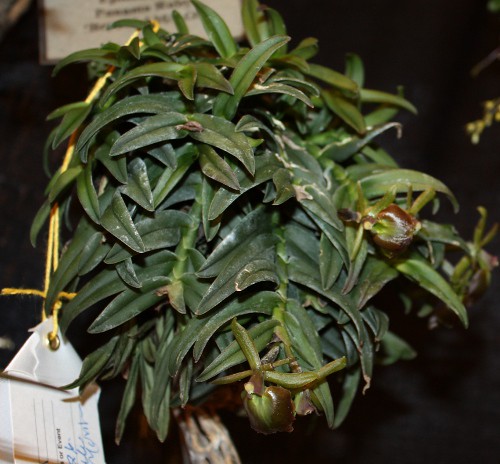
andys_orchids_exhibit
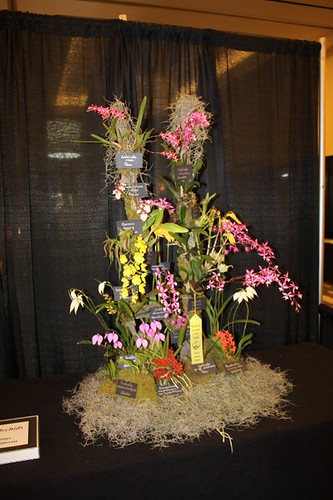
Exhibit by Andy's Orchids
Andy's Orchids had a really nice "exhibit by a commercial grower."  My friend Steve told me it was put together at their business and shipped in a box filled with packing peanuts.  When they got to the show, they just opened the box, pulled out the structure and let the peanuts fall away.
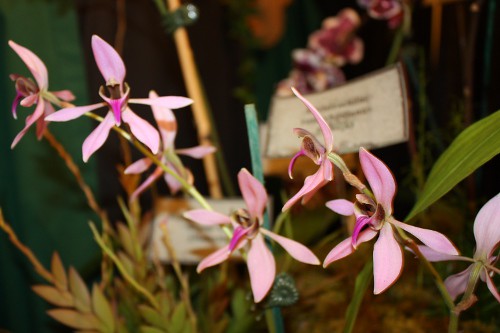
cochlioda_rosea
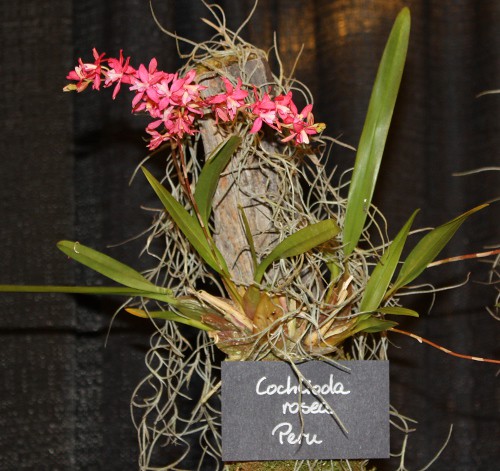
Cochlioda rosea
The exhibit consisted mostly of intermediate to cool growing orchids, including Masdevallias down near the bottom and at the top a couple of orchids from the genus Cochlioda, a new genus to me.

huge_exhibit
Spectacular exhibit by Max C. Thompson and Bryon K. Rinke
Two gentlemen that must have huge orchid collections put together this single amazing display that was gigantic.  Can you believe how many blooming orchids are in the photo above?  That is a lot of really nice orchids.  It took several visits by this exhibit to really take it all in.  Actually, scratch that, I doubt I took it all in, even after several visits.

ancistrochilus_rothschildianus
Ancistrochilus rothschildianus
epi_panama_ruby
Epidendrum Panama Ruby
These couple of photos are not really the highlights of their exhibit.  They are just plants that I was really interested in.  The above Epidendrum was just an oddball and that's why it was interesting to me.  Do you see the blooms?  They are kind of discrete.

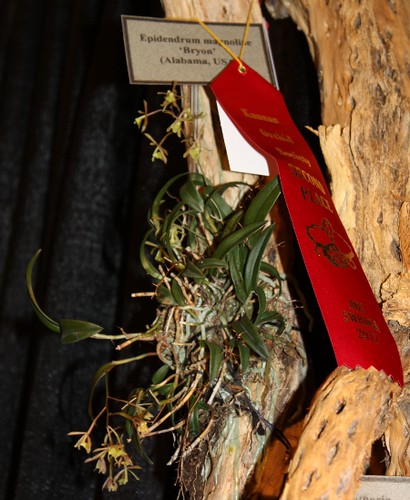
epi_magnoliae_bryon
Epidendrum magnoliae 'Bryon'
The Epidendrum above is native to the southeastern United States, found as far north as North Carolina.  It can withstand a light freeze and prefers to live in Magnolia trees, hence the name Epidendrum magnoliae.  I would like to try growing this orchid someday.

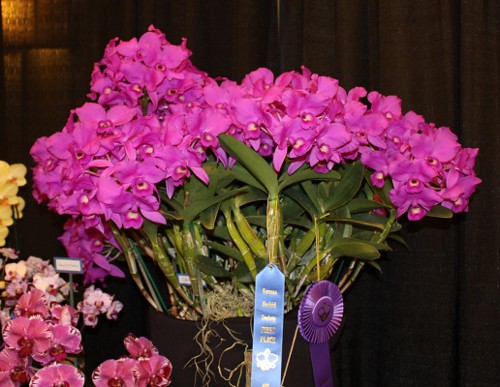
cattleya_first_place
Cattleya that won a first place ribbon
If you grow Cattleya orchids well, they will reward you with a lot of blooms.  If you grow them really well, they will build an army of flowers determined to march to the nearest orchid show and demand a first place ribbon.

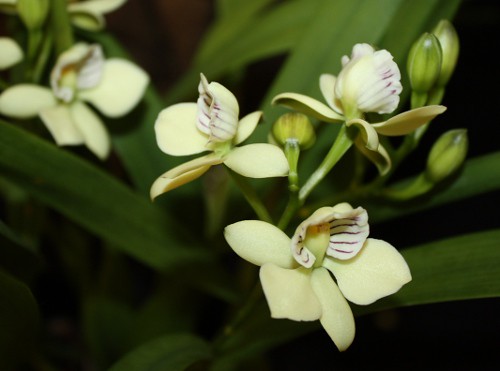
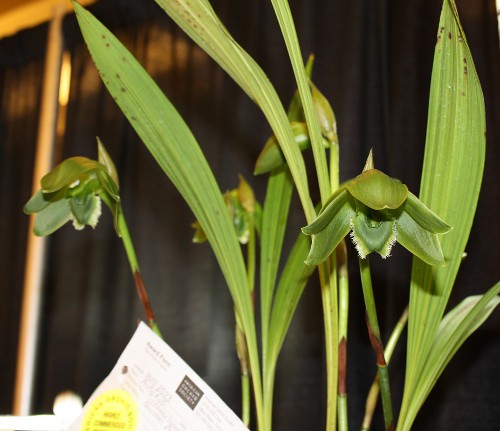
ida_locusta
Ida locusta
The most highly awarded plant had a totally green flower, with a little bit of yellow on the column.  The plant is Ida locusta and it was given the HCC award (Highly Commendable Certificate), which you can see in the lower part of the picture.