Showing posts with label gardening. Show all posts

Wednesday, May 23, 2018

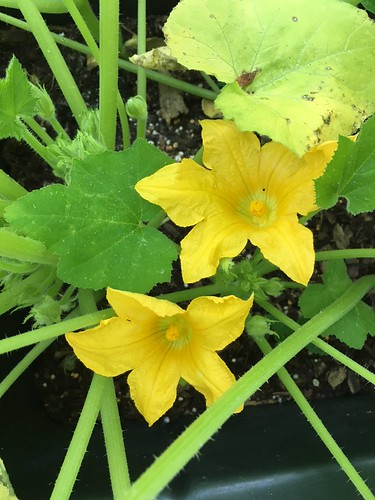
Squash in bloom

Invariably when I mention to someone that I have a greenhouse the next question is what kind of food plants I grow. People are always surprised to find that I grow tropical plants (mostly orchids and aroids) in my greenhouse.

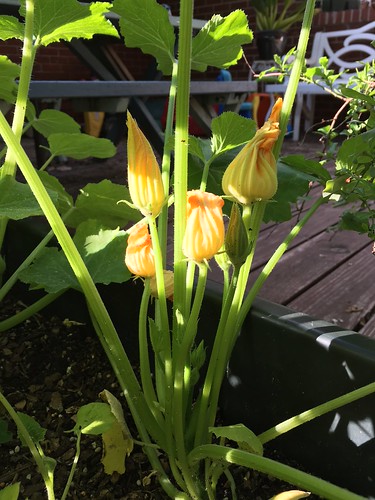
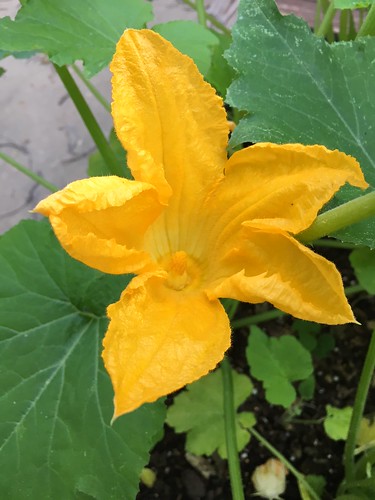
summer squash flowers
summer squash blooms

I have tried growing a few fruits and vegetables in the past, with limited success:
  • key lime - few fruits before the tree succumbed.
  • broccoli - my favorite vegetable, plants were destroyed by caterpillars before they flowered.
  • tomatoes - limited success.
  • squash - plants were either eaten by insects or withered in the sun before they flowered.
  • potatoes - actually a decent little harvest, especially considering the spot I picked was shadier than is ideal.
Much of our yard is shaded, which we love during the hot summer months, but there's not a great place to put in a garden. This year I decided to try some squash seeds in a planter box that I can move around to get the right level of sun. Also I figured the planter box is pretty similar to the raised beds that everyone is planting these days. Another change from my unsuccessful attempt with squash seeds last year: I decided to plant the seeds directly in the planter box, rather than starting them in a seed tray and then transplanting them. I started with two different varieties of yellow summer squash - the kind we really like to eat over the summer. I planted more seeds than recommended for the space, but figured I could thin them out if they got too crowded.

summer squash flowers
summer squash blooms

summer squash flowers
summer squash blooms
Things are going really well! The plants have been getting big and produced a bunch of buds over the last two weeks. The flowers just started opening over the weekend and I'm hopeful we'll have a bunch of squash a few weeks from now. I've been monitoring the plants closely for squash bugs and haven't seen one yet.

Friday, March 23, 2018

Plant all the seeds!

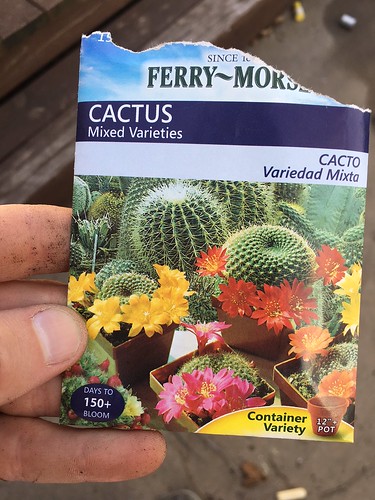
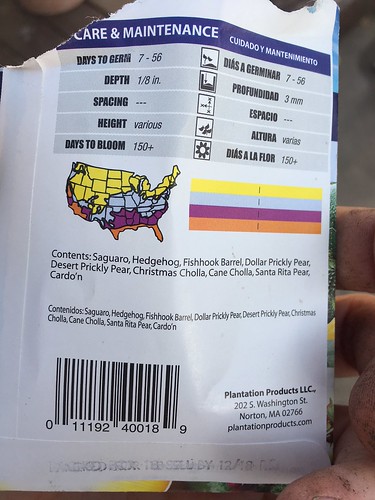
In my life of botanical interest, I have waffled back and forth on whether it was worth my effort to try to grow plants from seed. I'll try and have limited success, followed by a few failures, and then give up for a while. A few weeks ago I had to go to Lowe's to get something or other and the kids and I picked out some summer squash seeds to try growing. I germinated a couple of squash seeds last year and then planted them outdoors only to see them wither. While I was looking at the available seeds I saw some Asclepias seeds and also a curious package labeled "Cactus Mixed Varieties." I purchased one of each of those just to give them a shot.

IMG_8255

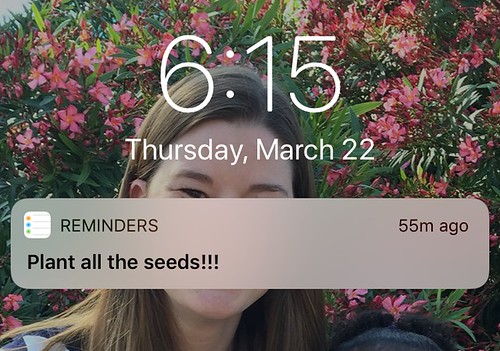
While on vacation last week I remembered that it was getting to be warm enough to plant my seeds so I put a reminder on my phone to plant the seeds when I got back from my trip.

IMG_8260

I think I have a pretty good setup for the squash plants. I hope they do well for me this year, as the kids will really enjoy watching us grow our own food and we love to cook squash when it's in season.

IMG_8256

I'm really curious about the cactus seeds. The back of the package mentions several different species(Saguaro, Hedgehog, Fishhook Barrel, Dollar Prickly Pear, Desert Prickly Pear, Christmas Cholla, Cane Cholla, Santa Rita Pear, and Cardo’n) but I suspect the package is dominated by one or two species that are the cheapest/most easily obtained. The contents of the package reveals some variety in seed size so I think I got at least 2 or 3 species. If I am lucky enough to get some of these seeds to germinate it could be quite a while before I am able to identify what they are.

Thursday, March 22, 2018

Galveston update

It's hard to believe I never did an update post on the Galveston garden that I planted back in 2012.  My life did change quite a bit from that trip onwards, as that is when I found out I was going to be a dad.  My blog posts trailed off a lot after that... Well, it's been over 5 years now, so it seems like a great time to check in on my semi-tropical garden. Most of these update photos were taken in October, 5 years after the original planting of the garden.
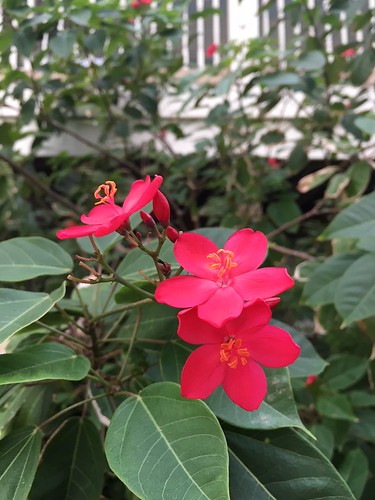
Jatropha
Jatropha

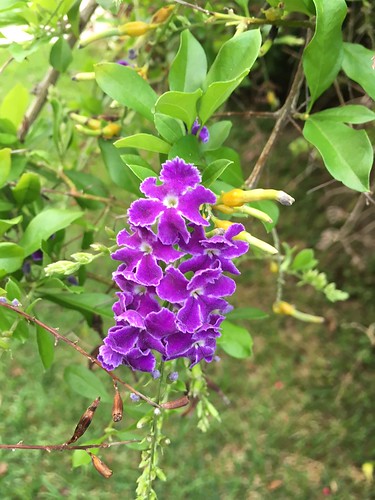
Duranta
Duranta
As with any garden I've ever planted, some plants thrive much more than others, and some succumb to one or more factors.  More often than not, those factors in my home gardens are heat and drought, occasionally to a hard winter.  I can safely say none of those factors have taken a toll on the plants in Galveston.

galveston_right_finished
The garden on the right side at time of planting, October 2012.
Can you even see the Justicia?  It's the lanky little stem with few leaves just below the black Crape Myrtle in the image.
See the struggling Yucca?
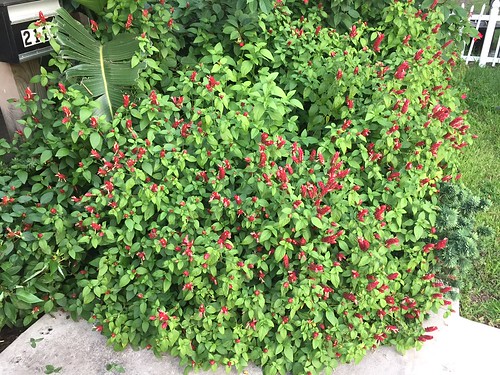
It seems my biggest issue in Galveston is competition.  A few aggressive growers have expanded faster than I expected and drowned out all the sunshine from their neighbors.  The biggest offenders are Bougainvillea, Red Shrimp Plant (Justicia bandegeana), Allamanda, Duranta, Plumbago, and Jatropha.
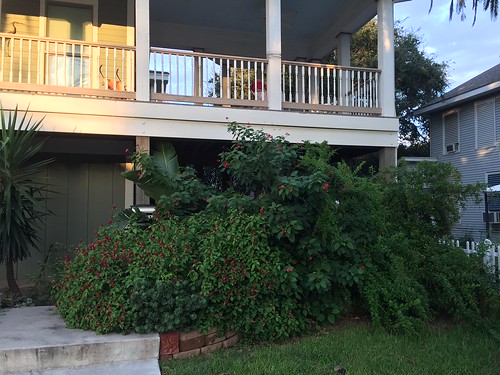
right garden
The garden on the right side, as seen in October 2016, before trimming.
The Black Diamond® Crape Myrtle (Lagerstroemia indica) is still alive, but it is struggling to get enough sunlight because of the Shrimp Plant.  That plant and a Yucca (far left of image above) have really surprised me with their rate of growth.  The Shrimp plant was a lanky little twig when I planted it.  Now it's 6 feet in diameter, and only because I whack it back on a regular basis. The Yucca was about 4 feet tall and only had 4 struggling leaves when it was planted.  Now the base of the tree has enlarged, it is about 7 feet tall, and has a nice head of green leaves.  It even bloomed recently!
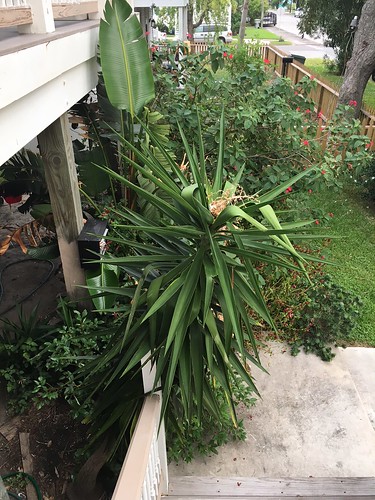
Galveston garden
The Yucca has really grown in height and you can see the remains of an inflorescence in this photo.
Unfortunately I didn't get to see it in flower.

Justicia
Red Shrimp Plant (Jatropha) as seen from above. The mailbox is becoming out of reach.
We visit Galveston a couple of times a year and on most of those trips I have spent an afternoon out in the yard, trimming. One of my priorities is always to cut back all of the growth in front of the mailbox, so that the postal worker can get to the box, which you can see is hard to access in the photo above.

mailbox after trimming
More accessible mailbox after trimming.
The trimming can be a heavy chore with the rate of growth of some of these plants.  And with the nasty thorns on the Natal Plum and the Bougainvillea, it can be a painful chore. The Natal Plums are covered in little white star-shaped flowers much of the year, which are followed by small edible fruits that my mother-in-law has used to make tiny tarts.
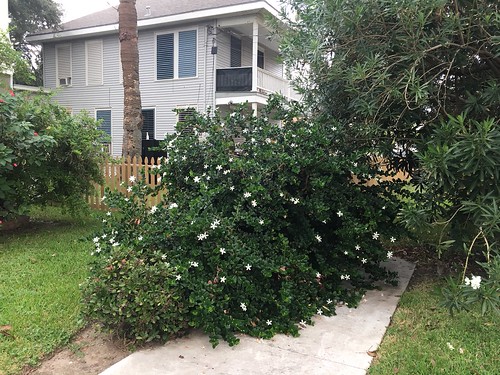
Natal Plum
Natal Plum covering the sidewalk. Luckily the sidewalk is just a segment that ends at each end of the yard, so no one used it anyway. It is required by the City of Galveston on all new construction. Who knows when a sidewalk will be installed in either of the neighbor's yards...
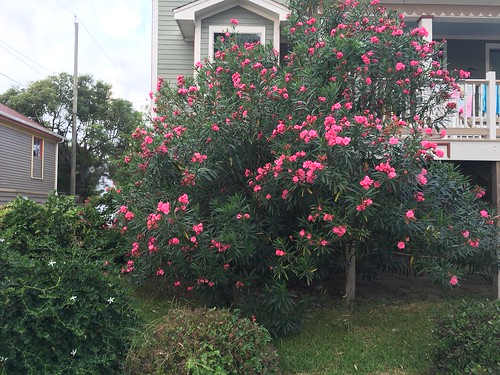
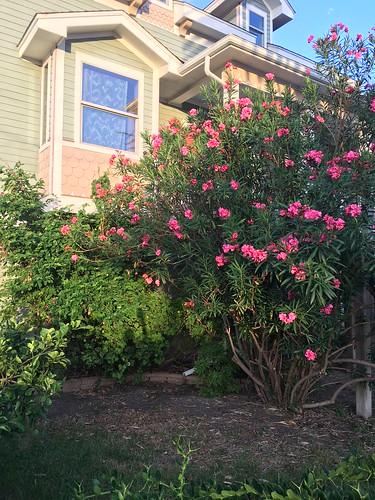
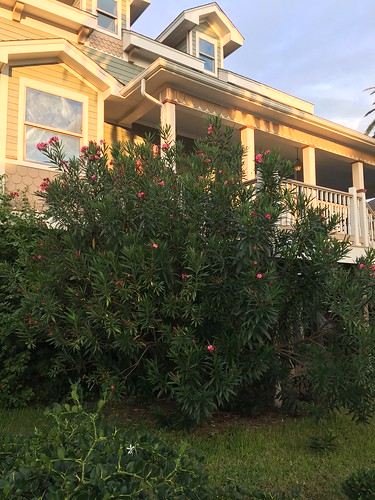
One of the Oleander we planted after the initial planting has shot up to the top of the stairs, which is really cool because the flowers are very fragrant and they are at nose level both on the ground and at the landing of the stairs. I still have to spend quite a while trimming the lower branches that grow horizontally.
left garden
Large Oleander towering up to the second story, October 2016.


Oleander
Another view of the dominating Oleander before trimming.

plumeria and bougainvillea after trimming
Some better definition, exposure of the yard and garden border, after a thorough trimming.
We also have a few invasive vines that I have to keep pulling up.  I gave up on ever ridding the garden of them, so I just try to keep them in check.  Sometimes it's easiest to just find them where they are coming up from the soil and clip them there.  It takes a long time to unwind them from all of the places they are climbing in the bushes.

The prize for plant that I didn't think would make it at all is a Bromeliad that my mother-in-law received as a gift and didn't want to keep growing in a pot in her home.  She planted it in the garden in Galveston and I figured it would surely be a goner in a few short months.  Much to my surprise, it has done well there and even flowered several times since it was planted in the ground.
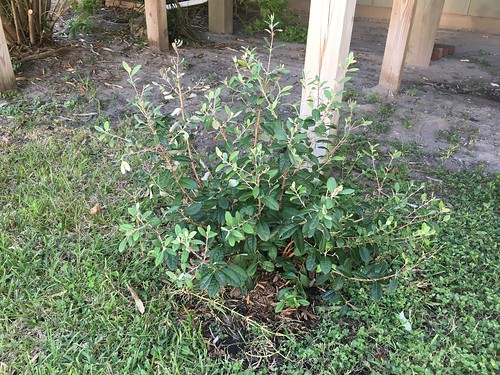
Pineapple Guava
Pineapple Guava

Buttonwood
Buttonwood
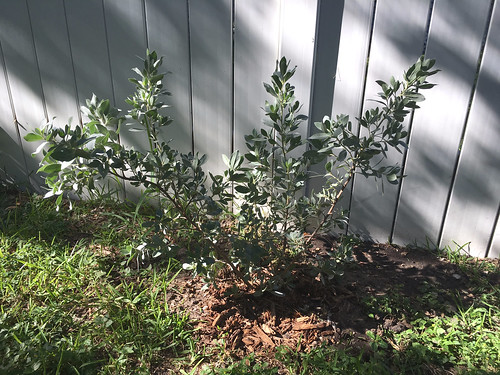
Late last year we added a couple of new bushes, a Pineapple Guava and a Buttonwood. Who knows if either of these will become monsters? To be continued.
Wednesday, November 21, 2012

New garden installation in Galveston

For the first time in my life, I got to plan and plant a garden in a “sub-tropical” zone.  Christie’s parents have built a house in Galveston, Texas and we got to install the garden out front.  We live in zone 7a and Galveston is zone 9b!  What does that mean exactly?  That I get to grow plants that thrive in an environment where the temperature never dips below 25 Fahrenheit.  My zone dips down to zero Fahrenheit. In October, Christie and I headed down to Galveston to help her parents finish the house and have a little leisure time.

galveston_placing_wall
Laying the retaining wall blocks
It was fun visiting the garden centers in this part of the country and seeing all of the plants that can be grown there that can’t be grown here.  I didn’t really have any rules about the landscaping, but I wanted to get items that can’t be grown here.  Here’s the full listing of what we planted: black Crepe Myrtle (Lagerstroemia), Canna ‘Pink Sunburst’, pink Bougainvillea, Bird of Paradise (Strelitzia), Zamia vazquezii, Dietes iridioides, Alocasia ‘Frydek’, Indian Hawthorne, Natal Plum (Carissa macrocarpa), Gardenia,  Banana Tree, Duranta, Bottlebrush (Callistemon citrinus ‘Little John’), spicy Jatropha (Jatropha integerrima), Plumbago auriculata, Blue Ginger (Dichorisandra thyrsifolia), Red Shrimp Plant (Justicia brandegeana), pink Oleanders (Nerium oleander), dwarf coral Ixora, Yucca, yellow Allamanda bush, Brugmansia.

galveston_plants_ondeck
Plants eagerly awaiting their new homes
We did more soil preparation for this garden than I have ever done before.  We purchased more than 30 bags of soil, manure and other amendments to mix with the sandy soil that is filled with shells.  We wanted to build the flowerbeds up about 8 inches in some areas and about 16 inches in other areas.  There was a lot of shovel work, but once the ingredients were mixed and spread, and the retaining wall was in place, the planting was very easy.

galveston_left_finished
Bird's eye view of the left side garden finished
We did more soil preparation for this garden than I have ever done before.  We purchased more than 30 bags of soil, manure and other amendments to mix with the sandy soil that is filled with shells.  We wanted to build the flowerbeds up about 8 inches in some areas and about 16 inches in other areas.  There was a lot of shovel work, but once the ingredients were mixed and spread, and the retaining wall was in place, the planting was very easy.

galveston_right_finished
Finished garden on the right side

Thursday, May 26, 2011

2011 Edition of "corner garden additions"

Each year we plant new stuff in our corner garden.  It's always a bit of a test to see what can become established, what we will remember to water, etc.  We always start with good intentions, but somewhere along the way it gets really hot and dry in the middle of the summer and we forget to water for a week or two and before you know it, we've lost some of our new plants.

This year we have started off with really good habits.  During this time of year we are normally allowing nature to water our garden, but this spring has been particularly dry.  To top it off, we laid out some Fescue grass sod about a month ago, so we were forced to be vigilant with our watering efforts.  Since we have been watering our sod and our new garden around the greenhouse, we have also been dragging the hose out to the corner garden and watering those new and established plants - to give them the water they are expecting at this time of year.

indian_hawthorn
Indian Hawthorn (Rhaphiolepis indica)
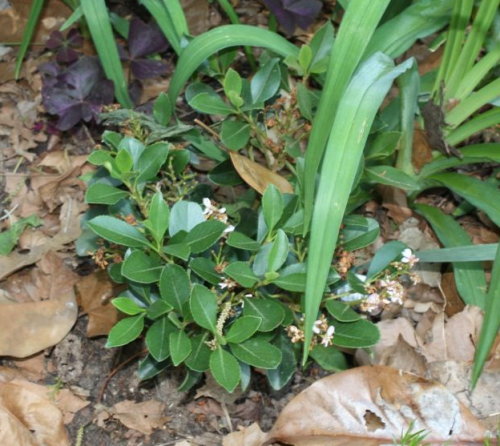
A plant that I have admired in some flowerbeds around town is the Indian Hawthorn (Rhaphiolepis indica).  After first seeing it blooming and subsequently producing blue berries in the flowerbeds in front of my office building, I searched online to find out what it was.  I read that it was sometimes a challenging plant to grow, but I observed that no one was giving it special care in the flowerbeds at the office.  In fact, I saw it growing in several other flowerbeds that receive irregular attention through the year.  When I saw this plant being offered pretty cheap at Lowe's, I snatched one up to try in the corner garden - saving my receipt, in case it doesn't work out.  (I hope you know that Lowe's has a 1 year guarantee on their plants...)

gaura_new
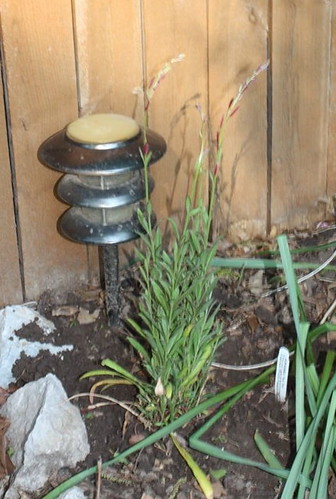
One of the new Gauras, in bud but not yet opened.  Sorry for the fuzzy picture.
We have planted Gauras (Oenothera sp., sometimes called "Butterfly Weed") in the corner garden before and lost them.  They are mildly drought tolerant, but need to become established first.  In other words, if you toss them in the ground, squirt them with the hose and then let them sit in the baking sun for the rest of the summer, they probably won't make it.  But if you give them some TLC for a year and then leave them to nature, they should be much more successful.  We got two beautiful mature Gauras this year and planted them in our brick garden around the greenhouse.  They have been growing steadily and blooming up a storm, since we have been watering them regularly.  So then I saw some smaller Gauras for a really good price ($2.49) and I snatched up two of them for the corner garden.

kniphofia
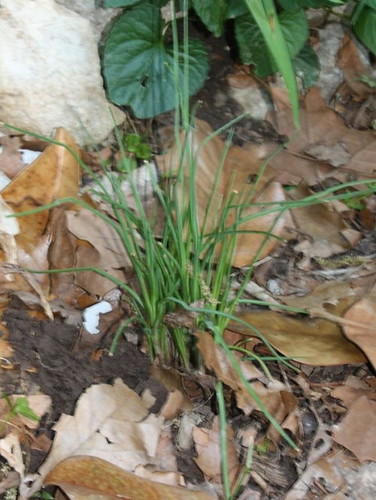
New Kniphofia, which is still quite small. Again, sorry for the fuzzy picture.
One of the really cool plants native to Ethiopia that we can actually grow outdoors in zone 7 is the Kniphofia.  My granddad actually had one of these growing in his front flowerbed a couple of years ago.  I saw a large one up in Seattle last year and it is really a cool plant.  My plant is tiny for the time being, but I'm hoping it will grow enough to produce the really neat red, orange and yellow blooms this summer.

salvia_pink
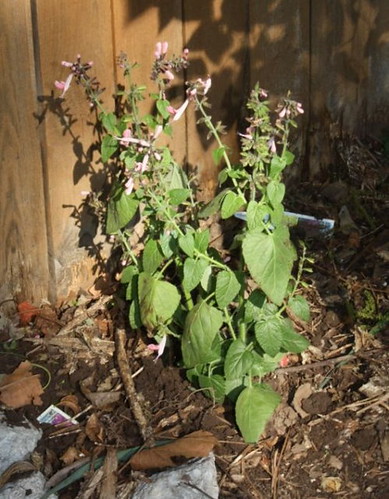
New light pink Salvia
We also added some of the purple/blue creeping Phlox, Christie's favorite spring bloomer.  We have had a couple of them in the corner garden, but a couple didn't come back this year.

salvia_last_year
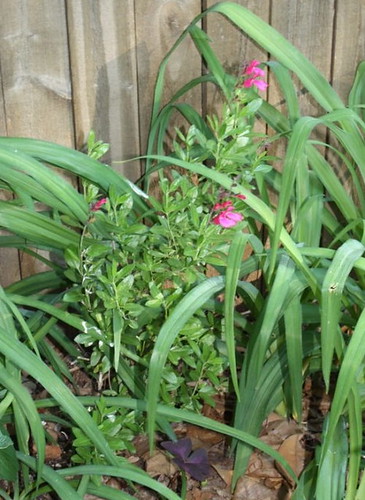
Salvia greggii which we planted last year.  It's getting bigger this year and has been blooming constantly.
I'm really happy to see that a couple of our additions from the last two years are thriving again this year - the Pink Preference Autumn Sage (Salvia greggii 'Pink Preference') and Elaeagnus.  The Blue False Indigo (Baptisia australis v. minor) from two years ago is still just a tiny plant.  I really home this is the year that it takes off and blooms!

Monday, August 30, 2010

Fruiting Peach Tree

Our peach tree was planted in April 2007, as a congratulatory gift when I got my real job after graduation.  It was about 3 feet tall then.  Three years later, it's pushing 15 feet and covered in blooms every spring.  This year we noticed something a little different after the blooms had all been blown away.

young_peaches
Very young peaches on the tree
Our tree is covered in fruit.  Up until this point I had been referring to our tree as a "Flowering Peach" because I thought it was a flowering only variety.  The fruits were growing quickly in the early Summer, but did not get big enough to eat this year.  Now they're beginning to litter the ground and get squished on our driveway.

small_peach
Little more mature peach. They didn't get much larger than this - maybe 2" in diameter.

I'm hoping that next year we might actually have some fruits mature enough to eat.  The hot and dry latter half of the Summer might have contributed to the small fruits, but I don't know very much about that.

Does anyone know if Peach trees (or any other fruiting trees) take some time before producing mature fruits?

Friday, November 13, 2009

Accidental sweet potato crop

Well, I've learned that I am better at growing ornamental sweet potatoes by mistake than I am at growing regular potatoes intentionally.

biggest_sweet_potato
A large sweet potato that formed underneath my ornamental sweet potato plants (Ipomoea batatas 'Blackie')
My regular potato crop this year netted me a small bowl full of potatoes. On the other hand, my ornamental Sweet Potato vines that fill the tulip bed after the tulips are out of season produced a large crop of some pretty big potatoes!

all_sweet_potatoes
My crop of ornamental sweet potatoes
I have read that these potatoes are actually edible, though they're not very tasty. Rather than suffer through a bunch of bland potatoes, I plan to save these potatoes and plant them next Spring to fill the tulip bed once again. It will save us some money. In fact, the reason I found these large potatoes, is because I was digging up a couple of the sweet potato plants (Ipomoea batatas 'Blackie') to keep in the greenhouse over the winter and replant it next Spring.

I put a couple of plants in a hanging basket in the greenhouse and will try to keep them happy over the winter. But now I have a large group of backups that will probably produce even better for me next year.

Wednesday, August 19, 2009

You say Potato, I say Solanum tuberosum

I just hauled in my first crop of potatoes.  I didn't get them in the ground as early in the Spring as I had meant, but they grew anyway.  I was surprised to see the nice, little purple blooms they produced in mid-Summer.

potato_blooms
Purple blooms on my potato plants
The plants died about a month ago, so I decided to go ahead and try sticking my fingers in the soil to see what was there.  I was happy to find about 10 potatoes, ranging from small pebble to fist size.

potatoes
My first potato crop, washed and ready for cooking
Since my first crop isn't all that plentiful, I cooked them all together in the crock pot with a pork loin and some other veggies.

crock_pot_potatoes
Crock pot dinner: pork loin, carrots, onions and potatoes
They were great!

In the next month, I'm going to work some compost into the veggie garden soil, so that the dirt is a little looser for next year.  Next Spring, I'll be trying to get them in the ground as soon as the freezes are over - mid March - and keeping them watered so the plants stick around a little longer and the potatoes can get larger.

Maybe after one more successful crop of cheap seed potatoes, I'll order some different fun varieties to experiment with, like "All-Blue" or "Fingerlings."

Thursday, July 23, 2009

A key lime was born

About a year ago, my parents-in-law brought a small key lime tree back to me from their vacation to Florida.

key_lime_tree
My Key Lime Tree (Citrus aurantifolia) covered in buds, summer 2008.  Even though the buds are pink the flowers are solid white when they open.
It bloomed all summer long and developed fruit at the end of the summer, much to my surprise and satisfaction.  There were four full-sized key limes, just a little smaller than the average lime.

lime_small_buds
Small key lime buds developing over the winter.
I was even more surprised to see that the plant continued to develop buds and bloom inside through the entire winter, sitting on the counter in my bathroom.  The first several winter blooms did not develop fruit, but I was very happy to have the bright little flowers filling the bathroom and hallway with their potent fragrance.  You could smell them just casually walking by the plant.

lime_large_bud
Mature key lime bud that formed this winter.  Notice this bud is solid white, while the summer buds were pink.
I think the fact that this plant bloomed at all throughout the winter was due to the copious amounts of fertilizer pellets that were worked into the soil by the grower.  I just repotted this little tree yet, and there is still plenty of fertilizer left in the soil for its growing and fruiting pleasure.  [Imagine what my other plants might look like if I actually fertilized!  I'm going to try fertilizing some of my plants this summer.  I have a couple of plants that have never bloomed for me, even though they seem to be large and healthy - a grapefruit tree, a bougainvillea, apostle plant/walking iris, a shell ginger, and a white bird of paradise.]

lime_blooms
Winter key lime open blooms.  These are the most fragrant blooms I have ever smelled.
The last of the winter blooms started to dry out the first week of Spring - around March 23rd.  I casually glanced at one of the blooms, brown petals falling to the floor and Hark!  What the heck is that!?! There was a lime developing at the base of the center stamen!

lime_stamen_fruit
Key lime fruit beginning to develop at base of stamen.  (mid to late March 2009)
lime_stamen
Lime developing at base of a different stamen after petals have fallen away.  I have about 10 pictures, trying to get one in focus.  Alas, this is the best it got.
How could this be?  There weren't any pollinators around, except for the occasional moth that flew into the house on nice days when we left the door open.  I'm kind of doubting that one of those moths managed to pollinate my lime tree before I hunted it down and escorted it back outside (preferably alive, sometimes dead).  I am suspecting that this is one of those self-pollinating varieties that I have seen available for other fruiting plants.  [I am planning on growing some kiwi from a self-pollinating vine.]

lime_start
Key lime fruit starting to develop
No doubt about it, there was definitely a little key lime beginning to form.  I'm really happy that I happened to notice it at this stage.  The first fruits that formed last summer caught me completely off guard and I don't think I got any pictures of them until they were full grown and cut into slices!  But not this time around.

lime_start_side
Key lime fruit starting to develop - different angle
tiny_lime
Something starting to resemble a small lime (last week of April 2009)
When I started writing this post, I expected I would be picking my lime and slicing it over some chicken sometime in mid-May.  In actuality, it is now late July and I haven't yet picked it.  But I think it is about ready to be picked now.  Maybe Monday night we'll have some lime seared chicken for dinner!

full_size_lime
A full sized key lime, ready for the plucking (late July 2009)

FYI: I found another blog where the inflorescence -> infructescence process was photo-documented.

Do you have any citrus trees that have produced fruit?

Wednesday, March 11, 2009

Gardening preparation

This weekend the weather was beautiful.  Christie and I spent several hours outside, cleaning up our yard and preparing our side flowerbed to be a vegetable garden.  The flowerbed runs the length of the side of our house - about 2' by 20'.  It has been filled with daylilies for years, and since the flowerbed is not full sun, the daylilies have not been blooming, only multiplying.  We dug up about a third of the daylilies last year and tackled about half this time around.  So now there is just a small remnant of daylilies on the other side of the Nandina bush.

blank_slate
The side flower (soon-to-be-vegetable) bed after having the daylilies removed
We have been transplanting the daylilies to a very sunny location at my wife's parents' business - the Thunderbird wedding chapel.

daylily_transplants
The Daylilies ready to be transplanted
Our vegetable gardening plans for this year consist of potatoes in this side bed with a self-pollinating kiwi vine growing up trellis mounted on the wall.  We are also going to plant tomatoes in pots so they can be moved to the sunniest locations.  And I think I will try growing broccoli in pots this year, too.  I might try making the plantings ornamental, with some flowers around the broccoli plants.

We bought our first seed potatoes, but decided not to plant them yet since there are more freezing nights in this week's forecast.  The two potatoes I bought are Red La Soda and Red Norland.  I think I would like to buy a large white potato variety as well, but there weren't any available this weekend.  I had planned on ordering my seed potatoes, but when I saw these in the store, I realized I could save a heck of a lot of money by buying them here.  I spent 93 cents on my two seed potatoes.

red_seed_potatoes
Red Morland and Red La Soda seed potatoes
I've got lots of cooking plans for my potatoes, so I hope they produce well for me.

Wednesday, December 31, 2008

Planty Resolutions

At this time of the year, everyone is making resolutions.  So I guess I will talk about what I plan to do for this next year.  More than resolutions, these are my goals.  The first four goals apply to this blog directly and the last five apply to me and my plants.

  1. Continue posting at the rate of 2-3 times per week.  I started this blog a year and a half ago, but only began posting at regular (frequent) intervals a couple of months ago.  So far I have not had trouble coming up with at least 2 posts a week.  I hope to keep that trend throughout the year.

  2. Review about 1 plant book a month.  Even if I don't read one new plant book each month, I have a backlog that should last me the full year - all I need to do is write the review.

  3. Write a "trip report" about once a month.  This will be a little trickier, as I don't know off the top of my head 12 different places to visit and write about.  But I will give it a shot.  More than likely this will become more of a quarterly post, or just as they occur.  I won't hold myself to the month interval, since my vacations tend to be distributed more heavily towards Spring and Summer.

  4. Write a "project" post once a month.  I have written three posts that I tagged and categorized as "projects."  I foresee more of these in the future, as I plan to write about my successes and failures of making hypertufa pots and terrariums.  We'll see what else I get my hands into.

  5. Start a collection of Asarums (Wild Ginger).  I have had just one species of Asarums in the past, but I've been saving up some money so that I can order 2 or 3 varieties from Asiatica Nursery and begin a real collection.  [I'm not sure if I want to start the collection in the Spring or wait until the Fall, since they will thrive in my cool, dark house overwinter.]  I received a collector's book on Asarums for Christmas that I will be posting about soon - stay tuned!

  6. Grow some of my own food.  During the summer of 2008, we grew about 5 tomatoes (maybe less) and 3 limes.  For the summer of 2009 I have some ambitious plans to grow: tomatoes, potatoes, kiwi (will not have fruit this year), and broccoli.  Last year I tried broccoli, but the plants kept getting eaten by some caterpillars.  I don't have a lot of room for gardening in the sun, but I am going to try growing the tomatoes and broccoli in pots this year, so that I can move them into the appropriate full sun locations and save my ground space for potatoes and kiwi.  The kiwi will take a couple of years before fruiting, but I want to get them in the ground this year.  The potatoes (my favorite vegetable) will also be a new venture for me.  Wish me luck!

  7. Vigorously plant front figure 8 bed.  We have a wonderful front flowerbed in the shape of a figure 8 that is filled with red and white tulips in the Spring.  The rest of the growing season it gets invaded by grass.  We have tried putting down tarp and covering with mulch after the tulips are finished, but that's just not very pretty.  Last year we planted potato vine, which was great.  The only problem is that we didn't plant enough.  This year I want to plant sooner (while the tulips are just finishing their blooming) and plant about twice as much.  If I stay on top of watering them at first, they should really fill out the bed nicely and keep the grass out.

  8. Fertilize. I have never fertilized any of my own plants before.  Some of my plants have not bloomed for me - ever.  Are these two items coincidental?  I think not.  I was very happy not fertilizing my plants, but I have committed to fertilizing regularly starting this spring.  Maybe I will get my Walking Iris, Shell Ginger and Bougainvillea to bloom this year!

  9. Recreate the corner garden.  Two years ago we started a beautiful little corner garden in our backyard.  At the time it was a shade garden.  After the ice storm in December 2007, it became a full/part sun garden, since the trees hanging over the garden were destroyed.  To make matters worse, the small cherry tree we had planted in front of the garden has since died, so we can't hope for it to one day shade the garden.  And I can't count on my tiny Japanese Maple to provide shade anytime soon.  This last summer the garden suffered because I had planted it with shade perennials (hostas and coral bells, mostly).  Now I need to either rethink the garden or plant a new shade tree so that this garden can return to form.  I've been thinking about planting a ginkgo tree ever since I saw one last fall that was a beautiful solid shade of yellow.  What do you think?

Well, that does it for now.  Those all seem like doable goals.  And each one of them will probably result in a couple of posts.  I'll keep you updated.