Showing posts with label trees. Show all posts

Tuesday, November 13, 2018

Trip Report: Treaty Oak

For my birthday weekend my wife and I went down to Austin for a few days sans kiddos. Our itinerary was mostly made up of places to eat and a few activities sprinkled in between. On Sunday morning we visited a famous tree, Treaty Oak, which my wife remembered having visited when she was young. This oak tree is thought to be about 500 years old and is the only member of a group of 14 trees that once stood in this location in what is today downtown Austin. In 1989 someone poisoned the tree and severely damaged it. That is when my wife traveled with her family to see it. Thankfully the tree pulled through and still stands.

My wife at Treaty Oak in downtown Austin
The plaque reads:
The Caldwell Treat-Oak Park
Estimated to have been a majestic tree of about 100 years when Columbus first landed on North American shores, this live oak tree has been pronounced the most perfect specimen of a tree in North America, and its picture hangs in the Hall of Fame of Forestry at Washington.
Formerly standing as the center of a group of trees called "The Council Oaks," this tree takes its name from its role in the history of the Lone Star State. Stephen F. Austin is reputed to have signed the first boundary line agreement between Indians and whites under the canopy of its branches; battles and important conferences have been planned, pacts signed, and feasts and religious ceremonies celebrated in its shade.
The Treaty Oak was purchased by the City of Austin in 1937 to stand as a living and fitting symbol of the mighty state it has watched develop.
We were both surprised to see how much of the tree lies on the ground. I don't know if this is characteristic of the species (Texas Live Oak, Quercus fusiformis), or if it has more to do with the vandalism, or the age of this particular tree.

Treaty Oak acorns

While we were visiting the tree I noticed some acorn caps on the branches at eye level and realized there must be some dropped acorns nearby. We searched around and found 5 that were brown and "ripe." I brought these home and soaked them in a bowl of water to see if any floated, which means the acorn is not viable. They all sunk and I decided I would plant them the next day. But I forgot.

Treaty Oak acorn beginning to germinate
More than a week passed before I noticed the bowl of acorns! I was worried at first when I saw they looked different, but on closer inspection I realized they were sprouting. I went ahead and potted the five acorns and watered them well (since they were used to being saturated and seemed happy with the situation). If I am successful I will have some offspring from a famous tree, which is kind of fun. Updates to come!

Monday, October 22, 2018

A tree with a view

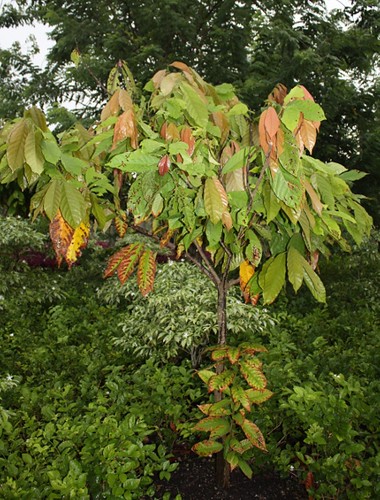
My good friend Steve gave me a couple of Paw-Paw trees (Asimina triloba) during the summer. I have kept them in the pot until now, wanting to make sure they were kept watered and healthy during the hot season.

Paw-Paw tree (Asimina triloba) with a view of a little pond
Last week I took them out to my in-law's land where there is plenty of room to plant trees and searched for a good spot. I also had some young Persimmon (Diospyros virginiana) trees to plant. My mother-in-law pointed me an area which already had a cluster of Persimmon trees growing. I don't know if the trees were planted together here many years ago (when my wife's ancestors settled the land), or if they grew here naturally. My mother-in-law had shown these to me in the past but I had never seen any fruit on them. This time around I saw a few fruits up on the tall skinny trees and I saw one smaller, squat tree that was absolutely covered in fruit.

Nearby Persimmon (Diospyros virginiana) tree loaded with fruit
We decided that we would go ahead and plant the Paw-Paw trees here with the Persimmon trees. I like that these little trees have such a nice view. By the way, I took advantage of the loaded Persimmon tree.

Persimmon fruits

Persimmon seeds removed from fruit.
There's actually more seed volume than fruit volume and it was a lot of work to separate the two.

Persimmon cookies
I brought about 30 fruits home and laboriously separated the small amount of fruit from the large amount of skin and seeds and made one batch of Persimmon cookies using the recipe I've shared before. I only got 1/3 cup of persimmon out of the fruits I collected, so I had to modify the recipe. The end result was 14 delicious cookies and 110 seeds that I can now plant. Johnny Appleseed, there's a new seed sower in town.

Wednesday, September 12, 2018

Update: Sacred Bodhi Tree

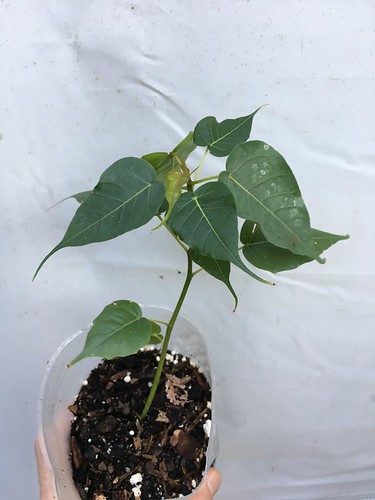
Seven years ago I was gifted some seedling Sacred Bodhi trees (Ficus religiosa) from a friend. Read more about the tree here. I gave one of those seedlings to my mother-in-law for insurance. I'm glad I did because my tree died a couple of years ago when it got too dry in my greenhouse. My mother-in-law's tree goes through a series of phases: rapid growth, scale infestation, dropping all the leaves - repeat. We're not sure why the scale keeps coming back, as it seems completely free of them when it is in it's rapid growth phase. Anyway, it seems to be an established pattern now.

Ficus religiosa
Sacred Bodhi Tree sapling (Ficus religiosa)

I recently took two cuttings of her tree when it was in a rapid growth phase and one of those cuttings has rooted. I started the cutting in pure vermiculite. After I was sure that roots were established I transferred it to potting soil. It's now producing new leaves and seems to be pretty happy. In a humid tropical climate this tree would easily be meters tall by now, but in our temperate Oklahoma climate (and my mother-in-law's plant being grown indoors) it is staying fairly small, almost a bonsai. I'm so thankful to have this little tree back in my collection and will monitor it closely.

Wednesday, August 29, 2018

Cockspur Coral Tree from seed

This past summer my family ventured to Galveston in early June and again at the end of July. On our first trip we had a picnic at Moody Gardens and walked around the grounds. I was very sad to see that the butterfly garden was barren, normally fully planted and bursting in color. One of the few living plants in this area was a Cockspur Coral Tree (Erythrina crista-galli), which was about 10' tall and in bloom. I'm guessing this tree blooms through much of the year, because it also had seed pods on it.

Cockspur Coral Tree (Erythrina crista-galli) in bloom at Moody Gardens, Galveston, Texas.

Cockspur Coral Tree (Erythrina crista-galli) in bloom at Moody Gardens, Galveston, Texas.

You know me, I swiped a seed pod, thinking maybe I would be able to germinate them. I planted the seeds a while later and most (maybe all) of the seeds germinated. I don't know this species very well and was a little surprised to find how prickly they are, even as little seedlings. See the photo below.

Cockspur Coral Tree (Erythrina crista-galli) seedlings.
I don't recommend growing trees in a hanging basket. This is just what I started the seeds in.

Prickles on Cockspur Coral Tree (Erythrina crista-galli) seedling.

On our return trip to Galveston in July I took one little 5" tall seedling with me. I planted this seedling in one of the spots vacated by the Natal Plums (Carissa macrocarpa). The Natal Plums died back to the ground over the winter, but were sprouting back from the roots. My mother-in-law suggested that we take this opportunity and just remove them since they were way oversized for the location where they had been planted and were covered in fierce thorns. I obliged her, digging up all of the plants and roots, and transferred one of these to a pot, where I plan to keep it trimmed (sort of a bonsai) and small.

potted Natal Plum (Carissa macrocarpa)

The Cockspur Coral Tree looks pretty pathetic in this location right now, but I put some barriers around it so that it won't be mowed down and I'm hoping that the Galveston climate will have this little tree growing towards the heavens in no time. The little Natal Plum does not look pathetic in it's pot on my front porch. It looks awesome! Let's just hope I can keep it small - the thorns on this plant are vicious!

Monday, August 27, 2018

Trip Report: Exploring Austin, part 4

I've written about finding interesting Bauhinia, Catalpa, and Persimmon trees in the Austin area in previous posts.

Mexican Buckeye (Ungnadia speciosa)
On my first morning in Austin I went to a small natural area known as Stillhouse Hollow Nature Preserve, nestled into a neighborhood. The sign at the entrance told about an endangered species, the Karst Invertebrate, which lives in limestone caves. This area is also home to the endangered bird species Golden-cheeked Warblers and Black-capped Vireos. There is a nice path through this park and then an overlook. Near the overlook are signs asking that people stay on the path and respect the native flora and fauna, one of which is this endangered species living underground. I would have loved to explore off the path and find this little cave dweller, but I stuck to the rules and observed from the path only.

Mexican Buckeye (Ungnadia speciosa) seed pod
One item of interest off the path and out of reach was a shrub that had distinct seed pods. After using iNaturalist to identify this as a buckeye I assumed this was a species that I had seen in bloom once or twice before, one of the Aesculus genus. However, I learned that this was a Mexican Buckeye (Ungnadia speciosa). Thankfully even though this plant was well off the path, I came across this plant at nearly every other park I visited in the Austin area and was able to collect seeds from other plants.

Photo by iNaturalist observer caliche_kid.
I researched germination methods for each of the species I brought home. Most require some form of cold stratification and spring planting. This species was the exception, suggesting germination of fresh seeds. I went ahead and planted some of the seeds, setting aside some others to try in the spring if this first batch wasn't successful. In the week after planting the seeds we had consistent rains every few days - unusual for August. After just 10 days I noticed that the seeds had sprouted and were growing vigorously.

Mexican Buckeye (Ungnadia speciosa) seedlings - off to the races!
10 days after planting
Mexican Buckeye (Ungnadia speciosa) seedlings.
15 days after planting.
I'm not exactly sure where I will plant these bushes. From what I can find online they are probably only hardy in zones 8 and greater, but I think my parents' land near Lake Texoma (zone 7b) might work. I'll probably wait to see how many plants I have. If I have plenty then I'll test some in that climate and keep others potted in my greenhouse as insurance.

Friday, August 24, 2018

Trip Report: Exploring Austin, part 3

In my last two posts I talked about plants that I found along the Colorado River in downtown Austin.

On a different day I went to St. Edward's Park to do some birding and I noticed one tree had small green fruits on it - about the size of a pecan with it's outer green shell still attached. iNaturalist to the rescue again, I learned that this was a Texas Persimmon Tree (Diospyros texana). My admiration for native Persimmon trees is well known to readers of this blog, and I was very excited to learn that there is more than one species that grows natively in the United States. I saw a larger specimen of this tree when I visited Mayfield Park and Nature Preserve, this one marked with a placard.

Texas Persimmon at Mayfield Park and Nature Preserve


I also found this tree growing at Commons Ford Ranch Metropolitan Park. I collected a couple of fruits and harvested the seeds. Since I had good luck germinating some native persimmons last year, I am trying the same method: removing all fruit from the seeds, placing them in a pot of soil outdoors, and leaving them alone through the fall and winter. I may move this pot into a slightly warmer spot over the coldest part of the winter, just in case they aren't quite as hardy as I'm hoping, but I do want them to experience the cold they would naturally in the Austin area. Here are some photos of the fruits and flowers by other iNaturalist observers.

Photo by iNaturalist observer butterflies4fun.
Photo by iNaturalist observer manesalinas.

I've done some research on this species (good info here and here) and found that it is likely hardy where I live in central Oklahoma, so I plan to try growing in here. It is also a recommended species for greater landscaping use, being small, nicely formed, attractive bark, naturally feeding wildlife, and drought tolerant. As the placard mentions above, the fruit is small but edible. Hopefully I'll have a chance to try one some day.

Wednesday, August 22, 2018

Trip Report: Exploring Austin, part 2

In my last post I talked about finding a native species of Bauhinia along the Colorado River in downtown Austin.

Catalpa leaves and seed pods

Also along this path I came across a large Catalpa tree. I am familiar with these trees growing in Oklahoma. They are easily distinguished by their large leaves, showy flowers in the spring, and long green seed pods through the summer into the fall. The tree along the path was in seed pod stage and the pods were longer and more slender (pencil size or skinnier) than those I am used to seeing (finger size or thicker). Comparing images on iNaturalist and reading some articles online, I believe this is the Northern Catalpa (Catalpa speciosa), whereas the species I see at home is the Southern Catalpa (Catalpa bignonioides). This is a bit ironic since I am finding the northern species to the south of where I am used to seeing the southern species. Anyway, I believe this is correct.

Catalpa seed pods
True to form, I collected the seeds from these long seed pods shown in the photo and will plant them next spring.

I have a few more posts related to my time in Austin, so stay tuned!

Monday, August 20, 2018

Trip Report: Exploring Austin, part 1

I spent two weeks in Austin this summer, taking a training course to be a Red Hat System Administrator. In the evenings I traipsed around the metro area, birding in local parks and natural areas and doing my normal thing - observing and logging everything new species (to me) using the iNaturalist app.

I visited 10 different parks during my two weeks and covered a lot of ground. I observed a few new species of birds (Black-crested Titmice, Least Grebe, Pectoral Sandpiper), several new dragon/damselflies (Swift Setwing, Marl Pennant, Kiowa Dancer, Dusky Dancer, Checkered Setwing, American Rubyspot), several new plants, and even found a nice gastropod fossil. But this is a plant blog, so let me dive in to more detail about some of the plants.

Small bilobed leaves of the Anacacho Orchid tree (Bauhinia lunarioides)

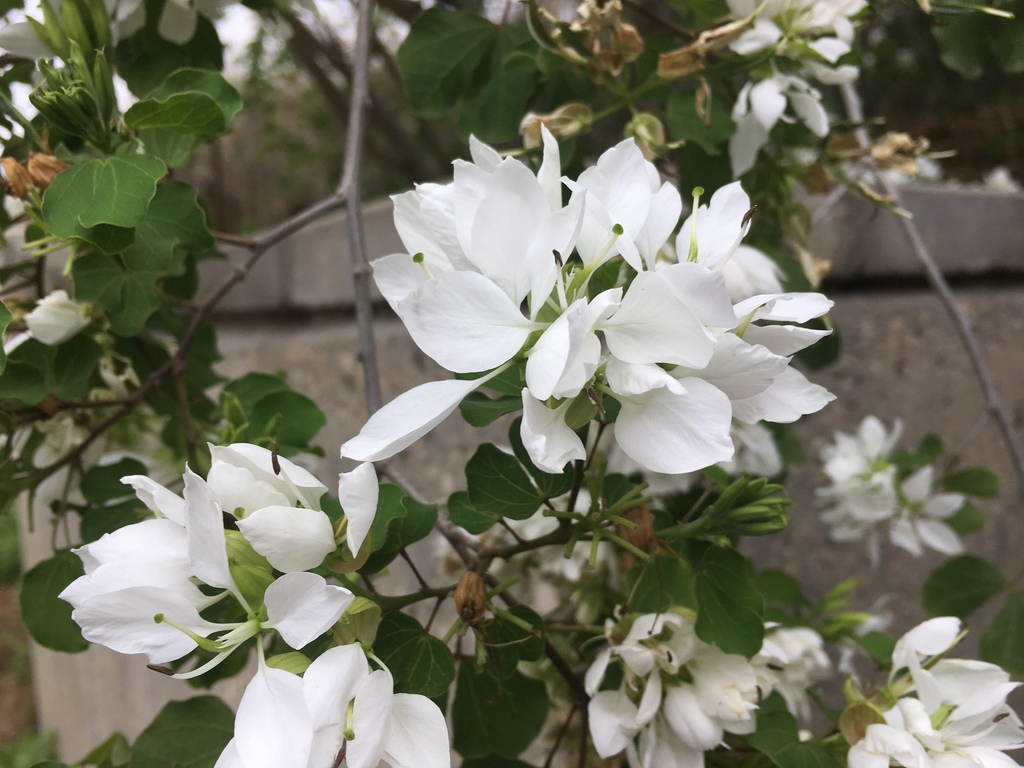
Along the Colorado River in Austin there is a nice walking trail that is well used by locals walking their dogs, cycling, and jogging, as well as to observe bats at the Congress Avenue Bridge. (I sort of stumbled along this myself and was treated to quite the spectacle around sunset.) Along this path I came across a couple of really neat plants. The first was a small shrubby tree (probably about 6' tall and about the same width that was covered in opened seed pods. There was nothing too remarkable about the tree except that the seed pods had all split open in a spiraling fashion and they were pretty conspicuous. Upon closer examination I realized the leaves were the distinct shape of a Bauhinia, which greatly excited me. I took some photos and uploaded the observation to iNaturalist, which suggested the name of Anacacho Orchid (Bauhinia lunarioides), a native of central and southern Texas into northern Mexico. This species has small and deeply split leaves, almost appearing as two leaves. The flowers (which appear in the spring) are white (or occasionally pink) and showy. I don't have any of my own photos of flowers to show, but the photos below are from iNaturalist observations (here and here).

Photo by iNaturalist user anschad.

Photo by iNaturalist user johnkarges.

Of course I collected a handful of seeds and brought them home for experimentation. I have started other species of Bauhinia from seed and they have germinated easily and been a fairly easy plant to grow, although they are tropical and cannot winter outdoors in my climate. This species appears to be a little more hardy, but not enough (zone 8) to overwinter in central Oklahoma (zone 7). It's not clear to me whether the tree was growing naturally along the path or had been planted there. I'm guessing the latter but who knows?

Part 2 coming later this week!

Thursday, August 2, 2012

Trip Report: Interesting trees at Gardens by the Bay

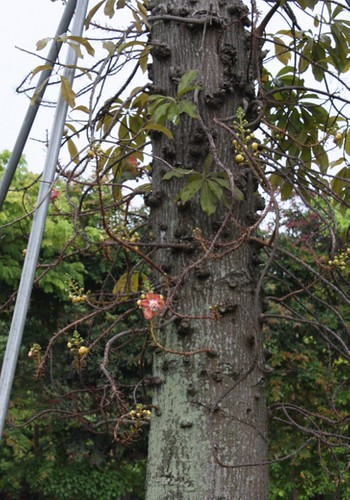
Even though much of Gardens by the Bay has just recently been planted, the garden planners went all out to purchase mature trees from all over the world.  For example, check out the size of this Cannonball tree!
cannonball_tree
Couroupita guianensis, the Cannonball tree
Yes, I have seen a larger one, but it must have been in place for a hundred years or more.  The tree at Gardens by the Bay was just planted!  So, you can see it is just starting to bloom.  Soon it will have cannonballs all over the trunk.
coccoloba_rugosa
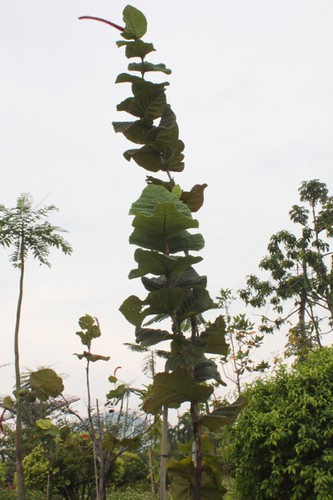
Coccoloba rugosa, the Red-Flowered Sea Grape
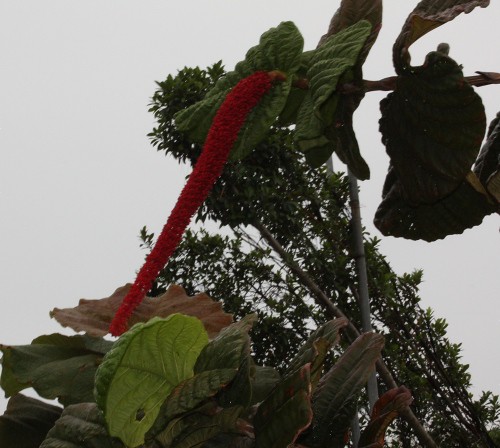
In one grove of trees there were a couple of really neat, large leaved trees.  Coccoloba rugosa, the Red-flowered Sea Grape, was a tall skinny tree, with large, round leaves and blooms emerging from the top.
coccoloba_flower
Coccoloba rugosa flowers
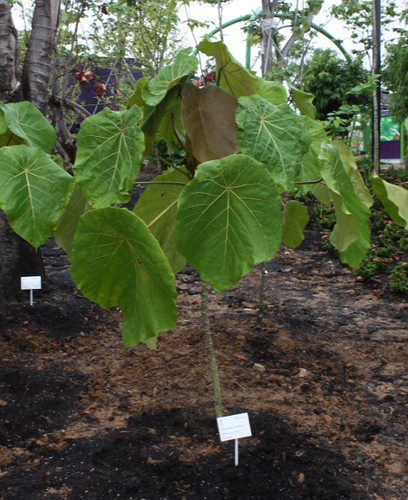
Another large-leaved tree is Macaranga grandiflora, the Parasol Leaf tree.
macaranga_grandiflora
Macaranga grandiflora, Parasol Leaf tree
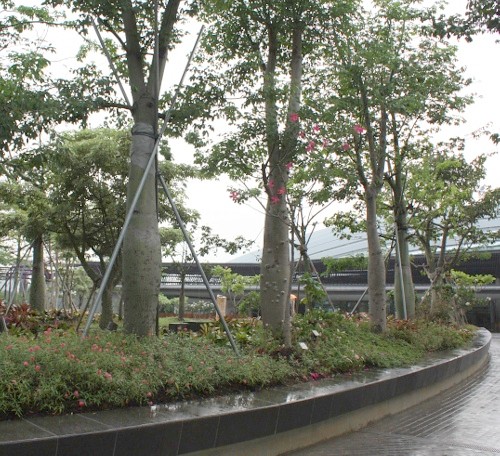
The Silk Floss tree (Ceiba speciosa) is one that I am familiar with from the Myriad Gardens.  The most prominent feature of this tree (when not in bloom) is the large thorns covering the trunk of the tree.  One area of the gardens is planted with a bunch of Ceiba.  It is curious to me that some trunks are covered in thorns and others are almost entirely smooth.
ceiba_grove
Grove of Ceiba speciosa (Silk floss) trees
In bloom, this tree has beautiful pink flowers.  After the blooms are pollinated, they produce seed pods that open to reveal some fluffy silk-like threads surrounding the seeds.  This is where it gets its common name.
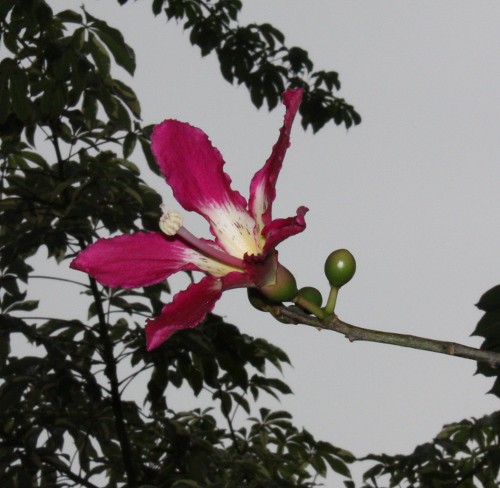
ceiba_flower
Ceiba speciosa flower
Another tree with nice flowers was a Jatropha.  Does anyone know what species this is?  It has really neat leaves to accompany the vibrant orange flowers. [Update 2012-09-04: Tom commented that this is probably Jatropha podagrica.  Thanks Tom!]
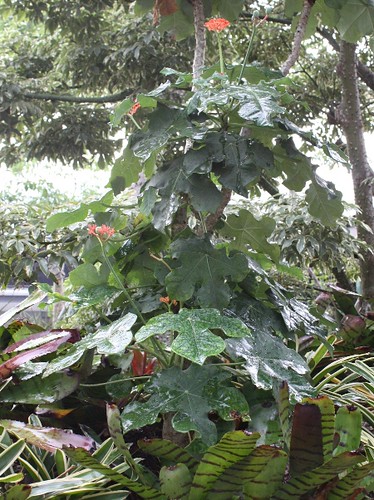
jatropha_orange
Jatropha podagrica with orange blooms
theobroma
Theobroma cacao
The cacao (chocolate) tree, Theobroma cacao, will start blooming and producing fruit at a small size.  That's good news, because this tree is only about 8 feet tall.
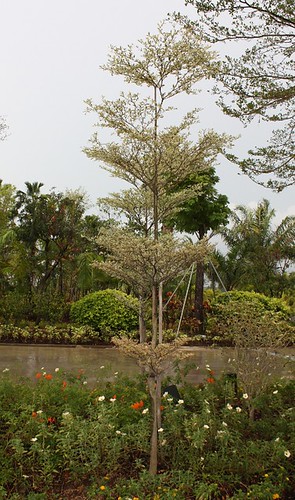
layered_tree
Beautiful layered tree, Terminalia mantaly 'Tricolour'
One of my favorite trees in the outdoor gardens was this beautiful tree (Terminalia mantaly 'Tricolour') that naturally grows in layers.  The leaves are patterned in white, green and a touch of pink.
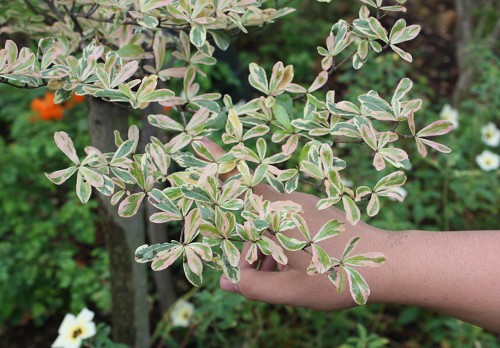
layer
Colorful leaves of the layered tree, Terminalia mantaly 'Tricolour'
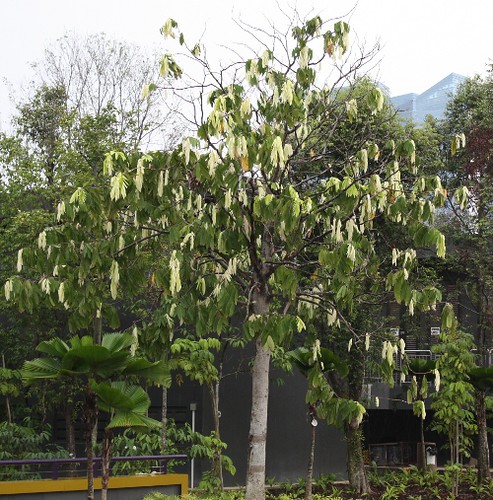
From a distance, I thought this next tree was blooming or had hanging fruit.  As I approached, I realized it was just the new emergent leaves that hang down and reflect light with their glossy texture.
emergent_leaves
Tree with conspicuous emergent leaves
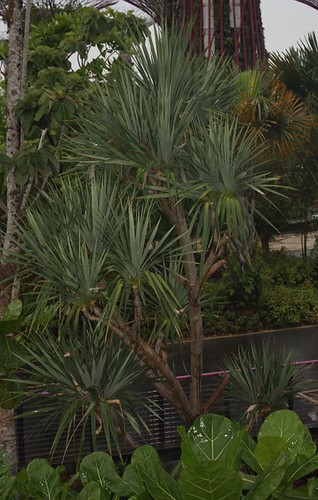
Until my trip to Singapore, I thought Pandanus was a genus only consisting of large, stilt-root trees.  While at the gardens, Shawn pointed out several small plants and shrubs that he said were Pandanus.  One tree that I knew was Pandanus was this large tree.
pandanus
Pandanus tree
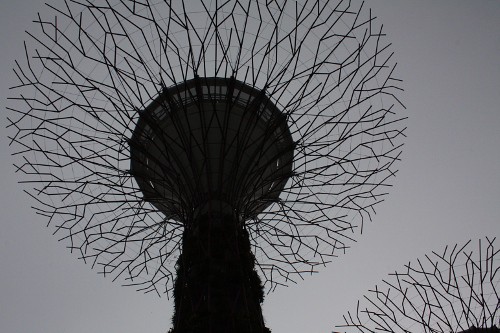
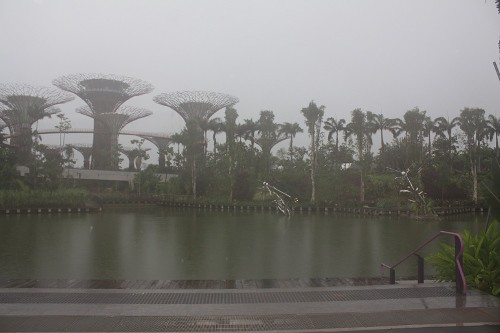
The last "trees" I will show you are not living trees, exactly.  They are the gigantic metal "supertrees" which are visible from anywhere in the gardens.  They are covered with bromeliads and other epiphytes, which will fill in over time.
under_supertrees
Under the Supertrees
Due to the overcast sky, I really couldn't get a good photo of these trees, but here are some highly backlit photos anyway.
supertrees
The Supertrees under a rainy sky

Monday, August 8, 2011

Unusual Ginkgo tree

You may already know, I love Ginkgo trees.  I pretty much have the handful of Ginkgo trees in my town mentally mapped out.  I can count them.

Ginkgo biloba
Ginkgo biloba tree with undivided fan leaves
I know that the Ginkgo genus is monotypic, meaning that there is only one species in the genus, Ginkgo biloba.  However, there are a number of cultivars, which are consistent variations from the normal species.  They are not distinct enough to be considered a new species, just some variations on that species.  Some of these are called "sports."  Typical Ginkgo variations include the size of the tree: some sports are grown as small shrubs or bushes, some even weeping.  I have been very interested in growing one of the small shrub types.  I have even seen a Ginkgo bonsai tree, which was wonderful.  Other variations include the leaf shape.  Some have very narrow fan shape leaves; others are curly.  Most of the Ginkgo trees that I see have the same classic look to them.  But there is one here in town that looks different.

Ginkgo biloba
Closer view of the small, undivided Ginkgo biloba leaves
This Ginkgo has leaves without the split in them, making the leaves just a perfect little fan shape.  Also, the leaves on this tree are quite small.  For comparison, my 3 foot tall tree has leaves that are 2-3 times larger than the largest leaves on this 15 foot tree.  The leaves are also somewhat curved, especially when they are new and first emerging.

Ginkgo biloba
Ginkgo biloba in front of my favorite Thai restaurant
This tree is growing in front of my favorite Thai restaurant.  I will happily go back to visit it - and have a bite to eat while I'm there.   Massaman chicken, here I come!

Monday, May 23, 2011

Plant Find: Ginkgo biloba trees

I have long admired the Ginkgo tree. I can pretty much name every place where I have seen one now - the Fort Worth Botanic Gardens, the Missouri Botanic Gardens and two here in town (one small tree in my neighbor's backyard and one near a park by our house). I have even been inspired by the Ginkgo to paint my first piece of art (maybe - it may or may not look like art once I'm finished).

Even though these trees are well known and well loved, they are really hard to find around here. The only ones I have seen for sale were very expensive at a local nursery. I got some seeds from a friend, but none of them have sprouted for me. Then I came across a real deal on eBay several weeks ago! For $14, I got two saplings between 18" and 24" tall each - shipping included! That's much better than the $150 I would have had to pay for a 6 foot tree here locally!

ginkgo_leaves_starting
Leaves just beginning to emerge from the tip of the tree planted in the ground.
So I have two Ginkgos now. What will I do with two of these things? Not sure. For now, one is planted in our backyard near the corner garden. I have put a tomato cage around it to keep the pups from running it over while it is still small. The other is in a pot, where it will remain for the time being. I don't know how long it will be happy in a pot, but I imagine it is doable, considering some people train Ginkgos to be bonsai specimens. My two trees are already too big to be trained as bonsai, but maybe this one will still make a nice container tree. Of the two trees I now have, the one in the pot is growing more quickly than the one in the ground, possibly because it is in partial shade and just quicker to establish.

first_ginkgo_leaves
Ginkgo biloba leaves out and mature. This is actually the tree I potted.
The two plants were sent to me bareroot, wrapped in moist paper towel and had not yet produced any leaves, but they are already starting to pop out now, as you can see in the pictures above. Ginkgo trees have the most amazing leaf shape and really beautiful color in the fall, when they turn solid yellow. I am looking forward to that show every year.

Thursday, June 11, 2009

InTREEguing

I know, I know.  My blog post is misspelled.  I started to name this post "Intriguing Trees."  Then I decided I could make it all one word - just for fun.  [Don't try this at a spelling bee.  Spelling Bee judges aren't known for their sense of humor.]

This post is one of those eclectic collections of plant profiles (like My "onion" plants post).  It is a list of trees which I find intriguing, for one reason or another, and a short description of the trees.  Only a couple of these trees have I ever grown before.  And there are only a couple more that I would ever try to grow.  The others won't grow in my region and are not suited to growing in a pot indoors.  I narrowed down the list to my top 6, listed here in no particular order:

Sassafras - I visited the OU (University of Oklahoma) Greenhouses a couple of years ago.  The caretaker, Cal Lemke, showed me a sassafras tree and had me sniff a leaf, not telling me what it was.  The smell was unmistakable.  Though, I admit, at the time I couldn't name what the smell was.  But I knew the smell, nonetheless.  When he said the tree was a Sassafras, I thought "Of course, that smells just like Root Beer!"  The leaves of the Sassafras tree are uniquely tri-lobed.  The tree has small yellow flowers, but is otherwise an ordinary-looking tree.  I just think this tree is really neat because of the smell that is so evidently root beer-ish.  I think I will try to grow this tree at some point.  To top it all off, this tree can be grown in my zone and has wonderful fall foliage color.

Sassafras tree leaves - courtesy flickr member Muffet
Cacao tree - Let's face it: Chocolate is one of the greatest discoveries of mankind.  I can't imagine having a Cacao tree of my own and processing the beans to make my own chocolate.  I imagine it would be quite a task, but the rewards...?  Well worth it!  I might have to try growing a small specimen tree in a greenhouse.  I'm not sure that I would be able to do all of the processing required to make chocolate from the beans, but I could sure try.

cacao
Cacao tree at the Foster Botanical Garden - Honolulu, Hawaii
Cork - How many trees do you know of that are harvested for their bark - and then they continue to grow and produce more to harvest?  Just one that I know.

Cork tree - from http://www.marylandcork.com

Rainbow Bark Eucalyptus - If you haven't seen one of these in person, you almost have to assume they aren't real.  I mean, really - rainbow stripes on a tree trunk!?!  Come on - that's ridiculous!

rainbow_eucalyptus
Rainbow bark Eucalyptus trees in Maui, Hawaii
Coconut Palm - This is one of the trees I have tried to grow - "tried" being the most important word.  Twice, in fact.  I've mentioned those failures before on this blog.  The Coconut Palm simply requires more light than I can offer on a year-long basis.  The light requirements are easy to meet in the summer, but the winter is another story.  This tree makes the list (regardless of my difficulty growing it) because of it's initial growth habit.  The tree literally sprouts from a full-sized coconut.  It is a really cool looking oddity of a tree at about 4-6 feet tall and a definite conversation piece - though I wouldn't suggest sitting it on your coffee table.

Coconut palm tree sprouting from the coconut - courtesy flickr member Bemep
Ginkgo tree - I have wanted to grow this tree ever since I saw once in its solid yellow Fall coloring at a local nursery.  I should have just bought it that day.  I guess I didn't because it was about 15 feet tall and I was driving a small car and it was priced more than I could afford.  I also didn't have an adequate space for it.  The tree is gorgeous in the Fall and the leaves have a very unique shape, unlike any other tree that I know.

Ginkgo trees are thought to be one of the oldest tree species still growing.  The species is thought to have existed at least 270 million years, back to the Jurassic period.

Ginkgo biloba leaves in Fall color - courtesy of Flickr user Rozanne
Ginkgo biloba leaves in Fall color - courtesy Flickr member Rozanne

Other trees receiving votes:As with the AP Sports voting, I have accumulated a list of other trees that, while not making the list of top six, got some votes.  It's an "honorable mention" sort of award:
  • Rubber plant (mine is really more of a plant than a tree).

  • Olive tree (though one of my favorites, this tree is too widely known and grown to make the list).

  • Baobab tree (probably on anyone else's crazy-cool tree list, but I don't have any desire to grow this one).  There is a really funny segment on the BBC Planet Earth DVDs of the filming of the Baobab trees.

  • Banyan trees (Some of my absolute favorite photographs are pictures of the tree roots entangled within and growing over the ruins of Angkor Wat.  There are several famous Banyan Tree groves across the globe, including several I saw recently in Hawaii.  The largest one I have seen takes up a whole city block in Lahaina on the island Maui, Hawaii.).

What would you put on your list of "intriguing trees?"