Showing posts with label Passiflora. Show all posts

Thursday, June 9, 2011

Plant Find: Two new Passionflowers, one in bloom

Since our family cruise over Thanksgiving last year left from Galveston, Texas I figured it would be a good opportunity to visit a nursery or two that has some tropical plants.  I did a little scouting ahead of time and asked for some recommendations from people that live in the area.  I ended up stopping at the Houston nursery of "Zone 9 Tropicals", which specializes in Gingers, Passionflowers and other flowering vines.

Christie really liked the historic neighborhood and will be happy to go back there again.  She wandered the streets while I wandered around looking at the plants.

Passiflora 'Lady Margaret'
My first bloom from Passiflora 'Lady Margaret'
I purchased 5 plants in all from Zone 9, including two Passiflora.  The first is Passiflora 'Lady Margaret'.  This is one of the more popular red(ish) Passionflowers.  It is a hybrid of P. coccinea and P. incarnata.  That first parent is more of a solid red, while the hybrid 'Lady Margaret' is a wine red.  You can see the influence of P. incarnata in the wavy tendrils.  Passiflora incarnata has very long, wavy tendrils.

p_batwing
Passiflora 'Sunburst' leaves in the signature "batwing" shape.
The second is Passiflora 'Sunburst'. This is a hybrid of P. gilbertiana and P. jorullensis.  The small flowers have incredible colors and apparently smell like turpentine.  The leaves of this plant are also very unique.  Since mine hasn't bloomed yet, I am just enjoying the leaves.  I need to get this one put on a trellis.  For now, it is growing in the greenhouse, kind of laying up against the bark wall, but not really attaching to anything and not getting as much light as it would probably prefer.

p_batwing_under
Underside of Passiflora 'Sunburst' leaves.
Neither of these Passifloras are hardy in my zone 7a region, so I will need to overwinter them in the greenhouse.  I'm hoping I can get my 'Sunburst' to bloom this summer.

Monday, June 6, 2011

DIY trellis

For the last couple of years we have had a couple of non-hardy plants growing on trellises that we transport back and forth from the greenhouse to the back fence with the changing seasons.  This way we can enjoy some near-tropical climbing and flowering plants in the yard during the summer and keep them alive over the winter.  I mounted brackets on the back fence for reattaching the trellises each year and I have Christie help me move the potted plant, attached to the trellis back and forth.

old_trellis
One of our purchased trellises.  Notice the Passiflora bloom.  More on that later...
This year I had another plant (or two) that I wanted to add to the shuffle, but I was out of trellises.  I knew that I could buy another trellis to match the ones I have, but it would require a trip to Oklahoma City and also would cost a bit of moolah.  And we had some wood lying around...

wood_pile
Veritable smorgasbord of unknown projects
So I decided to just make my own trellis.  It's a pretty simple contraption and it didn't even need to be an exact match to look legit.  After previous unpleasant incidents with the circular saw, I had Christie on hand to help me hold the wood while I was cutting these slivers of wood.  It helps to have a supervisor nearby who reminds you not to do stupid things - like getting your fingers in the way of whirring blades that don't notice the difference in wood and finger.

new_trellis
My new trellis, crafted by moi.
About fifteen minutes of work and we had a new trellis mounted on the back fence with my Flame Vine (Pyrostegia venusta) planted at the base.  (and I still had all my fingers!)

Tuesday, December 29, 2009

Passionflower in bloom

After just a week in the greenhouse, I could already tell that the plants were happy.  Immediately my Aroids began to produce aerial roots where they hadn't before.  In fact, I have a variegated Monstera deliciosa that now has an aerial root about 5 feet long.  Pretty impressive for a plant that is only about 8 inches tall with 2 leaves!

Anyway, one of the best indicators of a plant's happiness is their bloomage.  Not that a non-blooming plant is unhappy, but it's a pretty sure bet that a blooming plant is happy.  In some rare cases, a very unhappy plant will produce blooms just before dying - a last ditch effort to spread seed and ensure its survival through its offspring.  But you can usually tell if your plant is blooming for this reason.

I don't have very many "blooming" plants.  Most of my plants do flower at some point in their life cycles, but their flowers are not particular showy, colorful or desirable to look at.  But those few that I have have been performing for me pretty well since being moved into the greenhouse.  The Datura (Angel Trumpet) has been producing yellow trumpet blooms constantly, followed by nice, full seed pods.  The lime tree put out a profusion of blooms once moved in and is now desperately trying to make fruit from those blooms, even though I can't seem to give it enough water.  Christie's Streptocarpus (False African Violet) has been covered in little blue-purple flowers since we got it several weeks ago.

And my favorite blooming plant in my collection has even been performing.  I have two Passiflora x alatocaerulea (a hybrid Passionflower) in my greenhouse that have been producing a couple of blooms each week.  We purchased both of these plants last summer, keeping one and giving the other as a gift to Christie's grandmother for mother's day.  Since they are not hardy plants in our climate, I offered to overwinter her plant in the greenhouse with my own.  I was able to keep it attached to her grandmother's trellis and temporarily hang the trellis in the greenhouse.  Assuming I can keep it from getting too tangled with my other plants and greenhouse itself, it should be easy to transport back to her house in the Spring.

gh_passion_bloom
Passiflora x alatocaerulea blooming in the greenhouse
With Christmas day just a couple of days behind us, I figured now is a good time to share about the symbolism and name for the Passionflower.  If you have seen a Passionflower bloom before, you were probably amazed at the complicated sets of elements that are present.  There is just so much going on with each bloom.  It's not a simple set of petals with a colored center, like members of the Asteraceae family.  The Passionflower has many different parts and the numbers of those parts are significant in the Christian culture.  In addition, the Spanish saw a resemblance in this flower and a Saint's halo, commonly depicted in Roman Catholic art.

Back to the numerology of the bloom.  The bloom consists of five petals and five sepals, which represents the ten apostles - leaving out Judas the betrayer and Peter the denier.  The filaments can represent the thorns in Jesus's crown.  Apparently there are 72 of them and that is how many thorns were in Jesus's crown, though I'm not sure where that knowledge came from...  There are many myths and elements to teh Catholic faith that are not shared by the Protestant Christian denominations, of which I am a member.  There are five stamens, which is the number of wounds that inflicted Jesus.  In fact, the plant is referred to as "Flower of the Five Wounds" by South American Catholics.

Additional symbolism can be found in the shape of the leaves of some species of Passiflora, such that they look like spears, which pierced Jesus's side.  And some dots underneath the leaves are to represent the 33 pieces of silver which were paid to Judas for the betrayal.

Passionflower blooms are only open for one day, the same time that Jesus suffered on the cross.  After their show the bloom closes rather than falling from the vine, like many other flowers do.  This closing symbolizes hidden wisdom and Jesus being placed into the tomb.

I hope that you had a wonderful Christmas and I wish the best in the New Year.

Wednesday, November 18, 2009

Passionflowers in the wild

My family heads down to Lake Texoma (on Oklahoma's southern border) on the weekends during the Summer, to ride around the lake on our boat and waterski.  There is a nearby area we like to call "Jurassic Park" because of its thick vegetation.  We drive in on a golf cart and forget that we are in the central United States.  You almost feel like you are in a South American jungle, unless you look closely at the type of plants growing.  Looking at the vegetation, I never saw anything spectacular (in the tropical sense).  That is, until recently.

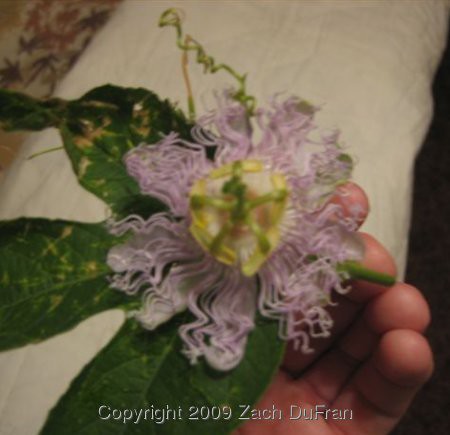
The picture below is of a Passionflower bloom that I cut off of a plant growing wild in "Jurassic Park," about 100 yards from the waters of Lake Texoma.  It is unlikely that this plant was growing there natively, but it is also unlikely that it was planted.  My guess is that somewhere nearby this plant is in someone's garden and a bird ate from the fruit and deposited the seed in this location.

buncombe_passionflower
Passiflora incarnata bloom, cut from plants growing wild in southern Oklahoma
I have heard people talk about how hardy Passionflowers can be very invasive in our climate.  The first year the plant is beautiful and robust and the next year there are plants coming up everywhere.  But I hadn't seen this in person, so, like Thomas, I doubted.  Now I have seen some of this Passionflower growing wild in a very unexpected location.  This area was the last place I expected to see a beautiful flower that looks so tropical.  The plants were covering much of the undergrowth and were bearing fruits in many areas.  Once you saw one, you would see tens of them.  Your eyes just had to be attuned.

I immediately wanted to bring some of this plant home with me.  First, I tried digging up some of the smaller plants and bringing them home with me, but it was very difficult to dig up the plants and bring the roots along.  The plants died within a matter of days.  To add injury to insult, I ended up covered in poison ivy that lasted for several weeks.  It was miserable.

A couple of weeks later, against the recommendations of all of my family members, I went back to take cuttings of these plants.  This time I was very wary of the poison ivy and stayed free of it.  The cuttings stayed green for a couple of weeks and I held out hope that they would produce roots, but none of them did and eventually the cuttings withered and died.

If you happen to have a tip for taking cuttings of Passionflowers, I would love to hear it.

Wednesday, May 6, 2009

Plant Find: Two new trellis climbers

I lured my wife into yet another plant-inspired weekend road trip.  It's really not that hard to lure my wife into road trips.  This weekend we took a drive a little over an hour north to Stillwater, Oklahoma, to visit a plant nursery that I had heard about from another plant blogger that lives in Oklahoma.  Martha from All the Dirt on Gardening suggested I visit Bustani Plant Farm for a little variety.

The Bustani Plant Farm has a great selection of plants that tolerate the heat and humidity of an Oklahoma summer and they have the appropriate motto "Grow something different."  Many of their plants I had not seen available anywhere else.

I bought about 10 different plants, including some perennials for the corner garden and some tropicals that I will have to overwinter indoors or in a greenhouse.  The two coolest plants I walked away with are Spanish Flag (Ipomoea lobata) and a Hybrid Passionflower (Passiflora x alatocaerulea 'Pfordtii').  These plants are both tropical climbing plants that like full sun.  I hadn't really planned where I would put the plants when I got home.  I just knew that I had to have both of them.  :)

I found some nice-looking, inexpensive wooden trellises and mounted them to the back fence for these two plants to climb this summer.  I mounted the trellises in such a manner that I can remove them easily this Fall and leave the brackets in place.  My wife can help me carry the trellis (with plant attached) while I carry the pot and we can keep each plant alive indoors over the winter and then bring them back outdoors again next Summer.  I imagine the Passionflower will be pretty hard to remove from the fence, due to the clingy tendrils it forms.  I had quite a difficult time just separating my little plant from the other plants next to it at the nursery.  I might have to monitor it throughout the summer, making sure that it is clinging tightly to the trellis but discouraging it from clinging to the fence.

passiflora_trellis
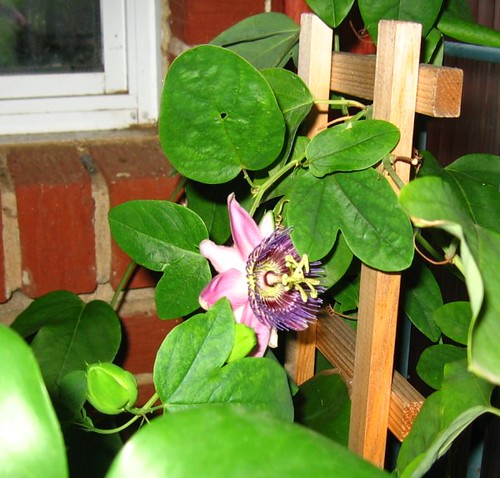
Hybrid Passionflower (Passiflora x alatocaerulea ‘Pfordtii’) growing on trellis along back fence.  See all of the swollen buds, ready to open?

I had pored over the pictures on the Bustani Plant Farm website before my visit and was really happy to see that the plants were of great quality when we arrived.  My Passionflower is already blooming and looks every bit as cool as the picture on the website.  Passionflowers, in general, just look like made-up, imagined plants to me.  It doesn't seem like they could be real.  Every time I see one I think, "Surely, that's fake!"

passiflora
Hybrid Passionflower (Passiflora x alatocaerulea ‘Pfordtii’) bloom - simply amazing! Notice the alternating sepal colors - green to purple.
The sepals of the bloom alternate from purple to pale green/white.  This is an interspecific hybrid, which means that it was bred from two different species (P. alata and P. caerulea).  It does not produce any seed, but supposedly blooms more because it does not have to put energy into the production of fruit.  Bustani also had a Passionflower that is a hardy perennial in my zone, but I really wanted to try this hybrid with the different coloring.  I brought one of the hardy blue Passionflowers back for my mom, so we'll get to enjoy that variety as well.

lobata_trellis
Spanish Flag (Ipomoea lobata) growing on trellis along back fence.
The other climber I mounted along the back fence is the Spanish Flag (Ipomoea lobata, sometimes also called Mina lobata).  This plant is the in the Morning Glory family, along with the ornamental Sweet Potato Vines (Ipomoea batatas), the edible Sweet Potatoes, and the Cypress Vine (Ipomoea quamoclit).  It is a fast grower and attracts hummingbirds with its colorful display of red to orange to yellow to white flowers (see picture below).  The blooms are very different from other members of the Ipomoea genus, which otherwise seem to resemble each other.  My plant is not yet blooming, but is pretty healthy.  With all of the rain we have been receiving, I can already see some new growth.

What do you think of my new acquisitions?

Friday, January 23, 2009

Desert Island Challenge

A fellow plant blogger (Shirl's Gardenwatch) issued a challenge to other plant bloggers and many (43, so far) have tackled it.  I was slow to jump on the bandwagon, but I caught the caboose.  [Imagine a bandwagon that has a caboose.]

The challenge:  If I was stuck on a desert island and could take any 3 plants with me, which plants would they be?

The details:  Forget growing requirements - any plant will survive just fine on this desert island.  Also, you don't need the plant for food or anything like that.  Just pick the plants you would want there with you.

In other words, if I could only see three plants for the rest of my days, which plants would I pick?

Of course, for anyone who likes plants this is a tough challenge.  I imagine even someone who doesn't notice plants would have trouble devising a list.

I am trying to decide whether I would want to look at some of my favorites over and over again or something that I have never kept before...  Hmm...

First, I have to choose a plant from my favorite family (Aroids).  I would choose Scindapsus pictus.  It's simply one of the most beautiful foliage plants I've ever seen - and I really like foliage plants.  I'm also a big fan of vining plants.  I'm picturing myself stuck on this island for the rest of my life, which could be a good 60-70 years, so it would be really great to see a Scindapsus pictus after 60 years of growth.
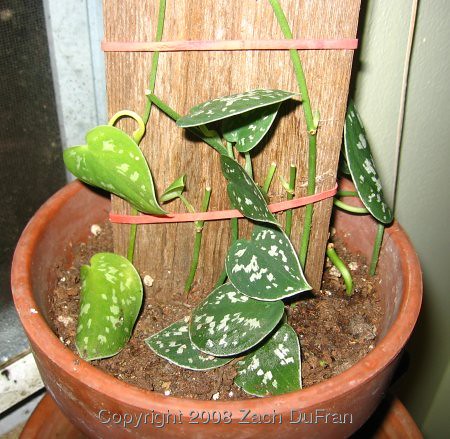
staked
one of my small Scindapsus pictus
On the other hand, I have seen some very large Scindapsus pictus and nothing really changes about them.  Beyond the leaves getting a couple inches larger in width, the plant just keeps creeping and filling more space.  They do change growth habit a little bit when allowed to climb up the surface of a tree or rocks, so I think I would have to plant my Scindapsus pictus around a tree, allowing some to climb around on the ground and other vines to creep up the tree in the "shingling" habit.

The next plant on my list will need to be a little more dynamic and changing with time.  It will need to be something that blooms or changed leaf habit as it grows.  Potential candidates include other Aroids, like Monsteras or Philodendrons.  I think I could definitely spend a lot of time looking at plants from these two genera.  And I would enjoy watching the Monsteras produce new fenestrations as they matured.  But I have already picked an Aroid, and I have grown a lot of these.  I think I would choose a plant that I don't have - a plant that would offer something new to me.

I'm going to go for a Passion flower.  There are so many brilliantly colored Passion flowers - I don't know which color I would choose.  I would probably pick one of the purple ones, but I recently saw a picture of a red one that was pretty amazing, too.

Passion flower
Passion flower - photo from herbal extracts plus
The last plant is one that just suddenly came to me.  It is a plant I have only seen a couple of times, but it was beautiful.  The Silver Russian Olive tree.  I saw a bunch of these in Boulder, Colorado when I was there last year for a conference.  I asked my coworker what they were, knowing that he had lived there a couple of years ago and must know.  He told me they were God's curse to the world.  Well, he wasn't quite that harsh, but he said they were somewhat invasive there and had spines on them.  He had volunteered to help a friend clean up their yard and remove a tree.  Apparently he came away from the experience with some wounds.

Anyway, it didn't take anything away from their appearance if you ask me.  And I won't be chopping down any trees on my desert island, so I don't expect this tree to give me any problems.

Silver Russian Olive 'Quicksilver' (Elaeagnus angusitfolia)
The trees I saw on the side of the road in Boulder were large, with thick trunks almost black in color.  It was a great contrast with the silvery, almost white, leaves.

There's my list.  It's a weird one and the plants aren't in any way a cohesive group, but who said they needed to be?  If I made a list tomorrow, it would probably be different.  There are simply too many plants that I would enjoy viewing for the rest of my days - desert island or not.