Wednesday, May 6, 2009

Plant Find: Two new trellis climbers

I lured my wife into yet another plant-inspired weekend road trip.  It's really not that hard to lure my wife into road trips.  This weekend we took a drive a little over an hour north to Stillwater, Oklahoma, to visit a plant nursery that I had heard about from another plant blogger that lives in Oklahoma.  Martha from All the Dirt on Gardening suggested I visit Bustani Plant Farm for a little variety.

The Bustani Plant Farm has a great selection of plants that tolerate the heat and humidity of an Oklahoma summer and they have the appropriate motto "Grow something different."  Many of their plants I had not seen available anywhere else.

I bought about 10 different plants, including some perennials for the corner garden and some tropicals that I will have to overwinter indoors or in a greenhouse.  The two coolest plants I walked away with are Spanish Flag (Ipomoea lobata) and a Hybrid Passionflower (Passiflora x alatocaerulea 'Pfordtii').  These plants are both tropical climbing plants that like full sun.  I hadn't really planned where I would put the plants when I got home.  I just knew that I had to have both of them.  :)

I found some nice-looking, inexpensive wooden trellises and mounted them to the back fence for these two plants to climb this summer.  I mounted the trellises in such a manner that I can remove them easily this Fall and leave the brackets in place.  My wife can help me carry the trellis (with plant attached) while I carry the pot and we can keep each plant alive indoors over the winter and then bring them back outdoors again next Summer.  I imagine the Passionflower will be pretty hard to remove from the fence, due to the clingy tendrils it forms.  I had quite a difficult time just separating my little plant from the other plants next to it at the nursery.  I might have to monitor it throughout the summer, making sure that it is clinging tightly to the trellis but discouraging it from clinging to the fence.

passiflora_trellis
Hybrid Passionflower (Passiflora x alatocaerulea ‘Pfordtii’) growing on trellis along back fence.  See all of the swollen buds, ready to open?

I had pored over the pictures on the Bustani Plant Farm website before my visit and was really happy to see that the plants were of great quality when we arrived.  My Passionflower is already blooming and looks every bit as cool as the picture on the website.  Passionflowers, in general, just look like made-up, imagined plants to me.  It doesn't seem like they could be real.  Every time I see one I think, "Surely, that's fake!"

passiflora
Hybrid Passionflower (Passiflora x alatocaerulea ‘Pfordtii’) bloom - simply amazing! Notice the alternating sepal colors - green to purple.
The sepals of the bloom alternate from purple to pale green/white.  This is an interspecific hybrid, which means that it was bred from two different species (P. alata and P. caerulea).  It does not produce any seed, but supposedly blooms more because it does not have to put energy into the production of fruit.  Bustani also had a Passionflower that is a hardy perennial in my zone, but I really wanted to try this hybrid with the different coloring.  I brought one of the hardy blue Passionflowers back for my mom, so we'll get to enjoy that variety as well.

lobata_trellis
Spanish Flag (Ipomoea lobata) growing on trellis along back fence.
The other climber I mounted along the back fence is the Spanish Flag (Ipomoea lobata, sometimes also called Mina lobata).  This plant is the in the Morning Glory family, along with the ornamental Sweet Potato Vines (Ipomoea batatas), the edible Sweet Potatoes, and the Cypress Vine (Ipomoea quamoclit).  It is a fast grower and attracts hummingbirds with its colorful display of red to orange to yellow to white flowers (see picture below).  The blooms are very different from other members of the Ipomoea genus, which otherwise seem to resemble each other.  My plant is not yet blooming, but is pretty healthy.  With all of the rain we have been receiving, I can already see some new growth.

What do you think of my new acquisitions?

Tuesday, May 5, 2009

Flowers along the road

The last two weekends my wife and I have been on the road across Oklahoma.  April 18-19 we drove south into Texas, April 25-26 we drove east into Arkansas, and on May 2 we drove north to Stillwater, Oklahoma.  We have seen lots of color along the road.  On our trip down to Fort Worth, Texas, we saw Indian Paintbrush (Castilleja sp.), Texas Bluebonnet (Lupinus texensis), Indian Blanket (Gaillardia pulchella) and some light pink cup-shaped blooms called Light Poppy-mallow (Callirhoe alcaeoides).  On our drive to Siloam Springs, Arkansas, we saw more Indian Paintbrush (Castilleja sp.), Crimson Clover (Trifolium incarnatum), purple Texas Toadflax (Nuttallanthus texanus), purple Verbena (Verbena canadensis), purple Blue-Eyed Grass (Sisyrinchium sp.), and some tiny flowering Daffodils (Narcissus sp.).

mid_purple
Verbena canadensis with Blue-Eyed Grass (Sisyrinchium sp.) in the foreground lower left.
tall_purple
Tall plant with purple blooms is Nuttallanthus texanus.  Crimson Clover (Trifolium incarnatum) is in the foreground lower left.
red_field
Field of Crimson Clover (Trifolium incarnatum) in eastern Oklahoma.  This was our favorite wildflower seen on our roadtrips.

The Indian Blanket (Gaillardia pulchella) that we saw in the southern part of the state is Oklahoma's state wildflower.  In some states, one flower would be enough official representation, but not here.  Oklahoma is represented by three different flowers.  Mistletoe (Phoradendron serotinum) is the state "floral emblem," adopted 14 years before Oklahoma became a state.  The state wildflower was adopted in 1910, three years after Oklahoma became a state.  And the official state flower is the hybrid Tea Rose named "Oklahoma."  It was not added until 2004!  While the rose is crimson in color (one of the University of Oklahoma's two school colors), the hybrid was bred at a rival school, Oklahoma State University.


bluebonnets
Texas Bluebonnets - state flower of Texas
I think the rose was adopted as the state flower due to all of the jokes going around about Oklahoma's flower actually being a parasite.  Even with the high standing of mistletoe around the Christmas season, the parasitic label wasn't something the state wanted perpetuated.  So the mistletoe got demoted to "floral emblem."  I think that's kind of funny.  I would almost prefer the rose to be our "floral emblem," considering it has an attractive flower.  No one really pays attention to the flowers of Mistletoe.  Maybe it should be our "berry emblem."

There was a small amount of protest when the bill was introduced to adopt the rose as the state flower, since it is not native to Oklahoma.  Ultimately, there were many more people who were happy to borrow a non-native as our flower and lay the mistletoe aside.  Many gardening groups and nurseries across the state were strong supporters of the hybrid rose. [Here's the story.]

paintbrush_closeup
Indian Paintbrush (Castilleja indivisa).  This is another of our favorites and the most plentiful wildflower in Oklahoma.
Personally, I would have been in favor of promoting the Indian Blanket to the state flower.  Either that, or adopting the Indian Paintbrush (pictured above) as the state flower.  According to the USDA Plants Profiles webpage, there are four species of Indian Paintbrush that grow natively in Oklahoma (scarlet Indian Paintbrush C. coccinea, downy Indian Paintbrush C. purpurea, downy painted cup C. sessiliflora, entireleaf Indian Paintbrush C. indivisa).  The Indian Paintbrush species C. linariaefolia is designated as the state flower of Wyoming.  The flowers that I see on the side of the road in Oklahoma are salmon colored, most likely C. indivisa.

Coincidentally, the Indian Paintbrush is also a parasite!  I must admit that I am not very knowledgeable about parasites, but I think the Indian Paintbrush is sort of an unusual parasite.  The parasites I am familiar with are those like the Mistletoe, which are obviously living off of a host plant.  The Indian Paintbrush, on the other hand, secretly feeds off of nearby plants by tapping into the roots.  Various grasses usually serve this purpose, but the Oklahoma Gardening Guide suggests planting Indian Paintbrush with Bluebonnets.  I'm not sure if Steve Dobbs made the suggestion tongue-in-cheek, delighted by the idea that a symbol of Oklahoma would be sucking life out of a symbol of Texas, or if I was just reading too much into it. :)

Monday, May 4, 2009

Asparagus Ferns

Today is my mom's birthday!  I attribute most of my admiration for plants to my mom.  I grew up surrounded by plants and started helping her with watering and plant maintenance at an early age.  I am celebrating her birthday on my blog by profiling one of her favorite plants - the Asparagus Fern.  This is a very common house plant/outdoor summer plant in our area of the country.

You might wonder why this plant is given the common name "Asparagus Fern."  These plants (which are actually not ferns) belong to the Asparagus genus.  The genus also includes Asparagus officinalis, the plant which produces the edible aspargus spears that we all know and love (or tolerate, in my case).  So if you have an Asparagus Fern, believe it or not, your plant is very closely related to the edible asparagus!  You might be able to tell a resemblance in the new fronds of foliage that emerge.  They look very similar to the edible aspargus.

New Asparagus fern (Asparagus densiflorus) frond - photo courtesy flickr user yauda
New frond from an Asparagus fern (Asparagus setaceus) - photo courtesy flickr user yauda
There are over 300 distinct species in the Asparagus genus, two of which are commonly kept as ornamental plants: A. densiflorus (synonym A. sprengeri) and A. plumosus (synonym A. setaceus).  Both of these species use the common name "Asparagus Fern."  A. plumosus is sometimes also labelled "Plumosa Fern" or "Florist's Fern."  The fronds of this plant are airy and soft.  They are sometimes used in floral arrangements.

Plumosa fern (Asparagus ) - photo courtesy flickr user vanillalotus
Plumosa fern (Asparagus setaceus) - photo courtesy flickr user vanilla lotus
The other species (A. densiflorus) has two common varieties that can be found as an ornamental plant.  This is the species that my mom grows so well.  To make the naming conventions even a little more complicated, the Asparagus densiflorus plant is sometimes given the common name "Sprenger's Asparagus."  According to wikipedia, Carl Ludwig Sprenger made these ferns popular in Europe.  So to reward him, his name has been applied as the botanical species name of the "Plumosa Fern" as as one of the common names for a different species A. densiflorus.

Aspargus densiflorus
Aspargus densiflorus - photo courtesy flickr user Mrs Ramsay
As I said, there are two common varieties of A. densiflorus.  One of these is sometimes labelled A. densiflorus 'Meyersii' and sometimes given the common name "Foxtail Asparagus Fern."  This plant has a much more manicured look, with foliage densely confined around each branch, almost forming perfect cones.  If you didn't know any better, you might think this plant had been pruned with some intricate little hedge trimmer.   The other variety is the true species, and is more of a free spirit, with branches that contain less form.  Even though the name Asparagus sprengeri was in honor of a person, this plant seems deserving of the name "sprengeri," because it looks "springy" as opposed to the 'Meyersii' variety.

Asparagus densiflorus Meyersii
Foxtail Asparagus Fern - Asparagus densiflorus 'Meyersii' - photo courtesy flickr user pandorea
I have an Asparagus densiflorus and A. densiflorus 'Meyersii' potted together.  Sadly, my Asparagus plumosus is no longer with us.  I would have shared photos of my ferns, but they become rather dormant over the winter and are just now being to "leaf out" again.  Of course, they are more like needles than leaves.  Botanically speaking, they are flattened stems that are capable of photosynthesis and they are called phylloclades.

Asparagus densiflorus in bloom
Asparagus densiflorus in bloom - photo courtesy flickr user Distraction Limited

Asparagus densiflorus berries
Asparagus densiflorus berries - photo courtesy flickr user Mr. Greenjeans
These plants have small white flowers, followed by green berries which become red with time.  I have a couple of Asparagus ferns on my front porch, and occasionally new plants will come up from seed that was spread to neighboring pots.  Underground, a small bulb-like feature grows.  It reminds me a bit of the bulbs of Pregnant Onion.

Asparagus densiflorus seedling
Asparagus densiflorus seedling - photo courtesy flickr user joeysplanting

Happy Birthday, Mom!  May all your fern fronds be green! :)

Friday, May 1, 2009

Trip Report: Exotic Rainforest in Siloam Springs, AR

You might think I've fallen off my rocker with that title, but it's true!  There is an exotic rainforest in Siloam Springs, Arkansas.

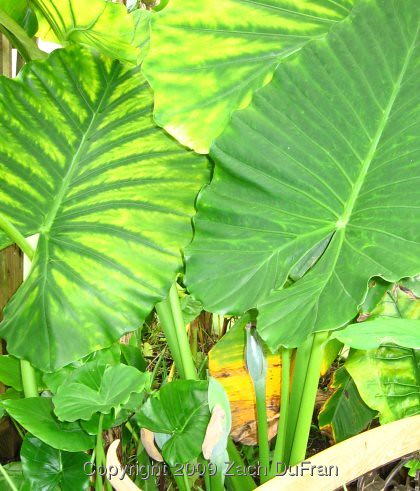
alocasia
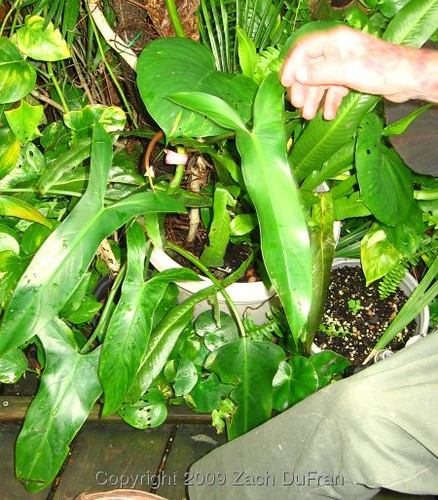
Large Alocasia growing in the Exotic Rainforest.  Notice the multiple inflorescences in the lower half of the picture.
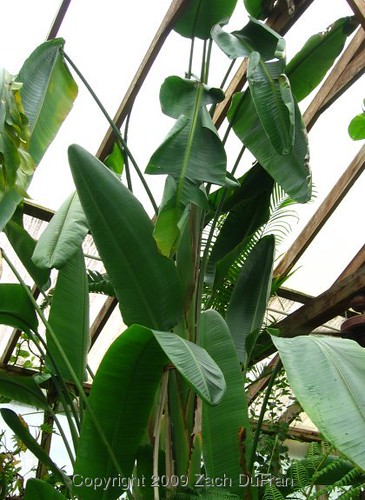
bird_of_paradise
White Bird of Paradise (Strelitzia nicolai) reaching the upper limits of the atrium.
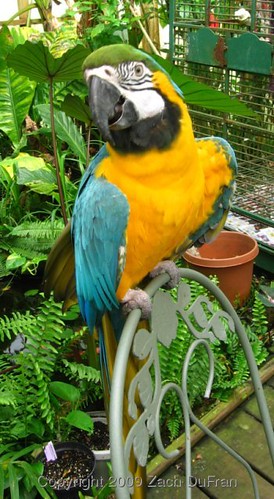
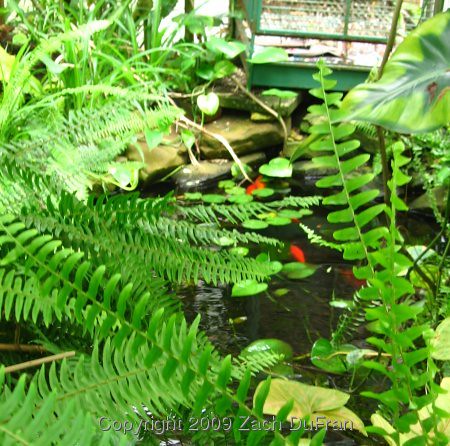
The "rainforest" is contained in a 24' by 24' atrium that is built onto the back of the private home of Aroid collector Steve Lucas.  Steve lived in Florida for a number of years, amassing a large collection of tropical plants which covered the grounds around his house.  When he decided to move to Arkansas, he was determined to continue his hobby of growing tropical plants and take what he could with him.  Others thought he was crazy, but he built a large greenhouse and turned it into a tropical paradise.  It contains somewhere on the order of 300 species of Aroids, a lot of orchids, a blue and gold Macaw, tree frogs, a waterfall and a pond stocked with fish!

wizard
Wizard, the blue and gold Macaw
pond
Pond in the rainforest atrium
tree_frog
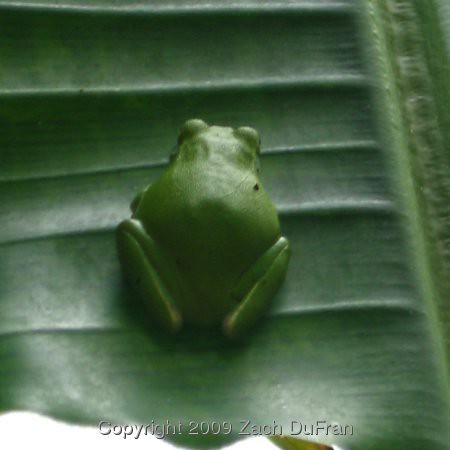
Tree frog perched on a leaf of the Bird of Paradise.
Our trip to Steve's house was something I have been looking forward to for about 6 months now.  Steve is an amateur botanist, though only "amateur" in that his professional training is in another subject.  Steve collaborates on a regular basis with many of the leading researchers focused on the Aroid (Araceae) family, and has a working knowledge of Aroids greater than anyone I know.  It was great to finally meet him after seeing lots of his pictures on his website and reading his passionate descriptions and discussions of Aroids.  Steve took me through his collection, telling me about each plant - the botanical name, commonly mistaken identities, key features, locations where it is found in nature and the story of his particular plant.

mexicanum
Steve showing me his Philodendron mexicanum (of which he gave me a cutting)
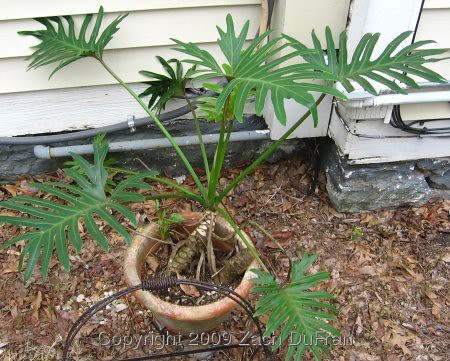
Steve has some plants in his collection with particularly interesting stories.  The plant pictured below was one of two plants used by Julius Boos and Drs. Tom Croat and Simon Mayo to write the scientific description of Philodendron xanadu.  Julius Boos gave the plant to Steve as a gift.  That's a pretty special plant!

xanadu
Philodendron xanadu plant used for formal description
Steve also has a Philodendron that is currently unnamed.  He is carefully documenting all new growth and changes that he sees and communicating that information to one of the world's leading Aroid experts, Dr. Tom Croat of the Missouri Botanical Gardens.  His hope is to have the plant produce an inflorescence this year and soon the plant will be determined to be a distinct species that had not yet been discovered.

noid
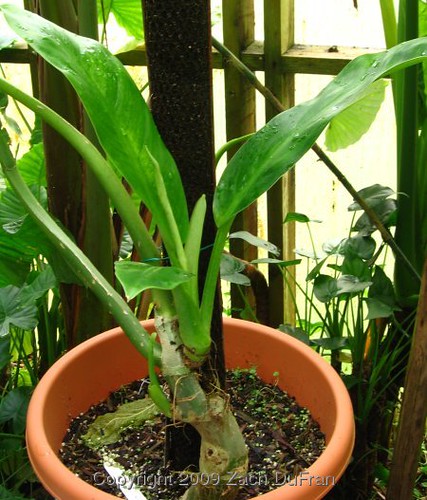
Steve's prize plant, an unidentified (and potentially undocumented) Philodendron species.
I have grown some Aroids for 3 or 4 years, but my collecting of Aroids really just began last Fall.  Steve had loads of information to share with me and was kind enough to give me cuttings of several of his plants.  Any plant that had enough stem to cut away he was willing to share.

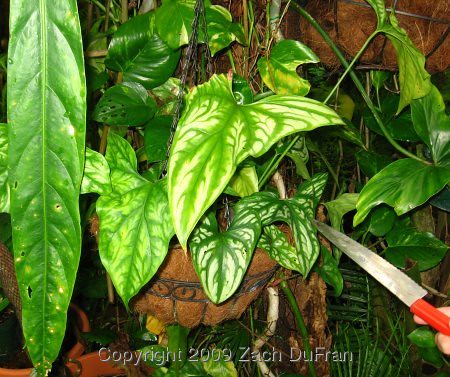
cercestis
Cercestis mirabilis. The big red knife is what Steve used to make cuttings of several of his plants for me.
Because of his generosity, I have added six new Philodendrons, one Alocasia and one Tillandsia (from the Bromeliad family) to my collection: P. atabapoense, P. billietiae, P. erubescens, P. mayoi, P. mexicanum, P. 69686, A. gageana and T. albida.

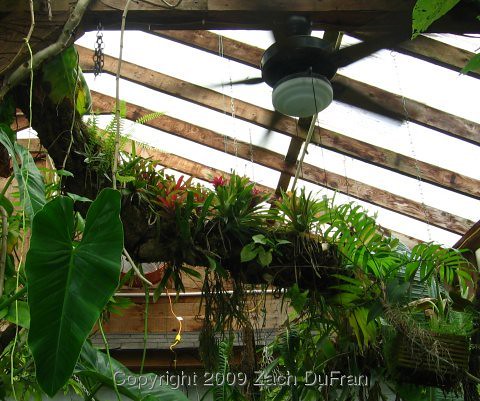
Steve has installed an artificial log wrapped in growing medium and mounted with epiphytic plants - ferns, Bromeliads, Orchids and Aroids.  As Steve says, in the rainforest, there are more plants growing on the trees than on the ground.

epiphyte_log
Artificial log mounted with various epiphytic plants - ferns, Orchids, Bromeliads and Aroids.
There is a wealth of information on his website concerning Aroids, orchids and tropical greenhouses.  He also has some wonderful pictures.  Check it out!  www.exoticrainforest.com

Wednesday, April 29, 2009

Trip Report: Muskogee Azalea Festival

My wife and I spent another weekend on the road.  This time we started by driving to the Azalea Festival in Muskogee, Oklahoma, which is about a 2 and a half hour drive from home.  I wasn't sure what to expect from this festival.  I had heard that the ice storm from December 2007 had damaged many of the older, well-established Azaleas and that they had been replaced by younger plants, which would not be mature for several more years.  I also wasn't sure what to expect in terms of Azalea-density.  I was thinking we would just drive around town and see 2 or 3 Azalea bushes in every yard.  I had heard that we should go to Honor Heights Park, but didn't really know any more than that.

panorama


Boy, were we surprised!  Honor Heights Park is a really beautiful space with a concentrated display of Azaleas.  There are also some really nice water features, including a wandering waterfall that comes down the hillside and pools a couple of times before eventually draining into the huge ponds of the park.  There are giant geese paddleboats that you can ride around the pond, if you are so inclined.
waterfall

The park was crowded with locals and visitors alike, all enjoying the nice Spring weather and the beautiful scenery.

cp_white

I was impressed with the number and diversity of Azaleas on display at the park.  I'm pretty sure I had seen all of the color varieties before, but the red variety was my favorite, a less common color for Azaleas.
pale_purple
orange_sky

Our weekend ended up being the "Weekend of Festivals."  We were also in Tahlequah, Oklahoma for the "Red Fern Festival" and in Siloam Springs, Arkansas for the "Dogwood Festival."  The latter two festivals are simply named after native plants that are in their most spectacular form during this time of year, but the festivals don't actually have anything to do with the plants, like the Azalea Festival.

cp_maple

pink_detail


Most of the Azaleas had the classic blossom like the pink Azalea pictured above.  Others had really long stamens and small petals, like the two pictures below.  They look wispy and remind me of the "Black Bat Plant."

orange_funky

pink_funky

We could tell that many of the Azaleas were youngsters that were just installed in the last couple of years.  They park will be even more breathtaking in 4 or 5 years, when they have had time to mature into larger bushes.  We had a great time and plan to visit again in the future!

cp_me_red

Monday, April 27, 2009

Book Review: Oklahoma Gardener's Guide

I have been reading a book that my mom lent me, Oklahoma Gardener's Guide by Steve Dobbs.  I am really getting a lot out of the book, because of its focus on gardening in my location.  I would definitely recommend the purchase (or at least a library checkout) of a gardening book that applies directly to your region.  I'm sure there is probably one for every state in the country.

The introduction to the book tells about gardening in Oklahoma, including a short discussion on plant hardiness and ecosystems made up of similar climates and geographies.  That discussion got me to thinking and researching a little bit more.  Most of this post is about that subject.

The majority of the Oklahoma Gardener's Guide consists of plant profiles.  The profiles include information on how to grow these plants in Oklahoma, as well as different named varieties that are available and which are best choices for our location.  The profiles are divided up into several different categories:

  • Annuals

  • Bulbs

  • Ground Covers

  • Ornamental Grasses

  • Perennials

  • Roses

  • Shrubs

  • Trees

  • Vines

  • Great Plains Plants

A large appendix includes maps and information from the following topics:

  • Planning and Starting a Lawn

  • United States Ecoregions Map

  • Oklahoma Frost-Free Map

  • Oklahoma Freeze Map

  • Oklahoma Precipitation Map

  • Oklahoma Northern Counties Map

  • Perennial Ground Covers as Lawn Alternatives

  • Beneficial Insects

  • Other Plants for Oklahoma

  • Natives as Ornamentals

  • Oklahoma Public Gardens

  • Reference Publications of Interest

  • Glossary

  • Your Garden Plans

Discussion of Plant Hardiness

In addition to the USDA Plant Hardiness Zones map, Steve Dobbs includes a map of Ecosystems in the continental United States.  There are six ecosystems identified in the United States: Pacific West, Mountain West, Desert Southwest, Great Plains, Continental East and Humid South.  The last four of those ecosystems intersect in the center of Oklahoma.  The center of Oklahoma is a sort of "four corners," dividing the state into quarters.  Lucky for me, I live right in the center of the state.  This means that gardening outdoors can be a little tricky where I live.  The map below shows a much more detailed view of ecosystems in the US.

USDA Ecological Subregions map
USDA Ecological Subregions map.  This is a more detailed map than the one shown in the book,  but still demonstrates the diversity of Oklahoma's ecoregions.

Oklahoma is known for its extreme weather, usually in the form of severe storms and tornadoes.  But Oklahoma made national news at the end of 2007 when we were hit by a horrible ice storm that tore down many trees and left others severely damaged.  It is also not unusual to have fairly long droughts during the mid to late Summer, when much of the state is behaving more like the Desert Southwest, rather than the Humid South.  Temperatures in my home town range from 10 F to 105 F in an average year.

The USDA plant hardiness zone map was updated in 1990, dividing many of the zones in two (an "a" and a "b").  Those zones have been consistently used by growers to indicate the cold hardiness of plants for several decades now.  However, the map indicates only the lowest temperature that could be expected during the course of the year.  Steve Dobbs writes that a single indicator is not enough information to convey whether a plant will survive in your yard or not.  Just as you need to take into account how much to water a plant and what sun exposure it needs, you also have to consider the relative humidity required by the plant and the heat that it can endure.  This is often described by saying that a plant is drought hardy, but being able to withstand a week without rain is different than withstanding a month's worth of high temperatures above 95 degrees Fahrenheit.  This happens in July and August in Oklahoma.

As it is now, plants that are hardy in my zone (zone 7) are suggested for here as well as Delaware and New York City.  Clearly these are very different climates and the same plant would require different care in these two locations, assuming the plant could live in both places.

There is some discussion about the USDA creating a heat hardiness map that would indicate the maximum temperature that can be expected in a year.  This map would show most of Oklahoma hitting a maximum temperature of 105-110 F.

The American Horticultural Society has produced a US Plant Heat-Zone Map that categorizes locations based on how many days each year the temperature reaches above a threshold value (86 F).  On that map, the majority of Oklahoma is in heat zone 8, with 90-120 days above 86 F.  By contrast, New York City is in zone 4, with 14-30 days above 86 F!  Now all we need is for growers to start labeling their plants by heat hardiness.  For instance, a marigold plant might be hardy for cold zones 4-9 and heat zones 7-8.  I just made that up as an example, so don't get worried if you're trying to grow Marigolds in heat zone 6.  I don't really know where Marigolds are hardy.

Most people that have gardened for more than a year or so understand that there is more to satisfying a plant's needs than just matching it with a cold hardiness zone.  But the more information that becomes consistently available for all of the plants that we see, the better for all.

Friday, April 24, 2009

The Oklahoma Redbud

In honor of Arbor Day today, I am posting about one of my favorite trees native to Oklahoma.

Probably the most beautiful natural plant growing in the state is the Oklahoma Redbud Tree (Cercis reniformis).  [By the way, Cercis is pronounced Sur-sis.]  This post contains many pictures of this tree and only one of the pictures was taken more than 3 miles from my house - most of them are from within a couple of blocks.

large_redbud
Large Redbud Tree (Cercis reniformis) in my neighborhood.  Sadly, about a third of this tree was damaged and lost in the December 2007 ice storm, but it is still alive and blooming each Spring.
To me, this tree is tied to the part of our state history that most Americans know pretty well.  Oklahoma was first opened to settlers in a series of "Land Runs," where prospective owners lined up and waited for a gunshot before setting off to stake a claim to their future homeland.  [The final 30 minutes of the movie "Far and Away," starring Nicole Kidman and Tom Cruise, captures the moment in history.]

shutter_redbud
Beautiful Redbud tree (Cercis sp.) in another neighbor's yard.
My wife's family was involved in the Land Run of 1889 and claimed the land where my parents-in-law currently live, surrounded by dense woods.  Much of the land has been untouched and is in its pristine, natural state.  Last Spring, my wife and I wandered around on the land and dug up some of the Oklahoma Redbuds (Cercis renifomis) which grow there naturally and transplanted them to our house.  In our day and age, most everything I have growing at my house was started in a greenhouse or by some professional grower and transplanted to my yard.  These transplanted native trees are a little more special, knowing that they were never touched by human hands before me.  They are completely the artifacts of nature, with no human intervention.

perfect_redbud
A wonderful, old Redbud (Cercis reniformis) near our house.
[I should note here that we only transplanted two trees and did not destroy any ecosystems.  The trees seed very well and there are many more to take their place.  The balance of nature has not been disturbed.] :)

old_redbud
A beautiful, old Redbud (Cercis reniformis). Try to ignore the trash cans sitting under this tree.
When my wife and I went out on our Redbud transplanting expedition, my parents-in-law warned us that our transplants wouldn't survive.  In the 15 years they have lived there, they have tried relocating some of the trees from deeper in the woods to a location visible from their house.  They have never had a successful transplant.  That didn't bother us much.  We barely even got roots with our two 6-8 foot saplings, but both of them survived the transplant and are growing very well in our yard.

redbud_blooms_2008
Oklahoma Redbud Tree (Cercis reniformis) blooms. This is one of the trees we transplanted from my wife's family's land to our yard in town.
The Redbuds in town start blooming in mid March, with the Redbuds outside of town following 2 to 3 weeks later.  My wife and I have observed this consistent phenomenon for the last several years.  We assume that it is attributable to the "heat island" effect, but I'm kind of surprised that the small city of Norman, Oklahoma would have such a strong affect.  [According to the US EPA website, a city with a population of 1 million people will be 1-3 degrees Fahrenheit warmer than the surrounding rural areas.  Norman is just about 100,000 in population.]

The blooms persist for more than a month and then fall away as the trees start to leaf out.  I wanted to add some more pictures to this post to show the variability in coloration and form of different Redbud trees.  There are wonderful examples all over town, but what better place to go than a college campus for beautiful trees and landscaping?  The University of Oklahoma is right here in my hometown of Norman, Oklahoma.

redbud_fountain
Redbud trees (Cercis sp.) on campus of the University of Oklahoma
soccer_fence_row
Redbuds (Cercis sp.) planted along the length of the University of Oklahoma women's soccer field.
redbud_seeds
Redbud (Cercis sp.) blooms and hanging seed - University of Oklahoma campus
redbud_heavy_seeds
Redbud tree (Cercis sp.) covered in seeds and blooms across the street from us.
new_sapling_leaves
One of our transplant Redbuds (Cercis reniformis) beginning to leaf out.
There is a pretty large Redbud tree in our neighbor's yard, right next to our shared fence.  The tree overhangs our yard and sheds its seed.  We have quite a few little 3-4" saplings that come up every Spring.  I have transplanted several of them to pots to let them mature, while the others get mowed over.

small_redbud
Small Redbud tree (Cercis reniformis) that grew in our yard - about 4 inches tall.
After they have gotten large enough, I will give these little trees away to friends and family that want a Redbud tree.

trunk_blossoms
Redbud (Cercis sp.) blossoms forming in clumps along the branches of a tree in our neighborhood.
I carried my camera around town with me for a couple of days and took pictures of about 50 different Redbud trees.  I was hoping to show the color variation in these trees, but the pictures don't quite show what I see with my own eyes.  Regardless, I have lots of beautiful Redbud pictures.  I was successful in documenting the different forms of trees that I have seen.  The older trees more closely resemble the native trees that my wife and I saw when we went hunting in the woods.  The newer trees that are being planted in many yards are nursery-grown and nursery-"improved" trees.  I don't know if the trees are actually different species or if the nursery does something to "improve" the trees.  They usually have much thicker trunks and the branches are more dense.

thick_trunk_redbud
A nursery-grown Redbud tree (Cercis sp.). The form of this tree is very different than the ones you find naturally growing in Oklahoma.  It might be an Eastern Redbud (Cercis canadensis), but I don't know for sure.
Most of these nursery trees are really well shaped.  Some are not (below).

skinny_redbuds
Two very funny looking Redbuds (Cercis sp.) growing in a neighborhood near my house.  The one on the right looks more like a Crape Myrtle than a Redbud.
The nursery-grown trees are beautiful, but I wonder if they will be much like the Bradford Pear Trees that are all over town.  The Bradford Pears have been improved for branch density so much that they are constantly splitting because they can't support their own weight.

The Redbuds that I see around town that are not Oklahoma Redbuds (Cercis reniformis) are most likely the Eastern Redbud (C. canadensis), which I see a lot at nurseries.  A couple of weeks ago I saw a new variety of the Eastern Redbud (Cercis canadensis) for sale.  It is called 'Forest Pansy,' and has shiny wine red leaves in the Spring, which turn green but keep the purple tinge during the Summer.  In Fall, the leaves turn yellow and orange like many other trees, while keeping some green and purple as well.  I imagine this will become a very popular tree.  You can read some more about the cultivar here.  After seeing one specimen at the store, I saw two planted at the Fort Worth Botanic Gardens over the weekend.  They had begun to turn green and I really liked the mix of red and green leaves.

forest_pansy
Cercis canadensis 'Forest Pansy' at the Fort Worth Botanical Gardens
Another interesting species in the Cercis genus is Cercis siliquastrum, the Judas Tree.  This tree grows in the Mediterranean region.  It derives its common name from a supposed myth that states that this is the species of tree by which Judas Iscariot hung himself after betraying Jesus Christ to the Roman soldiers.  There is speculation that this name and the associated legend came from a mix up in translation, whereas the name should actually be "Tree of Judea," not "Judas Tree."  Since the tree grows in the region of the New Testament events, someone mistranslated and then a legend was born.  A motive was not established, but the tree was in the right place at the right time.

I hope you have enjoyed my Redbud pictures.  If you're interested in a little sapling, let me know!  I have several available.

For full disclosure, I must admit that I don't know the exact species of many of the pictures in this post.  The Cercis genus is composed of about 20 species of trees.  I have seen Redbud trees around town with varying colors (from bright pink to dark purple) and varying forms (from short and stalky to long and sparse branches).  However, I am not enough of an expert on this genus to pick out the different species.  I happen to know that the greenhouse grown trees have a shorter, thicker form than the ones that I find naturally growing in Oklahoma forests.  I also know that some of the color variation just depends on what phase of bloom the tree is in.  Before the buds open they are dark purple and the blooms turn lighter pink as the petals emerge.  I tried to label all pictures accurately.  When "Cercis sp." is used, I don't know the exact species.