Showing posts with label Anacheilium. Show all posts

Thursday, May 24, 2012

Trip Report: OKC Orchid Show, part 2

I have already posted about a dozen photos from the OKC Orchid Show, so check those out, if you haven't already.
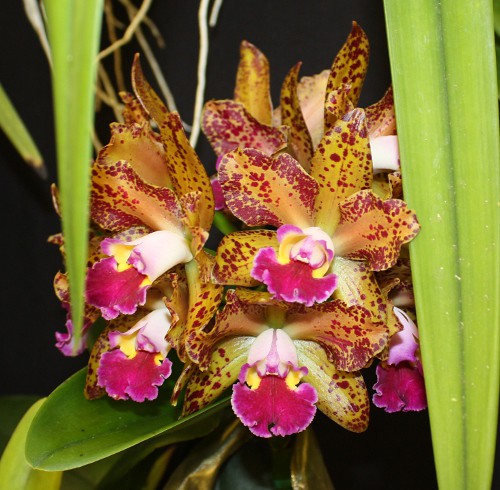
ryncholaeliacattleya_waianea_leopard_ching_hua
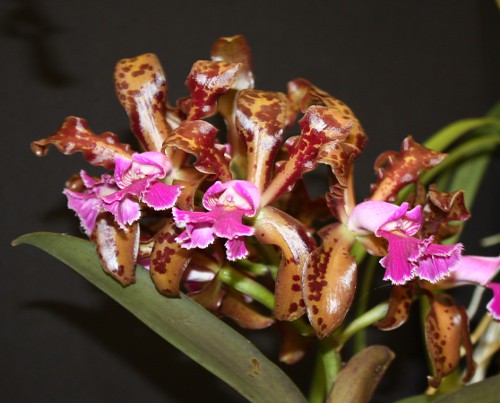
Blc. Waianea Leopard 'Ching Hua'
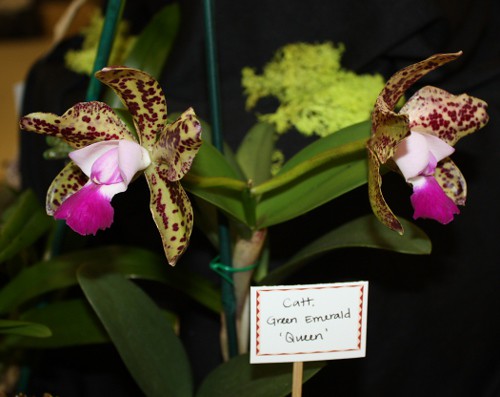
Just like there are "Vanda People" and "Slipper People," there are "Catt(leya) People." I have to say that I am not one of those people. Cattleyas tend to be large flowers that are kind of frilly like bearded Irises, and they just don't appeal to me that much. That being said, I do enjoy some Cattleyas, mainly the spotted ones, and I am posting photos of those.
catt_green_emerald_queen
Cattleya Green Emerald 'Queen'
catt_schilleriana
Cattleya schilleriana
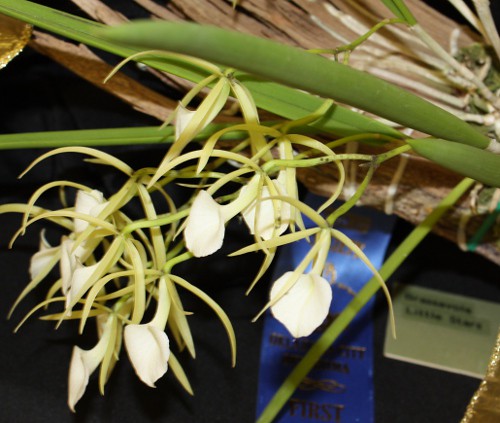
Brassavola nodosa is a popular orchid that is known for its fragrance, but only in the evening. There are several cultivars or hybrids made with this species, including Brassavola Little Stars (below).
brassavola_little_stars
Brassavola Little Stars
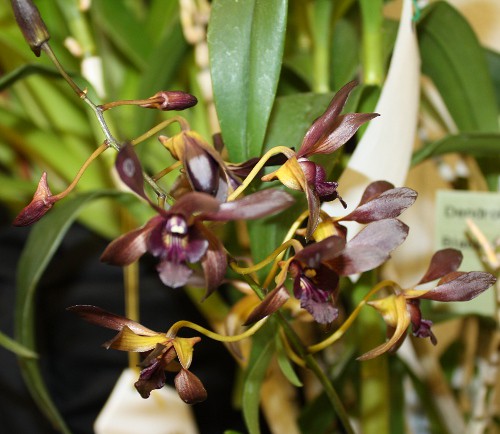
By far the coolest thing I saw at the show was the Dendrobium Black Spider. I haven't ever seen a black Dendrobium, or really anything close to this dark. When I was helping tear down the exhibits on Sunday I complimented the grower on her black Dendrobium and she kind of shrugged and didn't say anything. I guess some people are less interested in discussing their plants than others. Or maybe she was just tired from the weekend...
den_black_spider
Dendrobium Black Spider
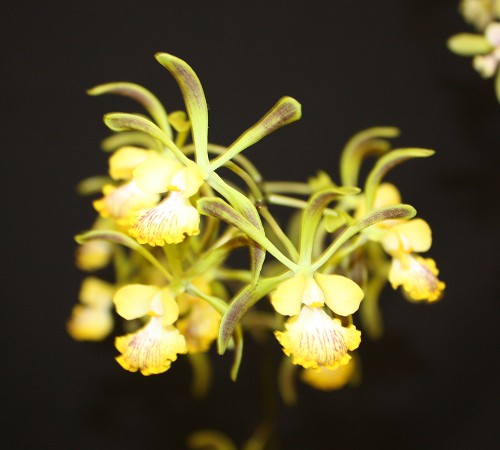
I don't know whether Encyclias are more popular around here than I had previously thought, or if I am just paying more attention to them this year, or if this is just a really good blooming year for them. Whatever the case, there were many Encyclias on display in Wichita and in Oklahoma City.
enc_alata
Encyclia alata
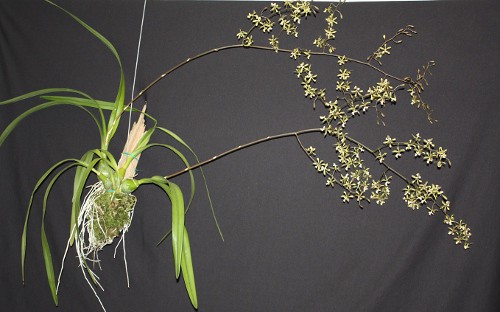
The plant above is the species Encyclia alata and the plant below is a primary hybrid of Encyclia alata and Encyclia mooreana. Both are awesome plants.
enc_alata_x_mooreana
Encyclia alata x mooreana
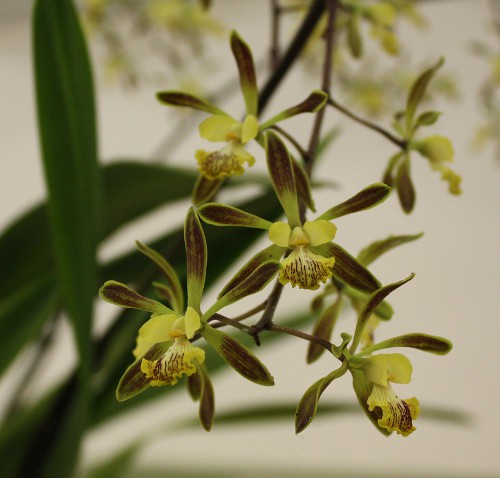
The large primary hybrid above and the species below were both featured as the centerpiece of their respective displays. In fact, that photo above was taken before any of the rest of the plants were in place. (I wouldn't have been able to get such a picture of just this plant once the exhibit was assembled, because many other plants were crowded around it.
enc_alatum_majus
Encyclia alatum majus
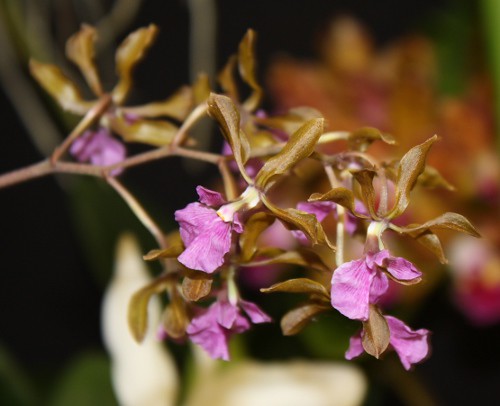
Don't you just love the colors of the Encyclia hanburii (below)?  Just awesome!
enc_hanburii
Encyclia hanburii
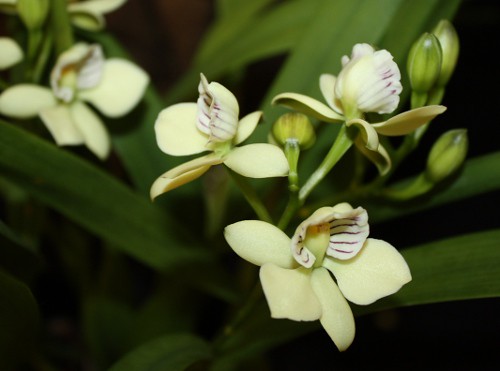
The odd ball Encyclia at the show is one of those that keeps getting shuffled around taxonomically.  It has been in several different genera, including Encyclia, Anacheilium, Prosthechea and, of course, the original catch-all genus Epidendrum.  According to orchidspecies.com, which is what I normally consider the authority, it is currently classified as Anacheilium radiata.
enc_radiata
Encylia radiata
I hope you enjoyed your virtual participation in the Oklahoma Orchid Society show.  If you're in the area, you should try to attend in person next year.  We always have our show on Mother's Day weekend at the Will Rogers Garden Center in Oklahoma City.

Wednesday, August 3, 2011

Octopus orchid update

I now have the school of octupi that I was hoping for.  There are now 3 flowers completely open and one more bud that could open in the coming weeks.

Anacheilium cochleata blooms
This little orchid has moved up on my list to near the top.  I hope that what I have read about it blooming on each new growth (virtually year round) is true.  The next growth could be just about ready to produce blooms by the time this one finishes.

Thursday, July 14, 2011

Octopus orchid in bloom

I purchased an octopus orchid (labeled Encyclia cochleata, but actually Anacheilium cochleata) on eBay back in January.  At the time, the plant had a bloom spike.  However, the travel was too taxing on the plant and the spike quickly withered, so I didn't get to see the weird little blooms.

Encyclia (Anacheilium) cochleata
Anacheilium cochleata shortly after I noticed the bloom spike for the first time.
However, the seller did mention that this orchid blooms on each new growth (pseudobulb).  What I didn't notice was that the largest growth on my plant was actually the "new" growth that hadn't yet bloomed.  When a newer growth started recently I got excited, thinking that a couple months from now, it might start to bloom.  But then shortly thereafter I noticed there was a bloom spike growing out of that larger pseudobulb!

Encyclia (Anacheilium) cochleata
Anacheilium cochleata flower almost open
Doesn't this orchid have the coolest flowers?

Encyclia (Anacheilium) cochleata
First Anacheilium cochleata flower
I was operating under the assumption that the genus name Encyclia was correct for this plant, but I was surprised that the bloom shape looks so different from the other Encyclias. Then I found out that this and a couple of other plants have been tossed around among a couple of different genera over the years - including Prosthechea, Encyclia, and Anacheilium. For now, the taxonomists seem to have settled on the last one. Many people in the orchid world just refer to this plant by it's species name (cochleata), since that is the only part of the name that has stayed consistent.

Encyclia (Anacheilium) cochleata
Anacheilium cochleata buds and back side of bloom
There are a total of 5 buds on my orchid right now, so hopefully I will have a little "school" of octupi soon. I don't know if "school" is really the right word. There might not be a correct word for a group of octopus, since I don't think they are social creatures, by nature.

One reason the blooms of this orchid look different from many Encyclias is that they are resupinate, which means they are upside down from the normal orientation. Regardless of whether this is an Encyclia or not, or has the same orientation of normal Encyclias, I seem to be drawn to plants which have had the name Encyclia attached at some point or another.  I think one thing that attracts me to many Encyclias is the color combinations in the blooms.  Many of them are kind of a brown/mauve background, sometimes with a splash of color, sometimes not.  Some of them almost look like dirt.  Sounds pretty cool, huh?  A flower that is the color of dirt.  Anyway, I like them.  Check out these Encyclias!

I have one true Encyclia in my collection - Encyclia polybulbon.  It is a mounted specimen that has neat, yellow brown blooms.  One really nice thing about Encyclias for me is that they are mostly small, so I can have quite a few of them without taking up too much space.  Some people would consider their small blooms to be a downside, but I like their size - and their dirt brown blooms.