Showing posts with label Jatropha. Show all posts

Thursday, March 22, 2018

Galveston update

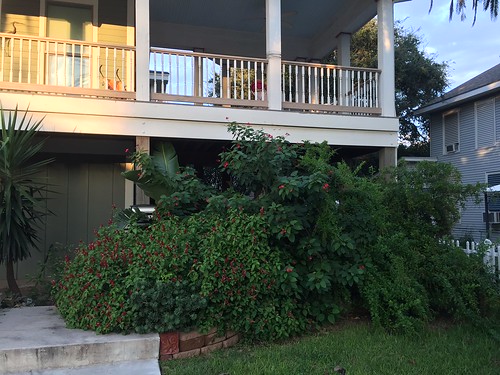
It's hard to believe I never did an update post on the Galveston garden that I planted back in 2012.  My life did change quite a bit from that trip onwards, as that is when I found out I was going to be a dad.  My blog posts trailed off a lot after that... Well, it's been over 5 years now, so it seems like a great time to check in on my semi-tropical garden. Most of these update photos were taken in October, 5 years after the original planting of the garden.

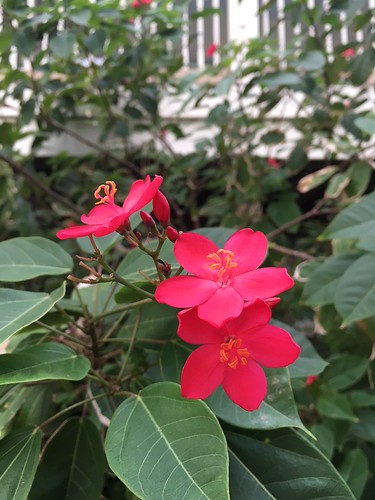
Jatropha
Jatropha

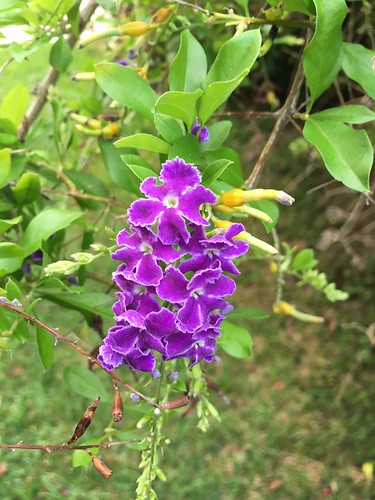
Duranta
Duranta
As with any garden I've ever planted, some plants thrive much more than others, and some succumb to one or more factors.  More often than not, those factors in my home gardens are heat and drought, occasionally to a hard winter.  I can safely say none of those factors have taken a toll on the plants in Galveston.

galveston_right_finished
The garden on the right side at time of planting, October 2012.
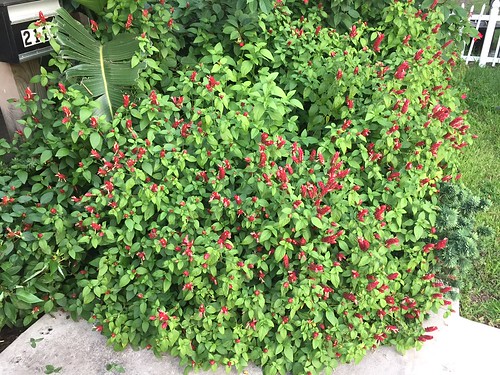
Can you even see the Justicia?  It's the lanky little stem with few leaves just below the black Crape Myrtle in the image.
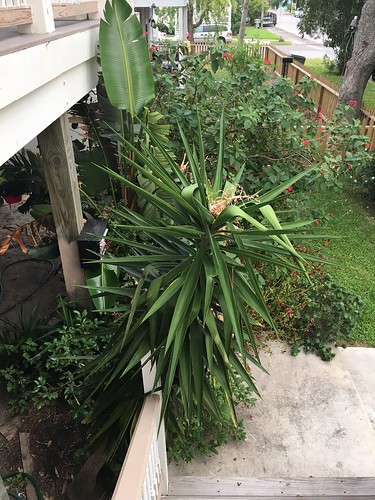
See the struggling Yucca?
It seems my biggest issue in Galveston is competition.  A few aggressive growers have expanded faster than I expected and drowned out all the sunshine from their neighbors.  The biggest offenders are Bougainvillea, Red Shrimp Plant (Justicia bandegeana), Allamanda, Duranta, Plumbago, and Jatropha.

right garden
The garden on the right side, as seen in October 2016, before trimming.
The Black Diamond® Crape Myrtle (Lagerstroemia indica) is still alive, but it is struggling to get enough sunlight because of the Shrimp Plant.  That plant and a Yucca (far left of image above) have really surprised me with their rate of growth.  The Shrimp plant was a lanky little twig when I planted it.  Now it's 6 feet in diameter, and only because I whack it back on a regular basis. The Yucca was about 4 feet tall and only had 4 struggling leaves when it was planted.  Now the base of the tree has enlarged, it is about 7 feet tall, and has a nice head of green leaves.  It even bloomed recently!

Galveston garden
The Yucca has really grown in height and you can see the remains of an inflorescence in this photo.
Unfortunately I didn't get to see it in flower.

Justicia
Red Shrimp Plant (Jatropha) as seen from above. The mailbox is becoming out of reach.
We visit Galveston a couple of times a year and on most of those trips I have spent an afternoon out in the yard, trimming. One of my priorities is always to cut back all of the growth in front of the mailbox, so that the postal worker can get to the box, which you can see is hard to access in the photo above.

mailbox after trimming
More accessible mailbox after trimming.
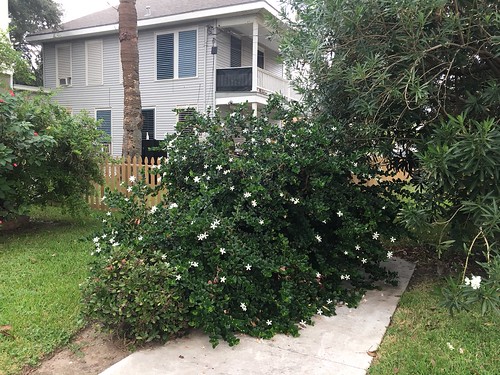
The trimming can be a heavy chore with the rate of growth of some of these plants.  And with the nasty thorns on the Natal Plum and the Bougainvillea, it can be a painful chore. The Natal Plums are covered in little white star-shaped flowers much of the year, which are followed by small edible fruits that my mother-in-law has used to make tiny tarts.

Natal Plum
Natal Plum covering the sidewalk. Luckily the sidewalk is just a segment that ends at each end of the yard, so no one used it anyway. It is required by the City of Galveston on all new construction. Who knows when a sidewalk will be installed in either of the neighbor's yards...
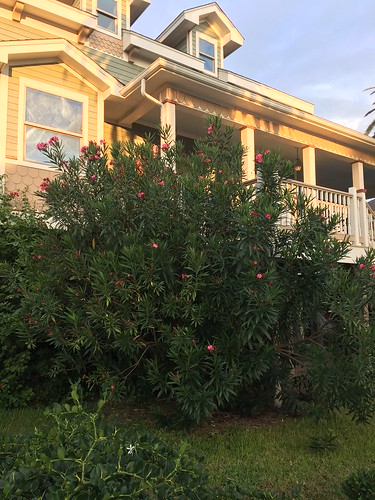
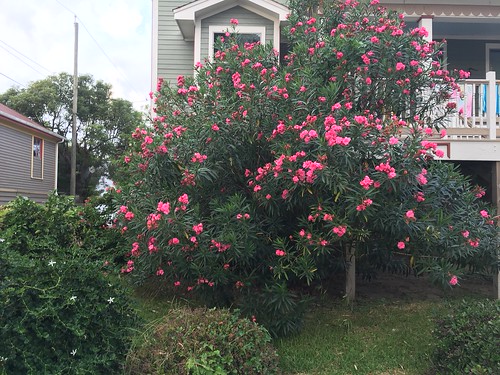
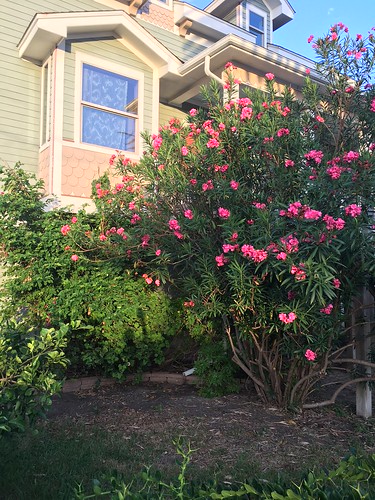
One of the Oleander we planted after the initial planting has shot up to the top of the stairs, which is really cool because the flowers are very fragrant and they are at nose level both on the ground and at the landing of the stairs. I still have to spend quite a while trimming the lower branches that grow horizontally.

left garden
Large Oleander towering up to the second story, October 2016.


Oleander
Another view of the dominating Oleander before trimming.

plumeria and bougainvillea after trimming
Some better definition, exposure of the yard and garden border, after a thorough trimming.
We also have a few invasive vines that I have to keep pulling up.  I gave up on ever ridding the garden of them, so I just try to keep them in check.  Sometimes it's easiest to just find them where they are coming up from the soil and clip them there.  It takes a long time to unwind them from all of the places they are climbing in the bushes.

The prize for plant that I didn't think would make it at all is a Bromeliad that my mother-in-law received as a gift and didn't want to keep growing in a pot in her home.  She planted it in the garden in Galveston and I figured it would surely be a goner in a few short months.  Much to my surprise, it has done well there and even flowered several times since it was planted in the ground.

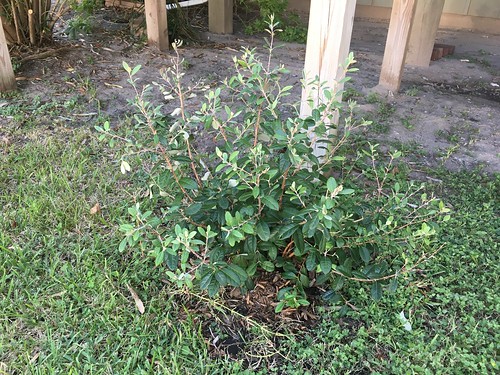
Pineapple Guava
Pineapple Guava

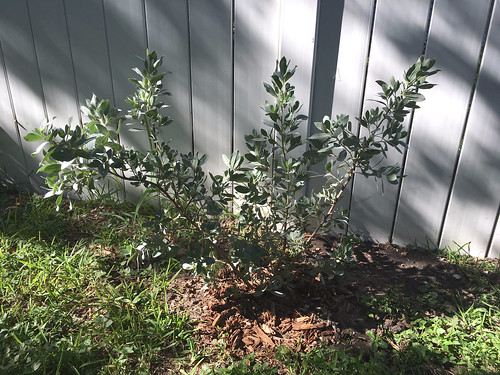
Buttonwood
Buttonwood
Late last year we added a couple of new bushes, a Pineapple Guava and a Buttonwood. Who knows if either of these will become monsters? To be continued.

Thursday, August 2, 2012

Trip Report: Interesting trees at Gardens by the Bay

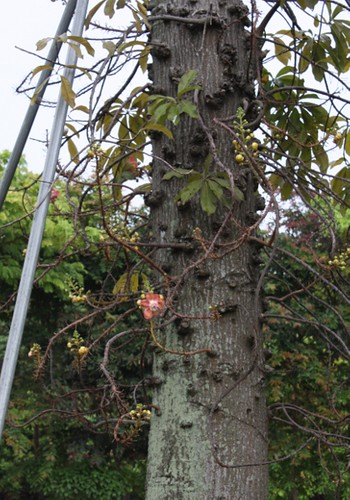
Even though much of Gardens by the Bay has just recently been planted, the garden planners went all out to purchase mature trees from all over the world.  For example, check out the size of this Cannonball tree!
cannonball_tree
Couroupita guianensis, the Cannonball tree
Yes, I have seen a larger one, but it must have been in place for a hundred years or more.  The tree at Gardens by the Bay was just planted!  So, you can see it is just starting to bloom.  Soon it will have cannonballs all over the trunk.
coccoloba_rugosa
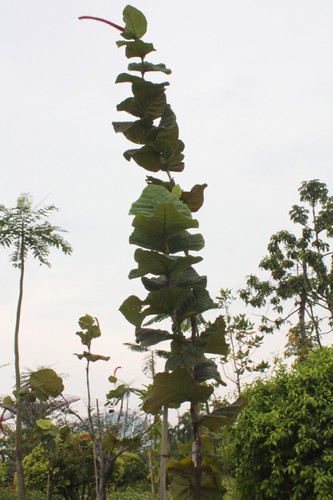
Coccoloba rugosa, the Red-Flowered Sea Grape
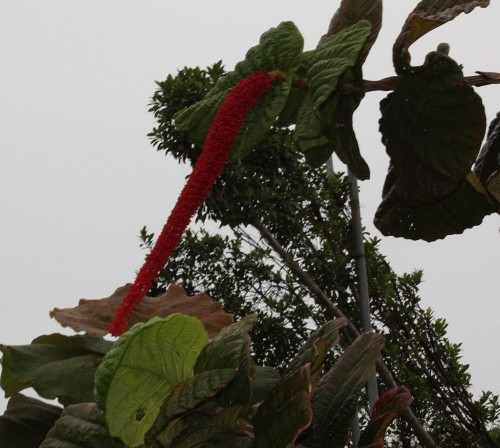
In one grove of trees there were a couple of really neat, large leaved trees.  Coccoloba rugosa, the Red-flowered Sea Grape, was a tall skinny tree, with large, round leaves and blooms emerging from the top.
coccoloba_flower
Coccoloba rugosa flowers
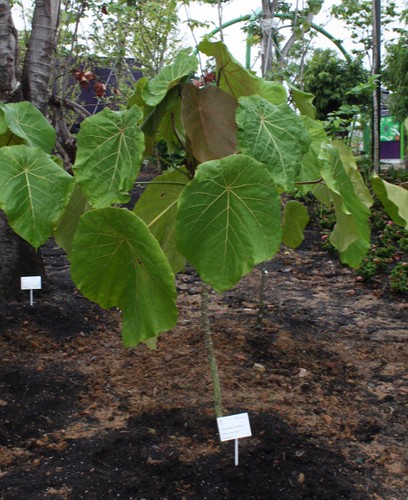
Another large-leaved tree is Macaranga grandiflora, the Parasol Leaf tree.
macaranga_grandiflora
Macaranga grandiflora, Parasol Leaf tree
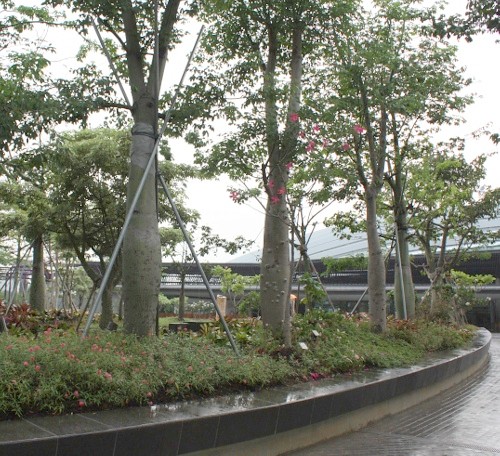
The Silk Floss tree (Ceiba speciosa) is one that I am familiar with from the Myriad Gardens.  The most prominent feature of this tree (when not in bloom) is the large thorns covering the trunk of the tree.  One area of the gardens is planted with a bunch of Ceiba.  It is curious to me that some trunks are covered in thorns and others are almost entirely smooth.
ceiba_grove
Grove of Ceiba speciosa (Silk floss) trees
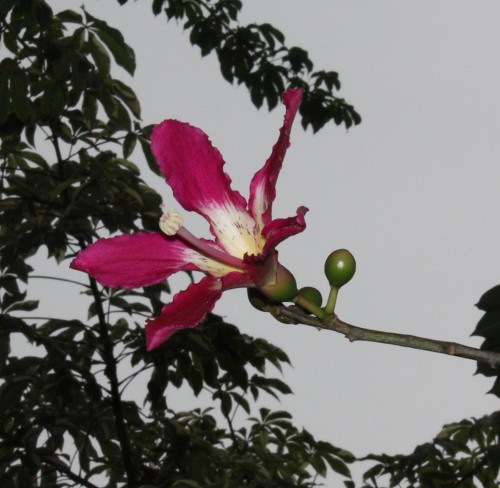
In bloom, this tree has beautiful pink flowers.  After the blooms are pollinated, they produce seed pods that open to reveal some fluffy silk-like threads surrounding the seeds.  This is where it gets its common name.
ceiba_flower
Ceiba speciosa flower
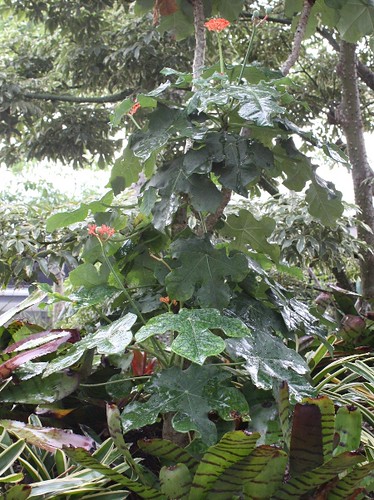
Another tree with nice flowers was a Jatropha.  Does anyone know what species this is?  It has really neat leaves to accompany the vibrant orange flowers. [Update 2012-09-04: Tom commented that this is probably Jatropha podagrica.  Thanks Tom!]
jatropha_orange
Jatropha podagrica with orange blooms
theobroma
Theobroma cacao
The cacao (chocolate) tree, Theobroma cacao, will start blooming and producing fruit at a small size.  That's good news, because this tree is only about 8 feet tall.
layered_tree
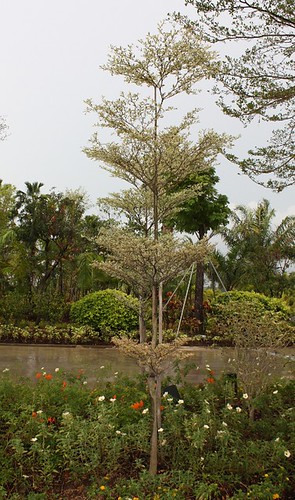
Beautiful layered tree, Terminalia mantaly 'Tricolour'
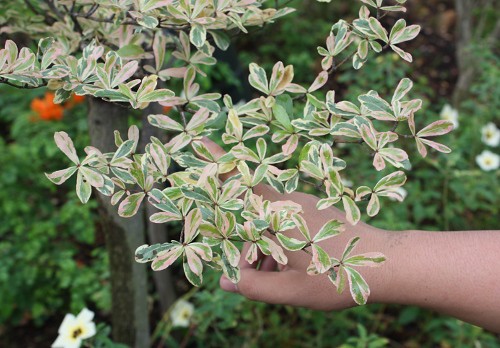
One of my favorite trees in the outdoor gardens was this beautiful tree (Terminalia mantaly 'Tricolour') that naturally grows in layers.  The leaves are patterned in white, green and a touch of pink.
layer
Colorful leaves of the layered tree, Terminalia mantaly 'Tricolour'
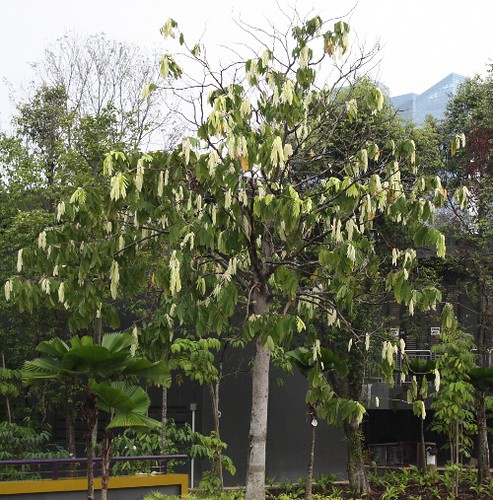
From a distance, I thought this next tree was blooming or had hanging fruit.  As I approached, I realized it was just the new emergent leaves that hang down and reflect light with their glossy texture.
emergent_leaves
Tree with conspicuous emergent leaves
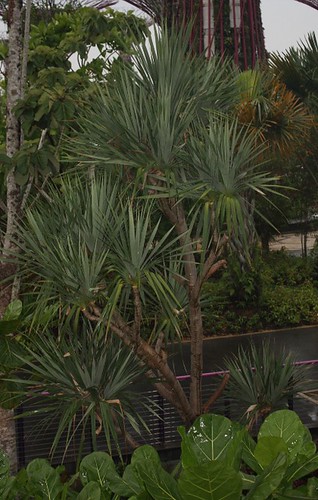
Until my trip to Singapore, I thought Pandanus was a genus only consisting of large, stilt-root trees.  While at the gardens, Shawn pointed out several small plants and shrubs that he said were Pandanus.  One tree that I knew was Pandanus was this large tree.
pandanus
Pandanus tree
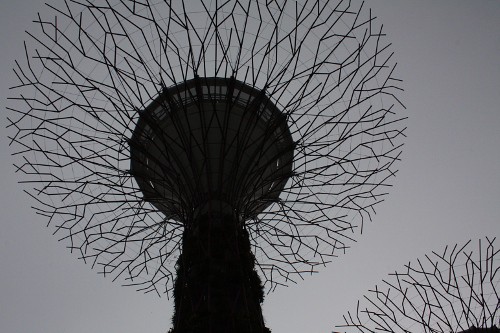
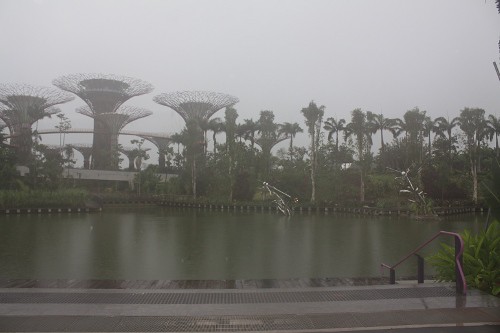
The last "trees" I will show you are not living trees, exactly.  They are the gigantic metal "supertrees" which are visible from anywhere in the gardens.  They are covered with bromeliads and other epiphytes, which will fill in over time.
under_supertrees
Under the Supertrees
Due to the overcast sky, I really couldn't get a good photo of these trees, but here are some highly backlit photos anyway.
supertrees
The Supertrees under a rainy sky