While on vacation in Hawaii this May, my wife and I visited the Foster Botanical Garden in Honolulu. In Oklahoma, a tropical botanical garden would necessarily reside in an enclosed structure. Not so in Hawaii. The only enclosed structure on the grounds of the Foster garden is to keep a group of hybrid orchids in a pristine environment, where they will not spread into the wild or cross with naturally occurring species.
The Foster Botanical Garden has a long history, dating back to 1853. [You can read about the history
here.] The garden includes areas dedicated to orchids,
hybrid orchids, Cycads, palms, bromeliads, Aroids, gingers, and Heliconias. Unfortunately I wasn't able to see the Hybrid Orchid greenhouse because I took too long in other parts of the garden and the garden closed before I got there.
 |
| Map of Foster Botanical Garden |
I would like to just give a run down of the specific sections of the garden and then point you to my photo album, which I'm sure you will enjoy! :)
Exceptional Trees
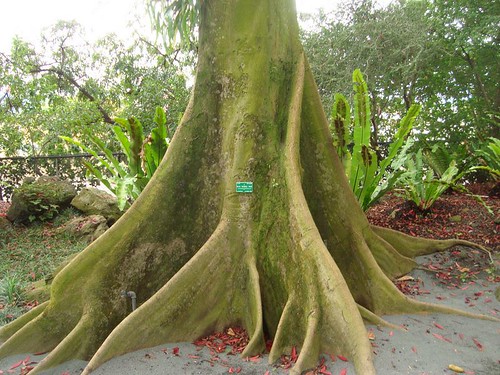
The Foster Botanical Garden has a wonderful collection of 24 "Exceptional Trees." Exceptional Trees are those that have been designated as trees which are to be protected and cannot be cut down. According to the legend, one of these trees is the offspring of the tree under which Buddha sat when he gained his knowledge. You can see pictures of many of the very large trees in my photo album. A couple of the exceptional trees are palms, of which the Foster BG has more than 100 different species.
Palms
There are literally hundreds, if not thousands, of palm trees in this relatively small botanical garden. Not being a connoisseur of palm trees, many of them look the same to me. However, there were about 10 different species that really stuck out, including the Double Coconut Palm and the Grugru Palm. The palm trees ranged in size from about 8 feet tall to well over 80 feet tall. Their trunks varied from smooth to covered in spines (the Grugru palm).
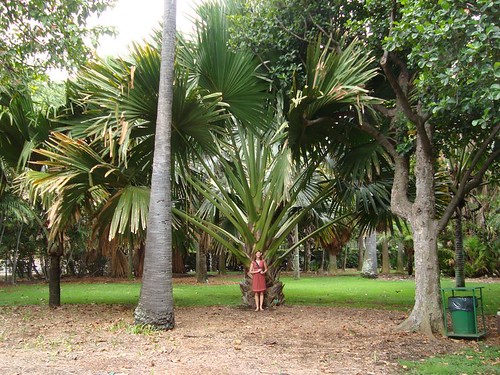 |
| Christie standing in front of a huge palm tree with spreading fronds |
Cycads
On first glance, many cycads look like members of the palm family. But they are a very different family of plants, and can grown into the subtropical and temperate zones, including Oklahoma. These plants are displayed in the "Prehistoric Glen" of the Foster Botanical Garden. Cycads are among the oldest trees in the world. The individual trees themselves are not the oldest plants, but the species have been found in the fossil records dating back to the age of the dinosaurs!
Heliconias, Gingers and Marantas
The botanical order Zingiberales contains the families Heliconiaceae, Zingiberaceae and Marantaceae - which were all featured in the center terraces of the Foster BG. Of course, I am a huge fan of plants from the Marantaceae family. I was surprised to find many plants from this family were labeled with incomplete signs, such as "Calathea plant, Calathea sp." It was as if they had tried to determine the species and had been unable. I have had this problem quite often with this family of plants. It is surprising to me that for such a beautiful group of plants, the names are not more widely known.
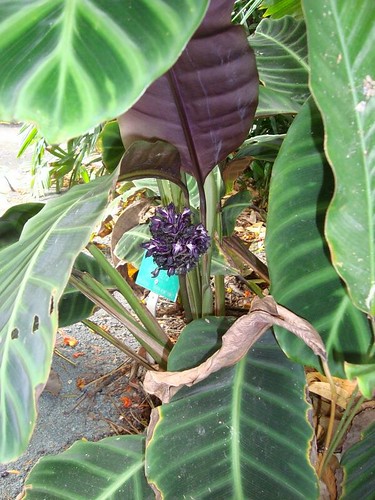 |
| Calathea picturata inflorescence |
There was a beautiful flowering specimen of
Calathea picturata and many flowering
Heliconia. Unfortunately, many of the Gingers were not in bloom while I was there. I did see them blooming in other parts of Hawaii though - and I brought back 5 different varieties to grow at home.
Orchids
There is a great collection of orchids, mounted on stumps and tree trunks and planted in the ground. One of them is appropriately named "The Giant Orchid" (
Grammatophyllum speciosum). It has long, wandering stems that arch towards the ground and was probably a good 8-10 feet in diameter!
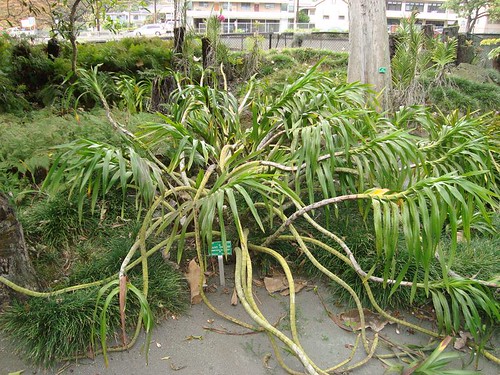 |
| Giant orchid (Grammatophyllum speciosum) |
It's simply amazing to see these plants growing outdoors. I would never think of putting one of mine outdoors.
Odds and Ends
There are certainly some oddball plants at the Foster BG. One of these was the Cannonball Tree (Couroupita guianensis), which has tendrils growing down it's trunk that are covered in blooms that look like orchids. Later, very large nuts form on these tendrils that look like a large, round coconut (or a cannonball). As they mature, they begin falling from the tree. Weighing somewhere around 20 pounds, these large nuts can be dangerous to someone not paying attention!
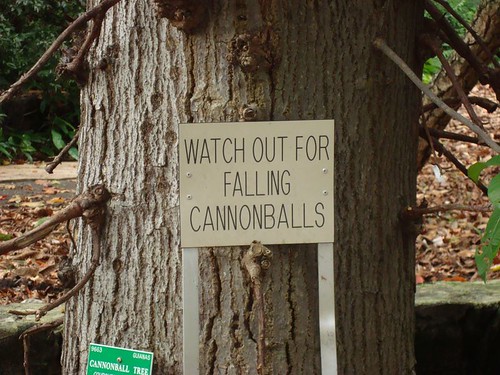 |
| Warning sign under the Cannonball Tree (Couroupita guianensis) |
Another odd specimen at the garden was the Buddha's hand citrus tree (Citrus medica var. sarcodactylus). I had seen pictures of these truly odd fruits before, but not seen one in person until I was here.
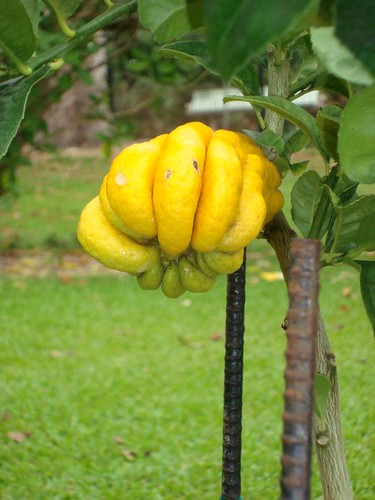 |
| Fruit of the Buddha's-hand Citron (Citrus medica var. sarcodactylus) |
To see all of my pictures from the garden (289 of them) click on the image below. Enjoy!