Monday, January 25, 2010

Beefsteak Begonia starts

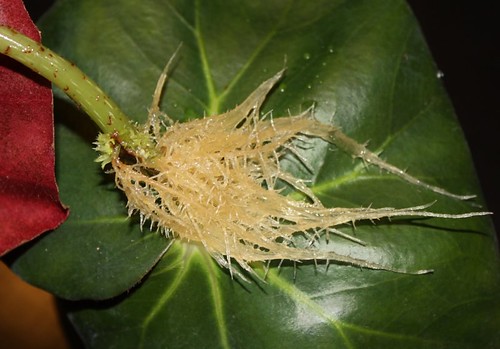
My neighbor across the street gave me four cuttings of her large Beefsteak Begonia (Begonia ‘Erythrophylla’) for me to root.  Begonias are generally pretty easy to root from leaf cuttings.  These cuttings took about a month to produce a nice set of roots.

begonia_roots
Roots began to form after just about a week in water
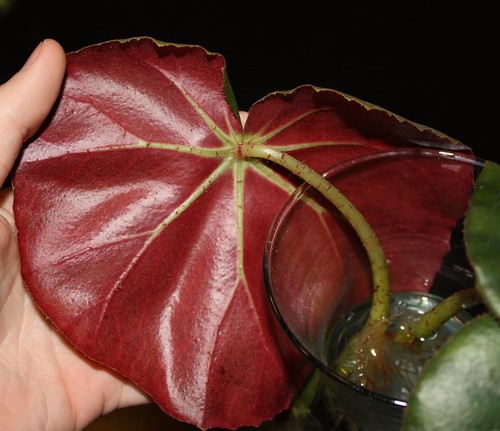
The beefsteak Begonia has very large, waxy and thick leaves.  They are dark green on top and purple underneath.

begonia_under
Underside of the Begonia leaves
The petioles are rough with small hairs.  It is a very attractive plant, that is usually pretty dense with leaves that droop down to the soil surface, or over the edge of the pot.  You couldn't even see the pot buried  underneath my neighbor's plant.  I'm hoping to have as much luck with my cuttings.

Friday, January 15, 2010

Announcement: Plant meeting at the Missouri Botanical Gardens

I'm happy to announce that the MidAmerica chapter of the International Aroid Society (IAS) will be having their second meeting at the Missouri Botanical Gardens (MOBOT) in St. Louis, Missouri on April 24th.  The MOBOT has one of the largest research collections of Aroids in the world, the largest herbarium, beautiful outdoor gardens and the world famous Climatron tropical conservatory.  The MOBOT is one of the largest botanical gardens in the country and well respected by other botanical gardens worldwide.

All plant enthusiasts are invited to attend the events of April 24.  You don't have to be a member of the IAS or even know what an Aroid is.  (If you like plants, then you probably know a bunch of different plants from the Aroid family, but just didn't know they were related.)

We have a full day of activities planned, but you can just attend half, if you would like.  Here are a couple of highlights:

  • Dr. Thomas Croat will be giving two formal presentations on his research with Aroids and will also be leading tours of the herbarium, greenhouses and the MOBOT grounds.

  • Joep Moonen will be in town from French Guiana and will be talking about the Aroids of South America and particularly the collection of the Roberto Burle Marx estate.

  • Steve Lucas will be talking about how he maintains a tropical rainforest in northwest Arkansas.

  • Steve Marak will talk about growing temperate Aroids outdoors in our climate.

  • We will also have a plant trade.  Bring cuttings or plants you would like to share with others, if you have any.  If not, you just might be going home with something anyway. :)

This is a meeting you will not want to miss!  If you are in the area, be there!  If you are within 6 hours of driving, I would encourage you to consider driving over for a long weekend in St. Louis and see some of the other things St. Louis has to offer.

It's going to be a great meeting.  Here's the tentative agenda:
Opening Gathering:
8:30-9:30 AM. Coffee
Opening: 9:30 AM A review of Systematic work with Araceae in the New World. Thomas B. Croat, Missouri Botanical Garden

10:15 AM Coffee break

10:45 AM     A preview of the Philodendron from some arid areas of Brazil and a visit to the Burle Marx Collection in Brazil, Joep Moonen, Emerald Jungle Village, French Guiana.

11:15 AM    Missouri Botanical Gardens Grounds Tour. This tour will concentrate on some of the grounds near the Ridgway Center since at least some of us will return there for lunch.

12:15 PM    Lunch break


Opening of Afternoon session:
1:00 PM     An introduction to aroid genera, Thomas B. Croat, Missouri Botanical Garden
1:45 PM    Cultivating tropical plants efficiently in a temperate environment, Steve Lucas, Siloam Springs, Arkansas.

2:15 PM     Cultivating Aroids outdoors in a temperate area.  Steve Marak, Springdale, Arkansas

2:30 PM    Coffee break and plant swap and give away

3:00 PM     Tour of Missouri Botanical Garden Aroid Collection

3:45 PM      Tour of Research complex at Lehmann Building herbarium. This will include seeing the world’s largest collection of herbarium specimens, demonstrations on the use of Lucid, a session at the CATE Araceae site at Kew and an explanation of Croat’s research efforts with revisionary and floristic studies.

4:30 PM         Refreshments

5:00 PM         Adjournment for dinner (any who would like to meet at a restaurant)


If you think you might be able to come, I would appreciate an RSVP so we can have the right amount of space and refreshments.

Stay update by visiting the MidAmerica chapter website.

Thursday, January 14, 2010

Book Review: The Black Tulip

Over the last year I have read several plant-related books that have referenced a classic historical fiction novel by Alexandre Dumas, The Black Tulip.  Alexandre Dumas is the author who wrote The Three Musketeers and The Count of Monte Cristo.  After reading about the importance of this book and its portrayal of a very real tulip obsession in Holland, I found myself an old copy of the book and read it last Fall.

The book focuses on a tulip fancier who is committed to being the first person to breed a truly black tulip, a challenge issued by the royal plant society.  The story intertwines historical figures and events, to really put the reader into the time frame of these events.

I have to say that this book was one of the most enjoyable books I've read in quite a while.  It has a nice love story, with the main character being equally entranced in his love interests: a female and a trio of tulip bulbs.

I would recommend this book to anyone, really.  You don't have to be a plant nut to enjoy the book, and it might even shed a little light on what may otherwise seem to be a crazy obsession.

Do you know of any other great works of fiction that involve plants in pivotal roles?

Friday, January 8, 2010

Christmas Orchid

Aunts- and uncles-in law are not usually noted for their gift-giving abilities.  My in-laws drove from southern California to join my wife's family here in Oklahoma for Christmas this year and brought with them a gem of a gift for me.

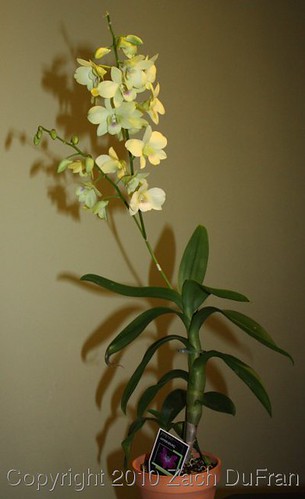
dendrobium_full
Dendrobium Christmas gift
This Dendrobium orchid has a total of about 25 buds born on two stems - about 8 of those still closed.  The color of the petals is pale yellow and almost green.  There is a new book out from my favorite plant-book publisher, Timber Press, called Green Flowers.  In a way, green is the most boring color that a flower can be, since the majority of plant material is green.  It just blends into the background, part of the noise that nature can sometimes be.  We tend to gravitate towards the colorful spotlights of red, pink, purple and yellow, which readily stand out on all shades of green foliage.  And it's not just us - insects are attracted to these colors.  What to us says "beauty" says "food" to many creatures.

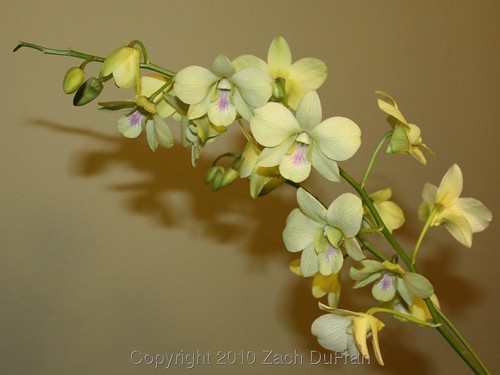
dendrobium_stalk
Dendrobium blooms
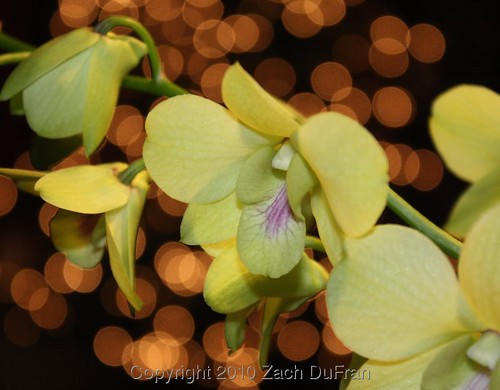
But there is a simple beauty to the green flowers.  Maybe the texture and shapes are better observed when the color doesn't trump the senses.  The pearly sheen that is unique to orchid flower petals stands out on this flower.  There is also a really subtle hint of red on the inner part of the flower, that I pretend is there just to reward those who take the time to look closely.

dendrobium_closeup
Dendrobium bloom detail
This particular orchid had a generic "Dendrobium" tag on the stem and a specific tag with hybrid identification in the pot.  Unfortunately, the tag was snapped in half and all I have is a couple of letters - not enough for me to have figured it out yet.  But I'll keep trying, out of sheer curiosity.  I don't really need to know anything more than the genus for this particular orchid, in order to take good care of it.

Wednesday, January 6, 2010

Gigantic Geranium

My mother-in-law has a knack for growing very large plants.  I should qualify that statement by explaining that she does not grow large plants, but grows plants large.  In other words, plants in her care tend to grow much larger than their "normal" size.

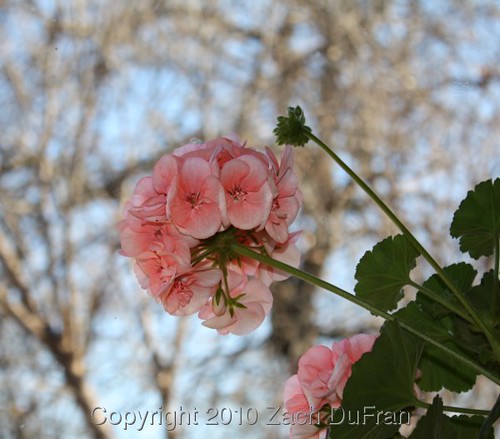
geranium_blooms
Geranium bloom head
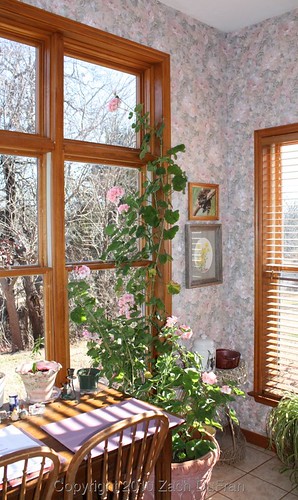
One such example is her ordinary Geranium that is about 8 feet tall.  Yes, an ordinary Geranium.

geranium_height
An ordinary Geranium of extraordinary height.
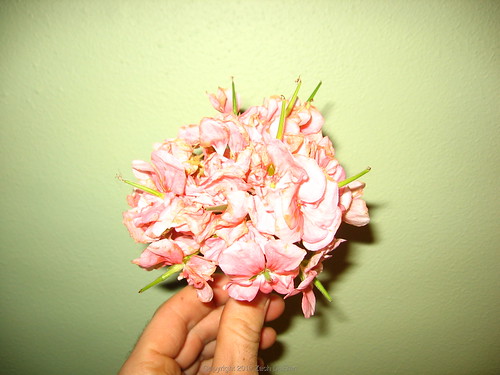
I believe the key ingredient here is lots of light year-round.  This Geranium produced some behavior recently that I had never noticed before.  The blooms were actually pollinated and produced seed pods.  I don't know whether this is common for Geraniums to do in Oklahoma and I have just never paid attention enough to notice, or if this is somewhat rare.  Anyway, I do have some seeds from this mammoth plant that I might try to germinate soon.

geranium_seed_pods
A Geranium flower head with spikes protruding from seed pods.
She also has a corn plant (Dracaena fragrans) which is of unusual height.  It grows in the 2 story foyer to their house and is likely 18 feet tall.  This plant has a good history, including at least one suspected period of death, from which it valiantly arose like a phoenix.  Even recently it went through a spell of poor health, but has been sprouting anew, after the top was lopped off.

Monday, January 4, 2010

Report on 2009 resolutions

At the beginning of 2009 I made myself a list of resolutions for my plant hobby and specifically for my blog.  Some of these were pretty well upheld.  Others - not so well.  Here's how I did:

  1. Post 2-3 times per week. This task went pretty well - most of the time.  But a couple of projects kept me very busy in my "free time" which reduced the number of posts.  The biggest project was the building of my greenhouse, which gave me plenty of fodder for posts, but not much time for writing them.  I also started several very big posts that just never got complete enough to post.  All in all, I posted 100 times during the 2009 year.  The first half of the year I posted 61 times (about 10 per month).  The second half of the year I only posted 39 times (6.5 per month).  I have made myself a "schedule" of upcoming posts and I hope to be more regular once again.

  2. Review 1 book per month. I reviewed 7 books this last year, so I probably should have set this goal to be semi-monthly.  My reading and writing are always fighting for my free time.  This last year, both of them were neglected in favor of projects and trips.  I foresee several books being covered over the next couple of months: Black Plants by Paul Bonine, The Amazing Aglaonema by Frank Brown, Botany for Gardeners by Brian Capon, and One River by Wade Davis.

  3. Write a "trip report" once per month. I wrote 8 trip report posts this last year.  I probably could have written two more, but 12 would have been a stretch.  This category works well as once a month during the "growing" seasons, but I don't travel much when the temperature is below 50F...  The only trip we have planned for this next year is to St. Louis.  But that trip will definitely have a good trip report, seeing as our 2nd IAS MidAmerica chapter meeting will be held at the Missouri Botanical Gardens!  I think we will be working in some other fun, nearby trips, as well.  And I never posted about our foliage drive in the Fall of last year.  I might just post that in the next month, so stay tuned!

  4. Write a "project" post once per month. I actually wrote 17 project posts this last year!  This was by far my most productive category.  That production is due mostly to my greenhouse building project.  One particular project I have been planning is my first oil painting.  I've not really ever painted before, but I have an idea for a painting that I really want to do this year.  I just bought my easel, paints and canvas and I'm looking forward to creating my first piece.  I'll share that painting here, if it turns out halfway decent.

  5. Start my Asarum collection. This never got off the ground this year, but my birthday and Christmas added some green to my wallet, so I might just order some Asarums soon and start my little collection.

  6. Grow some of my own food. My first potato crop was a success, but also left some room for improvement.  I know what to do differently next year and hopefully have better size and quantity in my crop next Fall.  I'm also hoping to start a couple of hardy kiwi vines this coming Spring.

  7. Vigorously plant figure 8 bed. Due to our Spring vacation to Hawaii about the same time that we should have been planting and watering our sweet potato vine in the figure 8 bed, I don't think "vigorous" is the apt description.  The good news is that my sweet potato plants produced large underground tubers, which I dug up and plan to plant this Spring.

  8. Fertilize. I think I have only fertilized my plants once, around the middle of the year.  So it is probably a good time to sprinkle some pellets over the soil again.  This is new to me, so it's good I made this a resolution; at least now I have a reminder whenever I check to see how I'm doing with my resolutions.

  9. Recreate corner garden. Last Spring and Summer we added several perennial plants to the corner garden that are colorful and should work better in the full to part sun that is being received in that bed.  I also added some Fall-blooming bulbs which were nice to see blooming well into November.  This Spring will reveal the success our perennial additions.  I might also add a couple of Daylilies this Spring as they are the most likely to succeed.

All in all, I had moderate success with my resolutions in 2009.  I guess it is good to aim high and push myself.  This year, I will likely be aiming for the same goals, with the exceptions I noted above.  My top priority will be the first goal: post 2-3 times per week.  Wish me luck!

Tuesday, December 29, 2009

Passionflower in bloom

After just a week in the greenhouse, I could already tell that the plants were happy.  Immediately my Aroids began to produce aerial roots where they hadn't before.  In fact, I have a variegated Monstera deliciosa that now has an aerial root about 5 feet long.  Pretty impressive for a plant that is only about 8 inches tall with 2 leaves!

Anyway, one of the best indicators of a plant's happiness is their bloomage.  Not that a non-blooming plant is unhappy, but it's a pretty sure bet that a blooming plant is happy.  In some rare cases, a very unhappy plant will produce blooms just before dying - a last ditch effort to spread seed and ensure its survival through its offspring.  But you can usually tell if your plant is blooming for this reason.

I don't have very many "blooming" plants.  Most of my plants do flower at some point in their life cycles, but their flowers are not particular showy, colorful or desirable to look at.  But those few that I have have been performing for me pretty well since being moved into the greenhouse.  The Datura (Angel Trumpet) has been producing yellow trumpet blooms constantly, followed by nice, full seed pods.  The lime tree put out a profusion of blooms once moved in and is now desperately trying to make fruit from those blooms, even though I can't seem to give it enough water.  Christie's Streptocarpus (False African Violet) has been covered in little blue-purple flowers since we got it several weeks ago.

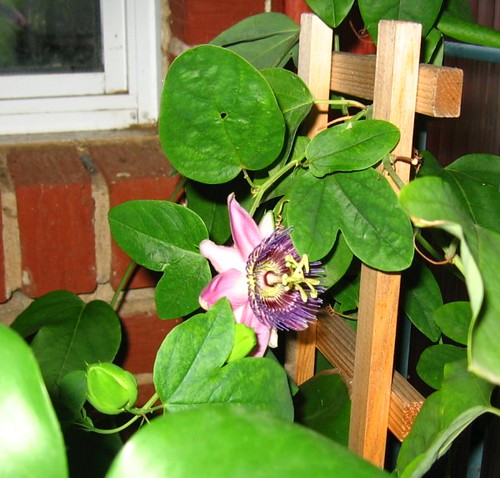
And my favorite blooming plant in my collection has even been performing.  I have two Passiflora x alatocaerulea (a hybrid Passionflower) in my greenhouse that have been producing a couple of blooms each week.  We purchased both of these plants last summer, keeping one and giving the other as a gift to Christie's grandmother for mother's day.  Since they are not hardy plants in our climate, I offered to overwinter her plant in the greenhouse with my own.  I was able to keep it attached to her grandmother's trellis and temporarily hang the trellis in the greenhouse.  Assuming I can keep it from getting too tangled with my other plants and greenhouse itself, it should be easy to transport back to her house in the Spring.

gh_passion_bloom
Passiflora x alatocaerulea blooming in the greenhouse
With Christmas day just a couple of days behind us, I figured now is a good time to share about the symbolism and name for the Passionflower.  If you have seen a Passionflower bloom before, you were probably amazed at the complicated sets of elements that are present.  There is just so much going on with each bloom.  It's not a simple set of petals with a colored center, like members of the Asteraceae family.  The Passionflower has many different parts and the numbers of those parts are significant in the Christian culture.  In addition, the Spanish saw a resemblance in this flower and a Saint's halo, commonly depicted in Roman Catholic art.

Back to the numerology of the bloom.  The bloom consists of five petals and five sepals, which represents the ten apostles - leaving out Judas the betrayer and Peter the denier.  The filaments can represent the thorns in Jesus's crown.  Apparently there are 72 of them and that is how many thorns were in Jesus's crown, though I'm not sure where that knowledge came from...  There are many myths and elements to teh Catholic faith that are not shared by the Protestant Christian denominations, of which I am a member.  There are five stamens, which is the number of wounds that inflicted Jesus.  In fact, the plant is referred to as "Flower of the Five Wounds" by South American Catholics.

Additional symbolism can be found in the shape of the leaves of some species of Passiflora, such that they look like spears, which pierced Jesus's side.  And some dots underneath the leaves are to represent the 33 pieces of silver which were paid to Judas for the betrayal.

Passionflower blooms are only open for one day, the same time that Jesus suffered on the cross.  After their show the bloom closes rather than falling from the vine, like many other flowers do.  This closing symbolizes hidden wisdom and Jesus being placed into the tomb.

I hope that you had a wonderful Christmas and I wish the best in the New Year.