Wednesday, March 14, 2012

Hand pollinating Dendrobium orchids

My friend Derek inspired me to try hand pollinating some of my orchids.  Derek hand pollinated his Phalaenopsis with itself.  I was lucky enough to have two Dendrobium species (not hybrids) in bloom at the same time, so I set out to cross this unusual and very different species.  The anatomy of orchids is very similar, regardless of the genus, which is what makes them orchids.  I watched a video on youtube before trying this.  It is a very simple process, but that didn’t prevent me from making a mistake!
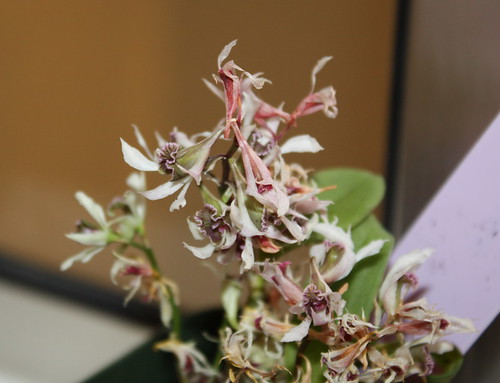
d_peguanum
Dendrobium peguanum blooms
One of my plants is Dendrobium anceps, which I posted photos of recently.  The other is Dendrobium peguanum, a little miniature that I purchased recently in full bloom.  This little guy is only about 2 inches tall (maybe less) and held about 25 blooms above his little pseudobulbs.
The process of hand pollination requires 2 easy steps:

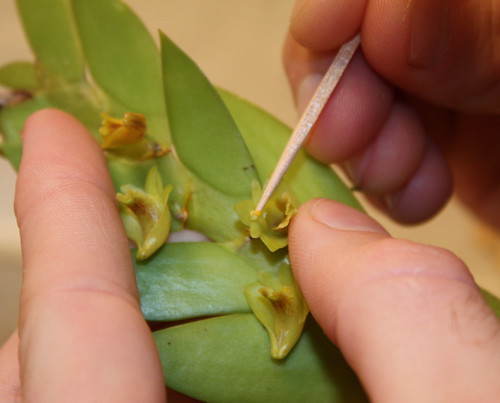
1. Choose one healthy bloom.  Using a toothpick, remove the pollinia from this bloom.
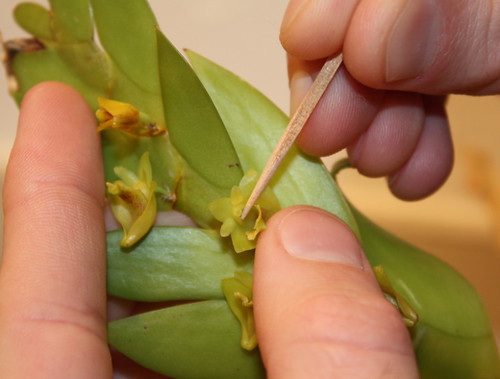
d_anceps_removal
Dendrobium anceps pollinia being removed
d_anceps_pollinia
Dendrobium anceps pollinia being removed
The pollinia are two tiny orange dots that are hidden behind the anther cap on the column.  And for these little Dendrobium I was working with, when I say little, I mean tiny.  In my case, I separated the anther cap from the pollinia so I could concentrate on keeping track of the pollinia, which is the only part that matters here.
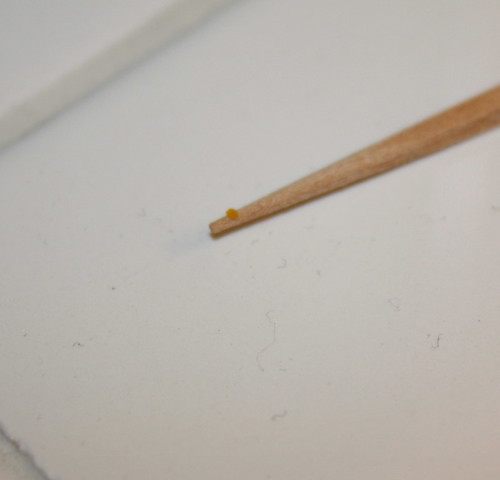
pollinia_toothpick
Dendrobium anceps pollinia on toothpick
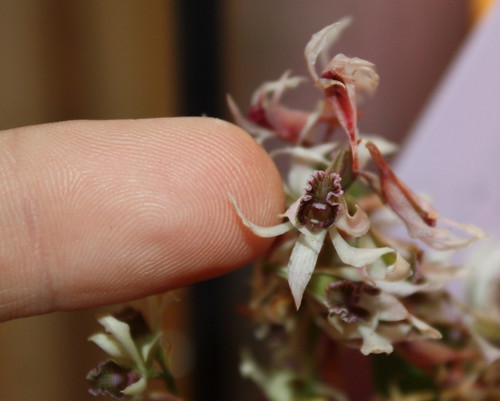
The column is the part that sticks out from the plane of the flower and is opposite the lip.  The lip is usually pretty obvious, sometimes being frilly on the edges.  Usually, the column is positioned above the lip, which is called resupinate and means “upside down.”  So the “norm” for orchids is upside down.  When the column and lip are arranged the opposite way it is considered non-resupinate.  These Dendrobium have a mixture of arrangements on them, as you can see in the pictures below.  Same bloom, just “upside down” in one and “right side up” in the other.
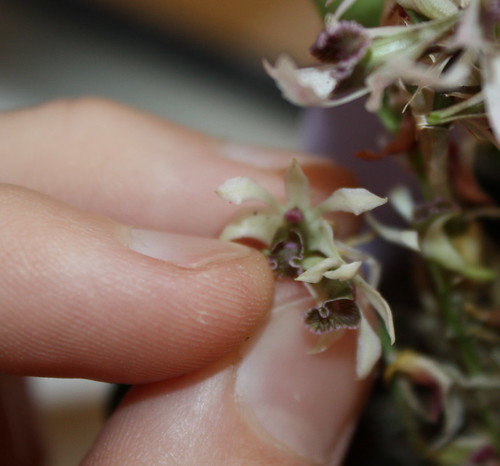
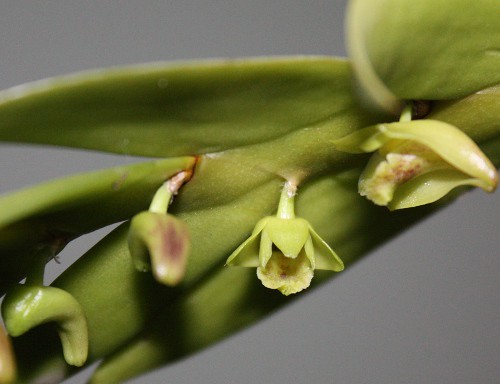
d_peguanum_close
Dendrobium peguanum resupinate bloom
d_peguanum_finger
Dendrobium peguanum non-resupinate bloom
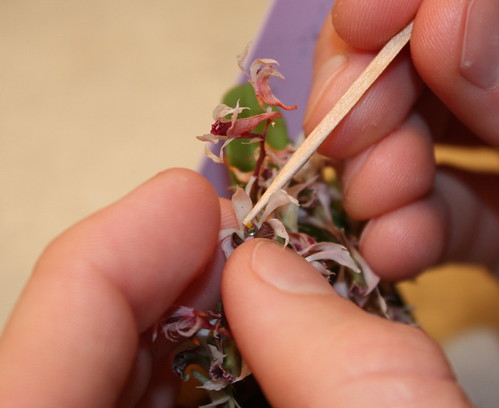
2. Place the pollinia inside the receptor on the column. This is where I screwed up.  Once the anther cap and pollinia are removed from the column, there is a little bit of a hole exposed on the tip of the column.  I tried to place the pollinia back in that hole.  After I did so, I was laying in bed thinking something didn’t seem right about that.  I got out of bed, watched another youtube video and realized my mistake.  Thankfully, the pollinia were relatively simple to remove and I was able to put them in the proper location.  The proper location is the little green void that you can see just below the tip of my toothpick in the picture below.
d_peguanum_pollinating
Dendrobium pegaunum being pollinated with pollinia from Dendrobium anceps
Since both plants had many flowers in good health, I pollinated several on each plant independently, and then I crossed one flower on each plant.  After doing so, I put a little sticky note flag next to each of the blooms that was a crossed pollination, so I will know that those are special, if a seed pod forms.

Orchids are not easy to grow from seed.  Although it happens in the wild in a haphazard manner, to grow an orchid from seed outside of nature, it must be done in a sterile lab environment.  And it costs money.  If I get pods to form on my orchids I will probably count it a success but not do anything with them.  UNLESS I get pods to form on those two flagged blooms.  Those would be special, because I would have created my own hybrid, Dendrobium anceps x Dendrobium peguanum and Dendrobium peguanum x Dendrobium anceps, depending on which plant was the pollinator or the pollinatee.   If I get this lucky, I will probably send my pods off to be flasked, in which case I could wait 6 months to a year before getting some little plants back.  I don’t know if these have been crossed before or not.  Maybe something interesting will result.

Monday, March 12, 2012

Hardy aroids emerging

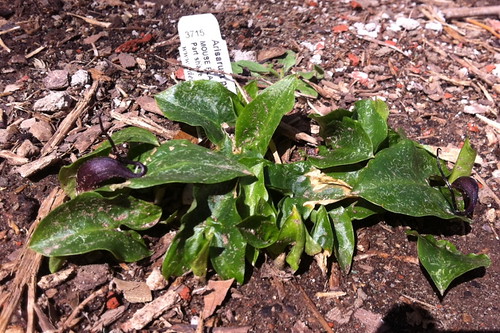
Last year I was brave and planted some aroids outside in the brick path garden.  Now they are starting to break through the soil surface and enjoy these unseasonably warm days we’ve been having.

a_probo_201203
Arisarum proboscideum - Mouse Tail Plant
If you look closely, you’ll notice in the picture above there are two different blooms (mice) on my little clump of Arisarum.  You will also notice there are lots of little red brick shards and clumps of gray mortar.  This plant is growing in the garden around the greenhouse and when the greenhouse was bricked a couple of months ago, the area really got trampled.  Some of the plants that we put in last year are probably gone now, but several are coming up and looking really nice.  I was especially happy to see these little “Mouse Tails.”

z_aethiopica
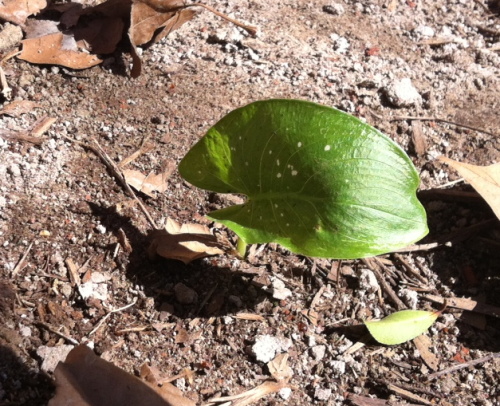
Zantedeschia aethiopica - first leaf
The Zantedeschia aethiopica is not much to look at right now – just a single leaf.  I don’t expect it to bloom this year, but if it does, I will be very happy – and you can expect an update!  Jason gave me this plant last year.

Monday, March 5, 2012

Terete orchids

The term terete means "cylindrical or slightly tapering, and without substantial furrows or ridges."  This term is sometimes incorporated in the Latin names of plants, such as Luisa teretifolia, which you could translate to mean "the Luisa with cylindrical foliage."  There, you just learned Latin!  Wasn't that easy?

There are a number of orchids with terete leaves and I have obtained some recently.  Sometimes these orchids are referred to as succulent because of their appearance.  These  plants are well adapted to dry seasons and can store energy in their swollen, cylindrical leaves during dry periods, just like many cacti and succulents do.  But note: just because an orchid (or any other plant) has terete leaves does not mean that it is succulent or that it grows in a location with a dry season.

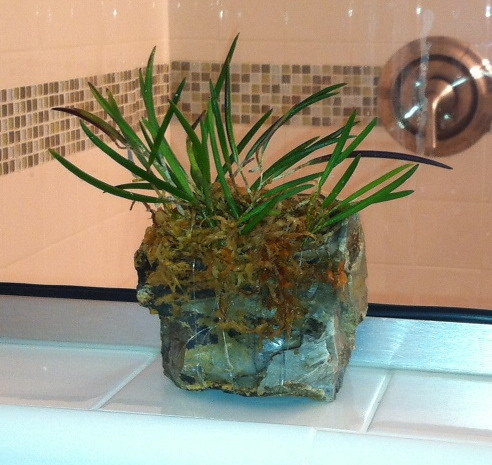
dock_striolata
Dockrillia striolata mounted on rock

Dockrillia is a genus that was once considered part of the gigantic Dendrobium genus.  These plants are home to Australia and Papua New Guinea and are distinguished from other Dendrobiums since they lack pseudobulbs, which are usually very prominent as "canes" with other Dendrobiums.  I just got a little plant (pictured above) of Dockrillia striolata (synonymous with Dendrobium striolatum).  The fleshy little needles of this orchid will turn red when exposed to a lot of light.  You can see that a couple of the leaves on mine are more purple/red in color.  You can see a photo of the blooms here.

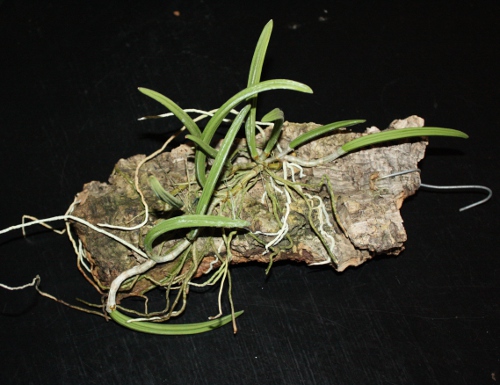
dock_wassellii
Dockrillia wassellii

I also recently got a large mounted Dockrillia wassellii (above).  These two species are the most common of the Dockrillia genus in the US.  There are MANY cultivars and other species available in Australia, but it is not easy to import these to the US.  My wassellii plant is considerably larger than I expected it to be.  I started to joke with Christie about how unreasonably large the box was when I received it for such a small plant inside.  Then I opened it to see that the box size was quite appropriate.  This plant is listed as being "nearly terete" since the leaves are actually have furrows running the length.

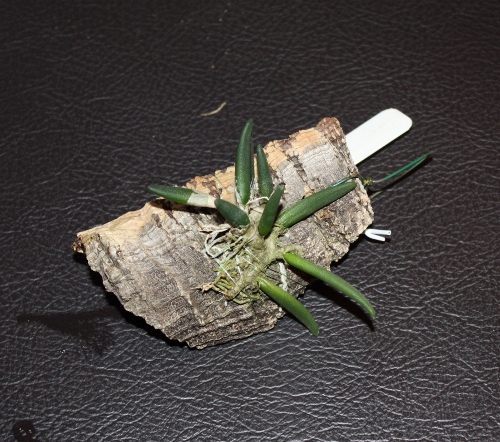
den_lichenastrum
Dendrobium lichenastrum var. prenticei

My main reason for expecting a smaller plant was because I was expecting something more along the lines of the Dendrobium lichenastrum v. prenticei that I had purchased just a couple weeks earlier (pictured above).  That plant is tiny.  I talked about that plant in my mounted orchids post in December.  I'm not sure why this plant has not been transferred to the Dockrillia genus.  It appears to be a good candidate and is even from Australia.

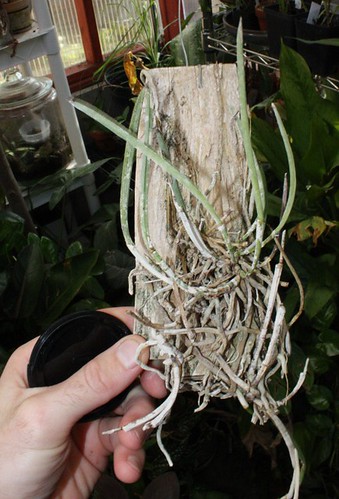
brassavola_nodosa
Brassavola nodosa

Another plant I included in my mounted orchids post in December is terete-leaved, Brassavola nodosa (pictured above).

bepi_femme_fatale_20120302
Bepi. 'Femme Fatale'

I have had this intergeneric hybrid orchid, Brassoepidendrum Femme Fatale 'BJ' for about eight months now.  It has stiff, terete leaves and the most awesome speckled blooms.  Mine hasn't bloomed yet, but I'm anxiously awaiting that day.

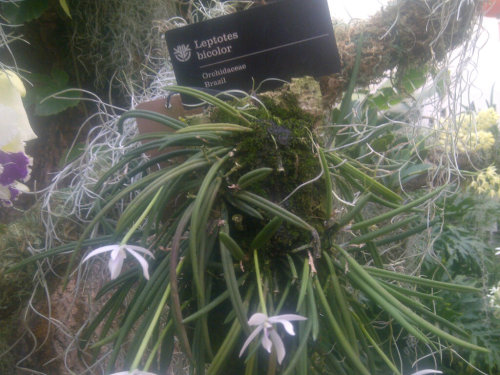
leptotes_bicolor
Leptotes bicolor

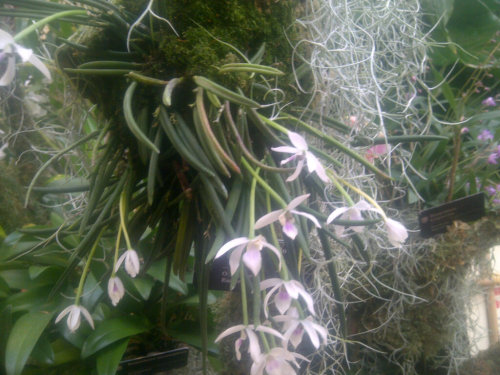
My final recent purchase of a terete-leaved orchid is Leptotes bicolor.  I'll finish my post with a couple of bloom pictures.  Recently, my friend Leslie attended the big orchid show at the Missouri Botanical Gardens and took some photos of a mature, blooming Leptotes for me.  It is a beautiful plant in bloom.

l_bicolor_mobot01
Leptotes bicolor in bloom at the Missouri Botanical Garden

l_bicolor_mobot02
Leptotes bicolor at the Missouri Botanical Garden

Friday, March 2, 2012

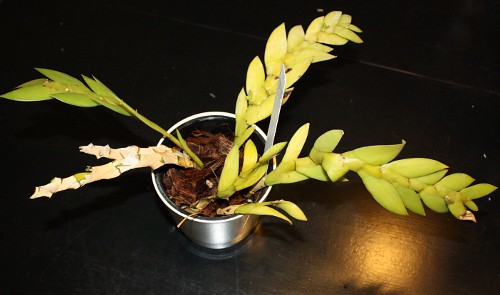
Dendrobium anceps in bloom

This plant is admittedly not one that people call “beautiful.” It is an oddity that I admired when visiting Lowell’s greenhouse last August. When I inquired about the name, he graciously offered me some pieces of it and brought them to our next Oklahoma Orchid Society meeting. The plant is Dendrobium anceps, anceps meaning “double-edged.”

d_anceps_full
Dendrobium anceps
It is planted in a net pot with coconut husk chips. The plant hasn’t looked great over the last 5 months and I wasn’t sure that I was giving it the care that it desired. However, I noticed recently that it was covered in buds. And I mean covered! It is even blooming on the leaves that look burnt and dead.

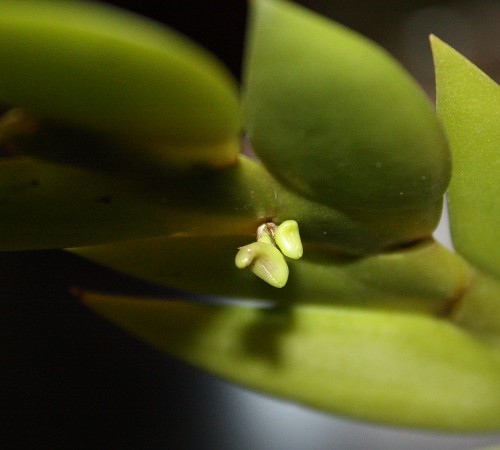
d_anceps_detail01
Dendrobium anceps buds

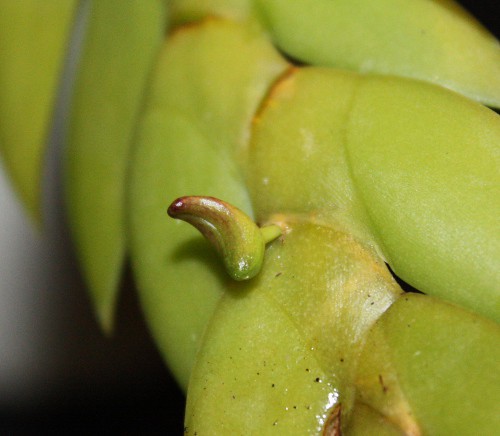
d_anceps_detail02
Dendrobium anceps bud - such an interesting shape
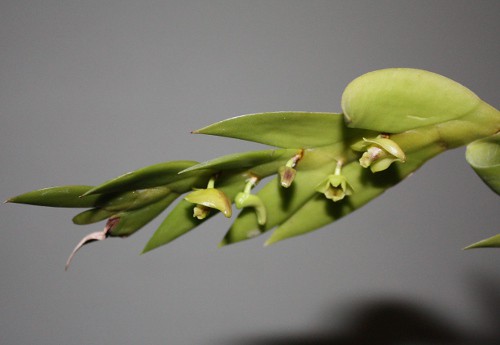
The buds peak out from the overlapping leaves and look really neat before they open. Once they open, they have that signature look of many Dendrobium.

d_anceps_detail03
Dendrobium anceps blooms

d_anceps_detail04
Dendrobium anceps blooms

Thursday, February 23, 2012

Greetings, Henbit Deadnettle

We don't spray stuff on our lawn.  On occasion, I will sprinkle some fertilizer pellets, but that is pretty rare.  We never spray weeds.  This is partly because I realize that anything that goes on the lawn ends up in our drinking water, partly because the weed-to-grass ratio is not that important to me and mainly because those chemicals are expensive!

My weed control consists of me bending over and hand weeding the front yard during the February-August months.  I would probably just let them be, except that they grow much faster than the grass, which makes the yard look unkempt and means I need to mow more often.  Plus, I really like spending time pulling the weeds.  It's therapeutic.

There is some debate about what makes a weed, a weed?  Some people talk about whether that plant is difficult to get rid of, or whether it is native to their location.  A common definition is simply a plant that you don't want growing there.  Far from technical, but usually accurate.  There are two major weeds that I deal with in our front yard and a different one in our backyard.  That alone is pretty interesting to me.  Why do I see these weeds all over town, but the two that are in our front yard aren't present in our backyard and vice-versa?  Puzzling.

I passed a yard on my way to work this morning that was a sea of purple.  This is one of the weeds that I contend with in our front yard.  It got me to thinking about how Christie has commented that she thinks the purple flowers are pretty.  Like many wildflowers in our area, if you look closely at a single specimen, the weedy foliage dominates the paltry flowers, but in mass, the sea of color can be quite nice.  I'm pretty sure that she's on the same page as me, when it comes to pulling these weeds, ultimately, because they do make our yards look horrible, as they start to get big.

This morning, after I passed that yard carpeted in purple, I started thinking about how utterly rude it has been for me to uproot these weeds all these years and never introduce myself.  Can you believe, I've been pulling these weeds and tossing them on the scalding pavement in the middle of summer, roasting them to smithereens so that there is no way they could come back and invade my yard, and yet I didn't even know their names!?!

So I dedicated myself to the quest of learning the name of my nemesis.  At all costs, I would know my foe.  I didn't care if it took driving to the Ag Sciences County Extension Office with samples of this plant so they could run the DNA and match it to their database of beautiful lawn saboteurs and other botanical miscreants.

Of course, about 2 minutes of Google searches brought me an answer.  Now I know the one I hunt.

Greetings, Henbit Deadnettle.  I am Zach DuFran, but you can call me Zach, or Worthy Adversary, whichever you prefer.  What's that?  You prefer I call you Lamium amplexicaule?  No problem.  I respect your desire to honor your Latin heritage.

Henbit Deadnettle (Lamium amplexicaule) - from wikipedia


Did I mention that I learned my adversary is edible?

Tuesday, January 17, 2012

Anthurium scandens from seed

A while back, I mentioned my purchase of Anthurium scandens.  I was lucky enough to purchase the plant on eBay, only to be given one a couple of days later.  At that time I was a little annoyed I had spent money on a plant, only to receive a larger one for free.  But then a couple of months later, when my free cutting died, I was glad that I had purchased the original.

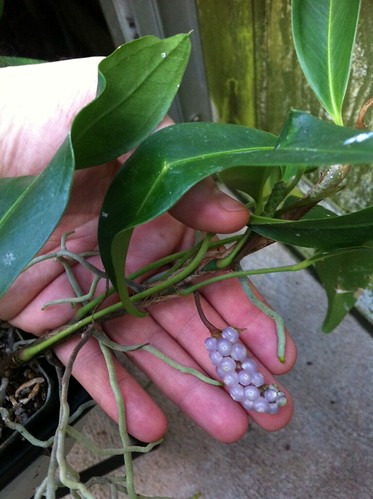
The feature that really drew me to this plant was the "woody" appearance.  It has a "woody" look because it has persistent brown cataphylls.  In laypeople's terms, the stems of the plant have little brown sheaths that cover the green stems.  Another cool attribute of the plant is the profusion of adventitious roots coming out of the length of the stem, as well as inflorescences at nearly every node.  These inflorescences self-pollinate and bear white fruit (berries).  It is quite remarkable, unlike any other aroid I have ever grown.

Anthurium scandens
Anthurium scandens - photo courtesy Christopher Rogers

Anyway, the plant that I purchased, I still have.  But it has barely grown for me and doesn't have the distinct persistent cataphylls.  Maybe this is just a variation or maybe my plant is just not mature enough yet.  Time will tell.

Anthurium scandens amethyst_grape_dpowazek
Anthurium scandens - photo courtesy Derek Powazek.  Notice the color of the berries.  And again the adventitious roots are prominent. 
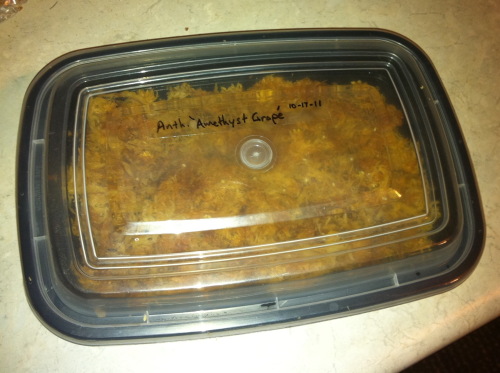
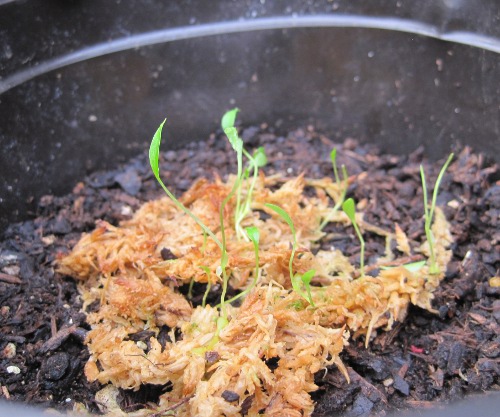
Then recently, I received some seeds from a friend of Anthurium scandens and now have little seedlings growing!  I'm super pumped about these little guys.
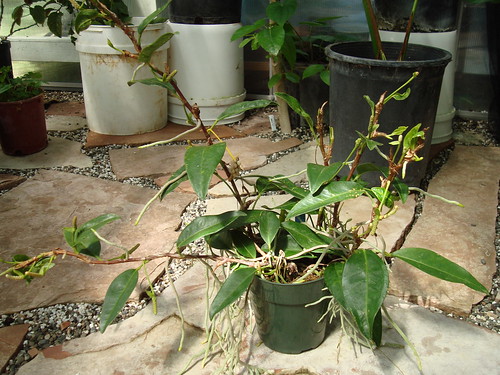
Anthurium scandens
Anthurium scandens seeds germinating

Anthurium scandens
Anthurium scandens seedlings - as of January 16, 2012.

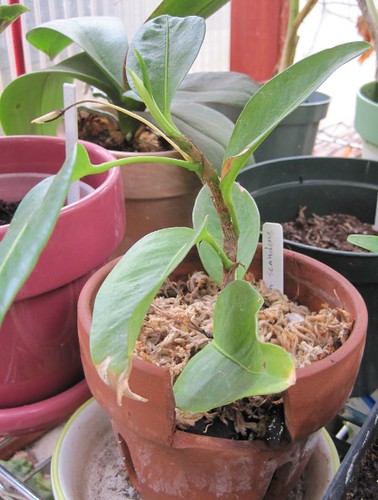
I also got a cutting from Jason's plant, who got his at the Fort Worth Botanic Garden at our MidAmerica meeting.  So these are cuttings from the same plant that I had.  I'm really happy to have this plant back in my collection and I looking forward to my seedlings becoming mature.

Anthurium scandens
Anthurium scandens cutting from Jason

Friday, January 13, 2012

Greenhouse facelift

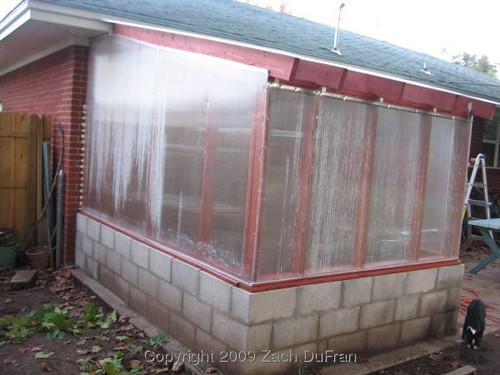
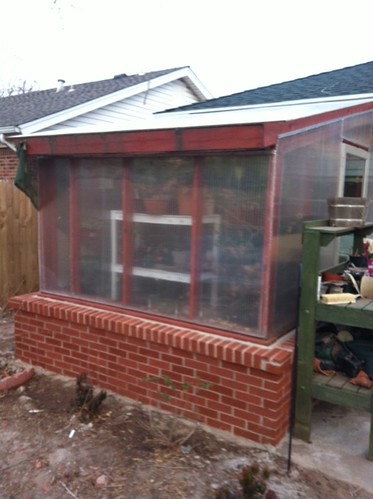
My blogging hiatus continues due to all of my free time going towards our house addition.  The addition was bricked a couple of weeks ago and it turns out that I ordered entirely too much brick.  Apparently that is difficult to do, so I have a hidden talent.  If you ever need someone to over estimate the number of bricks you need for a project, give me a call!  Anyway, I had our brick layer come back this week and use some of the extra bricks, to brick the greenhouse.  Check it out:

finished_poly
BEFORE (picture taken just after finishing the greenhouse, that brief moment before all the plants moved in)

The above picture was taken just after finishing the greenhouse, in that brief moment before all the plants went running inside.

bricked_end
AFTER


Pretty nice, huh?  It's just a little sad to see my nice cinder blocks covered up.  But now the greenhouse perfectly matches the house and looks a little more official.

And here's a photo of our addition, all finished on the outside.  It's getting close to being finished on the inside, as well.

brick_and_siding
Finished exterior of our house addition