Thursday, May 10, 2012

Trip Report: Orchid Show in Wichita, uncommon orchids

This is the fourth post in a 5 part series.  Part 1 focused on the exhibits; part 2 on the Slippers and Vandas; and part 3 on the Dendrobiums and Encyclias.  This time around, I'm going to show some pictures of some nice orchids you just don't see every day.

Phalaenopsis is the most widely known orchid, the one that you can find for sale in grocery stores and hardware stores.  So, I am kind of starting off this post of "uncommon orchids" with one of the most common orchids there is!  They are so popular for a number of reasons, one being that they are not too hard to grow and to get to re-flower.  Most orchid growers have some of these on hand in their collections because they know they bloom reliably each year.

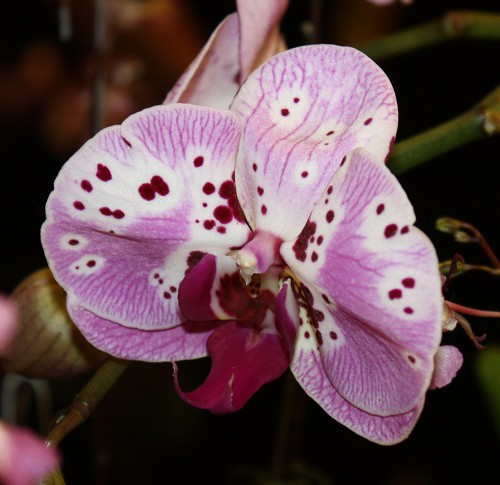
phal_interesting_pattern2
Phalaenopsis with "brush strokes"
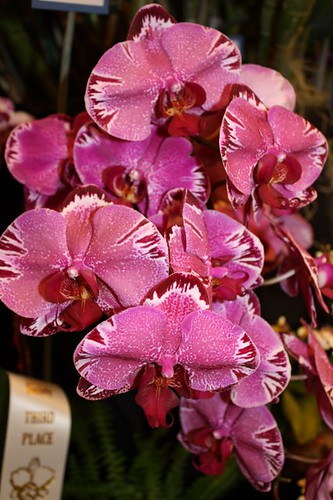
Another reason they are so popular is because of the hybridization potential.  It seems the hybridizers always have something a little new with these orchids - a new color combination or a new pattern.  The Phalaenopsis pictured above is a fairly new pattern, with what looks like brush strokes near the edges.  I remember a year or two ago I saw my first harlequin (patches of color) Phalaenopsis.  This year, the pattern that was new to me is kind of hard to describe.  It looks like some drops of color have been splashed onto the flowers and repelled other colors.  There is a sort of white halo around these dots.

phal_interesting_pattern
Phalaenopsis with interesting color pattern
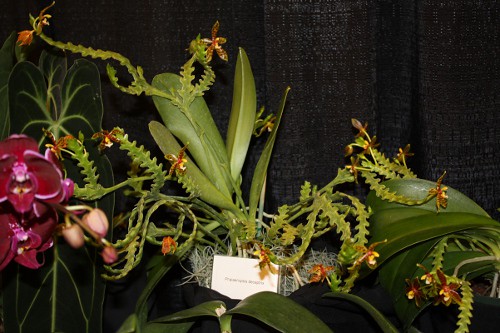
There were other nice hybrid Phalaenopsis with all sorts of different colors and patterns.  There was a really neat specimen of Phalaenopsis deceptrix cornu-cervi (below) on display, too.  The blooms from this orchid emerge from a weird, zigzag spike.  When the flowers are finished, it looks like this plant has two distinct types of leaves.  I don't know what people normally do when they have this plant and it finishes flowering, but I would have trouble cutting off those weird spikes.  I would want to leave them on the plant.

phal_deceptrix
Phalaenopsis cornu-cervi (labeled Phalaenopsis deceptrix)
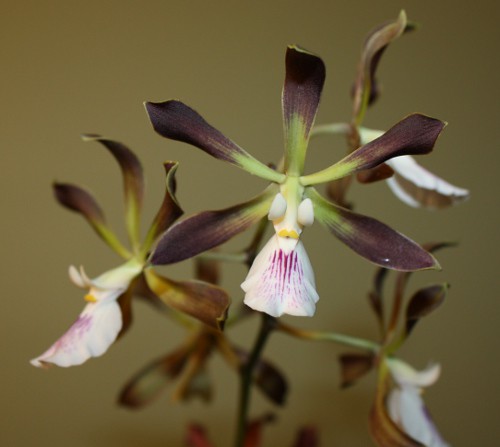
Eulophia guineensis is a really nice flower, which looks similar to some Encyclias, except that the lip is much larger than the petals and sepals, which are always pointing upwards.  Also, the plant is different morphologically and is terrestrial, whereas Encyclias are epiphytic.  Eulophias are native to equatorial Africa and this species is probably one of the more common ones to find in someone's collection.

eulophia_guineensis
Eulophia guineensis
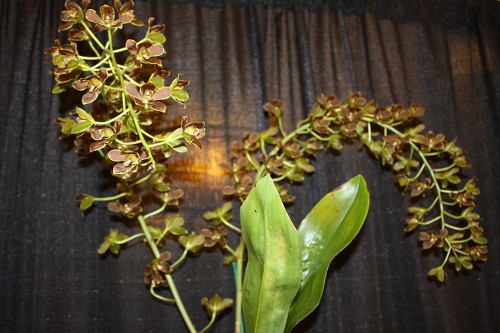
Grammatophyllum is the genus of "giant orchids."  These plants get really large and can become very heavy with time.  I like how their roots point upwards (not shown in this photo).  They have very neat blooms of brown and yellow.  Usually they are pretty spotted, like a leopard.  This particular plant was named Leopard and yet, the blooms weren't really spotted.  It was more like the brown had taken over all but the edge of the petals, which retained the yellow coloring.

gramm_leopard
Grammatophyllum Leopard
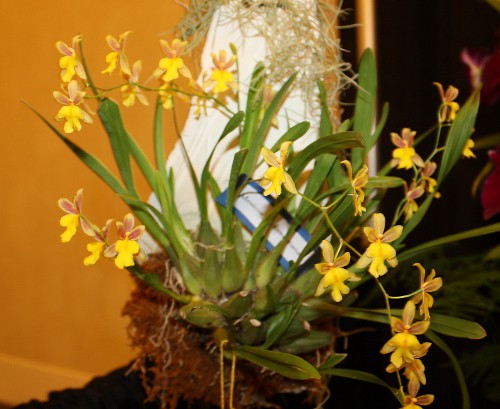
The plant below belongs to the Mexicoa genus, which I had never heard of.  It was a nicely grown plant with some neat little yellow flowers.  I think that Mexicoa is a monotypic genus, because I can't find any references to a species other than this one.  Apparently, it used to be Oncidium ghiesbrechtiana, but has unique floral features that allowed it to be moved to its own genus.

mexicoa_ghiesbrechtiana
Mexicoa ghiesbrechtiana
My friend, Leland, who lives in Hawaii is on the brink of being sucked into the orchid vortex.  The orchid of his dreams is Bulbophyllum phalaenopsis.  (Why did they let someone give a genus name in place of the specific epithet?)  The species gets very large leaves that look like those of the Phalaenopsis genus.  You don't even notice the psuedobulbs much due to the large leaves.  When this plant blooms, it creates this hanging purple tongue of flowers that smell like a thousand dead elephants.  Prairie Orchids had this plant for sale for $75, which is not out of the ordinary for this species.

bulb_phalaenopsis
Bulbophyllum phalaenopsis
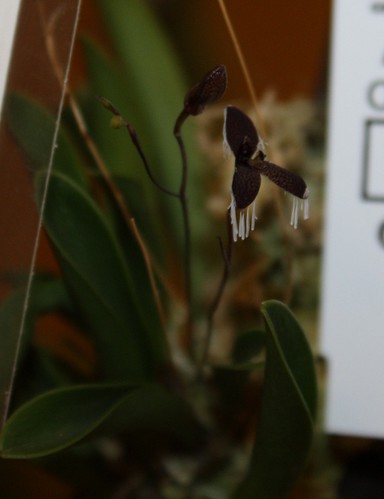
The final two orchids are both Pleurothallis and were both for sale at vendor's booths.  I just have one little Pleurothallis and I really like it.  They tend to be cool to intermediate growers and don't need much light.  I keep mine on the kitchen windowsill inside and it has been growing well for me.  I probably need to fertilize it because it was blooming this time last year when I bought it and it is bigger this year and not blooming.

pleurothallis_ornata
Pleurothallis ornata for sale at Andy's Orchids booth
Pleurothallis ornata (above) has these cool little icicles (not the technical term) hanging from the blooms.  Now the photo above doesn't show scale, but these little flowers are smaller than a dime.  Generally people that grow Pleurothallis and related genera are interested in miniatures and oddballs.  I'll be trying more of these in the future.

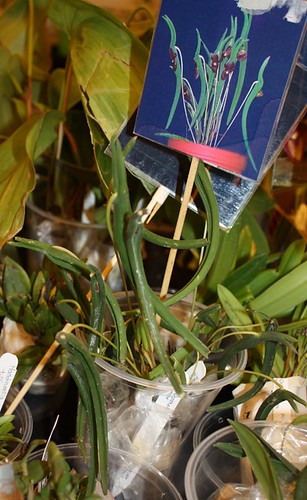
Now, prepare yourself.  The photo you are about to see is amazing...

pleurothallis_dilemma
Pleurothallis dilemma for sale at Ecuagenera booth
By far the most bizarre plant at the show was this Pleurothallis dilemma (above).  Eat your heart out, cucumber orchid!  This thing is like the "conjoined twin green bean" orchid.  It was for sale at the Ecuagenera table and I really wish I had bought it now.  Of course, my allowance is better off, but man, is this ever a neat little oddity!  (There is a better photo here.)

Tuesday, May 8, 2012

Trip Report: Orchid Show in Wichita, Dendrobiums and Encyclias

This is part 3 of the 5 part series known as "Orchid Show in Wichita."  If you missed the first or second post, check them out here and here.

First, you might be wondering what Dendrobiums and Encyclias have to do with one another.*  The truth is just that these are two of my favorite orchid genera.  There were lots of plants from these two genera at the show and I took lots of photos of them.  So they grouped themselves well for a blog post.  Now you know.
zach_dendrobiums
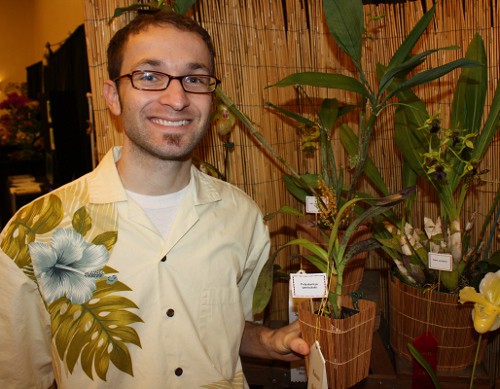
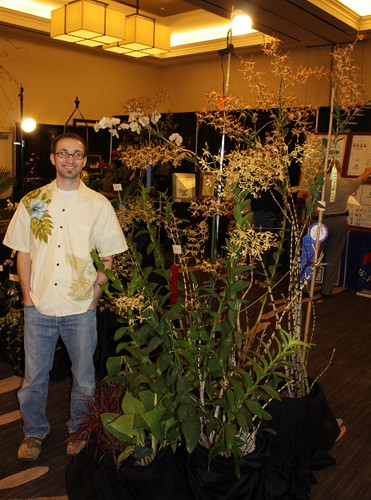
Me standing beside the really tall Dendrobium
Sarah Pratt is the owner of Timbucktoo Orchids and has come to speak to our Oklahoma Orchid Society in the past year.  She had a large, walk-through exhibit that featured four different very tall Dendrobiums from section Spatulata, which means they have the tall "antlers" or "antennae."  I know that I'm not a very tall guy, but still!  Those plants (above) are sitting on the ground and easily two or three feet taller than I am.  The sheer size of the plants can be overwhelming such that you miss how cool the individual blooms are.  But I took the time to stop and
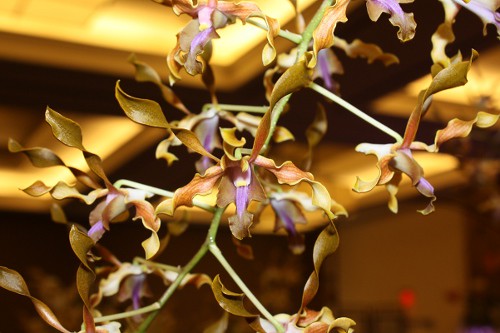
smell the rosesphotograph the flowers (below), for your enjoyment.
dend_spatulata1
Dendrobium Exotic's Spiral
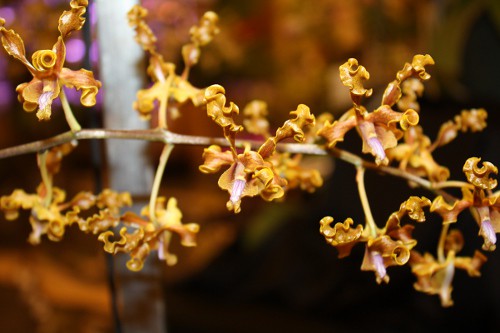
I didn't see the labels on these two orchids (below and above).  The one above could possibly be Dendrobium aries.  It might also be a hybrid with or without D. aries as a parent.  The one below is almost definitely the species Dendrobium discolor.  [Update: I contacted the owner of these plants and got both of the names.  The plant above is Dendrobium Exotic's Spiral, which is D. Palolo Rainbow x D. strebloceras.  The one below is what I was thinking, the species Dendrobium discolor.]
dend_spatulata2
Dendrobium discolor
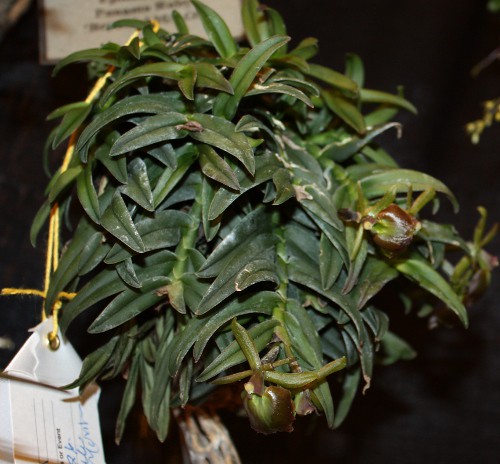
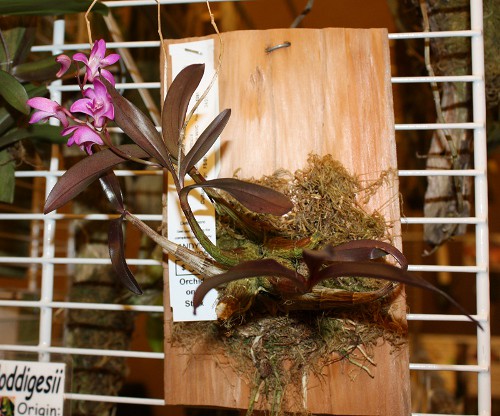
I recently bought a Dendrobium kingianum.  My plant is a little clump of green.  This one (below) that was for sale at the Andy's Orchids table has very dark leaves of a purple/red shade.  It is a really nice little plant.
dend_kingianum
Dendronium kingianum for sale at Andy's Orchids booth
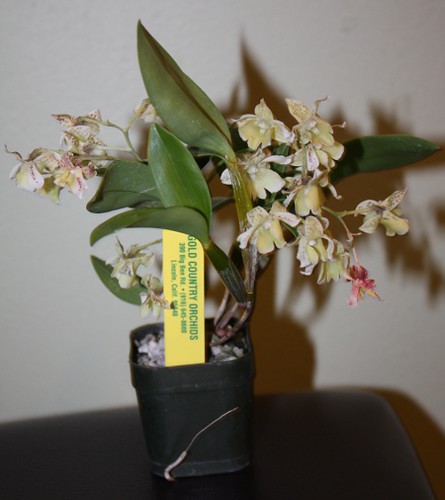
I purchased a really nice miniature Dendrobium Micro Chip,
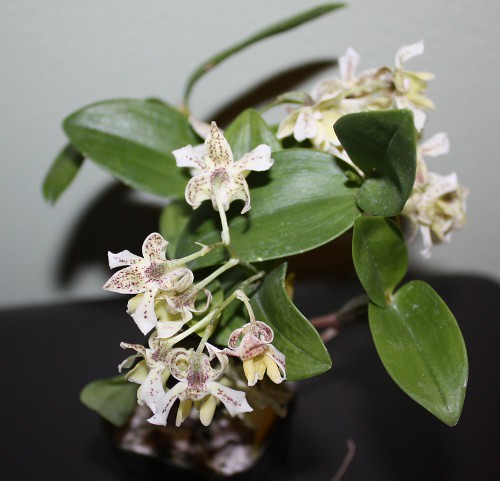
also known as Dendrobium Aussie Chip, because apparently there was something invalid about the name "Micro Chip."  [Correction: The hybrid Dendrobium Aussie Chip is a cross between Den. aberrans and Den. atroviolaceum.Micro Chip is a primary hybrid of Den. aberrans x Den. normanbyense.  It is covered in little white flowers that are peppered with black specks.
den_microchip
Dendrobium Micro Chip
den_microchip_birdseye
Dendrobium Micro Chip - Birdseye view so you can see the peppering
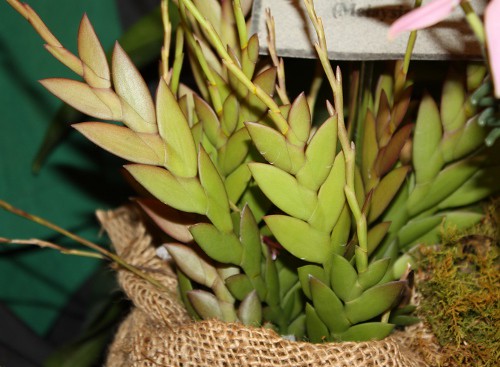
There are several species of Dendrobium that are similar to my Dendrobium anceps that bloomed recently.  One of these has dark pink blooms that are much more attractive than my little green blooms.  That species (Dendrobium rosellum) also has more coloration in the leaves themselves.  There was a nice specimen (shown above) in the gigantic display at the show.
dend_rosellum
Dendrobium rosellum
When I walk into an orchid show I am in shock for a couple of minutes.  I hope that as long as I live, and as many orchid shows that I attend, I never get to the point where I don't have that experience when I first walk into one of these shows.  When we got to this show, I paused momentarily and tried to get my bearings, before diving right in to look as closely as I could at the vendor tables, trying to not miss anything important.  On the first table we looked at there was a large and flowering Encyclia that smelled wonderful.  It was priced so reasonably we immediately agreed that it would be going home with us.  But seeing as it was the first table of plants, we were patient and decided to just keep an eye on it while we scoped out the other vendors.  We ended up going back to buy it not long after, before even finishing looking at the other vendors.

christie_with_anniversary_encyclia
Christie with Encyclia Gay Rabbit
enc_gay_rabbit_flowers
Encyclia Gay Rabbit closeup (Do you see the rabbit ears?)
Christie carried this orchid around with us for most of the show.  It was a bit heavy since it was a large plant, potted in a clay pot, so I joked that she was my orchid pack mule.  She was a pretty happy pack mule though, because we had this awesome aroma following us around as we looked at the plants.  I would relieve her for a little bit and carry the plant while pointing at plants that I wanted her to photograph for me.  The plant is Encyclia Gay Rabbit, which is a 2nd generation hybrid, including E. cordigera and E. alata.
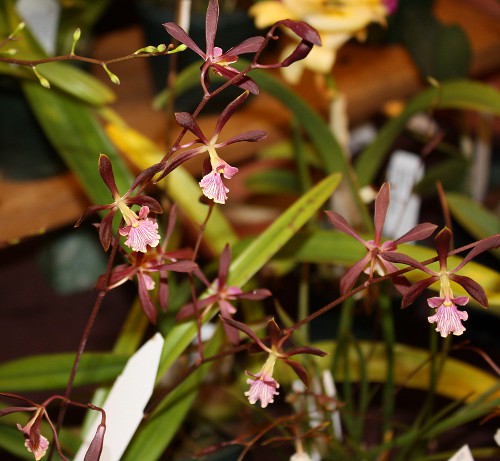
enc_bractescens_x
Encyclia primary hybrid, with Enc. bractescens as one parent.
I was tempted to purchase one of these hybrids with bractescens parentage, but I got another one from Michel (below).  It is Encyclia profusa x E. fowlei.  The species E. profusa has been on my want list and I also really like E. fowlei.  It should be neat to see what this plant looks like when it blooms, and I shouldn't have to wait too long since it is in bud.  E. profusa has dainty, creamy white flowers with a little bit of pink on the lip.  E. fowlei has a creamy yellow flower with some brown streaks.  The petals of fowlei flare out a little, so there will probably be some variation in the form of the flowers.  The color could be anything from white to brown, possibly with some pink on the column or lip.
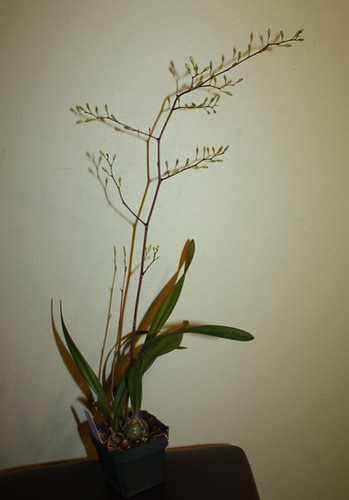
enc_profusa_x_fowlei
My Encyclia profusa x fowlei in bud
Michel Orchids had a lot of primary hybrids of Encyclias and other interesting plants.  The plant pictured above was one of these.  I can't remember what the other parent was for this particular hybrid, but the Enc. bractescens is pretty apparent with these tiny flowers and the thin leaves.
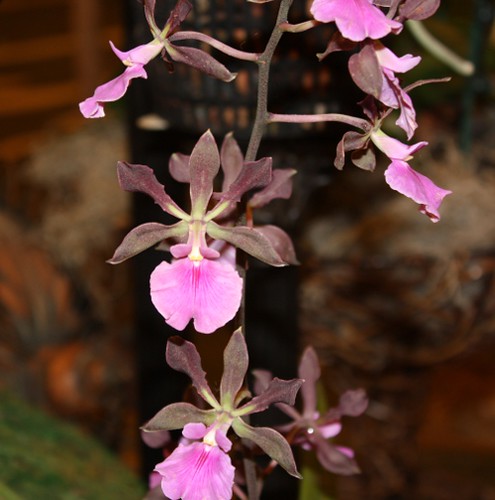
enc_hybrid_noid
Encyclia (possibly cordigera v. rosea)
The plant above is probably Encyclia cordigera v. rosea, but I didn't take a picture of the label so I can't be sure.  Either way, it's a nice orchid with fragrant flowers.

enc_hereford_jewel
Encyclia Hereford Jewel (Enc. cordigera x Enc. bractescens)
The plant above is another primary hybrid that was on display and had received several awards.  It is obviously being grown well considering the number of flowers.

* If you're curious about how closely related the Dendrobium and Encyclia genera are, they are both within the same subfamily, Epidendroideae.  That doesn't say too much though, considering there are only five subfamilies in the Orchid family, which is hugely diverse.  Also, the Epidendroideae subfamily is the largest with 576 genera and more than 15,000 species.
Thursday, May 3, 2012

Trip Report: Orchid Show in Wichita, Slippers and Vandas

This is part 2 of the 5 part series known as "Orchid Show in Wichita."  If you missed the first post, check it out here.  If you missed the third through fifth posts, you are incredibly punctual or you are reading this in the future.  (Hello, people of the future.  Do we have flying cars yet?)

First, you might be wondering what Slippers and Vandas have to do with one another.*  Or maybe you're wondering what a Slipper is?  Well, let me answer that question first.  Slipper orchids are plants from the five genera Cypripedium, Mexipedium, Paphiopedilum, Phragmipedium and Selenipedium.  They are called "slipper" orchids because the lip of the flower forms a pouch that looks a bit like a woman could slip her toes inside.  Many people see various "Paphs" or "Phrags" and think they look like they are carnivorous because of this pouch.  The pouches do kind of trap insects, but only for the purpose of pollination, not for certain death and consumption.

Now, back to the reason that I clumped Vandas** with Slippers...  Well, these are two popular groups of orchids that I just don't grow.  When I say popular, I mean really popular.  There are "Vanda People" and "Slipper People" that grow plants from one of these two groups exclusively.  There are also people that grow a couple here and a couple there, but there are many people that like to specialize in one of these two alliances.  I grouped them together because they are plants that I admire but don't have a great inclination to buy and grow (like I do so many other orchids).

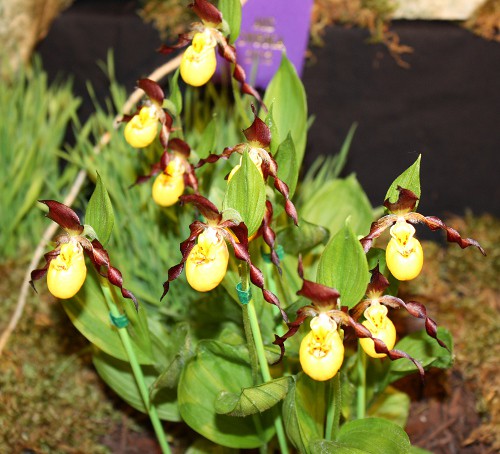
cyp_parviflorum_v_makasin
Cypripedium parviflorum var. makasin
The Cypripediums pictured above were exceptionally healthy plants.  Steve told me about how the owner of this plant grows it.  He has a special setup where he grows the plants in plastic tubs that have a bit of water standing in the bottom.  He allows them to overwinter in his garage while they are dormant and made it sound as though the care of these plants is quite easy with his setup.

paph_bel_royal
Paphiopedilum Bel Royal (P. kolopakingii x. P. rothschildianum)
The Paphiopedilum pictured above is a primary hybrid.  I really like the multiple blooming Paphs and this striped hybrid is very nice.

phrag_delesandroi
Phragmipedium delesandroi
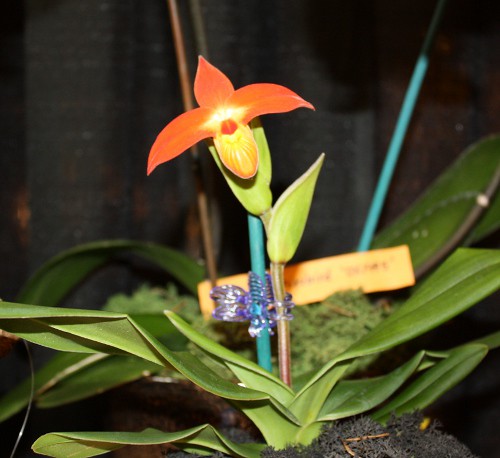
Many of the slipper orchids are various shades of white, deep red, brown, pink and green.  Then there are some exceptions, like the Phrag above, which is bright orange and yellow.  Normally I'm not a big fan of orange and yellow.  Maybe I just like this one because orange and yellow are the oddball colors for these plants.  I also like the simplicity of the shape of this orchid.

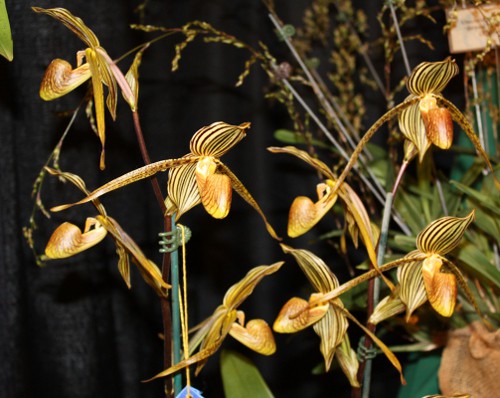
paph_sanderianum
Paphiopedilum sanderianum
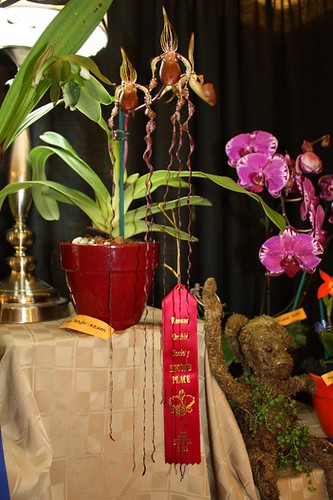
On the other end of the spectrum, you have to admire the complexity of the long petals that hang from this exceptional Paphiopedilum sanderianum.  Do you realize how long those are?  I wish I had had a ruler with me to measure them for you all.  They are easily 20 inches long.  Leslie told me she heard that higher humidity in the growing environment encourages these extra long petals.  You have to have these orchids in a special location so that the petals are not just laying in a coil on the bench where they are sitting.  If I ever grow this plant, I will nickname it Rapunzel.  I'm sure there is probably already a cultivar with this name.

wallpaper_covering
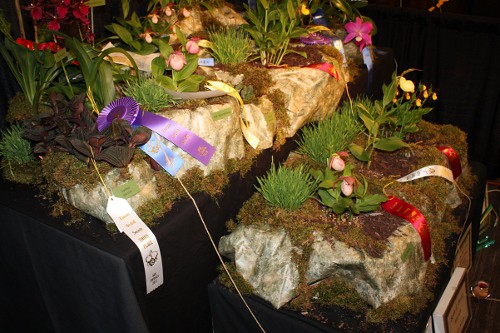
Rock-like planters made with wallpaper
The exhibit above was really pleasing to the eye, with the terrestrial orchids planted in their rock containers.  Or wait, are those really rock?  I was discussing the show with Steve when he exclaimed how cool these containers were and how real they looked.  I was confused until he explained to me that they weren't really rock, but wallpaper.  We walked over to the exhibit together and he showed me.  Even when you know that it is wallpaper, it is convincing.  When you don't know to look for the imposter wallpaper, you have no idea that it is not real.

vanda_pachara_delight_sakate
Vanda Pachara Delight 'Sakate'
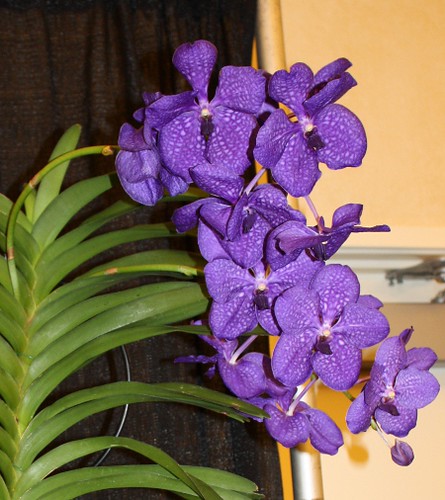
Vandas are known for being vibrantly colored and having some colors that are not common among other orchids - especially purples and royal blues.  The orchid above is a great example.  The photo doesn't quite show the blue-ness of the flower as it appeared to the human eye.  Even still, it is very nice.

vanda_paki
Vanda Paki (V. suavis x V. cristata)
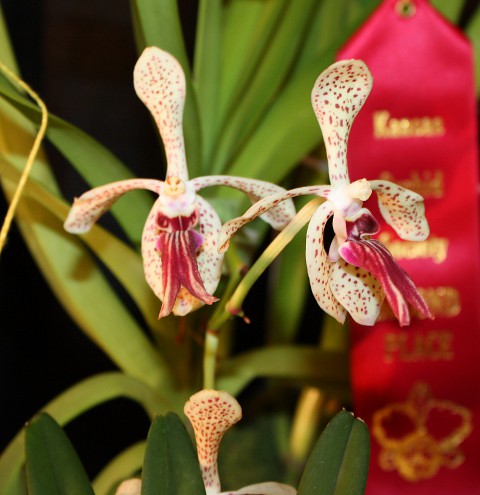
There were some nice Vandas that had spider-like flowers.  I really like these two varieties (above and below) that were primarily white, with brown peppering and pink lips.  These flowers are also neat because of the way the lower petals bend in towards each other.

vanda_walnut_valley_mike
Vanda Walnut Valley 'Mike'
There were actually fewer Vandas at this show than I have seen at some others.  Maybe it was the time of year.  I haven't had any luck with Vandaceous orchids, myself.  I bought one in Florida last year that was determined to die, no matter how I took care of it.  Like I said, it is nice to have some orchids that you can just admire and not be tempted to own.

* From the botanical/taxonomical/anatomical/habitat-ual (I made up that last word) standpoint, these orchid groups are about as far away from one another as possible.  Vandas are tropical epiphytes, growing in hot and humid areas and not liking any growing media against their roots.  Slippers are terrestrial, growing in the ground in a variety of locations, from the tropics to snow covered regions.

** While I'm at it, I should go ahead and mention that the Vanda Alliance includes several related genera, but this post only includes plants from the Vanda genus.

Wednesday, May 2, 2012

Trip Report: Orchid Show in Wichita, Exceptional Exhibits

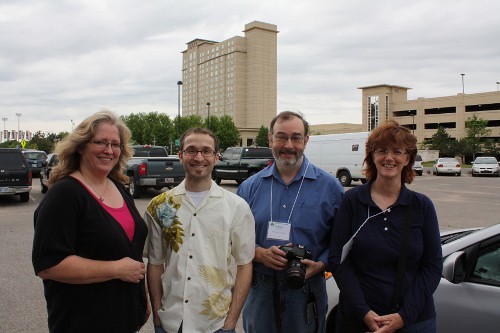
Over the weekend, we traveled to Wichita, Kansas for the Kansas Orchid Society's annual show, which was in conjunction with the spring meeting of the American Orchid Society.  Whenever the AOS meeting coincides with a regional show, it is a big affair, with more plants on exhibit and more vendors present.  Some of my good plant friends from neighboring states converged on Wichita, so I got to spend time with plants and friends, which made for a really fun weekend.

leslie_zach_steve_cathy
Some of my good plant friends.
We're all members of the International Aroid Society, as well as local orchid societies.
Since I have so many pictures and so much to talk about, I am going to split this post into a several different posts, the first concentrating on the exhibit highlights.

award_orchids
Me with my two award winners, Polystachya paniculata (in hand) and Dendrobium Little Green Apples (on upper right)
For the first time, I sent a couple of my blooming orchids for inclusion in the Oklahoma Orchid Society's exhibit.  Both of my orchids (Dendrobium Little Green Apples and Polystachya paniculata) were given 3rd place ribbons, so that was encouraging.

polystachya_paniculata
My Polystachya paniculata plant
I have heard about Andy's Orchids for a while.  It is probably one of the five most popular orchid vendors online.  They have a lot of species available and generally have pretty reasonable prices.  Most of their plants are mounted on sticks, which is nice, too.
andys_orchids_exhibit
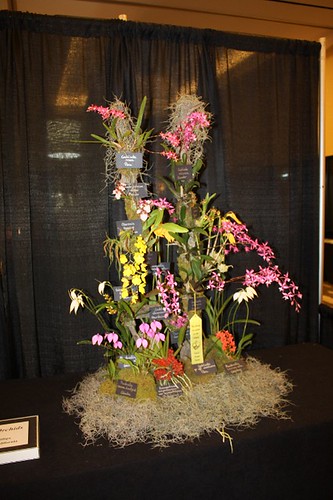
Exhibit by Andy's Orchids
Andy's Orchids had a really nice "exhibit by a commercial grower."  My friend Steve told me it was put together at their business and shipped in a box filled with packing peanuts.  When they got to the show, they just opened the box, pulled out the structure and let the peanuts fall away.

cochlioda_rosea
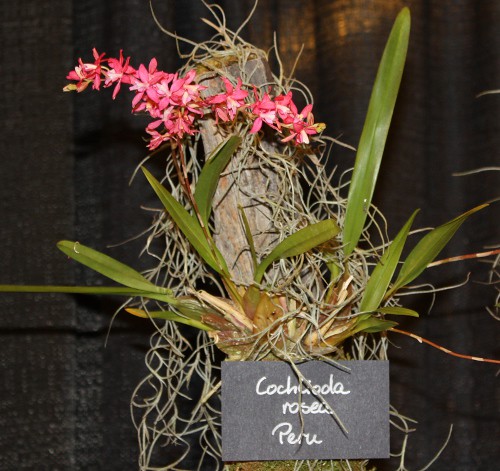
Cochlioda rosea
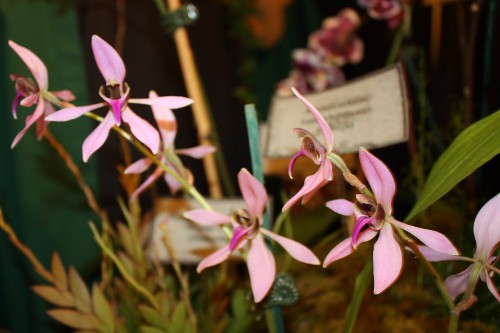
The exhibit consisted mostly of intermediate to cool growing orchids, including Masdevallias down near the bottom and at the top a couple of orchids from the genus Cochlioda, a new genus to me.

huge_exhibit
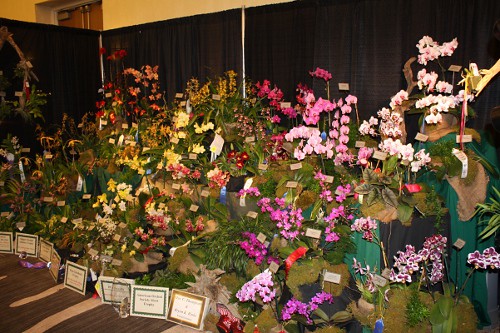
Spectacular exhibit by Max C. Thompson and Bryon K. Rinke
Two gentlemen that must have huge orchid collections put together this single amazing display that was gigantic.  Can you believe how many blooming orchids are in the photo above?  That is a lot of really nice orchids.  It took several visits by this exhibit to really take it all in.  Actually, scratch that, I doubt I took it all in, even after several visits.

ancistrochilus_rothschildianus
Ancistrochilus rothschildianus
epi_panama_ruby
Epidendrum Panama Ruby
These couple of photos are not really the highlights of their exhibit.  They are just plants that I was really interested in.  The above Epidendrum was just an oddball and that's why it was interesting to me.  Do you see the blooms?  They are kind of discrete.

epi_magnoliae_bryon
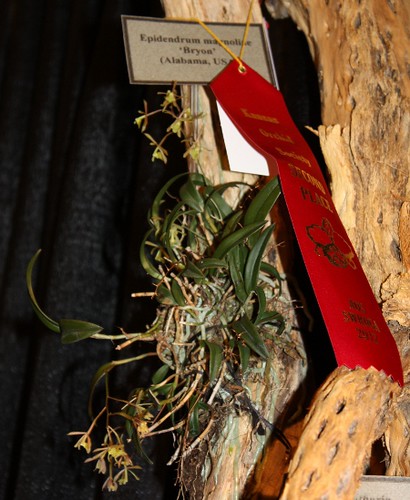
Epidendrum magnoliae 'Bryon'
The Epidendrum above is native to the southeastern United States, found as far north as North Carolina.  It can withstand a light freeze and prefers to live in Magnolia trees, hence the name Epidendrum magnoliae.  I would like to try growing this orchid someday.

cattleya_first_place
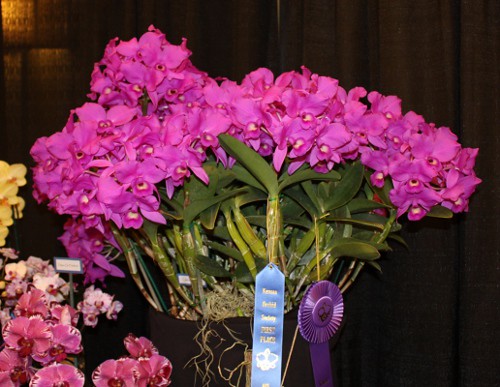
Cattleya that won a first place ribbon
If you grow Cattleya orchids well, they will reward you with a lot of blooms.  If you grow them really well, they will build an army of flowers determined to march to the nearest orchid show and demand a first place ribbon.

ida_locusta
Ida locusta
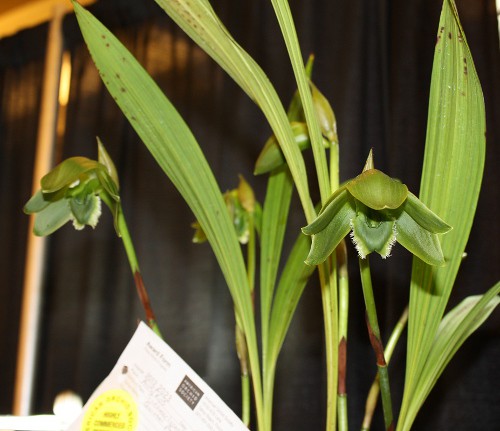
The most highly awarded plant had a totally green flower, with a little bit of yellow on the column.  The plant is Ida locusta and it was given the HCC award (Highly Commendable Certificate), which you can see in the lower part of the picture.

Thursday, April 5, 2012

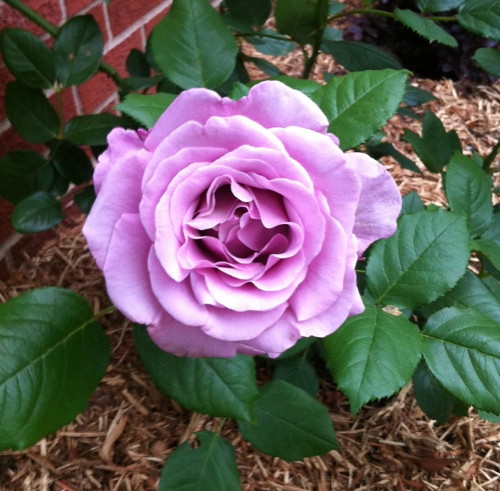
We are the proud owners of our first two rose blooms. Right up until the day they began to open we were thinking we were going to have red or magenta blooms, when we had specifically picked out a lavender-blooming rose. But the next day, when the rose opened fully, we discovered that it was exactly the color we wanted.

rose_neptune_20120405
Rose Neptune - one of our first two blooms
Fragrance is not the first attribute I look (sniff) for in a plant, but these roses really smell wonderful. And we both love this color. I hope that we can be so lucky as to have this new little bush produce more buds throughout the summer.

Monday, April 2, 2012

New flowerbed project

Our dream is to have a backyard that is functional, beautiful and relaxing. We want to have lots of areas where you can sit down and enjoy the outdoors while reading a book or just enjoy the weather. We have worked to create this feel in several parts of our yard. After building on to our house, our backyard had changed and we had a new area to perfect.

back_garden_before
Before: Our blank (and messy) canvas
We decided to add a flowerbed against the back our addition that would soften the big red brick wall and bring some more color into our yard. Once we decided to put in another flowerbed, we started thinking about how we could be a little smarter with our plant purchases this time around. In the past we have poured money into our corner garden year after year, with only a couple of our perennials sticking around to see another year. We didn’t want to do that with this garden.

peewee_supervising
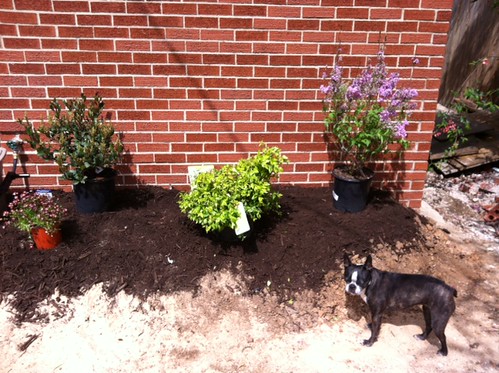
All decisions go through the tiny creature. Pee-Wee supervised each step of the landscaping process. At this point in the process we had laid out our plants, but not yet mixed the soil components, so you can see the rich black compost on top, clay and dirt on the right and sand on the left.

lilac
Lilac bush

back_garden_grouping
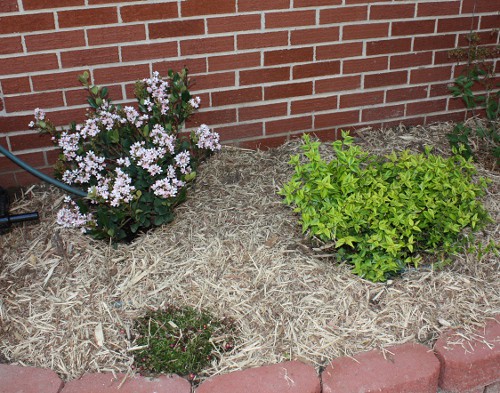
Grouping of Indian Hawthorn, Saxifraga and Abelia
Christie read several magazine articles about planting new flowerbeds and they all suggested starting with foundation evergreen plants before doing anything else. This makes sense for a number of reasons: You want your garden to have year-round interest, so putting these in first is like planning for even the most boring part of your annual cycle to be appealing. It also makes sense because these plants are generally the largest ones in the garden and you really want to place those before you put in the more superfluous splashes of color. So we came up with a list of several evergreens that we wanted to find for our new garden and we vowed to not change our mindset on the evergreens, even if we saw a bunch of super spectacularly awesome plants with more pizzazz.

euonymus
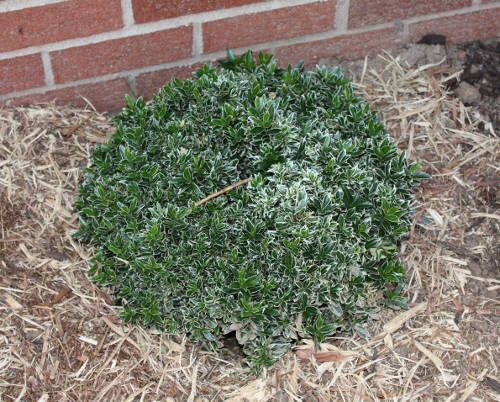
Variegated Euonymus Boxleaf
It turns out that when we were walking through the garden center looking for evergreens, we noticed some really nice features in them and really fell in love with several evergreens. We don’t have trouble “stopping to smell the roses,” but until now we had not “stopped to gaze at evergreens.” Granted these don’t have the most showy flowers or amazing colors or anything, but there are some really nice evergreens available for our zone and we took advantage of their variety.

abelia
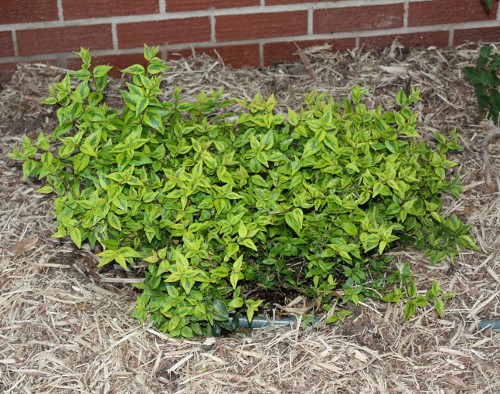
Kaleidoscope Abelia
One other change to our garden philosophy this time around was to buy plants that were more expensive but also more mature. We decided that a more mature plant is more likely to make it through our difficult growing season than a petite plant. Nearly every summer we have about a week of days above 100 F and periods of no rain. And about 1 out of every 5 winters will dip down to about 5 F. We figure the initial investment is definitely more, but the plants are more likely to make it through the critical first couple of years if they are mature plants when they go in the ground.

back_garden_curve
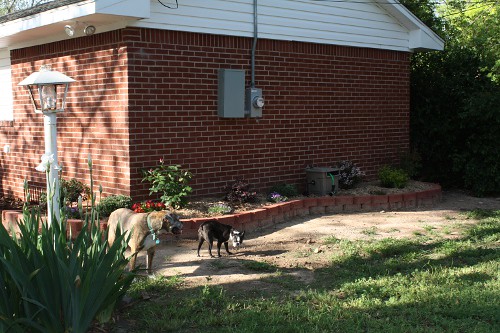
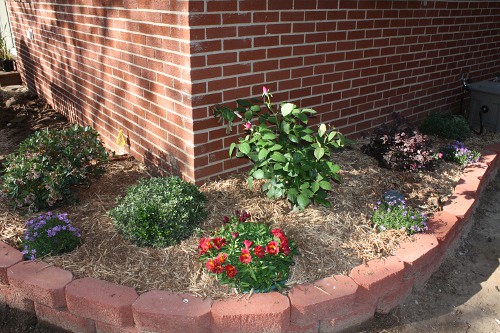
Back garden along the curve. Bright red flowers are Alstromeria. Rose bush behind and to the right.

pip_with_compost
Pippa finds landscaping very relaxing. She kept track of where the last block was to be placed and also helped us sift out the large sticks from the compost mix. (Notice the stick in her mouth.)
Once again*, we were incredibly fortunate in that we wanted to build a raised flowerbed and a neighbor down the street had a huge pile of dirt in their front yard that they needed hauled away. They put in an underground storm shelter; we put in a flowerbed. Win-win. (Of course, somewhere in there Christie and I had to shovel and haul about 20 wheelbarrow loads full of dirt about 1/4 mile down the street.) I mixed equal parts of sand, leftover from our addition, to offset the tough clay nature of the dirt. Then we got a bunch of free compost from the city and mixed that in as well. It was a lot of shovel work, but I think it resulted in an excellent soil for our plants.

loropetalum
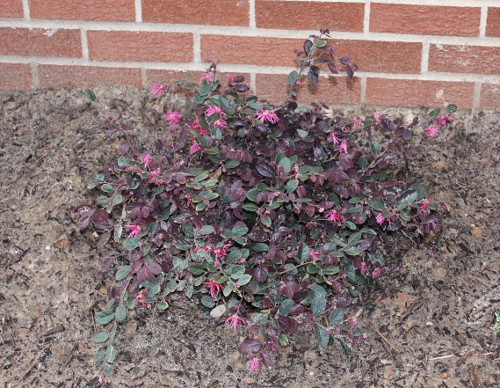
Loropetalum
Another first for us came when we purchased our first rosebush. We have always appreciated cut roses and have seen some very nice rose gardens, but we have never grown roses before. We both really like the light lavender roses, so we were looking particularly for one of those varieties. We found a nice bush of Neptune and we’re really excited to see how many roses we will get from our little bush. Right now there are two big buds on it that are about to open and they look very much like they will be red or at least a dark pink/magenta color. We’ll have to see if they change before they completely open or if the plant was mislabeled.

So, what did we end up planting?
  • Rose ‘Neptune’
  • Snow Pink and Pink Lady Indian Hawthorns: Rhaphiolepsis indica ‘Snow Pink’ and ‘Pink Lady’ (evergreen with light pink flowers in the spring, followed by blue berries)
  • Burgundy Blast Loropetalum Loropetalum chinesis rubrum ‘Burgundy Blast’ (evergreen, or “ever purple,” with interesting pink fringe blooms in the spring)
  • Oxana Princess Lily Alstroemeria x hybrida ‘Staprioxa’ (early riser with red blooms in spring)
  • 2 Dwarf Variegated Boxleaf Euonymus Euonymus japonica ‘Microphylla Variegata’
  • Kaleidoscope Abelia Abelia x grandiflora ‘Kaleidoscope’ (evergreen, changes color throughout the year, small white blooms in summer)
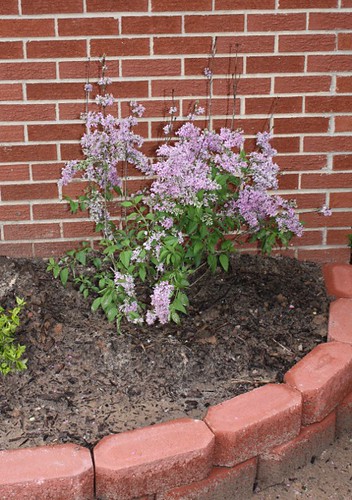
  • Persian Lilac Syringa x persica (deciduous, fragrant light purple blooms)
  • Touran Scarlet Saxifraga Saxifraga x ardensii ‘Touran Scarlet’
  • Phlox, phlox, phlox (Christie’s favorite creeping spring bloomer, an evergreen groundcover)
  • Peony Sarah Bernhardt Paeonia ‘Sarah Bernhardt’
back_garden_full
Full view of the new garden
* There is this strange phenomenon that occurs every time we need dirt. This is the third occurrence. The first occurrence was shortly after we were married and wanted to install our corner garden. We had some neighbors do landscaping and they regraded their front yard, resulting in a pile of dirt that ended up being just the right amount of dirt to build up our 3 tiers. Then, a couple of years later, we wanted to put in our waterfall in the front garden and a neighbor in the opposite direction took out a raised flowerbed in their yard. We hauled that dirt down the street in a matter of one afternoon and voila!

Friday, March 16, 2012

Trip Report: Garvan Gardens' Tulip Extravaganza

Last weekend, Christie and I drove over to Hot Springs, Arkansas for the weekend.  The town is aptly named after the natural springs that flow from the ground and have brought travelers here for hundreds of years.


Our trip to Hot Springs was inspired by the Tulip Extravaganza at the Garvan Woodland Gardens, but we also enjoyed the National Park focused on the hot springs.  (Ask the locals and they’ll tell you that it is the first US National Park.  In truth, it doesn’t have that official designation, but it was the first nature reserve set aside by the US government, before there was a national park system.)

img_6870_35496761995_o
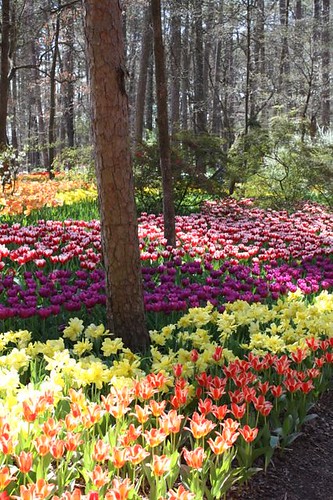
Tulips at Garvan Woodland Gardens
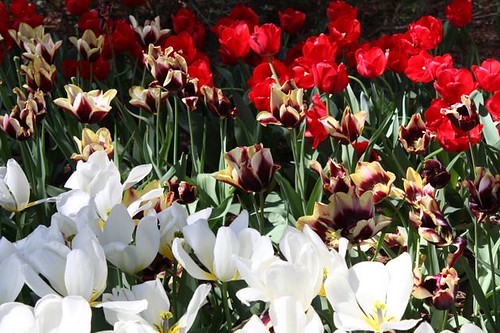
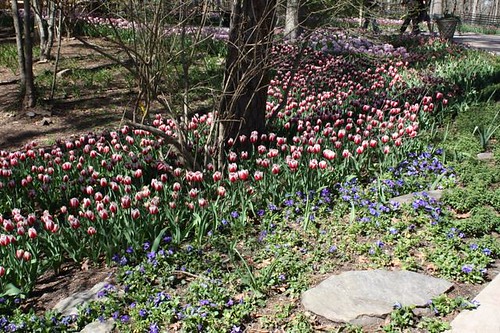
As you can see, the gardens were beautiful.  They are planted fresh each year so that they can create new swaths of color and have premium new bulbs from Holland.  We enjoyed the diverse palate of colors and tulip styles.

img_6849_35329665352_o
Tulips at Garvan Woodland Gardens
The gardens included lots of neat areas and we spent our whole afternoon wandering through the acres of carefully designed planting.  I have uploaded a photo album with tons of pictures, so feel free to peruse them all by clicking on the photo below.

Garvan Woodland Gardens 2012
Click for complete album