Showing posts with label Epiphyllum. Show all posts

Wednesday, July 27, 2011

Plant Find: Dragonfruit

The Dragonfruit plant (Hylocereus, also called Pitaya) is a climbing cactus which produces tasty horned fruits after it blooms.  The plant is closely related to Epiphyllums, the orchid cacti, and the blooms look nearly identical.  One of my blogging friends recently took a trip to Thailand and got to see dragonfruit growing in an orchard.  These gangly plants are growing in a tangled mess on top of poles in a big field.  It's crazy to see.

After I saw Derek's pictures, I decided I need to try out this plant myself.  I'm not a big cactus guy, but I do like my Stapelias and I'm excited about the possibility of my Epiphyllums blooming for me one day.  So I got on eBay and found an inexpensive cutting of a dragonfruit hybrid, which has red fruits - Hylocereus polyrhizus x. H. undatus.  The cutting was not really rooted, but I was assured that it would be easy to root.  So I stuck it in some potting soil when it arrived in the mail just two weeks ago.
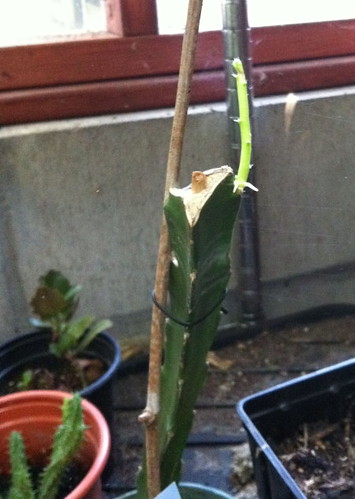
dragon_fruit_growth
Hylocereus sending up a new growth
I don't know what's going on underneath the soil, but up here it's doing really well, producing new growth!   It must enjoy 100+ temperatures.  Now I just need to decide whether I want it to climb a totem or let it dangle from the pot like most Epiphyllums are grown.  It seems most people grow them climbing up a totem and then let them go crazy Medusa-like once they get to the top.  I'm not sure if there is a reason for that or not.  It might be close to their natural habitat, where they are most often tree-climbers.  I'll have to do some more research.  Interestingly enough (according to wikipedia), the native region for this plant has never been resolved.

Monday, November 8, 2010

Epiphyllum growth

After seeing some beautiful blooming plants at the Volunteer Park Conservatory in June, I purchased some Epiphyllum cuttings a couple of months ago from eBay.  Epiphyllums are the genus of plants commonly referred to as the "Orchid Cactus."

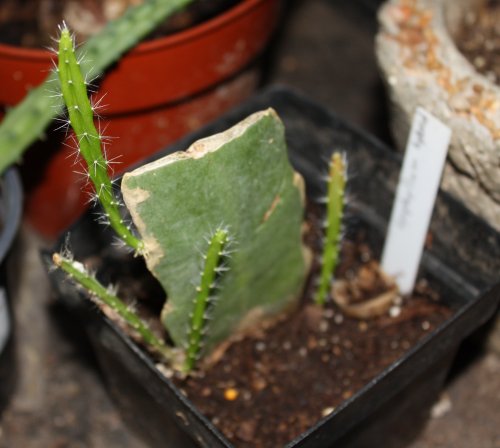
ep_noid_growth
New growth from my non-identified Epiphyllum
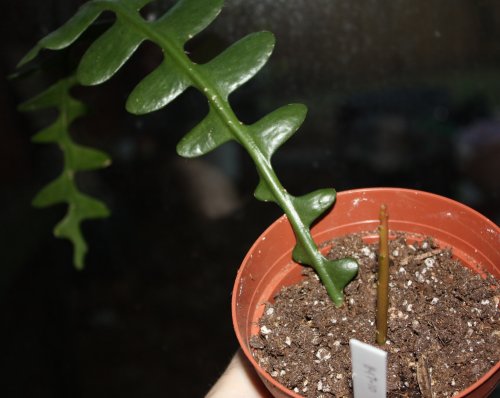
The picture above is clearly a cutting from another plant.  It will probably take about 3 years before the plant is mature enough to produce a bloom.  I bought this cutting as an unidentified variety, so I don't know what color the blooms will be when they come.  The plant below is a little more mature and might bloom in another year or two.  This one (below) is the species Epiphyllum anguliger, which has a white bloom and the outer most petals (called "tepals") are light orange or yellow.  The tepals of Epiphyllums are generally much narrower than and a different color from the rest of the petals in the bloom.  Before the bloom actually opens, the tepals are all that you see, so the color is deceiving until the bloom opens.  I have noticed this before with Christmas cacti (Schlumbergera).  You can google image search for "Epiphyllum anguliger" to see pictures of the blooms of my plant below.  Generally Epiphyllums bloom in Spring or Fall, as I understand.

ep_anguliger_growth
New growth on my Epiphullum anguliger

Wednesday, July 14, 2010

Trip Report: Volunteer Park Epiphyllums

Epiphyllum is the genus commonly called "Orchid Cactus."  That common name comes from the appearance of the plant when not blooming (cactus-like) and the beautiful flowers (not really orchid-like, but very pretty).  This genus of about 20 species is in the Cactaceae family, so it truly is a cactus.  It is found in Central America.

The plant itself has a growth habit similar to my Stapelia, with long, lanky stems - which I guess are technically the leaves of a cactus.  Epiphyllums also bloom from the end of long cascading stems.  However, the stems of the Stapelia have more bulk to them, whereas Epiphyllums are slender with a central vein that is a little thicker.  But this plant is not grown for its green stems.  It is grown for it's beautiful blooms.  Take a look!

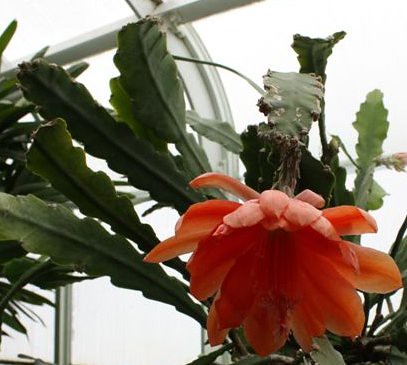
peach
Peach Epiphyllum bloom
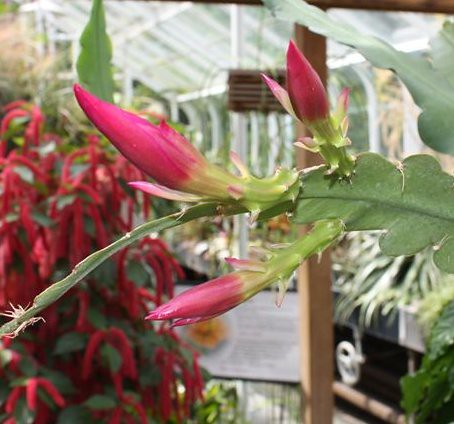
pink_buds
Epiphyllum buds
One of the most widely recognized Epiphyllums has a pure white bloom and has some spidery petals.  It is called Queen of the Night and is supposed to bloom primarily during the dark house.  Epiphyllum blooms are very short-lived (just one day), so we were very lucky to see a couple dozen blooms of different colors at the Volunteer Park Conservatory in Seattle.

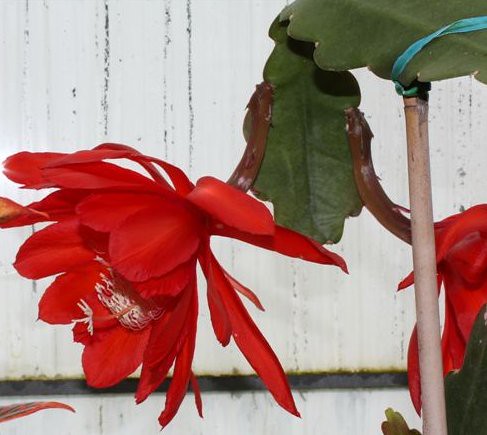
red
Red Epiphyllum bloom
Like the Fuschias, many of the Epiphyllums on display were colorful hybrids, which are commonly kept as houseplants.  From what I've read, this genus is a pretty easy houseplant.  It has the inherent trait of other cacti, being drought hardy, while also growing well in part shade.

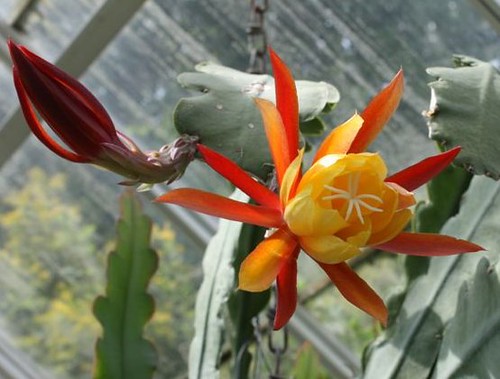
sunburst
If I was naming this plant, I would call it Epiphyllum 'Sunburst'.
christie_and_pink
My beautiful wife, Christie, posing with a cascade of pink Epiphyllum blooms

Next time I have a chance to buy an affordable Epiphyllum, I'll be happy to take one home!