Showing posts with label Galveston. Show all posts

Friday, August 31, 2018

Butterfly Vine from seed

I have long-since admired a particular plant growing in the Butterfly Garden on the bay side of Moody Gardens in Galveston. I'm actually amazed that I've never blogged about it before. This plant is a creeping and mounding vine, and I suppose it would climb if it had something to climb. In the summer it produces many small yellow flowers in clusters.
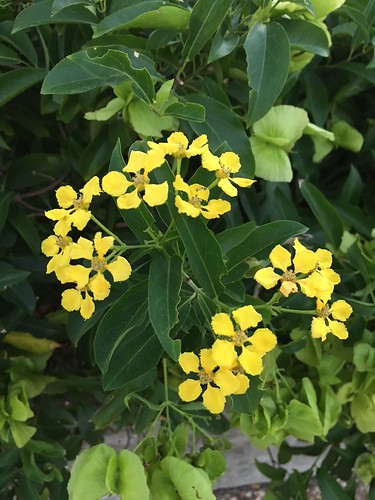
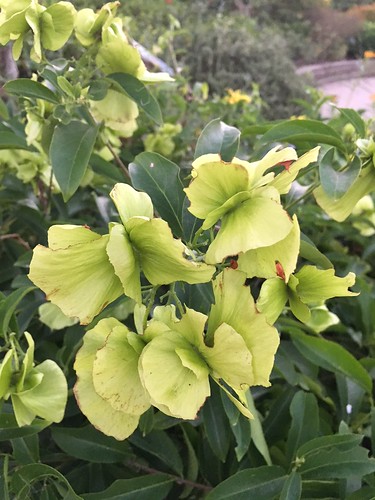
Mascagnia macroptera


Mascagnia macroptera

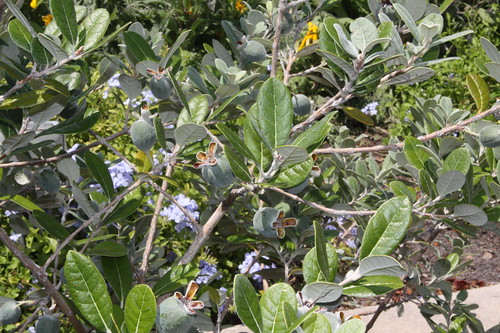
After those flowers are pollinated the seed pods form and things start getting interesting. The seed pods begin green and sort of blend in with the foliage, but they have a very interesting shape. Like many other seeds they have wings that help them disperse in the wind. It just so happens that these wings make them look a lot like butterflies. As the season progresses the seed pods dry out and become a more conspicuous brown. I collected some of these seed pods a few years ago and my mother-in-law was using them as decorations.
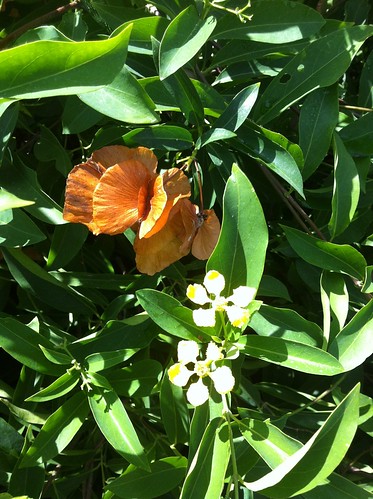
Mascagnia macroptera (butterfly vine)

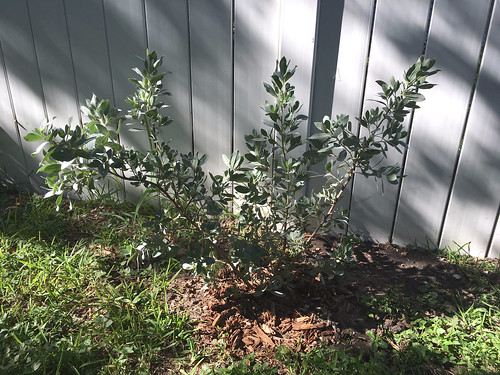
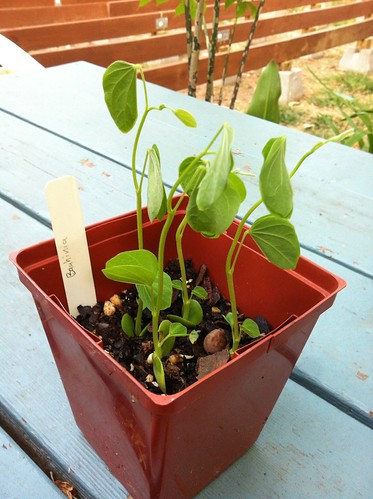
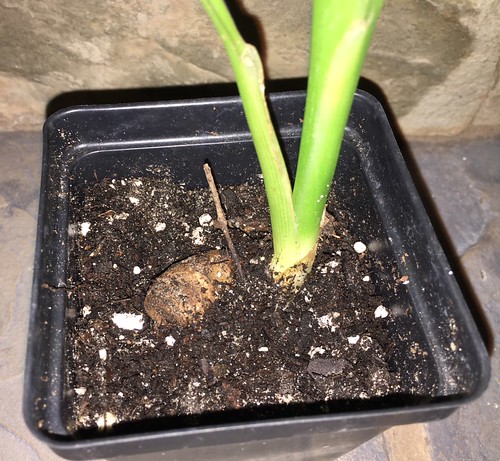
This summer I decided to dissect a few of these to get to the seeds. The seeds are smaller than I was expecting. I planted them in some moist soil and let time do its thing. Just a few of these germinated for me, not surprising considering the amount of time since they had been harvested. I planted one of these along the fence line at the house in Galveston and I'm hoping it will do well there without any special care. I have kept the other one at home, in a community pot with other seedlings I started this summer. It is slow growing so far. Perhaps I need to provide more sunlight.


Butterfly Vine (Mascagnia macroptera) seedling,
growing in a community pot with Cockspur Coral Tree (Erythrina crista-galli) seedlings.

I found a story from Birds & Blooms magazine about a woman who painted the seed pods as real butterflies. Pretty neat.

Wednesday, August 29, 2018

Cockspur Coral Tree from seed

This past summer my family ventured to Galveston in early June and again at the end of July. On our first trip we had a picnic at Moody Gardens and walked around the grounds. I was very sad to see that the butterfly garden was barren, normally fully planted and bursting in color. One of the few living plants in this area was a Cockspur Coral Tree (Erythrina crista-galli), which was about 10' tall and in bloom. I'm guessing this tree blooms through much of the year, because it also had seed pods on it.

Cockspur Coral Tree (Erythrina crista-galli) in bloom at Moody Gardens, Galveston, Texas.

Cockspur Coral Tree (Erythrina crista-galli) in bloom at Moody Gardens, Galveston, Texas.

You know me, I swiped a seed pod, thinking maybe I would be able to germinate them. I planted the seeds a while later and most (maybe all) of the seeds germinated. I don't know this species very well and was a little surprised to find how prickly they are, even as little seedlings. See the photo below.

Cockspur Coral Tree (Erythrina crista-galli) seedlings.
I don't recommend growing trees in a hanging basket. This is just what I started the seeds in.

Prickles on Cockspur Coral Tree (Erythrina crista-galli) seedling.

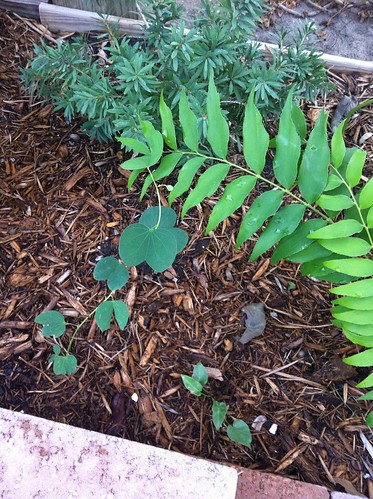
On our return trip to Galveston in July I took one little 5" tall seedling with me. I planted this seedling in one of the spots vacated by the Natal Plums (Carissa macrocarpa). The Natal Plums died back to the ground over the winter, but were sprouting back from the roots. My mother-in-law suggested that we take this opportunity and just remove them since they were way oversized for the location where they had been planted and were covered in fierce thorns. I obliged her, digging up all of the plants and roots, and transferred one of these to a pot, where I plan to keep it trimmed (sort of a bonsai) and small.

potted Natal Plum (Carissa macrocarpa)

The Cockspur Coral Tree looks pretty pathetic in this location right now, but I put some barriers around it so that it won't be mowed down and I'm hoping that the Galveston climate will have this little tree growing towards the heavens in no time. The little Natal Plum does not look pathetic in it's pot on my front porch. It looks awesome! Let's just hope I can keep it small - the thorns on this plant are vicious!

Monday, May 21, 2018

Hard winter strikes a blow

Just a month after posting my Galveston garden update I traveled down there for a weekend birding trip and found that the garden didn't quite look the same. Apparently this winter was a hard one in coastal Texas and a number of plants that had never before seen a hard freeze were zapped to the ground.

Galveston winter damage
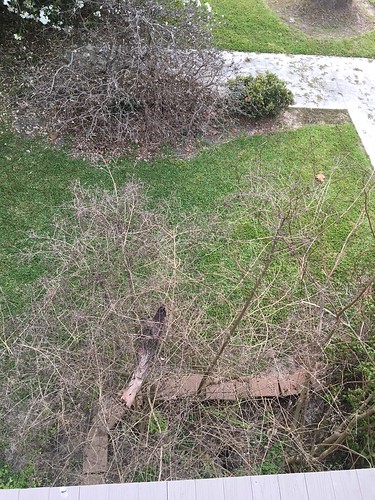
Dead plant material where there used to be Natal Plum (top), as well as Duranta and Jatropha (bottom).

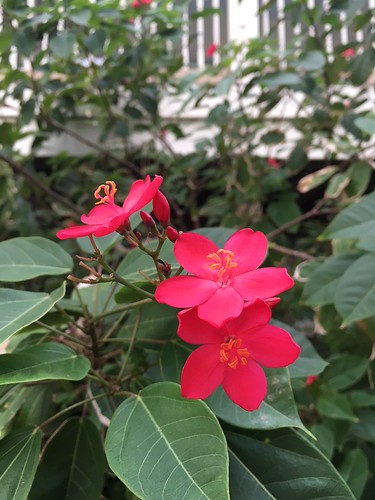
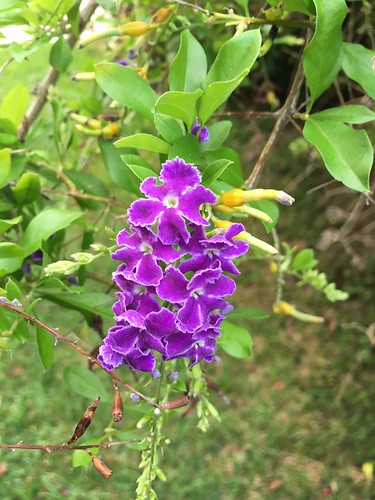
The Natal Plums (Carissa macrocarpa) along the front sidewalk had grown really large over the last 5 years but after this winter they were DEAD to the ground. The Duranta (Duranta erecta), Plumbago (P. auriculata), Spicy Jatropha (J. integerrima), White Bird-of-Paradise (Strelitzia nicolai), Esperanza (Tecoma stans), and Bougainvillea were also all dead to the ground.


Galveston winter damage
Dead plant material where there used to be Bougainvillea and Esperanza.
You can see new Esperanza growth beginning.

The good news is that I could see new green stems appearing at the ground level, coming up from the roots, of just about everything. I will have a heck of a job cutting back and disposing of the old, dead growth on my next trip down to Galveston, but thankfully this winter did not spell the end for most of the plants. I guess the other silver lining is that the plants will not be as crowded now that many of them are starting over from ground level.

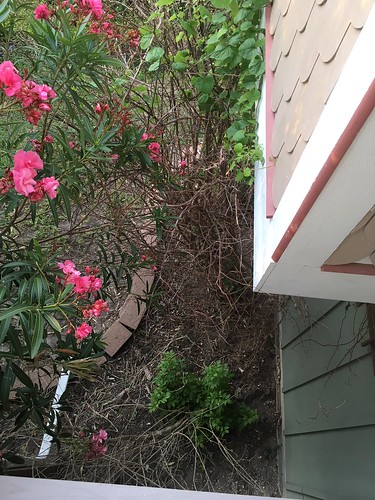
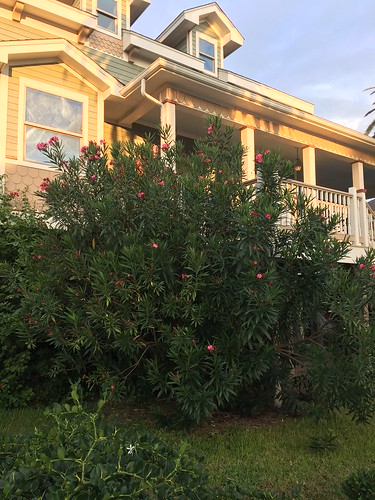
Plants that seemed to have been unfazed by the winter include: all of the Oleanders, Indian Hawthorns (Rhaphiolepsis indica), Shrimp Plant (Justicia brandegeana), Bottlebrush (Callistemon citrinus 'Little John'), Yucca, Pineapple Guava (Feijoa sellowiana), Buttonwood (Conocarpus erectus), and Cycad (Zamia vazquezii).

Thursday, March 22, 2018

Galveston update

It's hard to believe I never did an update post on the Galveston garden that I planted back in 2012.  My life did change quite a bit from that trip onwards, as that is when I found out I was going to be a dad.  My blog posts trailed off a lot after that... Well, it's been over 5 years now, so it seems like a great time to check in on my semi-tropical garden. Most of these update photos were taken in October, 5 years after the original planting of the garden.

Jatropha
Jatropha

Duranta
Duranta
As with any garden I've ever planted, some plants thrive much more than others, and some succumb to one or more factors.  More often than not, those factors in my home gardens are heat and drought, occasionally to a hard winter.  I can safely say none of those factors have taken a toll on the plants in Galveston.

galveston_right_finished
The garden on the right side at time of planting, October 2012.
Can you even see the Justicia?  It's the lanky little stem with few leaves just below the black Crape Myrtle in the image.
See the struggling Yucca?
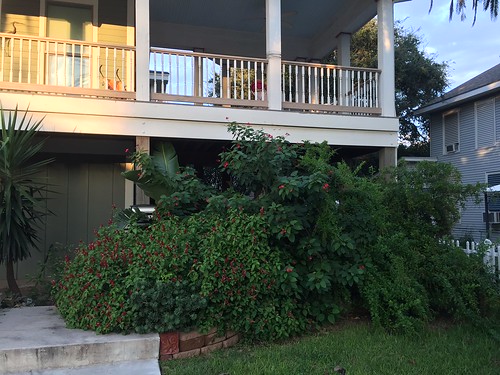
It seems my biggest issue in Galveston is competition.  A few aggressive growers have expanded faster than I expected and drowned out all the sunshine from their neighbors.  The biggest offenders are Bougainvillea, Red Shrimp Plant (Justicia bandegeana), Allamanda, Duranta, Plumbago, and Jatropha.

right garden
The garden on the right side, as seen in October 2016, before trimming.
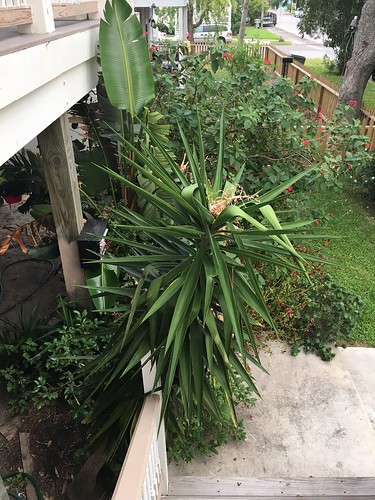
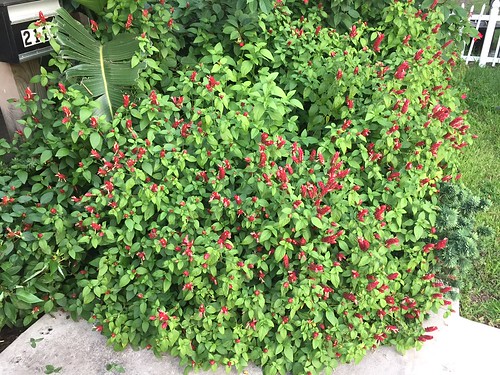
The Black Diamond® Crape Myrtle (Lagerstroemia indica) is still alive, but it is struggling to get enough sunlight because of the Shrimp Plant.  That plant and a Yucca (far left of image above) have really surprised me with their rate of growth.  The Shrimp plant was a lanky little twig when I planted it.  Now it's 6 feet in diameter, and only because I whack it back on a regular basis. The Yucca was about 4 feet tall and only had 4 struggling leaves when it was planted.  Now the base of the tree has enlarged, it is about 7 feet tall, and has a nice head of green leaves.  It even bloomed recently!

Galveston garden
The Yucca has really grown in height and you can see the remains of an inflorescence in this photo.
Unfortunately I didn't get to see it in flower.

Justicia
Red Shrimp Plant (Jatropha) as seen from above. The mailbox is becoming out of reach.
We visit Galveston a couple of times a year and on most of those trips I have spent an afternoon out in the yard, trimming. One of my priorities is always to cut back all of the growth in front of the mailbox, so that the postal worker can get to the box, which you can see is hard to access in the photo above.

mailbox after trimming
More accessible mailbox after trimming.
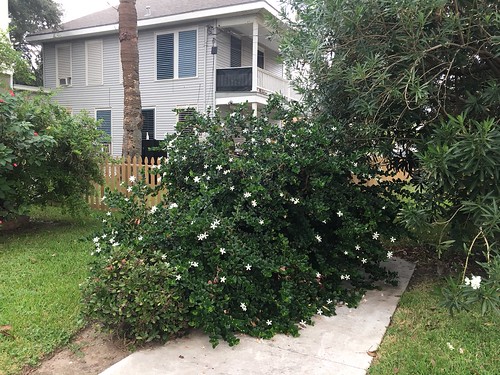
The trimming can be a heavy chore with the rate of growth of some of these plants.  And with the nasty thorns on the Natal Plum and the Bougainvillea, it can be a painful chore. The Natal Plums are covered in little white star-shaped flowers much of the year, which are followed by small edible fruits that my mother-in-law has used to make tiny tarts.

Natal Plum
Natal Plum covering the sidewalk. Luckily the sidewalk is just a segment that ends at each end of the yard, so no one used it anyway. It is required by the City of Galveston on all new construction. Who knows when a sidewalk will be installed in either of the neighbor's yards...
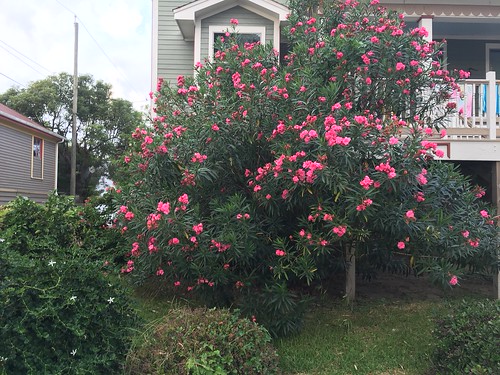
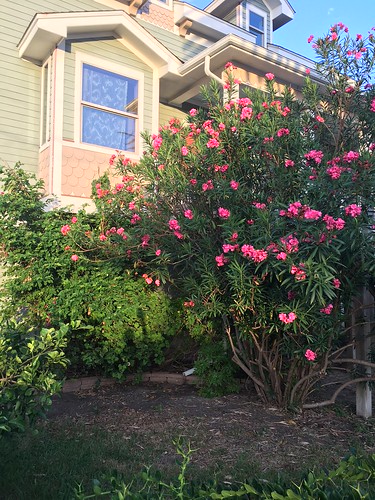
One of the Oleander we planted after the initial planting has shot up to the top of the stairs, which is really cool because the flowers are very fragrant and they are at nose level both on the ground and at the landing of the stairs. I still have to spend quite a while trimming the lower branches that grow horizontally.

left garden
Large Oleander towering up to the second story, October 2016.


Oleander
Another view of the dominating Oleander before trimming.

plumeria and bougainvillea after trimming
Some better definition, exposure of the yard and garden border, after a thorough trimming.
We also have a few invasive vines that I have to keep pulling up.  I gave up on ever ridding the garden of them, so I just try to keep them in check.  Sometimes it's easiest to just find them where they are coming up from the soil and clip them there.  It takes a long time to unwind them from all of the places they are climbing in the bushes.

The prize for plant that I didn't think would make it at all is a Bromeliad that my mother-in-law received as a gift and didn't want to keep growing in a pot in her home.  She planted it in the garden in Galveston and I figured it would surely be a goner in a few short months.  Much to my surprise, it has done well there and even flowered several times since it was planted in the ground.

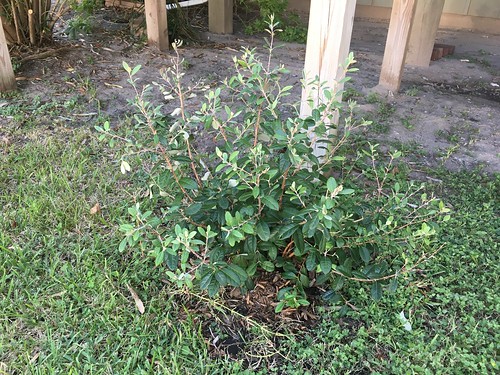
Pineapple Guava
Pineapple Guava

Buttonwood
Buttonwood
Late last year we added a couple of new bushes, a Pineapple Guava and a Buttonwood. Who knows if either of these will become monsters? To be continued.

Wednesday, October 25, 2017

Plant Find: Bauhinia galpinii

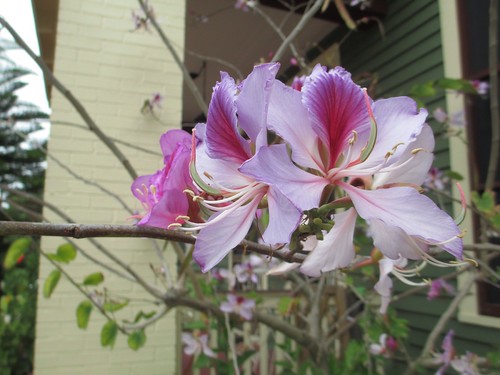
From the moment I first saw one, I have loved Orchid Trees (Bauhinia).  Bauhinia is a genus of more than 500 species of tropical flowering plants, many of them trees, but some are more shrubs and some are even vines.  They are found throughout the world in tropical regions and I have seen them growing in the wild, as well as cultivated in yards in the southern US.  In Galveston, there are several Bauhinia variegata growing in front yards and flowering with their beautiful pink or white blooms.

Bauhinia variegata seedlings
A few years ago I collected some seeds from a tree in Galveston and was able to germinate those seeds. I tried planting a few of the young seedlings to the Galveston yard, but they didn't make it. I don't know if their sunlight was choked out by their more aggressive neighbors, or something else happened. I have a few saplings now that have gotten to a decent size and I plan to plant in the Galveston yard when they get even a little bit larger.

Bauhinia variegata (orchid tree)
Young Bauhinia variegata seedlings that I transplanted to Galveston garden.
As beautiful as the blooms are, the leaves are every bit as stunning.  They unfold like a set of hands asking for a piece of bread.  I read that Linnaeus named this genus after a set of twin botanists, which is fitting due to the symmetric, two lobed leaf.

Bauhinia variegata
Bauhinia variegata flowers on a tree in Galveston

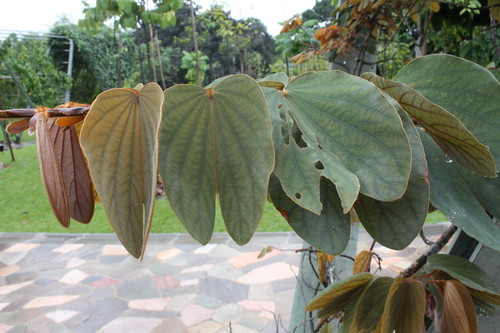
I mentioned that there are some species of Bauhinia that are vining.  I saw one of these species at the Singapore Botanic Gardens a few years ago (photo below).  The stems are woody and there is a fuzzy brown sheath that covers the new leaves as they emerge.  The emergent leaves are sort of red and bronze, turning to a medium green with dark veins. 

Bauhinia semibifida
Bauhinia semibifida at Singapore Botanic Gardens
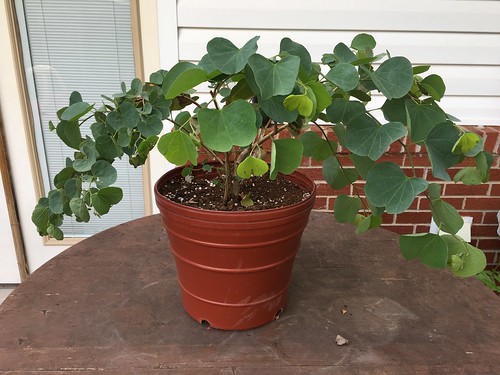
On my most recent trip to Galveston I visited a nursery and came across a beautiful miniature Bauhinia in a pot that I assume is meant to stay a miniature.  It is Bauhinia galpinii and it is so cute. 

Bauhinia galpinii
Bauhinia galpinii

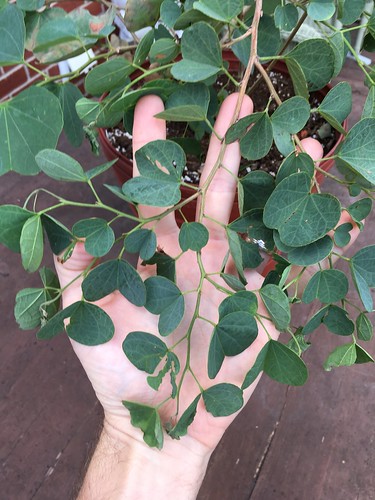
There are actually two small trees in the pot and one of them has much smaller leaves than the other.  Since I have grown Bauhinia variegata from seed and know that the leaves are large from a young age, I do believe this is actually going to retain the small leaves.

Bauhinia galpinii
Tiny leaves of Bauhinia galpinii

My plant is not yet blooming, but I found photos of the flowers online.  They are salmon red and petite compared to B. variegata, but of the same shape.  I hope I can keep this plant happy in the greenhouse over the winter and then I have the perfect place for it next spring when it is warm enough to move my plants outdoors.

Monday, October 23, 2017

Plant Find: Turmeric

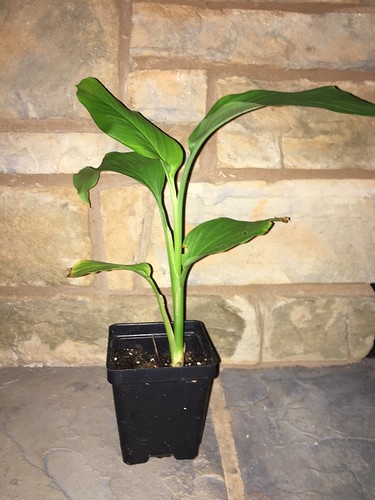
There was a (very) small mid-week farmer's market held at a neighborhood park in Galveston and I walked over to see if there was anything interesting.  One of the five vendors had a handful of plants for sale, one of which looked like a Canna or ginger to me.  I asked the owner what it was and he surprised me by saying it was Turmeric.

turmeric
Turmeric (Curcuma longa) plant
Sometime last year I was in a cooking phase and had a recipe I really wanted to cook that called for turmeric roots.  I have turmeric powder and knew that I could use that, but started researching the roots, which would surely be a more fresh and potentially have a richer flavor.  I found that I could buy turmeric roots on Amazon and they look a lot like ginger roots, except they are orange inside, much like a sweet potato.

turmeric
Turmeric root, used for cooking
I talked to the guy at the farmer's market and asked him how he goes about harvesting and replanting.  He says that he grows the turmeric in a raised bed and will harvest about 90% of his clump of turmeric and leave 10% behind to grow the next batch.  He wasn't asking much for the small plant and I decided that even if I don't end up using the plant for cooking and just grow it as ornamental (like all my other plants) I would be happy to have a turmeric plant in my collection.

Friday, October 20, 2017

Plant Find: new Galveston garden additions

I split out my Galveston garden update into two posts since one was much more related to maintenance and the other is about two new plants I acquired and added to the garden.  Both of these plants have the silvery green foliage that I love so much.

My favorite little nursery in Galveston has a neat assortment of plants that are so unlike anything we have in central Oklahoma.  I really enjoy looking at the assortment of semi-tropical trees and shrubs that can be grown outdoors in Galveston.  On my most recent trip I came across a few plants that I have been coveting for years.

Buttonwood
Buttonwood (Conocarpus erectus) planted in the Galveston yard

I have previously posted about a tree (sometimes a shrub) that Christie and I fell in love with while in south Florida, the Buttonwood (Conocarpus erectus).  I actually tried propagating those trees from cuttings and had some initial success, but couldn't keep the cuttings alive long-term.  I found a nice size bush at the nursery for a reasonable price and had not previously seen one for sale at all, so of course I snatched it up.

Guava
Gauva fruits at Moody Gardens - aren't they cute?
I believe these are the same Pineapple Guava, but I'm not positive.

Another plant that I had been coveting is a small guava bush.  I had seen these growing at the Moody Gardens in Galveston and taken their photos in years past.  They have really funky little flowers, followed by cute little guava fruits that I find really interesting.  I like the little fruit with the four-point star that persists on the bottom.  Again, when I saw one of these at a reasonable price, I had to scoop it up.

Pineapple Guava
Pineapple Guava (Feijoa sellowiana) planted in front of the Galveston house

We had honestly run out of room for planting any new plants in Galveston, thanks to the monsters that took over the garden (post coming soon), but who needs a lawn anyway?  We just dug up grass and fit 'em in.  I envision some day a few years down the road needing to buy some paving stones so that you can walk through what used to be the yard, but is now a jungle of beautiful, lush tropical forest...

Wednesday, November 21, 2012

New garden installation in Galveston

For the first time in my life, I got to plan and plant a garden in a “sub-tropical” zone.  Christie’s parents have built a house in Galveston, Texas and we got to install the garden out front.  We live in zone 7a and Galveston is zone 9b!  What does that mean exactly?  That I get to grow plants that thrive in an environment where the temperature never dips below 25 Fahrenheit.  My zone dips down to zero Fahrenheit. In October, Christie and I headed down to Galveston to help her parents finish the house and have a little leisure time.

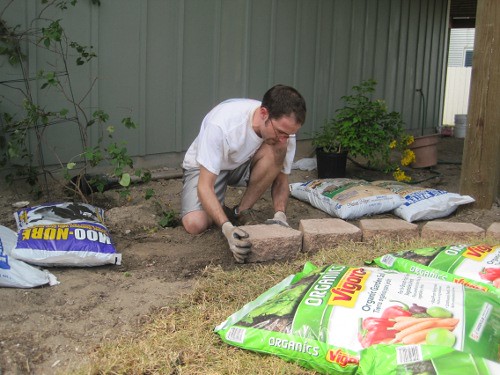
galveston_placing_wall
Laying the retaining wall blocks
It was fun visiting the garden centers in this part of the country and seeing all of the plants that can be grown there that can’t be grown here.  I didn’t really have any rules about the landscaping, but I wanted to get items that can’t be grown here.  Here’s the full listing of what we planted: black Crepe Myrtle (Lagerstroemia), Canna ‘Pink Sunburst’, pink Bougainvillea, Bird of Paradise (Strelitzia), Zamia vazquezii, Dietes iridioides, Alocasia ‘Frydek’, Indian Hawthorne, Natal Plum (Carissa macrocarpa), Gardenia,  Banana Tree, Duranta, Bottlebrush (Callistemon citrinus ‘Little John’), spicy Jatropha (Jatropha integerrima), Plumbago auriculata, Blue Ginger (Dichorisandra thyrsifolia), Red Shrimp Plant (Justicia brandegeana), pink Oleanders (Nerium oleander), dwarf coral Ixora, Yucca, yellow Allamanda bush, Brugmansia.

galveston_plants_ondeck
Plants eagerly awaiting their new homes
We did more soil preparation for this garden than I have ever done before.  We purchased more than 30 bags of soil, manure and other amendments to mix with the sandy soil that is filled with shells.  We wanted to build the flowerbeds up about 8 inches in some areas and about 16 inches in other areas.  There was a lot of shovel work, but once the ingredients were mixed and spread, and the retaining wall was in place, the planting was very easy.

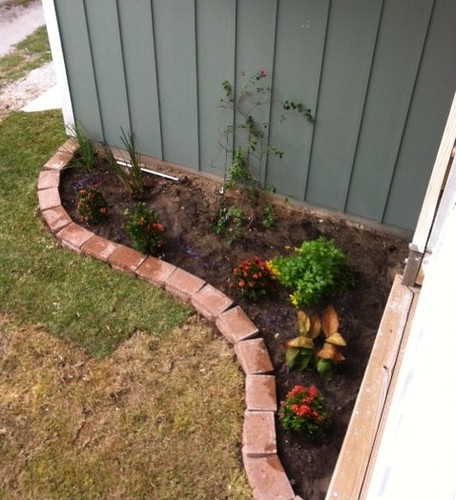
galveston_left_finished
Bird's eye view of the left side garden finished
We did more soil preparation for this garden than I have ever done before.  We purchased more than 30 bags of soil, manure and other amendments to mix with the sandy soil that is filled with shells.  We wanted to build the flowerbeds up about 8 inches in some areas and about 16 inches in other areas.  There was a lot of shovel work, but once the ingredients were mixed and spread, and the retaining wall was in place, the planting was very easy.

galveston_right_finished
Finished garden on the right side