Showing posts with label ginger. Show all posts

Thursday, March 31, 2011

Mammals of the Plant Kingdom

Some plants have a unique way of "giving birth" to their offspring that is called vivipary.  The difference between these viviparous plants and those that scatter seeds is that the new plant begins to grow while still attached to the parent plant.  Here are some examples:

iris_vivipary
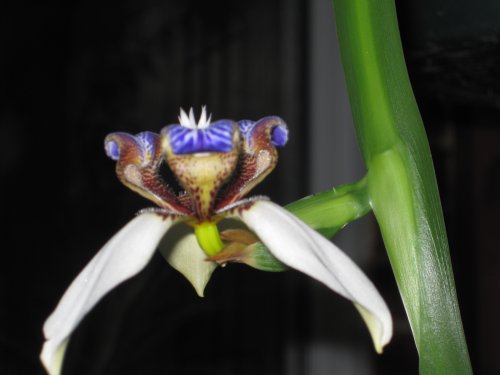
Walking Iris (Neomarica gracilis) bloom with plantlet forming

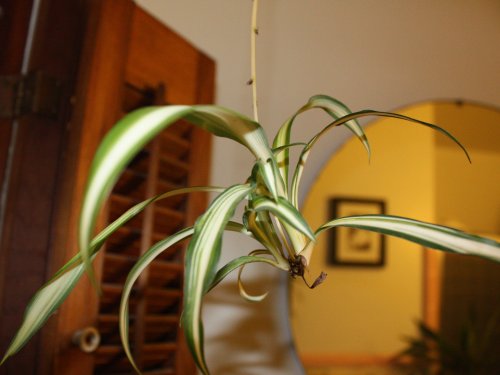
The Walking Iris Neomarica gracilis (pictured above) is so named because of it's propagation habit.  Most Iris bloom on stems that only include flowers.  The Walking Iris blooms from the ends of it's normal leaves.  Usually several blooms follow in succession over a period of a couple of weeks.  All the while, a new plant is forming at this junction.  The weight of the new plant at the end of this leaf blade will make contact with the ground, where the new plant will establish itself.  This is similar to the common houseplant called Airplane or Spider plant Chlorophytum comosum (pictured below).

chlorophytum_offset
Spider plant (Chlorophytum) plantlet
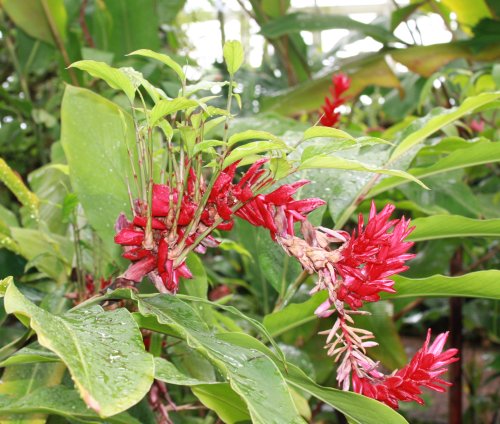
Some gingers (like the one pictured below) produce flowers that are pollinated and produce seed, which immediately germinates and begins to grow on the plant, weighing down the stem until it is upon the ground, where the new plants become established.  I have seen this same type of ginger demonstrating this behavior in the Oklahoma City Myriad Gardens and in Jamaica - a more natural habitat.

ginger_vivipary
Ginger at the OKC Myriad Gardens with new plantlets forming in the blooming bracts
Now true botanical (plant) vivipary (live-birth-ness), results from seeds germinating while still on the host plant.  In some of these cases, the plantlet that forms on the parent is not a result of seed germination, so it is not really true vivipary.  Plants can produce new offspring in just about every imaginable way - from the roots, from the leaves, from the junction of petioles and stems - pretty much every piece of plant anatomy is used for propagation by some plant species.  Surely not all of this is viviparous behavior, right?

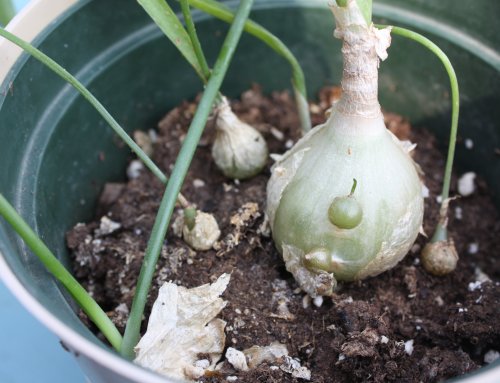
I'm not a botanist, but I try to understand some of the terminology.  There is a condition which is called pseudovivipary which is defined as "a condition in which vegetative propagules replace some or all of the normal sexual flowers in the inflorescence."  To me, this means that a plant is able to produce new plants without necessarily producing flowers, seed, etc.  A good example of this might be the Pregnant Onion, which produces new plants within the "skin" of it's bulb.  As the new plants mature, they will fall away from the parent plant become independent.  At which point the parent bulb cries "They grow up so fast!"

pregnant_onion_closeup
Pregnant Onion (Ornithogalum longibracteatum) with many baby plants

I had actually planned to write about this since I read this term in a book I read a couple of months ago.  Then I saw that Derek had posted about this same topic on Plantgasm.  He beat me to it, but it also gives me a good reason to link to his blog, which I really enjoy.  Derek has some great time lapse presentations of different plants producing new leaves (including aroids) or flowers opening.  I highly recommend you check them out!

Do you know of any other plants that demonstrate viviparious behavior?

Friday, December 24, 2010

Plant Find: a new ginger

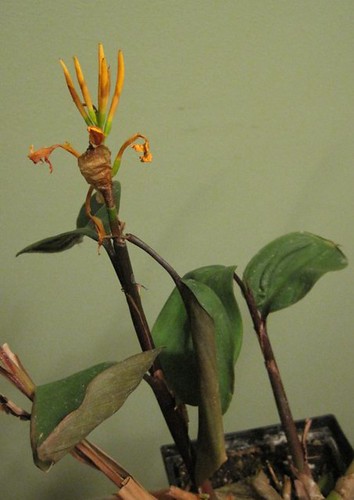
I purchased a ginger I had never seen before at Zone 9 Tropicals.  It is commonly called Golden Brush or Golden Ginger.  The scientific name is Burbidgea scheizocheila.  It has the typical growth habit of a gingers, but stays pretty short and is considered by some as a "dwarf" ginger.  The leaves are deep green on reddish purple stems.  The blooms are orangey-yellow.

burbidgea
Burbidgea scheizocheila

Tuesday, June 9, 2009

Trip Report: Foster Botanical Garden in Honolulu, Hawaii

While on vacation in Hawaii this May, my wife and I visited the Foster Botanical Garden in Honolulu.  In Oklahoma, a tropical botanical garden would necessarily reside in an enclosed structure.  Not so in Hawaii.  The only enclosed structure on the grounds of the Foster garden is to keep a group of hybrid orchids in a pristine environment, where they will not spread into the wild or cross with naturally occurring species.

The Foster Botanical Garden has a long history, dating back to 1853.  [You can read about the history here.]  The garden includes areas dedicated to orchids, hybrid orchids, Cycads, palms, bromeliads, Aroids, gingers, and Heliconias.  Unfortunately I wasn't able to see the Hybrid Orchid greenhouse because I took too long in other parts of the garden and the garden closed before I got there.

I would like to just give a run down of the specific sections of the garden and then point you to my photo album, which I'm sure you will enjoy! :)

Exceptional Trees

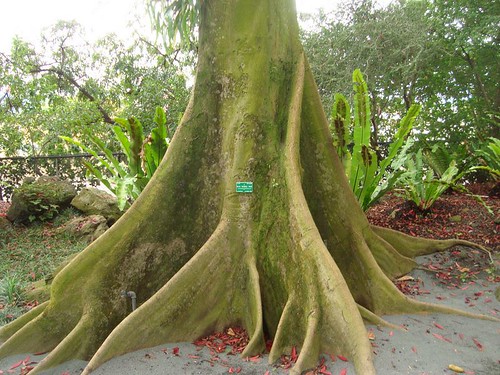
The Foster Botanical Garden has a wonderful collection of 24 "Exceptional Trees."  Exceptional Trees are those that have been designated as trees which are to be protected and cannot be cut down.  According to the legend, one of these trees is the offspring of the tree under which Buddha sat when he gained his knowledge.  You can see pictures of many of the very large trees in my photo album.  A couple of the exceptional trees are palms, of which the Foster BG has more than 100 different species.

Palms

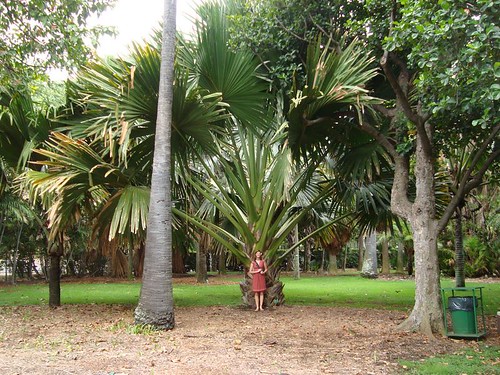
There are literally hundreds, if not thousands, of palm trees in this relatively small botanical garden.  Not being a connoisseur of palm trees, many of them look the same to me.  However, there were about 10 different species that really stuck out, including the Double Coconut Palm and the Grugru Palm.  The palm trees ranged in size from about 8 feet tall to well over 80 feet tall.  Their trunks varied from smooth to covered in spines (the Grugru palm).

dsc03433_35329767132_o
Christie standing in front of a huge palm tree with spreading fronds
Cycads

On first glance, many cycads look like members of the palm family.  But they are a very different family of plants, and can grown into the subtropical and temperate zones, including Oklahoma.  These plants are displayed in the "Prehistoric Glen" of the Foster Botanical Garden.  Cycads are among the oldest trees in the world.  The individual trees themselves are not the oldest plants, but the species have been found in the fossil records dating back to the age of the dinosaurs!

Heliconias, Gingers and Marantas

The botanical order Zingiberales contains the families Heliconiaceae, Zingiberaceae and Marantaceae - which were all featured in the center terraces of the Foster BG.  Of course, I am a huge fan of plants from the Marantaceae family.  I was surprised to find many plants from this family were labeled with incomplete signs, such as "Calathea plant, Calathea sp."  It was as if they had tried to determine the species and had been unable.  I have had this problem quite often with this family of plants.  It is surprising to me that for such a beautiful group of plants, the names are not more widely known.

dsc03529_34686860533_o
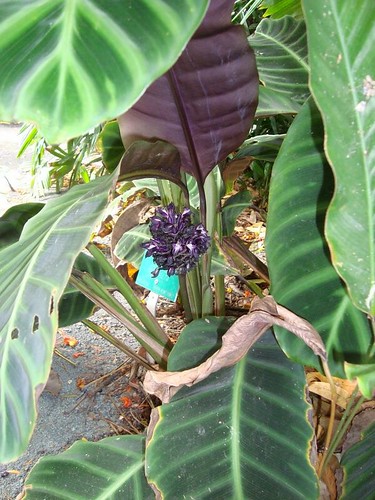
Calathea picturata inflorescence
There was a beautiful flowering specimen of Calathea picturata and many flowering Heliconia.  Unfortunately, many of the Gingers were not in bloom while I was there.  I did see them blooming in other parts of Hawaii though - and I brought back 5 different varieties to grow at home.

Orchids

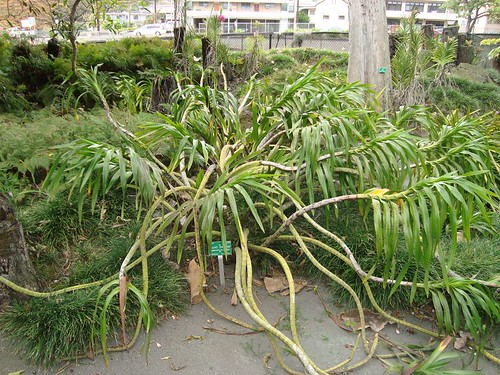
There is a great collection of orchids, mounted on stumps and tree trunks and planted in the ground.  One of them is appropriately named "The Giant Orchid" (Grammatophyllum speciosum).  It has long, wandering stems that arch towards the ground and was probably a good 8-10 feet in diameter!

dsc03410_34655723694_o
Giant orchid (Grammatophyllum speciosum)
It's simply amazing to see these plants growing outdoors.  I would never think of putting one of mine outdoors.

Odds and Ends

There are certainly some oddball plants at the Foster BG.  One of these was the Cannonball Tree (Couroupita guianensis), which has tendrils growing down it's trunk that are covered in blooms that look like orchids.  Later, very large nuts form on these tendrils that look like a large, round coconut (or a cannonball).  As they mature, they begin falling from the tree.  Weighing somewhere around 20 pounds, these large nuts can be dangerous to someone not paying attention!

dsc03560_35366022551_o
Warning sign under the Cannonball Tree (Couroupita guianensis)
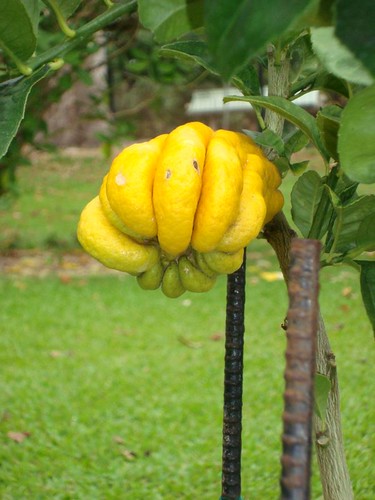
Another odd specimen at the garden was the Buddha's hand citrus tree (Citrus medica var. sarcodactylus).  I had seen pictures of these truly odd fruits before, but not seen one in person until I was here.

dsc03607_35110137400_o
Fruit of the Buddha's-hand Citron (Citrus medica var. sarcodactylus)
To see all of my pictures from the garden (289 of them) click on the image below. Enjoy!

Foster Botanic Gardens

Monday, December 29, 2008

Trip Report: Myriad Gardens continued

Last week I posted a new photo album containing over 200 pictures of the Myriad Botanical Gardens in Oklahoma City.  I posted the album in pre-Christmas haste, without labeling any of them.  But now I have labeled the majority of the pictures.  So, if you haven't seen them yet, or you already looked and want to know an ID of one of the plants, you can check them out here.

Last week in my Myriad Gardens post I just wrote about a couple of the highlights.  I wanted to give a little more information about the Gardens today.

The Myriad Botanical Gardens is a 17 acre colorfully landscaped plot in downtown Oklahoma City.  In the center is the Crystal Bridge Tropical Conservatory, which is a big tropical rainforest inside a cylindrical greenhouse on it's side.  The big greenhouse hovers over a pond, giving it the name "The Crystal Bridge."

The outdoor gardens are nice, but the real action is inside.  About 2/3 of the inside space is dedicated to a tropical rainforest collection, while the remaining 1/3 is dedicated to a dry tropical zone.  There is no physical boundary between the two collections, so I am partly surprised they coexist so well, sharing the same humid air with one another.  The dry zone is watered less frequently the entire year and is watered sparsely if at all during a certain dormant period of the year.

While many of the plants at the Myriad Gardens are those you would expect to see in a rain forest recreation, the Myriad Gardens has focused on a couple of specific plant groups.

Aroids

This is not one of the collections noted on the official website, but being an Aroid collector, I couldn't help but notice how many plants were present from this family.  Maybe the website needs a little update.

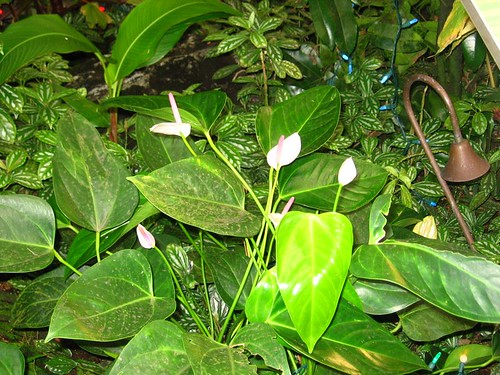
The collection of Aroids from the genus Anthurium was astounding.  There are two types of Anthurium (in my mind): those with the very colorful blooms and ordinary foliage, and those with the really cool foliage but discrete blooms.  The Myriad Gardens had several color varieties of the first category.  I had never seen a pale purple Anthurium before and unfortunately I didn't get a very good picture of it.
img_8794_35365880481_o
Pale purple Anthurium
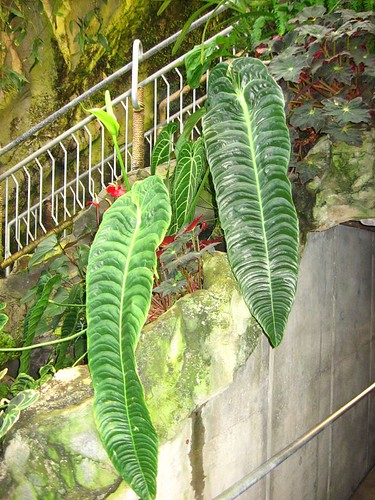
They also have a number of the unique foliage species of Anthuriums, including the King Anthurium (Anthurium veitchii).  Notice the size of the guard rail in comparison.
img_8760_35365941711_o
King Anthurium (Anthurium veitchii)
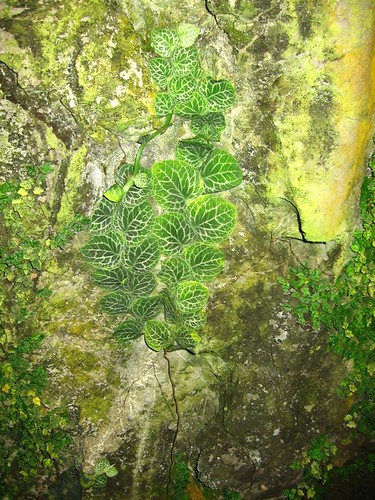
I also saw a cool shingler Aroid that I had never seen before.  This little climber was so appressed to the rock wall that the leaves were conforming to the contours of the rocks.
img_8782_35496653015_o
Rhaphidophora cryptantha - an Aroid shingler - at the Myriad Gardens
Really there were tons more Aroids that I noticed (and photographed) but I won't waste any more space here.  If you're interested, go to my photo album to see them.

Marantaceae (Prayer Plants)

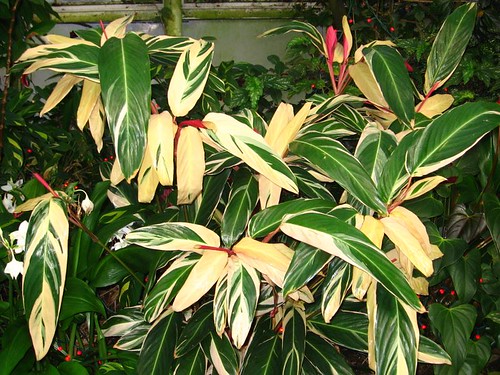
This category was also not mentioned on the official website, but I noticed quite a few unique species from this family that I had never seen before, and several that I had.  Two particular varieties from the same species caught my attention.  I had seen the Stromanthe 'Triostar' before, but never this large.
img_8770_34655478864_o
Stromanthe sanguinea 'Triostar' at the Myriad Gardens
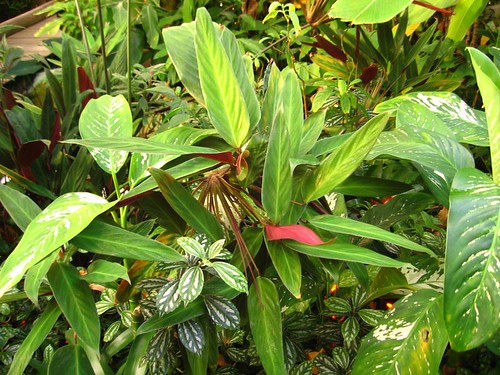
I have not quite identified the other variety, but I think it is also from Stromanthe sanguinea.
img_8805_35329502842_o
Stromanthe sanguinea(?) at the Myriad Gardens

Of course, there were also several very large Zebra Plants (Calathea zebrina), of which I have a small one of my own at home.  It was fun to see these plants waist high or higher.

Palms

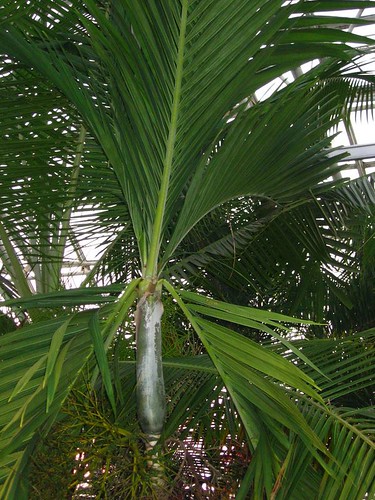
According to their website, there are supposedly 100 species of palms in the Myriad Gardens.  If I had to count, I would probably tell you there were about 10.  The only palm I could correctly identify was the Coconut Palm (Cocos nucifera).  They also have the palm species which has some of the largest leaves in the world - the Bismarckia nobilis.
img_8895_35496587435_o
One of the palms in the Myriad Gardens
Cycads

The Myriad Gardens also has a nice collection of cycads scattered throughout their rainforest collection.  Cycads are pretty much the oldest plants on the planet, having shared time with dinosaurs.  They are often mistaken as palms and have similar characteristics, but are usually shorter.  I don't know that I got any good pictures of the Cycads.

Gingers

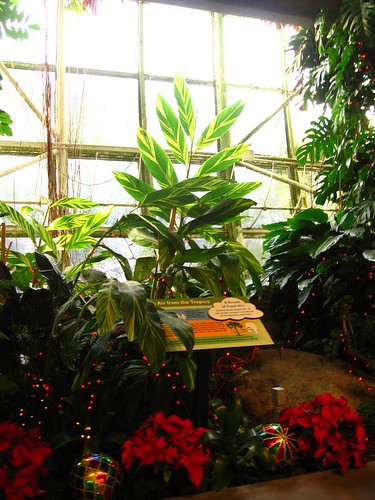
Ah, one of my favorites!  The collection of gingers may just seem large, but not very diverse, whenever the plants are out of bloom.  But when they are in bloom, it is easier to see that the Myriad Gardens has a number of different species of Gingers.  These are beautiful, tall plants with very colorful blooms.  I am still waiting for my own personal shell ginger to bloom.  Maybe next summer.
img_8753_35329569822_o
A variegated shell ginger - Alpinia zerumbet 'variegata' - at the Myriad Gardens
img_8806_35329501212_o
An unknown ginger at the Myriad Gardens
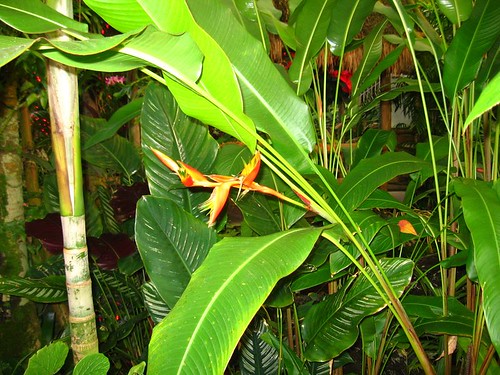
One closely related plant to the family of gingers is the genus Heliconia.  Heliconias are commonly called "False Bird of Paradise" because of their resemblance to the Bird of Paradise inflorescence.  The Myriad Gardens had a couple of different Heliconias in their collection.
img_8792_35365883791_o
False Bird of Paradise - Heliconia lankesteria
Bromeliads

No one would call this collection of bromeliads small.  And it seems they are always in bloom.  The botanical family Bromeliaceae contains the genera Aechmea (the most common Bromeliad), Ananas (which includes the Pineapple plant), Billbergia, Bromelia, Cryptanthus, Tillandsia (commonly called "Air plant") and more than 50 others.  Many of the Bromeliads (Aechmeas, Ananas) are planted in the ground, while others (Tillandsia) are growing attached to trees or rock.  I didn't take too many pictures of the bromeliads, but there are several in my photo album.
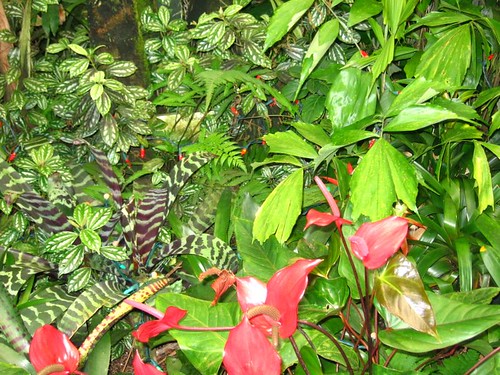
img_8796_35329516332_o
One of my favorite Bromeliads on the left (striped purple and green).
35365894431_3e670c412b_o
One of the many bromeliads in bloom

Orchids

The Myriad Gardens actually has a fantastic display of orchids.  At one location there is a concentrated wall of orchids.  But elsewhere in the rain forest collection you can see them attached to trees and rocks and walls.  It is simply amazing how many orchids are in bloom at any one time.  More than 1200 of the orchids in the collection were bequeathed to the Gardens in 2002 by a local collector named Fred Strothmann.  My photo album has quite a few pictures of the orchid collection.  Even though I have had some experience raising orchids, I didn't try to tackle identifying any of them.  I could tell a couple of the genera, but nothing beyond that.
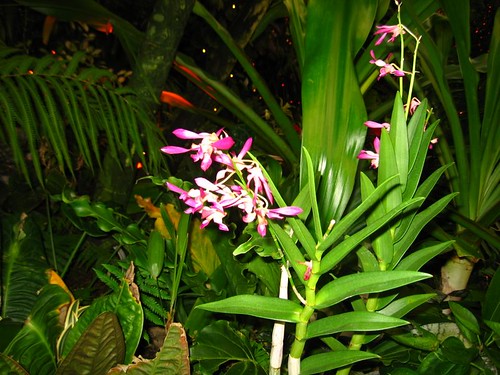
img_8830_35457073096_o
Unknown Dendrobium orchid
Begonias

To be honest, I only noticed 3 or 4 begonias in the Gardens, but the website states that there are over 100 species present.  I'm not denying that they were there, because I was kind of being overstimulated by the place.  If I worked there everyday it would probably take a good month before my head stopped spinning each time I walked in the Gardens.  One particular (large) begonia did catch my eye, the Begonia 'Black Taffeta.'
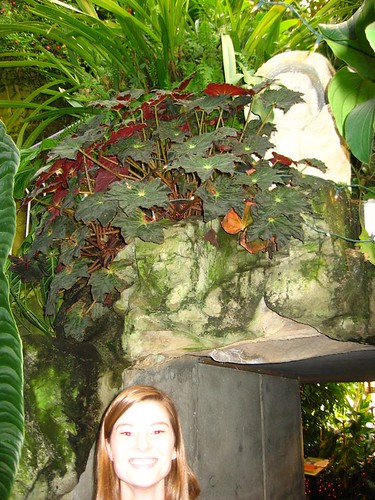
img_8759_35365944861_o
Begonia 'Black Taffeta' and my beautiful wife

Euphorbias

Euphorbias are a bit of mystery to me.  Why?  Well, because the most common Euphorbia I know is Euphorbia pulcherrima - The Poinsettia.  Most of the other Euphorbias with which I am familiar all have spines and are what I would call in a very general sense - cacti.  Now I know that technically Euphorbias are not cacti, and I'm okay with that.  But what I don't understand is what is the Poinsettia doing in the same genus as Euphorbia lactea?
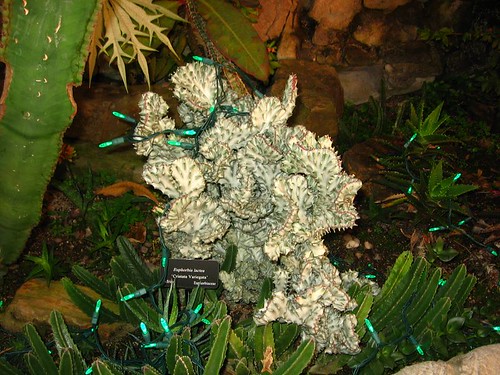
img_8862_35365834341_o
Euphorbia lactea 'Cristata'
The Myriad Gardens collection of Euphorbias resides in the dry tropical zone.  Do you know the difference between a cactus and a Euphorbia?  Euphorbias grow in the Eastern Hemisphere while cacti grown in the Western Hemisphere.  Both plant groupings are filled with succulent plants with thick stems that store a milky sap and require very little moisture in their natural environments.  The Myriad Gardens collection of Euphorbias contains 40 species and if I had to guess, I would have told you it contained more than that.  There are quite a few pictures of Euphorbias in my photo album.

My favorite Euphorbia in the building was probably Euphorbia punicea - The Jamaican Poinsettia tree.  Here is one picture and there are a couple more pictures in my photo album.
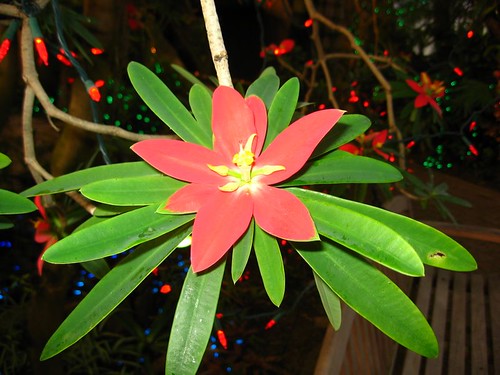
img_8834_35457068386_o
Euphorbia punicea - The Jamaican Poinsettia Tree
The Myriad Gardens are a really great place to visit, with a small admission for the time that you can spend inside (if you're a plant lover).  If you haven't yet clicked on any of the dozens of links I provided to my photo album, I suggest you do so now.  You can get a better feel for the wonderful collection on hand.