Showing posts with label infructescence. Show all posts

Monday, August 22, 2011

Aglaonema infructescence

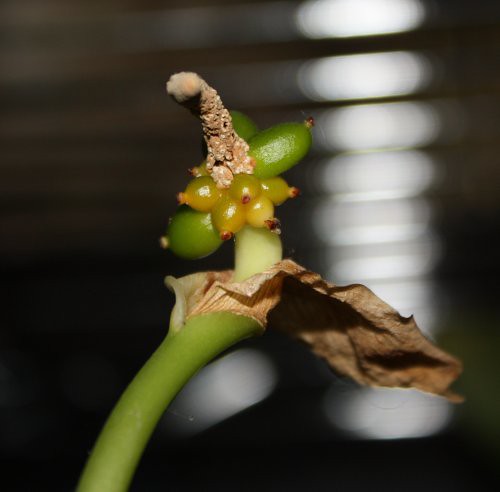
Sometime in late December or early January I had an Aglaonema bloom.  I was planning on collecting some of the pollen and using it to pollinate future blooms on my other Aglaonemas, but I didn't get any after all.  I have left the inflorescence alone and was surprised to see a couple weeks after the spadix was "finished" that berries were beginning to form on the lower half of the spadix.

Aglaonema commutatum berries
Aglaonema commutatum infructescence - Feb 3, 2011
Time ticks by and the berries begin to get larger and darker green.

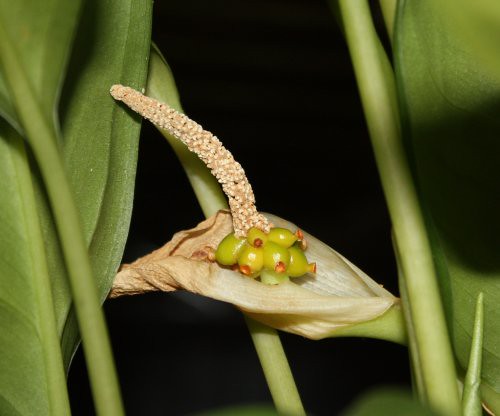
Aglaonema commutatum berries
Aglaonema berries - April 28, 2011.  Notice that a couple berries are getting large.
At the same time, the 2nd inflorescence on the plant began to set fruit as well.  But these berries were a little behind the other set and eventually this infructescence shriveled up and fell off the plant.

Aglaonema commutatum berries
Aglaonema berries on 2nd infructescence - April 28, 2011
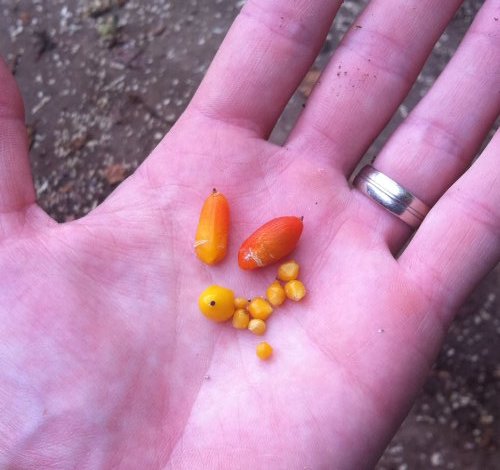
The berries on the original infructescence stayed large and firm with very little change in color or size over the summer.  Then, all of the sudden, I noticed the berries were orange.  I reached down to feel of them and the first big berry had become soft and fell right off the spathe.  This is the sign I was looking for.  I plucked the berries off and here they are.

Aglaonema commutatum berries
Aglaonema berries - August 18, 2011
The berries vary greatly in size.  There are a total of 11, 3 of them of decent size and the others pretty tiny.  I'll get these cleaned and planted this week, knowing they need to be fresh.

Now I have another Aglaonema setting berries, Aglaonema Decora.  Wish me luck with all of my aroid seedlings.  I'm going to need it with these extreme temperatures!

Monday, January 17, 2011

Plant Find: Anthurium scandens

About six months ago I saw my first pictures of Anthurium scandens.  This plant has many different features compared with all other Anthuriums I have known.  First of all, it grows as a vine, while most other Anthuriums grow as rosettes.  Also, this Anthurium is easily distinguishable by its profuse flowering (inflorescences) and the distinct white berries which form when the inflorescence is pollinated.

a_scandens2
Anthurium scandens with single inflorescence
A couple of months ago I saw a small plant of Anthurium scandens listed for sale on eBay and I couldn't pass it up.  I purchased it, along with another unique Aroid.  Just a week later, at the plant swap of our aroid meeting at the Fort Worth Botanical Gardens, there were about 10 ziplock bags with cuttings of Anthurium scandens.  On the one hand, I was kicking myself for having purchased one of these plants just weeks before when I could get one for free at our plant swap.  On the other hand, I was happy to have duplicates of this beautiful plant and knew that there was no way I could have known ahead of time that these would be available.

a_scandens1
Anthurium scandens with two inflorescences

So now I have a couple of Anthurium scandens in my plant collection.  The cutting I brought home from the Fort Worth Botanic Garden even had a couple of inflorescences that had pollinated and formed berries (infructescence).  The smaller plant that I bought on eBay is doing well and producing a new inflorescence every couple weeks.  I have the larger plant hanging in a pot near the ceiling of my greenhouse, with my Anthurium paraguayensis, also from the FWBG meeting.  Eventually I would like to have some sort of tree branch arching across the top of my greenhouse that my Anthurium scandens can creep across.
Wednesday, September 23, 2009

The first real quince fruit

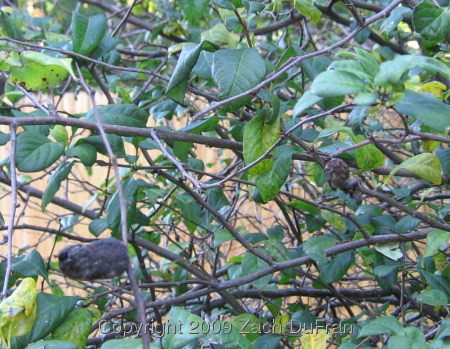
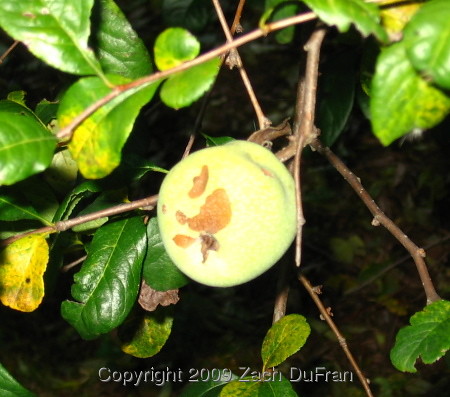
We have a large quince bush in our backyard that presents a beautiful display of color in the early Spring, late Winter.  A number of people have asked me if it produces fruit and I always reply that it is just a flowering quince.  My neighbor, who has a degree in landscaping, told me that it probably still produces fruit.  Until recently, the only thing I had seen that resembled fruit was a little hard, dried and shriveled brown thing that I wasn't really sure about.  I suspected it might be something that wasps make, called a gall, after reading about them in a plant book.

quince_gall
Unknown growths on my quince bush (foreground left and background right). Might be a gall produced by a wasp.
I've tried looking online for similar galls on quince bushes, but haven't found any.  I'm not really sure what those things are.  But sometime over the last week I spotted a definite fruit on my quince bush, for the first time.  This bush is just covered in blooms in the Spring, and yet, somehow, only one fruit formed on the whole bush.

quince_fruit
The first real fruit that I have found on my quince bush (Chaenomeles speciosa)
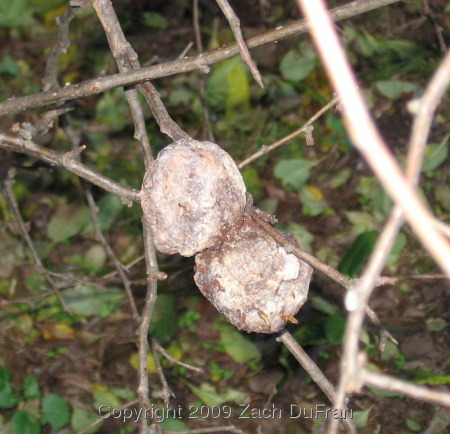
I scoured the bush, looking very closely at every branch, trying to find additional fruits, but the only thing I could find was what looks like 2 dead fruits that might be from last year.  I'll have to look more closely in the future.

quince_dead_fruit
Dead fruits overlooked until recently and possibly produced last summer.
If anyone knows what the mystery growths from the first picture might be, please let me know!