Showing posts with label Maranta. Show all posts

Friday, October 22, 2010

Trip Report: Prayer plants in the Climatron

The Climatron is a 50-year old geodesic dome that serves as a tropical greenhouse at the Missouri Botanical Gardens (MoBot).  During our Aroid meeting at the MoBot (back in April) the Climatron was closed as they were setting up a dinosaur exhibit for the next weekend.  Thankfully we got "back stage passes" into the Climatron with our staff escorts!
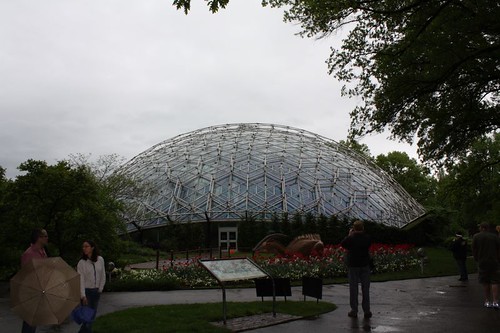
outside_climatron
Outside of the Climatron
The Climatron is much like the Myriad Botanical Gardens in Oklahoma City, with which I have become very familiar.  The center is at a height of 70 feet and by my calculations, the ground space is about 24 thousand square feet.  The Climatron has many of their plant families grouped together that are more scattered in the Myriad Gardens.  For instance, there are two areas in the Climatron devoted only to Begonias and to prayer plants (Marantaceae family), respectively.  The only other venue where I have seen as many Marantaceae would be the Foster Botanical Gardens in Honolulu, Hawaii.
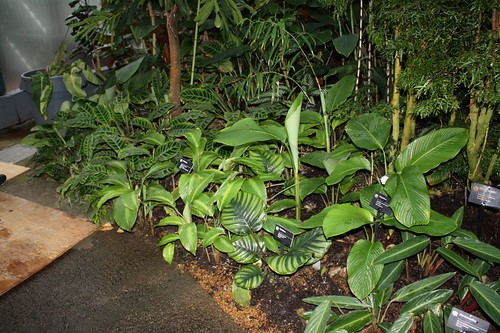
marantaceaes
Some of the Marantaceae in the Climatron.
I was really excited to see this dedicated area for prayer plants, since they are my second favorite family of plants.  The greatest thing was that almost all of them were in bloom and I have only seen blooms on these plants on a couple of rare occasions.
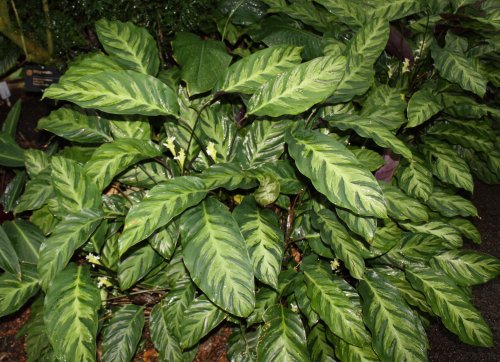
c_albertii_group
Healthy group of Calathea albertii
The impressive species display was the Calathea albertii grouping (above and below).  These plants are obviously very happy in this growing environment, having spread out quite a bit and blooming like crazy.  I was ever so tempted to ask for an offset.
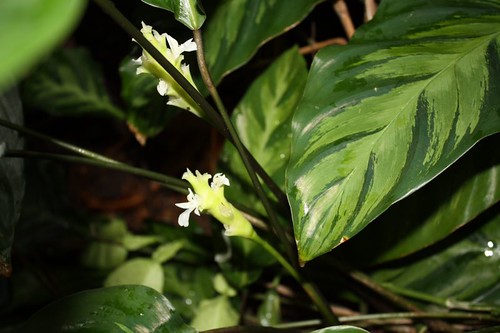
c_albertii_bloom
Calathea albertii in bloom
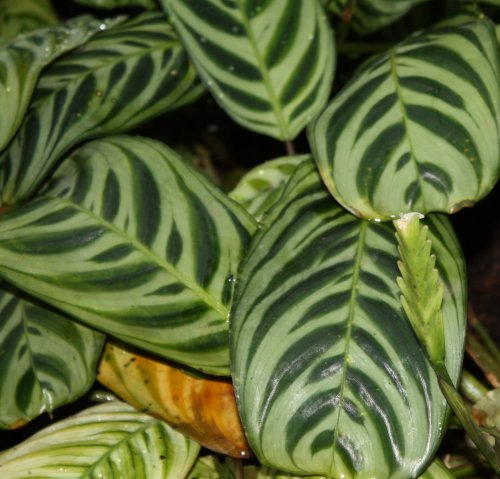
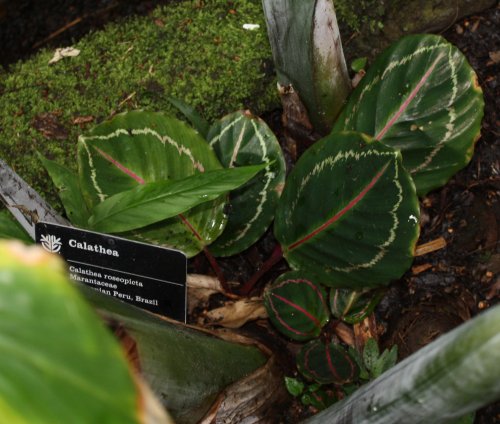
There are many colorful hybrid Calatheas sold as houseplants at Lowe's nowadays.  I think most of these are variations or hybrids based on the Calathea roseopicta species (below), which has pretty stunning color as a naturally-occurring species.
c_roseopicta
Calathea roseopicta
c_burle_marxii
Calathea burle-marxii in bloom
Calathea burle-marxii (above) is the species that I have had the best success growing in my greenhouse.  My plants haven't bloomed before, but it looks like I wasn't missing out on much.  Small white flower petals emerge from an otherwise boring green bract that kind of resembles some Bromeliad bloom bracts.
c_fucata
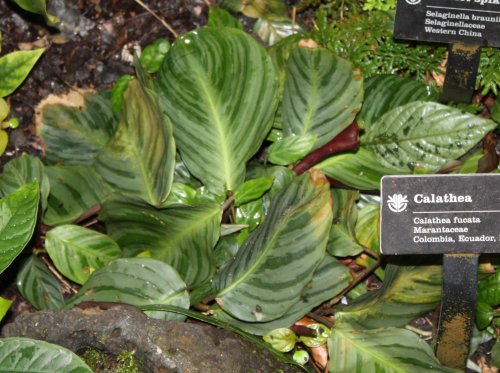
Calathea fucata
Calathea fucata (above) was one of the few species that was not in bloom.  It leaves me all the more curious about what it's blooms might look like.  I guess I'll just have to go back for another visit sometime...
c_violacea
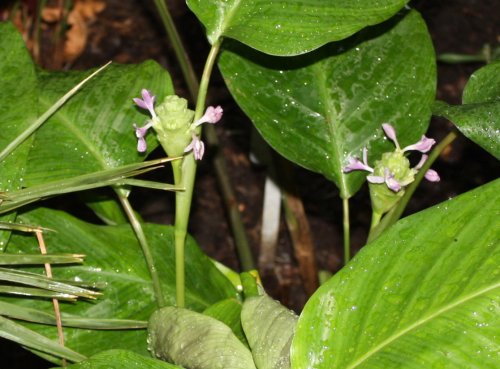
Calathea violacea in bloom
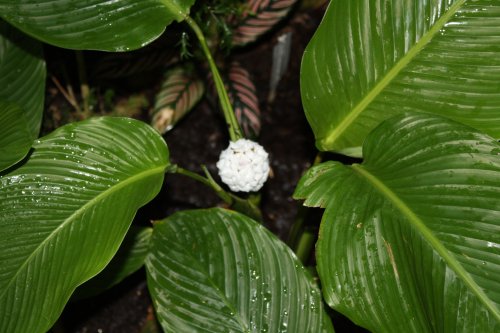
The plant below puzzles me a little bit.  I didn't get an ID on the plant, but comparing the leaves, it is very similar to the identified Calathea violacea (pictured above).  The blooms look different, but I am wondering if I just caught the blooms at different stages and it is the same species.  I'll try to recruit some expert Calathea help to get that question answered.
c_noid
Calathea violacea? in bloom
Now Calathea zebrina (below) is one of my favorite species.  I have seen this plant a couple of times in person.  There were some beautiful specimens at the Foster Botanic Gardens that were in bloom while we were there.  The plants in the Climatron seemed monstrous in comparison, though.  The zebrina species has very velvety textured leaves with solid purple undersides.  The thick stems of these plants almost reminded me of banana trees.
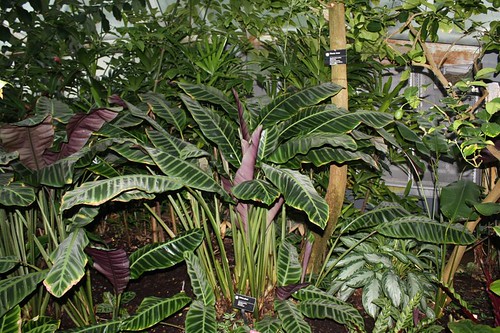
c_zebrina_forest
Forest of tall Calathea zebrina - the tallest being 6 feet or more.
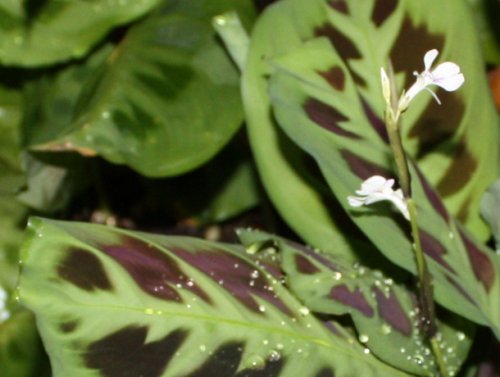
One of the most common "prayer plants" is Maranata leuconeura v. kerchoveana (below).  Okay, so it's not the easiest name, but it is one of the more common house plants from this family.  But you don't very often get to see these plants blooming in the house setting.  Obviously these plants are grown for their striking foliage, but I think the blooms are pretty neat, anyway.  Look at the closeup below.
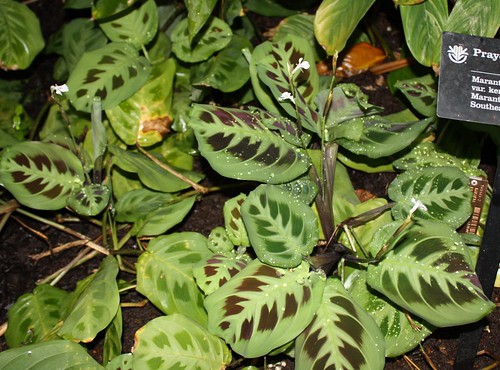
m_leuconeura
Maranta leuconeura v. kerchoveana in bloom
m_leuconeura_bloom
Maranta leuconeura v. kerchoveana bloom closeup

Monday, May 11, 2009

Plant Find: Four new Orchids

I have had some success with Orchids in the past, but I have not kept any Orchids lately.  That was until I went to the Orchid Show and Sale at the Fort Worth Botanic Gardens last weekend!

The Orchid Show was nice, but the real excitement came in the sale room, which was packed with orchids of various sizes, colors and price ranges.  My wife agreed with me that the sale room was much more fun, just knowing that you could take any of them home with you, assuming you had the money.

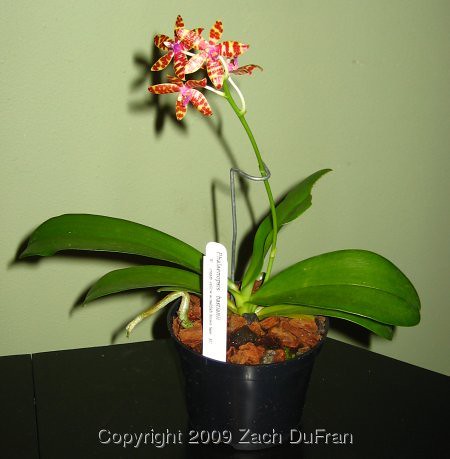
granddads
Phalaenopsis bastianii - birthday gift for my green-thumbed granddad who has recently started growing orchids.
But you didn't have to be a millionaire to walk away with a nice plant.  There were quite a few plants available in the $10-15 price range and very few plants more than $25.  We did see that a couple of the largest and rarest specimens had price tags around $75.

There were orchid seedlings for only $4 each!  Assuming you can keep the orchid alive for a year or two, this is a great deal.  I bought myself a miniature orchid that was in bloom, as well as 3 seedlings.

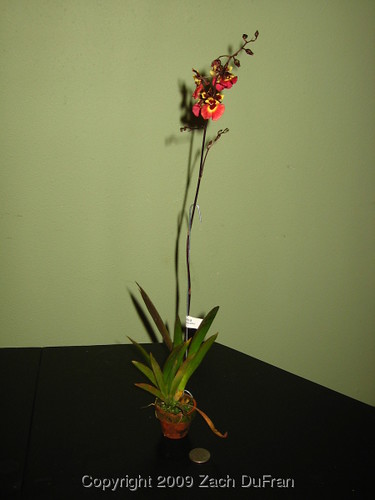
tolumnia_tall
Tolumnia 'Genting Volcano'
tolumnia_quarter
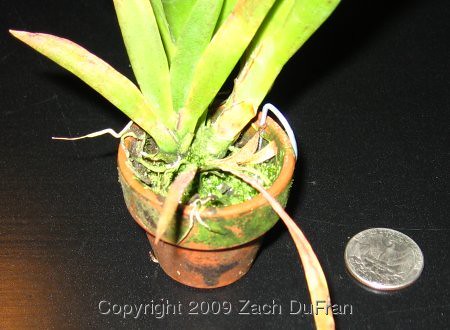
Tolumnia 'Genting Volcano' pot with quarter for size comparison
The miniature orchid appealed to me on several different levels.  It is cool just because it is "full-grown" and still so small, housed in a 1" diameter pot.  I didn't even realize they made pots that small!  It also has a great inflorescence.  This particular plant is Tolumnia 'Genting Volcano.'  The Tolumnia genus is a section of what was once considered the Oncidium genus.  Oncidium was a very large genus and some plants were removed in 1986 and placed in the new genus Tolumnia.  Oncidium is one of the most recognizable genera of the Orchid family, containing the plants which are commonly called "Dancing Ladies" and "Sherry Baby," which is known for its fragrance of vanilla chocolate.  I had heard about this smell before, but not witnessed it until the sale.  It is amazing how much it smells like chocolate.

3_seedlings
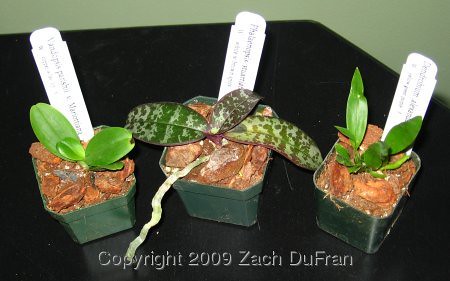
Three orchid seedlings: Vandopsis parishii v. Mariottiana, Phalaenopsis stuartiana, Dendrobium alexanderae
When I realized you could buy seedlings for $4, I started reading all of the tags, which were labeled with the genus and species, as well as the color of blooms.  I picked out one seedling from the common genus Phaelenopsis which had variegated foliage.  I also chose a Dendrobium and a Vandopsis.

orchidarium_20090511
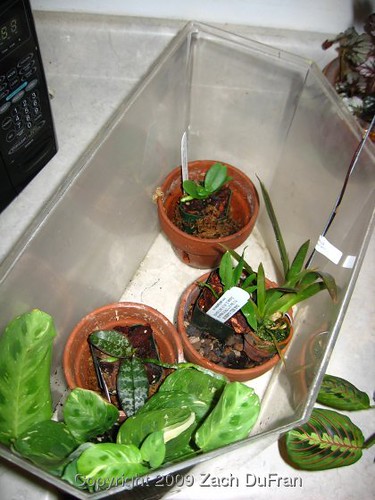
My simple 8 gallon Orchidarium, including a variegated Maranta in the lower left.
I have set up an "Orchidarium" in a 10 gallon aquarium that I had on hand.  By putting these plants inside the aquarium, there is an increased local humidity that suits these plants well.  A small amount of water is kept in the bottom of the aquarium, at or below the gravel level.  A lid is not necessary and would inhibit air circulation, which can instigate problems with pests and fungi.

Eventually I will add some things to the orchidarium to make it look more natural and hide the pots - some driftwood, pieces of bark and sphagnum moss, probably.

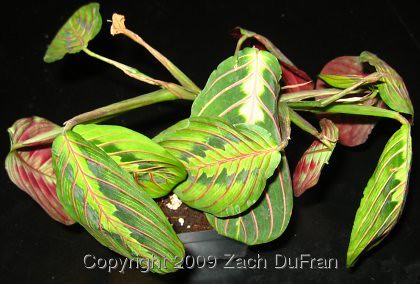
Right now I have a couple of Marantas living in there with the orchids, which help to hide the pots.  They also enjoy the elevated humidity.  I pulled the red-veined Maranta out for the picture so that you could see the setup a little better.

What do you think of my new orchids?

Monday, March 2, 2009

Plant Find: Calathea, Marantas, and Stromanthe

I am fond of plants from the Marantaceae family.  This family includes several genera that are common houseplants, including Calathea (peacock plants) and Maranta (prayer plants), as well as the less common Ctenanthe and Stromanthe.  There are actually about 30 genera in this family, but those 4 are the only ones with which I am familiar.

Generally, plants from this family are grown for their striking colors.  One of the features I enjoy is watching how all of the new leaves unfurl.  Also, mature leaves will retract whenever they dry out.  Marantas tend to fold in half (like praying hands), while Calatheas roll into a scroll.

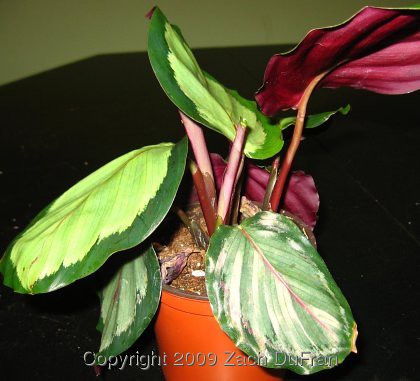
Last week I added 3 new plants from this family to my collection.  I found a Calathea at Lowe's for $5 and it was a color variety that I had never seen before.  I figured I should snatch it up in case I never saw it again.  You know how that goes.

calathea
Peacock plant - Calathea roseopicta 'Saturn'
When I found myself driving through north Oklahoma City last Tuesday, I decided I should probably stop by my favorite plant nursery, TLC Florist and Greenhouses.  As usual, they had a couple of great plants for a mere $2!  I bought 2 different Marantas.

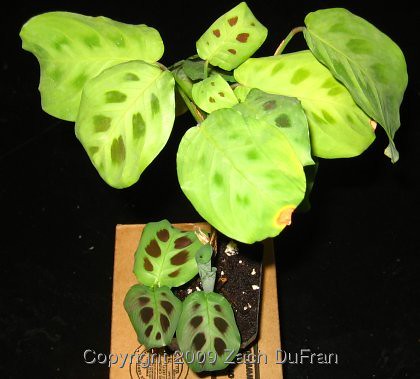
maranta_green
Prayer plant - Maranta leuconeura
Marantas have a wonderful, delicate feel.  They are fairly sensitive to soil moisture levels.  I try to not let the soil ever dry out.

maranta_red
Red-veined Prayer plant - Maranta leuconeura erythroneuro
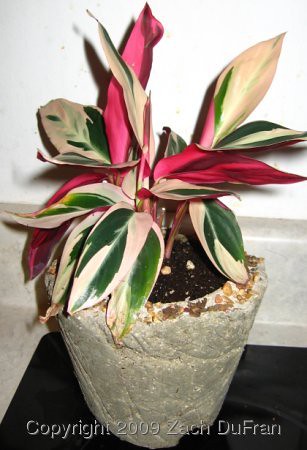
Back in January, I added 2 other plants to my Marantaceae collection.  One is Stromanthe sanguinea 'Triostar', which I found for a very reasonable price at Lowe's.  It is a beautiful tri-colored plant that I saw in bloom at the Myriad Gardens last week.

stromanthe_triostar
Stromanthe sanguinea 'Triostar'
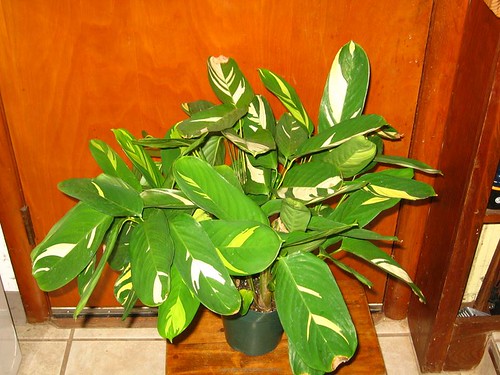
The other plant is a Ctenanthe, which I got at TLC Florist and Greenhouses.  In case you missed my post about TLC, you can see the post here and the photo album here.

35496614615_c016eb4af5_o
Ctenanthe lubbersiana
I will probably post a more thorough guide to plants from the Marantaceae family in the next couple of months.