Showing posts with label travel. Show all posts

Wednesday, July 11, 2012

Trip Report: Plants along the streets of Jakarta

Yesterday I went for a walk.  Along the way I took a lot of pictures of plants growing along the sidewalk.  Jakarta is not a particularly pretty place, but there are some neat tropical plants growing wherever they can take hold.  For purposes of this blog, I'll be showing you those pictures.

polyathia
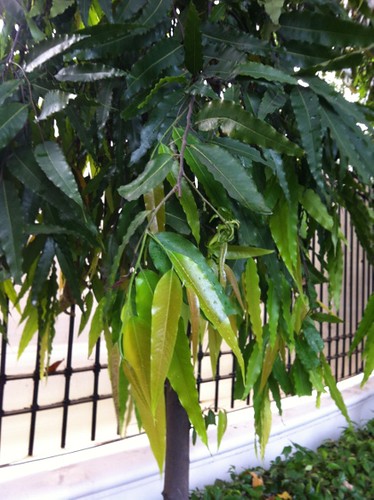
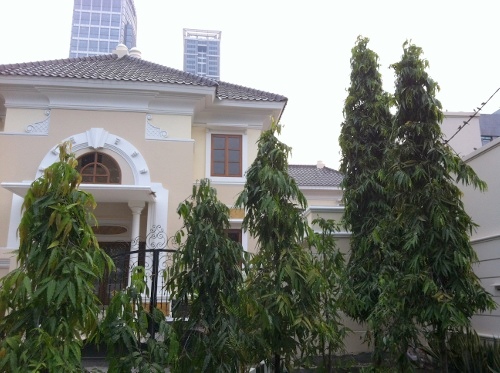
Polyathia longifolia in front of a nice house in Jakarta
One of the more common trees here in Jakarta is the Polyathia longifolia, which is usually growing tall and skinny like an Italian cypress tree. It has long shiny leaves with undulate margins (wavy edges).

polyathia_leaves
Leaves of Polyathia longifolia
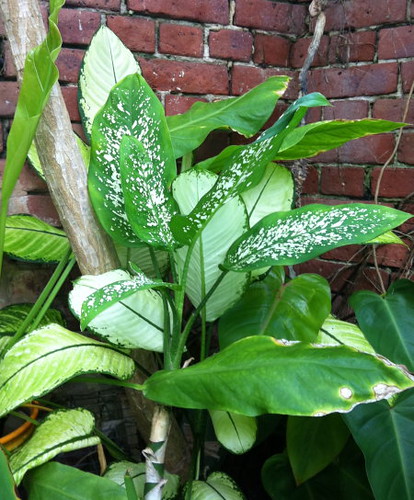
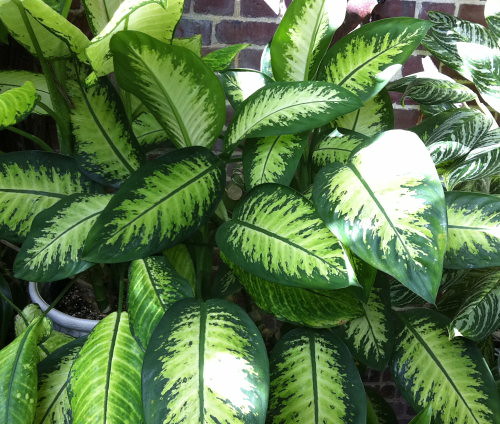
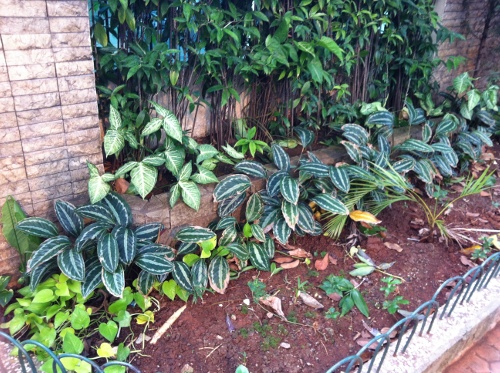
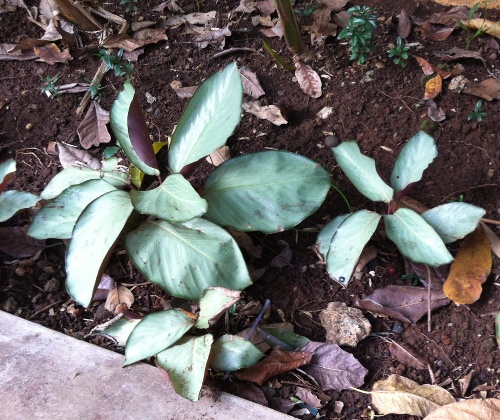
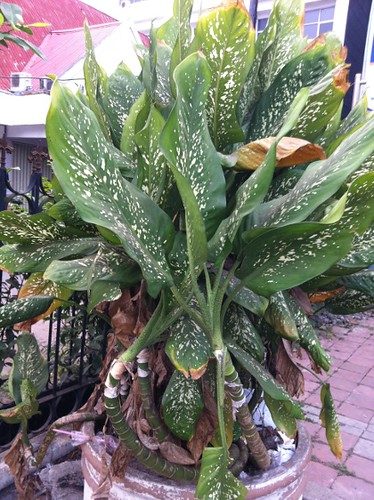
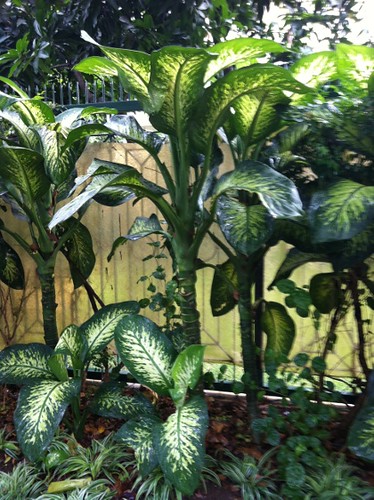
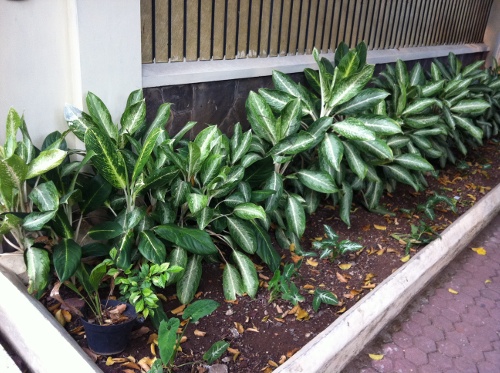
Some of my favorite plants (Aglaonema, Dieffenbachia, and Calathea) are growing everywhere here.

dark_calathea
Calathea

silver_calathea
Calathea

crowded_dieffenbachia
A pot full of Dieffenbachia
giant_dieffenbachia
Really large Dieffenbachia
aglaonema
Aglaonema, maybe

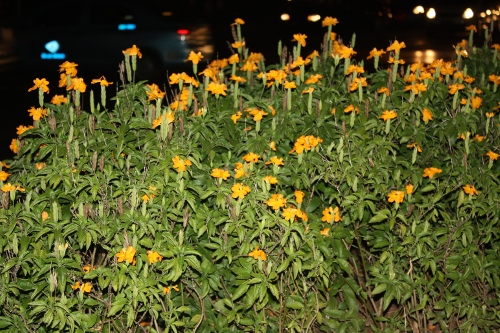
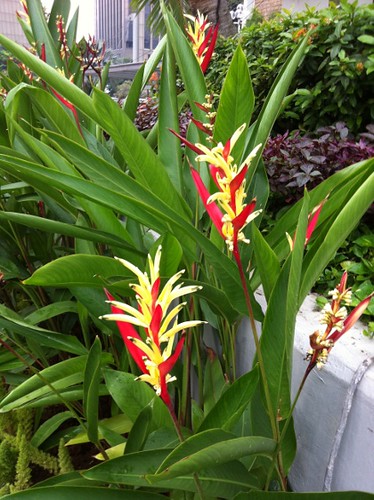
There are also lots of colorful flowering plants around: Bougainvillea, Plumeria, Heliconia, Canna and things I have never seen before.

acanthaceae
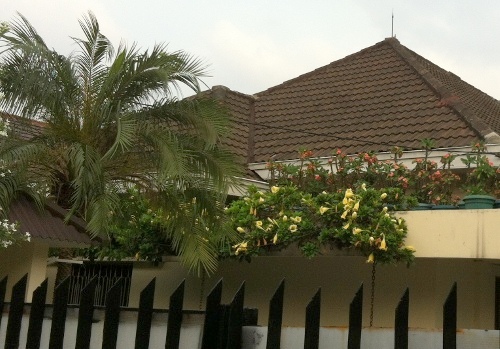
Some sort of Acanthaceae, possibly Crossandra

solanum
Solandra

heliconia
Heliconia

neat_flowers
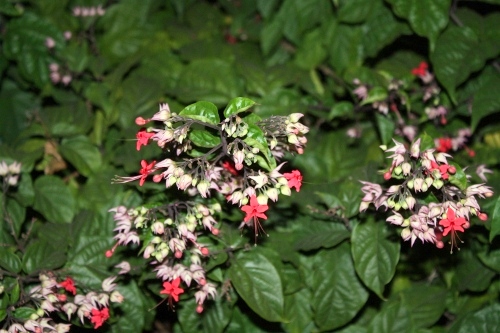
Do you know what this is?
(Update: mr_subjunctive and peaches identified this as Clerodendron thomsoniae)

There were some other nice Aroids (besides the Dieffenbachia and Aglaonema) growing here and there...

climbing_aroid
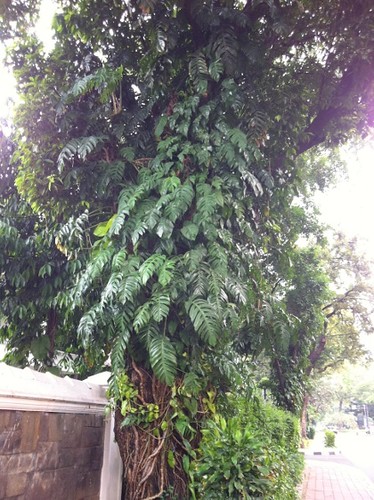
An aroid climbing a tree. Perhaps Epipremnum or Rhaphidophora.

homalomena
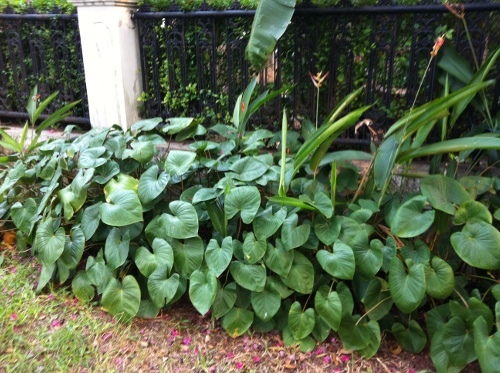
Homalomena

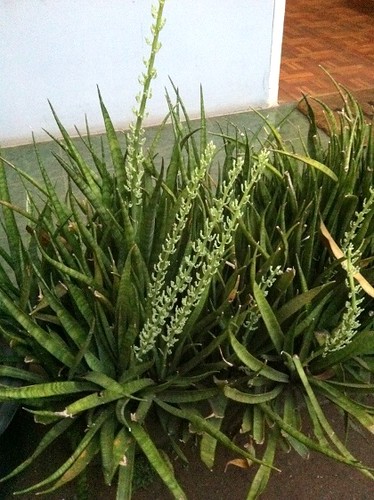
There are Sansevieria growing everywhere. I noticed one in particular that was in bloom.

sansevieria
Sansevieria in bloom

When I finished my leisurely walk, I came back to the hotel, where is some more formal landscaping out front.

hotel_cacti
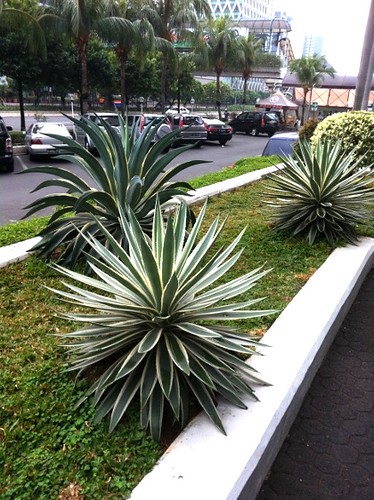
Agave in front of the hotel

hotel_garden
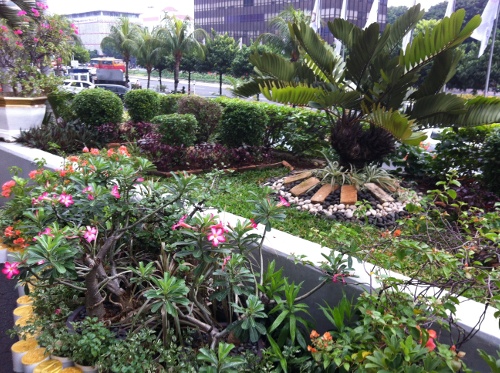
Adenium (foreground) and Cycad (back right) in garden at hotel entrance
My walk took me to a park about a mile away from the hotel.  I'll post pictures from there in a separate post.  Stay tuned!

Friday, October 21, 2011

Trip Report: West Martello Tower

martello_archway
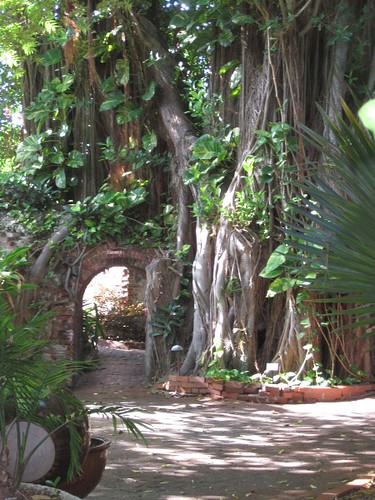
Strangler fig covering a section of wall at the Martello Tower
On the island of Key West, not far from the marker for the "southern most point in the continental US" is the West Martello Tower and gardens, which is maintained by the Key West Garden Club.  This beautiful garden is the site of a never-completed fort, which is really just a great setting, with brick walls of various heights and wandering paths through what is not a lush tropical garden.
cp_martello
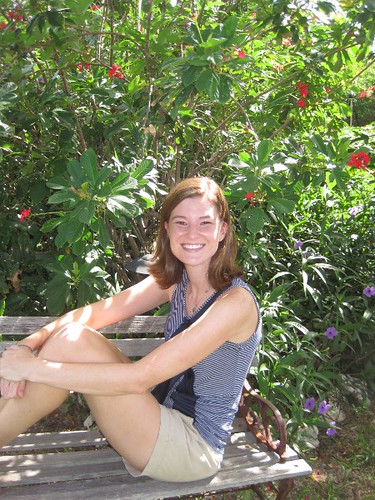
Christie enjoying the beautiful Martello Tower gardens
I have to admit, I enjoyed visiting here much more as it is today than I would have if it had been completed and now stood as a military historical site.
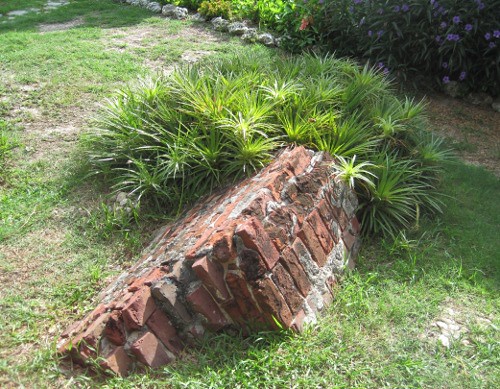
bromeliad_brick
Bromeliads planted around a collapsed portion of wall
The grounds are filled with nice compositions, including the nice spot above where some chunk of brick wall has collapsed and lays half buried, book-ended with a spreading bromeliad.
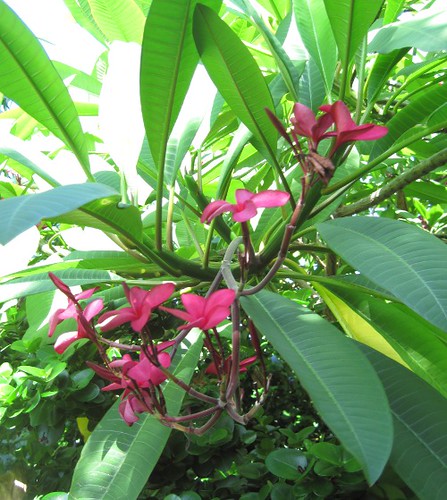
plumeria_rubra_blooms
Gorgeous Plumeria rubra blooms
plumeria_seed_pod
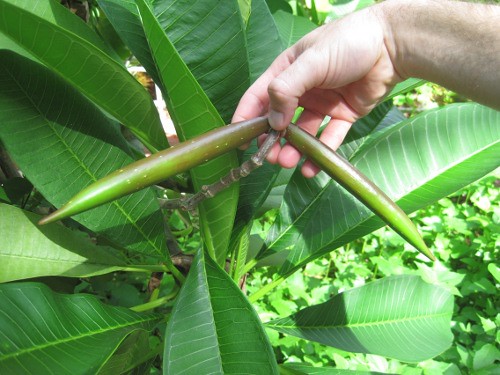
Interesting Plumeria seed pods
Many people are familiar with the Plumeria pictured above. This is sometimes called Frangipani. It has a beautiful flower, which has been bred for different colors. But the tree is more or less the same for each of these different bloom colors. The Martello Tower Gardens had another species of Plumeria (below), which I hadn't seen before this Florida trip. Plumeria pudica has a different shaped leaf and the flowers are pure white, with the slightest bit of yellow in the center. (It's hard to see the yellow in my image due to the bright sun.)
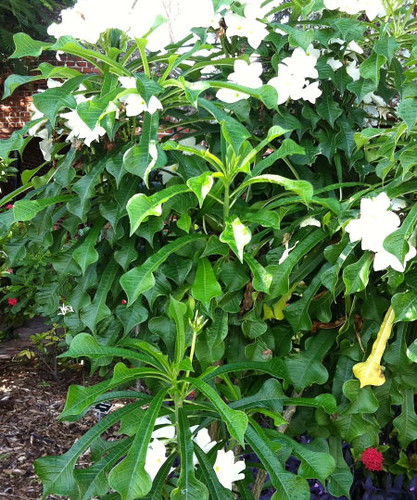
plumeria_pudica
Plumeria pudica
ruellias
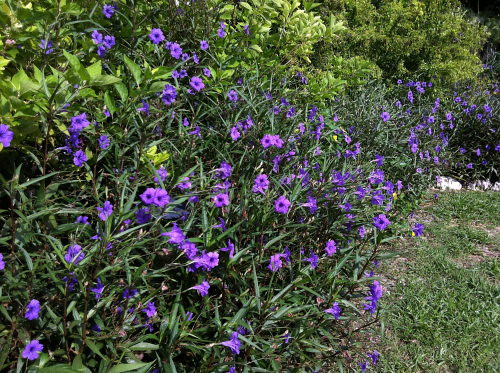
Lots and lots of Ruellias!
I have seen Screwpine trees (Pandanus) in just a couple of places.  They are known for their network of stilt roots, which are usually spiny.  The first time was in the tropical dome at the Missouri Botanical Gardens in St. Louis.  The second time would be in conservatory at the Fort Worth Botanic Garden, where there is a large Pandanus whose huge stilt roots reach into the water of the adjacent pond and fragment into a million tiny roots.  That was a site to see.  There are also quite a few Pandanus growing at the Fairchild Tropical Botanical Gardens in Miami.
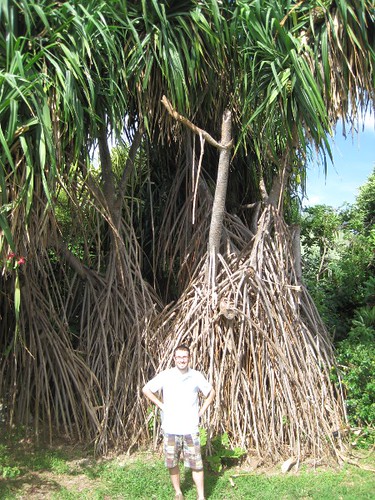
pandanus_sanderi
Pandanus sanderi tree with amazing prop roots
pink_canna
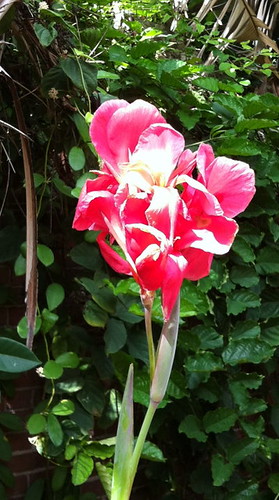
Dark pink canna
traveller_palm_bloom
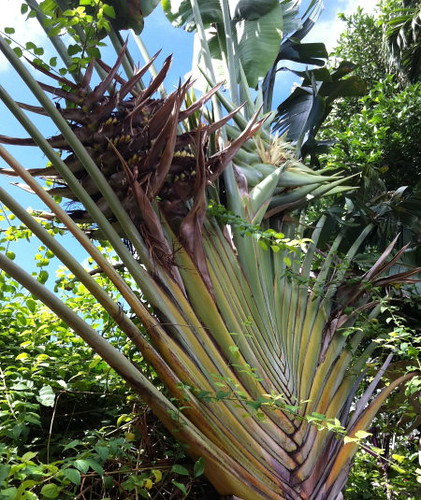
Traveller's palm (Ravenala madagascariensis) in bloom
The tree pictured above is called the Traveller's Palm, although it is not really a palm.  I have seen these trees in just about every tropical, beach front area I have visited and always just assumed they were in the palm family (Arecaceae) or possibly the banana family (Musaceae).  But when I saw this tree at the Martello garden I realized it had to be in the same family as the Bird of Paradise (Strelitziaceae).  The bloom bracts are unmistakeably similar.  Reading the wikipedia page confirmed my conviction and also mentioned that this tree was once upon a time placed in the banana family - just as I would have put it, without seeing a bloom.  It belongs to the monotypic genus, Ravenala, and is native to Madagascar.
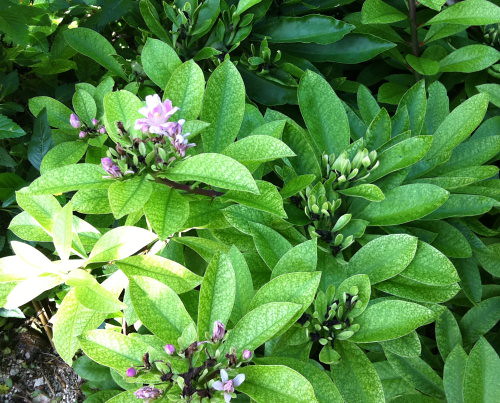
pereskia_grandifolia
Rose cactus - Pereskia grandifolia
The plant pictured above is called "rose cactus" because it has nice blooms and some killer thorns.  It is actually a cactus, which kind of surprised me, since it does not have the normal succulent look to it.  We saw Ixora all over southern Florida and I really liked their profusion of blooms - usually coral in color, like the plant pictured below.
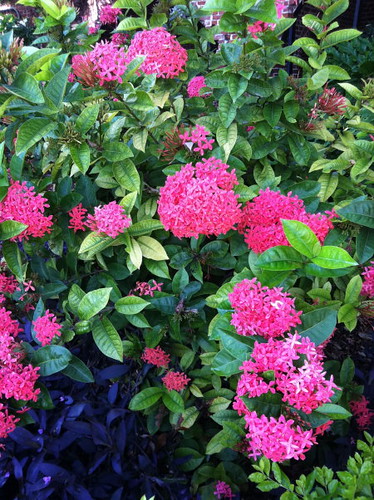
ixora
Coral colored Ixora
I think the Jatropha (below) was probably my favorite blooming plant at the Martello Tower, with dark leaves of interesting shapes and vibrant and contrasting blooms.
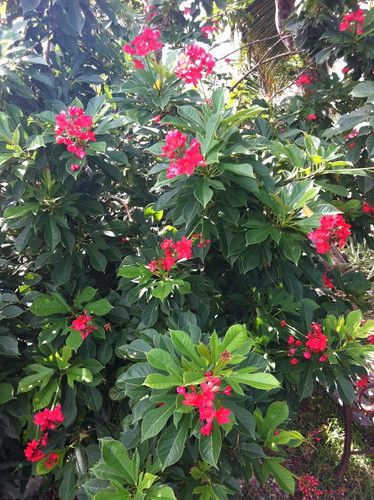
jatropha_integerrima
Jatropha integerrima
Well, the first half of this post was the colorful half.  The rest is shades of green only.  These happen to be some of my favorite plants.  I was really excited to see that the Key West Garden Club has a nice collection of Dieffenbachias and Aglaonemas inside their tower walls.  The plants are exposed to the elements and natural sunlight, but are inside a bricked area, so they are probably a little more sheltered.  Also, these plants were all growing in pots, whereas most of the rest of the plants in the gardens are growing in the ground.
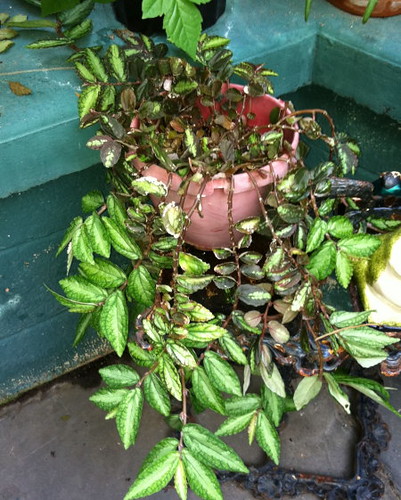
pellionia
Pellionia repens
But before we get to all of the Dieffenbachias, check out this large Pellionia repens.  I thought it was interesting to see how the leaf colors vary on this plant.  I have this species myself, growing in a tall glass terrarium.  It is sometimes referred to as "Trailing Watermelon Begonia," but it is not actually from the Begonia genus.  Good thing, because I have more luck with this plant, than I do with Begonias, generally speaking.  This species is probably the second most common Pellionia, after Pellionia pulchra.
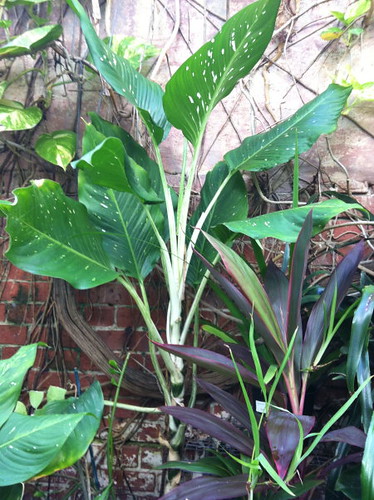
dief_1
Dieffenbachia oerstedii
dief_2
Dieffenbachia maculata
I didn't know the ID of any of these Dieffenbachias for sure, but I had a pretty good idea about the one that turned  out to be Dieffenbachia amoena 'Tropic Snow'  because my mom has that one.  I consulted with my Dieffenbachia enthusiast friends and got help on the other names.  It turns out that the speckled plant pictured above is the species Dieffenbachia maculata and the plant below is a cultivar, Dieffenbachia maculata 'Rudolph Roehrs'.  In some cases, the cultivar reverts to the original species, as shown in this picture by my friend, Russ Hammer.
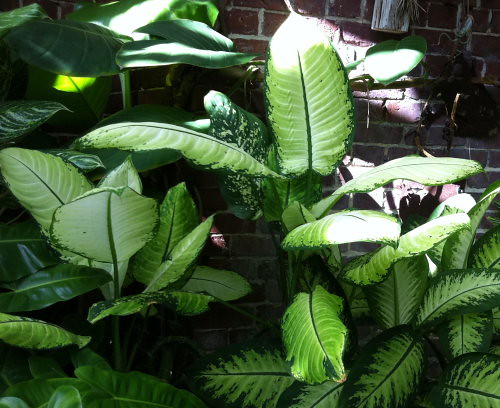
dief_3
Dieffenbachia maculate 'Rudolph Roehrs'
dief_4
Dieffenbachia amoena 'Tropic Snow'
The Martello Gardens also had a small, but happy collection of orchids and a small collection of bonsai trees.  The bonsai trees were all mislabeled, which I found to be interesting, but not surprising.  I bet they were all repotted at some point and then the labels got put back in the wrong pots.  I did notice that one label was in the wrong pot, but some of the labels didn't match any of the plants I saw.  Regardless, I could appreciate their appearance and really enjoyed my time at this garden!
Tuesday, October 11, 2011

Florida plants revealed

On our trip to Florida I was introduced to a number of plants that I formerly had not seen before.  Some of these made an impression on me and I thought I would talk about those plants a bit.

Lignum Vitae (Guaiacum sanctum)

The common name for this tree sounds more like a Latin genus and species.  Mainly that is because it is Latin.  The words translate to "wood of life."  The wood of this tree is very strong and has had many uses over the years, including structural and medicinal.  I found these trees growing in a couple of planted settings at specific gardens, including Fairchild Tropical Botanical Gardens and the West Martello tower gardens in Key West (post coming soon).

lignum_vitae
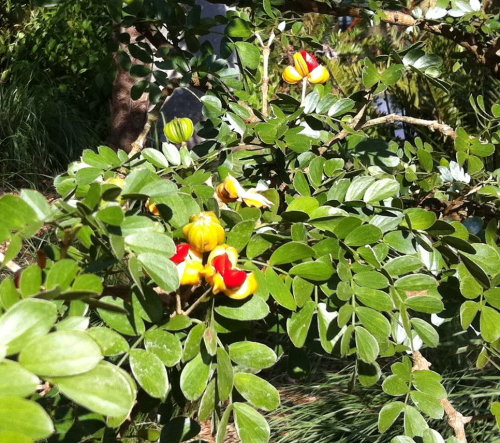
Lignum Vitae (Guaiacum sanctum) with red seeds showing.


Apparently the tree has very nice royal blue flowers, but we were there after the trees had bloomed and they all had little yellow fruits with red seed pods bursting out of them.  At first I thought the fruits were flowers - yellow with red centers - until I got a closer look.  It wasn't until I came home and looked up photos that I learned the flowers are actually a blue-purple.

Silver Buttonwood (Conocarpus erectus var.sericeus)

Two of the plants on my short three plant list fall in the silver-blue foliage category.  What can I say?  I'm a sucker for this color foliage.  We hadn't been in Miami for an hour before we pulled over and admired this tree.  I did my normal hands-on inspection and found the leaves to be fuzzy and soft like the Lamb's Ear plant (Stachys).  Christie really liked the texture of these leaves.  Buttonwoods were growing everywhere in south Florida, in several different habits.  Sometimes they were small trees, ranging from 10 to 15 feet tall.  Other times, they were grown as little bushes, either natural or trimmed to shape.  Other times they were growing in a pruned hedge.

silver_buttonwood
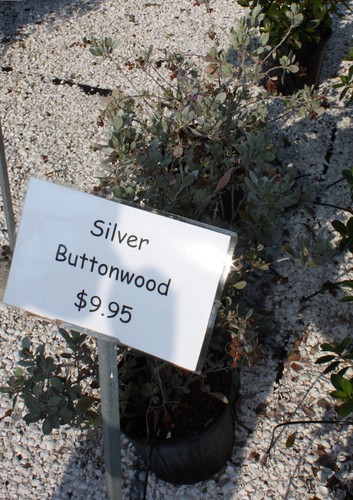
My lone, lousy picture of a Silver Buttonwood was taken at a nursery which had small shrubs for sale. I can't imagine how I didn't get a better picture on the trip... They were EVERYWHERE!
On our last day of the vacation we were driving from Key West up to Miami.  We stopped on the side of the road and took cuttings of some Buttonwoods and I am really hoping they root for me.  If so, I will try to keep one or two happy in a pot, while transplanting the others in Galveston.  However, I am a little worried that it is not quite hardy enough to handle the Galveston winters.  Maybe I should keep them all in pots at home!

Since I didn't get a very good picture, you should look here and here to see what a mature tree looks like in all it's glory.

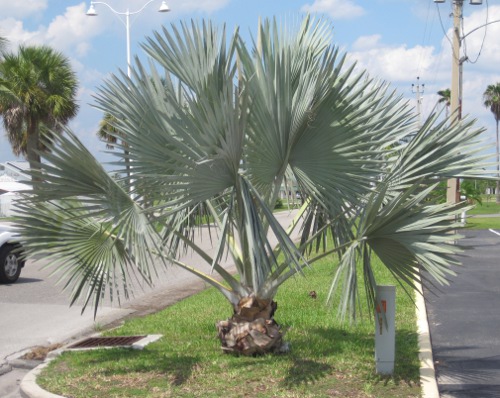
Bismarckia

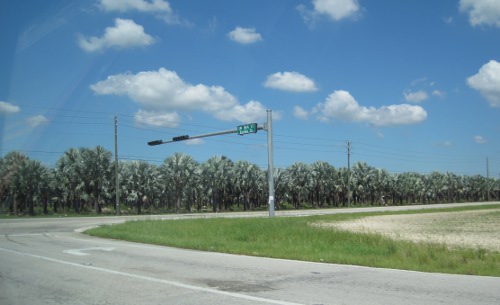
Bismarckia is a monotypic genus that is found all over south Florida, the sole species being Bismarckia nobilis.  Since I love silver-blue foliage, this is my favorite palm.  At one point we drove past a tree farm that was just Bismarckia nobilis planted at regular intervals as far as the eye could see.  It was pretty amazing.

bismarckia_field
Field of Bismarckia palms in south Miami

young_bismarckia
Young Bismarckia palm in a parking lot in Everglades City

I am going to try to find one of these palms to plant at the Galveston house.  I wonder what the best size is for starting a palm tree on a budget?  Maybe something like the one pictured above.

Friday, September 30, 2011

Trip Report: Ruben in Orchids

Before embarking on our trip to southern Florida, I scoured the web, looking for planty places to visit. I knew I would be visiting the wonderful Fairchild Tropical Botanic Gardens, for the IAS show and sale, but I also wanted to visit some nurseries while we were in the area. I am always coming across plants that are sold on eBay or other sites from nurseries in the Miami area. Also, I was particularly interested in finding some places that sold certain genera of orchids and other places that sold Aglaonemas.

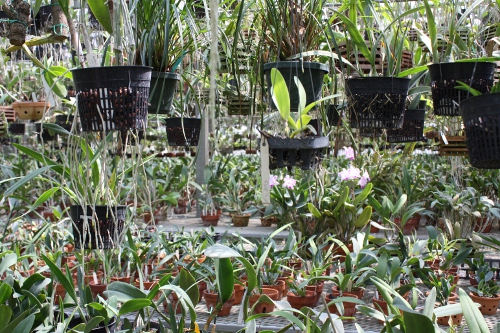
Ruben in Orchids
Sea of orchids at Ruben in Orchids

One of the places I found that sold Encyclia orchids is Ruben in Orchids, which is located in the Redlandsssh , Florida - south of Miami. The owner is Dr. Ruben P. Salueda, who has a long history hybridizing Encyclias and Cattleyas. I sent an email and found that they would be open while we were there. I was excited!

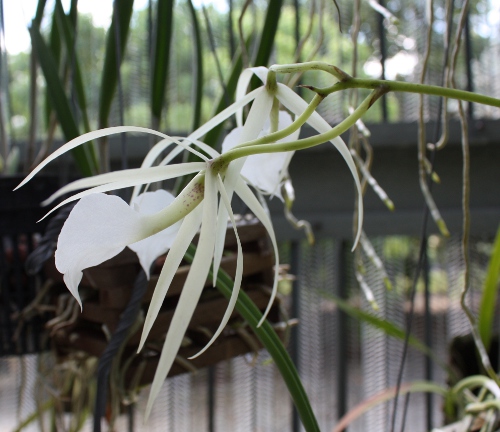
brassavola
Brassavola

We had a little trouble finding the place, thanks to Miami's genius idea of naming all of their streets with numbers - in both directions. What I mean is that this place was near the intersection of SW 184th and SW 224th. Do you see why this is confusing? In addition to using numbers for all the street names, they use both cardinal directions.  It should be S 184th and W 224th.  That would make sense.  Anyway, finally we discovered that east-west roads are called "streets" and the north-south roads are "avenues."  That's helpful to know, but there are also exceptions to that rule.  Every once in a while one of them is a "court" or "drive."  Anyway, we did make it there, as referenced by the pictures.

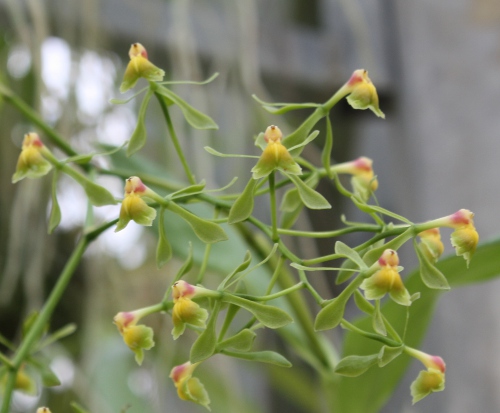
epi_noid
Epidendrum of some sort - possibly E. pseudepidendrum.

Ruben's wife, Claudia, showed us around the place.  She told us they have only been in this location for about 4 years, which is astounding, considering how settled they look and how much maturity there is in the place and the landscapes.  You would have guessed they had been there 20 years or more.  Their love of orchids and other plants is evidenced all over their property.  The backyard has orchids hanging in the trees, some attached to the trunks, others hanging in baskets.  There are vanilla orchids and dragon fruit cacti climbing up the trunks of all of their palms.  Beautiful plants everywhere.

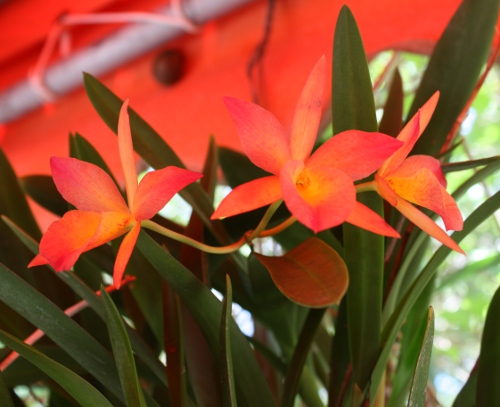
beautiful_peach
A beautiful peach-colored hybrid orchid growing on the back porch. Sadly, not for sale.  Christie and I both loved the colors on this one.

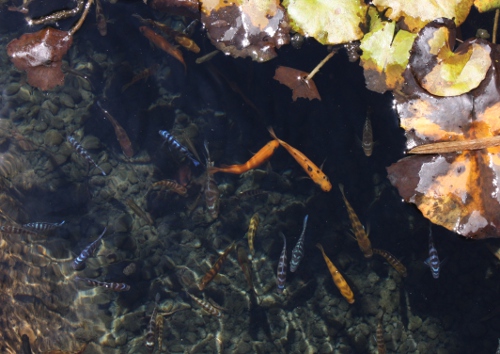
They even have African reef lake cichlids in their pond up by the house. Amazing!

pond_cichlids
African cichlids happily living in an outdoor pond


Needless to say, I was in heaven. I was surrounded by orchids - and many of them were Encyclias.  This place wasn't set up for shoppers really.  It was a grower's greenhouse.  So prices weren't clear - or even a tag to know if the plant was for sale or not.  But I had a wonderful time perusing the rows of orchids and seeing all sorts of things I hadn't seen before.

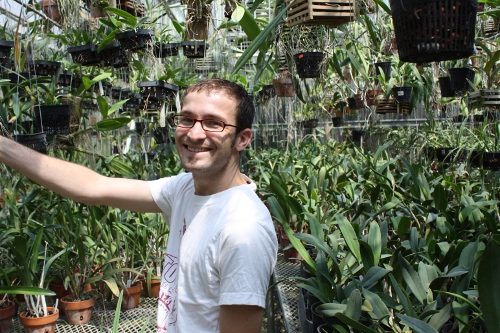
happy_zach
One happy guy!

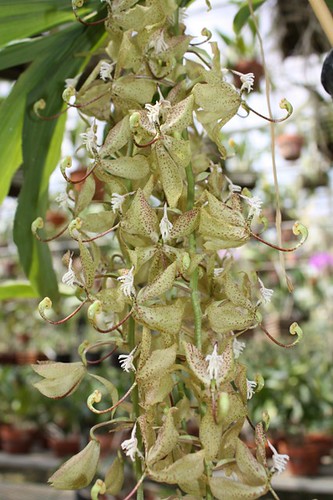
cycnoches_chlorochilon
Beautiful pendant blooms of Cycnoches chlorochilon - at least that is what it was labeled. It doesn't match the photos here, though. I think it could be Cycnoches dianae.

At the last Oklahoma Orchid Society meeting I attended, the talk was given on the genus Cycnoches, which is unique among orchids. Most orchids have both male and female parts on every flower, while Cycnoches have separate male and female flowers, though they can be on the same plant and even on the same raceme. It's fascinating. And we got to see one of these in person at Ruben's. It was a really nice specimen in the prime of it's bloom.

orchid_noid
Somehow I didn't catch the name on this one and I really wish I had. It is awesome!

epi_mabel_kanda_x_enc_cordigera
Epidendrum Mabel Kanda x Encyclia cordigera - I think.

I ended up purchasing two really nice Encyclias from Ruben in Orchids - Encyclia tampensis and Encyclia plicata.  The E. plicata was in bloom with really tall bloom stalks.  We enjoyed them for the remainder of our vacation and then had to clip them off before getting on our plane to fly home.  Maybe next time we'll be able to fly.  Of course, I can only imagine how much money I would spend if we drove and had lots of room in the car for plants...

encyc_hybrid
Hybrid orchid - probably a mix of Encyclia and Cattleya.

Before we left, Claudia told us we should visit R.F. Orchids, which was "just down the road."  I was shocked, because I had heard of R.F. Orchids and had no idea they were in the area.  It's a good thing I didn't know, because I might have gone there, rather than Ruben's place.  And I'm really glad I visited Ruben's.

enc_plicata
Blooms from the Encyclia plicata plant I bought.

Driving around the Redlands we discovered that this is orchid territory.  There were literally stands on the side of the road all over the place with signs advertising "$6 orchids," "$7 orchids" and even "$1 orchids."  We checked out several of these places on our way to R.F. Orchids, some of which had some really good deals.  More on that soon.

Monday, September 26, 2011

Trip Report: Florida native Encyclias

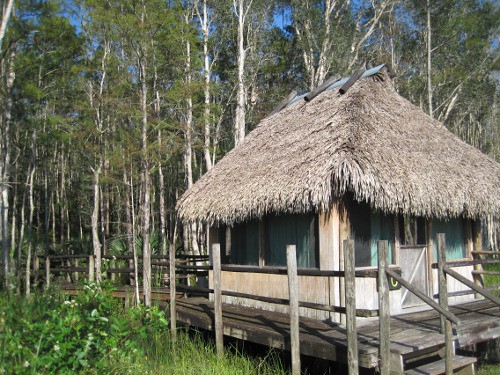
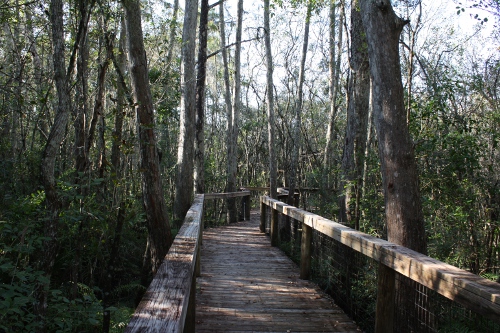
Our Florida vacation started with a bang, when we spent two nights camped in a chickee hut in the northern part of the Florida Everglades.  Our little hut was on stilts in a swampy area on Seminole reservation land.  Directly next to our hut was the entrance to a boardwalk running about a half mile (by my estimation) through a cypress stand.  We went out on this boardwalk twice and really enjoyed it.  It easily landed in the top 3 activities on our trip.

cp_boardwalk_entrance
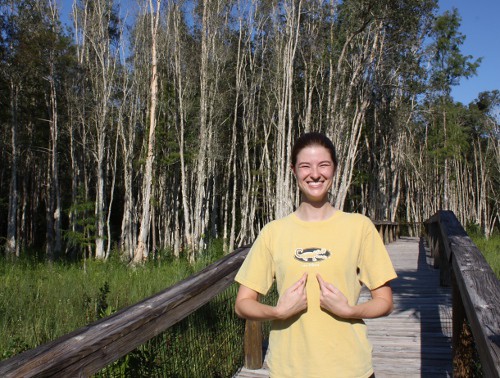
Christie at the entrance to the boardwalk, sporting her very appropriate alligator shirt
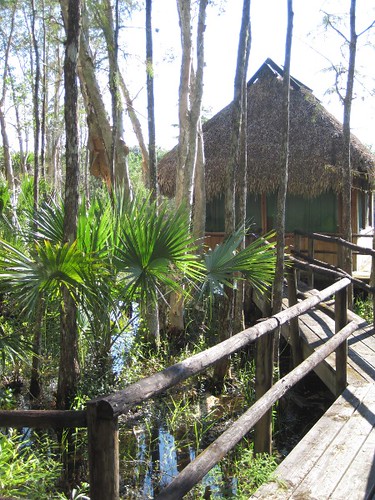
Along the walk we encountered several alligators, some large and some mid-sized.  The largest one was camped just outside the back pier of our chickee hut.  Yes, our chickee hut had it's own boardwalk leading back to a picnic table. That's how cool this place was.

chickee_hut_2
Our chickee hut from the front
chickee_hut
Our chickee hut along the back walkway
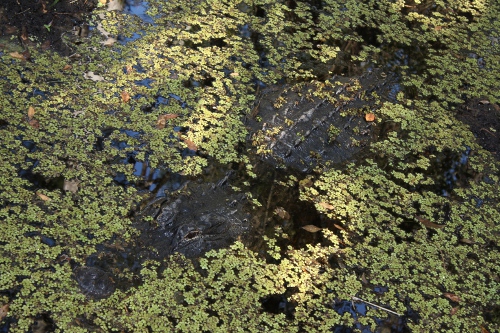
Anyway, the alligator behind our chickee hut was probably easily an 8-footer.  We were just about sure that he was fake since he wasn't moving, but the next day we noticed he was in a slightly different position.  Christie has a theory that he had just eaten a large meal (the people who stayed in our chickee hut before us) and so he was just resting (and waiting for the next careless chickee renters to fall in).  We saw several alligators along the boardwalk, including the one pictured below.

gator_watching
One of the larger alligators watching us just a couple feet away.
boardwalk_wander
Wandering the boardwalk

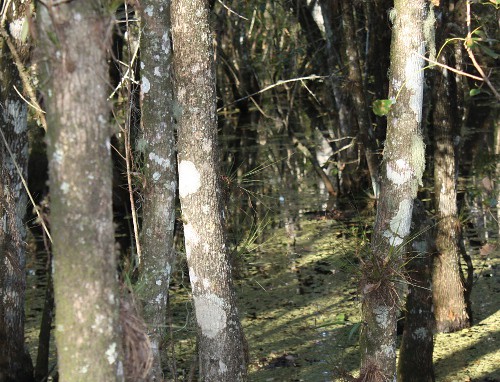
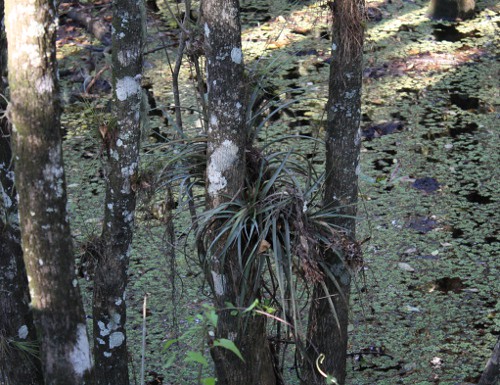
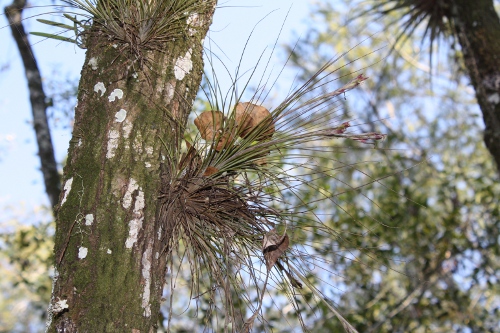
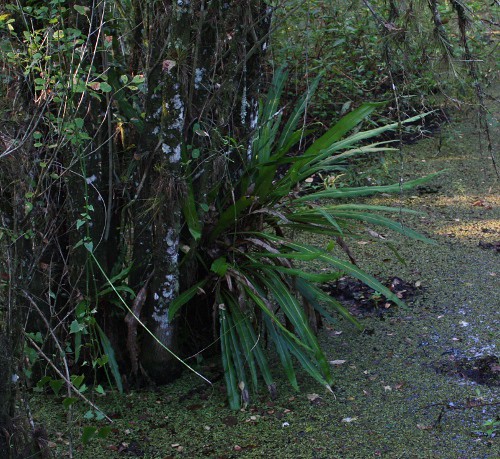
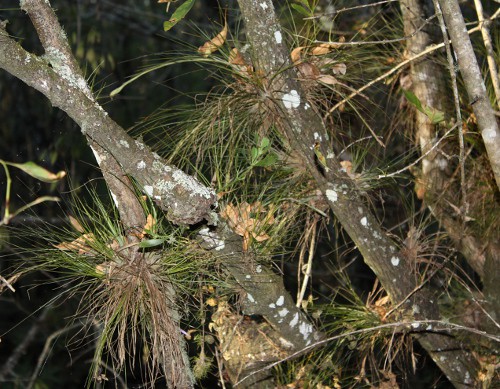
From the boardwalk you could see trees covered in Tillandsias.  It was almost comical at some points to see how many Tillandsias were coating the trunks or hanging twigs of the trees around us.

tillandsia_trees_1
Tillandsias
tillandsia_madness
Tillandsia madness

large_tillandsias
Large Tillandsias

tillandsia_closeup
More Tillandsias
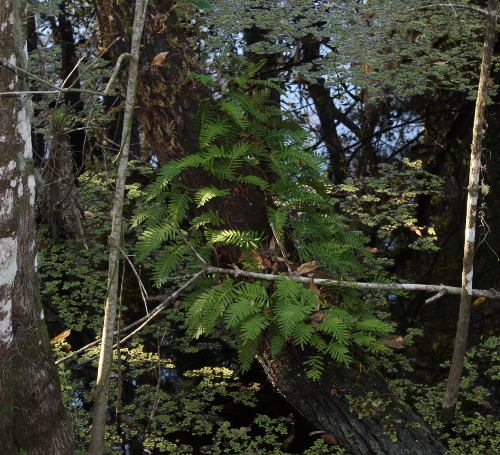
From what we learned, the area we were in would be on the northern part of what is considered the Everglades.  The Everglades is a large region of subtropical wetlands that gently slopes downwards as you go south.  So the entire area is slowly draining towards the sea.  It is not really a swamp, since the water is moving and not stagnant.  However, by observation, there are small pockets where water is motionless and I think the boardwalk here was built over one of those stagnant and swampy areas.  This may or may not have an impact on what plants grow in this area.  I imagine there were no fewer than 5 different species of Tillandsia.  I'm sure a Tillandsia nut would have been able to pick them out, but that is not me.  Also, we probably saw 4 or 5 different species of fern.

interesting_fern_1
Really nice fern
interesting_fern_2
An interesting lanceolate fern near the water line
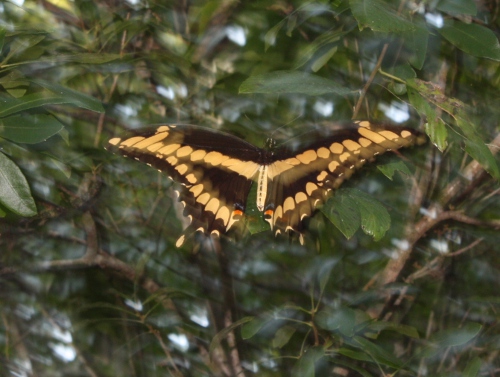
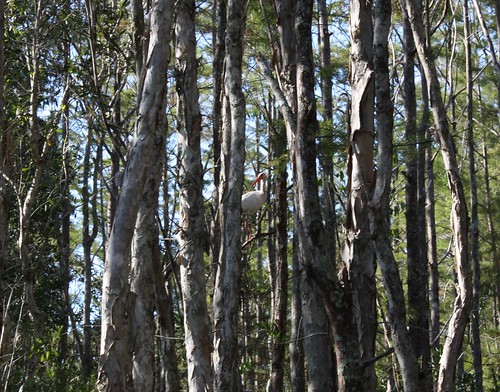
We did see some other animal life, besides gators.

butterfly
Nice butterfly. Just when you think it's going to sit still, it starts to move again...
White Ibis - Eudocimus albus
White ibis (Eudocimus albus)
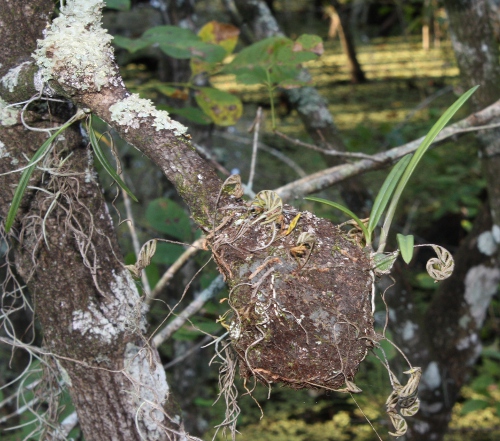
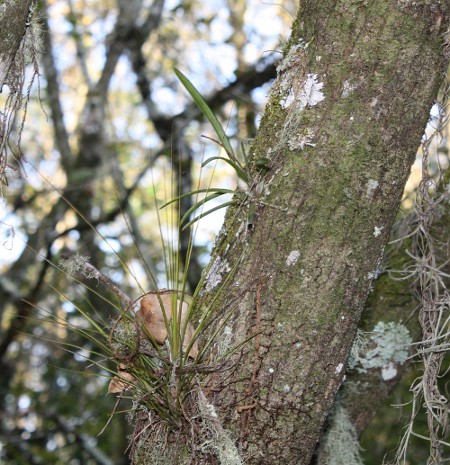
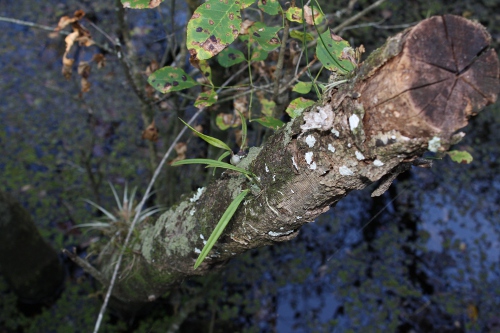
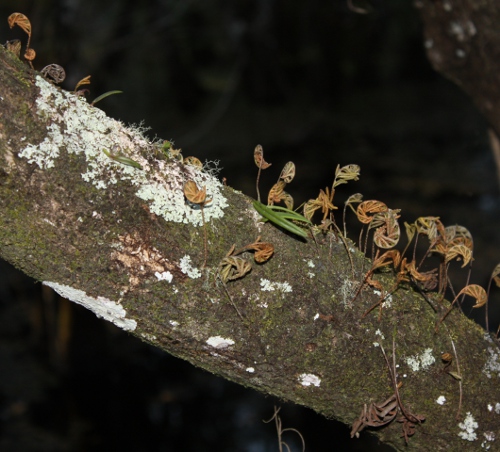
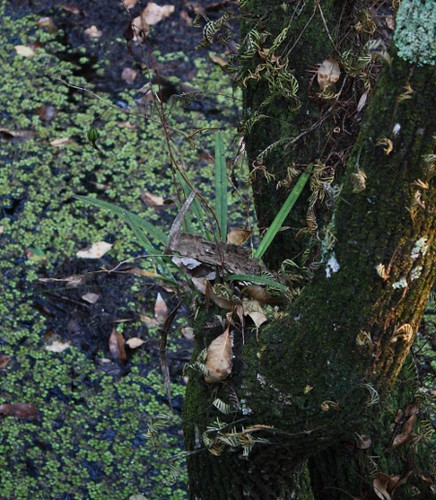
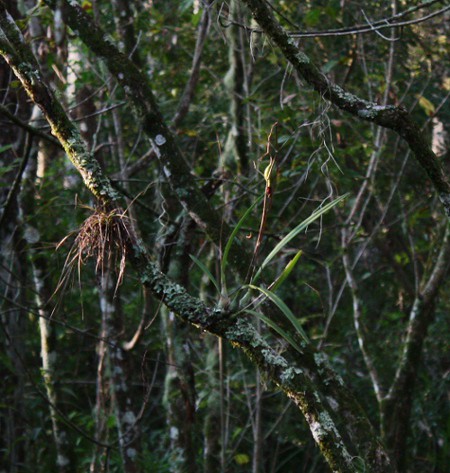
When we had just about reached the end of our trek the first time, I noticed the first orchid perched on the side of a tree - an Encyclia.  As we retraced our steps on the boardwalk back to our chickee hut, I began to see them all over the place.  My eyes just had to become attuned to look for them.  Without seeing any of these plants in bloom I can't definitively identify the species, but as far as I understand, only Encyclia tampensis grows in this area, so it should be that species.   Encyclia tampensis is common enough in Florida to be known as the "Florida Butterfly" orchid.

encyclia_4
The first Encyclia sighting!

encyclia_2
Encyclia (upper) and Tillandsia (lower)
encyclia_1
Encyclia!

encyclia_babies
Baby Encyclias spotted along with resurrection fern
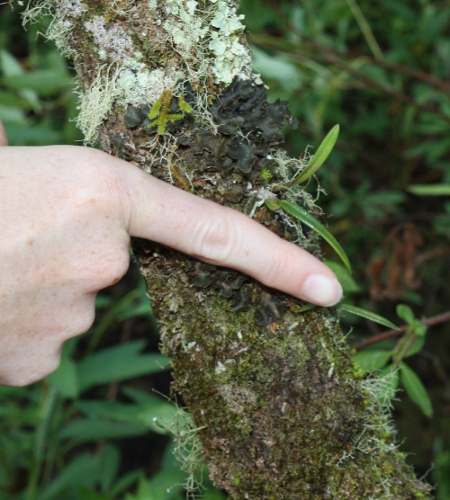
encyclia_finger
Encyclia size comparison
The next morning when we went on the same boardwalk through this stand, I started seeing even more.  I quickly noticed that one of the larger Encyclias had a seed pod perched on a thin bloom stalk above the plant.  Then I began to notice other Encyclias with this same seed pod.

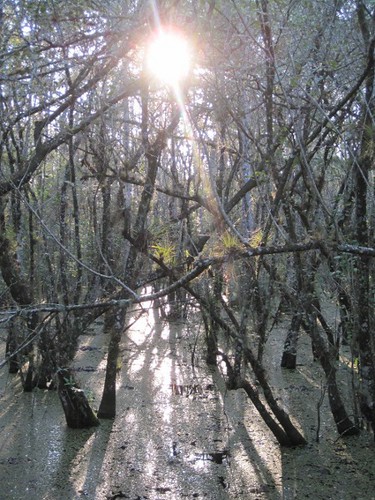
boardwalk_sunrise
Boardwalk in morning light
encyclia_seedpod_1
Encyclia with seedpod.  Look closely in the upper left.  It is green and shaped like a little football.

encyclia_seedpod_2
Encyclia with more visible seedpod
It was great to see these plants growing in their natural habitat and in such prolific numbers.  I was actually able to cross an item off my bucket list by seeing these little orchids growing in nature.  Collecting these plants is illegal and I was happy to uphold the law, only photographing the plants and taking pleasure in the fact that they are doing so well in their natural habitat.

taking_pics
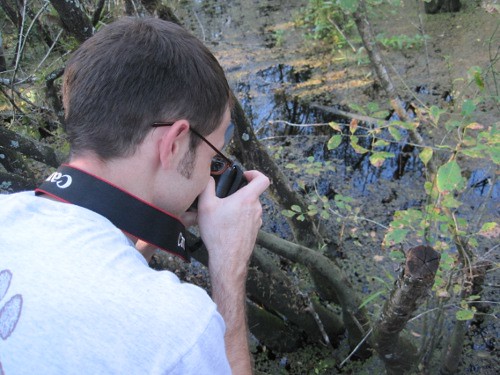
Photographing the Encyclias
encyclia_petting
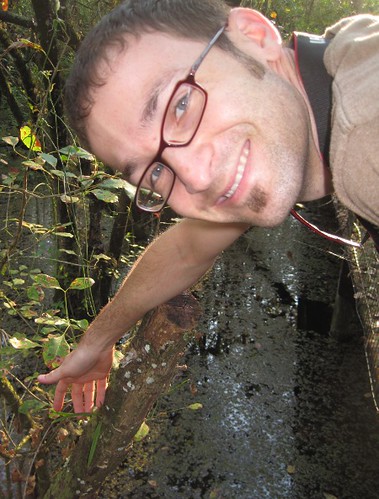
Yes, I could even touch them! This is one happy guy!