Showing posts with label updates. Show all posts

Monday, February 25, 2019

Gomphocarpus from seed

One of several plants I started from seed last year was a milkweed nicknamed Hairy Balls or Balloon Plant (Gomphocarpus physocarpus). The nicknames are from the appearance of the large pods that form when the flowers set seed. This plant is native to southeast Africa, but is a good food source for Monarchs here in the United States. I ended up with two very tall and lanky plants. They did not branch and just continued to grow taller throughout the summer. At one point there were a few small flower buds but they aborted before opening. I don't know if this plant wanted more sunshine or something different. It seemed healthy and grew steadily, but I didn't get any flowers. I read that if you are growing these from seed it is best to start them indoors early because the growing season may not be long enough for flowers and new seed pods. Maybe that's what happened in my case.

My tall and lanky Hairy Ball plants (Gomphocarpus physocarpus) in August of last year.

Thankfully, the plant has stayed happy in my greenhouse this winter so maybe next summer I will get some flowers. Ideally those flowers will set seed pods so that I can start new plants from seed and maybe prune my two existing stalks to get a fuller plant.

Open seed pod of Gomphocarpus physocarpus.
Like many other milkweeds, the seed are attached to a fluffy piece of cotton-like material
that helps them disperse in the wind.

Tuesday, January 22, 2019

Treaty Oak update 1

I've been trying to be patient and not disturb my little Treaty Oak seeds. I managed to go a couple of weeks without looking at the pot. Over the weekend I stole about 30 minutes to give my greenhouse a thorough watering and glanced at the Treaty Oak pot to see what was happening.

Seedlings from the Austin Treaty Oak
Texas Live Oak (Quercus fusiformis)
Yes! Four little seedlings have broken the surface and have leaves! Even at this tiny size, the leaves have a unique shape. The stems were growing towards the light, which was coming mostly from one direction, so I snapped a few pictures, rotated the pot, and put it back on the shelf. I am very happy to see that they are doing well. These are Texas Live Oaks (Quercus fusiformis). I plan to give one to my mother-in-law for Mother's Day, since this tree has some special significance to her. I will look for other homes for the other ones. I am not quite sure if they are hardy in central Oklahoma, but I think they will do well in southern Oklahoma, so I could plant some at my parents' lake cabin.

Wednesday, September 12, 2018

Update: Sacred Bodhi Tree

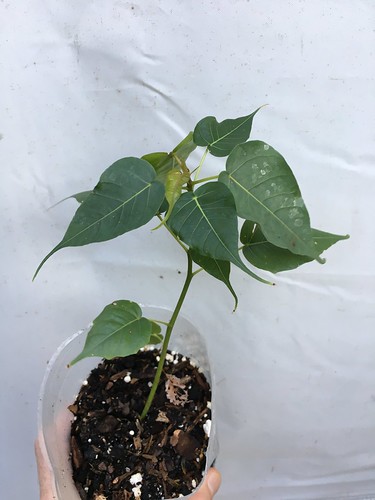
Seven years ago I was gifted some seedling Sacred Bodhi trees (Ficus religiosa) from a friend. Read more about the tree here. I gave one of those seedlings to my mother-in-law for insurance. I'm glad I did because my tree died a couple of years ago when it got too dry in my greenhouse. My mother-in-law's tree goes through a series of phases: rapid growth, scale infestation, dropping all the leaves - repeat. We're not sure why the scale keeps coming back, as it seems completely free of them when it is in it's rapid growth phase. Anyway, it seems to be an established pattern now.

Ficus religiosa
Sacred Bodhi Tree sapling (Ficus religiosa)

I recently took two cuttings of her tree when it was in a rapid growth phase and one of those cuttings has rooted. I started the cutting in pure vermiculite. After I was sure that roots were established I transferred it to potting soil. It's now producing new leaves and seems to be pretty happy. In a humid tropical climate this tree would easily be meters tall by now, but in our temperate Oklahoma climate (and my mother-in-law's plant being grown indoors) it is staying fairly small, almost a bonsai. I'm so thankful to have this little tree back in my collection and will monitor it closely.

Tuesday, May 22, 2018

Update: Native persimmons

You may recall that last year I collected a wild persimmon and planted the seeds. I put these in a pot outdoors and just let them be - no water, no attention whatsoever. I figured the less I messed with them, the more likely they would be to germinate.

Persimmon tree (Diospyros virginiana)
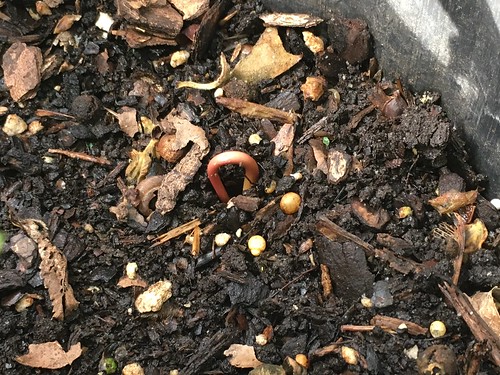
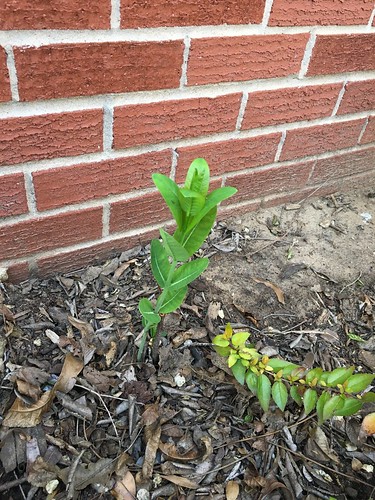
Persimmon tree (Diospyros virginiana) beginning to sprout from the soil.
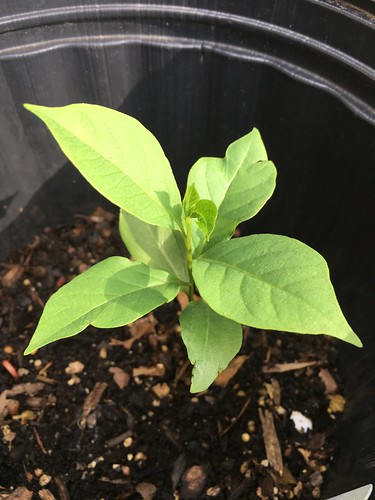
It appears my gambit worked! I have one little tree that sprouted from the soil in late March or early April and another one is breaking through the soil now. (And I'm pretty sure it's not a pecan or oak tree planted by a neighborhood squirrel, which is what usually comes up in my pots that sit outdoors...)

Persimmon tree (Diospyros virginiana)
Persimmon tree (Diospyros virginiana) growing quickly.
The funny thing is that just a week before the first tree sprouted I placed an order from a plant catalog and included two small persimmon trees, so it looks like I may soon have persimmon trees coming out my ears and I don't really have a plan for where to plant them!

I know my mom would love to be able to pick persimmons from her own yard, but I also know that these native persimmons are not the ideal candidates for cooking. And I also realize it will be years before the trees are large enough to bear fruit...

I do have access to land where I can plant these, so maybe I'll start a little grove there.

Monday, May 21, 2018

Hard winter strikes a blow

Just a month after posting my Galveston garden update I traveled down there for a weekend birding trip and found that the garden didn't quite look the same. Apparently this winter was a hard one in coastal Texas and a number of plants that had never before seen a hard freeze were zapped to the ground.

Galveston winter damage
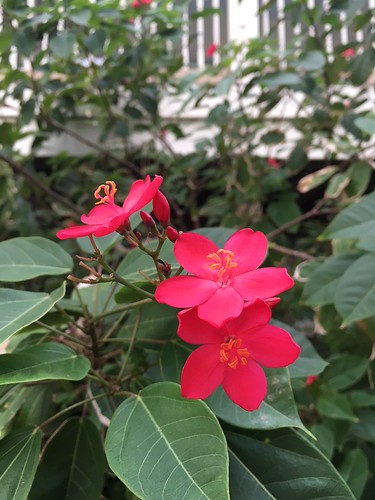
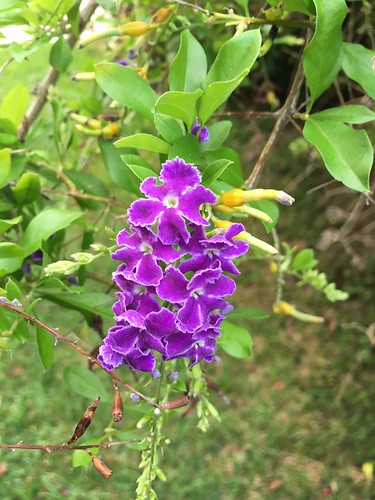
Dead plant material where there used to be Natal Plum (top), as well as Duranta and Jatropha (bottom).

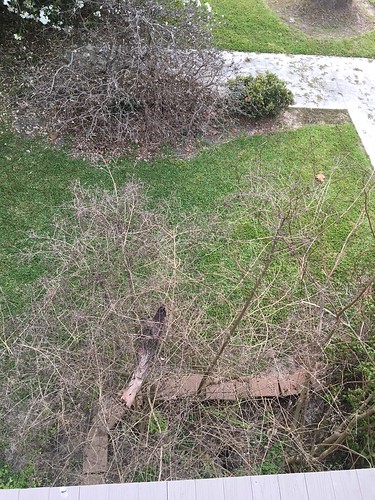
The Natal Plums (Carissa macrocarpa) along the front sidewalk had grown really large over the last 5 years but after this winter they were DEAD to the ground. The Duranta (Duranta erecta), Plumbago (P. auriculata), Spicy Jatropha (J. integerrima), White Bird-of-Paradise (Strelitzia nicolai), Esperanza (Tecoma stans), and Bougainvillea were also all dead to the ground.


Galveston winter damage
Dead plant material where there used to be Bougainvillea and Esperanza.
You can see new Esperanza growth beginning.

The good news is that I could see new green stems appearing at the ground level, coming up from the roots, of just about everything. I will have a heck of a job cutting back and disposing of the old, dead growth on my next trip down to Galveston, but thankfully this winter did not spell the end for most of the plants. I guess the other silver lining is that the plants will not be as crowded now that many of them are starting over from ground level.

Plants that seemed to have been unfazed by the winter include: all of the Oleanders, Indian Hawthorns (Rhaphiolepsis indica), Shrimp Plant (Justicia brandegeana), Bottlebrush (Callistemon citrinus 'Little John'), Yucca, Pineapple Guava (Feijoa sellowiana), Buttonwood (Conocarpus erectus), and Cycad (Zamia vazquezii).

Thursday, April 26, 2018

Update: Plant all the seeds!

A little more than a month ago I planted a bunch of seeds and it looks like I've had good results with most, if not all, of them.

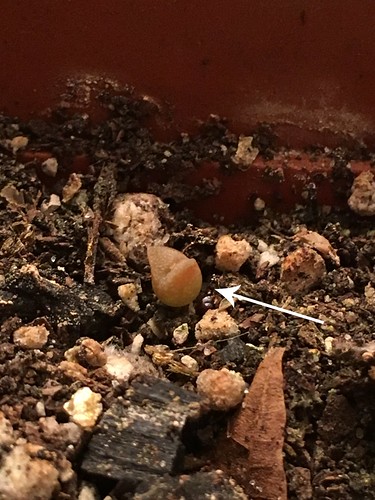
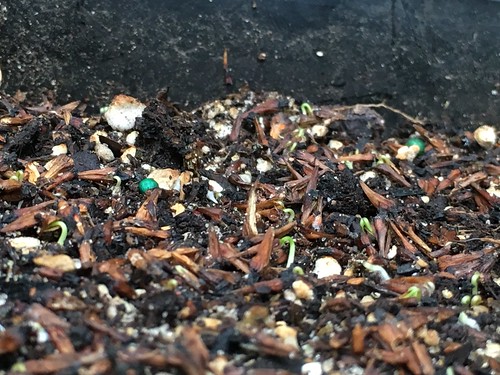
From the pots of mixed cacti seeds, I can see some funny little forms rising from the soil. The germination percentage is low at this point - just three little seedlings. It's quite possible that these three seedlings are just the species with the quickest germination period and others will come up over time. Hard to say for sure at this point. I wonder how long it will be before these little seedlings are recognizable.

Unknown cactus seedling
First signs of life in the mixed cacti pots.
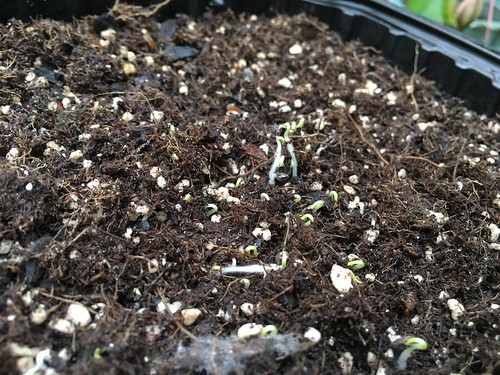
My native butterfly-attracting Common Buttonbush (Cephalanthus occidentalis) seeds are beginning to sprout!

Common Buttonbush (Cephalanthus occidentalis) seedlings

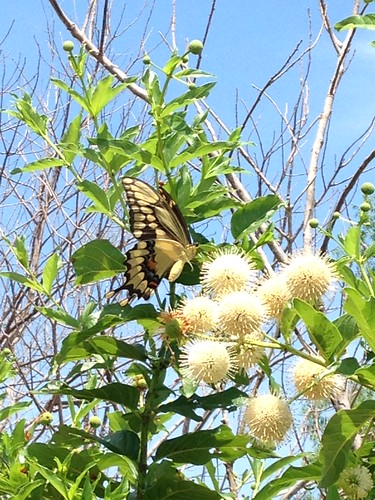
Eastern Giant Swallowtail (Papilio cresphontes) on Common Buttonbush (Cephalanthus occidentalis)
Eastern Giant Swallowtail (Papilio cresphontes)
on Common Buttonbush (Cephalanthus occidentalis)
at Lake Texoma (July 2016)
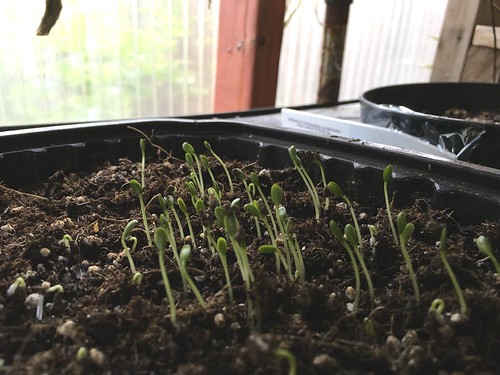
My non-native (south African) butterfly-attracting Hairy Balls (Gomphocarpus physocarpus) have sprouted and are off to the races! Check out the fast growth over just 30 hours!

Gomphocarpus physocarpus seedlings
Gomphocarpus physocarpus 6 days after planting

Gomphocarpus physocarpus seedlings
Gomphocarpus physocarpus 7 days after planting

The other seeds I planted were some Bauhinia (Orchid Tree) and Dietes (Fortnight Lily/Iris) that I collected in Los Angeles in March. I have had luck germinating each of these before, so I am hopeful in both cases, but haven't seen any action yet with this batch. The Bauhinia trees that I grew from seed previously are now about 5' tall and ready to be planted outdoors in an appropriate climate (not central Oklahoma). Unfortunately my previous encounter with Dietes didn't end well. After the two seeds germinated and sprouted tiny plants, they didn't survive long. I'm hoping to do better this time and, with luck, I'll have more seedlings and can experiment a little more with lighting, humidity, and soil moisture.

Tuesday, April 24, 2018

Update: Native Asclepias

Last year I transplanted some native Asclepias from some family property where they were growing wild into my own flowerbed. A couple of them stayed green for the remainder of the summer, so I was hopeful that they were establishing. At least one other appeared to have dropped dead.

Asclepias amplexicaulis (transplant)
Asclepias amplexicaulis emerging about 9 months after the transplant
I was really surprised to see the one that looked the least likely to have survived sprung up first this Spring! It is also one of the less common species in this area, so I am really happy it survived the transplant. I have confidence I can keep it alive (even with little to no care) now, considering it is an ideal plant for our hot Oklahoma summers and cold winters.

I don't know about all of the transplants yet, but I can see that at least one other plant, Asclepias tuberosa, is beginning to emerge. I'm very excited about having these native, butterfly-attracting plants established in our flowerbed.

Thursday, March 22, 2018

Galveston update

It's hard to believe I never did an update post on the Galveston garden that I planted back in 2012.  My life did change quite a bit from that trip onwards, as that is when I found out I was going to be a dad.  My blog posts trailed off a lot after that... Well, it's been over 5 years now, so it seems like a great time to check in on my semi-tropical garden. Most of these update photos were taken in October, 5 years after the original planting of the garden.

Jatropha
Jatropha

Duranta
Duranta
As with any garden I've ever planted, some plants thrive much more than others, and some succumb to one or more factors.  More often than not, those factors in my home gardens are heat and drought, occasionally to a hard winter.  I can safely say none of those factors have taken a toll on the plants in Galveston.

galveston_right_finished
The garden on the right side at time of planting, October 2012.
Can you even see the Justicia?  It's the lanky little stem with few leaves just below the black Crape Myrtle in the image.
See the struggling Yucca?
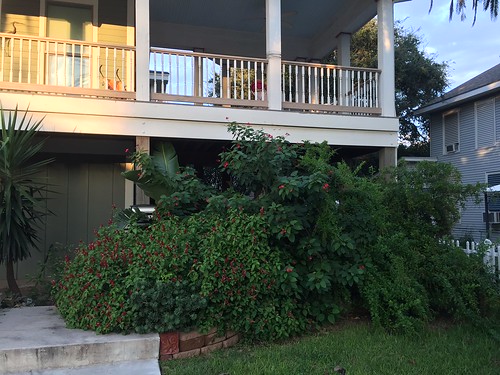
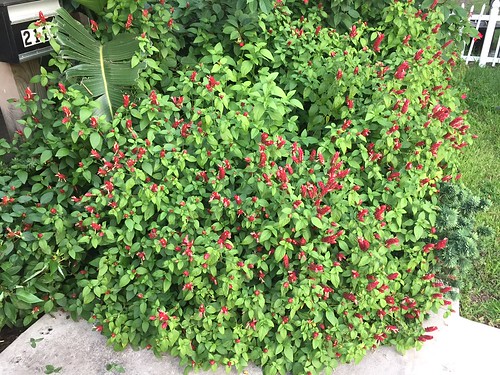
It seems my biggest issue in Galveston is competition.  A few aggressive growers have expanded faster than I expected and drowned out all the sunshine from their neighbors.  The biggest offenders are Bougainvillea, Red Shrimp Plant (Justicia bandegeana), Allamanda, Duranta, Plumbago, and Jatropha.

right garden
The garden on the right side, as seen in October 2016, before trimming.
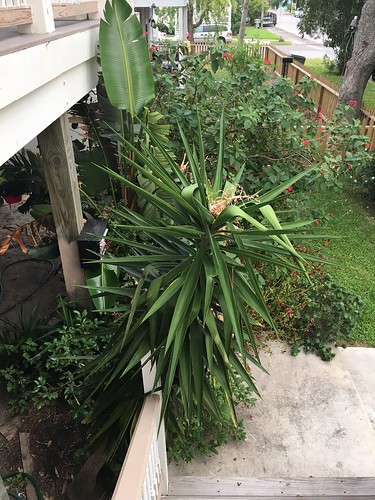
The Black Diamond® Crape Myrtle (Lagerstroemia indica) is still alive, but it is struggling to get enough sunlight because of the Shrimp Plant.  That plant and a Yucca (far left of image above) have really surprised me with their rate of growth.  The Shrimp plant was a lanky little twig when I planted it.  Now it's 6 feet in diameter, and only because I whack it back on a regular basis. The Yucca was about 4 feet tall and only had 4 struggling leaves when it was planted.  Now the base of the tree has enlarged, it is about 7 feet tall, and has a nice head of green leaves.  It even bloomed recently!

Galveston garden
The Yucca has really grown in height and you can see the remains of an inflorescence in this photo.
Unfortunately I didn't get to see it in flower.

Justicia
Red Shrimp Plant (Jatropha) as seen from above. The mailbox is becoming out of reach.
We visit Galveston a couple of times a year and on most of those trips I have spent an afternoon out in the yard, trimming. One of my priorities is always to cut back all of the growth in front of the mailbox, so that the postal worker can get to the box, which you can see is hard to access in the photo above.

mailbox after trimming
More accessible mailbox after trimming.
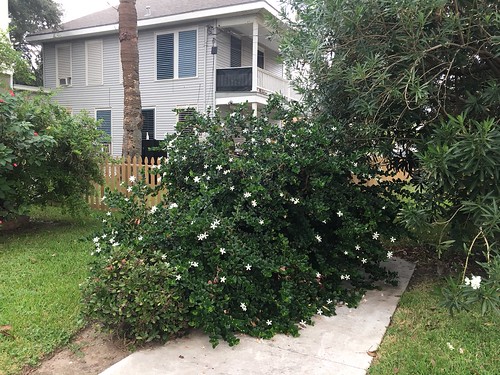
The trimming can be a heavy chore with the rate of growth of some of these plants.  And with the nasty thorns on the Natal Plum and the Bougainvillea, it can be a painful chore. The Natal Plums are covered in little white star-shaped flowers much of the year, which are followed by small edible fruits that my mother-in-law has used to make tiny tarts.

Natal Plum
Natal Plum covering the sidewalk. Luckily the sidewalk is just a segment that ends at each end of the yard, so no one used it anyway. It is required by the City of Galveston on all new construction. Who knows when a sidewalk will be installed in either of the neighbor's yards...
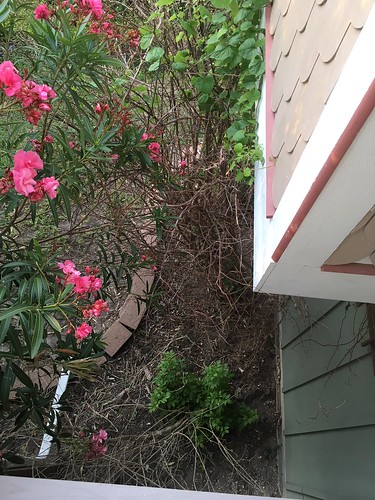
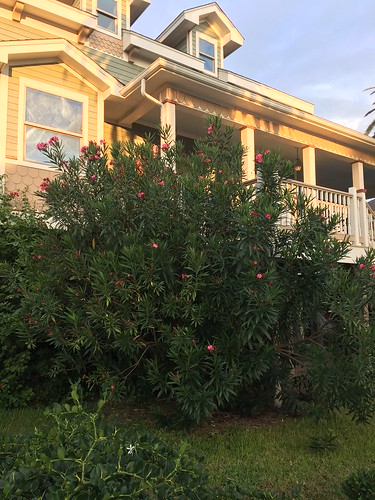
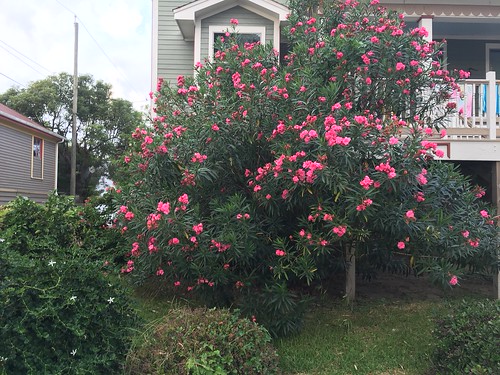
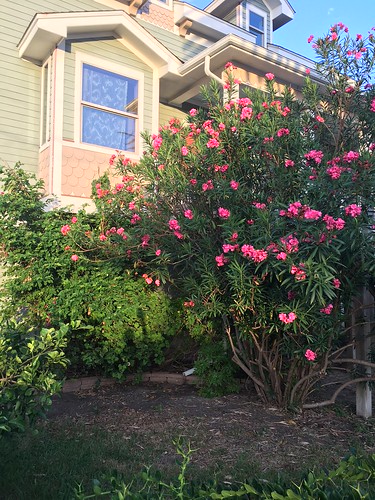
One of the Oleander we planted after the initial planting has shot up to the top of the stairs, which is really cool because the flowers are very fragrant and they are at nose level both on the ground and at the landing of the stairs. I still have to spend quite a while trimming the lower branches that grow horizontally.

left garden
Large Oleander towering up to the second story, October 2016.


Oleander
Another view of the dominating Oleander before trimming.

plumeria and bougainvillea after trimming
Some better definition, exposure of the yard and garden border, after a thorough trimming.
We also have a few invasive vines that I have to keep pulling up.  I gave up on ever ridding the garden of them, so I just try to keep them in check.  Sometimes it's easiest to just find them where they are coming up from the soil and clip them there.  It takes a long time to unwind them from all of the places they are climbing in the bushes.

The prize for plant that I didn't think would make it at all is a Bromeliad that my mother-in-law received as a gift and didn't want to keep growing in a pot in her home.  She planted it in the garden in Galveston and I figured it would surely be a goner in a few short months.  Much to my surprise, it has done well there and even flowered several times since it was planted in the ground.

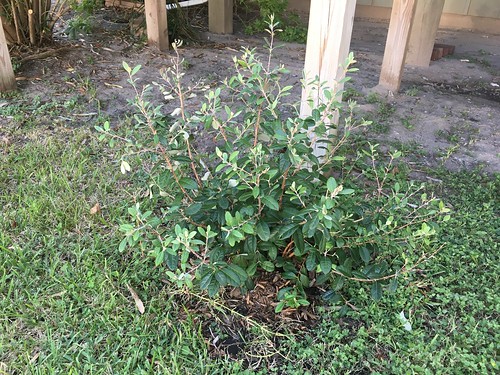
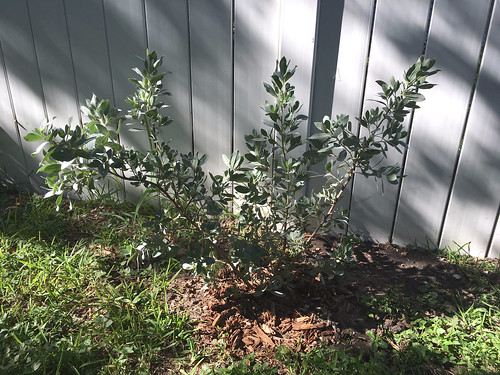
Pineapple Guava
Pineapple Guava

Buttonwood
Buttonwood
Late last year we added a couple of new bushes, a Pineapple Guava and a Buttonwood. Who knows if either of these will become monsters? To be continued.

Friday, July 26, 2013

An update on my batch of lemonade

In my last post I talked about trying to make lemonade out of my broken Amorphophallus atroviridis leaf.  Last night I impatiently opened the container, checked the leaves, and then gently brushed aside the vermiculite to see if there was anything at the end of the leaf cutting.

Amorphophallus atroviridis
Rooted Amorphophallus atroviridis leaf cutting
I was ecstatic to find several roots growing there.  I snapped a quick picture and returned the cutting to the container, gently pushing the media back in place.  I didn't want to disturb the two other cuttings.  I have a feeling all three of them have rooted because none of the leaves have wilted.  At this pace I imagine I will have some tubers forming in the next month and then maybe a new leaf will emerge from each of those tubers in a couple of months after that.

Friday, July 1, 2011

Correction: Pinellia seedlings

Yesterday I posted about my recent adventures into growing aroids from seed.  I told you that I've had luck with a couple of different species of Anthurium and Philodendron, but that the Pinellia seeds I got from Derek didn't germinate.  Boy was I wrong!

The Pinellia seeds hadn't done anything noticeable as of last week, so I started making use of those pots by thinning out my Philodendron seedlings and transplanting some in there.  Then, earlier this week I noticed there were some big (relatively-speaking) cordate leaves in the pots that originally housed the Pinellias.  I did consciously notice that those leaves were only in the pots where the Pinellia seed were, but I was thinking it might be some interesting phenomenon concerning my transplanting of the Philodendron seedlings.  I didn't think it could possibly be the Pinellias.

Pinellia seedlings
My now-community pot of Philodendron (small leaves) and Pinellia (large cordate leaves) seedlings.
Thankfully, Derek didn't put both in the same pot, so he knows for certain that the seedlings which came up for him this week are Pinellias.  And now I know, too!  So, I knew I had Philodendrons, and I thought I didn't have Pinellias.  So I used the Pinellia pots for my Philodendrons, then noticed some of my Philodendrons looked different, only to find that my different-looking Philodendrons were actually Pinellias!  Got that?

Wednesday, January 14, 2009

Plant photo directory

I have already written about the MyFolia website, which is a wonderful plant networking community.  The single most enjoyable aspect of MyFolia was one that I initially underestimated - the photos of my plantings.

When I first started building my catalog on MyFolia, I found that most of the plants I have in my collection were not in the database of MyFolia.  Since the MyFolia database of plants is created by the users, I attribute the missing plants to the group of people who have used MyFolia so far.  I would gander that many of them are traditional "gardeners," which (to me) means that they grow vegetables and flowers and things in their yards.  I consider myself more of a "plant enthusiast" and "plant collector."  For me, the gardening side is a small fraction of my plant hobby.  Most of my plants reside in pots and most must live half the year indoors.  Another portion of my plants reside in my aquariums.  So far not a single one of my aquatic plants was already in the MyFolia database.

So from the get-go, I was having to add each one of my plants to the database, as well as to my list of plantings.  I give great credit to the developers of MyFolia, because this was an easy and quick task.  But as I was focused on adding the correct genus and species names for all of my 160+ plants, I neglected to invest any time in uploading pictures.  Besides, MyFolia requires you to upload pictures to a photo-sharing community (Flickr, PicasaWeb or a couple of other options).  Since I didn't already have an account, I put that task on the back burner.

It was just a couple of days later before I decided I should probably open a Flickr account so that I could post some of my plant pictures to MyFolia.  Boy, am I glad I did.  My "Plantings" (what MyFolia calls your list of plants) is now a wonderful photo directory of the plant list that I also have listed here on The Variegated Thumb.  The MyFolia developers were pretty smart in using an existing photo sharing community, because they can just show a snapshot from Flickr, without having to store the pictures on their own servers.  The only downside is that to see the full picture, you must click the link and go to the Flickr website.

On LibraryThing (a website for book lovers - very similar to MyFolia), you can look at your "Library" (book collection) in list form or cover form.  I found that it was really fun to look at all the books I have read in cover form.  I thought this would also be a really cool feature for my plant collection, to see the little uploaded snapshots of my "plantings" (analogous to my "library" on LibraryThing).  I have written the developers to suggest this feature for MyFolia, so we'll see what happens.

So, the cool thing is that I have been thinking about taking a picture of every plant in my collection and building a photo album of my plants, to accompany My Plant List page on this blog.  But the problem with that method is updating the photo album would be a hassle.  Using MyFolia will be much easier to add a new plant and a new picture, so the work is done for me already.  Check out my plantings on MyFolia here.

Also, MyFolia has a Wish List, which is just like my "Plant Wants" page.  So I have started transferring my Plant Wants list to MyFolia, as well.

Monday, December 29, 2008

Trip Report: Myriad Gardens continued

Last week I posted a new photo album containing over 200 pictures of the Myriad Botanical Gardens in Oklahoma City.  I posted the album in pre-Christmas haste, without labeling any of them.  But now I have labeled the majority of the pictures.  So, if you haven't seen them yet, or you already looked and want to know an ID of one of the plants, you can check them out here.

Last week in my Myriad Gardens post I just wrote about a couple of the highlights.  I wanted to give a little more information about the Gardens today.

The Myriad Botanical Gardens is a 17 acre colorfully landscaped plot in downtown Oklahoma City.  In the center is the Crystal Bridge Tropical Conservatory, which is a big tropical rainforest inside a cylindrical greenhouse on it's side.  The big greenhouse hovers over a pond, giving it the name "The Crystal Bridge."

The outdoor gardens are nice, but the real action is inside.  About 2/3 of the inside space is dedicated to a tropical rainforest collection, while the remaining 1/3 is dedicated to a dry tropical zone.  There is no physical boundary between the two collections, so I am partly surprised they coexist so well, sharing the same humid air with one another.  The dry zone is watered less frequently the entire year and is watered sparsely if at all during a certain dormant period of the year.

While many of the plants at the Myriad Gardens are those you would expect to see in a rain forest recreation, the Myriad Gardens has focused on a couple of specific plant groups.

Aroids

This is not one of the collections noted on the official website, but being an Aroid collector, I couldn't help but notice how many plants were present from this family.  Maybe the website needs a little update.

The collection of Aroids from the genus Anthurium was astounding.  There are two types of Anthurium (in my mind): those with the very colorful blooms and ordinary foliage, and those with the really cool foliage but discrete blooms.  The Myriad Gardens had several color varieties of the first category.  I had never seen a pale purple Anthurium before and unfortunately I didn't get a very good picture of it.
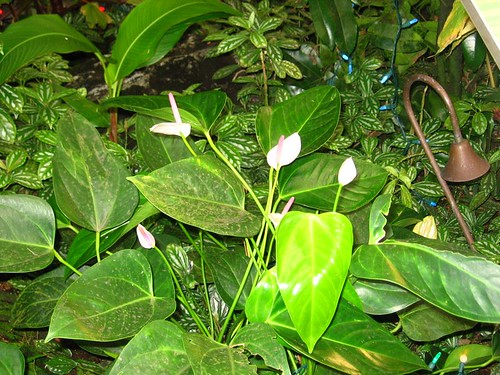
img_8794_35365880481_o
Pale purple Anthurium
They also have a number of the unique foliage species of Anthuriums, including the King Anthurium (Anthurium veitchii).  Notice the size of the guard rail in comparison.
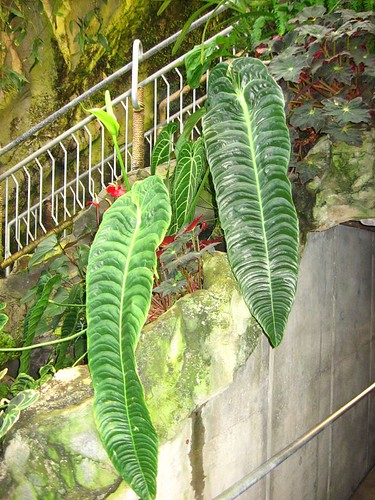
img_8760_35365941711_o
King Anthurium (Anthurium veitchii)
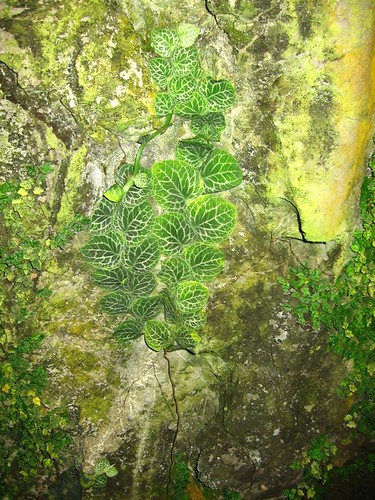
I also saw a cool shingler Aroid that I had never seen before.  This little climber was so appressed to the rock wall that the leaves were conforming to the contours of the rocks.
img_8782_35496653015_o
Rhaphidophora cryptantha - an Aroid shingler - at the Myriad Gardens
Really there were tons more Aroids that I noticed (and photographed) but I won't waste any more space here.  If you're interested, go to my photo album to see them.

Marantaceae (Prayer Plants)

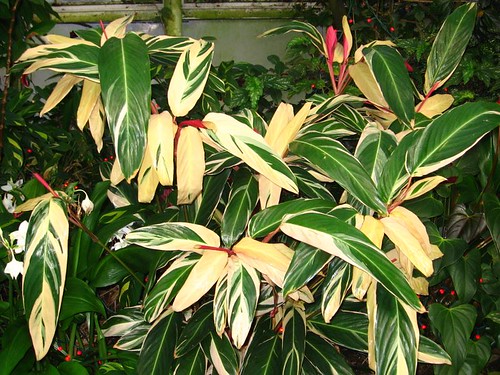
This category was also not mentioned on the official website, but I noticed quite a few unique species from this family that I had never seen before, and several that I had.  Two particular varieties from the same species caught my attention.  I had seen the Stromanthe 'Triostar' before, but never this large.
img_8770_34655478864_o
Stromanthe sanguinea 'Triostar' at the Myriad Gardens
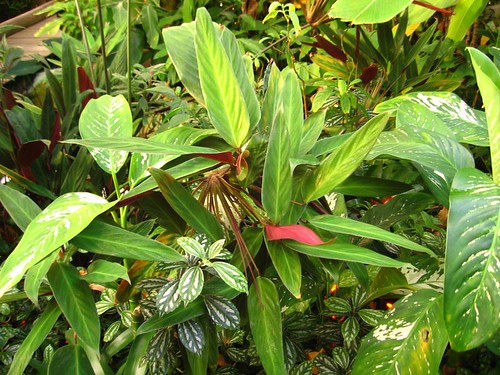
I have not quite identified the other variety, but I think it is also from Stromanthe sanguinea.
img_8805_35329502842_o
Stromanthe sanguinea(?) at the Myriad Gardens

Of course, there were also several very large Zebra Plants (Calathea zebrina), of which I have a small one of my own at home.  It was fun to see these plants waist high or higher.

Palms

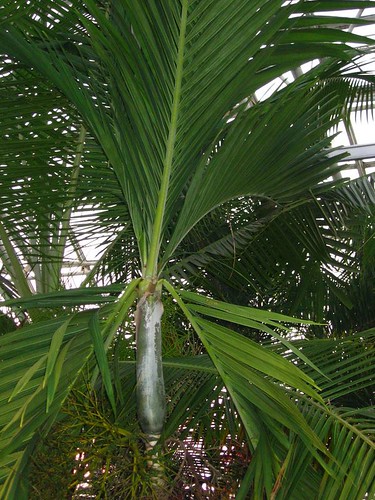
According to their website, there are supposedly 100 species of palms in the Myriad Gardens.  If I had to count, I would probably tell you there were about 10.  The only palm I could correctly identify was the Coconut Palm (Cocos nucifera).  They also have the palm species which has some of the largest leaves in the world - the Bismarckia nobilis.
img_8895_35496587435_o
One of the palms in the Myriad Gardens
Cycads

The Myriad Gardens also has a nice collection of cycads scattered throughout their rainforest collection.  Cycads are pretty much the oldest plants on the planet, having shared time with dinosaurs.  They are often mistaken as palms and have similar characteristics, but are usually shorter.  I don't know that I got any good pictures of the Cycads.

Gingers

Ah, one of my favorites!  The collection of gingers may just seem large, but not very diverse, whenever the plants are out of bloom.  But when they are in bloom, it is easier to see that the Myriad Gardens has a number of different species of Gingers.  These are beautiful, tall plants with very colorful blooms.  I am still waiting for my own personal shell ginger to bloom.  Maybe next summer.
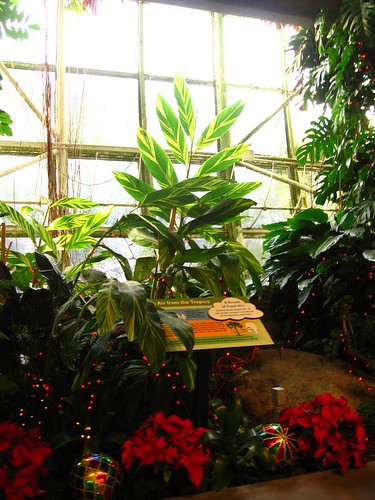
img_8753_35329569822_o
A variegated shell ginger - Alpinia zerumbet 'variegata' - at the Myriad Gardens
img_8806_35329501212_o
An unknown ginger at the Myriad Gardens
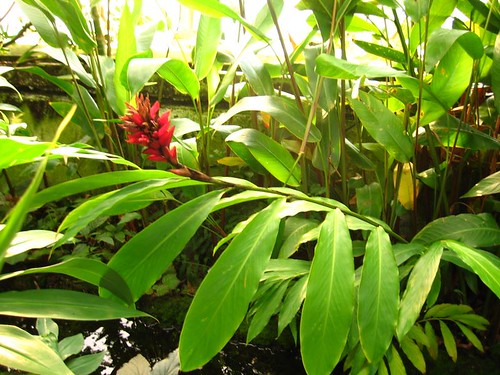
One closely related plant to the family of gingers is the genus Heliconia.  Heliconias are commonly called "False Bird of Paradise" because of their resemblance to the Bird of Paradise inflorescence.  The Myriad Gardens had a couple of different Heliconias in their collection.
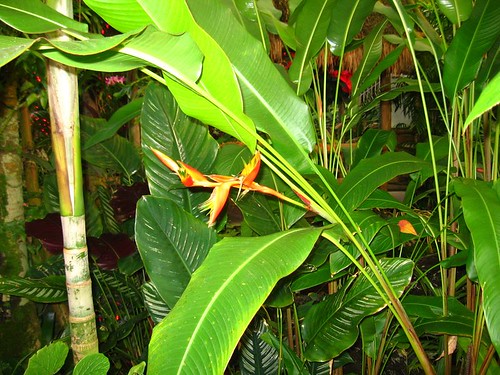
img_8792_35365883791_o
False Bird of Paradise - Heliconia lankesteria
Bromeliads

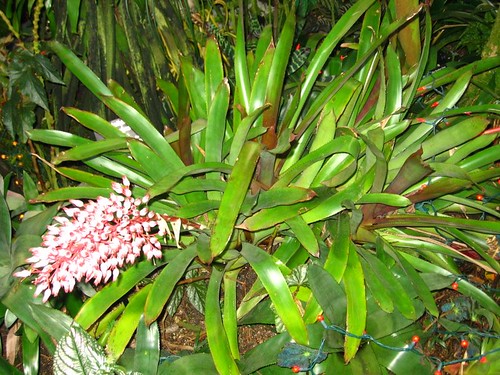
No one would call this collection of bromeliads small.  And it seems they are always in bloom.  The botanical family Bromeliaceae contains the genera Aechmea (the most common Bromeliad), Ananas (which includes the Pineapple plant), Billbergia, Bromelia, Cryptanthus, Tillandsia (commonly called "Air plant") and more than 50 others.  Many of the Bromeliads (Aechmeas, Ananas) are planted in the ground, while others (Tillandsia) are growing attached to trees or rock.  I didn't take too many pictures of the bromeliads, but there are several in my photo album.
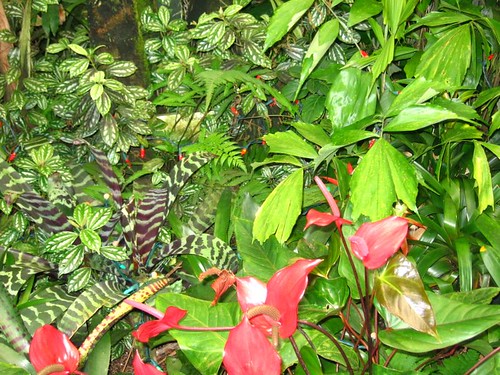
img_8796_35329516332_o
One of my favorite Bromeliads on the left (striped purple and green).
35365894431_3e670c412b_o
One of the many bromeliads in bloom

Orchids

The Myriad Gardens actually has a fantastic display of orchids.  At one location there is a concentrated wall of orchids.  But elsewhere in the rain forest collection you can see them attached to trees and rocks and walls.  It is simply amazing how many orchids are in bloom at any one time.  More than 1200 of the orchids in the collection were bequeathed to the Gardens in 2002 by a local collector named Fred Strothmann.  My photo album has quite a few pictures of the orchid collection.  Even though I have had some experience raising orchids, I didn't try to tackle identifying any of them.  I could tell a couple of the genera, but nothing beyond that.
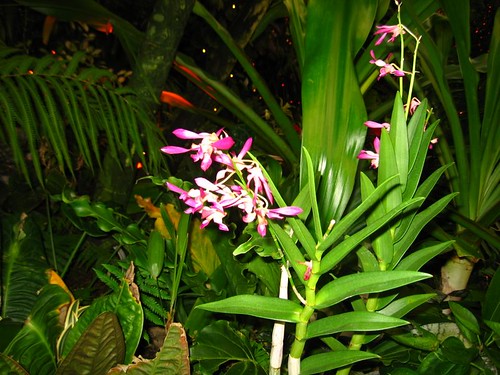
img_8830_35457073096_o
Unknown Dendrobium orchid
Begonias

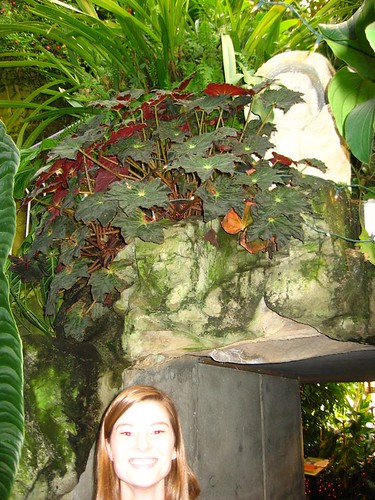
To be honest, I only noticed 3 or 4 begonias in the Gardens, but the website states that there are over 100 species present.  I'm not denying that they were there, because I was kind of being overstimulated by the place.  If I worked there everyday it would probably take a good month before my head stopped spinning each time I walked in the Gardens.  One particular (large) begonia did catch my eye, the Begonia 'Black Taffeta.'
img_8759_35365944861_o
Begonia 'Black Taffeta' and my beautiful wife

Euphorbias

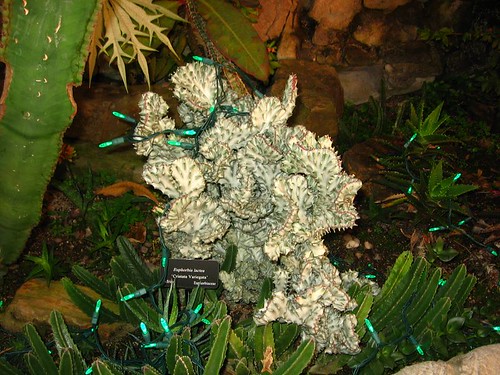
Euphorbias are a bit of mystery to me.  Why?  Well, because the most common Euphorbia I know is Euphorbia pulcherrima - The Poinsettia.  Most of the other Euphorbias with which I am familiar all have spines and are what I would call in a very general sense - cacti.  Now I know that technically Euphorbias are not cacti, and I'm okay with that.  But what I don't understand is what is the Poinsettia doing in the same genus as Euphorbia lactea?
img_8862_35365834341_o
Euphorbia lactea 'Cristata'
The Myriad Gardens collection of Euphorbias resides in the dry tropical zone.  Do you know the difference between a cactus and a Euphorbia?  Euphorbias grow in the Eastern Hemisphere while cacti grown in the Western Hemisphere.  Both plant groupings are filled with succulent plants with thick stems that store a milky sap and require very little moisture in their natural environments.  The Myriad Gardens collection of Euphorbias contains 40 species and if I had to guess, I would have told you it contained more than that.  There are quite a few pictures of Euphorbias in my photo album.

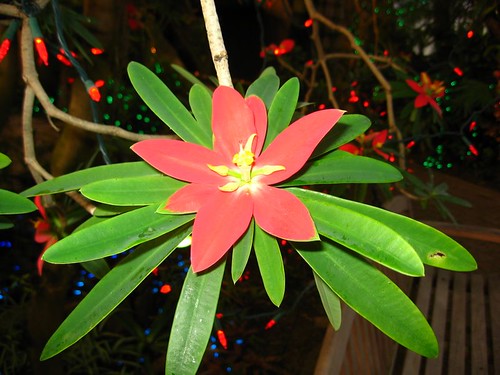
My favorite Euphorbia in the building was probably Euphorbia punicea - The Jamaican Poinsettia tree.  Here is one picture and there are a couple more pictures in my photo album.
img_8834_35457068386_o
Euphorbia punicea - The Jamaican Poinsettia Tree
The Myriad Gardens are a really great place to visit, with a small admission for the time that you can spend inside (if you're a plant lover).  If you haven't yet clicked on any of the dozens of links I provided to my photo album, I suggest you do so now.  You can get a better feel for the wonderful collection on hand.

Tuesday, November 25, 2008

My plant list and suggested reading

[2017 Update: now that my blog is moved to blogspot, I have deactivated the subpages, so the links in this post no longer work.]

I wanted to call attention to some new features on The Variegated Thumb.  On the sidebar, under "Pages" you will notice a number of links, including About, My Plant List, Photo Albums, Some Vocabulary, Suggested Links and Suggested Reading.  Most of these are new and some are in progress.

My Plant List is nearly a complete list of the plants I have at home - whether in pots in the house or planted out in the yard.  I know there are some missing items (a couple of trees, some unwanteds, and just some overlooked plants), but most all of my plants are on the list.  The list contains 137 distinct plant species/varieties/cultivars, categorized by family.  I'm not sure that categorizing by family is the best way of looking at my plants, since I only have one plant from many different families.  But, it is kind of interesting, because it shows where my interest is most invested.  I have far more Araceae (Aroids) than I do any other family.  In compiling the list, I had to look up almost every plant to see what family it is in.  So, my own collection held many surprises for me.  I was surprised to see that I had 8 plants from the family Ruscaceae.  And I guess I had forgotten that I have 4 species from the genus Ficus.

The Suggested Reading list is just a couple of plant books from different genres that I have read and enjoy - books that I would recommend to a friend.  I have only read a limited number of books on gardening and plant care, so it is certainly not a list of the best plant books on a given topic, but it does represent the best books I have read on each topic.

The Suggested Links list includes most of the websites that I frequent concerning plants.  In fact, since I compiled that list, it's like I have a bookmarks away from home.  I can just go to The Variegated Thumb, click on Suggested Links and have all of my favorite websites at my fingertips.  It's kind of handy for me, and hopefully you can find something useful there as well.  The real trove of information is kind of hidden in the links to the GardenWeb Forums and Dave's Garden.  There is enough information on those sites (and constantly growing) to keep you busy for hundreds of human lifetimes!  I also compiled a pretty good list of some online plant stores that have plants that interest me (Aroids, aquatics, houseplants, exotics).

Feel free to look at the other links on the Pages tab.  About simply tells about my blog.  Photo Albums is a collection of links to the photo albums I have included in some of my blogs.  I will probably add a new album about once per month.  Some Vocabulary is a list of some words I may use on my blog to talk about plants.  The definitions are nothing fancy - some may sound like a dictionary, while others are obviously my own words.

Enjoy!

Tuesday, November 11, 2008

Updated Design

I just finished a plethora of changes to the blog.  Look around!  I have made a separate page that includes links to my photo albums, so that they are easily accessible, even after the respective blog post is older and hidden somewhere in the dusty archives.  Hopefully there will be a new photo album about once a month.  Also, you should be able to find old posts more easily, as I have categorized and tagged all of my them.  The Tag cloud in the sidebar shows the relative frequency of tags in my posts.  You'll notice that "aglaonemas" is the most prevalent.  If you click on it, you'll find all of the blog posts I have written that are tagged with "aglaonemas," which happens to be 7 right now.

I've started a list of "Links of Interest."  Of course there are many more websites that I frequent.  I will probably be adding to this list quite a bit over the next couple of weeks.

Everything seems to be working correctly, but let me know if you notice any problems.

Enjoy!