Showing posts with label Book Review. Show all posts

Monday, February 28, 2011

Book Review: Wild Orchids Across North America

Ever since I found a Spiranthes growing in my front yard, I have been scouring all nearby landscapes with my eyes.  I wanted to know about other wild orchids in this part of the country, as well as in areas where I might be traveling around the US.  So I ordered a book on Amazon called Wild Orchids Across America: A Botanical Travelogue by Philip E. Keenan.  The book is published by Timber Press.  I am finding myself reading more and more books by this publisher.

This was a very enjoyable read, which tells about many (but not all) of the orchids which can be found in the Canada and the continental US (including Alaska, but not Florida).  It is primarily a description of the orchids themselves and their habitats, but there are some nice stories about the orchid hunting. It is called a "botanical travelogue" so the stories of the travel are part of the ride.  I'll be checking this book before I go on each vacation to see if I'll be in range of any blooming orchids that I can visit.

The accompanying photos for each species, taken by the author, are very nice and necessary for a book about orchids - in my opinion.

There is a considerable chunk of the book dedicated to northern climates (Alaska 28 pages, Canada 40 pages and New England 72 pages), which is not my area of interest.  There are some really cool orchids growing in these locations, but I don't see myself going to these places for orchid viewing any time soon.  The coverage of central United States orchids was very poor.  There were sections of the book that focused on "Midwestern states" (just Ohio) and "Western states" (California, Washington, Utah and Arizona), but nothing focusing on any area close to me.  Somehow the states of Arkansas, Oklahoma, Texas and Missouri are entirely skipped, although a couple of species are mentioned as originating in these locations.  It's too bad that Keenan didn't feel the need to explore these areas for his book.

All in all, I enjoyed reading the book.  I would say it is a "must read" for those who want to see orchids in the eastern United States, as those areas are very well covered in the book.

Thursday, January 14, 2010

Book Review: The Black Tulip

Over the last year I have read several plant-related books that have referenced a classic historical fiction novel by Alexandre Dumas, The Black Tulip.  Alexandre Dumas is the author who wrote The Three Musketeers and The Count of Monte Cristo.  After reading about the importance of this book and its portrayal of a very real tulip obsession in Holland, I found myself an old copy of the book and read it last Fall.

The book focuses on a tulip fancier who is committed to being the first person to breed a truly black tulip, a challenge issued by the royal plant society.  The story intertwines historical figures and events, to really put the reader into the time frame of these events.

I have to say that this book was one of the most enjoyable books I've read in quite a while.  It has a nice love story, with the main character being equally entranced in his love interests: a female and a trio of tulip bulbs.

I would recommend this book to anyone, really.  You don't have to be a plant nut to enjoy the book, and it might even shed a little light on what may otherwise seem to be a crazy obsession.

Do you know of any other great works of fiction that involve plants in pivotal roles?

Tuesday, December 1, 2009

Book Review: Wicked Plants

I mentioned several weeks back that I was waiting on a copy of Amy Stewart's newest book Wicked Plants to be available at my library.  I got my hands on it a couple of weeks ago and have been reading it off and on.  It is an easy book to read in pieces, as most plant descriptions are just a couple of pages in length.

In Wicked Plants, Amy Stewart writes about all sorts of mischievous plants.  Those that have acted as mere annoyances by getting stuck in your socks when out for a walk, or those that have killed hundreds of people throughout history.  The stories I enjoyed most were those that played a role in history.  For example, Abraham Lincoln lost his mother at a young age.  She was poisoned by drinking milk from a cow which had eaten a dangerous weed.  Actually, this is the subtitle of the book: Wicked Plants: The Weed that Killed Lincoln's Mother and Other Botanical Atrocities.

One of the more interesting accounts in the book is about a specific plant whose effects may have resulted in myths about vampires.  The plant is a common food plant, that when eaten as a staple food can result in dietary deficiencies and leads to the following ailments: dermatitis, dementia, diarrhea and (eventually) death.  These symptoms made the offenders appear pale and sensitive to sunlight.  When exposed to sunlight, they would develop ghastly sores.  Additionally, the symptom of foul-smelling mouth and bloody sores in the mouth might have led to the ideas that vampires have sulphuric-smelling breath and are drinkers of blood.   The dietary deficiency can lead to brain degeneration which can manifest itself through insomnia and aggression.  I'll leave the name of this food a mystery, as Amy Stewart would probably prefer you read her book. :)

My favorite story was probably that of a young teenager who wandered into a patch of Poison Sumac, which left him completely blinded for several weeks.  Even when his eyesight returned, it was never the same again.  During this period, he was not able to attend school and says that his seclusion nurtured his love of the outdoors.  This young man, named Frederick Law Olmstead, later went on to design New York City's Central Park - a tribute to the outdoors that he loved so much.

If you would enjoy reading about poisonous plants and even a couple of antidote anecdotes, I would suggest Amy Stewart's Wicked Plants as an entertaining read.

The next book review will likely be One River by Wade Davis.  Look for that one in about a month.

Monday, October 12, 2009

Book Review: Flower Confidential

Have you ever wondered how far the flowers at your local florist shop traveled to reach your vase?  Have you ever wondered what their life is like or who brought them to flower?

There's a new book available by Amy Stewart called Wicked Plants, which doesn't tell you any of that.  Wicked Plants has been getting lots of publicity in the plant world lately, so I put my name on the hold list at the library.  While I was waiting on that book to become available, I looked into other books by Stewart, including Flower Confidential, which tells the story of the international flower producing market.  That book does answer all your questions about the cut flower industry.

Flower Confidential is an entertaining read, written in the same format as Michael Pollan's Botany of Desire.  The sections of the book are divided into Breeding, Selling and Growing.  Each chapter uses separate flowers from different parts of the world as illustrative examples of the flower industry.  Gerbera daisies, Roses, Tulips and Lilies are all used to tell about different facets of this unique industry.

I have to admit, the book had more information on the cut flower industry than I cared to know.  But it was the subject of the book, so I can't fault Amy Stewart for that.  The parts I most enjoyed were sections describing the different growers with whom she visited and what their growing methods and interests were.

Some things I learned

The entire book was filled with information that I had never heard before, but a couple of little things struck me as particularly interesting.

When flower breeders began to try to force plants to bloom out of season, it was loosely determined that photoperiod determined when many different plants bloom.  Photoperiod is number of daylight hours available each day.  Most people would be content to know that this is important in determining when flowers would bloom.  Growers could either force plants to flower or hold them back by manipulating the hours of light available to their plants.  The manipulation could be done by using artificial lighting during dark hours and shades during the light hours, to make sure the desired photoperiod was met.  However, there were some horticulturalists that were a little more curious than the average grower who wondered, Is it really the number of daylight hours, or is it the number of dark hours? You might say that it doesn't really matter, since the two are related.  However, the scientists were able to set up a completely controlled growing environment, in which they created different day lengths.  For example, in a covered building, they were able to simulated 26 or 30 hour days and varied the number of hours in which the plants received light.  They determined that the number of dark hours was the actual trigger that initiated the blooming process.  In other words, regardless of the time from one sunrise to the next sunrise, a plant requires a specific number of dark hours to initiate the blooming process.  If the length of the entire day varies, but the number of dark hours stays constant, the plant would still be triggered to bloom.  Cool, huh?

On a completely different note, I learned about a unique type of flower auction that is held in the Netherlands.  I didn't know that flower auctions were even held in the Netherlands, but I was more surprised to hear about the format of these auctions.  A large round scale is available for each cut flower that is being put on auction.  Picture a produce scale from the grocery store, except that the value is displayed with a little digital light around the rim of the circle.  And the value is the cost per stem of a particular cut flower.  The top of the "clock" represents $1.00 and the bottom represents 50 cents.  For a value greater than $1, a different colored light is used to represent dollars, much like an hour hand on a clock.

But the clock itself is not what is so unique about this auction, in my mind.  These auctions are held in Aalsmeer in the second largest (by floorspace) building in the world!  But even that is not the unique factor I found so fascinating.  The unique factor here is that the flower auctions are descending-bid auctions.  That is, the auction starts off with a value that is much more than anyone would pay for the item, rather than much less.  Then, the "clock" device begins to tick downwards.  Everyone interested in the available flowers is anxiously watching the dial to see the light approach the value they are willing to bid.  But unlike other auctions, the first bid that is placed is the winner.  So you can decide ahead of time that you will buy this bundle of flowers if the price falls to $1.43 per stem.  You sit there watching and it gets down to $1.47, $1.46, $1.45 and DING!  Your price was too low.  Someone just snatched them up at $1.45!  Next time you might get a little more anxious as the price nears the value you had planned to bid.  This time you end up bidding on the flowers at $1.46 - just to be safe.

Amy Stewart pointed out that, while this form of auction seems very backwards to most people at first hearing, it is actually a lot like how most people make their normal purchasing decisions.  You see an item at the store that you are interested in buying, but you shop around until you find the price low enough that you are willing to purchase it.  Or you wait until later in the season, hoping the store will discount the price.  Either way, whether shopping around or waiting for a mark down, you run the risk of the items all being sold before a lower price is offered.  This is just how the descending-bid auction works.

So it doesn't have much to do with plants, but I found it very interesting.  I hope you did, too.

Friday, May 29, 2009

Book Review: The Orchid Thief

On vacation last week, I took a couple of books with me - both having plants as their main subject.  One book was a field guide to plants and trees in Hawaii.  It proved very handy in identifying much of the plant life along side the road - plants that aren't found growing in Oklahoma, outdoors or in greenhouses.

The other book is a non-fiction novel called The Orchid Thief by Susan Orlean.  (I always want to put an "s" at the end of her last name.)  The story revolves around an Orchid fanatic in south Florida that has stolen some rare Orchids from a protected nature preserve with a plan to clone them and make lots of money.  The author does a wonderful job of pulling in the reader from the first couple of sentences.  I loved the descriptions of this character that I could vividly picture and felt like I knew.  I also loved the portrayal of south Florida, which is unlike any other area I have visited.

It was a really fun read for my trip to Hawaii, too.  Even though the scenery is very different from Florida, I was getting to enjoy orchids growing outdoors in natural settings while reading this book.

There are lots of deviations from the story (which I enjoyed).  Many of these deviations are historical accounts of the Seminole tribes that occupy Florida.  Did you know that they are the one native people who never signed a treaty with the US?  I didn't.

On the downside, by the time I was 3/4 of the way through the book I kind of started to realize that the book wasn't really going anywhere.  When you write fiction, you can do something about that.  When you're a reporter, relaying the true story of a crazy man obsessed with orchids, well...  you can't.

Anyway, I would thoroughly recommend this book to any plant lover who has at times felt "obsessed" with plants (I am one of them), and especially to those who have a great admiration for Orchids.  It is a fun read and easy to identify with the characters, if you happen to be one of these people.

Monday, April 27, 2009

Book Review: Oklahoma Gardener's Guide

I have been reading a book that my mom lent me, Oklahoma Gardener's Guide by Steve Dobbs.  I am really getting a lot out of the book, because of its focus on gardening in my location.  I would definitely recommend the purchase (or at least a library checkout) of a gardening book that applies directly to your region.  I'm sure there is probably one for every state in the country.

The introduction to the book tells about gardening in Oklahoma, including a short discussion on plant hardiness and ecosystems made up of similar climates and geographies.  That discussion got me to thinking and researching a little bit more.  Most of this post is about that subject.

The majority of the Oklahoma Gardener's Guide consists of plant profiles.  The profiles include information on how to grow these plants in Oklahoma, as well as different named varieties that are available and which are best choices for our location.  The profiles are divided up into several different categories:

  • Annuals

  • Bulbs

  • Ground Covers

  • Ornamental Grasses

  • Perennials

  • Roses

  • Shrubs

  • Trees

  • Vines

  • Great Plains Plants

A large appendix includes maps and information from the following topics:

  • Planning and Starting a Lawn

  • United States Ecoregions Map

  • Oklahoma Frost-Free Map

  • Oklahoma Freeze Map

  • Oklahoma Precipitation Map

  • Oklahoma Northern Counties Map

  • Perennial Ground Covers as Lawn Alternatives

  • Beneficial Insects

  • Other Plants for Oklahoma

  • Natives as Ornamentals

  • Oklahoma Public Gardens

  • Reference Publications of Interest

  • Glossary

  • Your Garden Plans

Discussion of Plant Hardiness

In addition to the USDA Plant Hardiness Zones map, Steve Dobbs includes a map of Ecosystems in the continental United States.  There are six ecosystems identified in the United States: Pacific West, Mountain West, Desert Southwest, Great Plains, Continental East and Humid South.  The last four of those ecosystems intersect in the center of Oklahoma.  The center of Oklahoma is a sort of "four corners," dividing the state into quarters.  Lucky for me, I live right in the center of the state.  This means that gardening outdoors can be a little tricky where I live.  The map below shows a much more detailed view of ecosystems in the US.

USDA Ecological Subregions map
USDA Ecological Subregions map.  This is a more detailed map than the one shown in the book,  but still demonstrates the diversity of Oklahoma's ecoregions.

Oklahoma is known for its extreme weather, usually in the form of severe storms and tornadoes.  But Oklahoma made national news at the end of 2007 when we were hit by a horrible ice storm that tore down many trees and left others severely damaged.  It is also not unusual to have fairly long droughts during the mid to late Summer, when much of the state is behaving more like the Desert Southwest, rather than the Humid South.  Temperatures in my home town range from 10 F to 105 F in an average year.

The USDA plant hardiness zone map was updated in 1990, dividing many of the zones in two (an "a" and a "b").  Those zones have been consistently used by growers to indicate the cold hardiness of plants for several decades now.  However, the map indicates only the lowest temperature that could be expected during the course of the year.  Steve Dobbs writes that a single indicator is not enough information to convey whether a plant will survive in your yard or not.  Just as you need to take into account how much to water a plant and what sun exposure it needs, you also have to consider the relative humidity required by the plant and the heat that it can endure.  This is often described by saying that a plant is drought hardy, but being able to withstand a week without rain is different than withstanding a month's worth of high temperatures above 95 degrees Fahrenheit.  This happens in July and August in Oklahoma.

As it is now, plants that are hardy in my zone (zone 7) are suggested for here as well as Delaware and New York City.  Clearly these are very different climates and the same plant would require different care in these two locations, assuming the plant could live in both places.

There is some discussion about the USDA creating a heat hardiness map that would indicate the maximum temperature that can be expected in a year.  This map would show most of Oklahoma hitting a maximum temperature of 105-110 F.

The American Horticultural Society has produced a US Plant Heat-Zone Map that categorizes locations based on how many days each year the temperature reaches above a threshold value (86 F).  On that map, the majority of Oklahoma is in heat zone 8, with 90-120 days above 86 F.  By contrast, New York City is in zone 4, with 14-30 days above 86 F!  Now all we need is for growers to start labeling their plants by heat hardiness.  For instance, a marigold plant might be hardy for cold zones 4-9 and heat zones 7-8.  I just made that up as an example, so don't get worried if you're trying to grow Marigolds in heat zone 6.  I don't really know where Marigolds are hardy.

Most people that have gardened for more than a year or so understand that there is more to satisfying a plant's needs than just matching it with a cold hardiness zone.  But the more information that becomes consistently available for all of the plants that we see, the better for all.

Tuesday, March 17, 2009

Funny quote from Planthropology

I have been reading a new book by Ken Druse called Planthropology: The Myths, Mysteries and Miracles of My Garden Favorites.  It's a fun read if you're a plant-aholic, like I am.  The book is a well-written hodge-podge of information and fascinating little stories about plants and how we, as humans, relate to them.  Tonight I was reading a section on medicinal plants and their potential lethality in large doses.  Ken writes that many plants with medicinal uses are fatal in large amounts.  Here's a passage that I particularly enjoyed:

By now, you are probably thinking about never venturing out into the garden again.  It's true that some plants make one sick if eaten, others cause a rash if touched, and several may even cause immediate and drastic results; I've heard, for example, that the first symptom of yew poisoning is death.

I thought that was an eloquent way of putting it.

Thursday, February 12, 2009

Book Review: Toki No Hana

Doesn't that title just draw you in?  No?

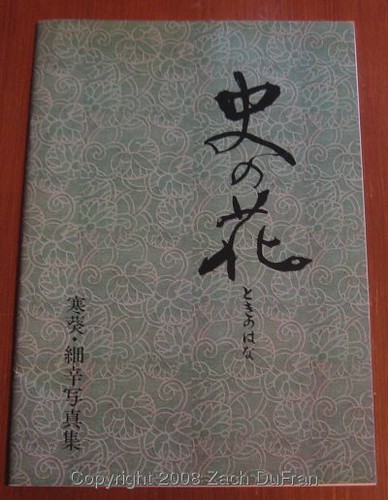
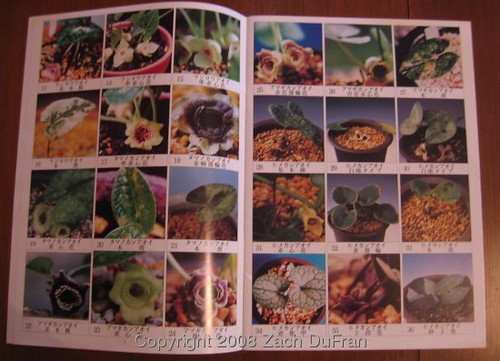
Well, maybe that explains why everyone was rolling their eyes when I opened this Christmas present from my parents (which I had requested, by the way).  The Japanese book "Toki No Hana" is a 45 page monograph (book with one subject) with 480 photographs of plants from the genus Asarum.

toki_cover
Toki No Hana cover
Although I have only grown one species from this genus, I greatly admire the genus and I have plans to start a small collection.  In the United States, Asarum are grown most often as groundcovers in woodland shade gardens in the north.  There are a couple of species native to North America.  You might run across their mottled foliage in the woods of the northern states and in Canada.

In southeast Asia, it's a completely different matter.  For thousands of years, the Japanese have cultivated different varieties for their variable foliage and subtle, but beautiful blooms.  The foliage can be anywhere from solid green to almost completely silver.  The blooms vary from yellow with red centers to solid purple.  They are treasured plants, grown in small pots where they can show off their blooms most easily.  You see, the inflorescence of an Asarum is at the base of them stem, literally lying on the surface of the soil (or pebbles in the pictures below).  One of the most recognized blooms looks like a little panda bear, being white and a deep purple that looks black.
toki_pics
Asarum pictures from Toki No Hana
The book was compiled by the Japanese Asarum Preservation Society and is a collection of pictures of all of the different varieties that have been cultivated there.  It is fascinating to see the variation.  Some are stunning and others are... well, not so pretty.  After all of the pictures are several pages of notes on the identification and origin of the different species and cultivars presented in the pictures.  Of course, the notes are in Japanese:


toki_japanese
Notes on Asarum species - did you get all that?
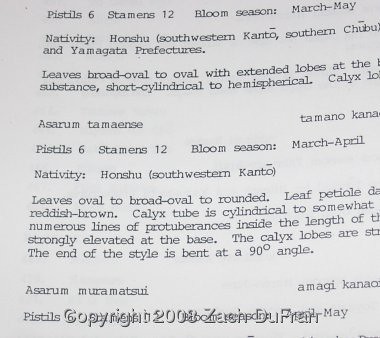
Thankfully, my parents purchased this book from a US source (Asiatica Nursery) that had grabbed a bunch of these books in Japan and translated the notes to English.

toki_eng
Ah, much better. Asarum notes translated from Japanese to English by Barry Yinger.
This Spring I will be checking the Atwoods store here in town where I have purchased Asarum splendens in the past.  I will probably get three or four plants to start with.  Since Asarum are actually a cool climate plant and will do very well in dimly lit, cool rooms, my plan is to start my collection in earnest this Fall by purchasing several more varieties from Asiatica Nursery, an online retailer that specializes in Asarum.  They usually have about 70 different varieties available.  I already have a short list of the plants I plan to purchase:


  • Asarum kiusianum var. tubulosum - solid white flowers, low clumping leaves


  • Asarum maximum Green panda wild ginger - one of the most famous species


  • Asarum splendens Chinese wild ginger - the variety I will buy at Atwood's in town


  • Asarum subglobosum - pink/beige flowers, green leaves have center white stripe


  • Asarum takaoi ‘Ginba’ - solid silver leaves


  • Asarum wulingense

  • It will be great fun to watch my plants mature into specimens as beautiful as those pictured in Toki No Hana and to see my plants produce some of these amazing inflorescences.

    Stay tuned for pictures of my plants as I collect them!

    Wednesday, January 21, 2009

    Book Review: Tempting Tropicals

    Tempting Tropicals: 175 Irresistible Indoor Plants by Ellen Zachos is a book about tropical houseplants.  Unlike most books on houseplants, the species highlighted in this book are a little less common and some are rare or exotic.  But all of the plants can be grown indoors, they're just not necessarily easy to find.

    Tempting Tropicals by Ellen Zachos
    Tempting Tropicals by Ellen Zachos

    I really like the bold choices made by Zachos for this book.  She has apparently read her share of houseplant books that cover the same common species that you see in many houses.  She decided to pick out some odd balls from her years of experience growing tropical plants in a very non-tropical environment (apartment buildings in various parts of the northeast United States) and tell about her favorite plants from all of those little experiments.

    Because the book does not focus on the typical houseplants, I would not recommend this book as a good reference for someone who doesn't already have a general houseplant book or two.  But for someone who already has some of those books in their library, you won't find a lot of repetition on these pages.  And if you are interested in growing something that you haven't seen before or something that will surprise your peers, this would be a great book to reference.

    The first quarter of the book covers the care of tropical plants in the home environment.  Chapter topics include classification, growth information, container choice, potting media, fertilization, light exposure, artificial lighting, humidity, pruning, repotting, propagation, pest profiles, pest management and diseases.  This front quarter of the book has generally good information from someone that obviously has a lot of experience.  Though I had read much of this advice before from a number of different sources, I picked up new tips and especially gained a lot of knowledge from the section about artificial lighting options.

    The remaining three-quarters of the book is occupied with plant profiles for 175 different plants, many of which I was not familiar with.  The profile tells about the physical characteristics of the plants and how to care for them.  Additionally, each plant's "winning attributes" are described.

    I won't list all of the great plants in the book, but here are a couple of highlights:

    Climbing Onion - Boweia volubulis - This is a unique onion plant with very delicate foliage above the large, flaky onion bulbs that sit on the soil's surface.

    Peacock Plant - Calathea lancifolia - I am a lover of Calatheas anyway, and this is one of the less common ones, with lance-shaped leaves.  This plant is towards the top of my wish list.

    Coconut Palm - Cocos nucifera - This is the common coconut palm tree, which looks really cool as a specimen tree, because the stalk of the tree grows directly out of the coconut.  I have twice tried growing this plant in my house and it simply will not survive in my low-light conditions.

    Sealing Wax Palm - Cyrtostachys renda - This is a really intriguing plant.  It looks just like a palm tree with bright red stems that are waxy looking (as the name implies).

    Elephant's Foot - Dioscorea elephantipes - This plant reminds me a lot of the climbing onion (above).  It has a large above-ground base, in this case not a classic onion but more of a hard sphere of wood.  The upper growth of the plant has wandering branches with small roundish leaves.  It is a true oddball.  I hope to run across one of these someday.

    Butterwort - Pinguicula ehlerserac x. P. oblingoloba - This little plant has bright lemony-green leaves with tall stalks of dainty magenta blooms.  Apparently this is a very easy plant that grows rapidly and likes a lot of water.

    The plants are alphabetized by genus name and many times there are a couple of species covered under each genus.  At least one picture accompanies each genus in the profiles.  There is a lot of variation in plants described in the book - from colorful, showy blooms to beautiful foliage plants to spiky cacti.

    There is a final, short section with some miscellaneous topics, including traveling with plants, bark mounting and summering plants outdoors.

    As I said, this book is for the person who already has some experience with growing the typical houseplants (and already has a couple of books in that department).  It is for someone who is ready to try something new and maybe venture in to the world of ordering something rare, exotic and outlandish (maybe even from a foreign country) and growing it in your own home.

    Wednesday, December 10, 2008

    Book Review: Botany of Desire - A Plant's Eye View of the World

    For some reason I want to say this is my first plant book review of a Fiction book.  However, Botany of Desire: A Plant's-Eye View of the World is not fiction.  I guess it's just that it's the first non-reference book I've reviewed on my blog.


    Botany of Desire by Michael Pollan is more of an historical account of nature's interaction with plants - and specifically human kind's interaction with plants.  It chronicles the influences of man on "natural" selection.  It also conjectures about the influence of plants on humans! No, that wasn't a typo. :)

    Plants have natural variations in their offspring.  Some of those offspring are more successful than others.  The variations that succeed are more likely to reproduce than those that fail.  This is natural selection, of course.  Well, you might have heard someone say that since humans are so all-powerful, we have begun to trump nature's selection by choosing ourselves what species we want to live, etc.  For instance, it might be that the prettiest rose survives, rather than the rose most immune to certain diseases.

    We know that plants have generated natural variations that take advantage of other living beings to profit themselves.  For instance, many plants produce beautiful flowers that appeal to pollinators (bees and birds).  Why do the plants do this?  They do it for their own benefit - so that the plant gets pollinated and reproduces.

    The premise of The Botany of Desire is this:
    Maybe plants have been using us humans just like they do bees and birds.  Maybe plants have been specifically creating variations that appeal to humans in order to sustain their own populations.


    It sounds kind of science fictiony and far-fetched, but on the most basic level you almost have to agree that it is true.  In many cases, the variations of plants that have been promoted by humans have not been for the betterment of the plant.  For instance, the apples we buy in the grocery store today are thickly coated with insecticides (more than ever before in history) for one specific reason.  Because we found an apple that we liked and have been spreading it forward by grafting (rather than allowing natural variation through seedlings), the apple tree has not adapted to the insects that feed on it.  If mankind were to have left the apple alone, it would have adapted to it's natural predators.  Therefore, it only makes sense that some plants would begin to make the best of a bad situation and start to produce variations that are appealing to humans, who have begun to more or less control the spread of plant life.

    In the end, the premise is not so much that plants are using us, but that there is a reciprocal relationship.  Plants have merely begun to notice that we have desires and that by meeting our desires, they can benefit, as well.

    Michael Pollan elegantly weaves his story, following four separate plant species which have appealed to different human desires:  the apple (sweetness), the rose (beauty), marijuana (intoxicant), and the potato (control).  The story is well-written, following Johnny Appleseed on his journey across the frontier, and recounting the quest for the perfect black tulip in Amsterdam.  Pollan also talks about his own experiences of growing marijuana and the genetic engineering that has been performed on the potato in recent decades.  The four plants are selected well in terms of highlighting four different desires, as well as progressing his story forward in time.  This is an entertaining and insightful book that I would recommend to any gardener.

    Tuesday, November 25, 2008

    My plant list and suggested reading

    [2017 Update: now that my blog is moved to blogspot, I have deactivated the subpages, so the links in this post no longer work.]

    I wanted to call attention to some new features on The Variegated Thumb.  On the sidebar, under "Pages" you will notice a number of links, including About, My Plant List, Photo Albums, Some Vocabulary, Suggested Links and Suggested Reading.  Most of these are new and some are in progress.

    My Plant List is nearly a complete list of the plants I have at home - whether in pots in the house or planted out in the yard.  I know there are some missing items (a couple of trees, some unwanteds, and just some overlooked plants), but most all of my plants are on the list.  The list contains 137 distinct plant species/varieties/cultivars, categorized by family.  I'm not sure that categorizing by family is the best way of looking at my plants, since I only have one plant from many different families.  But, it is kind of interesting, because it shows where my interest is most invested.  I have far more Araceae (Aroids) than I do any other family.  In compiling the list, I had to look up almost every plant to see what family it is in.  So, my own collection held many surprises for me.  I was surprised to see that I had 8 plants from the family Ruscaceae.  And I guess I had forgotten that I have 4 species from the genus Ficus.

    The Suggested Reading list is just a couple of plant books from different genres that I have read and enjoy - books that I would recommend to a friend.  I have only read a limited number of books on gardening and plant care, so it is certainly not a list of the best plant books on a given topic, but it does represent the best books I have read on each topic.

    The Suggested Links list includes most of the websites that I frequent concerning plants.  In fact, since I compiled that list, it's like I have a bookmarks away from home.  I can just go to The Variegated Thumb, click on Suggested Links and have all of my favorite websites at my fingertips.  It's kind of handy for me, and hopefully you can find something useful there as well.  The real trove of information is kind of hidden in the links to the GardenWeb Forums and Dave's Garden.  There is enough information on those sites (and constantly growing) to keep you busy for hundreds of human lifetimes!  I also compiled a pretty good list of some online plant stores that have plants that interest me (Aroids, aquatics, houseplants, exotics).

    Feel free to look at the other links on the Pages tab.  About simply tells about my blog.  Photo Albums is a collection of links to the photo albums I have included in some of my blogs.  I will probably add a new album about once per month.  Some Vocabulary is a list of some words I may use on my blog to talk about plants.  The definitions are nothing fancy - some may sound like a dictionary, while others are obviously my own words.

    Enjoy!

    Thursday, November 13, 2008

    Book Reviews of two NY Times plant books

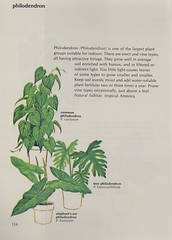
    I have a collection of 20 to 30 books on plants.  Among those are two books that I really enjoy, both published by the New York Times.  The first is the 1973 book The New York Times Book of House Plants by Joan Lee Faust with illustrations by Allianora Rosse.  The first section of the book contains the requisite general care guide that explains watering, lighting, repotting, etc.  It also contains a Calendar of Care, that outlines when certain tasks (repotting, fertilizing, dormancy) should be performed with your houseplants.  The meat of this book is a section of profiles and hand drawn pictures of 150 different common house plants.  The plants are alphabetical by their common name, but there is at least a Genus (and usually a species) included for each plant (most of which are correct).  I remember looking at my mom's copy of this book a number of times growing up and purchased a copy of my own in a used book store about a year ago.  I think what I like most about this book is the illustrations.  It's weird to say this, but it almost seems that the illustrations convey more about the plants than a picture could.  I know that a photograph is worth a thousand words and all that, but there is a simplicity in the illustrations that speaks louder than the detail of photographs.  There is something very elegant about them.  The qualities of the plant that are apparent to the human eye are accentuated very well in these pictures.  Here is one such example:

    houseplants_page_scan
    NY Times Book of Houseplants - Philodendrons
    [On a separate note, there is a really good catalog of aquatic plants with illustrations at the Tropica website.  It is linked on my sidebar.  Check it out if you are interested in aquatic plants, or this type of plant illustration.]

    The plant descriptions and care guidance are decent, but nothing special.  After the 150 common plants is a list and very short description (with no pictures) of 19 "unusual" houseplants.  These include impatiens, lantana and hydrangea.  I find nothing unusual about these plants, so it is either the book showing its age, or it is simply the fact that these books are not usually kept as houseplants.  You normally find them planted outdoors or in pots on front porches.

    This book also contains a section on miscellaneous topics, including gardening under lights, bottle gardens & terrariums, bulb forcing, and propagation.  The most outdated section of the book is a short directory of places to buy houseplants.  It is one of those things that will forever identify this book as being written pre-internet.  I probably would not have much of a plant hobby if the nearest place to buy houseplants and supplies was a five hour drive from me.  :)  In a book published in the last couple of years, this section would not even be considered.  It's unlikely that there would even be a list of website URLs where you could find information or buy plants or supplies.  With the onset of the internet, that type of information is easily accessible to anyone interested.  The internet is a wonderful thing - though I often find time slipping away all too quickly in its grasp.

    If you're interested in purchasing a copy of this book, you can get one very cheap on Amazon.

    The other NY Times book in my collection is a more recent one.  The New York Times 1000 Gardening Questions and Answers: Based on the New York Times Column 'Garden Q & A' is a really long title, huh?  Well, it's also a great reference book.  I came across this book on a shopping spree (of sorts) at a huge book store in the Dallas/Fort Worth metro area.  I had about an hour to choose any one book that I would like to take home for free.  This was a crazy idea of my parents-in-law.  [A crazy idea that I enjoyed very much, might I add.]  Anyway, after an hour of looking, this is the book I wanted to take home with me.  The book is divided into sections on flower gardening, landscape gardening, kitchen gardening, potted gardening and garden keeping.  Each of these topics is broken down further into some subcategories.  Questions range from the very general "What type of plant would you suggest for such and such location?" to the more specific "Most soil recipes call for perlite, vermiculite, or both.  What are they, and what's the difference between them?"  Okay, well that's not all that specific.  As I thumbed through the book looking for a specific question I realized that it doesn't get too specific.  This book is fun to read through and to learn some things.  But it's really not a great reference book for learning everything there is to know about any one subject.  It's aim is definitely breadth over depth.

    If you're interested in purchasing a copy of this book, they are going for about $14 new and less than a dollar for a used copy on Amazon.

    Tuesday, November 4, 2008

    Taxonomic Vocabulary / Book Review

    Last week I made a stop into a book store and spent some time looking at every title in the gardening section.  One book I stumbled upon, caught my fancy.  It was right up my alley - and also discounted because it was used.  [Who would return this book?]

    The book is Gardener's Latin: A Lexicon by Bill Neal.  It is a dictionary of words used in plant taxonomy.  It is a very informative book (in the classical dictionary sense), as well as having some entertaining  sidenotes and stories about plants.  Being a collector of books, plants and plant books, I naturally bought this book.

    The book primarily contains common species names (the second name in a binomial scientific name).  In a general sense, the first name (Genus) is a noun and the second name (species) is an adjective.  In the simplest case, a plant name translated to English is something like "skinny grass" or "blue canna."  Of course, the more distinctly desciptive a name can be, the better.  Most of the names help describe the appearance of the plant.  Other names describe the smell of the plant, the uses of the plant or even the location of the plant.  Some of the names seem pretty obvious, and you don't need to know latin to know that filamentosa means "filament-like."  I was surprised to find that a number of the names were in reference to other plant names.  For instance, agavoides means "Like the Agaves."

    Words that end in -flora deal with the bloom of the plant, while words that end in -phyllum or -folia/-folium deal with the foliage or leaves of the plant.  Words that end with -cladia/-cladium deal with the branch of the plant. Not surprisingly, words ending in -petalum deal with the petal of the plant.

    There is an online dictionary of latin plant names here.

    Here is a random collection of vocabulary that is somewhat common for describing Aroids - although not always in name.

    cordate/cordatum - heart-shaped
    fenestrations - holes
    hemiepiphyte - a plant that can start in the soil and grow up a tree trunk, or start on a tree and grow to the surface where it roots in soil
    pinnate - divided
    palmatum
    - shaped like a human hand (ex/ Japanese maple = Acer palmatum)
    pinnatifid - palm (as in palm tree) shapedscototrophism -condition where a plant seeks dark rather than light, presumably to find the trunk of a tree which can be climbed

    You can see the book here. By the way, LibraryThing.com is a really cool site.