Showing posts with label Huernia. Show all posts

Wednesday, September 5, 2018

A couple Huernia blooms

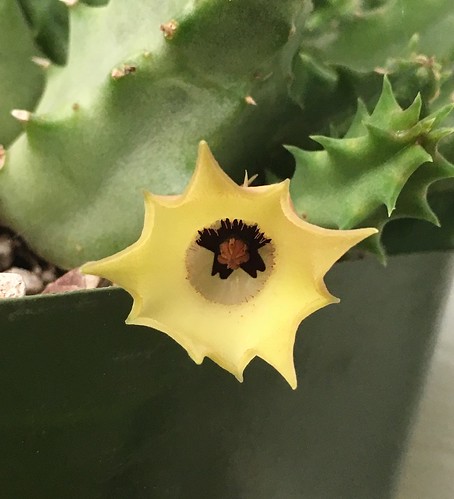
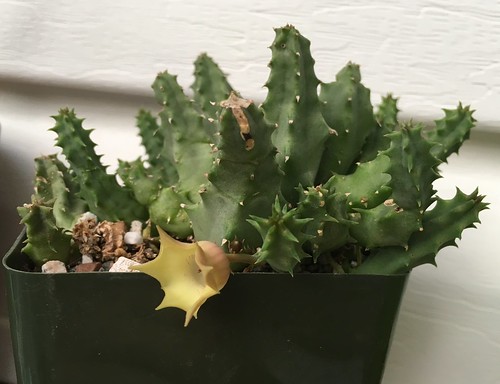
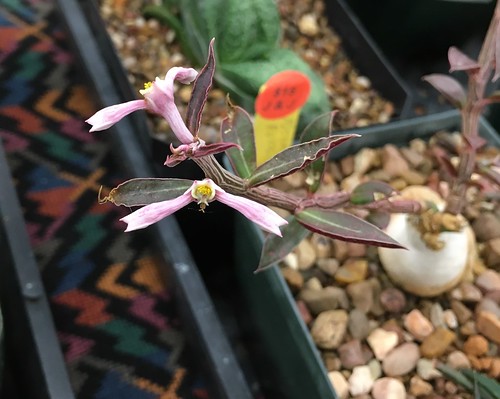
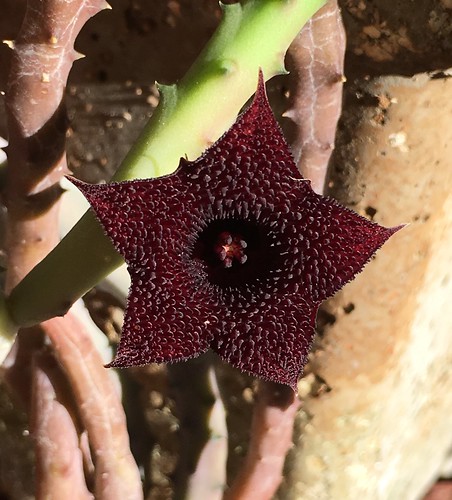
Without a doubt, Huernia is my favorite succulent genus. This genus is in the Stapeliaceae family, closely related to the common carrion flower/starfish plant, Stapelia gigantea. I have amassed a pretty good collection of these plants and always seek them out at the Central Oklahoma Cacti and Succulent Show. This year I purchased a new one that was labeled Huernia sp. The petals of the flower reflex after a day or two, resulting in a different appearance (shown in second photo).

It bloomed not long after the show and I was able to get some help identifying it as either Huernia procumbens or a hybrid of that species.

Huernia procumbens

Huernia procumbens

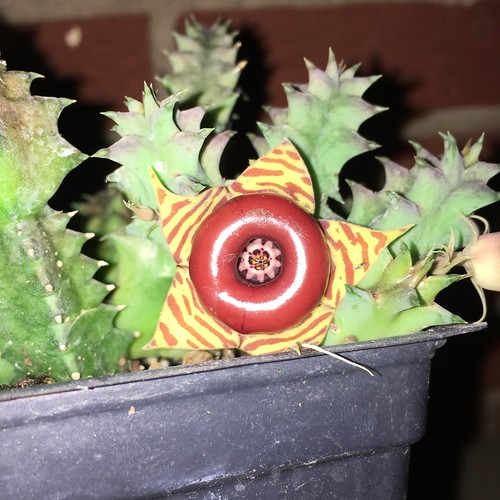
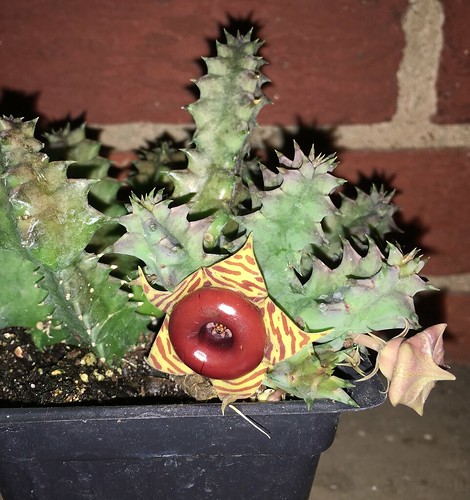
Another Huernia that I picked up recently is Huernia zebrina, which has very distinct yellow and red flowers. This plant is sometimes called the Lifesaver Plant, due to the red ring that forms in the center of the flower, similar to the plant above, but more pronounced and much more colorful. I was delighted when the first flower opened on my plant and have been pleasantly surprised to see this plant flower constantly all summer for me. There have been as many as 5 flowers open on the plant at one time.

Huernia zebrina

Monday, September 11, 2017

Plant Find: Three New Succulents

The whole family went on a little reconnaissance trip to a local nursery to look at some shrubs and trees that we might use when we relandscape our front yard.  With a three year old and a five year old we're in a perpetual mode of one of us watching the kids while the other is trying to do something productive, at least until their antics require both of us to bring the universe back into order.  When it was my turn to watch the kiddos I followed them into a long, nearly empty hoop house where they decided to pick up the tiny gravel from the ground and start throwing it out over the empty mesh tables.  I stifled my persistent desire to ask them to stop and just asked that they not throw rocks at each other or at plants.

Huernia zebrina
Huernia zebrina

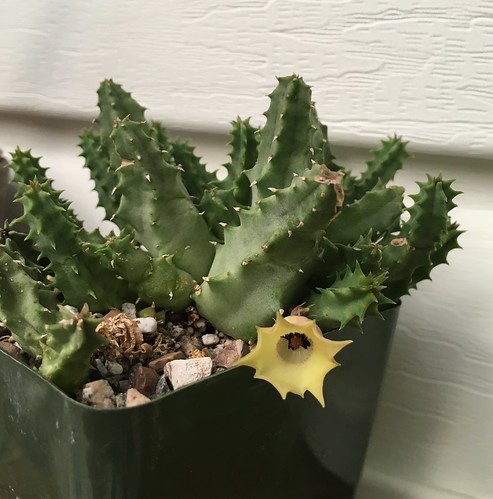
While they continued their onslaught of gravel flinging I wandered over to the only little patch of green in the hoop house.  It was a selection of small succulent plants with a sign that read "Priced as marked."  I looked around and was surprised to see about 8 little pots of Huernia zebrina, a Stapeliad that I have admired photos of for a white, but had not seen in person and had not yet added to my collection.  Price tag?  Nope.  Huh...


Huernia zebrina
Huernia zebrina

I picked out the best one of the lot, which was a tough choice, because they were all blooming, but some had more buds than others and some had more plant growth.  I selected the one with the most stems and buds I could find, not focusing as much on the current number of flowers.  The flowers are strange little things with a bright red ring that resembles an inner tube and leads to the common name of "Lifesaver plant."


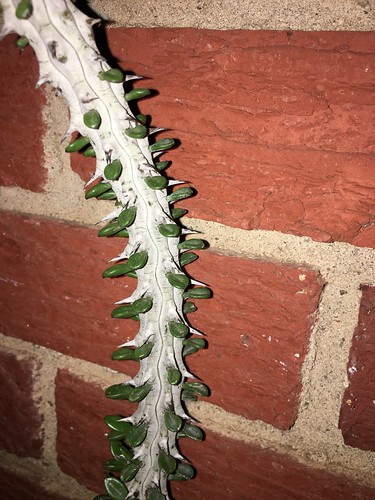
Alluaudia
Alluaudia
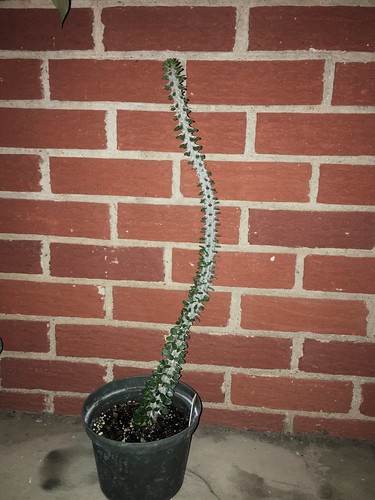
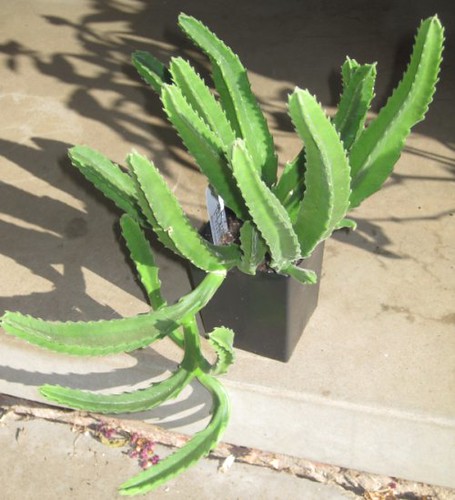
Then I looked at what else was on the table.  An Alluaudia?  Can it be!?!  There were four of them - long, lanky succulent with alternating rows of spines and leaves.  I have admired a giant Alluaudia at the Myriad Gardens for years.  I've never once seen one for sale.  I looked at the four available and picked the best.  This plant was considerably bigger than the Huernia but since I had not seen it for sale before I set a maximum price of $12 in my head.  I'm not sure which species this is, but I am thinking it is probably Alluaudia procera.


Alluaudia
Alluaudia
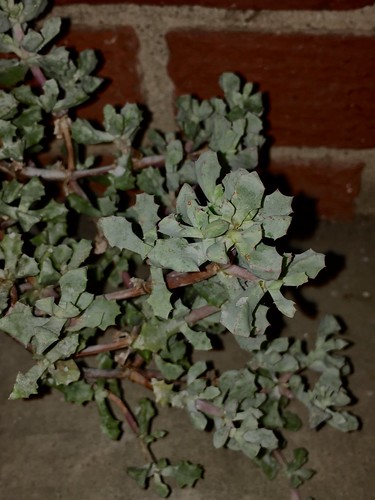
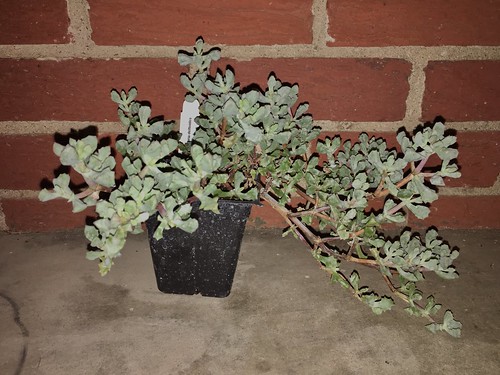
I looked a bit more.  Nothing significant that I had been wanting, but there was a cute little plant with very strange leaves.  This was the only plant with a price tag ($3) and also the only one with a real label in it.  It read "Pink Ice Plant (Oscularia deltoides)."  I picked out the best one and proceeded to the cash register, hoping for the best with my unmarked plants.  I figured having one plant with a $3 price tag may help with the others.


Oscularia deltoides
Pink Ice Plant - Oscularia deltoides

Oscularia deltoides
Pink Ice Plant - Oscularia deltoides
I was pleasantly surprised when the cashier decided my three plants were $2, $3, and $4.  Definitely one of my cheapest plant hauls ever!

Thursday, August 3, 2017

unidentified Huernia in bloom

[UPDATE 2017-09-15:  I have been informed that this plant is Huernia bayeri. ]

The unknown Huernia that I purchased at the cacti and succulent show and sale this year is now blooming.

Huernia sp.
Huernia sp.
Maybe this will help me identify the plant to species level.  The flowers are small bell-shaped pale yellow stars. 

Huernia sp.
Huernia sp.
I almost overlooked it when watering.  There is just one flower open so far, but there are a few more buds on the plant. 

Huernia sp.
Huernia sp.
I'm glad to see it is happy in my care.

Friday, June 16, 2017

Cactus and Succulent Show 2017

I have attended the annual show of the Central Oklahoma Cactus and Succulent Society (COCSS) for the last several years.  Although I don't spend a lot of time thinking about these plants or actively collecting them throughout the year, I always enjoy the show and find some really good deals on interesting plants.

Central Oklahoma Cacti and Succulent Show
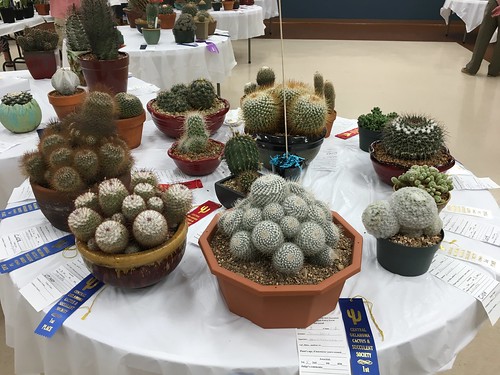
Some nice plants that received ribbons in the show area.

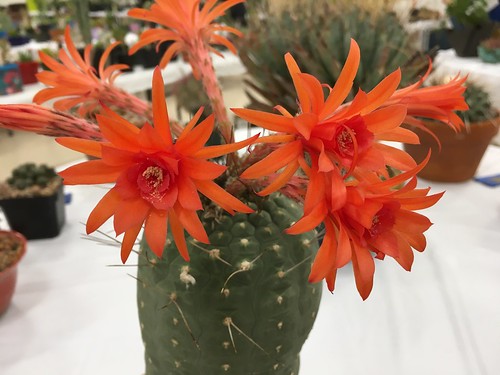
Matucana madisoniorum
Matucana madisoniorum - the most striking flowers at the show.
I only took a few photos of show and sale plants this year other than the ones I purchased.

Euphorbia neorubella (labeled as Monadenium rubellum)
Euphorbia neorubella
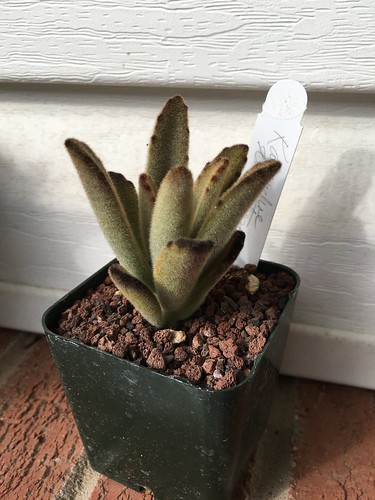
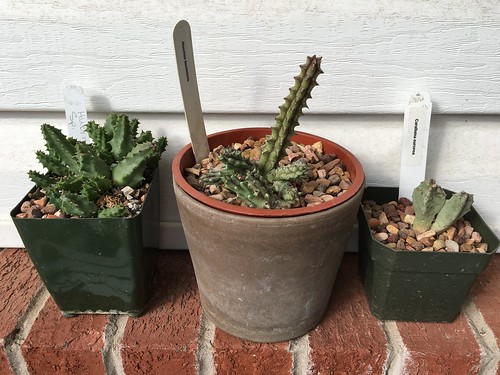
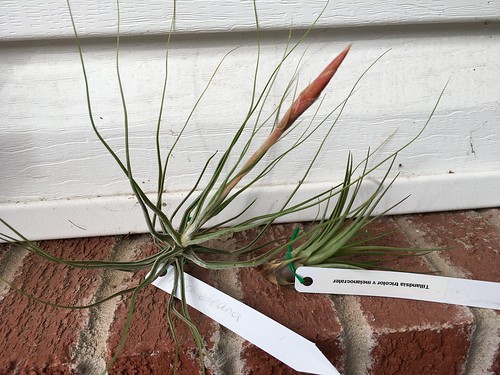
This year I purchased 7 plants: Kalanchoe tomentosa, an unlabeled Huernia species, Huernia keniensis, Caralluma europea, Opuntia violaceaTillandsia tricolor v. melanocrater, and Tillandsia schiedeana.

Kalanchoe tomentosa
Kalanchoe tomentosa

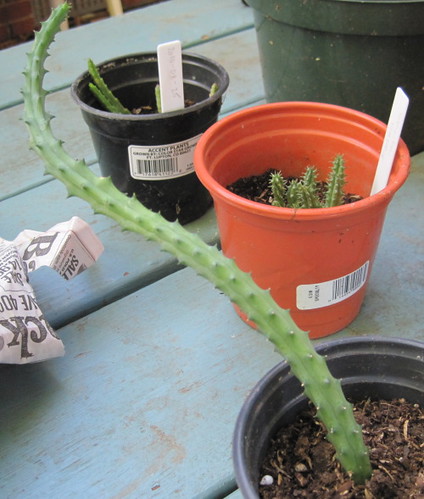
Huernia sp., Huernia keniensis, and Caralluma europea

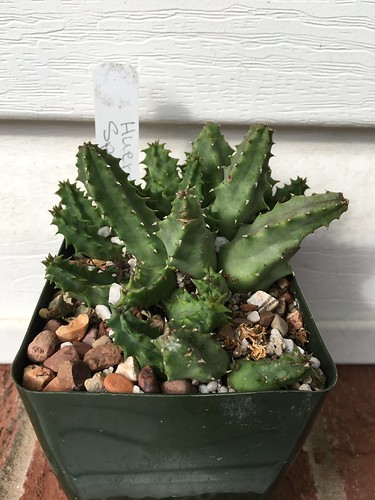
Huernia sp
The unidentified Huernia
Tillandsias aren't truly cacti or succulents, but the term "succulents" is already rather broad and is not taxonomically linked, like "cacti" is to the family Cactaceae.  I guess cacti and succulent people just like Tillandsias and brought some to sell.  I'm excited because one of them is on the verge of blooming.

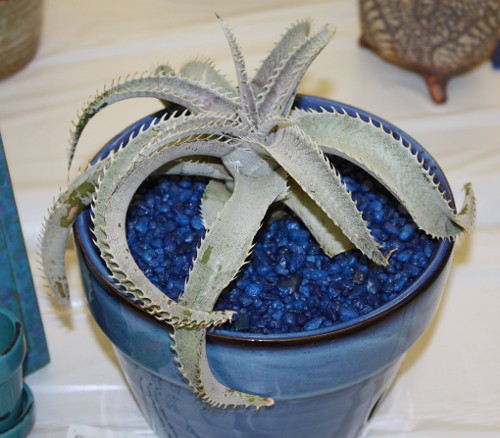
Tillandsia schiedeana and Tillandsia tricolor v. melanocrater
As I've mentioned before, my favorite succulents are the Stapeliads.  I have found that I can grow them pretty well, so I try to focus my money on those plants.  With my recent purchases my Stapeliad collection now includes 10 species:
  • Caralluma europea
  • Huernia sp (unknown species)
  • Huernia confusa
  • Huernia keniensis
  • Huernia penzigii
  • Huernia schneideriana
  • Stapelia ambigua
  • Stapelia flavopurpurea
  • Stapelia gigantea
  • Stapelia hirsuta
I've had some others in the past, but have lost some over the years.

Huernia penzigii
A recent bloom on my Huernia penzigii
A friend from northwest Arkansas came over for the show. I met him and his wife there and we exchanged a few plants and visited for a short time.  He brought me a neat Sinningia tubiflora, which was bred for hardiness in our region, as well as Kalanchoe beauverdii and Bryophyllum fedtschenkoi. Hopefully the Sinningia will flower for me soon and I'll share some photos.

Thursday, June 21, 2012

OKC Cactus and Succulent show

Before diving in, I must confess that cacti and succulents are not my passion. There are a couple of groups that interest me, like Stapelia and related genera. I decided to stop by the show and sale of the Central Oklahoma Cactus and Succulent Society last weekend because I figured it would be interesting to see, take photos and learn more about these plants.
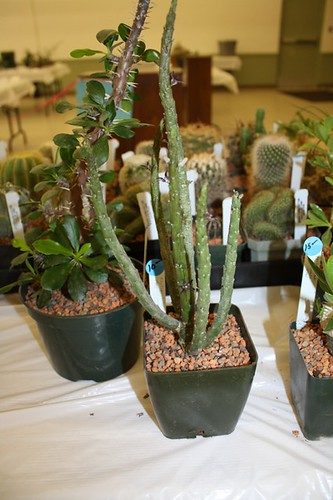
rhytidocaulon_macrolobum
Rhytidocaulon macrolobum
I was surprised to see more plants of interest to me than I had expected. The "show" plants were neat, but primarily plants that I enjoy looking at and that I don't have a great desire to grow myself. However, I found many plants on the vendor tables that were of interest to me. The first being the plant pictured above and below. Maybe you think it's ugly, but look at those awesome black flowers!
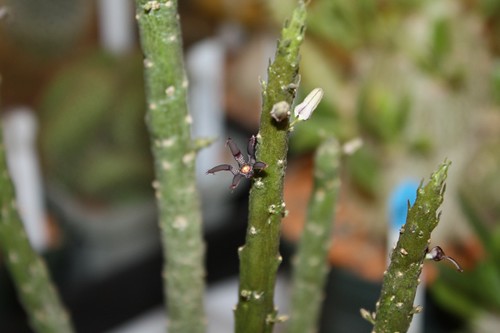
rhytidocaulon_macrolobum_flowers
Rhytidocaulon macrolobum
There were quite a few Pachypodium on display and for sale (sorry, no pictures). I had just been giving a tour at the Myriad Gardens on Saturday afternoon, where the Pachypodium are 10 feet tall!
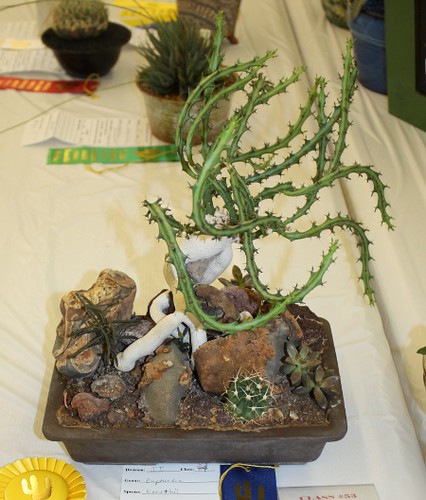
euphorbia_knuthii
Euphorbia knuthii
There were so many Euphorbia I couldn't count them. As I was telling my tour group, Euphorbia has to be the most diverse genus I know. If you read my old post on Euphorbia you would have seen everything from the Poinsettia to the dangerously spiny plants, like the one I purchased this weekend.
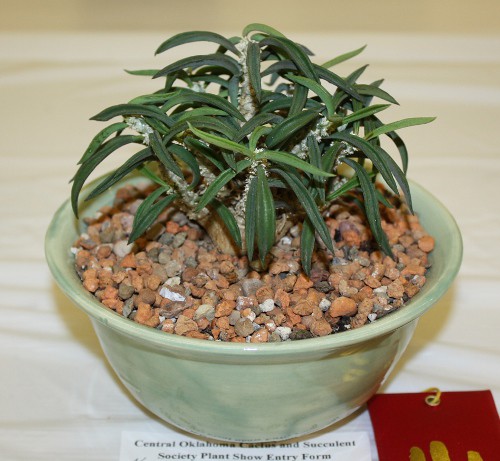
euphorbia_cylindrifolia
Euphorbia cylindrifolia
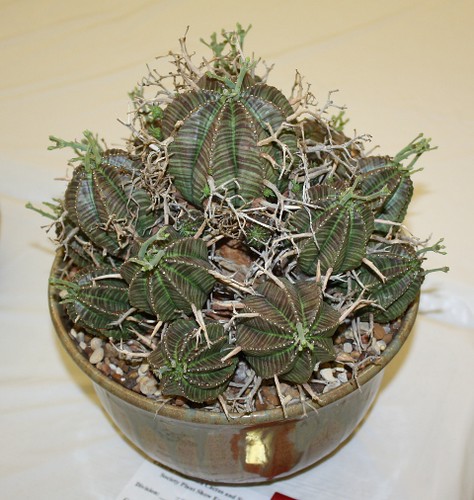
The Euphorbia pictured below has a growth habit more like Mamillaria (those spherical cacti with spines all over them).
euphorbia_valida
Euphorbia valida
dyckia_marneir-lapostollei
Dyckia marneir-lapostellei
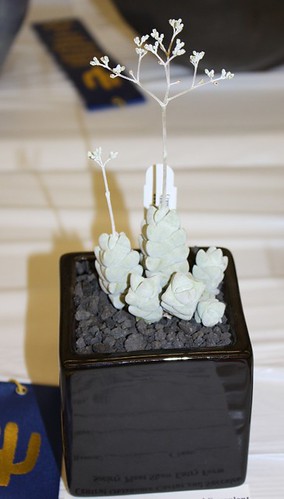
Check out the ghostly colors of the Dyckia and Crassula.
crassula_deceptor
Crassula deceptor
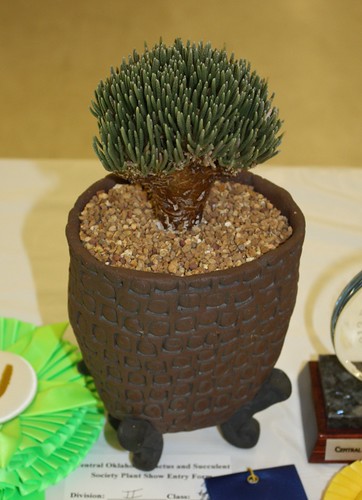
The little Avonia was quite adorable. It looks like a miniature and really doesn't look real.
avonia_quinaria_v_alstonii
Avonia quinaria v. alstonii
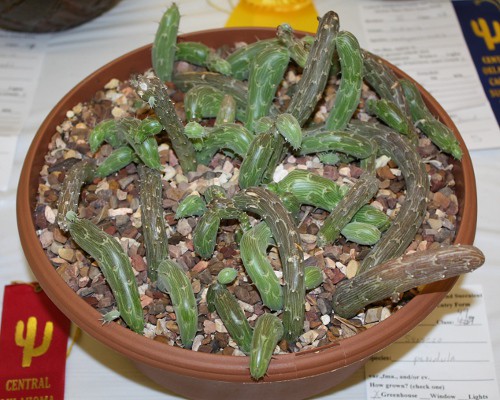
You have probably already seen my cucumber orchid. Now I see there is a cucumber succulent!
senecio_pendula
Senecio pendula


Sansevieria has quite a dedicated following. This show had two plants, one being the famous Sansevieria masoniana, with big floppy leaves. The other was more to my liking, Sansevieria scabrifolia.
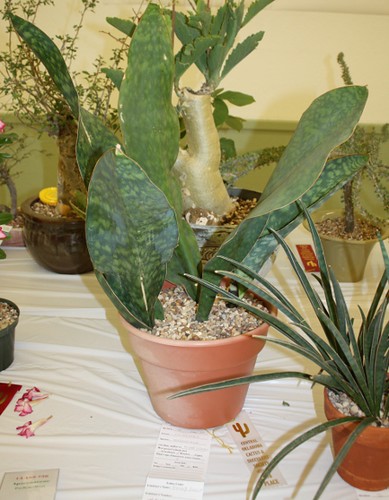
sans_masoniana_and_scabrifolia
Sansevieria masoniana 'Mason's Congo' and Sansevieria scabrifolia
Most of the plants I am showing won an award, but the cactus below won "Best Cactus." Check out that long fur hanging off of the pads.
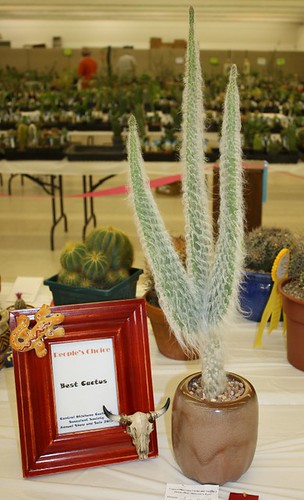
opuntia_tequiliana
Opuntia tequiliana - look at that fur!
The only Stapelia-like plant in the show was this Huernia. It was a really big plant that is supposedly just 3 years old. It must be a vigorous grower.
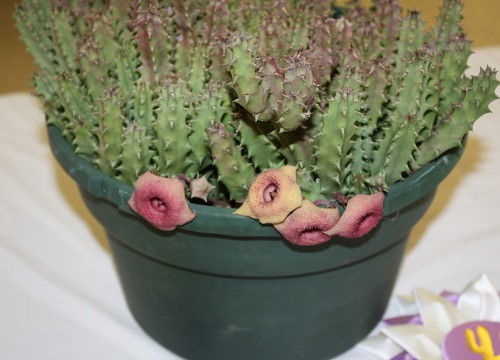
huernia_thuratii
Huernia thuratii
I ended up purchasing 4 plants, 1 of which was an orchid. I had been told by some friends that Eulophia petersii is easier to find at succulent shows than at orchid shows, since it likes to grow so dry. I was talking with a vendor at this show and he was telling me about how he once heard someone describing this plant as having "orchid-like flowers"...
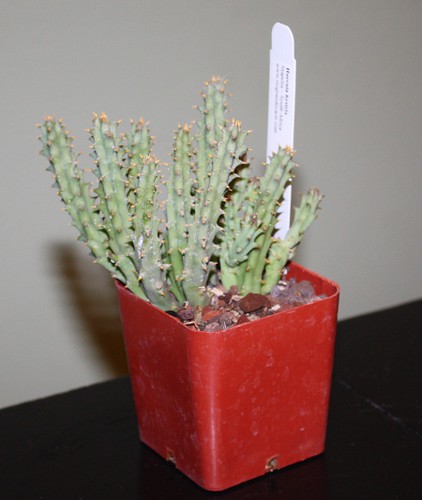
huernia_hystrix
Huernia hystrix
Two of the plants that I purchased are from my Stapeliae: Huernia hystrix and Stapelia hirsuta. The S. hirsuta is the one that gets really hairy flowers. It is also probably the species that is most similar to my Stapelia gigantea, which grows really well for me. So I feel confident I can get it to bloom eventually.
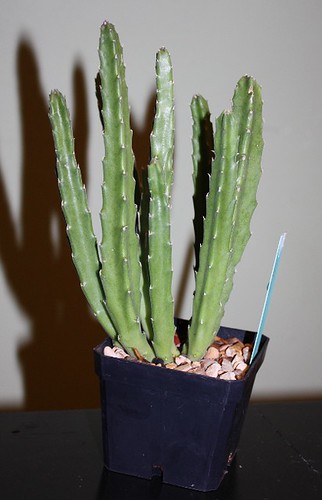
stapelia_hirsuta
Stapelia hirsuta
The last plant I purchased is the Euphorbia, which I mentioned earlier in this post. Dangerously spiney!
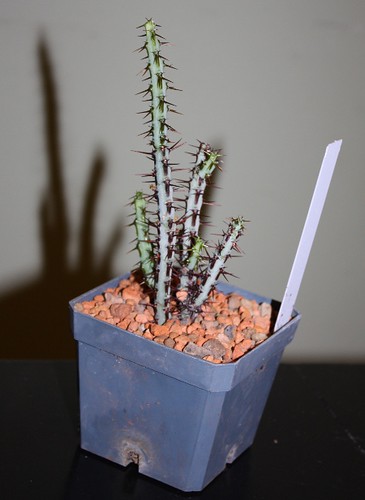
euphorbia_aeruginosa
Euphorbia aeruginosa
I don't plan to become a cacti and succulent addict, but I would like to go to this show again in the future. There were definitely some neat plants.
Friday, September 3, 2010

Plant Find: Stinky Succulents

Plants are very crafty when it comes to getting things done that they can't do on their own.  Without the mobility of many other living things on Earth, a single plant can manage to breed with plants miles away and then transport itself to a new location, via a seed which was carried by a bird or wafted away on a breeze.  But like I said, plants have to be pretty crafty to get all of this done.

In order to carry out the breeding, plants must intermingle their pollen.  Since they can't transport the pollen on their own, they have to attract some more mobile friends - like bees, flies, birds, moths and butterflies.  Many people are aware that brightly colored flowers are used for attracting some of these pollinators.  But some things that fly are not attracted so much to bright colors.  In fact, some flying things are attracted to some pretty disgusting things - like dung or dead bodies.  Don't think the plant kingdom has overlooked these flying things.  There is a nitch of plants which attract flies which feed on carrion by disguising their flowers with the perfume of a decaying body.  Lovely, huh?

In fact, there are several different families of plants that take advantage of these carrion-feeding pollinators.  One group is the Amorphophallus genus from the Aroid family.  Another is the Stapeliae tribe from the Apocynaceae family.  These plants have a pretty good following of people who collect from the genera Stapelia, Huernia, Caralluma, Tridentea and others.  Stapelia is kind of the shining star of the tribe, but I find Huernia to have some really neat species.
stapelia_gigantea
Stapelia gigantea after 4 months
I bought my first Stapelia (S. gigantea) back in April and it has been growing very rapidly this summer.

I bought 5 more plants over the last week from a couple of vendors on ebay.  Here they are!

huernia_aspera
Huernia aspera
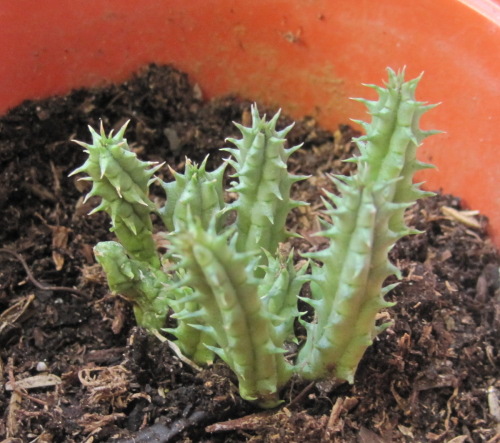
Huernia aspera is the largest plant I purchased.  The others are pretty tiny starts.  This plant has nice, deep red blooms that are shaped like stars, just like all plants in this tribe.  These blooms are often pendulous, facing down and looking like a bell in profile.

huernia_penzigii
Huernia penzigii
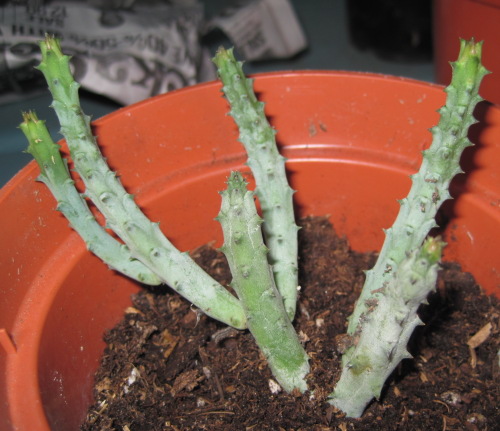
This is the most attractive plant while not blooming, with it's silvery stems.  I'm not sure about the blooms of this plant, as I've seen conflicting pictures online.  I guess I'll just have to wait and see!

huernia_longituba
Huernia longituba
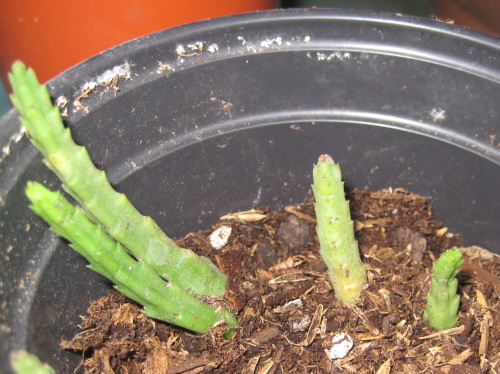
Huernia longituba has elongated blooms, as referenced in the species name.  The blooms have a base color of yellow with speckling of red on the inside.

stapelia_divaricata
Stapelia divaricata
Stapelia divaricata has very weird blooms that look like rubbery pale pink or yellow starfish.

stapelia_flavopurpurea
Stapelia flavopurpurea - with a flower bud.
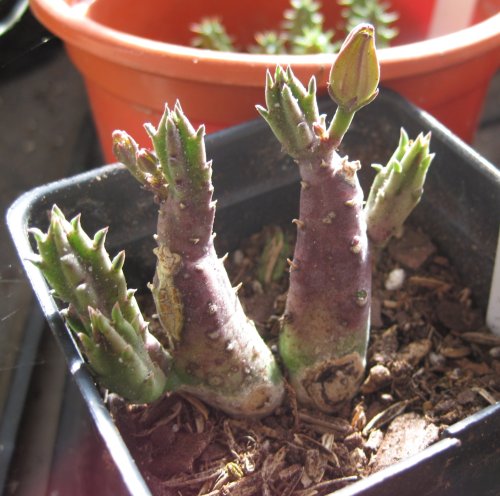
Stapelia flavopurpurea has really cool, petite blooms that almost have a touch of Passionflower-flare to them.  The plant I purchases has a bud on it.  I'm hoping it will open, but I wouldn't be totally surprised if it doesn't since it just went through a couple of days in a shipping box.

These plants are succulents primarily found in southern and eastern Africa, including some from Ethiopia!  They like to be pretty dry and they don't at all mind the heat we've been having lately.  With a little luck and a couple of seasons, I hope to be able to bring all of these to bloom.