Showing posts with label blooms. Show all posts

Wednesday, September 19, 2018

The Mighty Plumbago

I first became familiar with Plumbago (Plumbago auriculata) several years ago when we were planning our Galveston garden. This is a pretty popular garden plant in that area. It grows into a pretty big bush with time and will be covered in pale periwinkle blue flowers during much of the year (in warm climates).

Plumbago auriculata

We planted one in Galveston and it grew quite large - prior to the brutal winter, which killed it. We have since replaced that bush with a tiny starter, which I expect will take a year or two before it is dominating it's area of the flowerbed.

Plumbago auriculata
This has become my wife's favorite plant. A couple of years ago we ran across a Plumbago in a nice black square pot at a nursery in Oklahoma and decided to get one for our house, even though it's not hardy. We keep the plant in my greenhouse overwinter and it usually looks pretty rough in the spring when we pull it back outside, but it grows pretty quickly and flowers vigorously in the summer. It is putting on quite the show right now. Soon I will have to prune it back and squeeze it into my greenhouse for the cold winter months.

Wednesday, September 5, 2018

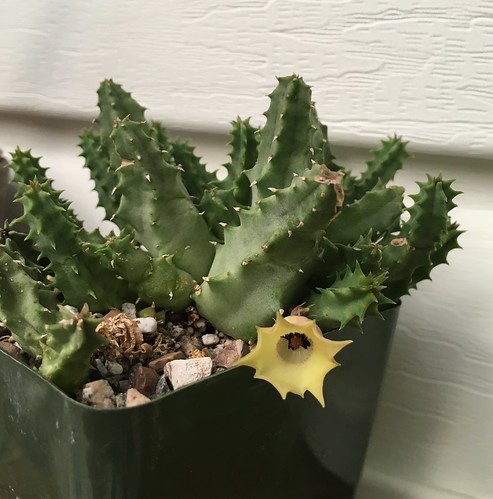
A couple Huernia blooms

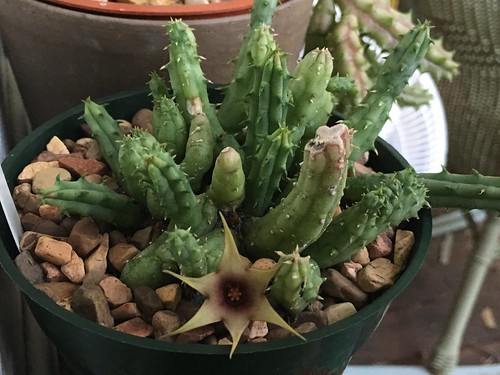
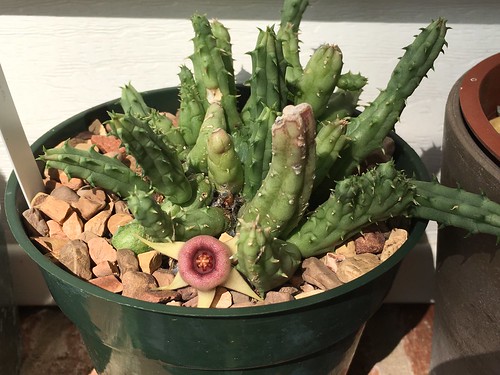
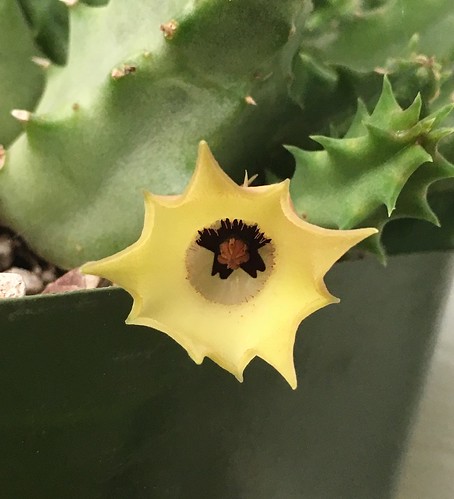
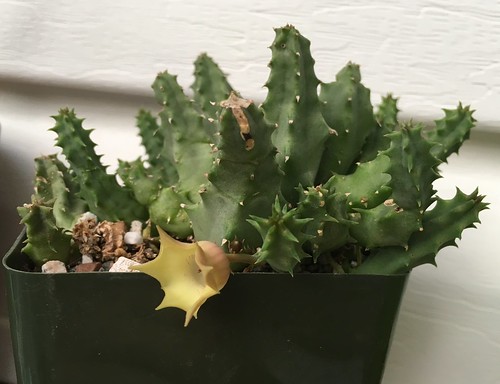
Without a doubt, Huernia is my favorite succulent genus. This genus is in the Stapeliaceae family, closely related to the common carrion flower/starfish plant, Stapelia gigantea. I have amassed a pretty good collection of these plants and always seek them out at the Central Oklahoma Cacti and Succulent Show. This year I purchased a new one that was labeled Huernia sp. The petals of the flower reflex after a day or two, resulting in a different appearance (shown in second photo).

It bloomed not long after the show and I was able to get some help identifying it as either Huernia procumbens or a hybrid of that species.

Huernia procumbens

Huernia procumbens

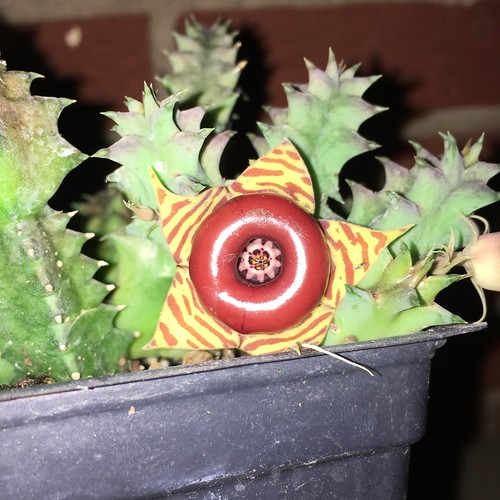
Another Huernia that I picked up recently is Huernia zebrina, which has very distinct yellow and red flowers. This plant is sometimes called the Lifesaver Plant, due to the red ring that forms in the center of the flower, similar to the plant above, but more pronounced and much more colorful. I was delighted when the first flower opened on my plant and have been pleasantly surprised to see this plant flower constantly all summer for me. There have been as many as 5 flowers open on the plant at one time.

Huernia zebrina

Monday, September 3, 2018

Year of Encyclia

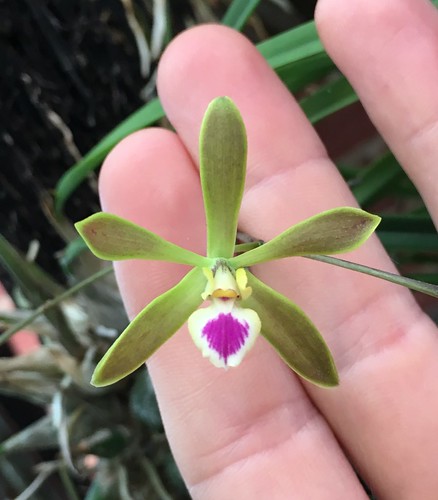
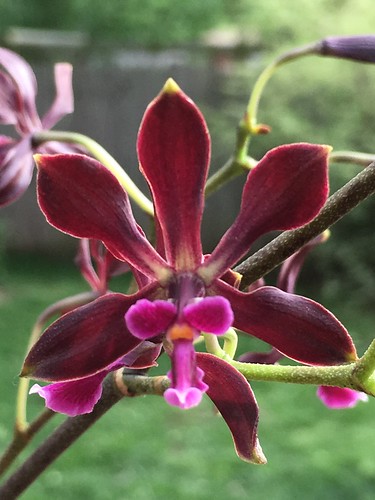
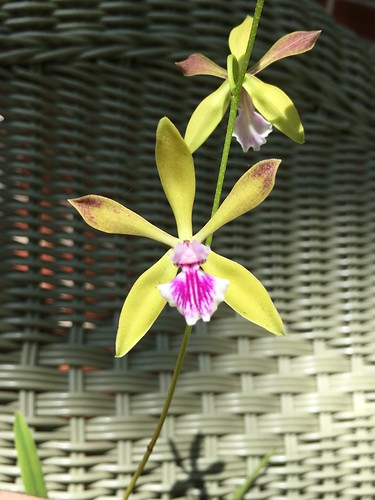
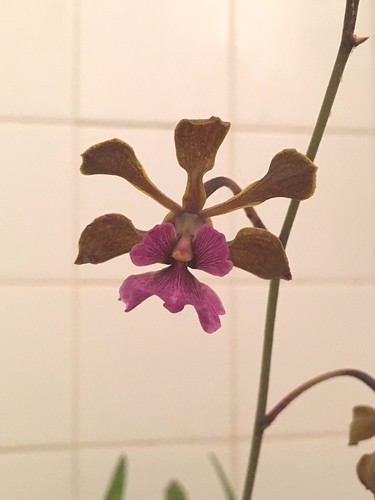
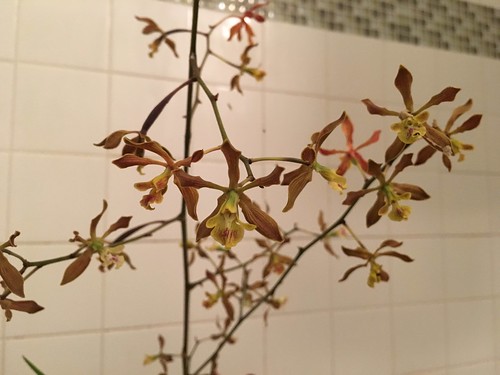
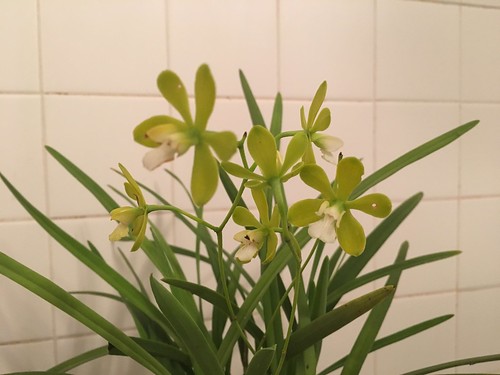
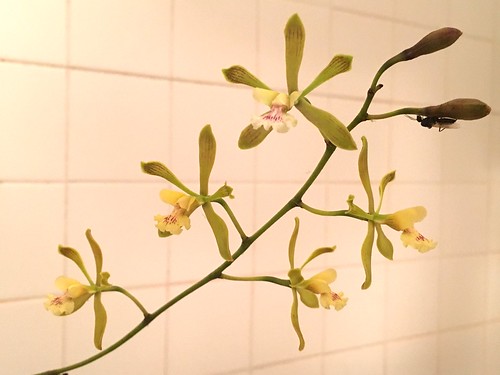
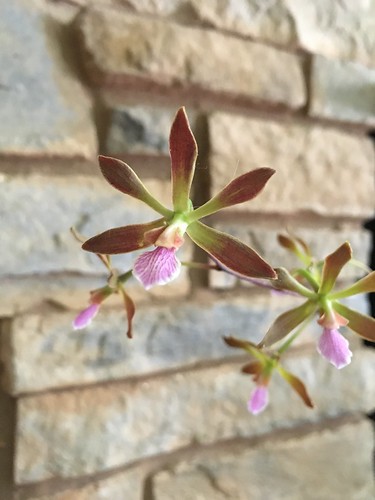
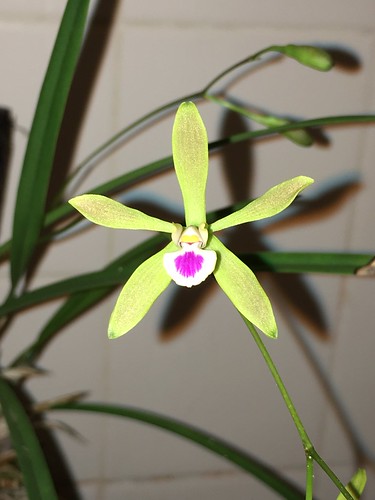
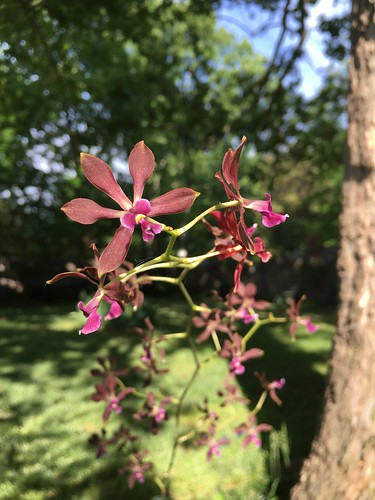
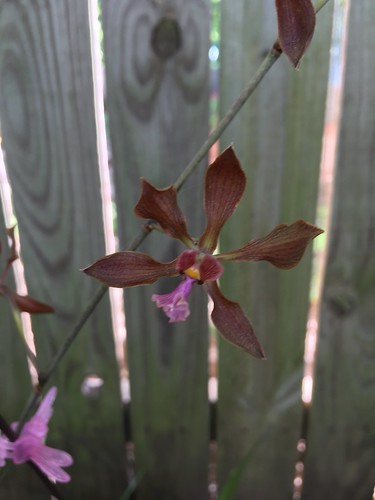
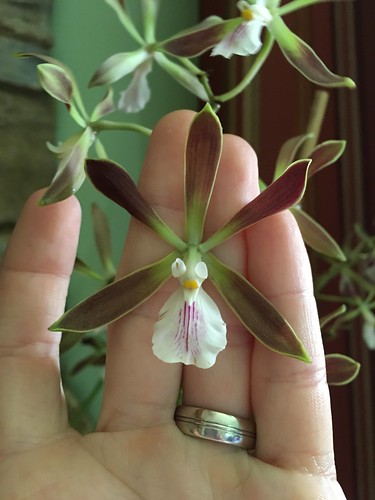
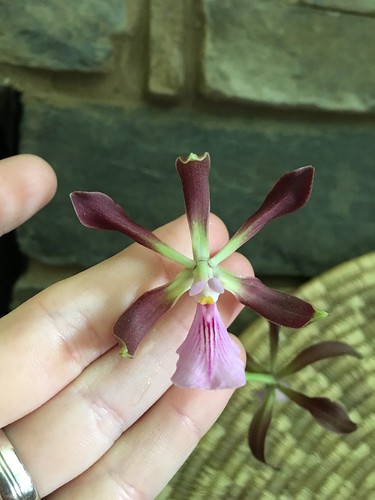
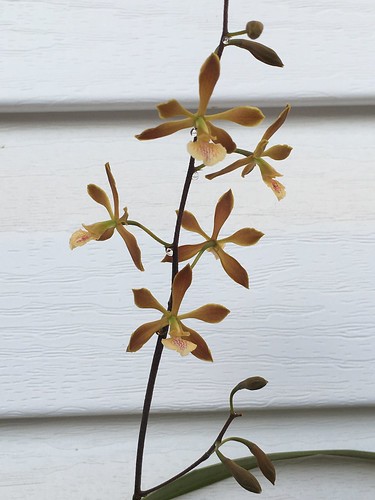
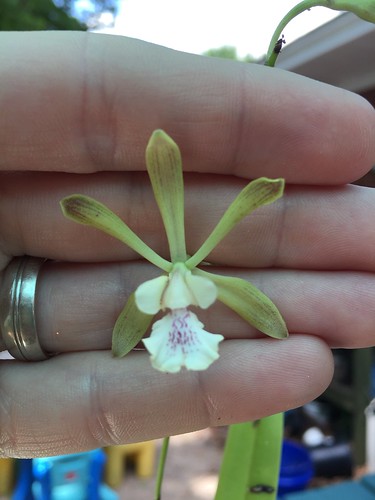
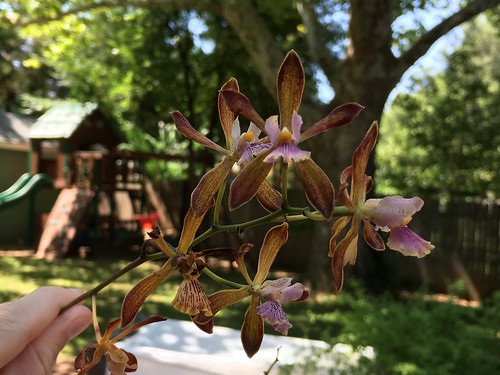
2018 has been a banner year for my Encyclia collection. I have never had so many species bloom before. I just wanted to post a bunch of photos of their beautiful flowers here together to share the variety.

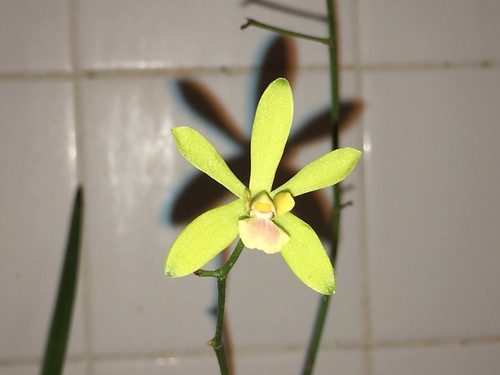
Encyclia Grand Bahama

Encyclia hanburyi

Encyclia ramonense

Encyclia unaensis

Encyclia tampensis v. alba

Encyclia sp. (from Belize)

Encyclia seidelii

Encyclia tampensis

Encyclia Faerie Glen

Encyclia atrorubens

Encyclia Gay Rabbit

Encyclia Gay Rabbit

Encyclia angustiloba

Encyclia belizensis

Encyclia Orchid Jungle


In all, I had at least 16 Encyclia plants bloom this year, as well as about 8 other orchids.
  • Encyclia alata (syn. belizensis)
  • Encyclia angustiloba
  • Encyclia atrorubens
  • Encyclia 'Belize 82'
  • Encyclia hanburyi
  • Encyclia phoenicea
  • Encyclia plicata
  • Encyclia ramonense
  • Encyclia seidelii
  • Encyclia tampensis
  • Encyclia tampensis v. alba
  • Encyclia unaensis
  • Encyclia Faerie Glen
  • Encyclia Gay Rabbit
  • Encyclia Grand Bahama
  • Encyclia Orchid Jungle

Wednesday, May 23, 2018

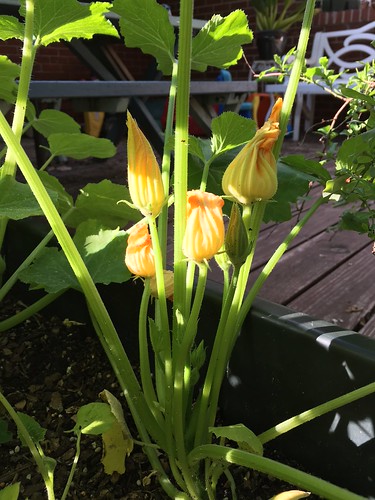
Squash in bloom

Invariably when I mention to someone that I have a greenhouse the next question is what kind of food plants I grow. People are always surprised to find that I grow tropical plants (mostly orchids and aroids) in my greenhouse.

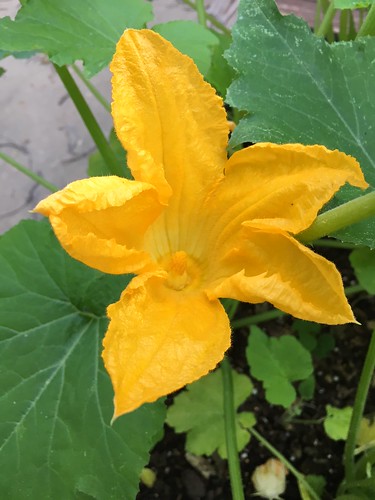
summer squash flowers
summer squash blooms

I have tried growing a few fruits and vegetables in the past, with limited success:
  • key lime - few fruits before the tree succumbed.
  • broccoli - my favorite vegetable, plants were destroyed by caterpillars before they flowered.
  • tomatoes - limited success.
  • squash - plants were either eaten by insects or withered in the sun before they flowered.
  • potatoes - actually a decent little harvest, especially considering the spot I picked was shadier than is ideal.
Much of our yard is shaded, which we love during the hot summer months, but there's not a great place to put in a garden. This year I decided to try some squash seeds in a planter box that I can move around to get the right level of sun. Also I figured the planter box is pretty similar to the raised beds that everyone is planting these days. Another change from my unsuccessful attempt with squash seeds last year: I decided to plant the seeds directly in the planter box, rather than starting them in a seed tray and then transplanting them. I started with two different varieties of yellow summer squash - the kind we really like to eat over the summer. I planted more seeds than recommended for the space, but figured I could thin them out if they got too crowded.

summer squash flowers
summer squash blooms

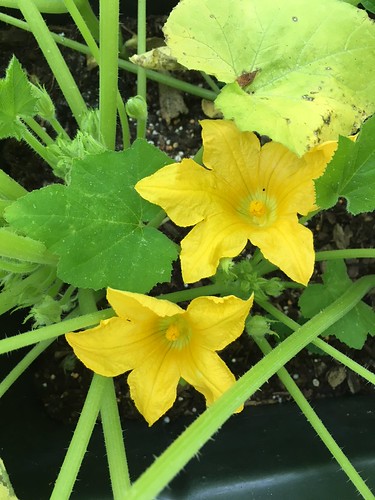
summer squash flowers
summer squash blooms
Things are going really well! The plants have been getting big and produced a bunch of buds over the last two weeks. The flowers just started opening over the weekend and I'm hopeful we'll have a bunch of squash a few weeks from now. I've been monitoring the plants closely for squash bugs and haven't seen one yet.

Thursday, May 17, 2018

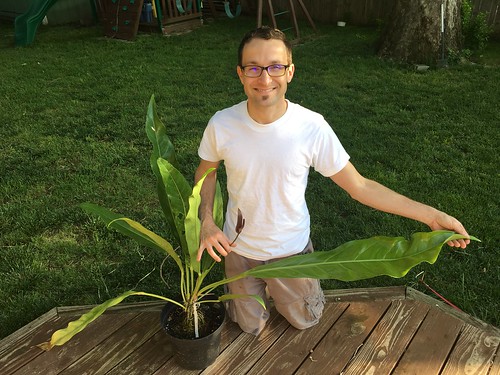
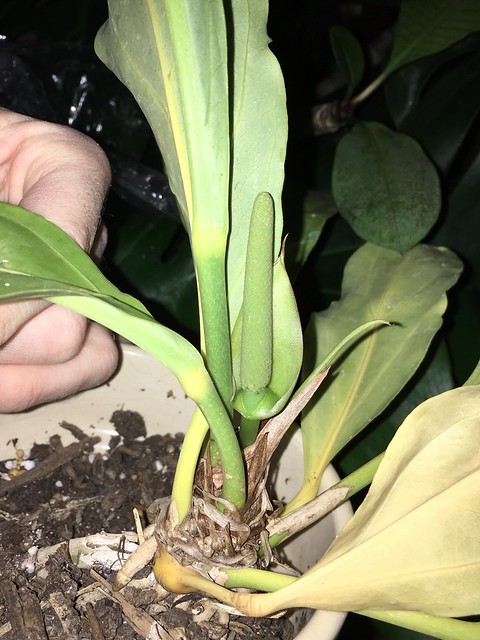
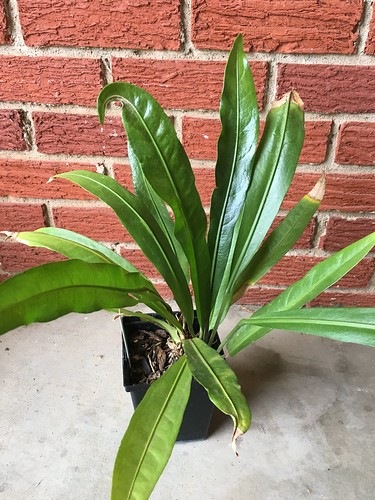
Anthurium llewelynii in bloom

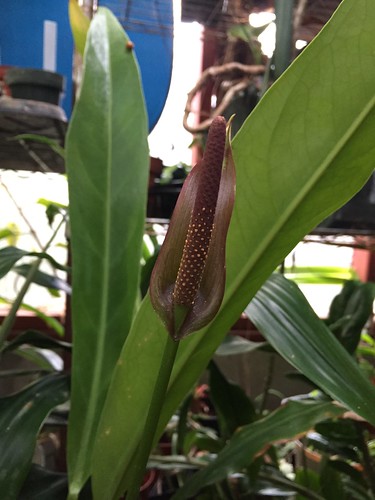
My Anthurium llewelynii is showing off, so I had to share. It has put out a really nice long leaf recently and also has a beautiful inflorescence right now.

Anthurium llewelynii
Nice, long leaf on my Anthurium llewelynii

This is the same plant that I repotted last summer and it seems to be enjoying it's new home.

Anthurium llewelynii
Inflorescence of Anthurium llewelynii

Monday, March 26, 2018

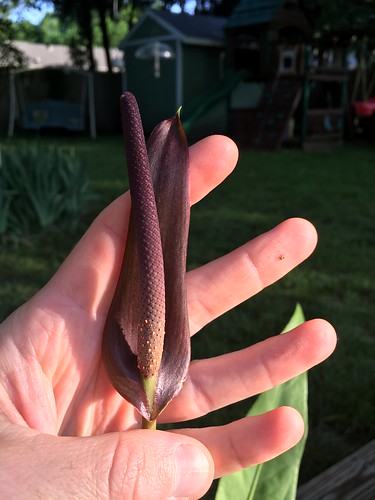
Anthurium plowmanii in bloom

I obtained my Anthurium plowmanii as a little seedling from a fellow International Aroid Society member back in 2010. It has grown slowly for me, but is a pretty healthy plant. I just noticed the first inflorescence, which is on a very short peduncle such that the bloom is mostly obscured by the leaves. (Peduncle is the term for the stem on which the inforescence grows.) I don't know if this is typical of the species or not.

Anthurium plowmanii

I have a few other Anthurium that are producing inflorescences right now, as well.

Monday, October 30, 2017

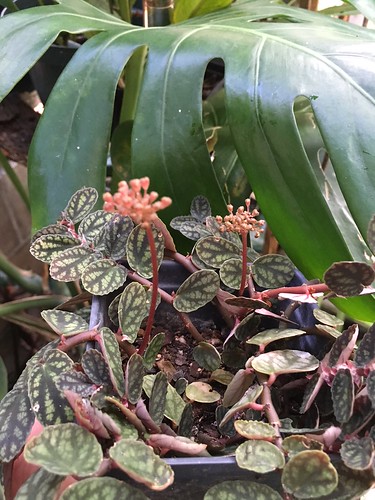
Pellionia in bloom

I have had two species of Pellionia in my collection for a long time, but don't remember seeing either of them bloom before.  The flowers are small and could be easily missed, so it's possible they had flown under my radar in the past.  Regardless, I was very happy to see these little flowers on my Pellionia pulchra plants recently.

Pellionia pulchra
Pellionia pulchra buds

Thursday, August 3, 2017

unidentified Huernia in bloom

[UPDATE 2017-09-15:  I have been informed that this plant is Huernia bayeri. ]

The unknown Huernia that I purchased at the cacti and succulent show and sale this year is now blooming.

Huernia sp.
Huernia sp.
Maybe this will help me identify the plant to species level.  The flowers are small bell-shaped pale yellow stars. 

Huernia sp.
Huernia sp.
I almost overlooked it when watering.  There is just one flower open so far, but there are a few more buds on the plant. 

Huernia sp.
Huernia sp.
I'm glad to see it is happy in my care.

Friday, July 28, 2017

Lycoris in bloom

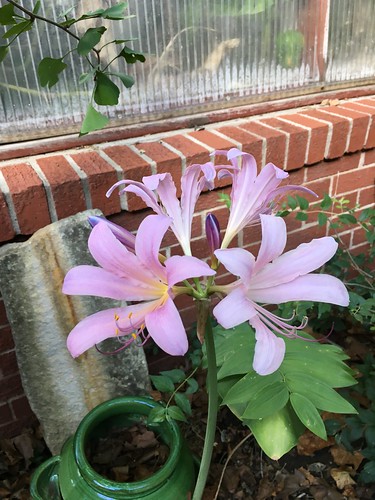
Years ago a friend and fellow plant blogger gave me some Naked Lady/Resurrection Lily (Lycoris squamigera) bulbs.  I planted some in a pot and some others in the ground.  They grew well for me for years and for the first couple of years I expected to see some blooms, but they never came.

I'd nearly forgotten there were some planted in the ground until I walked around the side of the house last week and saw this:

Lycoris squamigera
Lycoris squamigera
I don't know what spurred the flowering this year.  It's been pretty hot and dry lately and I wouldn't have thought July would be the time of year for these to bloom.  After a bit of googling I learned that August to September is the typical bloom season, so I guess late July is not far from the norm.  I look forward to seeing these bloom each year now.  Hopefully this was the first of many.

Monday, July 3, 2017

Anthurium inventory

I am following up my Encyclia inventory post with an inventory of another genus that comprises a decent portion of my plant collection.  This time it is an aroid genus, Anthurium, which happens to be the largest genus in the Aracaea (Aroid) family.  By "largest genus" I mean the genus with the most species.  I have had several Anthurium flower for me recently, so I have some nice photos to share.
Anthurium llewelynii
Anth. llewelynii

Anthurium bonplandii v guayanum
Anth. bonplandii v. guayanum

Anthurium acaule
Anth. acaule
While I love Aroids, and especially Anthurium, they don't all thrive under my care.  If I go a week (sometimes two) without venturing out to the greenhouse to water my plants - many of them take notice.  My Encyclia and some of my other plants don't mind these dry periods.  My Anthurium collection is not as big as it once was, primarily because there have been more periods of neglect in recent years and only the strong have survived. My collection of Anthurium currently includes 13 species and one hybrid.
Anthurium holmneilsenii
Anth. holmnielsenii

Anthurium paraguayense
Anth. paraguayense
Here is my complete inventory of Anthurium plants:
  • Anth. acaule *
  • Anth. bonplandii v. guayanum *
  • Anth. fornicifolium *
  • Anth. gracile *
  • Anth. holmnielsenii *
  • Anth. hookeri *
  • Anth. lezamai
  • Anth. llewelynii *
  • Anth. lucidum (or something else...)
  • Anth. paraguayense *
  • Anth. plowmanii
  • Anth. scandens *
  • Anth. scandens *
  • Anth. verapazense *
  • Anth. Marie
  • Anth. Marie
  • Anth. (unidentified seedling)
* indicates plants which have flowered for me

labeled Anthurium lucidum
Anthurium lucidum?
You'll notice that I'm not so sure my plant which is labeled Anthurium lucidum is actually that species.  I looked at the photographs on Tropicos and they look very different from my plant, so I'm not really sure what I have.

Anthurium fornicifolium inflorescence
Anth. fornicifolium

Anthurium Marie is a hybrid that Steve Nock developed and named after his wife.  I have had the pleasure of meeting both Steve and Marie at the IAS shows in Miami.  Steve and Marie own Ree Gardens and have been longtime members and supporters of the society.  They always have some really nice plants for sale at the shows.  The parentage of this hybrid has not been made public, as far as I am aware.  The plant has been widely tissue cultured and many of the plants develop inflorescences with two spadices and other oddities.

Anthurium gracile inflorescence
Anth. gracile
In addition, I have one unidentified seedling.  It is still pretty small and may be some time before it is large enough to flower and help me determine what it is.

Friday, June 30, 2017

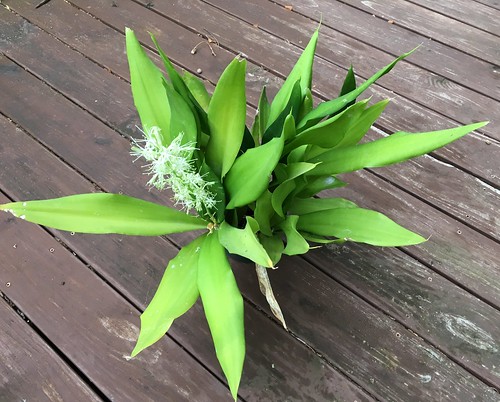
More Sansevieria blooms

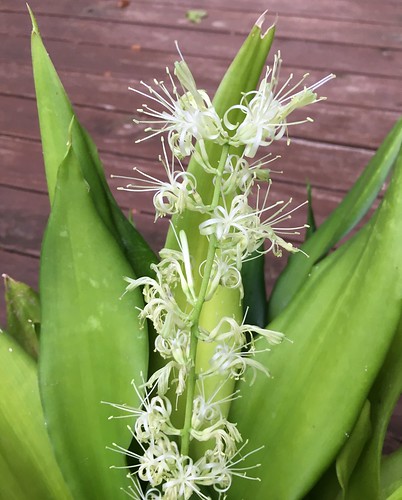
I don't have many Sansevieria in my collection. For some reason this was a banner year for the plants that I do have. I think I just have five plants and three of them have bloomed! I already wrote about one blooming in February. Then at the end of May I noticed that another of my Sansevieria was blooming. This one was purchased from Lowe's (I think) with a generic "Sansevieria" tag on it, so it is unlikely that it is a species. The flowers smell like ripe bananas.

Sansevieria
unlabeled Sansevieria

Sansevieria
unlabeled Sansevieria
At the same time I was pulling down that plant to take some photos of the flowers I realized that another of my Sansevieria was spiking. This last one was a plant I purchased at the Oklahoma Cacti and Succulent show last year, Sansevieria kirkii.

Sansevieria kirkii
Sansevieria kirkii

Sansevieria kirkii
Sansevieria kirkii
This species has incredibly thick and sturdy leaves. They could just about be used in a sword fight and stand up to the beating of a metal blade.

Sansevieria kirkii
Sansevieria kirkii flowers

Wednesday, June 28, 2017

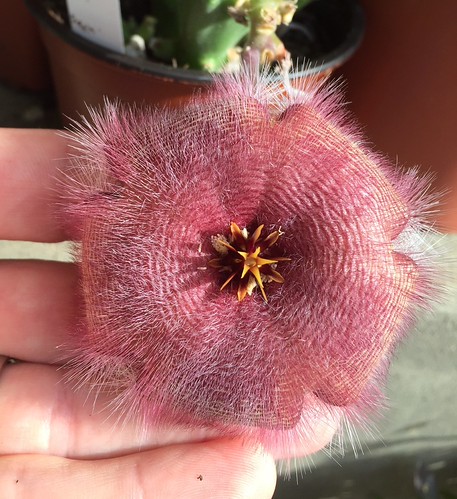
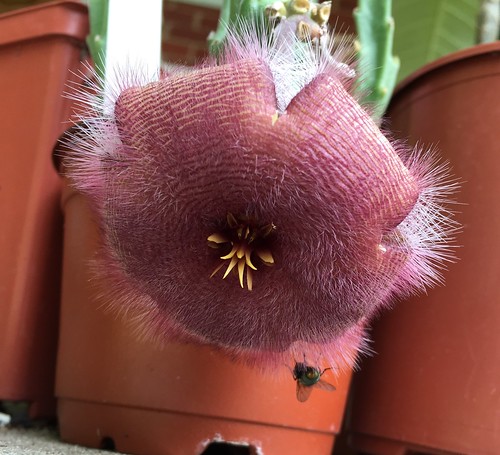
Stapelia hirsuta

My recent post about the cacti and succulent show had me looking back at my photos of my Stapeliads and I realized that I had never uploaded photos from when my Stapelia hirsuta bloomed last September.  It was a busy time of year, shortly after our son joined our family, and we were getting used to being responsible for two kiddos!

Stapelia hirsuta
Full plant in flower

Stapelia hirsuta
Check out all that hair

This species is very similar to Stapelia gigantean, which blooms for me regularly.  The plant itself is nearly identical when not in bloom.  The flowers of S. hirsuta are more red with yellow rather than yellow with red and they are also much hairier, hence the specific epithet "hirsuta" (hirsute = hairy).

Stapelia hirsuta
Petals have reflexed backwards

Stapelia hirsuta
This house fly thinks he has found some dead meat

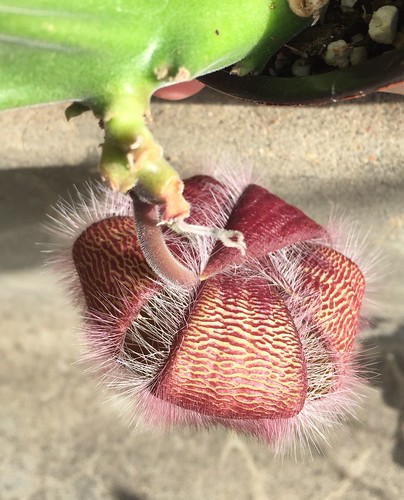
What struck me most about the flowers was how strongly the petals reflexed backwards when the flower opened.  I haven't noticed this with any other Stapelia species.

Stapelia hirsuta
A look at the reflexed petals from the backside of the flower

Monday, June 26, 2017

Encyclia inventory

Over time my collection of plants changes quite a bit. I buy new plants and other plants perish. At times I have tried to keep a comprehensive inventory, but my commitment to keep that inventory updated doesn't last and it gets to a point where it is so far behind I almost feel I need to start over.
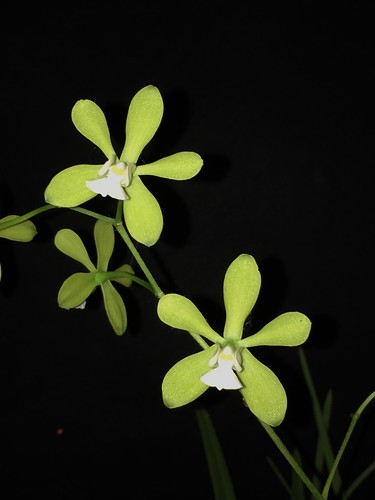
E. tampensis v. alba

Encyclia atrorubens?
E. atrorubens?
This plant is labeled as E. guatemalensis, but that is not a recognized species.

Encyclia tampensis
E. tampensis
This plant FINALLY bloomed this year after having been in my collection for almost 6 years.
You'll notice it looks very similar to the first plant pictured in this post, except the first plant is lacking the pink,
since it is the "alba" variety.
Recently I decided to inventory my plants in groups. I'm starting with my collection of Encyclia, which is probably the genus of which I have the most plants. It's fun to post this list now because a lot of them are blooming or bloomed recently.  It turns out I have more than 35 Encyclia plants, consisting of 22 species and10 known hybrids.  (I know, 22 and 10 do not add up to 35, but I have a couple of duplicates and a couple of unknowns.)

Complete inventory of Encyclia species:
  • E. angustiloba 
  • E. aspera
  • E. aspera
  • E. belizensis **
  • E. cordigera
  • E. fowliei x fowliei 'Duncan'
  • E. fucata
  • E. gracilis
  • E. guatemalensis * (may actually be E. atrorubens)
  • E. hanburyi 'Mem. Merlin Rigley'
  • E. kennedyi
  • E. moebusii
  • E. navanjapatensis
  • E. patens
  • E. phoenicea
  • E. plicata **
  • E. polybulbon
  • E. ramonense 'Dr Pepper' **
  • E. randii
  • E. seidelii *
  • E. tampensis *
  • E. tampensis v. alba **
  • E. unaensis
* indicates a species that has bloomed for me
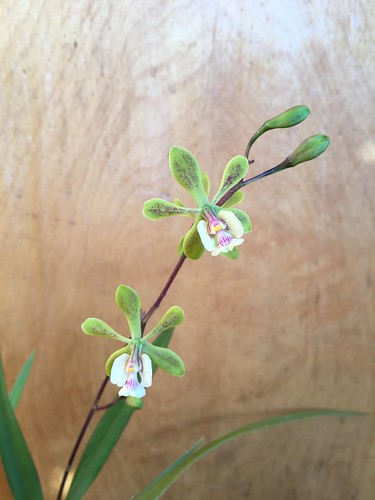
** indicates a species that blooms regularly for me

I'm not a complete species purist, but I do concentrate on collecting species.  Most of my hybrids are ones that I acquired in eBay auctions of multiple plants, and they were bundled with species I was interested in purchasing.  In all I have 12 hybrid orchids that include Encyclia among the parents or grandparents.

Complete inventory of Encyclia hybrids:
  • E. Faerie Glen (diota x mooreana) *
  • E. John Brunton (mooreana x tampensis)
  • E. phoenicea x tampensis
  • E. tampensis v. alba 'Mendenhall' x plicata 'Cherokee'
  • E. Cindy x dickinsoniana
  • E. Orchid Jungle (alata x phoenicea)
  • E. Gay Rabbit ([alata x cordigera] cordigera) *
  • E. (unidentified hybrid potted with Gay Rabbit) *
  • E. (unidentified, possibly Grand Bahama)
  • Epy. Mabel Kanda (E. cordigera x Epi. paniculatum) *
  • Epc. Siam Jade (C. Penny Kuroda x Epc. Vienna Woods)
  • Eplc. Pixie Charm (Lc. Pixie x E. alata)
* indicates a species that has bloomed for me

Epicyclia Mabel Kanda
Epy. Mabel Kanda
An intergeneric hybrid between Epidendrum and Encyclia.
I had to look up the correct abbreviation for this one in the RHS register.

Encyclia Faerie Glen (diota x mooreana)
E. Faerie Glen
This is a new plant that I just purchased at Santa Barbara Orchid Estate when I was in California in March.
The hybrids are a mix bag of primary hybrids (a pure species crossed with another species), multi-generation hybrids, and even intergeneric (plants from different genus being crossed) hybrids.  A lot of Encyclia are used in orchid hybridization, especially crossing with Cattleya, Laelia, and Epidendrum.  You'll notice that Mabel Kanda hybrid is a cross of an Encyclia and an Epidendrum, while Siam Jade is a second generation intergeneric hybrid - a Cattleya crossed with a hybrid of an Encyclia and a Cattleya.
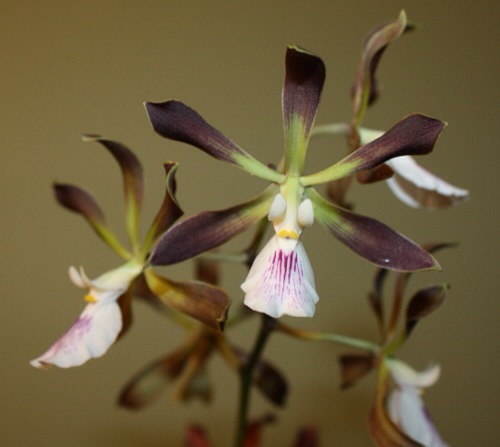
Encyclia Gay Rabbit (cordigera x Gail Nakagaki)
Unidentified Encyclia hybrid

The Encyclia above is a mystery because it is in a pot labeled Enc. Gay Rabbit. There are a lot of pseudobulbs in the pot and I have actually had two concurrent spikes with different flowers.  One set of flowers has a white lip with some dark pink streaking (as shown in the photo), while the other flowers have a solid pink lip.  I believe one is correctly labeled Gay Rabbit and the other (pictured above) may be something different.  It is also possible that both are the same hybrid from the same parents and they are just displaying some of the variation expected for this hybrid.
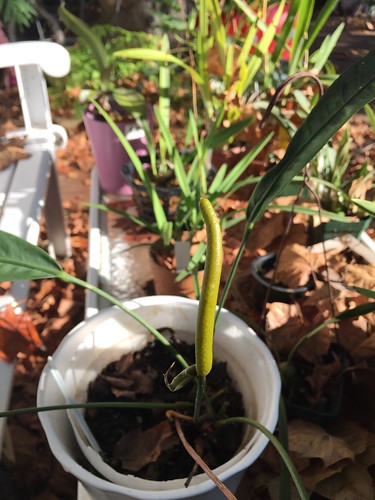
I have one other plant that is missing a label.  I am pretty certain it is an Encyclia species or hybrid, because the pseudobulbs and growth habit match and it is sitting with all of my other Encyclia.  Based on my past records, I think it may be E. Grand Bahama (tampensis x plicata).  I'm going to put that tentative label on it for now.