I have compiled a list of some of the velvetiest aroids there are. Not velvet Evlises, velvet aroids. When I speak of velvet aroids, the main criteria is the feel of the leaves. Some people describe a wide range of textures as being "velvety," while others notice small differences in the textures that make them more "satiny" or more like velour. The feel of the most velvety aroids is made possible due to tiny hairs which reside on the upper leaf surface. Botanically speaking, this is referred to as velutinous (velvety) adaxial (upper) surfaces.
Most of my blog posts include pictures of my own plants, or at least pictures that I
took while visiting some place with nice plants. This post is an exception. A majority of the pictures are being used, with permission, from various friends in the International Aroid Society. Many of these are from Enid Offolter, of NSE Tropicals. (By the way, Enid probably has the best selection of these plants available for sale.) Since I don't own many of these plants, I have to rely on other people's pictures and descriptions for classifying them as velvety or something similar. Which brings me to the secondary criteria for being on my velvet aroids list - which is appearance. Most (but not all) of these plants have an iridescence when you look at the leaves, due to their velvetiness. It is very prominent on some plants. Sometimes this feature doesn't always show up well in photographs, but there are quite a few photographs where you can see this.
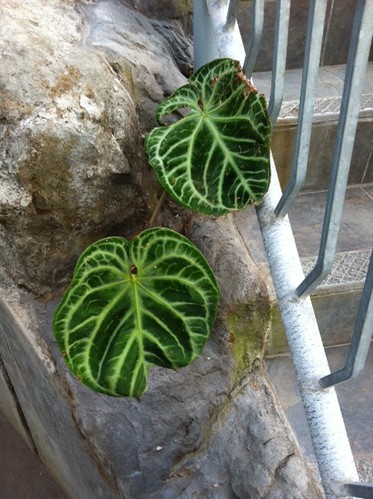 |
| Unknown velvet Anthurium at the Myriad Gardens in Oklahoma City |
I decided that I would concentrate on two genera only for this post -
Anthurium and
Philodendron. There are certainly other aroids with velvety textures, although I do believe the most velvety aroids are from these two genera. I have mentioned others at the end, but I know that when I depart from these two genera, I have no chance of being comprehensive, especially with the gazillion cultivars of
Colocasia and
Caladium, which are somewhat velvety.
I should also mention that some of these plants change texture with maturity. For instance,
Philodendron hederaceum is quite velvety in juvenile form, but eventually becomes glossy. Other species only attain the velvety texture when they reach maturity. Many times it is difficult to tell the differences in these different species, hybrids and cultivars, especially when you are switching back and forth between different websites. It is a little easier to compare them here, with them all pictured together. That was part of my impetus for writing this post. In some cases, seeing their pictures side by side makes you wonder how they are different species! (see
Anthurium crystallinum and
Anthurium clarinervium) But there are distinct differences as you train your eye and begin to look at other parts of the plant, beyond the shape and colors of the leaves. Enid Offolter has some expertise and tells me that the cross section of the petioles (3, 4 or 5 sided) can tell you a lot about these two plants and the various hybrids. There is a really good discussion (with photos) about identifying the differences between
Anthurium angamarcanum and
Anthurium marmoratum here.
And now, on to the list...
Velvet Anthuriums
Anthurium angamarcanum
If you clicked on that link above, you have already seen some photos of individual leaves of
Anthurium angamarcanum, but below you can see a mature plant in all its glory. Beautiful.
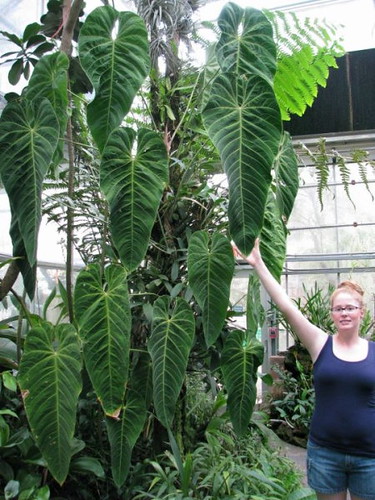 |
| Anthurium angamarcanum at the Atlanta Botanical Garden - photo courtesy Brian Williams |
Anthurium besseae
I am not really familiar with this plant and haven't heard of anyone growing it in cultivation. I only found a couple of
websites with information on this plant. Since one of them is
Tropicos, I know that it is a valid species.
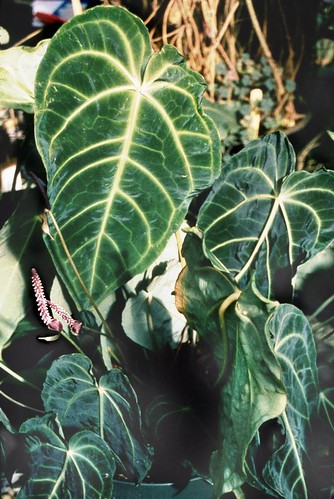 |
| Anthurium besseae - photo courtesy Dr. Thomas Croat |
Anthurium clarinervium
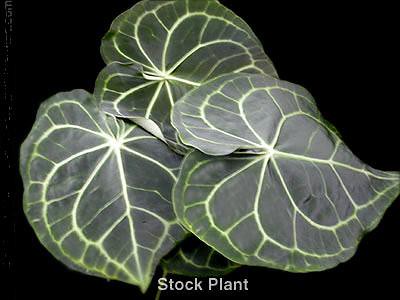
This species is very hard for me to separate from
Anthurium crystallinum (lower down in the post). So, how do I know which one is which? Well, here's my method. If the veins on the leaves are so vibrantly white/gold that they are
burning your retinas... that's
clarinervium. (Did you click that link? I did warn you.) If the veins are vibrant but your retinas aren't in pain, more likely
crystallinum.
Anthurium clarinervium - photo courtesy Enid Offolter
Anthurium UNKNOWN
This
Anthurium has special leaves. They look like the skin of an elephant in their rough texture. At the same time, they look soft. See what I mean? There is a plant in the Alocasia genus with similar looking leaves, but they are very stiff and not velvety. That plant is
Alocasia 'Maharani.'
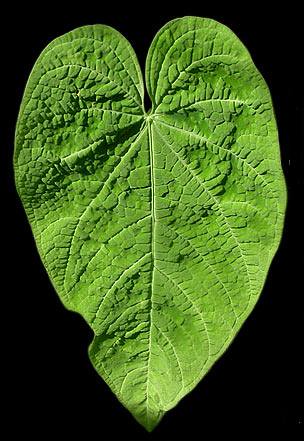 |
| Anthurium UNKNOWN- photo courtesy Enid Offolter |
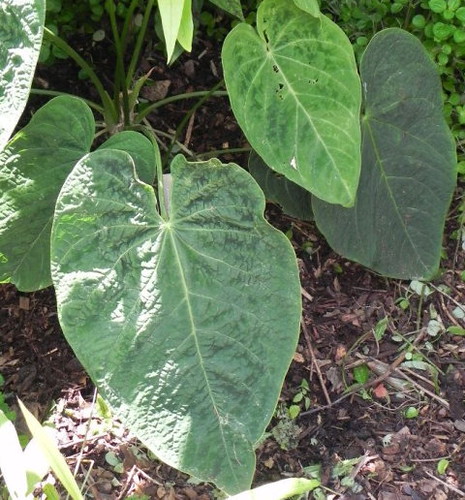 |
| Anthurium UNKNOWN - photo courtesy Taylor Holzer |
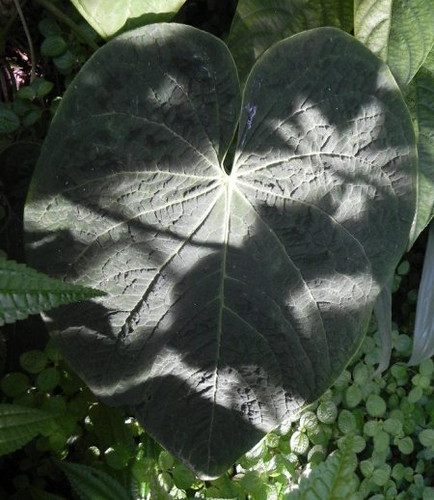 |
| Anthurium UNKNOWN (darker leaf) - photo courtesy Taylor Holzer |
Anthurium crystallinum
This is one of the few velvet plants that I own. I just bought it at the IAS show and sale in Miami last September. It is still a small plant, but it will one day be a huge and beautiful specimen (if I can keep it alive and happy). It definitely does not loose it's velvetiness with maturity. In fact, this is probably one of those plants which becomes more velvety with age.
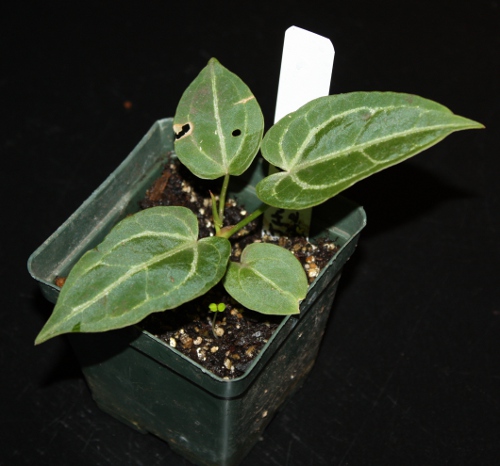 |
| My little Anthurium crystallinum |
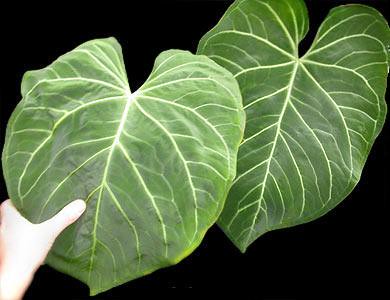 |
| Anthurium crystallinum - photo courtesy Enid Offolter |
Sometimes this plant produces leaves with a closed sinus. The sinus is the upper opening on the heart-shape. A picture of
Anthurium crystallinum with a closed sinus is shown on the Exotic Rainforest website,
here.
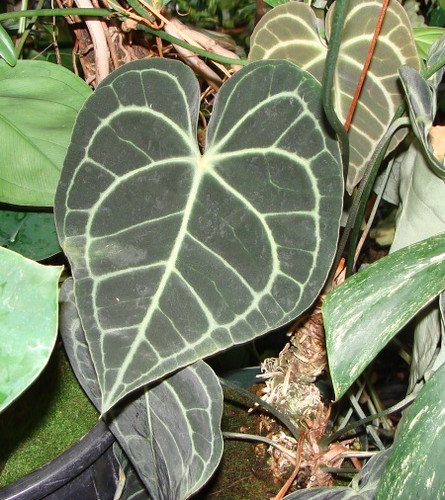 |
| Anthurium crystallinum - photo courtesy Christopher Rogers |
Anthurium 'Mehani'
As far as I understand, this plant is a cultivar of the species
Anthurium crystallinum. That just means that there were some desirable traits of a certain plant and it was propagated (probably cloned via tissue culture) so that all of the offspring would have the same traits. It is usually just labeled
Anthurium 'Mehani', but should really be labeled
Anthurium crystallinum 'Mehani.'
3.jpg "Anthurium 'Mehani' - photo courtesy mr_subjunctive") |
| Anthurium 'Mehani' - photo courtesy mr_subjunctive |
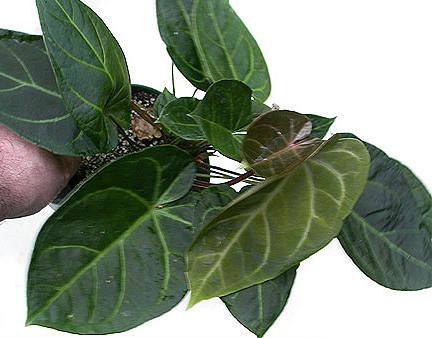 |
| Anthurium 'Mehani' - photo courtesy Enid Offolter |
Anthurium forgetii
This plant is very uncommon in cultivation, but I did find a couple of nice photos.
 |
| Anthurium forgetii - photo courtesy David Scherberich |
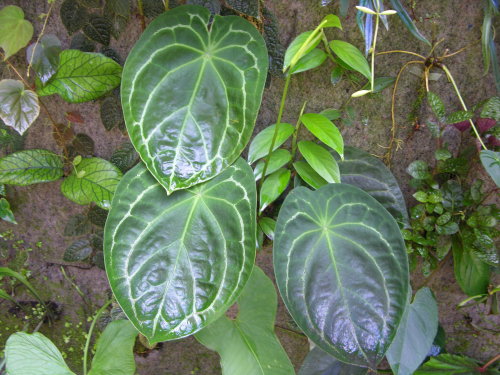 |
| Anthurium forgetii - photo courtesy Enid Offolter |
Anthurium hoffmannii
This is not a common plant in cultivation and it looks very similar to some of the other velvet
Anthuriums. I am told this one is more of a satiny texture.
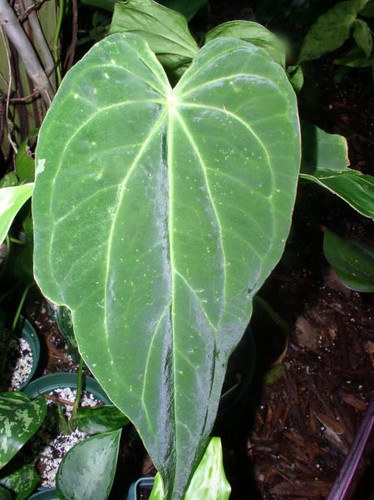 |
| Anthurium hoffmannii - photo courtesy Russ Hammer |
Anthurium leuconeurum
According to Deni Brown's book "Aroids: plants of the Arum family", this might not be a species, but a naturally occurring hybrid. For the time being it is given species status. Here are a couple of links with some information on this plant:
World Field Guide,
Araceum.
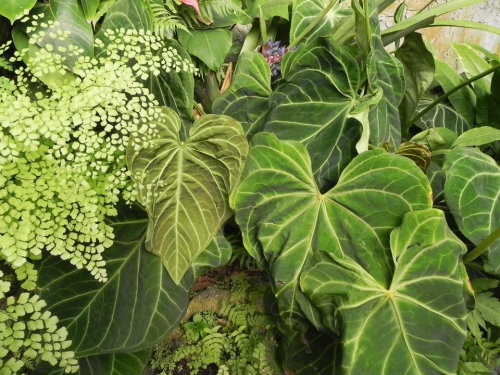 |
| Anthurium leuconeurum - photo courtesy Taylor Holzer |
Anthurium magnificum
This is one of those plants that is a little more satiny than velvety, I am told.
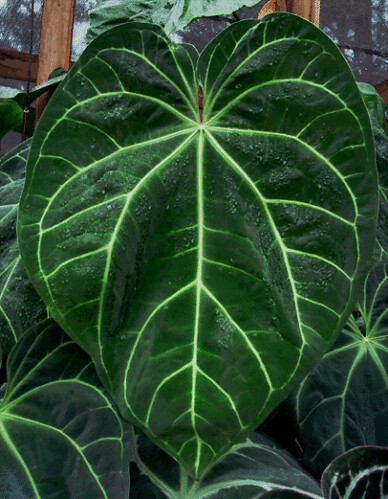 |
| Anthurium magnificum - photo courtesy Enid Offolter |
Anthurium marmoratum
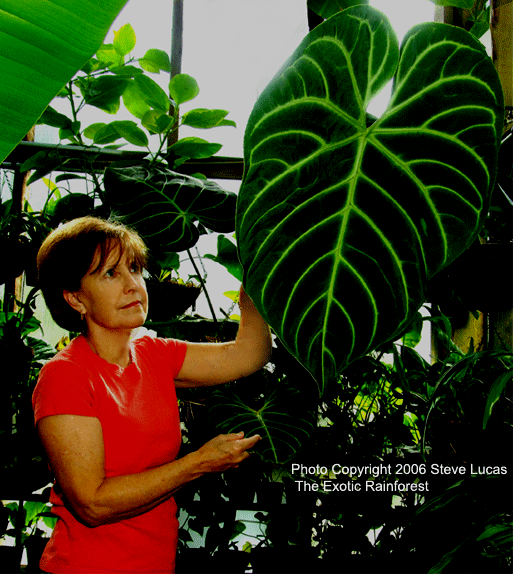
This
Anthurium has large leaves whose leaves are strongly iridescent.
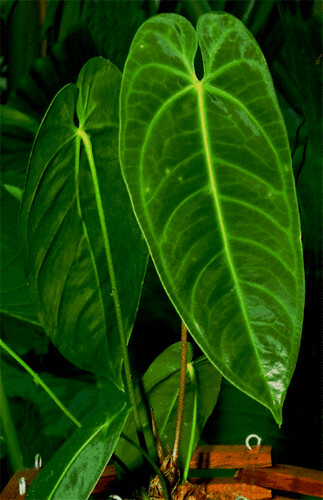 |
| Anthurium marmoratum - photo courtesy Steve Lucas |
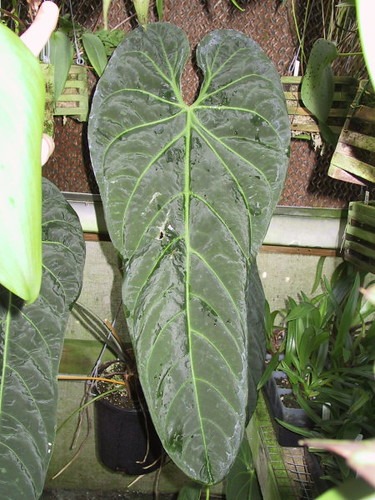 |
| Anthurium marmoratum - photo courtesy Ron Kaufmann |
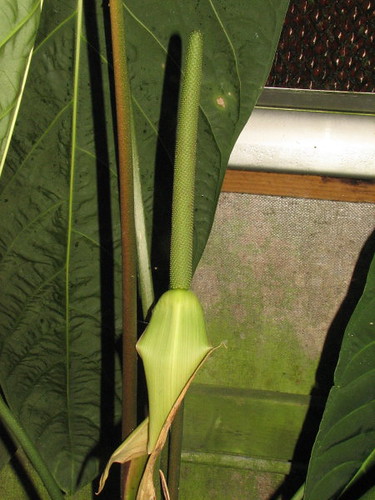 |
| Anthurium marmoratum with inflorescence - photo courtesy Ron Kaufmann |
Anthurium pallidiflorum
This is a strap-leaf, pendent
Anthurium, with satiny iridescent leaves. I have a small seedling of this plant, but it's nothing to look at yet. Here's an
excellent picture, and another
here.
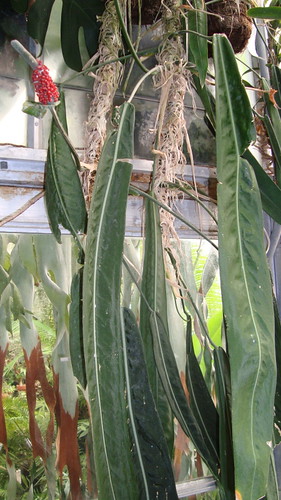 |
| Anthurium pallidiflorum - photo courtesy Christopher Rogers |
Anthurium papillilaminum
This plant blows me away. Check out those dark leaves with such an interesting shape. Very cool.
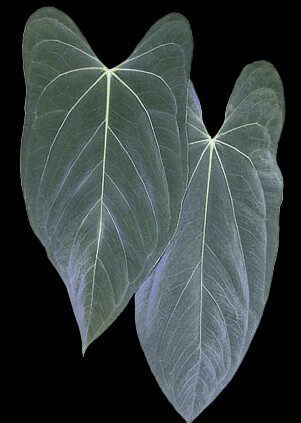 |
| Anthurium papillilaminum - photo courtesy of Enid Offolter |
Anthurium portilloi
This is one of those plants that might be better described as satiny, as opposed to velvety. It certainly looks that way from the picture.
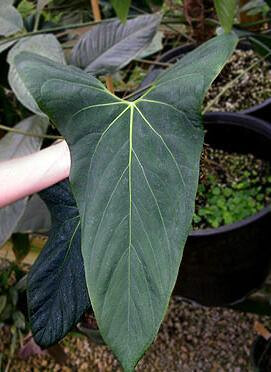 |
| Anthurium portilloi - photo courtesy of Enid Offolter |
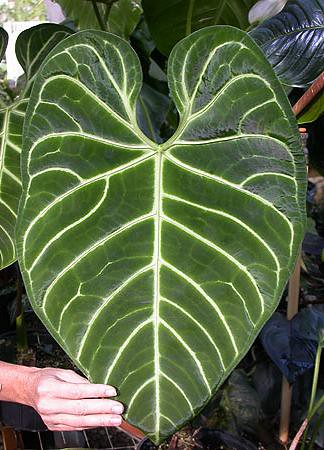
Anthurium regale
This is one of the more common velvet
Anthuriums in cultivation (not that any of them are really common). It looks very similar to
A. crystallinum, A. clarinervium and
A. magnificum. The main difference in appearance, that I notice, is that the sinus of
A. regale is considerably wider than any of the others. One of
Steve Lucas's photos has been immortalized on the latest International Aroid Society promotional brochures.
 |
| Anthurium regale - photo courtesy Enid Offolter |
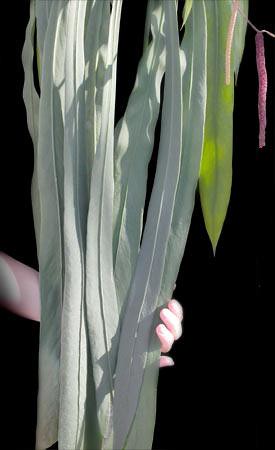
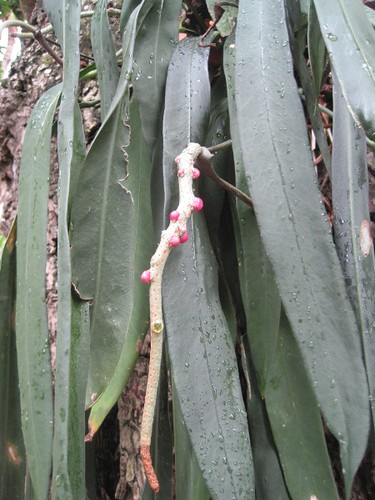
Anthurium vittariifolium
This is another of the strap-leaf, pendent
Anthuriums. It has satiny leaves of a silver-blue-green color. There are also some really nice pictures of strap-leaved
Anthuriums at the Palm Talk forum
here.
 |
| Anthurium vittariifolium - photo courtesy Enid Offolter |
 |
| Anthurium vittariifolium at the Audubon House, Key West, Florida |
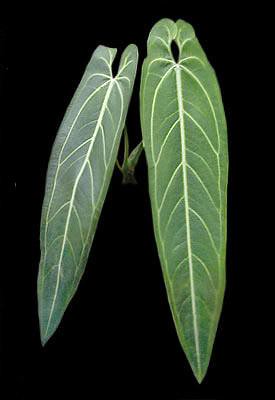
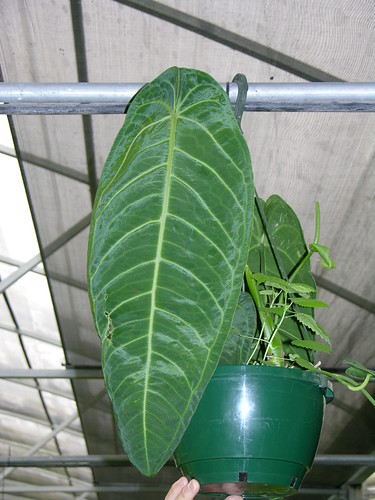
Anthurium warocqueanum
This beautiful
Anthurium is known for it's long and slender leaves with velvet texture. It has been given the common name "Queen Anthurium", while
Anthurium veitchii is known as the "King Anthurium." While both of these plants have long, slender leaves, the King Anthurium has a slick, glossy texture to the dark leaves.
 |
| The Queen Anthurium - Anthurium warocqueanum - photo courtesy Enid Offolter |
 |
| Anthurium warocqueanum (wide leaf variety) - photo courtesy Enid Offolter |
Anthurium 'Ace of Spades'
This plant is presumed to be a hybrid, but the parentage is unknown. The hybrid is believed to have originated in Hawaii and that's about all we know. The most prominent characteristic is the bronze/red leaves, which you can see in each of the following images.
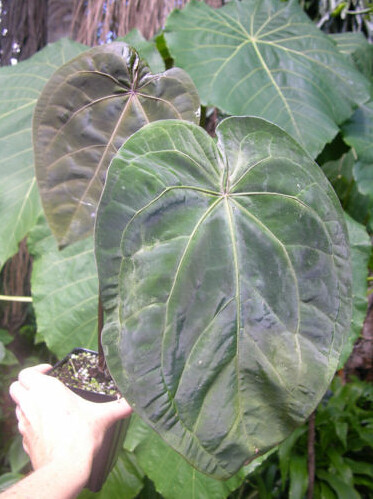 |
| Anthurium 'Ace of Spades' - photo courtesy Enid Offolter |
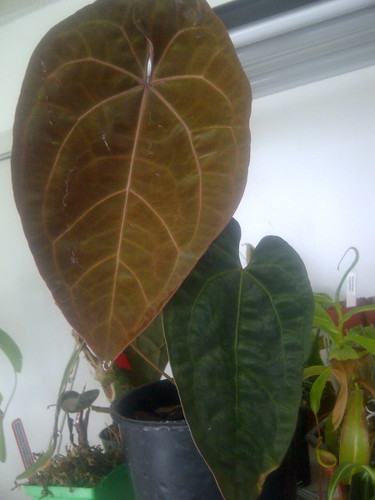 |
| Anthurium 'Ace of Spades' - photo courtesy Leslie Rule |
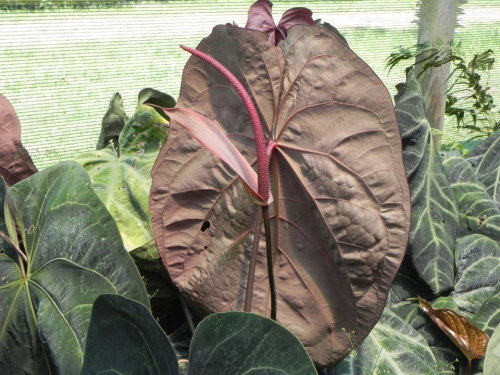 |
| Anthurium 'Ace of Spades' with inflorescence - photo courtesy Taylor Holzer |
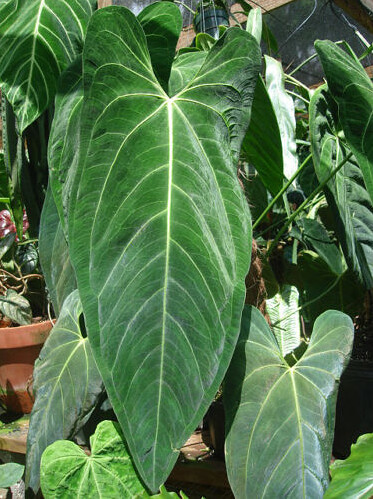
Anthurium 'Dark Mama' (Anth. warocqueanum x. Anth. papillilaminum)
This hybrid is the offspring of a set of velvety
Anthuriums, resulting in a really unique leaf shape and great, dark color. Look at the iridescence showing up on that lower right leaf. Beautiful.
 |
| Anthurium 'Dark Mama' (A. warocqueanum x. A. papillilaminum) - photo courtesy of Enid Offolter |
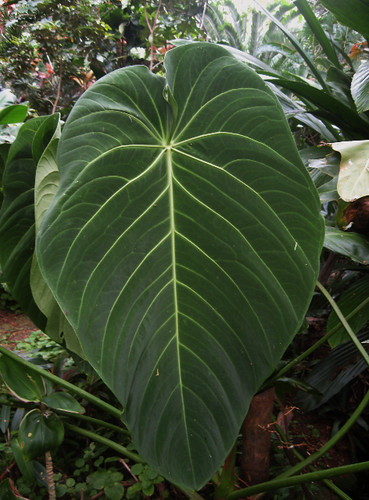
Anthurium 'Kybutzii'
This plant is of unknown origin. It might be a species or it could be a naturally occurring hybrid. It has large, satiny leaves and what appears to be raised primary veins on the adaxial (upper) leaf surface.
 |
| Anthurium 'Kybutzii' - photo courtesy Leland Miyano |
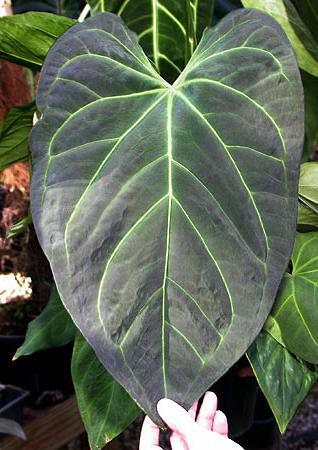
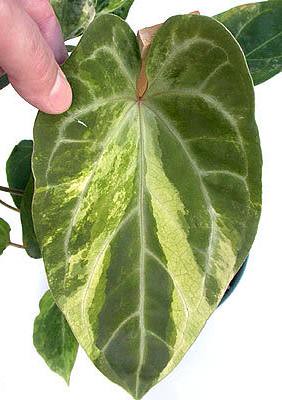
Anthurium 'Nikki'
This is another
Anthurium hybrid of unknown parentage. It came from a notable grower in India.
 |
| Anthurium 'Nikki' - photo courtesy Enid Offolter |
 |
| Anthurium 'Nikki' variegated - photo courtesy Enid Offolter |
Anthurium hybrid (Anth. magnificum x. Anth. crystallinum)
Of all the pictures in this post, I think this one is the most striking. This is quite a unique hybrid. The most recent plant sold for $52.50 on eBay!
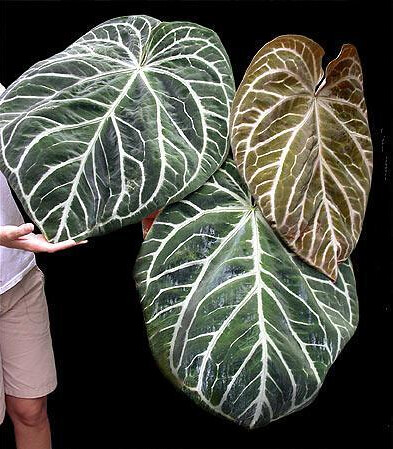 |
| Anthurium hybrid (A. magnificum x. A. crystallinum) - photo courtesy of Enid Offolter |
Velvet Philodendrons
Philodendron andreanum
This species name is most likely a synonym for
Philodendron melanochrysum, which is included farther down in this post.
Philodendron camposportoanum - lost with maturity
As a juvenile plant, this
Philodendron looks much like the common
Philodendron hederaceum, except that it is a bit lighter. With a little maturity (and something to climb), the leaves start to change shape, from cordate (heart-shaped) to something much more interesting. Soon the satiny sheen to the leaves will be gone. Personally, I like the adolescent phase of these leaves, as pictured below.
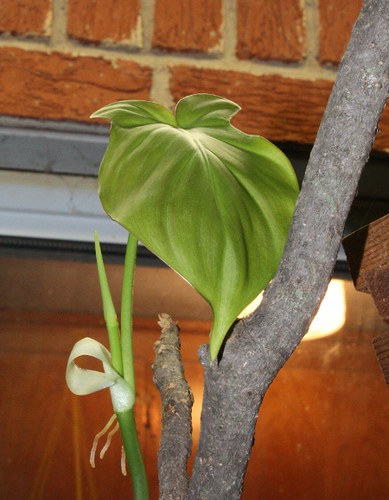 |
| Philodendron camposportoanum, climbing a natural structure in my greenhouse. |
Philodendron gigas
As a young plant, it is hard to know the potential of this plant, since it looks nearly identical to
Philodendron hederaceum 'Micans.' However, this plant can get huge leaves, when given an opportunity to climb.
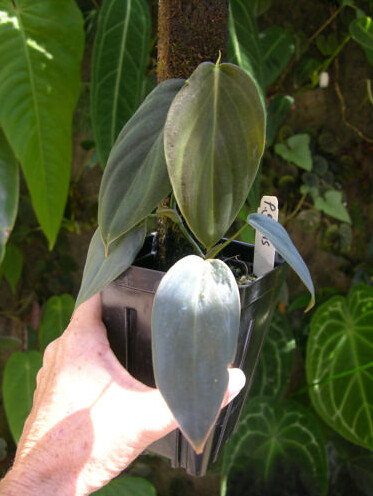 |
| Philodendron gigas juvenile plant - photo courtesy Enid Offolter |
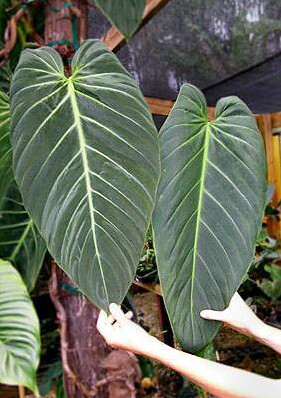 |
| Philodendron gigas mature plant - photo courtesy Enid Offolter |
Philodendron gloriosum
I purchased my
Philodendron gloriosum at the IAS show this year, so I haven't had it long. But I am told that it is one of the easiest houseplant
Philodendrons, not needing much light and really liking it's feet wet.
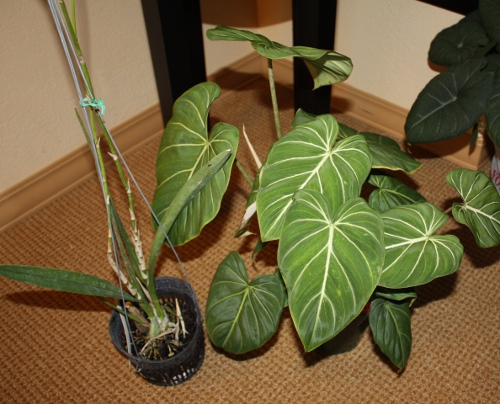 |
| My Philodendron gloriosum (center) |
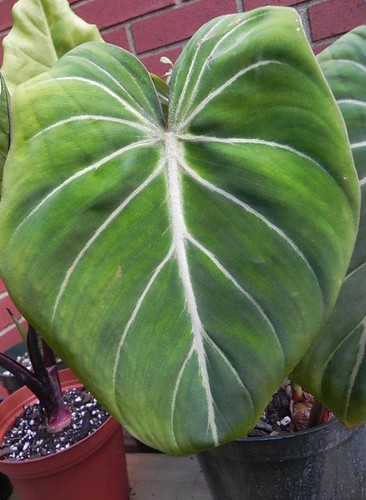 |
| Philodendron gloriosum - photo courtesy Taylor Holzer |
Caldwell Nursery has a really nice hybrid of
Philodendron gloriosum x Philodendron ventricosum shown below.
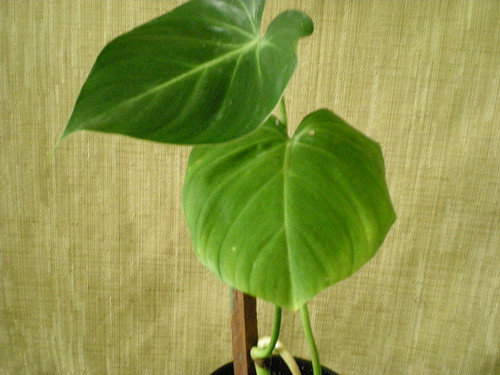 |
| Philodendron gloriosum x ventricosum - photo courtesy Caldwell Nursery |
Philodendron hederaceum
If given something to climb, this plant will begin to produce larger, more mature leaves. These leaves lose their velvety texture and become slick surfaced. There are several cultivars of this plant, including 'Micans' (pictured below) and 'Miduhoi.' My 'Micans' is growing on my desk at work and is a beautiful, large plant, that keeps trying to climb the partition of my cubicle.
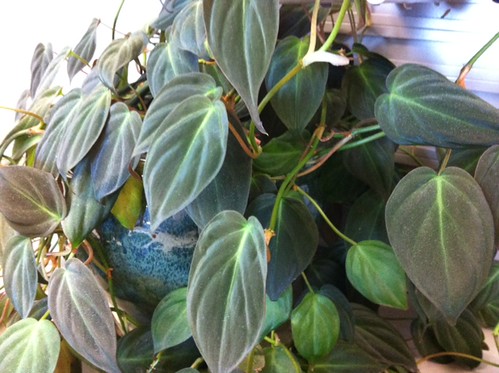 |
| Philodendron hederaceum 'Micans' |
Philodendron melanochrysum
Based on the pictures I have of this plant, I would guess that the extreme velvetiness of the juvenile plants fades a bit with maturity to more of a satin sheen on larger plants. This is one of my favorites. It is like a giant version of
Philodendron hederaceum 'Micans'.
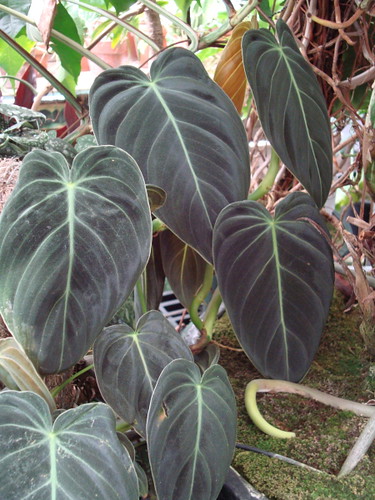 |
| Philodendron melanochrysum |
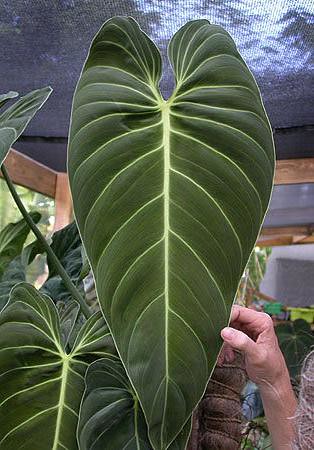 |
| Philodendron melanochrysum - photo courtesy Enid Offolter |
Philodendron ornatum
Caldwell Nursery has this plant for sale and their picture makes the plant look like it has a very similar texture to
Philodenron hederaceum, as a juvenile. There are pictures of a mature plant on the
IAS website which shows this species loses of it's velvety texture and iridescence.
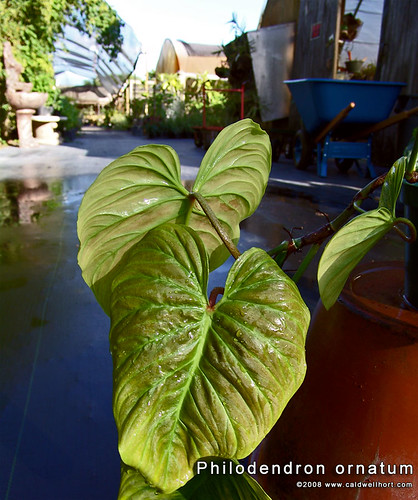 |
| Philodendron ornatum - photo courtesy Caldwell Nursery |
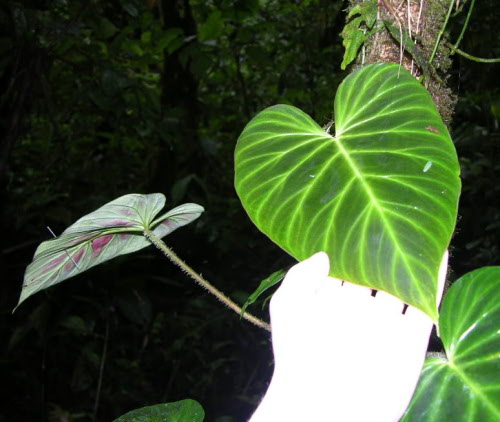
Philodendron UNKNOWN
This plant is native to Ecuador. The photos below are from a friend who lives there and has photographed it in nature. This species looks very similar to
Philodendron verrucosum to me.
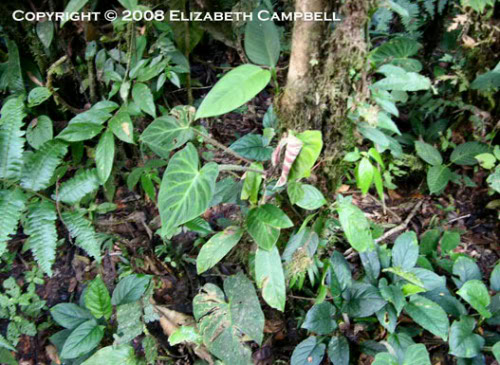 |
| Philodendron UNKNOWN - photo courtesy Elizabeth Campbell |
 |
| Philodendron UNKNOWN - photo courtesy Elizabeth Campbell |
Philodendron ventricosum
This species is endangered, due to the loss of habitat where it grows in Ecuador. I guess this explains, at least partly, why I could only find one picture of this plant. I did find some other pictures of hybrids where this plant is crossed with
Philodendron gloriosum.
|
| Philodendron ventricosum - photo courtesy flickr member Nature's Assets |
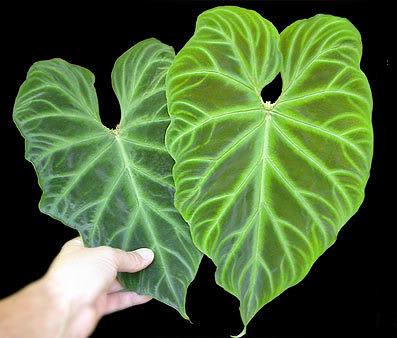
Philodendron verrucosum
This one is especially unique because of the petioles (leaf stems) which are very hairy. The only other Philodendron I know with such conspicuously furry petioles would be
Philodendron squamiferum. But this one has the added bonus of red and green velvet leaves. How can you not love this plant? Sometimes it is crossed with
Philodendron melanochrysum to form another neat velvety
Philodendron.
 |
| Philodendron verrucosum - photo courtesy Enid Offolter |
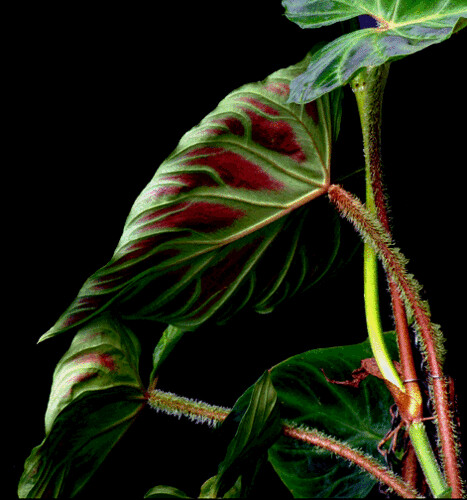 |
| Philodendron verrucosum petioles and abaxial (underside) leaf surface - photo courtesy Steve Lucas |
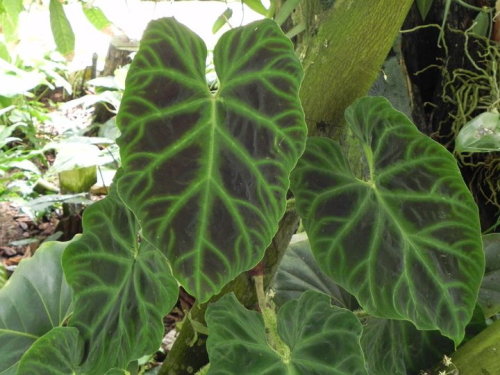 |
| Philodendron verrucosum - photo courtesy Taylor Holzer |
Other velvet aroids
As I mentioned at the beginning of the post, I will not try to list all aroids with velutinous leaves. I have confined my challenge to Anthuriums and Philodendrons. But I will include a couple of pictures I have taken over the years of velvety aroids outside of those two genera.
Alocasia 'Frydek' (also know as
Alocasia 'Green Velvet')
The plant pictured below is growing in great number at the newly-renovated Myriad Gardens in Oklahoma City. It is a very striking plant, with it's very dark leaves offset by the pure white veins.
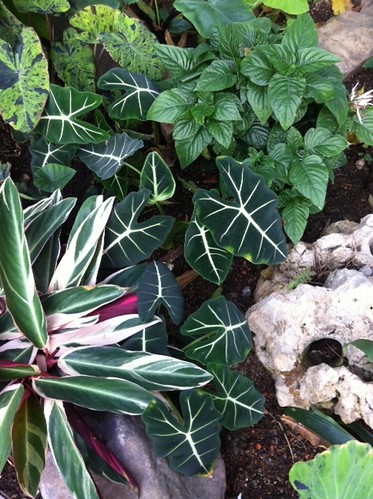 |
| Alocasia 'Frydek' (center) at the Myriad Gardens |
Scindapsus pictus
This beautiful little creeper/climber is becoming increasingly popular as a house plant, thanks to
Angel Brand plants, which stocks Wal-Mart and Lowe's buildings all over the country. The foliage of this plant is satiny and has really neat silver patches. And as a bonus, they grow pretty well in dark areas of the house. Usually they are grown in hanging baskets or in a simple pot, allowing the plant to drape over the edge. I had the rare opportunity to see one of these plants growing in a more natural setting, shingling up a rock wall in the tropical conservatory at the Fort Worth Botanic Gardens. It even had an inflorescence! I have a couple of these plants myself and might try to get one to shingle for me in my greenhouse.
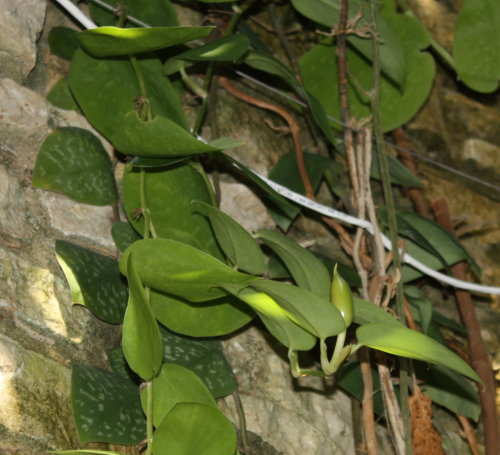 |
| Scindapsus pictus shingling and with an inflorescence |
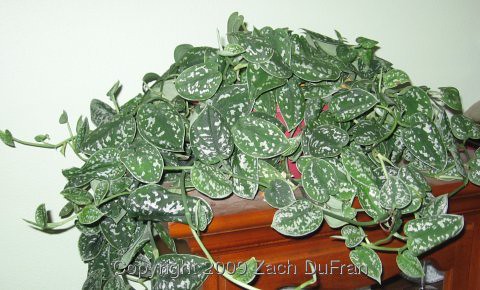 |
| Scindapsus pictus growing in a relatively dark area of our house |
Syngonium wendlandii
This is a neat plant that I had for a while. If kept trimmed, it will stay in a nice little clump in a pot. But it really prefers to climb, as you can see in the photos.
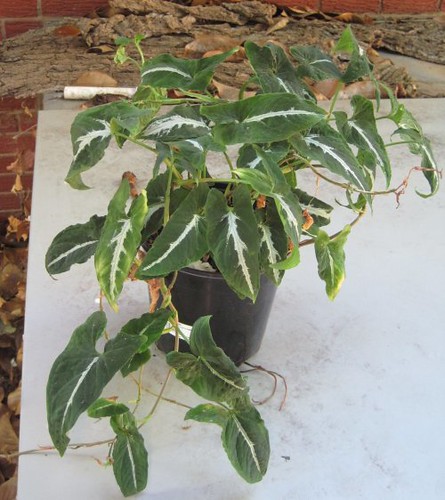 |
| Syngonium wendlandii |
Rhaphidophora tenuis
There are many shingling
Monstera and
Rhaphidophora which have satiny - or sometimes velvety - leaves in their juvenile forms. As they climb higher into the trees, the plant changes considerably and they lose their dainty juvenile leaves, in favor of larger split leaves. I had the wonderful opportunity to meet Peter Boyce and hear him speak at the IAS banquet this year. He is the primary taxonomist working in the field in southeast Asia, identifying new species of aroids.
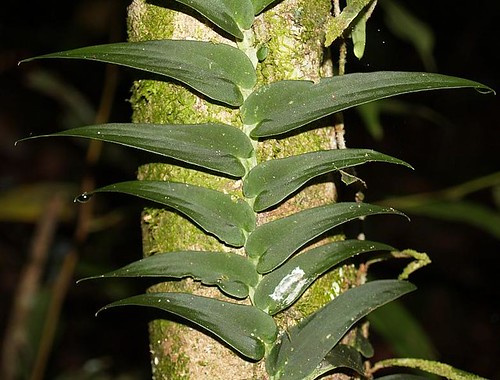 |
| shingling Rhaphidophora tenuis - photo courtesy Peter Boyce |
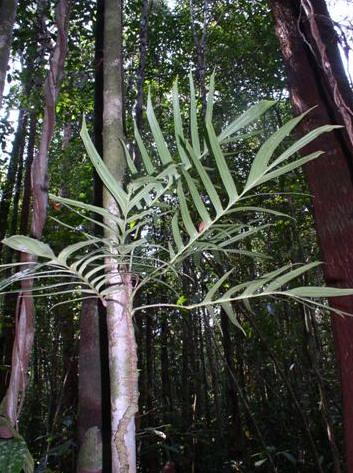 |
| mature Rhaphidophora tenuis - photo courtesy Peter Boyce |
For those of you interested in growing velvety
Anthuriums and
Philodendrons, here is a list of sellers which carry some:
Equatorial Exotics (in Australia),
Eldon Tropicals,
NSE Tropicals (Enid Offolter),
Brian's Botanicals (Brian Williams), and
Ecuagenera. Enid and Brian are members of the International Aroid Society and sell their plants through eBay.