Showing posts with label Asarum. Show all posts

Tuesday, April 27, 2010

My Asarum collection begins

One of my resolutions/goals for 2009 was to start a collection of Asarums, a plant genus that I have admired for a while.  I didn't get any Asarums during 2009, but I did place an order for 6 Asarum plants just 8 days into year 2010.  That order was delayed until the weather was permitting of shipment.

My love of Asarums began a couple of years ago when I saw a Chinese Wild Ginger (Asarum splendens) plant at a local garden center.  I think I bought one or two of them and planted them in our corner garden for the summer.  Even though they were supposed to be winter hardy in my zone, I was a little worried they would die and I would never have another opportunity to buy such a cool little plant.  So I dug mine up and kept them potted in the house over the winter.  I replanted them outside in the Spring the next year and Pippa promptly dug a hole where they were located.  To be fair to Pippa, she sometimes likes to dig nice cool depressions in our flowerbed to lay in, but I think this instance was in search of a mole that had been digging all over our backyard.  In the process, she managed to mangle my Asarums and they didn't survive.

My fears of not being able to find this plant again have been validated each Spring when I have returned to the same garden center to see that the supplier which grew the Asarums is still providing plants to this garden center, but no Asarums!

I found that Asiatica Nursery has tapped into the Asian (primarily Japanese) obsession with these little plants and has a HUGE variety of plants for sale on their website.  Their prices reflect the limited availability, so it took me a little while to save up enough to make my first order.

Here's what I got:

Asarum asperum

a_asperum_full
Asarum asperum
a_asperum_bloom
Detail of Asarum asperum blooms.

a_asperum_new_leaves
New leaves formed on my Asarum asperum just a couple of days after I got them.
Asarum caudigerum

a_caudigerum_full
Asarum caudigerum
a_caudigerum_bloom
Detail of somewhat withered Asarum caudigerum bloom.
Asarum maximum (Panda Asarum)

a_maximum_full
Asarum maximum with nice bloom
a_maximum_bloom
Asarum maximum bloom detail
Asarum minamitanianum

a_minamitanianum_full
Asarum minamitanianum with bloom.
a_minamitanianum_bloom
Asarum minamitanianum bloom detail
This one reminds me of the movie Tremors.  If you've seen the movie, you are likely to agree with me! :)

Asarum savatieri var. suntoh (albino form)

a_savatieri_v_suntoh
Asarum savatieri var. suntoh (albino form).  No blooms on this one.
Asarum takaoi

a_takaoi
Asarum takaoi. A very small bloom is withered at the base of the stems.

Thursday, February 12, 2009

Book Review: Toki No Hana

Doesn't that title just draw you in?  No?

Well, maybe that explains why everyone was rolling their eyes when I opened this Christmas present from my parents (which I had requested, by the way).  The Japanese book "Toki No Hana" is a 45 page monograph (book with one subject) with 480 photographs of plants from the genus Asarum.

toki_cover
Toki No Hana cover
Although I have only grown one species from this genus, I greatly admire the genus and I have plans to start a small collection.  In the United States, Asarum are grown most often as groundcovers in woodland shade gardens in the north.  There are a couple of species native to North America.  You might run across their mottled foliage in the woods of the northern states and in Canada.

In southeast Asia, it's a completely different matter.  For thousands of years, the Japanese have cultivated different varieties for their variable foliage and subtle, but beautiful blooms.  The foliage can be anywhere from solid green to almost completely silver.  The blooms vary from yellow with red centers to solid purple.  They are treasured plants, grown in small pots where they can show off their blooms most easily.  You see, the inflorescence of an Asarum is at the base of them stem, literally lying on the surface of the soil (or pebbles in the pictures below).  One of the most recognized blooms looks like a little panda bear, being white and a deep purple that looks black.
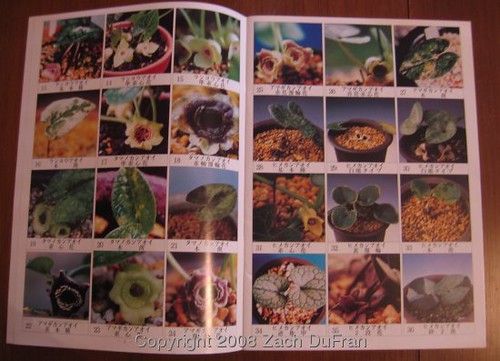
toki_pics
Asarum pictures from Toki No Hana
The book was compiled by the Japanese Asarum Preservation Society and is a collection of pictures of all of the different varieties that have been cultivated there.  It is fascinating to see the variation.  Some are stunning and others are... well, not so pretty.  After all of the pictures are several pages of notes on the identification and origin of the different species and cultivars presented in the pictures.  Of course, the notes are in Japanese:


toki_japanese
Notes on Asarum species - did you get all that?
Thankfully, my parents purchased this book from a US source (Asiatica Nursery) that had grabbed a bunch of these books in Japan and translated the notes to English.
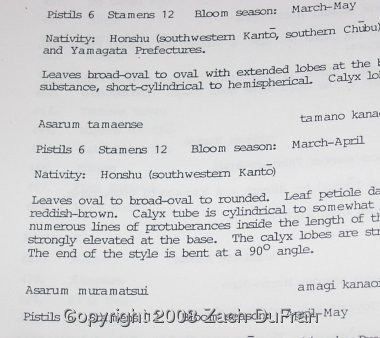
toki_eng
Ah, much better. Asarum notes translated from Japanese to English by Barry Yinger.
This Spring I will be checking the Atwoods store here in town where I have purchased Asarum splendens in the past.  I will probably get three or four plants to start with.  Since Asarum are actually a cool climate plant and will do very well in dimly lit, cool rooms, my plan is to start my collection in earnest this Fall by purchasing several more varieties from Asiatica Nursery, an online retailer that specializes in Asarum.  They usually have about 70 different varieties available.  I already have a short list of the plants I plan to purchase:


  • Asarum kiusianum var. tubulosum - solid white flowers, low clumping leaves


  • Asarum maximum Green panda wild ginger - one of the most famous species


  • Asarum splendens Chinese wild ginger - the variety I will buy at Atwood's in town


  • Asarum subglobosum - pink/beige flowers, green leaves have center white stripe


  • Asarum takaoi ‘Ginba’ - solid silver leaves


  • Asarum wulingense

  • It will be great fun to watch my plants mature into specimens as beautiful as those pictured in Toki No Hana and to see my plants produce some of these amazing inflorescences.

    Stay tuned for pictures of my plants as I collect them!

    Wednesday, December 31, 2008

    Planty Resolutions

    At this time of the year, everyone is making resolutions.  So I guess I will talk about what I plan to do for this next year.  More than resolutions, these are my goals.  The first four goals apply to this blog directly and the last five apply to me and my plants.

    1. Continue posting at the rate of 2-3 times per week.  I started this blog a year and a half ago, but only began posting at regular (frequent) intervals a couple of months ago.  So far I have not had trouble coming up with at least 2 posts a week.  I hope to keep that trend throughout the year.

    2. Review about 1 plant book a month.  Even if I don't read one new plant book each month, I have a backlog that should last me the full year - all I need to do is write the review.

    3. Write a "trip report" about once a month.  This will be a little trickier, as I don't know off the top of my head 12 different places to visit and write about.  But I will give it a shot.  More than likely this will become more of a quarterly post, or just as they occur.  I won't hold myself to the month interval, since my vacations tend to be distributed more heavily towards Spring and Summer.

    4. Write a "project" post once a month.  I have written three posts that I tagged and categorized as "projects."  I foresee more of these in the future, as I plan to write about my successes and failures of making hypertufa pots and terrariums.  We'll see what else I get my hands into.

    5. Start a collection of Asarums (Wild Ginger).  I have had just one species of Asarums in the past, but I've been saving up some money so that I can order 2 or 3 varieties from Asiatica Nursery and begin a real collection.  [I'm not sure if I want to start the collection in the Spring or wait until the Fall, since they will thrive in my cool, dark house overwinter.]  I received a collector's book on Asarums for Christmas that I will be posting about soon - stay tuned!

    6. Grow some of my own food.  During the summer of 2008, we grew about 5 tomatoes (maybe less) and 3 limes.  For the summer of 2009 I have some ambitious plans to grow: tomatoes, potatoes, kiwi (will not have fruit this year), and broccoli.  Last year I tried broccoli, but the plants kept getting eaten by some caterpillars.  I don't have a lot of room for gardening in the sun, but I am going to try growing the tomatoes and broccoli in pots this year, so that I can move them into the appropriate full sun locations and save my ground space for potatoes and kiwi.  The kiwi will take a couple of years before fruiting, but I want to get them in the ground this year.  The potatoes (my favorite vegetable) will also be a new venture for me.  Wish me luck!

    7. Vigorously plant front figure 8 bed.  We have a wonderful front flowerbed in the shape of a figure 8 that is filled with red and white tulips in the Spring.  The rest of the growing season it gets invaded by grass.  We have tried putting down tarp and covering with mulch after the tulips are finished, but that's just not very pretty.  Last year we planted potato vine, which was great.  The only problem is that we didn't plant enough.  This year I want to plant sooner (while the tulips are just finishing their blooming) and plant about twice as much.  If I stay on top of watering them at first, they should really fill out the bed nicely and keep the grass out.

    8. Fertilize. I have never fertilized any of my own plants before.  Some of my plants have not bloomed for me - ever.  Are these two items coincidental?  I think not.  I was very happy not fertilizing my plants, but I have committed to fertilizing regularly starting this spring.  Maybe I will get my Walking Iris, Shell Ginger and Bougainvillea to bloom this year!

    9. Recreate the corner garden.  Two years ago we started a beautiful little corner garden in our backyard.  At the time it was a shade garden.  After the ice storm in December 2007, it became a full/part sun garden, since the trees hanging over the garden were destroyed.  To make matters worse, the small cherry tree we had planted in front of the garden has since died, so we can't hope for it to one day shade the garden.  And I can't count on my tiny Japanese Maple to provide shade anytime soon.  This last summer the garden suffered because I had planted it with shade perennials (hostas and coral bells, mostly).  Now I need to either rethink the garden or plant a new shade tree so that this garden can return to form.  I've been thinking about planting a ginkgo tree ever since I saw one last fall that was a beautiful solid shade of yellow.  What do you think?

    Well, that does it for now.  Those all seem like doable goals.  And each one of them will probably result in a couple of posts.  I'll keep you updated.