Showing posts with label philosophy. Show all posts

Wednesday, February 3, 2010

Winter weather and hardiness zones

We have received more than our normal share of winter precipitation this year.  I have spent my whole life in the same town, and I don't really recall having more than 1 decent snow storm each winter.  This winter, we received a pretty good snowfall on Christmas Eve, measuring 8 inches in the middle of our front yard (away from any drifts).

christmas_eve_blizzard
Christmas Eve blizzard
Then we received an ice storm followed by 6 inches of snow last week.

icicle_handfull
Very thick icicle hanging from my greenhouse this week
In between those two snow storms our temperatures dipped down below 10 degrees Fahrenheit on three consecutive nights (6F, 6F, 8F).  We're not really used to these temperatures, but I was thinking about our USDA hardiness zone.  I am located in zone 7a, which is rated for winter temperatures between 0 and 5 F.  This is one of those winters that makes our hardiness zone rating seem appropriate.  I would say that in the average winter, our minimum temperature is probably somewhere around 15 degrees F, but the USDA zones aren't set up by average minimum temperatures.  You don't want to plant a tree and expect it to survive in your zone only in the years that are above average.  You want it to survive 50 years or more.  So the USDA zones are set up by using long-term historical climatic minimum temperatures.

I discussed in a previous post how the hardiness zones only tell a small part of the story, but I would like to mention that again here.  The hardiness zones only tell you whether a plant can brave your winter minimum temperatures, not whether they will be happy with your amount of moisture or sunlight or long, hot summer days.  Some efforts have been made to construct other zone maps for variables like humidity and heat index.  Once these maps have been constructed and distributed to plant people, nurseries will need to start to label their plants, in order for them to be useful.  I know that there are a number of plants which can survive our winters, but would not like our heat waves when the temperatures can be above 100 degrees F for a week solid in the middle of the summer.

Hopefully these new maps will be circulated soon and start getting used.  It might seem like a lot of numbers to keep up with, but I can envision a 3 map system, where you just always remember you are a "7-5-8" or something like that.  If the order is kept the same (cold hardiness, heat index, humidity), it will make this new system user friendly and could help a lot of new gardeners.

Friday, January 8, 2010

Christmas Orchid

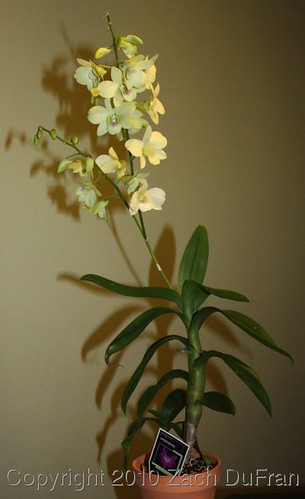
Aunts- and uncles-in law are not usually noted for their gift-giving abilities.  My in-laws drove from southern California to join my wife's family here in Oklahoma for Christmas this year and brought with them a gem of a gift for me.

dendrobium_full
Dendrobium Christmas gift
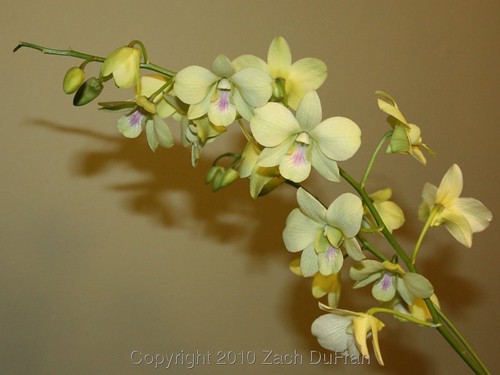
This Dendrobium orchid has a total of about 25 buds born on two stems - about 8 of those still closed.  The color of the petals is pale yellow and almost green.  There is a new book out from my favorite plant-book publisher, Timber Press, called Green Flowers.  In a way, green is the most boring color that a flower can be, since the majority of plant material is green.  It just blends into the background, part of the noise that nature can sometimes be.  We tend to gravitate towards the colorful spotlights of red, pink, purple and yellow, which readily stand out on all shades of green foliage.  And it's not just us - insects are attracted to these colors.  What to us says "beauty" says "food" to many creatures.

dendrobium_stalk
Dendrobium blooms
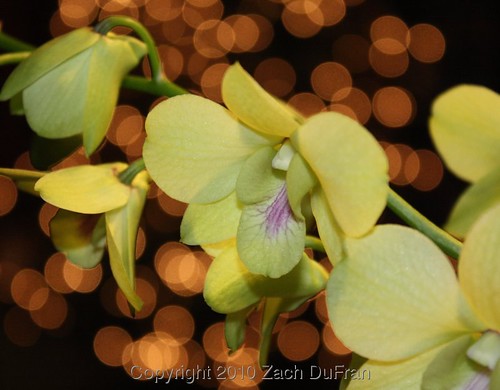
But there is a simple beauty to the green flowers.  Maybe the texture and shapes are better observed when the color doesn't trump the senses.  The pearly sheen that is unique to orchid flower petals stands out on this flower.  There is also a really subtle hint of red on the inner part of the flower, that I pretend is there just to reward those who take the time to look closely.

dendrobium_closeup
Dendrobium bloom detail
This particular orchid had a generic "Dendrobium" tag on the stem and a specific tag with hybrid identification in the pot.  Unfortunately, the tag was snapped in half and all I have is a couple of letters - not enough for me to have figured it out yet.  But I'll keep trying, out of sheer curiosity.  I don't really need to know anything more than the genus for this particular orchid, in order to take good care of it.

Monday, January 4, 2010

Report on 2009 resolutions

At the beginning of 2009 I made myself a list of resolutions for my plant hobby and specifically for my blog.  Some of these were pretty well upheld.  Others - not so well.  Here's how I did:

  1. Post 2-3 times per week. This task went pretty well - most of the time.  But a couple of projects kept me very busy in my "free time" which reduced the number of posts.  The biggest project was the building of my greenhouse, which gave me plenty of fodder for posts, but not much time for writing them.  I also started several very big posts that just never got complete enough to post.  All in all, I posted 100 times during the 2009 year.  The first half of the year I posted 61 times (about 10 per month).  The second half of the year I only posted 39 times (6.5 per month).  I have made myself a "schedule" of upcoming posts and I hope to be more regular once again.

  2. Review 1 book per month. I reviewed 7 books this last year, so I probably should have set this goal to be semi-monthly.  My reading and writing are always fighting for my free time.  This last year, both of them were neglected in favor of projects and trips.  I foresee several books being covered over the next couple of months: Black Plants by Paul Bonine, The Amazing Aglaonema by Frank Brown, Botany for Gardeners by Brian Capon, and One River by Wade Davis.

  3. Write a "trip report" once per month. I wrote 8 trip report posts this last year.  I probably could have written two more, but 12 would have been a stretch.  This category works well as once a month during the "growing" seasons, but I don't travel much when the temperature is below 50F...  The only trip we have planned for this next year is to St. Louis.  But that trip will definitely have a good trip report, seeing as our 2nd IAS MidAmerica chapter meeting will be held at the Missouri Botanical Gardens!  I think we will be working in some other fun, nearby trips, as well.  And I never posted about our foliage drive in the Fall of last year.  I might just post that in the next month, so stay tuned!

  4. Write a "project" post once per month. I actually wrote 17 project posts this last year!  This was by far my most productive category.  That production is due mostly to my greenhouse building project.  One particular project I have been planning is my first oil painting.  I've not really ever painted before, but I have an idea for a painting that I really want to do this year.  I just bought my easel, paints and canvas and I'm looking forward to creating my first piece.  I'll share that painting here, if it turns out halfway decent.

  5. Start my Asarum collection. This never got off the ground this year, but my birthday and Christmas added some green to my wallet, so I might just order some Asarums soon and start my little collection.

  6. Grow some of my own food. My first potato crop was a success, but also left some room for improvement.  I know what to do differently next year and hopefully have better size and quantity in my crop next Fall.  I'm also hoping to start a couple of hardy kiwi vines this coming Spring.

  7. Vigorously plant figure 8 bed. Due to our Spring vacation to Hawaii about the same time that we should have been planting and watering our sweet potato vine in the figure 8 bed, I don't think "vigorous" is the apt description.  The good news is that my sweet potato plants produced large underground tubers, which I dug up and plan to plant this Spring.

  8. Fertilize. I think I have only fertilized my plants once, around the middle of the year.  So it is probably a good time to sprinkle some pellets over the soil again.  This is new to me, so it's good I made this a resolution; at least now I have a reminder whenever I check to see how I'm doing with my resolutions.

  9. Recreate corner garden. Last Spring and Summer we added several perennial plants to the corner garden that are colorful and should work better in the full to part sun that is being received in that bed.  I also added some Fall-blooming bulbs which were nice to see blooming well into November.  This Spring will reveal the success our perennial additions.  I might also add a couple of Daylilies this Spring as they are the most likely to succeed.

All in all, I had moderate success with my resolutions in 2009.  I guess it is good to aim high and push myself.  This year, I will likely be aiming for the same goals, with the exceptions I noted above.  My top priority will be the first goal: post 2-3 times per week.  Wish me luck!

Monday, October 5, 2009

Is there really such a thing as a "new" plant?

Have you ever found yourself telling someone about a new plant that you saw recently?
There's three kinds of "new" plants in my book:

  1. a hybrid plant which was cultivated by humans and is just introduced on the market,

  2. a naturally occurring species that has just been discovered in the wild,

  3. a plant that has been around for ages but has just come back into style.

I suppose there should be a fourth category - a new naturally occurring species or hybrid - but I won't get into that.

We're probably all familiar with plants in the first category.  Everyday there are new hybrids being produced.  In fact, there are millions of new hybrids being produced.  But only a small fraction of those experiments prove to be successful and make it to the market.  Most of the efforts are concentrated on already popular plants whose market could be widened if certain traits of the plants were improved.  The "improvements" can range from cold hardiness to heat tolerance, drought tolerance to flood tolerance, a number of different light preferences, a variety of variegations, and even the structure of the growth.  Some plants that come to mind would be the vast array of colors that are available in the popular flowering plants - roses, daylilies, tulips, Clematis, etc.  Other common hybrids are in grasses and trees - the foundations of most domestic landscapes.  A new hybrid that I had to buy this year is the Euphorbia 'Diamond Frost.'  It's a beautiful plant for a mixed container, or all by itself.  And it is very heat tolerant.  I might have to try to keep some of mine alive indoors over the winter, since it is only hardy in the warmest USDA zones (10+).

diamond_frost
Euphorbia 'Diamond Frost' - a newish hybrid that is a very popular annual container plant
The second category - newly discovered naturally occurring species - is an interesting category.  Today there is little area on the planet that hasn't been precisely mapped and cataloged.  On the other hand, there are many remote locations which are just beginning to take note of their particular endemic species (plants that only grow in that one unique location).  New species are being discovered fairly often.  One day that discovery process will probably grind to a halt, but we're not there yet!  I am on the International Aroid Society's mailing list and it is very exciting to receive emails from some of the leading scientists in the world who are conducting research in the field and reporting back to the Aroid community about new species and whatnot.  (By the way, you don't have to be a member of the IAS to be on the mailing list.)

Coincidentally, after having written most of this post, but before publishing to my blog, I ran across a news story about research in the eastern Himalayas which has uncovered 353 new species of plant and animal life.  The news story was focused on the animals, but I found that 242 of the 353 new species were plants (including Orchids, Poppies, Palm trees, Bamboos, Ferns, Clematis and Impatiens).  If you want to read more, here's the news story and here's the actual report.

I happened upon another plant recently that caught my eye.  The plant was being sold as a ground cover at Lowe's, but I would have happily bought it as a tropical house plant.  The plant had very slender, dark green leaves along long, trailing stems that creep along the ground.  The midvein of each leaf was vibrant white or silver and  with some subtle silver veins reaching out to the tips.  The plant was labeled Euonymous 'Wolong Ghost.'  I immediately thought of the Wolong Nature Preserve in China.  This is the area that was hit harshly by the earthquakes last year and is one of the few places where the Giant Pandas are still roaming in the wild.  After doing a little research online, I found out that this plant was named as such because it was collected in the Wolong Nature Preserve and brought back to the US for propagation!  I also read in the one review on Dave's Garden that this plant makes a lousy ground cover because of its growth rate.  That was fine by me, since I wanted to keep it in a pot.  It's beauty probably wouldn't be appreciated as a ground cover anyway.  I bought 2 of the little plants the next day and put them in a pot, which now sits on my desk at work (and receives lots of compliments).

Euonymous fortunei Wolong Ghost
Euonymous fortunei 'Wolong Ghost' selected by growers at Hersonswood - image courtesy Oregon State University

The third category is a very interesting one.  I think about it from time to time.  It recently came to mind when I was reading Ken Druse's Planthropology.  It may be hard to admit, but mankind's fondness for different plants is just as susceptible to fads and trends as clothes are.  Bell bottoms were reinvented and re-marketed recently with the boot bottom jeans; simple tulips are coming back into favor after decades of more frilly, elaborate roses.  It's all part of the human factor.

We don't find favor in plants solely because they are useful to us or because one plant serves a better purpose than another.  While there is no objective measure of beauty that I know of, we wouldn't even use it if we found one.  Some plants are grown solely because of their hideousness (which you could also argue is in the eye of the beholder - or wincer).

And the definition of beauty is always changing.  At one time, heavier people were considered more beautiful because it meant that they were wealthy and did little work themselves.  There are plants coming in to fashion today that have been neglected for years or some that have never been considered beautiful in a landscape setting before.  One example would be the use of native grasses and weedy-looking wildflowers.  While people have probably enjoyed the beauty of these plants in nature before, they were reluctant to dig them up and replant them in an organized flowerbed until recently.

One interesting fad is that plants are beginning to be appreciated for their hardiness and native attributes.  As our culture is increasingly more aware of conserving energy and water, gardeners are acknowledging that plants which grow well naturally in their area are probably the best ones to plant in their garden.  They will be better attuned to the local annual rainfall and light amounts and require less water from a hose.

Horticulturalists have been capitalizing on the trend of cold hardy and drought tolerant plants by making new hybrids with more vibrant colors than the naturally occurring species.  (Here is an article, if you're interested.)  But those plants really belong in my first category, not this one.

You could even say that some garden trends follow the economy closely.  I haven't done a study myself, but I would bet that the ratio of perennials to annuals purchased each year would correlate pretty well with the overall health of the national economy.  When you have less money to spend, you're unlikely to spend it on plants that will only be around for a season.

Gardening itself is really an art form.  And just like other forms of art, there are always new styles being invented and old styles being rediscovered and appreciated.

Thursday, June 11, 2009

InTREEguing

I know, I know.  My blog post is misspelled.  I started to name this post "Intriguing Trees."  Then I decided I could make it all one word - just for fun.  [Don't try this at a spelling bee.  Spelling Bee judges aren't known for their sense of humor.]

This post is one of those eclectic collections of plant profiles (like My "onion" plants post).  It is a list of trees which I find intriguing, for one reason or another, and a short description of the trees.  Only a couple of these trees have I ever grown before.  And there are only a couple more that I would ever try to grow.  The others won't grow in my region and are not suited to growing in a pot indoors.  I narrowed down the list to my top 6, listed here in no particular order:

Sassafras - I visited the OU (University of Oklahoma) Greenhouses a couple of years ago.  The caretaker, Cal Lemke, showed me a sassafras tree and had me sniff a leaf, not telling me what it was.  The smell was unmistakable.  Though, I admit, at the time I couldn't name what the smell was.  But I knew the smell, nonetheless.  When he said the tree was a Sassafras, I thought "Of course, that smells just like Root Beer!"  The leaves of the Sassafras tree are uniquely tri-lobed.  The tree has small yellow flowers, but is otherwise an ordinary-looking tree.  I just think this tree is really neat because of the smell that is so evidently root beer-ish.  I think I will try to grow this tree at some point.  To top it all off, this tree can be grown in my zone and has wonderful fall foliage color.

Sassafras tree leaves - courtesy flickr member Muffet
Cacao tree - Let's face it: Chocolate is one of the greatest discoveries of mankind.  I can't imagine having a Cacao tree of my own and processing the beans to make my own chocolate.  I imagine it would be quite a task, but the rewards...?  Well worth it!  I might have to try growing a small specimen tree in a greenhouse.  I'm not sure that I would be able to do all of the processing required to make chocolate from the beans, but I could sure try.

cacao
Cacao tree at the Foster Botanical Garden - Honolulu, Hawaii
Cork - How many trees do you know of that are harvested for their bark - and then they continue to grow and produce more to harvest?  Just one that I know.

Cork tree - from http://www.marylandcork.com

Rainbow Bark Eucalyptus - If you haven't seen one of these in person, you almost have to assume they aren't real.  I mean, really - rainbow stripes on a tree trunk!?!  Come on - that's ridiculous!

rainbow_eucalyptus
Rainbow bark Eucalyptus trees in Maui, Hawaii
Coconut Palm - This is one of the trees I have tried to grow - "tried" being the most important word.  Twice, in fact.  I've mentioned those failures before on this blog.  The Coconut Palm simply requires more light than I can offer on a year-long basis.  The light requirements are easy to meet in the summer, but the winter is another story.  This tree makes the list (regardless of my difficulty growing it) because of it's initial growth habit.  The tree literally sprouts from a full-sized coconut.  It is a really cool looking oddity of a tree at about 4-6 feet tall and a definite conversation piece - though I wouldn't suggest sitting it on your coffee table.

Coconut palm tree sprouting from the coconut - courtesy flickr member Bemep
Ginkgo tree - I have wanted to grow this tree ever since I saw once in its solid yellow Fall coloring at a local nursery.  I should have just bought it that day.  I guess I didn't because it was about 15 feet tall and I was driving a small car and it was priced more than I could afford.  I also didn't have an adequate space for it.  The tree is gorgeous in the Fall and the leaves have a very unique shape, unlike any other tree that I know.

Ginkgo trees are thought to be one of the oldest tree species still growing.  The species is thought to have existed at least 270 million years, back to the Jurassic period.

Ginkgo biloba leaves in Fall color - courtesy of Flickr user Rozanne
Ginkgo biloba leaves in Fall color - courtesy Flickr member Rozanne

Other trees receiving votes:As with the AP Sports voting, I have accumulated a list of other trees that, while not making the list of top six, got some votes.  It's an "honorable mention" sort of award:
  • Rubber plant (mine is really more of a plant than a tree).

  • Olive tree (though one of my favorites, this tree is too widely known and grown to make the list).

  • Baobab tree (probably on anyone else's crazy-cool tree list, but I don't have any desire to grow this one).  There is a really funny segment on the BBC Planet Earth DVDs of the filming of the Baobab trees.

  • Banyan trees (Some of my absolute favorite photographs are pictures of the tree roots entangled within and growing over the ruins of Angkor Wat.  There are several famous Banyan Tree groves across the globe, including several I saw recently in Hawaii.  The largest one I have seen takes up a whole city block in Lahaina on the island Maui, Hawaii.).

What would you put on your list of "intriguing trees?"

Wednesday, June 3, 2009

Botanical pronunciations

I'm one of those people that tries to use the botanical names of plants.  I also know many of the common names for my plants, but many of my plants are not widely grown and therefore have not been given common names.  Anyway, I'm not writing this post to debate the merits of either common or botanical naming systems.  I'm simply going to talk about pronouncing the botanical names.  Pronouncing common names is almost always easy, since they are just a collection of English words with which most people are already familiar.

However, many botanical names you have seen but never heard.  And since they are usually Latin-based, it is often hard to know how to pronounce them.  I have been embarrassed on a couple of occasions when I pronounced something very different from someone at the greenhouse (also at the aquarium store).  In one case, I was new to the aquarium hobby and had just been reading about a bunch of different fish I might want to put in my first aquarium.  My wife and I had been referring to the ever-so-common algae-eating fish Plecostomus as "ple-coh-STOH-moos."  The correct pronunciation is actually "pleh-CAH-steh-muss," which flows off the tongue so much more easily.

After some of my embarrassing pronunciation encounters, I got to thinking that I wasn't necessarily wrong.  The worker might have been sitting at home thinking how embarrassed they were that a customer had pronounced the name correctly and they had always pronounced it differently.  This definitely wasn't the case for Plecostomus, but it might be in some other situations.  If we don't use the names in converstation with others, how are we ever to know the correct way of saying the names?  Don't you worry - I did some research and found some good sources for correct pronunciations of botanical names.

Many online dictionaries have a little sound graphic next to the word you just looked up that will actually have a 2 or 3 second sound bite of someone saying the word.  And nearly all of the dictionaries will have the written pronunciation.  The drawback to using online dictionaries is that many botanical names are not listed in these dictionaries.

One place that you can almost always find your plant listed is on Dave's Garden.  Dave's Garden includes a written pronunciation of all genera and most species names.

Here are some specific names that I found on Dave's Garden:

  • Heuchera (HEW-ker-uh) - genus of the popular shade plants "Coral Bells"

  • Clematis (KLEM-uh-tis or kli-MAT-is) - genus of very popular flowering, climbing perennial vines hear it

  • Liriope (luh-RYE-uh-pee) - genus of common ground covers, sometimes called "Lily Turf" or "Monkey Grass" hear it

  • Rudbeckia (rud-BEK-ee-a) - genus which contains "Black-Eyed Susans" and other perennial wildflowers hear it

  • Gaillardia (gay-LAR-dee-uh) - genus of common wildflowers sometimes referred to as "Indian Blanket"

  • Echinacea (ek-in-AY-shee-a) - genus which contains the common coneflowers hear it

  • Ipomoea (ip-oh-MEE-a) - genus which contains both the popular "Morning Glories" and ornamental "Sweet Potato Vines," as well as some other plants I enjoy growing "Cypress Vine" and "Spanish Flag"

  • Chlorophytum (kloh-roh-FY-tum) - genus which contains "Spider Plants," "Airplant Plants"

  • Justicia (jus-TEE-see-ah) - genus which includes the "Shrimp Plants"

  • Chamaedorea (ky-mee-DOR-ee-uh) - genus of palms, some of which are kept as houseplants - including the "Neanthe Bella Palm" and "Parlor Palm"

  • Phalaenopsis (fay-lay-NOP-sis) - genus that contains the most commonly seen orchids, referred to as "Moth Orchids" hear it

  • Ctenanthe (TEE-nan-thee) - a rare genus and favorite of mine from the prayer plant family

  • Calathea (ka-LAY-thee-uh) - a common genus from the prayer plant family

  • Stromanthe (stroh-MAN-thee) - a rare genus from the prayer plant family

  • Araceae (a-RAY-see-ee) - the family commonly referred to as "Aroids"

  • Rhaphidophora (ra-fid-OH-for-a) - a genus in the Aroid family

One quick observation: I'm noticing that the "ch" combination is almost always pronounced as a "k" in plant genera.  There are exceptions to every rule, but the "k" sounds seems to be the standard.  It's easy for me to use the "k" sound for names like Chlorophytum, but I want to use the "ch" sound for names like Heuchera.

I've had to make the most adjustments for Ctenanthe (I was trying to incorporate the leading "C" into the name) and Liriope (which I was pronouncing "leer-EE-ope").  I like the true pronunciation of Liriope much better than what I was saying.

The pronunciation with the most controversy that I encountered is Rudbeckia.  There were two sound bites for this name.  One sounds like "red-BEK-ee-a" and the other sounds like "RUDE-bek-ee-a."  I was really surprised by the "red" beginning to the one sound bite.  Additionally, I ran across a sign at a local nursery that said this name is easy to remember by memorizing the phrase "Susan has a black eye because rude Becky hit her."  (The "Black-Eyed Susan" species is R. hirta.)  The Dave's Garden pronunciation is a little different from all of these other options.  Good luck with that one!

Are there any plant names you've always wondered how to say?

Monday, June 1, 2009

Mid year report on resolutions

On the last day of 2008, I posted nine planty resolutions for 2009.  I thought I'd let you know how I'm doing.

  1. Post at the rate of 2-3 times per week. This has gone very well.  Since January 1, 2009 I have posted 54 times.  That is an average of 2.5 posts per week.  Pretty good, huh?  I managed to post at least twice each week, as I had planned.  February was the most active month, with 13 posts.  I never really ran out of material for posting, but I did have some trouble having time to write on occasion.  While on vacation to Hawaii last week, I used the post scheduler to update my blog with 2 pre-written posts.

  2. Review about 1 plant book per month. I have done pretty well with this task.  In March, I sort of cheated by only posting a quoted passage and couple of sentences about a plant book.

  3. Write a "trip report" about once per month. This is probably my favorite category of post to write.  Whenever I visit someplace that has plants, there is usually so much to write about that I have to contain myself.  This has been a very exciting category for 2009.  Although I didn't post a trip report during the month of March, I posted twice during each of the last two months. Here's the list:

  4. With my recent trip to Hawaii, I have a couple more trip posts planned for the next month.  I also have another couple post-inspiring trips for this summer and fall.  Stay tuned for more Trip Reports from The Variegated Thumb!
  5. Write a "project" post once per month. I should have said "about" for this goal.  Regardless, I almost met my goal for this category but fell short in the last month.  I did post three different times in this category during April, though.  I had a post planned for May on starting pineapple bromeliads from a grocery store pineapple.  But my newest pineapple has not yet sprouted roots in time to get the pictures for publishing the post.  Stay tuned for that post in June!

  6. Start a collection of Asarums. I had hoped to find some Asarum splendens plants at our local Atwoods store, but they did not have these plants this year as they have the last two years.  Alas, my Asarum collection must wait until the late Summer or early Fall when I place an order from Asiatica Nursery.  My plan is to order 5 or 6 species/varieties.  I saved this project for Fall because these plants will do well in my house over winter and that allows me to use my plant allowance elsewhere this summer.

  7. Grow some of my own food. I am in the growing process right now.  So far nothing looks like food, but the plants seem to be healthy, so hopefully I will have some produce in a month or two.  This year we planted potatoes (new for us), yellow straightneck squash (new to us), zucchini squash (new to us), tomatoes (old hat) and broccoli (new to us).  Actually we planted broccoli last year but it was eaten by caterpillars in a matter of days.  This time around it has lasted at least a month.  And our tomato planting is different this year, as we're using a "Topsy-Turvy" to grow them.  The device was a gift from my granddad and is actually very handy, as it can be hung on our front porch in the full sun.  Our planting location last year was probably shadier than the tomato plants would prefer.

  8. Vigorously plant front "figure 8" bed. For now, I have to say that I have failed miserably to accomplish this task.  The goal was to plant a lot of ornamental sweet potato vine in the figure 8 tulip bed in our front yard as soon as the tulips had quit blooming.  The hope was that the sweet potato vine would be in the ground when we get all of our mild weather and gallons and gallons of spring rains.  Then it would spread nicely and have filled out the bed by the time the tulip stems turned brown and are removed.  I have now removed the tulip stems and still not planted the sweet potato vine.  I have to admit that if we hadn't gone on vacation last week, this task might be complete.  Alas, Hawaii was calling out to us!

  9. Fertilize. I have had a bag of fertilizer sitting in my garage for more than a year.  It was just a matter of using it.  This Spring, as I brought all of my tender tropical plants outdoors, I added some slow-release fertilizer to the soil and watered it in.  It will be a while before I can tell if (and to what extent) the fertilizer has helped.  I did not fertilize any of our food plants, but I have fertilized nearly everything else that I am growing.  It was very quick and easy to lightly shake some of this fertilizer on the soil surface of each of my plants.

  10. Recreate the corner garden. This task has gone swimmingly!  I have posted a couple of times about new plants we have added to our corner garden, as well as several plans for future enhancements.  The corner garden is the foundation for making our backyard a comfortable paradise where we can relax at home.  Our fencing project has also helped to create a more inviting feel to our backyard.

Did you make any resolutions this year concerning your plants?  How have you kept up with them?

Monday, April 27, 2009

Book Review: Oklahoma Gardener's Guide

I have been reading a book that my mom lent me, Oklahoma Gardener's Guide by Steve Dobbs.  I am really getting a lot out of the book, because of its focus on gardening in my location.  I would definitely recommend the purchase (or at least a library checkout) of a gardening book that applies directly to your region.  I'm sure there is probably one for every state in the country.

The introduction to the book tells about gardening in Oklahoma, including a short discussion on plant hardiness and ecosystems made up of similar climates and geographies.  That discussion got me to thinking and researching a little bit more.  Most of this post is about that subject.

The majority of the Oklahoma Gardener's Guide consists of plant profiles.  The profiles include information on how to grow these plants in Oklahoma, as well as different named varieties that are available and which are best choices for our location.  The profiles are divided up into several different categories:

  • Annuals

  • Bulbs

  • Ground Covers

  • Ornamental Grasses

  • Perennials

  • Roses

  • Shrubs

  • Trees

  • Vines

  • Great Plains Plants

A large appendix includes maps and information from the following topics:

  • Planning and Starting a Lawn

  • United States Ecoregions Map

  • Oklahoma Frost-Free Map

  • Oklahoma Freeze Map

  • Oklahoma Precipitation Map

  • Oklahoma Northern Counties Map

  • Perennial Ground Covers as Lawn Alternatives

  • Beneficial Insects

  • Other Plants for Oklahoma

  • Natives as Ornamentals

  • Oklahoma Public Gardens

  • Reference Publications of Interest

  • Glossary

  • Your Garden Plans

Discussion of Plant Hardiness

In addition to the USDA Plant Hardiness Zones map, Steve Dobbs includes a map of Ecosystems in the continental United States.  There are six ecosystems identified in the United States: Pacific West, Mountain West, Desert Southwest, Great Plains, Continental East and Humid South.  The last four of those ecosystems intersect in the center of Oklahoma.  The center of Oklahoma is a sort of "four corners," dividing the state into quarters.  Lucky for me, I live right in the center of the state.  This means that gardening outdoors can be a little tricky where I live.  The map below shows a much more detailed view of ecosystems in the US.

USDA Ecological Subregions map
USDA Ecological Subregions map.  This is a more detailed map than the one shown in the book,  but still demonstrates the diversity of Oklahoma's ecoregions.

Oklahoma is known for its extreme weather, usually in the form of severe storms and tornadoes.  But Oklahoma made national news at the end of 2007 when we were hit by a horrible ice storm that tore down many trees and left others severely damaged.  It is also not unusual to have fairly long droughts during the mid to late Summer, when much of the state is behaving more like the Desert Southwest, rather than the Humid South.  Temperatures in my home town range from 10 F to 105 F in an average year.

The USDA plant hardiness zone map was updated in 1990, dividing many of the zones in two (an "a" and a "b").  Those zones have been consistently used by growers to indicate the cold hardiness of plants for several decades now.  However, the map indicates only the lowest temperature that could be expected during the course of the year.  Steve Dobbs writes that a single indicator is not enough information to convey whether a plant will survive in your yard or not.  Just as you need to take into account how much to water a plant and what sun exposure it needs, you also have to consider the relative humidity required by the plant and the heat that it can endure.  This is often described by saying that a plant is drought hardy, but being able to withstand a week without rain is different than withstanding a month's worth of high temperatures above 95 degrees Fahrenheit.  This happens in July and August in Oklahoma.

As it is now, plants that are hardy in my zone (zone 7) are suggested for here as well as Delaware and New York City.  Clearly these are very different climates and the same plant would require different care in these two locations, assuming the plant could live in both places.

There is some discussion about the USDA creating a heat hardiness map that would indicate the maximum temperature that can be expected in a year.  This map would show most of Oklahoma hitting a maximum temperature of 105-110 F.

The American Horticultural Society has produced a US Plant Heat-Zone Map that categorizes locations based on how many days each year the temperature reaches above a threshold value (86 F).  On that map, the majority of Oklahoma is in heat zone 8, with 90-120 days above 86 F.  By contrast, New York City is in zone 4, with 14-30 days above 86 F!  Now all we need is for growers to start labeling their plants by heat hardiness.  For instance, a marigold plant might be hardy for cold zones 4-9 and heat zones 7-8.  I just made that up as an example, so don't get worried if you're trying to grow Marigolds in heat zone 6.  I don't really know where Marigolds are hardy.

Most people that have gardened for more than a year or so understand that there is more to satisfying a plant's needs than just matching it with a cold hardiness zone.  But the more information that becomes consistently available for all of the plants that we see, the better for all.

Friday, April 10, 2009

Long term planning for a "Paradise corner"

I started daydreaming a couple of weeks ago about some things we could do to further spruce up our backyard and make it more inviting.  As it is, my wife spends almost every lunch break lounging on our hammock in the backyard, enjoying the breeze, the sun, the birds, the squirrels and the plant life.

You can see pictures of our corner garden on this post.

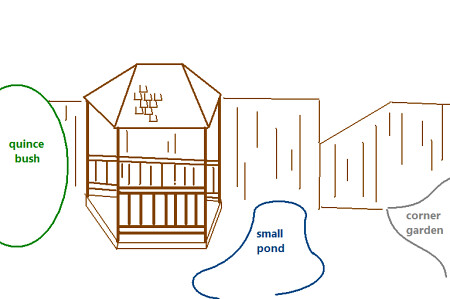
I came up with some ambitious plans for the future of our backyard.  There are several improvements we are planning on making in the short term (over the next 5 years), but this vision for our backyard is more along the 10 year time frame.  It might happen sooner, but it will most likely be a slow progression.
paradise_corner
A sketch of my plans for a "paradise corner"
My sketch is a simplistic view of what I want the corner to look like.  The elements in the sketch would provide a nice place to sit and relax, but the elements that are missing from the sketch are those that will truly make it a paradise.  There will be lots of plant life surrounding all of these features.

To see what the corner garden looks like now, with the new fence erected, check out the fourth picture in this post.

The Pond

I have the sketch labeled "small pond," but that's not very descriptive.  I think it will be about 8-10 feet in length and about 4 feet in width at the narrowest and about 6 feet at the wider bulge.  I will probably create the usual shelf so that the center of the pond is about 2-3 feet deep, while the outer ring is only about 1-1.5 feet deep.  There will probably be some aquatic plants, including: Cannas, black-stemmed Alocasia, Lotus (water lilies) and grasses.  I'm not sure yet whether we will have any fish, but I imagine we probably will.

In the middle of the pond will be a small fountain to keep the water circulating (cutting down on mosquitos) and to generate some nice splashing water sounds.

After I told my wife about my plan, she had something to add to my vision.  She suggested that we have a small bridge that steps over the pond, linking the gazebo to the corner garden.  We'll have to keep our eyes peeled for a small, sloped bridge (without railings).  I think it would look a little silly with railings, due to the scale of the pond.

The Half-Gazebo

I don't think I have ever seen a half-gazebo before, so I'm not sure where I got the idea.  I was just thinking how neat it would be to have a small gazebo in that part of our yard with our hammock inside of it.  Since the gazebo will be against the fence, it makes sense for it to be cut in half.  Also, we won't want it to cut very far into the yard.

The gazebo will be a wonderful place for us to sit and relax, looking at the flowers in our corner garden, listening to the gurgling water of our pond fountain and watching the birds and squirrels.  We will probably want to run electricity to the gazebo and put in an outlet so that we can plug in radios, or other things like that.  Also, we will need electricity for the pond fountain.

I would like to plant around the gazebo so that the structure blends into the environment.  I plan on planting a Passion Flower along the front side that will climb up the railings and posts of the gazebo.

The Corner Garden

I wrote a post earlier this week about expanding our "corner garden" along the right side.  This will help our paradise corner from being too heavy along the left fence line.

paradise_corner_birds_eye
Bird's eye view of the planned "paradise corner"
Rock Walk

The ground area joining the corner garden to the pond to the gazebo will be covered in flat stones.  Since the area is narrow, well-shaded and will probably be perpetually moist, it will be easier to maintain and more ascetically pleasing if this area is rock, rather than grass.  I will try to get some moss growing between and on top of the stones.  Hopefully we can find some rock locally that matches the rock used in the pond.

The Flowering Fence Line

Currently there are small flowering bushes planted all along the fence line where I am planning to build the half-gazebo.  In the first sketch in this post, I condensed the width of fence line that lies between the corner garden and the large quince bush.  There are about 5 or 6 small quince bushes along this fence that are offsets from the large quince.  Also there is an almond bush and a spirea.  If we decide to build the gazebo flush with the fence, we will relocate the flowering bushes to wrap around the gazebo.  Otherwise, we can build the gazebo about 4 feet into our yard and leave the bushes in place.  It all depends on how much yard we are willing to sacrifice.

Tuesday, April 7, 2009

Short term planning for the "Corner Garden"

Beginning

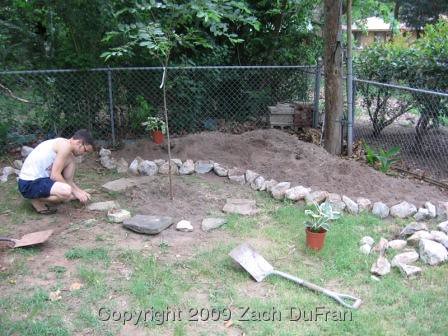
Our beloved "corner garden" was installed during the Summer of 2006.  One corner of our yard was particularly shady, so there wasn't any grass growing there.  Additionally, there is an unsightly utilities pole in that corner.  We decided to create a corner garden by erecting a wood fence inside of the corner of our yard and building a tiered garden in front of the fence.  We were lucky enough to have some neighbors doing some landscaping which left over a huge pile of dirt.  They were happy for us to haul it off and we were happy to have some free dirt.  We weren't as happy about the 50+ trips we made with the wheelbarrow to haul the dirt, though. :)  We also came across some free rocks from a relative who wanted them out of her garden.  Those we loaded in a truck.

before_corner_garden
Future site of the corner garden. Rocks were just being laid out to form the shape and dirt filled in.
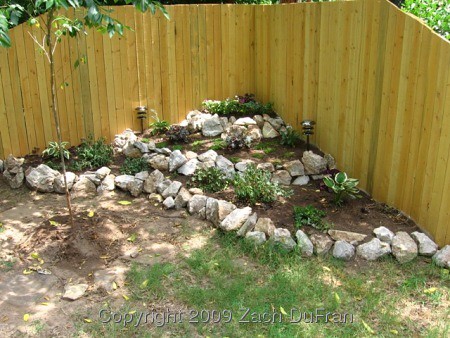
We used the rocks to create 3 tiers and hold the dirt in place.  We were very happy with the outcome of our garden.

corner_garden_v1
The corner garden once it was first complete (summer 2006).  None of the plants pictured are still in the corner garden.  If you look closely you will notice that the entire flowerbed is shaded.
We vigorously planted the corner garden the first year and it looked very nice for the first two years.  The Hostas got larger and several of the Heuchera (Coral Bells) came back.  The garden was starting to mature.

Change

However, during December of 2007 central Oklahoma had a really bad ice storm, resulting in the loss of a lot of beautiful trees.  Several of the scraggly trees from our neighbor's yard lost limbs that were responsible for shading the corner garden.  As a result, last summer most of the shade plants that we had established began to die under the intense full sun.  Several plants were removed and relocated before it was too late.  But the plants left a void.

current_corner_garden
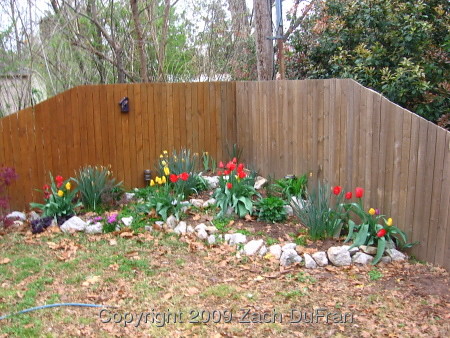
The current state of the corner garden.  It looks pretty good, but most everything green only lasts for a couple of months during the early Spring.  Soon it will all die back, leaving very little to look at during the Summer.
Right now the garden looks nice because it is filled with the colors of Spring bulbs.  But soon those will turn brown and die back until next Spring.  And there will be very little green left in our garden for the remainder of the Summer.

It's really sad, because the corner garden is a foundation of our backyard and one of our inspirations for continual improvement.  This year it needs some attention.

Revival

We are going to invest some of our gardening budget this year on reviving the corner garden with colorful perennials that are meant for a full-sun garden.  The goal is to have the corner garden looking great all year long.  At its current state, the corner garden only looks up to par during the Spring.

I have already ordered some Rudbeckias, which will provide color during the Summer.  We planted some creeping Phlox a couple of years ago, but it hasn't rebloomed until this year.  We're excited about that coming back.

I have also been thumbing through the plant catalogs and decided that the late Summer and Fall color will be attained by a collection of Asters.  Bluestone Perennials has an "Aster Collection," which includes 5 plants of different colors.  I can't remember the exact names of the plants, but there was a purple, a blue, a red and a white.  The value of the collection is that you get several different colors for a reduced price.  Lots of color and reduced cost sounds good to me!

Bluestone Perennials also has a bush to add vivid Fall color - Euonymus alatus compactus.  This shrub is commonly called "Burning Bush" because of it's bright red foliage in the Fall.  It also produces small red berries that remain after the leaves have fallen at the end of the Fall.

Euonymus alatus compactus - available from Bluestone Perennials
Dwarf Burning Bush (Euonymus alatus compactus), available from Bluestone Perennials.
And finally, we will need some evergreen plants mixed into our corner garden.  Sometimes I don't really consider green to be a color when it comes to plants, but compared to brown, dormant plants - green will do nicely.

I haven't figured out what type of evergreen plants to put in our garden.  I really like the junipers that we have planted around our garden waterfall.  Maybe I'll plant something like that, but I don't think the same type would fit with the feel of the corner garden.  I've got some time to think about that, though.

Expansion

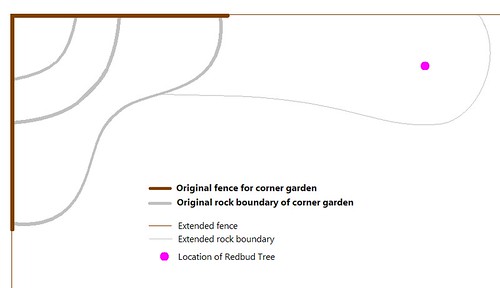
While the year-round color is a goal we expect to cover this year, we have another short-term goal that will probably be done in the next two years.  Last Spring we transplanted a Redbud tree along the fence line, about 10 feet away from our corner garden.  We have been talking about expanding the corner garden along the back fence line (to the right with respect to the corner) to enclose the Redbud tree.

Here's a little sketch of the existing corner garden and original fence backing (in bold) and the planned extension (fainter line).

corner_garden_expansion
Sketch of my plan for expanding the corner garden
The existing corner garden has 3 tiers, but the extension will only be for the lowest tier level.  It will allow us to plant some more things, including some larger items, like the small "Burning Bush" shrub shown above.

What do you think of our planned expansion?

Monday, February 23, 2009

Second Chances

I like to grow all kinds of different plants.  Some plants I pick for their foliage, others for their blooms, and still others for their unusual appearance.  Some plants thrive in my care and some others don't.  Occasionally some even die.  Whether it was my fault or simply a plant destined to death because of an unseen illness when I purchased it.

Every plant deserves a second chance, right?  [With the exception of Coconut palms.  I don't think I can ever grow one of those things.]

I have given quite a few plant species second chances in my care.  Last week I posted about my Philodendron 'Xanadu', which is just one species of plant I gave a second chance.  The first 'Xanadu' I purchased died about a month after I purchased it.  My second seems on it's way to a long and happy life in my care.

This post is about three particular plants that survived when given a second chance.

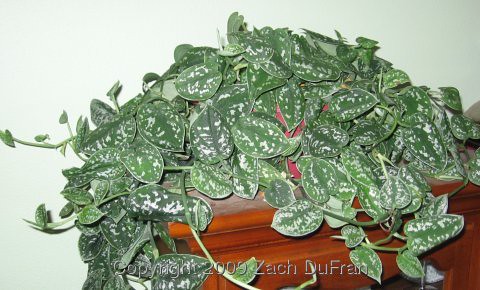
Scindapsus pictus - Silver pothos, Satin pothos
This is one of my very favorite plants is it's on my 2nd chance list!  How about that?  Actually, this plant would be one of my very favorites even if I had to give it a thousand chances and never succeeded in growing it.  It's just one of the most beautiful plants I've ever seen and no amount of struggle in growing it would ever dampen my admiration.  Thankfully, I haven't struggled too much to grow this one.  I just had a bad first experience with the plant.
scindapsus_hutch
Scindapsus pictus
Many small houseplants are put in stores mere days after being potted.  That's right, most houseplants are grown in big factories where they place cuttings in hydroponic chambers and force roots to develop.  When I bought my first Scindapsus pictus, I promptly repotted it when I got home.  I think it is possible that I tried to repot the plant when it still had rather immature roots.  The roots that grow in water have to adjust to actual soil conditions once they are transplanted.  The trauma of two transplants within a couple of days might have been enough to do this plant in.  The other problem was that I probably didn't have the plant in enough light.  I'm sure it was being grown in a greenhouse in Florida.  Believe it or not, a greenhouse in Florida receives more light than a shady windowsill in Oklahoma.  That's just how it goes.

Now that I have given the plant a second chance, I have a really nice specimen that has been growing at my desk at work for about a year and a half now.  I have taken some clippings from my office plant and potted them in a pot with a stake, hoping to train the plant to climb the stake.  About a month ago, I bought a large hanging Scindapsus for home.  It's the plant pictured above.

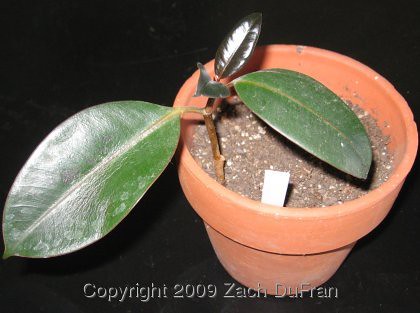
Ficus elastica 'Burgundy' - Burgundy Rubber Plant
I bought a small burgundy rubber plant a couple of years ago.  I think there were 3 or 4 stems in a small 4" pot.  I knew that they were fairly common houseplants and therefore probably not very hard to grow.  I expected mine to get large and so I repotted my little plant in a much larger pot shortly after I got it.  I didn't know at the time, but this is not a good idea.  Ideally a plant should be in a pot that is about 1-2 inches wider than the plant's root span.  Most people understand that when you water your plant, the roots absorb the water from the soil.  But what I didn't realize is that when you repot a plant in pot that is much wider than the root span, the roots will not absorb the water in much of the soil and the soil will stay wet much longer.  I'm almost certain that this is what happened to my first rubber plant, which showed signs of root rot before dying.

The second time around, I purchased one single little stem in a tiny pot.  How can you not take a chance on an attractive $2 plant?
rubber_tree
Ficus elastica 'Burgundy' - Rubber Tree
This time around, I have kept my single stem in a small pot.  I have had to resist the temptation to pot several plants in larger pots, having learned from my experience with the rubber plant (and a couple of others that had the same problem).  After a month or two of stagnancy, my rubber plant has finally starting producing some new leaves.  This is exciting because the new leaves are very glossy and dark red.  Over time the leaves thicken and deepen into that unique color of purple green.

There are some large specimens of this plant in the hallways of my office building that I enjoy looking at each time I have to go upstairs.

The Ficus genus is an interesting group of trees, ranging from the small, very common Ficus benjamina houseplant tree and all of the fig trees to the unique rubber tree and the gigantic Banyan tree (Ficus benghalensis).  There are some Banyan trees that cover acres.  One such famous tree is located in Lahaina, Maui, Hawaii.  Another one is located at the Indian Botanic Garden.  I will be visiting the Hawaiian Banyan tree this Spring and will hopefully have some pictures to post here.

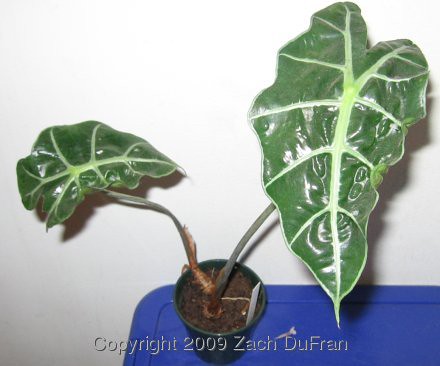
Alocasia amazonica - African Mask
I had one of these plants probably about 8 years ago.  I can't even remember how long I kept it alive or how it died.  I remember seeing it for the first time in a little houseplant store that opened on Main Street here in town.  My first reaction was that it reminded me of a Pterodactyl.  For some reason, the store had decided to start a plant business and buy about 100 of each of 3 different plants.  I'm not kidding - they had about 100 pots of 3 different plants (4 at most).  At least, that's how I remember it.  One of the plants they had decided to sell was Alocasia amazonica.  I'm not sure what their business plan was.  I guess it was to turn everyone in town into a fan of those three species.  Needless to say, the store didn't last very long.  Unfortunately, neither did my plant.  The two events were unrelated.  At the time I wasn't all that interested in plants and I think mine just got neglected.

Since then my plant habits have changed quite a bit.  I'm more likely to overcare for a plant now than to ignore one.  I bought a small pot with two Alocasia amazonica bulbs/stems just a couple of months ago.  My plant hasn't changed much - just grown taller - but I don't seem to be having any trouble keeping this one alive.  I imagine this summer my plant might produce a couple more bulbs and leaves whenever it is in happier growing conditions.  One of the two stems sort of collapsed recently, but it has been growing okay with a thin dowel rod as support.
a_amazonica
Alocasia amazonica, or as I like to say, the "pterodactyl" plant
Alocasias are from the Aroid family, of which I am a collector.  They are pretty closely related to Colocasias (another Aroid genus), which are the plants commonly called "Elephant Ears."  There are approximately 70 species of Alocasias and quite a few cultivars.  They are grown for their stunning, and often very glossy, foliage.

Tuesday, January 27, 2009

Keeping a plant journal

My Plant Journal

Since October 2008, I have been keeping a plant journal.  I have a thing for journals and little blank books, so I had a bookshelf full of them.  My intention was to fill them with my important thoughts over the years, be it a novel, lousy sketches or a journal.  I was thinking that I really needed to start keeping track of important events concerning my plants and decided that one of my little blank books was perfect for the job.

My current plant journal is a small earth-tones journal made by Paperblanks from their "embellished manuscript" collection.  I chose the Vincent van Gough journal because of the small garden scene drawn on the front.  They also make a couple of Mozart and Beethoven journals with music on the front, as well as Rembrandt sketches and even Shakespeare's writing.  On my journal, the wrap over piece magnetically attaches to the front.  The journal measures 7"x9" and has 144 lined pages.  The pages have just the right number of lines to be spaced correctly for my handwriting.  Paperblanks makes a bunch of really cool looking journals, including some with Asian art on the covers, while others are simple leather-bound books.  I purchased mine in the gift shop of Nathaniel Hawthorne's house in New England.  But I have also seen them sold at several local book stores. :)

I have been using my journal to keep track of when I purchase new plants, where I got them and how much they cost me.  Then I track when they bloom, when I notice anything weird about my plants, when I bring them in, put them out, prune them, etc.  It has been a fun experience and I think it will prove valuable as I continue forward and wonder when certain things happened.  It is also a nice compliment to my blog.  I will write in my journal as things occur and then blog about them on a more regular (twice a week) schedule.  So, even though I took a trip to a wonderful greenhouse a couple of weeks ago, it's not going to be on my blog for a couple more weeks.  In the meantime, my journal (and my camera) will hold all of the important information that I need to remember for my blog post.

My Gardening Sketchbook

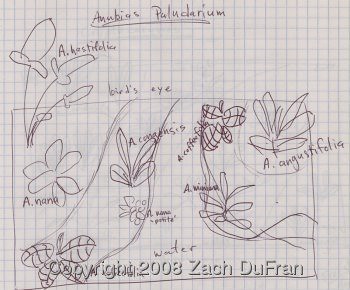
One day I wanted to sketch up a little idea for a terrarium that I wanted to plant.  But I wanted to be kind of messy and my plant journal was much too neat for this activity.  So I grabbed another journal - one of those lab books with the black and white marbled covers and gridded pages for drawing plots easily.  This journal has become my sketchbook for when I want to be messy and make plans.

anubias_sketch
Sketch of my plans for a 10 gallon Anubias paludarium
I have drawn up some plans for different terrarium and paludarium plantings, some sketches of my greenhouse plans and also made some lists of plants I would like to order.

greenhouse_sketch
Initial planning sketch for my greenhouse
These two journals are very separate things in my mind.  In my plant journal I use pencil and write pretty neatly.  In my sketchbook, I use a pen and scratch things out.  It's much more messy.  It's kind of like my two journals are for the two halves of my brain.

Do you keep a plant journal?

Wednesday, December 31, 2008

Planty Resolutions

At this time of the year, everyone is making resolutions.  So I guess I will talk about what I plan to do for this next year.  More than resolutions, these are my goals.  The first four goals apply to this blog directly and the last five apply to me and my plants.

  1. Continue posting at the rate of 2-3 times per week.  I started this blog a year and a half ago, but only began posting at regular (frequent) intervals a couple of months ago.  So far I have not had trouble coming up with at least 2 posts a week.  I hope to keep that trend throughout the year.

  2. Review about 1 plant book a month.  Even if I don't read one new plant book each month, I have a backlog that should last me the full year - all I need to do is write the review.

  3. Write a "trip report" about once a month.  This will be a little trickier, as I don't know off the top of my head 12 different places to visit and write about.  But I will give it a shot.  More than likely this will become more of a quarterly post, or just as they occur.  I won't hold myself to the month interval, since my vacations tend to be distributed more heavily towards Spring and Summer.

  4. Write a "project" post once a month.  I have written three posts that I tagged and categorized as "projects."  I foresee more of these in the future, as I plan to write about my successes and failures of making hypertufa pots and terrariums.  We'll see what else I get my hands into.

  5. Start a collection of Asarums (Wild Ginger).  I have had just one species of Asarums in the past, but I've been saving up some money so that I can order 2 or 3 varieties from Asiatica Nursery and begin a real collection.  [I'm not sure if I want to start the collection in the Spring or wait until the Fall, since they will thrive in my cool, dark house overwinter.]  I received a collector's book on Asarums for Christmas that I will be posting about soon - stay tuned!

  6. Grow some of my own food.  During the summer of 2008, we grew about 5 tomatoes (maybe less) and 3 limes.  For the summer of 2009 I have some ambitious plans to grow: tomatoes, potatoes, kiwi (will not have fruit this year), and broccoli.  Last year I tried broccoli, but the plants kept getting eaten by some caterpillars.  I don't have a lot of room for gardening in the sun, but I am going to try growing the tomatoes and broccoli in pots this year, so that I can move them into the appropriate full sun locations and save my ground space for potatoes and kiwi.  The kiwi will take a couple of years before fruiting, but I want to get them in the ground this year.  The potatoes (my favorite vegetable) will also be a new venture for me.  Wish me luck!

  7. Vigorously plant front figure 8 bed.  We have a wonderful front flowerbed in the shape of a figure 8 that is filled with red and white tulips in the Spring.  The rest of the growing season it gets invaded by grass.  We have tried putting down tarp and covering with mulch after the tulips are finished, but that's just not very pretty.  Last year we planted potato vine, which was great.  The only problem is that we didn't plant enough.  This year I want to plant sooner (while the tulips are just finishing their blooming) and plant about twice as much.  If I stay on top of watering them at first, they should really fill out the bed nicely and keep the grass out.

  8. Fertilize. I have never fertilized any of my own plants before.  Some of my plants have not bloomed for me - ever.  Are these two items coincidental?  I think not.  I was very happy not fertilizing my plants, but I have committed to fertilizing regularly starting this spring.  Maybe I will get my Walking Iris, Shell Ginger and Bougainvillea to bloom this year!

  9. Recreate the corner garden.  Two years ago we started a beautiful little corner garden in our backyard.  At the time it was a shade garden.  After the ice storm in December 2007, it became a full/part sun garden, since the trees hanging over the garden were destroyed.  To make matters worse, the small cherry tree we had planted in front of the garden has since died, so we can't hope for it to one day shade the garden.  And I can't count on my tiny Japanese Maple to provide shade anytime soon.  This last summer the garden suffered because I had planted it with shade perennials (hostas and coral bells, mostly).  Now I need to either rethink the garden or plant a new shade tree so that this garden can return to form.  I've been thinking about planting a ginkgo tree ever since I saw one last fall that was a beautiful solid shade of yellow.  What do you think?

Well, that does it for now.  Those all seem like doable goals.  And each one of them will probably result in a couple of posts.  I'll keep you updated.

Thursday, December 18, 2008

Why "The Variegated Thumb?"

This post really should have been my first post on this blog.  But it wasn't, and that's probably for the best.  There are actually a couple of people who read my blog now. :)

You may have (although probably not) wondered why I named my blog "The Variegated Thumb."  If you have wondered this, I wonder what you decided.  Did you decide that I am simply a lover of variegated plants?  Or maybe that my green thumb is not full photosynthesizing - implying that my skill with raising plants is sometimes lacking?  Pretty much anyone who knows a thing or two about plants (and by a thing or two, I mean things like "plants have leaves" and "plants can grow from seeds"), knows the common "green thumb" moniker applies to those who have an uncanny ability to grow any and every plant they toss in a pot or pile of dirt - or dark closet for that matter.

Well, I guess I took that oh-so-common moniker and modified it for a couple of reasons.  First, although some might confuse me for a green thumb because my house is filled with plants and I spend a lot of my free time tending to them, I don't consider myself a green thumb.  Maybe I'm trying to be modest, but I think it's more likely honesty.  I have more than once found myself killing a plant that I thought would be easy to care for - and I didn't even shove the plants in a dark closet! Now don't go thinking that I have a brown, black or dead thumb.  I have never killed a silk flower.  And I have grown a number of plants quite successfully, some of them considered difficult.

A variegated leaf, while having many cells that do photosynthesize, contains a variable number of cells which do not photosythesize and are usually white.  I feel that explains my success with plants rather well.  I just don't quite consider myself attaining the title of Green Thumb -- yet.  I'll consider it a future goal of mine.

Now, if you were one of those people thinking I named this blog after my love of variegated plants, don't let your heart be crushed.  (whispering) I'll let you in on a little secret... That was part of the reason, too. Actually, it was a big part of the reason.  The Variegated Thumb just matched me so well because of the abstract discussion above, as well as the fact that I tend to look for the not-so-ordinary in plants.  I know, variegated plants are a dime a dozen these days.  But you have to admit, they are more rare than non-variegated plants.  Most of my favorite plants fall in to the variegated category - from the Aglaonema genus to Scindapsus pictus.  If they aren't variegated, there is usually some other not-so-ordinary attribute for which I have picked the plant.  I really like to find the unusual, rare, exotic and quirky plants to put in my collection.

So, The Variegated Thumb is much more than a catchy name for my blog.  It describes me and my experiences with the great Kingdom Plantae.

Monday, October 27, 2008

My Heteroblastic Hobby

I started a plant journal (on paper) in the last month.  I decided to start keeping track of my plants as they grow, as well as document any new plants I get.  I have spent most of my journaling time not talking specifically about my plants, but about plant knowledge I have gained recently.  When Russ sent me a box stuffed full of Aroids, I did a lot of image searching of the different plants he had sent me.  A number of these plants have 2 distinct leaf habits, which is common among many Aroids, especially Philodendrons.  Leaves in the first stage - the immature or juvenile stage - are usually smaller and more simple looking.  Although sometimes the juvenile leaves are more colorful.  When the plant matures leaves can become much larger and often develop splits or holes.  This maturation process is usually instigated by the plant beginning to climb high up the trunk of a tree.  The splits and holes in the leaves enable the large leaves of the plant to be more resistant to wind.  The Epipremnum pinnatum v. 'Cebu Blue' that I received from Russ has small, lance-like, pale blue leaves.  As the Cebu Blue matures, the leaves can grow to several feet and have large splits in them.  If you are not familiar with this characteristic of many Aroids, you would find yourself trying to convince me that these could not be the same plant.  But they are!

Many plants displaying the 'immature' habits are called 'shinglers.'  I found an International Aroid Society article about these.  The immature flat, round leaves lay up close to the climbing surface, sometimes overlapping and looking like shingles.  One of the best examples of a shingler is a Scindapsus pictus.

I just learned today that the characteristic of multiple distinct leaf habits is called heteoroblastic development.  I think the word is a fitting analogy for my hobby with plants.  My hobby has recently gone through a transformation that makes my old hobby look like a different species of hobbies.  But it's the same me and the same love of plants that's underlying this hobby.

Here's some other miscellaneous knowledge that I recently gained.  Several times in picture captions I have seen a Genus name and then the word 'NOID.'  'NOID' means 'No Identification' or 'Not identified.'  From what I can tell, this can mean that the person does know what species the plant is, or it has literally not been classified yet.

Also, I've known that v. stands for 'variety' but I had never even seen 'f.' before until Russ was identifying one of my Aglaonemas as A. commutatum v. maculatum f. maculatum.  Apparently f. means 'forma.'