Showing posts with label native. Show all posts

Thursday, February 21, 2019

Milk Jug Germination

Spring will be here before we know it. Already I am seeing a few blooms on my quince bush, buds on our Daffodils, and leaves from our tulips are breaking through the surface of the soil.

I have seeds of several milkweeds that I would like to grow this year, including three native Asclepias and one Calotropis native to Africa and Asia. The American natives all require cold stratification. I have most of the seeds in the refrigerator, but I am starting a few others using a different method. 

I cut open two milk jugs and added soil to the bottom of the jug. I scattered some of my seeds on the top of the soil, watered them in, and then taped the jugs closed. I’ve sat the milk jugs outside on the ledge of my greenhouse. Hopefully they won’t blow over or become dog chew toys there. With any luck, they will experience the requisite cold period and then will germinate in about a month when the temperature begins to climb and the days get longer and they’ll have a head start in their little biodomes. If it doesn’t work, no big deal. I only used part of my seed stash on this experiment.

I did a little more reading on this technique and apparently it's important for the top cap to be removed. I was assuming more of a close greenhouse/terrarium setup was desired, but I will stick to the recommended method and remove my top caps.

Tuesday, January 22, 2019

Treaty Oak update 1

I've been trying to be patient and not disturb my little Treaty Oak seeds. I managed to go a couple of weeks without looking at the pot. Over the weekend I stole about 30 minutes to give my greenhouse a thorough watering and glanced at the Treaty Oak pot to see what was happening.

Seedlings from the Austin Treaty Oak
Texas Live Oak (Quercus fusiformis)
Yes! Four little seedlings have broken the surface and have leaves! Even at this tiny size, the leaves have a unique shape. The stems were growing towards the light, which was coming mostly from one direction, so I snapped a few pictures, rotated the pot, and put it back on the shelf. I am very happy to see that they are doing well. These are Texas Live Oaks (Quercus fusiformis). I plan to give one to my mother-in-law for Mother's Day, since this tree has some special significance to her. I will look for other homes for the other ones. I am not quite sure if they are hardy in central Oklahoma, but I think they will do well in southern Oklahoma, so I could plant some at my parents' lake cabin.

Monday, August 27, 2018

Trip Report: Exploring Austin, part 4

I've written about finding interesting Bauhinia, Catalpa, and Persimmon trees in the Austin area in previous posts.

Mexican Buckeye (Ungnadia speciosa)
On my first morning in Austin I went to a small natural area known as Stillhouse Hollow Nature Preserve, nestled into a neighborhood. The sign at the entrance told about an endangered species, the Karst Invertebrate, which lives in limestone caves. This area is also home to the endangered bird species Golden-cheeked Warblers and Black-capped Vireos. There is a nice path through this park and then an overlook. Near the overlook are signs asking that people stay on the path and respect the native flora and fauna, one of which is this endangered species living underground. I would have loved to explore off the path and find this little cave dweller, but I stuck to the rules and observed from the path only.

Mexican Buckeye (Ungnadia speciosa) seed pod
One item of interest off the path and out of reach was a shrub that had distinct seed pods. After using iNaturalist to identify this as a buckeye I assumed this was a species that I had seen in bloom once or twice before, one of the Aesculus genus. However, I learned that this was a Mexican Buckeye (Ungnadia speciosa). Thankfully even though this plant was well off the path, I came across this plant at nearly every other park I visited in the Austin area and was able to collect seeds from other plants.

Photo by iNaturalist observer caliche_kid.
I researched germination methods for each of the species I brought home. Most require some form of cold stratification and spring planting. This species was the exception, suggesting germination of fresh seeds. I went ahead and planted some of the seeds, setting aside some others to try in the spring if this first batch wasn't successful. In the week after planting the seeds we had consistent rains every few days - unusual for August. After just 10 days I noticed that the seeds had sprouted and were growing vigorously.

Mexican Buckeye (Ungnadia speciosa) seedlings - off to the races!
10 days after planting
Mexican Buckeye (Ungnadia speciosa) seedlings.
15 days after planting.
I'm not exactly sure where I will plant these bushes. From what I can find online they are probably only hardy in zones 8 and greater, but I think my parents' land near Lake Texoma (zone 7b) might work. I'll probably wait to see how many plants I have. If I have plenty then I'll test some in that climate and keep others potted in my greenhouse as insurance.

Friday, August 24, 2018

Trip Report: Exploring Austin, part 3

In my last two posts I talked about plants that I found along the Colorado River in downtown Austin.

On a different day I went to St. Edward's Park to do some birding and I noticed one tree had small green fruits on it - about the size of a pecan with it's outer green shell still attached. iNaturalist to the rescue again, I learned that this was a Texas Persimmon Tree (Diospyros texana). My admiration for native Persimmon trees is well known to readers of this blog, and I was very excited to learn that there is more than one species that grows natively in the United States. I saw a larger specimen of this tree when I visited Mayfield Park and Nature Preserve, this one marked with a placard.

Texas Persimmon at Mayfield Park and Nature Preserve


I also found this tree growing at Commons Ford Ranch Metropolitan Park. I collected a couple of fruits and harvested the seeds. Since I had good luck germinating some native persimmons last year, I am trying the same method: removing all fruit from the seeds, placing them in a pot of soil outdoors, and leaving them alone through the fall and winter. I may move this pot into a slightly warmer spot over the coldest part of the winter, just in case they aren't quite as hardy as I'm hoping, but I do want them to experience the cold they would naturally in the Austin area. Here are some photos of the fruits and flowers by other iNaturalist observers.

Photo by iNaturalist observer butterflies4fun.
Photo by iNaturalist observer manesalinas.

I've done some research on this species (good info here and here) and found that it is likely hardy where I live in central Oklahoma, so I plan to try growing in here. It is also a recommended species for greater landscaping use, being small, nicely formed, attractive bark, naturally feeding wildlife, and drought tolerant. As the placard mentions above, the fruit is small but edible. Hopefully I'll have a chance to try one some day.

Wednesday, August 22, 2018

Trip Report: Exploring Austin, part 2

In my last post I talked about finding a native species of Bauhinia along the Colorado River in downtown Austin.

Catalpa leaves and seed pods

Also along this path I came across a large Catalpa tree. I am familiar with these trees growing in Oklahoma. They are easily distinguished by their large leaves, showy flowers in the spring, and long green seed pods through the summer into the fall. The tree along the path was in seed pod stage and the pods were longer and more slender (pencil size or skinnier) than those I am used to seeing (finger size or thicker). Comparing images on iNaturalist and reading some articles online, I believe this is the Northern Catalpa (Catalpa speciosa), whereas the species I see at home is the Southern Catalpa (Catalpa bignonioides). This is a bit ironic since I am finding the northern species to the south of where I am used to seeing the southern species. Anyway, I believe this is correct.

Catalpa seed pods
True to form, I collected the seeds from these long seed pods shown in the photo and will plant them next spring.

I have a few more posts related to my time in Austin, so stay tuned!

Monday, August 20, 2018

Trip Report: Exploring Austin, part 1

I spent two weeks in Austin this summer, taking a training course to be a Red Hat System Administrator. In the evenings I traipsed around the metro area, birding in local parks and natural areas and doing my normal thing - observing and logging everything new species (to me) using the iNaturalist app.

I visited 10 different parks during my two weeks and covered a lot of ground. I observed a few new species of birds (Black-crested Titmice, Least Grebe, Pectoral Sandpiper), several new dragon/damselflies (Swift Setwing, Marl Pennant, Kiowa Dancer, Dusky Dancer, Checkered Setwing, American Rubyspot), several new plants, and even found a nice gastropod fossil. But this is a plant blog, so let me dive in to more detail about some of the plants.

Small bilobed leaves of the Anacacho Orchid tree (Bauhinia lunarioides)

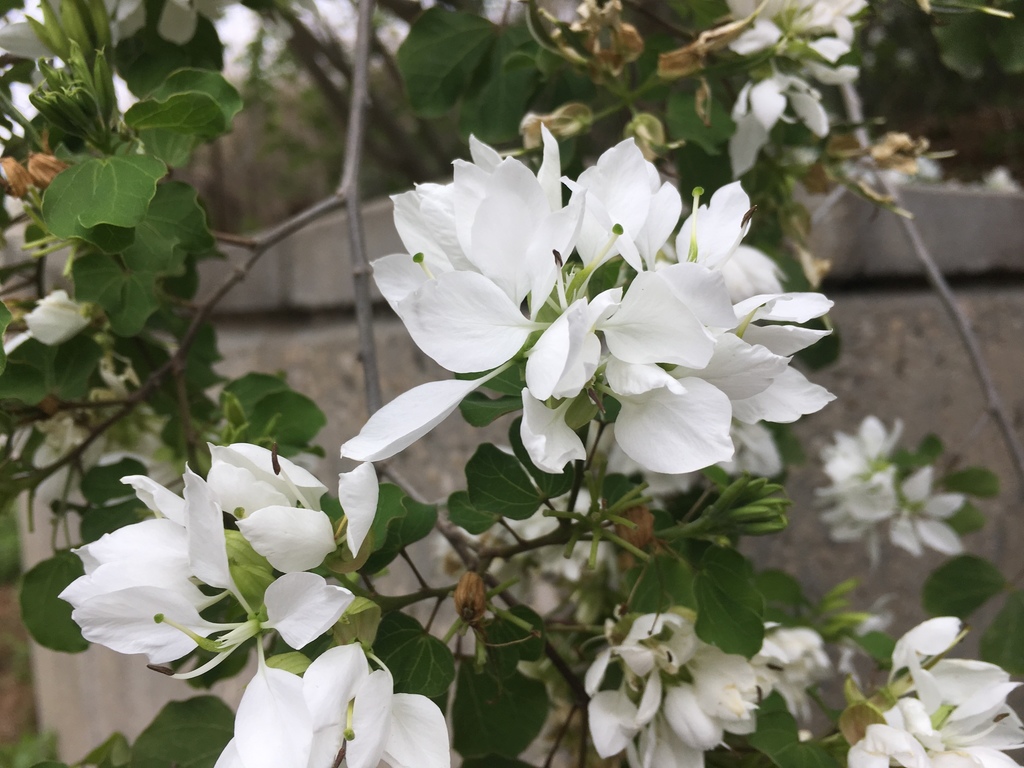
Along the Colorado River in Austin there is a nice walking trail that is well used by locals walking their dogs, cycling, and jogging, as well as to observe bats at the Congress Avenue Bridge. (I sort of stumbled along this myself and was treated to quite the spectacle around sunset.) Along this path I came across a couple of really neat plants. The first was a small shrubby tree (probably about 6' tall and about the same width that was covered in opened seed pods. There was nothing too remarkable about the tree except that the seed pods had all split open in a spiraling fashion and they were pretty conspicuous. Upon closer examination I realized the leaves were the distinct shape of a Bauhinia, which greatly excited me. I took some photos and uploaded the observation to iNaturalist, which suggested the name of Anacacho Orchid (Bauhinia lunarioides), a native of central and southern Texas into northern Mexico. This species has small and deeply split leaves, almost appearing as two leaves. The flowers (which appear in the spring) are white (or occasionally pink) and showy. I don't have any of my own photos of flowers to show, but the photos below are from iNaturalist observations (here and here).

Photo by iNaturalist user anschad.

Photo by iNaturalist user johnkarges.

Of course I collected a handful of seeds and brought them home for experimentation. I have started other species of Bauhinia from seed and they have germinated easily and been a fairly easy plant to grow, although they are tropical and cannot winter outdoors in my climate. This species appears to be a little more hardy, but not enough (zone 8) to overwinter in central Oklahoma (zone 7). It's not clear to me whether the tree was growing naturally along the path or had been planted there. I'm guessing the latter but who knows?

Part 2 coming later this week!

Tuesday, May 22, 2018

Update: Native persimmons

You may recall that last year I collected a wild persimmon and planted the seeds. I put these in a pot outdoors and just let them be - no water, no attention whatsoever. I figured the less I messed with them, the more likely they would be to germinate.

Persimmon tree (Diospyros virginiana)
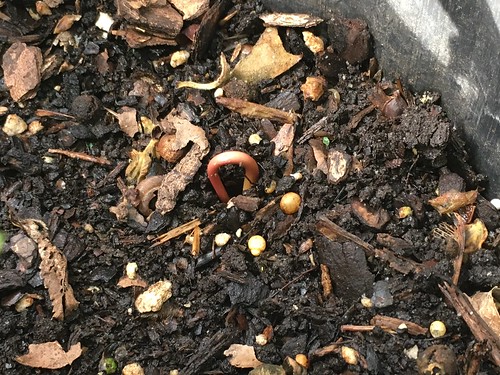
Persimmon tree (Diospyros virginiana) beginning to sprout from the soil.
It appears my gambit worked! I have one little tree that sprouted from the soil in late March or early April and another one is breaking through the soil now. (And I'm pretty sure it's not a pecan or oak tree planted by a neighborhood squirrel, which is what usually comes up in my pots that sit outdoors...)

Persimmon tree (Diospyros virginiana)
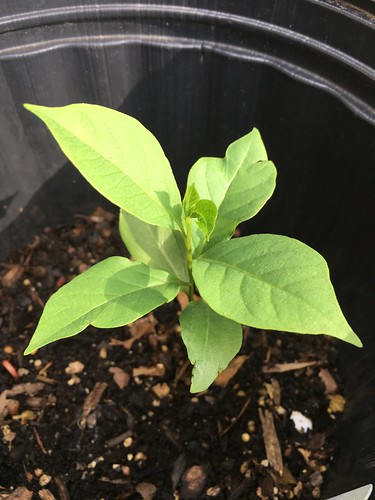
Persimmon tree (Diospyros virginiana) growing quickly.
The funny thing is that just a week before the first tree sprouted I placed an order from a plant catalog and included two small persimmon trees, so it looks like I may soon have persimmon trees coming out my ears and I don't really have a plan for where to plant them!

I know my mom would love to be able to pick persimmons from her own yard, but I also know that these native persimmons are not the ideal candidates for cooking. And I also realize it will be years before the trees are large enough to bear fruit...

I do have access to land where I can plant these, so maybe I'll start a little grove there.

Tuesday, April 24, 2018

Update: Native Asclepias

Last year I transplanted some native Asclepias from some family property where they were growing wild into my own flowerbed. A couple of them stayed green for the remainder of the summer, so I was hopeful that they were establishing. At least one other appeared to have dropped dead.

Asclepias amplexicaulis (transplant)
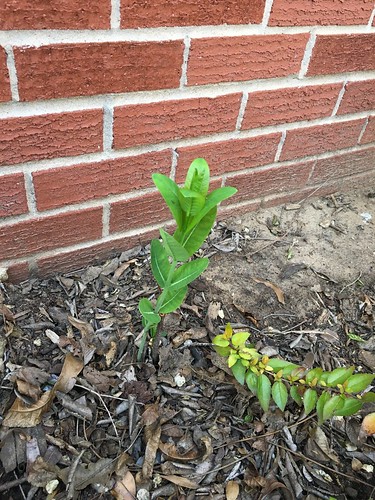
Asclepias amplexicaulis emerging about 9 months after the transplant
I was really surprised to see the one that looked the least likely to have survived sprung up first this Spring! It is also one of the less common species in this area, so I am really happy it survived the transplant. I have confidence I can keep it alive (even with little to no care) now, considering it is an ideal plant for our hot Oklahoma summers and cold winters.

I don't know about all of the transplants yet, but I can see that at least one other plant, Asclepias tuberosa, is beginning to emerge. I'm very excited about having these native, butterfly-attracting plants established in our flowerbed.

Friday, September 29, 2017

New seeds

I don't have a lot of experience growing native plants from seed*, but I have a lot of stock to practice with over the next year.  I purchased some Asclepias humistrata (Sandhill Milkweed) seeds from eBay and the seller sent me two other packets of seeds to try - Cosmos and Ipomoea purpurea (Candy Cane Morning Glories).

Eleven packets of seeds for me to plant
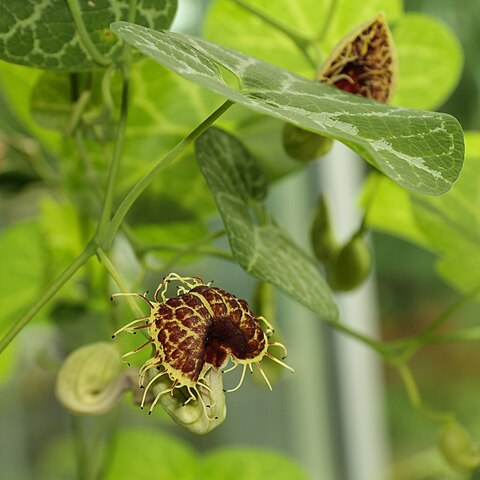
I have also been looking into growing some more native plants that host or attract birds and butterflies.  I came across a group on Facebook where one member was offering seeds to anyone who would pay for the postage.  She kindly sent me two envelopes full of seeds of butterfly host plants, including Maurandella antirrhiniflora (Snapdragon Vine), Asclepias asperula (Antelopehorn Milkweed), Phyla nodiflora (Frogfruit), Verbena bonariensis (Brazilian Verbena), Polanisia dodecandra (Clammyweed), Echinacea Cheyenne Spirit (Coneflower), Aristolochia fimbriata (White-veined Dutchman's Pipe), and Zinnia Zowie. 

Sandhill Milkweed (Asclepias humistrata) - courtesy of discoverlife.org

As I've mentioned before, I really like Asclepias, so I'm very excited about the prospect of growing these two species (A. asperula and A. humistrata) from seed.  The humistrata species (above) is not native to Oklahoma, but I think it will do well in my climate.  The Dutchman's pipe has some really funky flowers (below).  It would be cool to get this growing on my back fence.

White-veined Dutchman's Pipe (Aristolochia fimbriata) - courtesy of Wikimedia

Now I just need to find good places to plant them all!

* This is sort of funny because I have one and only peer-reviewed journal publication to my name and it is titled "Experiences growing aroids from seed."  I have had success growing aroids, but haven't tried many plants from other families from seed.

Thursday, August 31, 2017

Native Asclepias

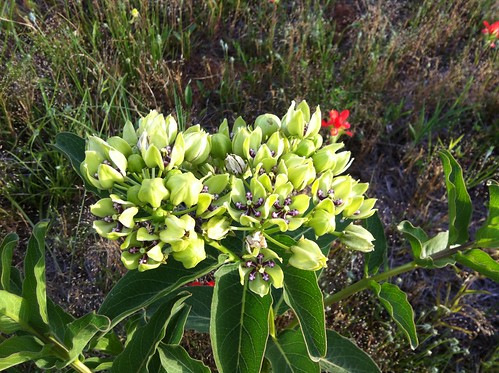
For several years I have been fascinated by Asclepias, one of the many plants given the common name of "milkweed."  This is a genus consisting of more than 140 species of flowering perennials native to North America.  Here in central and southern Oklahoma there is one species, Asclepias viridis (Green antelopehorn), that is prolific. There are three other species (A. tuberosa, A. amplexicaulis, and A. asperula) that I have seen in this area in smaller numbers. The USDA website lists 25 species of Asclepias that naturally occur in Oklahoma, which is surprising to me!  Some of those occur just in the western-most county of the Oklahoma panhandle.  Others occur just in the far eastern-most counties.  Oklahoma does have a lot of habitat diversity.

Asclepias viridis
Asclepias viridis

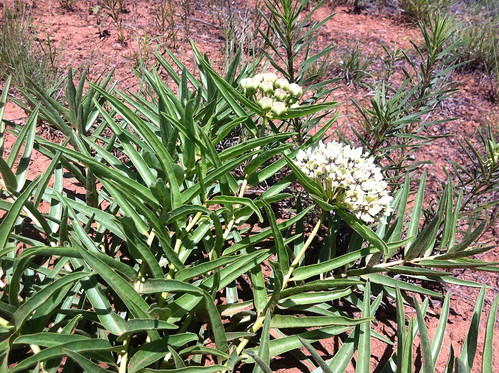
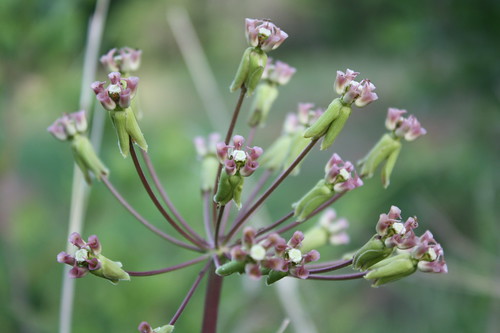
Asclepias asperula
Asclepias asperula
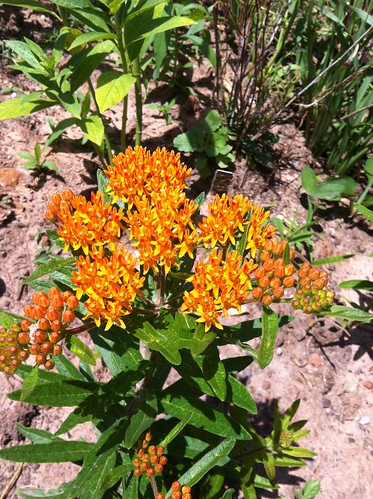
Asclepias tuberosa
Asclepias tuberosa
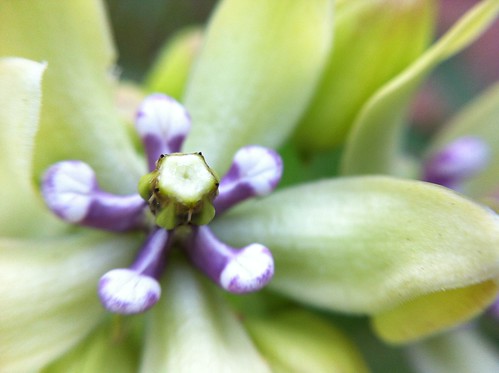
Asclepias are interesting plants for several reasons. They are a host plant for the endangered monarch butterflies/caterpillars, as well as many other species of moths and butterflies (Lepidoptera). Gardeners interested in planting native plants that attract butterflies and other local wildlife are fond of several species of Asclepias. Some species have really beautiful flowers and others have really strange flowers. When you look at Asclepias viridis up close it reminds me of the metallic looking passionflower from the THX sound test video.

Asclepias viridis
Asclepias viridis macro photo

Asclepias amplexicaulis
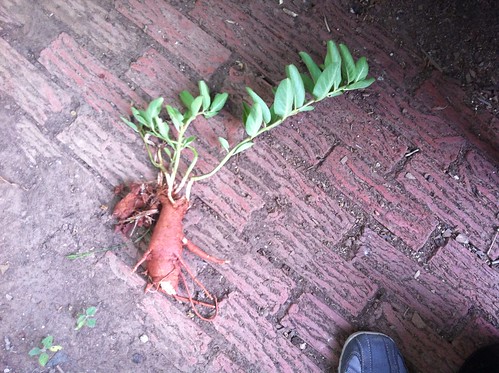
I have tried to transplant some Asclepias viridis from the wild into my yard on a few occasions. It is difficult because the root system of the Asclepias consists of a really large single tap root (like a paper towel roll that goes deep into the ground. Unfortunately the native red soil that these plants are growing in is hard and the root is brittle, so it easily snaps as you try to loosen the soil around it. Recently I dug up several species of Asclepias after we had had some rain, so the soil was a little more cooperative. I retrieved 3 viridis, 1 amplexicaulis, and 1 tuberosa.

Asclepias
An unsuccessful Asclepias viridis transplant from a few years ago.
Check out that root!

Chinese Bushclover (Lespedeza cuneata)
Successful transplant of Chinese Bushclover (Lespedeza cuneata) - an introduced species.
While I was digging up these plants my eye was drawn to some small-leaved flowering plants that were growing in good numbers nearby. I dug up a couple of these to try as well. I used my new favorite app, iNaturalist, to help me identify the unfamiliar plants and found that both are Lespedeza (Bushclovers). One is a native (L. virginica) and the other is a semi-invasive introduction from Asia (L. cuneata). Although I shouldn't be, I'm always a little surprised when I come across an introduced species in a place that I think of as undisturbed by humans. The truth is that humans aren't the only ones to introduce new species to a property. Birds, furred animals, and even the wind are perfectly capable of transporting seeds that were introduced anywhere on the continent.

transplanted Asclepias tuberosa
Asclepias tuberosa successful transplant

transplanted Asclepias viridis
Asclepias viridis successful transplant
I am hoping that my transplants survive this time around.  They all wilted within the first day, but some had the appearance of "I'm just thirsty and don't appreciate the change in scenery" wilted, whereas some had the "you killed me!" wilted.  Now that they have been in the ground for a couple of weeks I can tell that three have survived, two viridis and one tuberosa.  The others are most likely deceased, but could surprise me by putting up new growth from the roots.  You just never know.

transplanted Asclepias amplexicaulis
Not so successful Asclepias amplexicaulis transplant

Thursday, September 23, 2010

Trip Report: Skunk Cabbage in the northwest

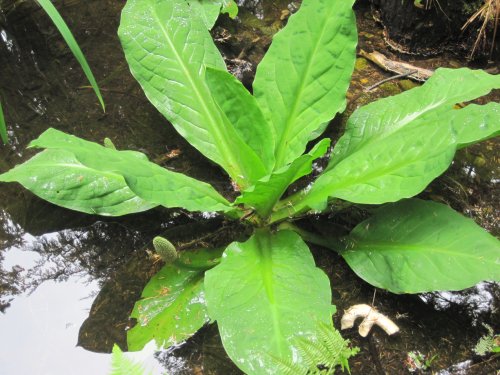
On our trip to the northwest back in June, Christie and I ran across the Western Skunk Cabbage (Lysichiton americanus) in several different locations.  I hadn't seem them in person before, so I didn't initially recognize them.  Actually I had a kind of hilarious encounter with one several days before realizing what it was.

skunk_cabbage
Skunk Cabbage (Lysichiton americanus) growing in a pond at the Capilano Suspension Bridge park
Here's the story:

I spend quite a bit of time around plants: at my own house, in plant stores, in nature.  I'm always pointing out different things to Christie: grabbing a leaf and pointing out something about the variegation or vein pattern or something else she probably is not too interested in.  Anyway, because I am used to dealing with plants, I can usually tell by looking at a plant what kind of care I need to take in handling it.  Well, for whatever reason this was not the case with the Skunk Cabbage.  We were walking along a hiking trail on this insanely long walk down to a beach from the road.  (The distance was not advertised, but we determined later it was approximately seven times longer than we would have preferred.)  I noticed something interesting about the plant along the side of the path (though I don't remember what was interesting now) and I called Christie's attention to it.  I grabbed the leaf, pulling it towards us and RIP!  This huge, beautiful leaf (about 3 feet long) just tore in half in my hand!  It wasn't a horrible loss considering there were hundreds of these plants within eyesight, but I felt horrible about it.  And it was pretty hilarious because I was like "Hey Christie, check out this - "  RIP! "Whoops!"

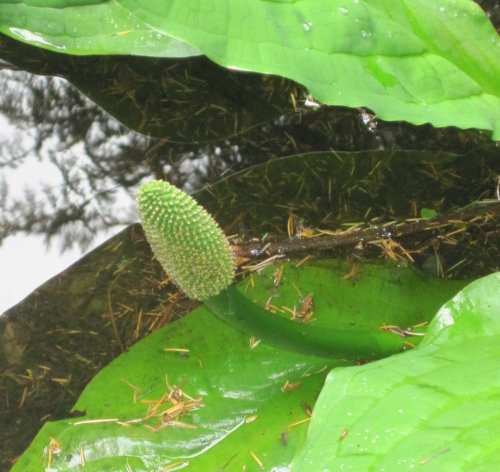
Anyway, that's the story.  It was several days later when we were in Vancouver at the Capilano Suspension Bridge park when I saw the spadix left over from an inflorescence on one of these plants.  That was when I realized what it was.  I think we got down close to it and could still smell the leftover stench of the bloom.  In the area where there were several of these plants it smelled like you were standing near a dumpster.  There wasn't an overwhelming smell, but you could definitely smell it.  We saw the spadices on several plants, but none still had the nice yellow spathe left.

skunk_cone
Skunk Cabbage inflorescence

Thursday, September 16, 2010

Native Orchid

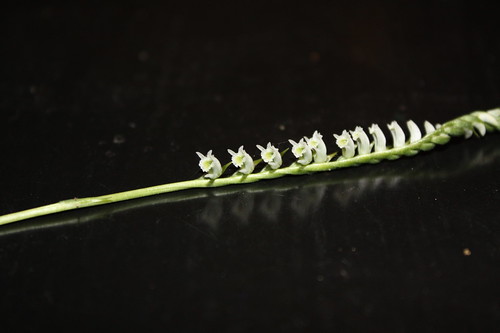
I was walking around my front yard talking on the phone this week and I reached down and plucked a flower stem off of a "weed" growing in my yard.  As I was walking around I started looking at the flower spike a little more closely and noticed that the flowers were very intricate and attractive, although very tiny.  In fact, they looked a lot like an orchid.

IMG_4144
Spiranthes lacera var. gracilis
The flowers spiral up the stem as they open and are all white, except for some yellow in the "throat."  I emailed a picture to my orchid friend, Steve, who lives in Arkansas.  He knows a lot about miniature orchids and natives, so I thought he might be able to give me some guidance.  He was familiar with my plant and told me it is called "Nodding Ladies' tresses" from the genus Spiranthes, possibly Spiranthes cernua.  There are a couple of other species that look very similar, as well.

[2010-09-24 Update:  I got a positive species identification on this plant.  It is Spiranthes lacera var. gracilis.  Thanks to the Native Orchid Conference mailing list for the ID help!]

Steve said that he has seen these in his yard before too and that he is amazed by their hardiness and survivability in mowed lawns.  Since I plucked mine before realizing what it was, I don't really know where I grabbed it or what the rest of the plant looks like, but Steve tells me it is a very non-descript grass like plant.  I'll keep my eyes peeled for more flower stems.

The USDA website shows that this plant is native to much of central and eastern North America.

Monday, August 31, 2009

Native grass bouquets

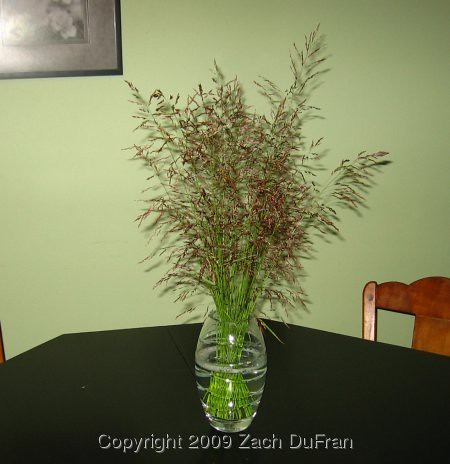
Over the last couple of weeks, I have noticed many different grasses going to seed along the side of the highways and interstates in Oklahoma.  There is one specific grass that has really cool, red seed heads.  I have said to Christie several times that we should stop and snip some to make a bouquet.  Yesterday, we snipped the tops off of two different grass types to make some really nice, simple bouquets.

native_white_grass
Bouquet of native white grass seed sitting on our TV
Grasses have been receiving more landscaping attention over the last couple of years.  People are beginning to include grasses as highlights in their flowerbeds, rather than just vast green lawns.  I recently read that growers are looking at more and more native grasses in Oklahoma for potential landscape focus.  Many of these grasses are well suited for xeriscape landscaping, since they can survive the hot and often very dry summers in Oklahoma.

native_red_grass
Bouquet of native red grass seed on our dining table
I wouldn't mind having some of this red grass planted in one of our flowerbeds!