Showing posts with label Scindapsus. Show all posts

Monday, November 1, 2010

Trip Report: Conservatory highlights from the IAS meeting in Fort Worth

I could probably write dozens of posts about our meeting this last Saturday at the Fort Worth Botanic Gardens.  Instead, I think I'll write two or three posts, focusing on a couple of topics.  This post, is just some picture highlights from the conservatory.

img_4221_34655680044_o
Plant swap table beginning to fill with plants
After a morning full of talks and a nice lunch from Jason's Deli, we held a plant swap among those who attended. There were so many plants that they overflowed the table and were spread out on the floor.  Philodendron, Monstera, Rhaphidophora, Anthurium, Amorphophallus, and even some Begonia and Orchids were available for trade.  It was a gigantic free-for-all and everyone benefited.

img_4235_34655674974_o
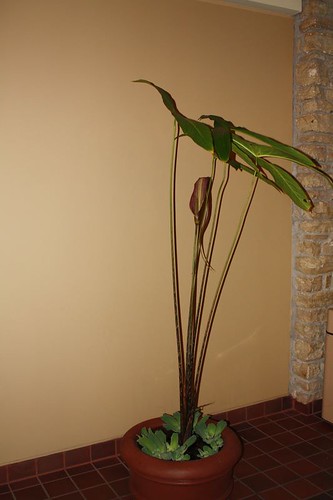
Urospatha in bloom
Out in the hallway by the entrance to our meeting room, the Fort Worth Botanic Gardens had on display a beautiful and tall (approximately 7 foot) Urospatha in bloom.   This was an incredible plant with uniquely marked stems and an amazing bloom, whose spathe curved away like in an elegant arc.

img_4245_35496829605_o
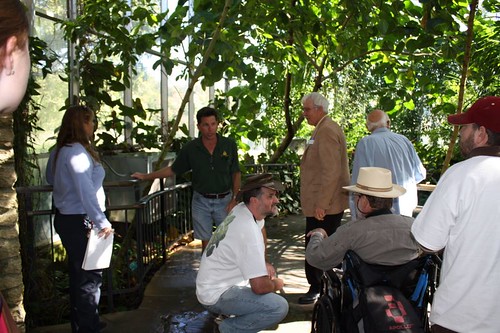
Great group of plant friends beginning a tour at the FWBG Conservatory
There were about 15 people in attendance and everyone really enjoyed themselves.  Some of us knew each other from previous meetings and email discussions and others were meeting for the first time.  There was even one long-time IAS member who has been a well-known figure in Aroids for 30 years or more.

img_4281_35366106771_o
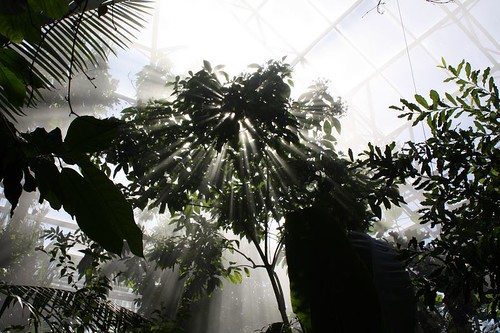
Crepuscular rays shining into the conservatory. It felt like the Garden of Eden.
The conservatory at the FWBG is very well kempt.  The plants are in great condition and there is a nice collection of Aroids, as well as several other families of plants that I like to grow (like Marantaceae).

img_4247_35496828675_o
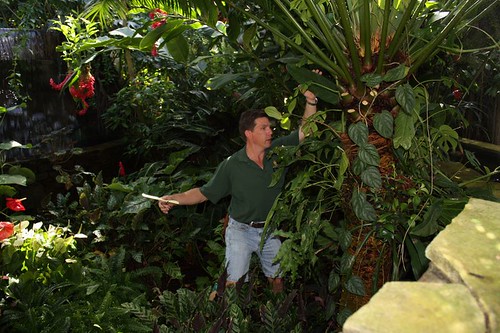
Our hands-on tour guide, John Langevin, showing off a plant
We were given a guided tour by John Langevin, who was generous enough to offer several of us cuttings or small plants from different parts of the collection, contributing lots of plants to our plant swap.  He was very knowledgeable about the collection and made the tour enjoyable.

img_4276_34655651844_o
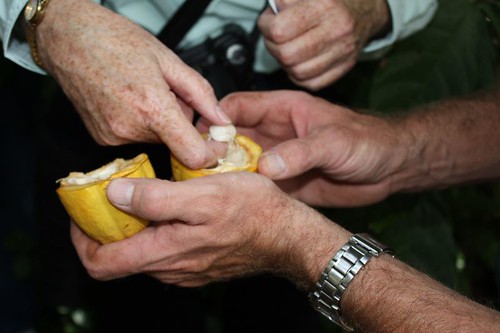
Fruit and seeds from Theobroma cacao
John removed one of the fruits from the chocolate tree (Theobroma cacao) and cut it open so that we could taste the pulp which surrounds the seeds.  I thought I smelled something resembling chocolate when he opened the fruit, but what I tasted was very different.  The pulp had more of a mild citrus taste with the texture of a slimy banana.   I brought two seeds home with me and will see if I can get them to germinate.

img_4263_35110287290_o
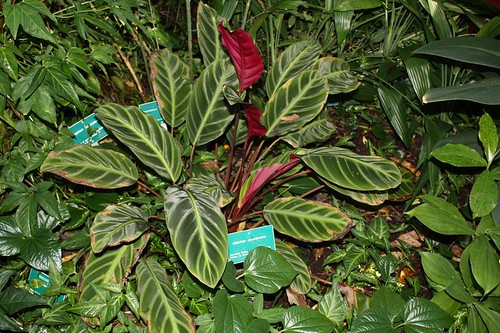
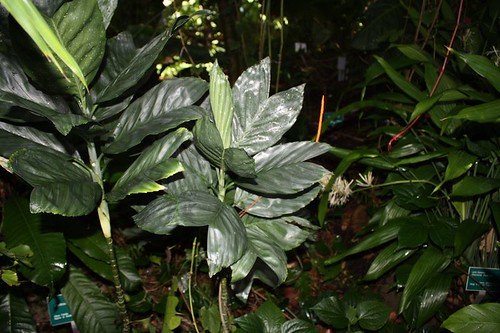
Calathea ecuadoriana
I knew from my previous visit that the conservatory has a really nice collection of Marantaceae, but I was surprised to see a species of Calathea that I hadn't seen before.  Calathea ecuadoriana looks very similar to Calathea zebrina and Calathea warscewiczii, which are already hard enough to separate!  They all have rich, deeply-colored, velvety leaves of green and purple.

img_4253_34686890613_o
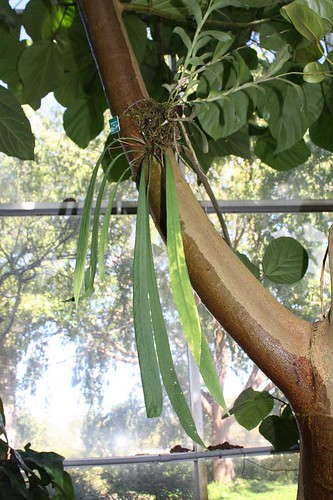
Beautiful pendant Anthurium
There were a number of nice Anthuriums growing in the conservatory.  One of my favorites was the simple pendant Anthurium pictured above.  I like the long, slender leaves of the pendant Anthuriums.

img_4252_34655666784_o
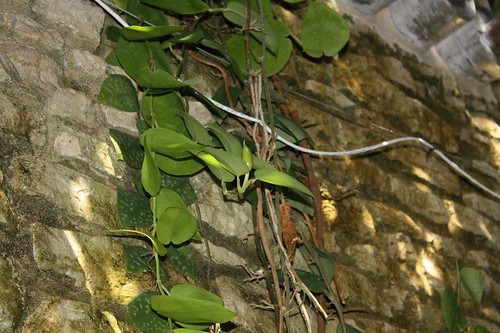
The rare inflorescence of Scindapsus pictus
Many people grow the Scindapsus pictus, sometimes called Satin Pothos vine, in their homes.  I have one on my desk at work and one in our dining room at home.  In most cases, these plants are grown in hanging baskets, or just in regular pots.  Rarely are they grown in a situation where they can scale a wall, as they like to do in nature.  This "shingling" habit is their preferred growth type.  Even in locations where they are grown shingling on a rock wall, they rarely bloom outside of their natural habitat.  However, the plants growing in the FWBG conservatory have bloomed regularly.  We got to see one of these early-stage inflorescences on Saturday.  What impressed me was the shape of the inflorescence, almost spherical in comparison to most other Aroid blooms.  It is also interesting that the plant blooms on pieces of the vine which have detached themselves from the wall where the rest of the plant is shingling.

img_4304_35457290416_o
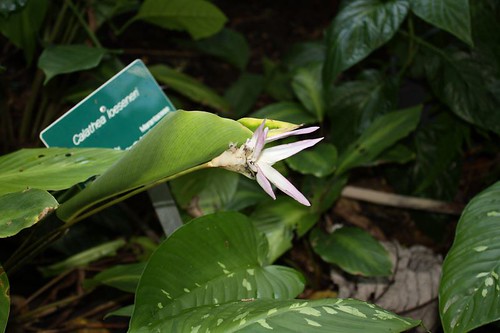
Calathea loesneri bloom
Calatheas are not known for their blooms, but for their foliage. However, there are a couple of Calatheas that have very nice blooms (and much less interesting foliage).  One of these is Calathea loeseneri, which was in bloom this Saturday on our visit.  I was lucky enough to get to take home one stem of this plant.

img_4335_35457383906_o
Metallic fishtail palm (Chamaedorea metallica)
The so-called Fishtail palms are given the common name designation because of the shape of their leaves.  Usually these palms are smaller than the more typical palm specimens which reach towering heights of 70-100 feet.  John told me that this particular palm (Chamaedorea metallica) stays smaller and has colorful fronds, making it a good specimen for a houseplant.  I really liked the silvery coloring of the leaves, no doubt the reason for it's species name of metallica.

img_4354_34686910813_o
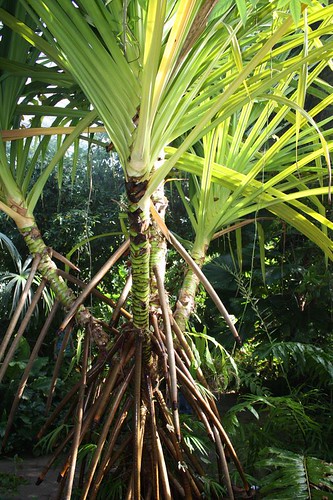
Screwpine Palm (Pandanus)
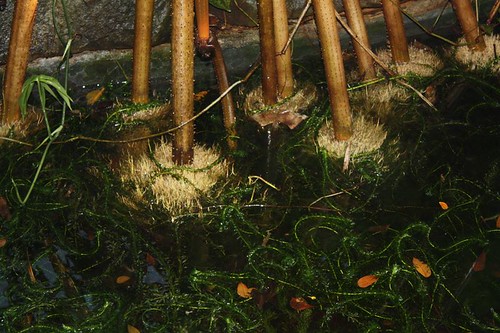
The Screwpine Palm (Pandanus sp.) is interesting because of the gigantic roots which are sent out in all directions to support the large tree.  The Screwpine growing in the FWBG conservatory was right next to the water and the roots which landed in water burst into thousands of smaller roots (below).  I imagine the roots which burrow into the ground do something similar.

img_4353_34686911743_o
Screwpine Palm (Pandanus) roots in water
One Alocasia caught many people's eyes as we passed on our tour.  Unfortunately, this plant did not have an ID tag anywhere in sight.   Maybe I'll be able to get an ID online.

img_4273_35110280650_o
Unidentified Alocasia with unique coloration - Update: Caladium picturatum

Tuesday, August 4, 2009

Bring your plants to work day

I'm not actually suggesting a new holiday.  It's just a clever name for my post.  Although I wouldn't mind this being a holiday - I already celebrate it everyday.

nwc
The National Weather Center - across the street from where I work.
[For those who are interested, I work on the research campus at the University of Oklahoma.  The research campus is made up of about six buildings built over the last 5 years.  These buildings are filled with academics, government groups and private companies (like the one I work for).  The anchor of the research campus is the National Weather Center.]

ag_palm
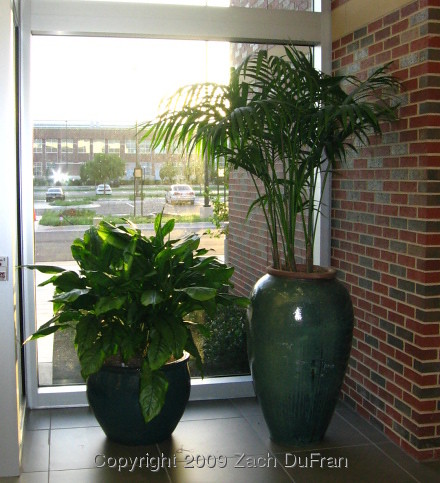
Aglaonema and a palm tree in the foyer of my office building
My office building (like the others on the campus) is a nice, new facility that has lots of plants in the hallways and office suites.  Plants are added for decoration, as well as to help purify air in the office environment.  This is a pretty trendy thing nowadays, and I guess it has been for quite a while.  What's cool for me is that some of my favorite plants are those common plants kept as easy-care foliage plants (such as the Aglaonema pictured above).

ficus_philo_sans
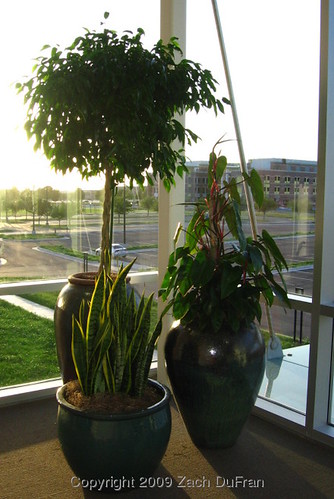
Ficus tree, Sanseveira (short pot) and a very cool Philodendron
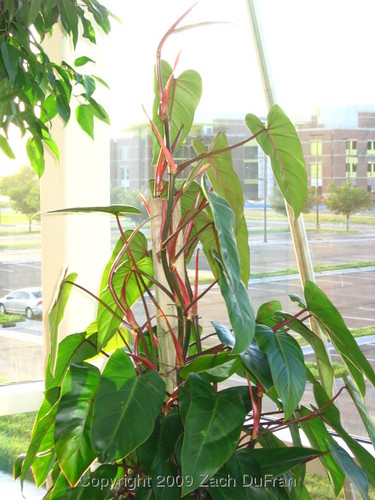
All of the plants are in really nice, huge pots.  And the plants are grouped in twos or threes.  This is my favorite grouping.  I walk by it each morning on my way up the stairs.  The Philodendron is so cool.  I think I might have to ask one of the plant maintainers if I could get a cutting...

philo_close
Close-up of the really cool Philodendron in the stairwell.
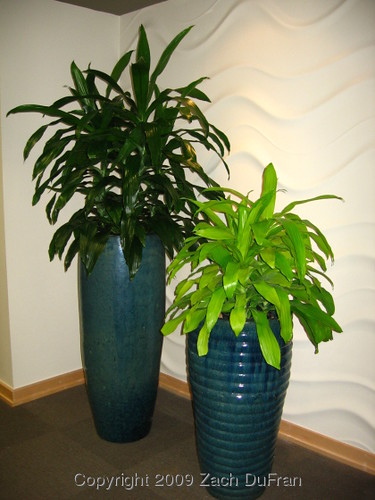
Other common plants in the office building are Dracaenas, Epipremnum ivies and large Bird of Paradise.  Here is a nice grouping of two Dracaenas in the hallway.

tall_dracaenas
Two tall Dracaena warneckii plants in the hallway.
Of course, being the planty guy that I am, all of these great plants scattered throughout the building aren't enough for me.  I have my own set of plants on my desk: Philodendron hederaceum ('Micans'), Polyscias scutellaria, Scindapsus pictus, Aglaonema sp.  I used to have a Philodendron 'Brazil' on my desk, but it got too large and had to be taken home.

aralia
A shield Aralia (Polyscias scutellaria) on my desk next to the computer monitor.
The shield Aralia was a birthday gift the first year I started working here, so it's now about 2 years old and has grown a lot.  I've heard that these plants are a little finicky and hard to keep.  No doubt it probably would not be as healthy as it is today if I wasn't looking at it 5 days a week!  The office environment (and my constant watching eye) has apparently suited it well.

philo_micans
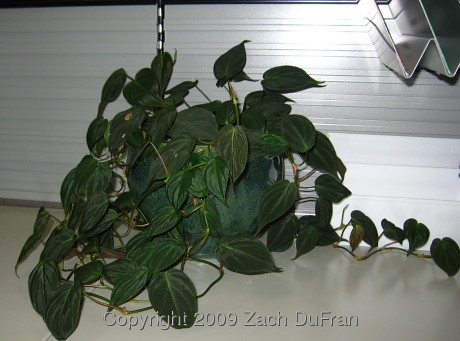
Philodendron hederaceum 'Micans'
My Philodendron 'Micans' is starting to grow as rapidly as my Philodendron 'Brazil' did.  It had to be taken home when our company moved and my desk space was reduced.  I really like it's rate of growth, but I hope the 'Micans' can stick around a while longer.

scindapsus_ag
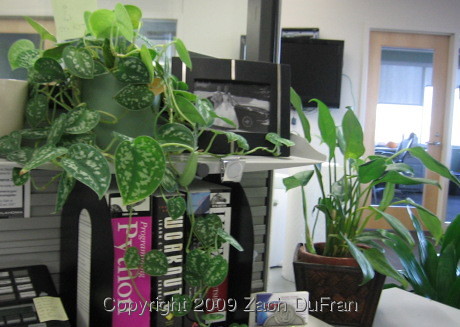
Scindapsus pictus and Aglaonema on my desk.
In addition to all sorts of health benefits in the office space, plants just make me happy and my work space would be depressing without them.

Do you keep any plants in your workspace?  Or does anyone else in your office?

Monday, February 23, 2009

Second Chances

I like to grow all kinds of different plants.  Some plants I pick for their foliage, others for their blooms, and still others for their unusual appearance.  Some plants thrive in my care and some others don't.  Occasionally some even die.  Whether it was my fault or simply a plant destined to death because of an unseen illness when I purchased it.

Every plant deserves a second chance, right?  [With the exception of Coconut palms.  I don't think I can ever grow one of those things.]

I have given quite a few plant species second chances in my care.  Last week I posted about my Philodendron 'Xanadu', which is just one species of plant I gave a second chance.  The first 'Xanadu' I purchased died about a month after I purchased it.  My second seems on it's way to a long and happy life in my care.

This post is about three particular plants that survived when given a second chance.

Scindapsus pictus - Silver pothos, Satin pothos
This is one of my very favorite plants is it's on my 2nd chance list!  How about that?  Actually, this plant would be one of my very favorites even if I had to give it a thousand chances and never succeeded in growing it.  It's just one of the most beautiful plants I've ever seen and no amount of struggle in growing it would ever dampen my admiration.  Thankfully, I haven't struggled too much to grow this one.  I just had a bad first experience with the plant.
scindapsus_hutch
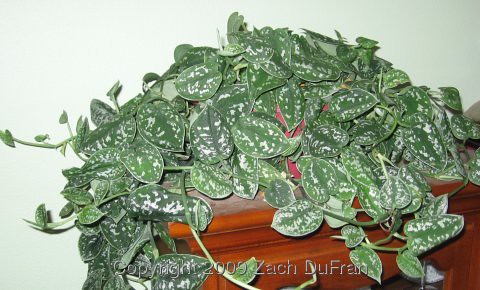
Scindapsus pictus
Many small houseplants are put in stores mere days after being potted.  That's right, most houseplants are grown in big factories where they place cuttings in hydroponic chambers and force roots to develop.  When I bought my first Scindapsus pictus, I promptly repotted it when I got home.  I think it is possible that I tried to repot the plant when it still had rather immature roots.  The roots that grow in water have to adjust to actual soil conditions once they are transplanted.  The trauma of two transplants within a couple of days might have been enough to do this plant in.  The other problem was that I probably didn't have the plant in enough light.  I'm sure it was being grown in a greenhouse in Florida.  Believe it or not, a greenhouse in Florida receives more light than a shady windowsill in Oklahoma.  That's just how it goes.

Now that I have given the plant a second chance, I have a really nice specimen that has been growing at my desk at work for about a year and a half now.  I have taken some clippings from my office plant and potted them in a pot with a stake, hoping to train the plant to climb the stake.  About a month ago, I bought a large hanging Scindapsus for home.  It's the plant pictured above.

Ficus elastica 'Burgundy' - Burgundy Rubber Plant
I bought a small burgundy rubber plant a couple of years ago.  I think there were 3 or 4 stems in a small 4" pot.  I knew that they were fairly common houseplants and therefore probably not very hard to grow.  I expected mine to get large and so I repotted my little plant in a much larger pot shortly after I got it.  I didn't know at the time, but this is not a good idea.  Ideally a plant should be in a pot that is about 1-2 inches wider than the plant's root span.  Most people understand that when you water your plant, the roots absorb the water from the soil.  But what I didn't realize is that when you repot a plant in pot that is much wider than the root span, the roots will not absorb the water in much of the soil and the soil will stay wet much longer.  I'm almost certain that this is what happened to my first rubber plant, which showed signs of root rot before dying.

The second time around, I purchased one single little stem in a tiny pot.  How can you not take a chance on an attractive $2 plant?
rubber_tree
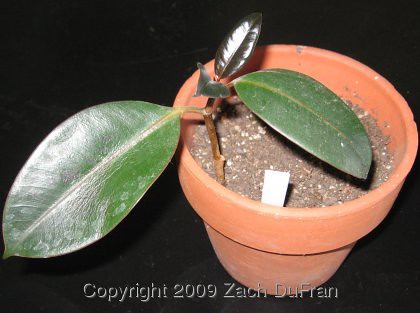
Ficus elastica 'Burgundy' - Rubber Tree
This time around, I have kept my single stem in a small pot.  I have had to resist the temptation to pot several plants in larger pots, having learned from my experience with the rubber plant (and a couple of others that had the same problem).  After a month or two of stagnancy, my rubber plant has finally starting producing some new leaves.  This is exciting because the new leaves are very glossy and dark red.  Over time the leaves thicken and deepen into that unique color of purple green.

There are some large specimens of this plant in the hallways of my office building that I enjoy looking at each time I have to go upstairs.

The Ficus genus is an interesting group of trees, ranging from the small, very common Ficus benjamina houseplant tree and all of the fig trees to the unique rubber tree and the gigantic Banyan tree (Ficus benghalensis).  There are some Banyan trees that cover acres.  One such famous tree is located in Lahaina, Maui, Hawaii.  Another one is located at the Indian Botanic Garden.  I will be visiting the Hawaiian Banyan tree this Spring and will hopefully have some pictures to post here.

Alocasia amazonica - African Mask
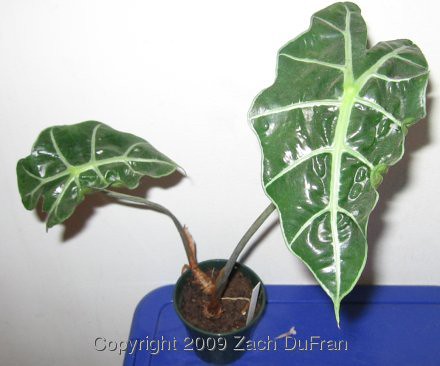
I had one of these plants probably about 8 years ago.  I can't even remember how long I kept it alive or how it died.  I remember seeing it for the first time in a little houseplant store that opened on Main Street here in town.  My first reaction was that it reminded me of a Pterodactyl.  For some reason, the store had decided to start a plant business and buy about 100 of each of 3 different plants.  I'm not kidding - they had about 100 pots of 3 different plants (4 at most).  At least, that's how I remember it.  One of the plants they had decided to sell was Alocasia amazonica.  I'm not sure what their business plan was.  I guess it was to turn everyone in town into a fan of those three species.  Needless to say, the store didn't last very long.  Unfortunately, neither did my plant.  The two events were unrelated.  At the time I wasn't all that interested in plants and I think mine just got neglected.

Since then my plant habits have changed quite a bit.  I'm more likely to overcare for a plant now than to ignore one.  I bought a small pot with two Alocasia amazonica bulbs/stems just a couple of months ago.  My plant hasn't changed much - just grown taller - but I don't seem to be having any trouble keeping this one alive.  I imagine this summer my plant might produce a couple more bulbs and leaves whenever it is in happier growing conditions.  One of the two stems sort of collapsed recently, but it has been growing okay with a thin dowel rod as support.
a_amazonica
Alocasia amazonica, or as I like to say, the "pterodactyl" plant
Alocasias are from the Aroid family, of which I am a collector.  They are pretty closely related to Colocasias (another Aroid genus), which are the plants commonly called "Elephant Ears."  There are approximately 70 species of Alocasias and quite a few cultivars.  They are grown for their stunning, and often very glossy, foliage.
Friday, January 23, 2009

Desert Island Challenge

A fellow plant blogger (Shirl's Gardenwatch) issued a challenge to other plant bloggers and many (43, so far) have tackled it.  I was slow to jump on the bandwagon, but I caught the caboose.  [Imagine a bandwagon that has a caboose.]

The challenge:  If I was stuck on a desert island and could take any 3 plants with me, which plants would they be?

The details:  Forget growing requirements - any plant will survive just fine on this desert island.  Also, you don't need the plant for food or anything like that.  Just pick the plants you would want there with you.

In other words, if I could only see three plants for the rest of my days, which plants would I pick?

Of course, for anyone who likes plants this is a tough challenge.  I imagine even someone who doesn't notice plants would have trouble devising a list.

I am trying to decide whether I would want to look at some of my favorites over and over again or something that I have never kept before...  Hmm...

First, I have to choose a plant from my favorite family (Aroids).  I would choose Scindapsus pictus.  It's simply one of the most beautiful foliage plants I've ever seen - and I really like foliage plants.  I'm also a big fan of vining plants.  I'm picturing myself stuck on this island for the rest of my life, which could be a good 60-70 years, so it would be really great to see a Scindapsus pictus after 60 years of growth.

staked
one of my small Scindapsus pictus
On the other hand, I have seen some very large Scindapsus pictus and nothing really changes about them.  Beyond the leaves getting a couple inches larger in width, the plant just keeps creeping and filling more space.  They do change growth habit a little bit when allowed to climb up the surface of a tree or rocks, so I think I would have to plant my Scindapsus pictus around a tree, allowing some to climb around on the ground and other vines to creep up the tree in the "shingling" habit.

The next plant on my list will need to be a little more dynamic and changing with time.  It will need to be something that blooms or changed leaf habit as it grows.  Potential candidates include other Aroids, like Monsteras or Philodendrons.  I think I could definitely spend a lot of time looking at plants from these two genera.  And I would enjoy watching the Monsteras produce new fenestrations as they matured.  But I have already picked an Aroid, and I have grown a lot of these.  I think I would choose a plant that I don't have - a plant that would offer something new to me.

I'm going to go for a Passion flower.  There are so many brilliantly colored Passion flowers - I don't know which color I would choose.  I would probably pick one of the purple ones, but I recently saw a picture of a red one that was pretty amazing, too.

Passion flower
Passion flower - photo from herbal extracts plus
The last plant is one that just suddenly came to me.  It is a plant I have only seen a couple of times, but it was beautiful.  The Silver Russian Olive tree.  I saw a bunch of these in Boulder, Colorado when I was there last year for a conference.  I asked my coworker what they were, knowing that he had lived there a couple of years ago and must know.  He told me they were God's curse to the world.  Well, he wasn't quite that harsh, but he said they were somewhat invasive there and had spines on them.  He had volunteered to help a friend clean up their yard and remove a tree.  Apparently he came away from the experience with some wounds.

Anyway, it didn't take anything away from their appearance if you ask me.  And I won't be chopping down any trees on my desert island, so I don't expect this tree to give me any problems.

Silver Russian Olive 'Quicksilver' (Elaeagnus angusitfolia)
The trees I saw on the side of the road in Boulder were large, with thick trunks almost black in color.  It was a great contrast with the silvery, almost white, leaves.

There's my list.  It's a weird one and the plants aren't in any way a cohesive group, but who said they needed to be?  If I made a list tomorrow, it would probably be different.  There are simply too many plants that I would enjoy viewing for the rest of my days - desert island or not.

Monday, December 15, 2008

Great piece of bark - what should I do with it?

I was driving home from work a couple weeks ago when I noticed a huge piece of bark on the side of the road.  It had fallen off the side of a large tree that had been cut down.  The tree had been chopped off at the height of the fence (about 6') and the bark slid off the tree several years later

Like a football scout (it is that season), I looked at it and all I could see was potential.  I came back that evening and loaded it up in my wife's SUV.  Now it's sitting on my back porch waiting to be put to good use.  The bark measures about 6 feet x 2.5 feet.  You should be able to see from the picture how big it is.  It also has really good character.

bark
Me holding up the prized piece of bark. Look how big!
The only problem is deciding what to do with it.  I have a couple of ideas, but haven't acted on anything yet.  Mainly my ideas focus on climbing plants.

1. I could construct a sort of stand and mount the bark on it, holding it upright.  Then I could start to train some of my climbers to attach to it.  I have a lot of good plant candidates (mostly Aroids) for this.  I have just begun to train a couple of my Aroids to climb up some stakes I made.  These are Philodendron microstictum and Scindapsus pictus (one of my favorite plants).

staked
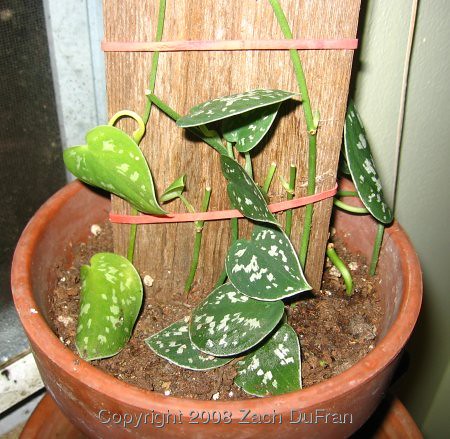
Clippings of Scindapsus pictus that I have staked for climbing.
2. One of the most common uses for bark among "planty" people is for mounting orchids.  However, I am kind of out of my orchid swing right now.  I have had as many as 5 orchids in the past, but I only have one right now and it has moved to my mother-in-law's house because it wasn't doing very well under my care.  This huge piece of bark would look amazing covered in orchids, but if I decide to use it in that manner I'll be putting it on hold for now.  I'm also not sure if this bark would be most appropriate for mounting orchids.  I suppose it couldn't hurt.  But orchid-mounting bark usually is more porous and can be soaked in water.  This piece of bark would not be a good fit for that kind of use due to its size, as well as its texture.

Do you have any ideas about how this great piece of bark could be used?

Monday, October 27, 2008

My Heteroblastic Hobby

I started a plant journal (on paper) in the last month.  I decided to start keeping track of my plants as they grow, as well as document any new plants I get.  I have spent most of my journaling time not talking specifically about my plants, but about plant knowledge I have gained recently.  When Russ sent me a box stuffed full of Aroids, I did a lot of image searching of the different plants he had sent me.  A number of these plants have 2 distinct leaf habits, which is common among many Aroids, especially Philodendrons.  Leaves in the first stage - the immature or juvenile stage - are usually smaller and more simple looking.  Although sometimes the juvenile leaves are more colorful.  When the plant matures leaves can become much larger and often develop splits or holes.  This maturation process is usually instigated by the plant beginning to climb high up the trunk of a tree.  The splits and holes in the leaves enable the large leaves of the plant to be more resistant to wind.  The Epipremnum pinnatum v. 'Cebu Blue' that I received from Russ has small, lance-like, pale blue leaves.  As the Cebu Blue matures, the leaves can grow to several feet and have large splits in them.  If you are not familiar with this characteristic of many Aroids, you would find yourself trying to convince me that these could not be the same plant.  But they are!

Many plants displaying the 'immature' habits are called 'shinglers.'  I found an International Aroid Society article about these.  The immature flat, round leaves lay up close to the climbing surface, sometimes overlapping and looking like shingles.  One of the best examples of a shingler is a Scindapsus pictus.

I just learned today that the characteristic of multiple distinct leaf habits is called heteoroblastic development.  I think the word is a fitting analogy for my hobby with plants.  My hobby has recently gone through a transformation that makes my old hobby look like a different species of hobbies.  But it's the same me and the same love of plants that's underlying this hobby.

Here's some other miscellaneous knowledge that I recently gained.  Several times in picture captions I have seen a Genus name and then the word 'NOID.'  'NOID' means 'No Identification' or 'Not identified.'  From what I can tell, this can mean that the person does know what species the plant is, or it has literally not been classified yet.

Also, I've known that v. stands for 'variety' but I had never even seen 'f.' before until Russ was identifying one of my Aglaonemas as A. commutatum v. maculatum f. maculatum.  Apparently f. means 'forma.'

Friday, July 13, 2007

Introduction

This post commences my plant blog. In the last year or two I have become a very avid hobbyist of all things plants. Maybe not all things plants, but many things plants, including some tangent hobbies. In fact, one of these tangent hobbies is how I made my way towards “plant-geek.”
I have kind of liked plants for a long time. When I was younger I used to help my mom water all of her plants. I was pretty good at remembering all of the names and identifying them when I saw them away from our home. My grandmothers were both fond of flowers and plants, too.

So, when I had my own house I naturally had a couple of houseplants to make the place feel “like home.”

Oddly enough, I think my current obsession with plants (yes, it is an obsession: ask Christie!) grew out of my aquarium hobby, which I just started at the beginning of 2005. After setting up my 29 gallon aquarium I was excited and spent quite a bit of time watching my newly-acquired fish swim around my fully-stocked tank. But soon, I became a little less interested in my aquarium, which would change little with time. All of my time of planning the perfect fish and decorations had allowed me to constantly change my mind and redesign. However, after the aquarium was set up there were few changes I could make (usually just when I lost a fish). Anyway, I soon found that there were some aquatic plants that could be added to my aquarium – and some of the fish I had in my tank actually prefer a planted tank! So I slowly started collecting plants for my aquarium and making my aquarium more suitable for their growth. I even went through a tedious process of emptying my tank and starting the whole setup again, using a richer plant substrate, rather than large gravel pebbles. I quickly became a huge fan of the aquatic genus Anubias. I now own the following Anubias species:


· A. afzelli var. lanceolata
· A. barteri
· A. barteri var. nana
· A. barteri var. nana ‘petite’
· A. barteri var. nana ‘marble leaf’
· A. coffeefolia
· A. gracilis


So, you might notice that one of those tangent hobbies that I have taken on is plant taxonomy. Not that I am a taxonomist, or anything. But I really like to know what varieties of each plant that I have. And I like to try to collect as many different types that I can. It’s especially a challenge for aquatic plants, since there are relatively few locations to buy them.

The analogous houseplant genus that I collect like anubias is called aglaonema. It is a very common and popular foliage plant used in office buildings and malls, etc. It’s common name is ‘Chinese Evergreen.’ There are a ton of varieties of this plant, both natural and cultivars. I just have 5 of them as of right now, but I am planning on collecting quite a few more. I currently have:

· A. ‘Silver King’ (nitidum x. pictum ‘Tricolor’)
· A. ‘B.J. Freeman’
· A. Minima
· A. ‘Maria’
· A. unknown


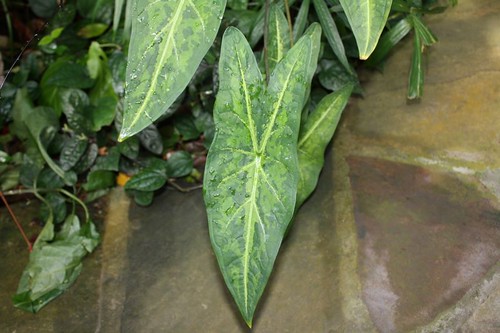
But hey! I'm getting a little too specific for my introductory post. Maybe you're wondering why I named my blog site what I did (or maybe not). Being a connoisseur of fine foliage plants, I like variegation, so rather than naming my site after the common phrase “The Green Thumb,” I chose this fun variation - or maybe I should say variegation! :)   For now, I will leave you with a picture of a beautiful scindapsus pictus: