Showing posts with label pictures. Show all posts

Thursday, June 21, 2012

OKC Cactus and Succulent show

Before diving in, I must confess that cacti and succulents are not my passion. There are a couple of groups that interest me, like Stapelia and related genera. I decided to stop by the show and sale of the Central Oklahoma Cactus and Succulent Society last weekend because I figured it would be interesting to see, take photos and learn more about these plants.

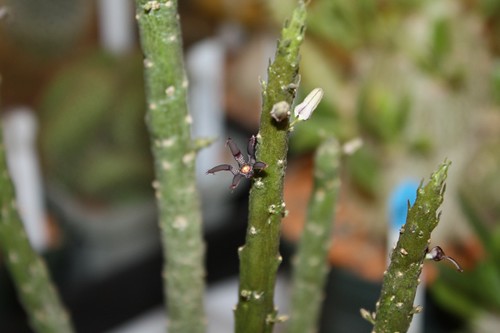
rhytidocaulon_macrolobum
Rhytidocaulon macrolobum
I was surprised to see more plants of interest to me than I had expected. The "show" plants were neat, but primarily plants that I enjoy looking at and that I don't have a great desire to grow myself. However, I found many plants on the vendor tables that were of interest to me. The first being the plant pictured above and below. Maybe you think it's ugly, but look at those awesome black flowers!

rhytidocaulon_macrolobum_flowers
Rhytidocaulon macrolobum
There were quite a few Pachypodium on display and for sale (sorry, no pictures). I had just been giving a tour at the Myriad Gardens on Saturday afternoon, where the Pachypodium are 10 feet tall!

euphorbia_knuthii
Euphorbia knuthii
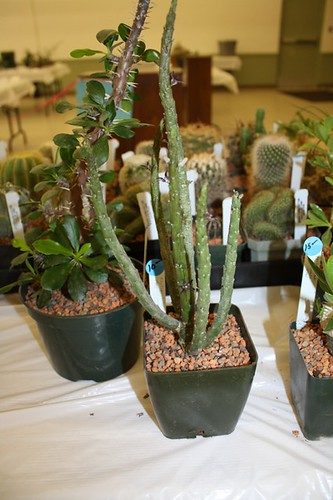
There were so many Euphorbia I couldn't count them. As I was telling my tour group, Euphorbia has to be the most diverse genus I know. If you read my old post on Euphorbia you would have seen everything from the Poinsettia to the dangerously spiny plants, like the one I purchased this weekend.

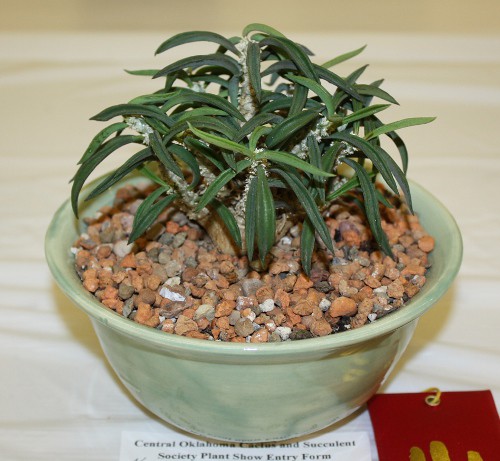
euphorbia_cylindrifolia
Euphorbia cylindrifolia
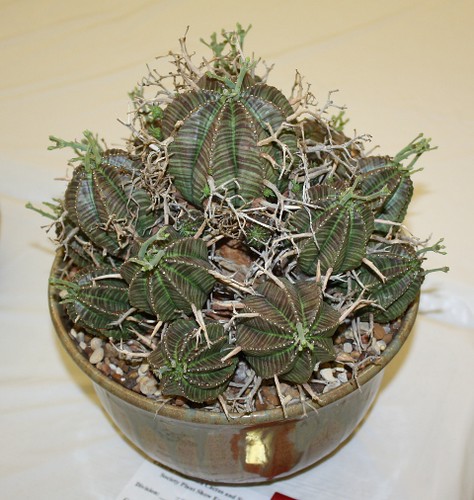
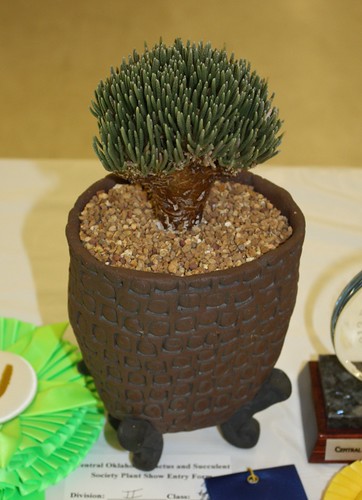
The Euphorbia pictured below has a growth habit more like Mamillaria (those spherical cacti with spines all over them).

euphorbia_valida
Euphorbia valida
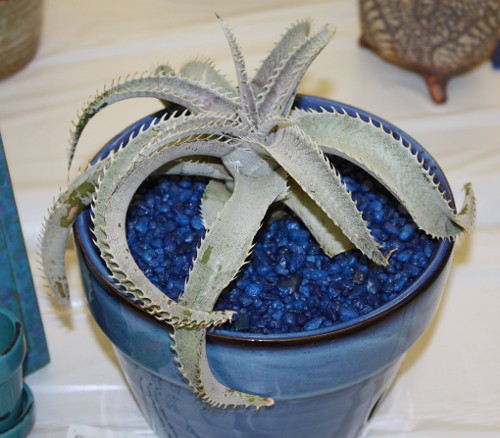
dyckia_marneir-lapostollei
Dyckia marneir-lapostellei
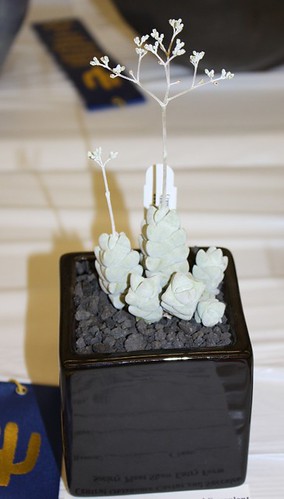
Check out the ghostly colors of the Dyckia and Crassula.

crassula_deceptor
Crassula deceptor
The little Avonia was quite adorable. It looks like a miniature and really doesn't look real.

avonia_quinaria_v_alstonii
Avonia quinaria v. alstonii
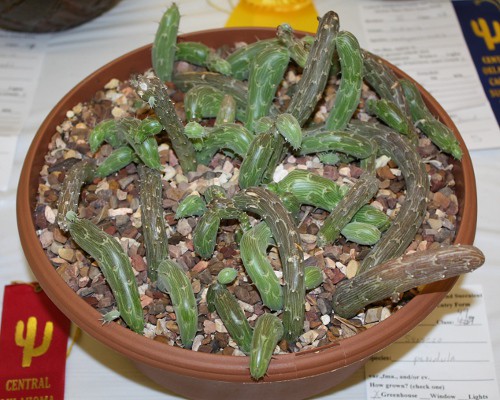
You have probably already seen my cucumber orchid. Now I see there is a cucumber succulent!

senecio_pendula
Senecio pendula


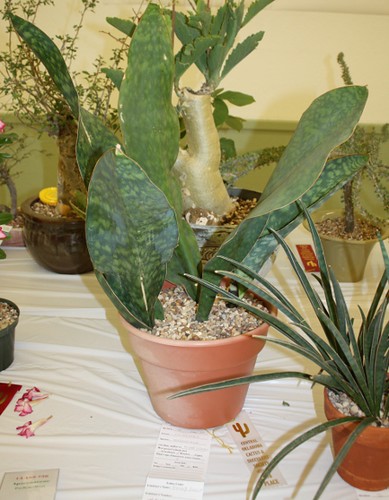
Sansevieria has quite a dedicated following. This show had two plants, one being the famous Sansevieria masoniana, with big floppy leaves. The other was more to my liking, Sansevieria scabrifolia.

sans_masoniana_and_scabrifolia
Sansevieria masoniana 'Mason's Congo' and Sansevieria scabrifolia
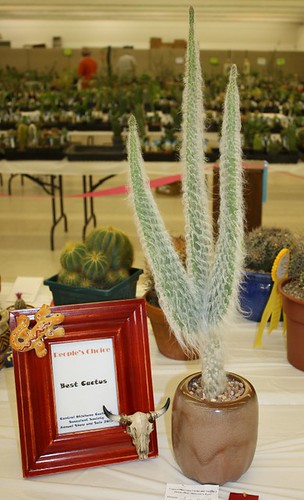
Most of the plants I am showing won an award, but the cactus below won "Best Cactus." Check out that long fur hanging off of the pads.

opuntia_tequiliana
Opuntia tequiliana - look at that fur!
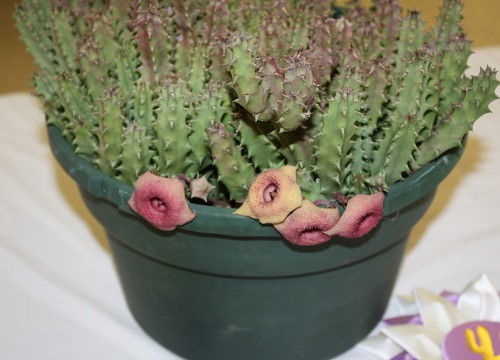
The only Stapelia-like plant in the show was this Huernia. It was a really big plant that is supposedly just 3 years old. It must be a vigorous grower.
huernia_thuratii
Huernia thuratii
I ended up purchasing 4 plants, 1 of which was an orchid. I had been told by some friends that Eulophia petersii is easier to find at succulent shows than at orchid shows, since it likes to grow so dry. I was talking with a vendor at this show and he was telling me about how he once heard someone describing this plant as having "orchid-like flowers"...

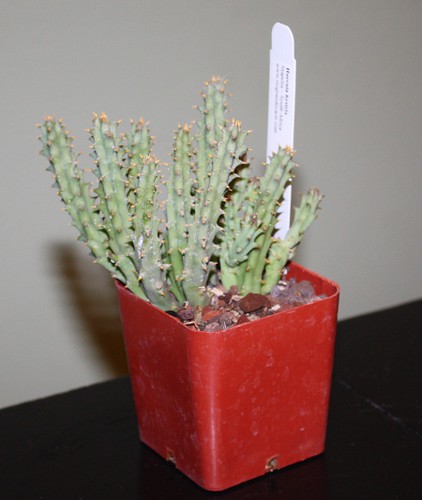
huernia_hystrix
Huernia hystrix
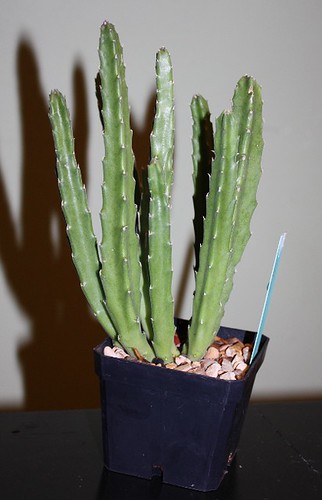
Two of the plants that I purchased are from my Stapeliae: Huernia hystrix and Stapelia hirsuta. The S. hirsuta is the one that gets really hairy flowers. It is also probably the species that is most similar to my Stapelia gigantea, which grows really well for me. So I feel confident I can get it to bloom eventually.

stapelia_hirsuta
Stapelia hirsuta
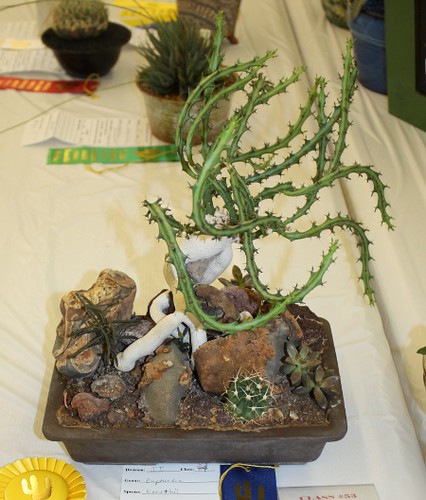
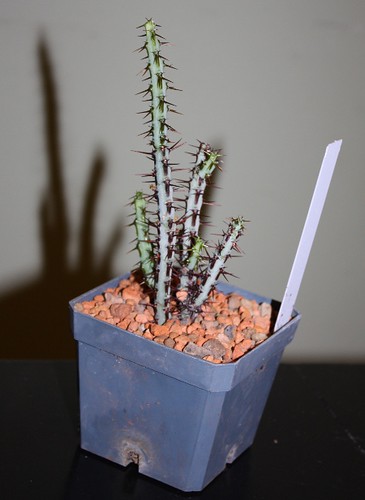
The last plant I purchased is the Euphorbia, which I mentioned earlier in this post. Dangerously spiney!

euphorbia_aeruginosa
Euphorbia aeruginosa
I don't plan to become a cacti and succulent addict, but I would like to go to this show again in the future. There were definitely some neat plants.

Thursday, June 7, 2012

Daisy Orchid in bloom

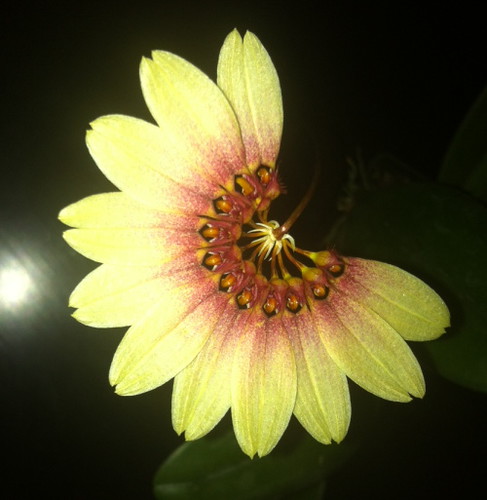
The Daisy Orchid (Cirrhopetalum makoyanum, synonymous with Bulbophyllum makoyanum) is given its common name due to the way its flowers are arranged to look like the petals of a Daisy, or really any other flower from the Asteraceae family (like Sunflowers, Chrysanthemums, etc).  In truth, when you look at this orchid it is not a set of petals you see, but a grouping of several tubular flowers arranged so that they splay out from a center point.  Of course, the "flower" of a daisy is also not singular.  The entire Asteraceae family is made up of plants that have composite flowers, which is to say that where you think you see one, you actually see many.  This is so common among flowering plants, I think the exception might be the rule.  Truly! Anyway, that's not why you clicked on this post.  You came here for pictures, gosh darnit!  Okay, calm down, angry masses.  Here come the pictures.


cirrho_makoyanum_flower_20120607
Cirrhopetalum makoyanum
Here you can see the flowers in all of their glory, from above, looking like a daisy.

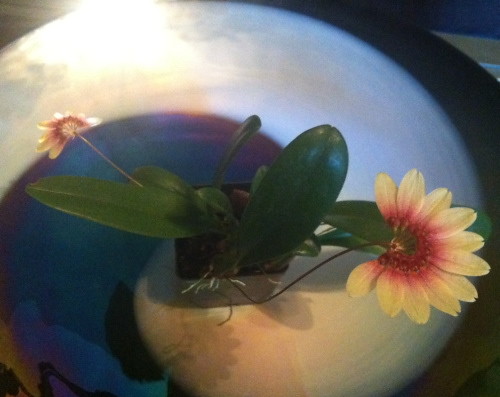
cirrho_makoyanum_full_20120607
Cirrhopetalum makoyanum
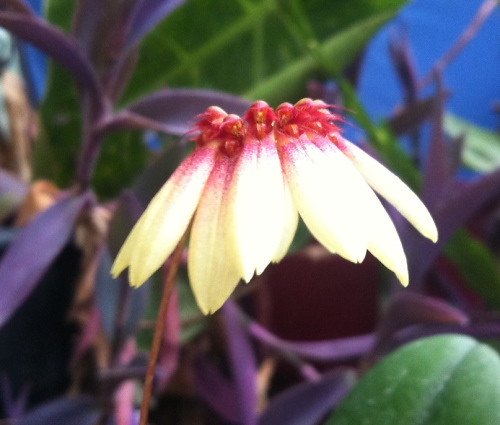
In the final photo you can see the individual flowers a little better, as they were unfurling and beginning to fan out into the daisy shape.

cirrho_makoyanum_flowers_20120606
Cirrhopetalum makoyanum
 

Friday, May 18, 2012

My first Pinellias

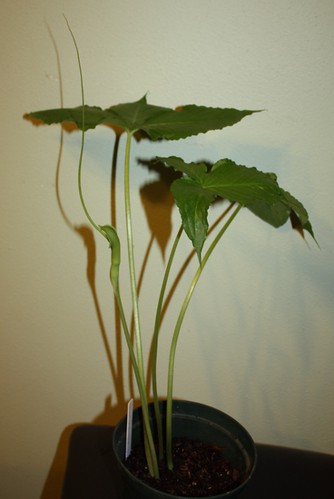
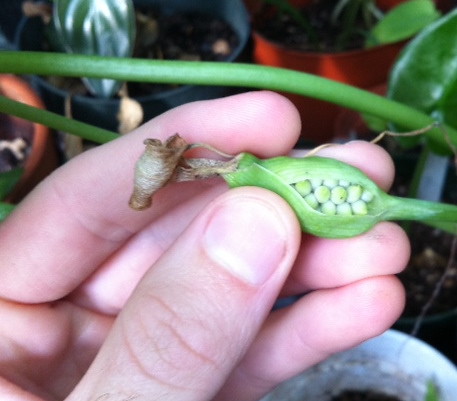
Last year, Derek got some great photos of his Pinellia tripartita in bloom, including one photo which was featured in the International Aroid Society calendar.  This plant is known to spread like crazy, since it offsets from the tubers, produces viable seed and also form bulbils at base of the petioles.  He shared some of his bulb offsets with me and then later some seeds, too.  I planted these in pots and kept them in my greenhouse over the winter.  The seeds sprouted shortly after I got them and stayed about the same over the winter.  The bulb offsets were dormant when I potted them up, but they have come up now and produced an inflorescence, which now has berries (infructescence).

pinellia_tripartita_20120413
Pinellia tripartita

I haven't planted this one outside yet and it performed so well for me in the pot this year that I don't know if I will.  However, since I have so many seeds, it looks like I could easily have enough to plant some outdoors and keep some in pots, which would be nice.

p_tripartita_infruct_20120514
Pinellia tripartita infructescence
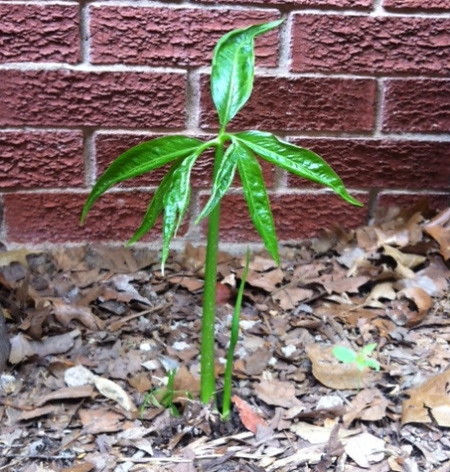
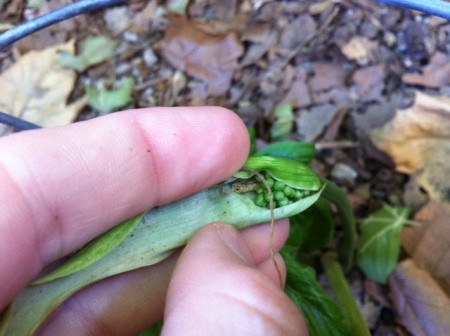
At the IAS show in September I picked up a Pinellia pedatisecta,  which Dr. Croat had pulled up from his own yard.  I planted that one outside and it has also come up and produced an inflorescence, and has now set berries.  Both of these plants are hardy in zones 5-10, so they shouldn't have any trouble with the extreme heat or freezing temperatures of my zone.

pinellia_pedatisecta
Pinellia pedatisecta
p_pedatisecta_infruct_20120515
Pinellia pedatisecta infructescence
At the Wichita orchid show I traded some plants with friends that I was meeting there.  I got a nice clump of Pinellia ternata from Steve and have planted those beside the Pinellia pedatisecta beside the greenhouse.  This plant also produces bulbils at the base of the petioles, so it spreads in a variety of methods.

p_ternata_20120515
Pinellia ternata
I know this plant doesn't look great right now, having just been transplanted, but it should perk up given a little time.  Hopefully next year the clump is just as big and has a couple of blooms to go along with it.  This little strip of garden along the back side of my greenhouse is becoming the hardy aroids area.

Monday, May 14, 2012

Trip Report: Orchid Show in Wichita, Odds and Ends

This is the final episode of the 6 part series on the orchid show I attended in Wichita a couple of weeks ago.  If you haven't already, read about the exhibits, slippers and Vandas, Dendrobiums and Encyclias, and uncommon orchids I saw there.  This last post will just feature any pictures that I have left that I wanted to share.  There's not a real unifying theme among them.

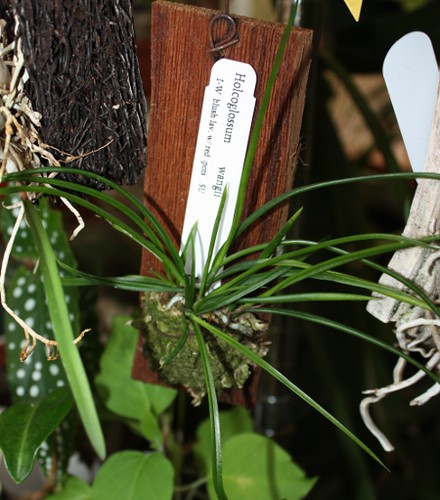
First, I'll show off the two plants I purchased at the show that I haven't already shown you.  I purchased a Holcoglossum wangii from Oak Hill Gardens.  I have been seeing this genus for a while and knew that Oak Hill had a couple species for sale as mounted plants, so this was on my want list before I went to the show.  We picked out a nice, full plant to add to my terete leaved orchid collection.

holc_wangii
Holcoglossum wangii hanging in my greenhouse
I'm sad to report that Oak Hill Gardens, one of my favorite orchid vendors, is closing their doors soon.  They are selling their orchids to another grower and selling their property to a non-orchid nursery company or something like that.  I have purchased more plants from Oak Hill than any other grower and I wish they were still going to be in business.  They have reasonable prices and grow a lot of species orchids.  They will be missed.

anth_marmoratum
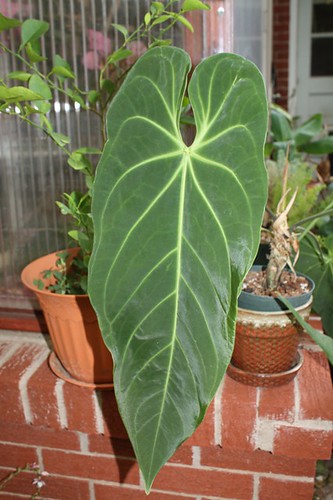
Anthurium marmoratum back at home
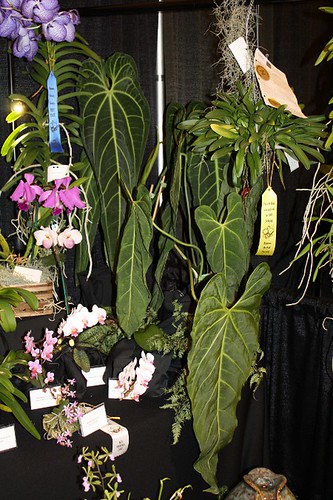
The other plant that I purchased and haven't yet shown off is not an orchid, but an aroid.  It is Anthurium marmoratum and is a really nice plant (above).  I have only seen this plant for sale on occasion on eBay and it is always much more than I paid.  I purchased this plant from Prairie Orchids.  They also had some really nice velvet leaf Anthuriums in their exhibit (pictured below).

prairie_orchids_anthuriums
A couple of Anthurium in the Prairie Orchids exhibit
The largest genus in the orchid family is Bulbophyllum.  I am not particularly drawn to this genus, but there are a couple of species that I like.  Below is a Bulbophyllum with rather large flowers (for the genus).

bulb_lobbii_v_sumatranum_Lenny
Bulbophyllum lobbii var. sumatranum 'Lenny'
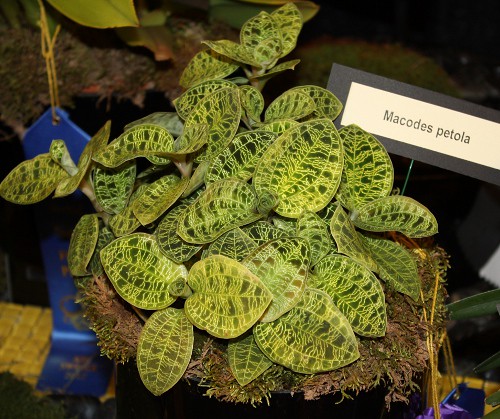
The picture below is fairly representative, but there is just no comparison to seeing this plant in person.  This jewel orchid, Macodes petola, looks like lightning is running through the leaves.  It is really something to see, and this particular plant was very healthy and larger than any I had seen before.

macodes_petola
Beautiful jewel orchid, Macodes petola
There are people who are absolutely fanatical about Neofinetias.  It is a tiny genus of just three known species, and yet there are hundreds of cultivars and intergeneric hybrids, including the genera Darwinia and Ascocenda.  The most common species, Neofinetia falcata, is known as the "Japanese Wind Orchid," and these plants are displayed in artistic displays and beautiful Asian pots like bonsai plants through Korea, China and especially in Japan.  The flower of the pure species Neofinetia falcata is white, but cultivars have light highlights of pink, purple or orange.  Hybrids can result in muted solid colors, like the plant pictured below.

neofinetia_hybrid
Neofinetia hybrid for sale at Michel Orchids table
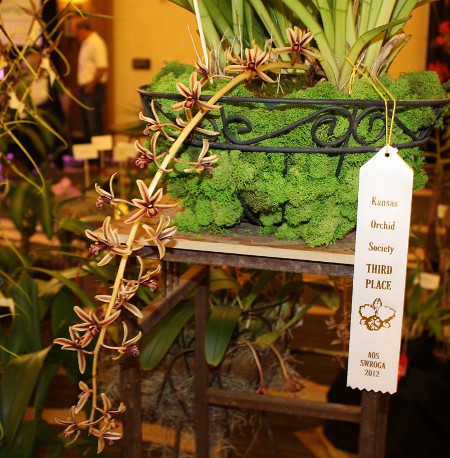
I have started growing several Cymbidium recently, primarily because they were given to me.  I would like to be able to grow these well, but the culture is different enough from my other orchids that I don't know if I will succeed.  All of my Cymbidiums produce their blooms on upright stalks.  Other Cymbidiums have pendulous bloom spikes that hang down from the plant, making these plants best suited to baskets or some other set up where the blooms will not just be laying on the ground.  There was a nice pendulous Cymbidium on display in Wichita (below).

pendulous_cymbidium
Pendulous Cymbidium finlaysonianum 'Zia's Ray'
I hope you enjoyed my orchid show pictures.  Stay tuned for some photos from the orchid show I attended in Oklahoma City a couple of weeks later!

Thursday, May 10, 2012

Trip Report: Orchid Show in Wichita, uncommon orchids

This is the fourth post in a 5 part series.  Part 1 focused on the exhibits; part 2 on the Slippers and Vandas; and part 3 on the Dendrobiums and Encyclias.  This time around, I'm going to show some pictures of some nice orchids you just don't see every day.

Phalaenopsis is the most widely known orchid, the one that you can find for sale in grocery stores and hardware stores.  So, I am kind of starting off this post of "uncommon orchids" with one of the most common orchids there is!  They are so popular for a number of reasons, one being that they are not too hard to grow and to get to re-flower.  Most orchid growers have some of these on hand in their collections because they know they bloom reliably each year.

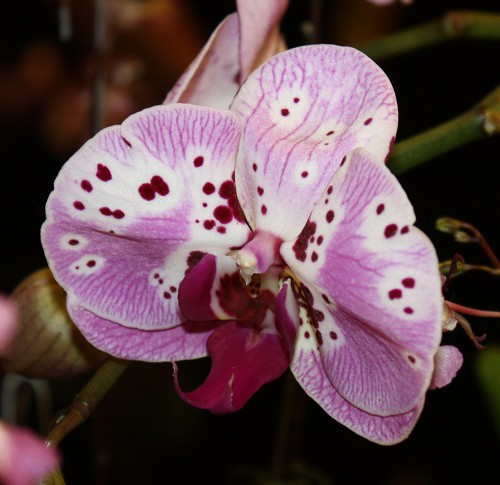
phal_interesting_pattern2
Phalaenopsis with "brush strokes"
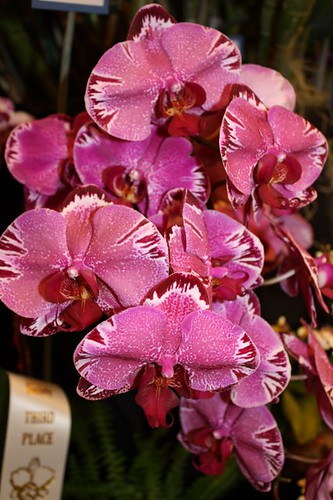
Another reason they are so popular is because of the hybridization potential.  It seems the hybridizers always have something a little new with these orchids - a new color combination or a new pattern.  The Phalaenopsis pictured above is a fairly new pattern, with what looks like brush strokes near the edges.  I remember a year or two ago I saw my first harlequin (patches of color) Phalaenopsis.  This year, the pattern that was new to me is kind of hard to describe.  It looks like some drops of color have been splashed onto the flowers and repelled other colors.  There is a sort of white halo around these dots.

phal_interesting_pattern
Phalaenopsis with interesting color pattern
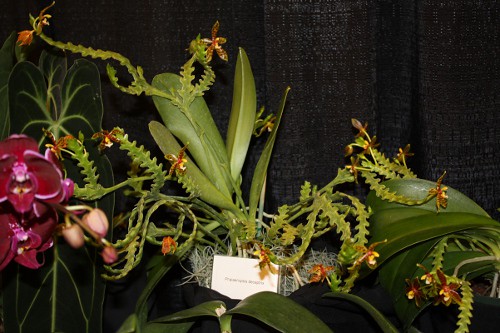
There were other nice hybrid Phalaenopsis with all sorts of different colors and patterns.  There was a really neat specimen of Phalaenopsis deceptrix cornu-cervi (below) on display, too.  The blooms from this orchid emerge from a weird, zigzag spike.  When the flowers are finished, it looks like this plant has two distinct types of leaves.  I don't know what people normally do when they have this plant and it finishes flowering, but I would have trouble cutting off those weird spikes.  I would want to leave them on the plant.

phal_deceptrix
Phalaenopsis cornu-cervi (labeled Phalaenopsis deceptrix)
Eulophia guineensis is a really nice flower, which looks similar to some Encyclias, except that the lip is much larger than the petals and sepals, which are always pointing upwards.  Also, the plant is different morphologically and is terrestrial, whereas Encyclias are epiphytic.  Eulophias are native to equatorial Africa and this species is probably one of the more common ones to find in someone's collection.

eulophia_guineensis
Eulophia guineensis
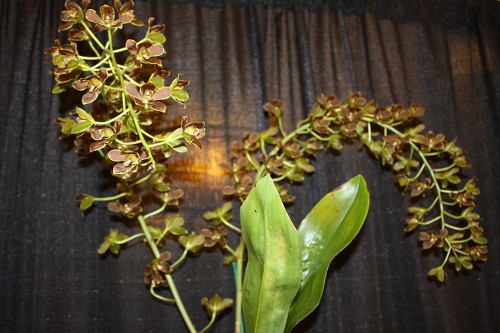
Grammatophyllum is the genus of "giant orchids."  These plants get really large and can become very heavy with time.  I like how their roots point upwards (not shown in this photo).  They have very neat blooms of brown and yellow.  Usually they are pretty spotted, like a leopard.  This particular plant was named Leopard and yet, the blooms weren't really spotted.  It was more like the brown had taken over all but the edge of the petals, which retained the yellow coloring.

gramm_leopard
Grammatophyllum Leopard
The plant below belongs to the Mexicoa genus, which I had never heard of.  It was a nicely grown plant with some neat little yellow flowers.  I think that Mexicoa is a monotypic genus, because I can't find any references to a species other than this one.  Apparently, it used to be Oncidium ghiesbrechtiana, but has unique floral features that allowed it to be moved to its own genus.

mexicoa_ghiesbrechtiana
Mexicoa ghiesbrechtiana
My friend, Leland, who lives in Hawaii is on the brink of being sucked into the orchid vortex.  The orchid of his dreams is Bulbophyllum phalaenopsis.  (Why did they let someone give a genus name in place of the specific epithet?)  The species gets very large leaves that look like those of the Phalaenopsis genus.  You don't even notice the psuedobulbs much due to the large leaves.  When this plant blooms, it creates this hanging purple tongue of flowers that smell like a thousand dead elephants.  Prairie Orchids had this plant for sale for $75, which is not out of the ordinary for this species.

bulb_phalaenopsis
Bulbophyllum phalaenopsis
The final two orchids are both Pleurothallis and were both for sale at vendor's booths.  I just have one little Pleurothallis and I really like it.  They tend to be cool to intermediate growers and don't need much light.  I keep mine on the kitchen windowsill inside and it has been growing well for me.  I probably need to fertilize it because it was blooming this time last year when I bought it and it is bigger this year and not blooming.

pleurothallis_ornata
Pleurothallis ornata for sale at Andy's Orchids booth
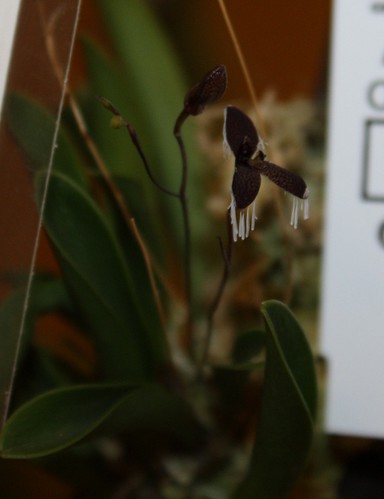
Pleurothallis ornata (above) has these cool little icicles (not the technical term) hanging from the blooms.  Now the photo above doesn't show scale, but these little flowers are smaller than a dime.  Generally people that grow Pleurothallis and related genera are interested in miniatures and oddballs.  I'll be trying more of these in the future.

Now, prepare yourself.  The photo you are about to see is amazing...

pleurothallis_dilemma
Pleurothallis dilemma for sale at Ecuagenera booth
By far the most bizarre plant at the show was this Pleurothallis dilemma (above).  Eat your heart out, cucumber orchid!  This thing is like the "conjoined twin green bean" orchid.  It was for sale at the Ecuagenera table and I really wish I had bought it now.  Of course, my allowance is better off, but man, is this ever a neat little oddity!  (There is a better photo here.)

Tuesday, May 8, 2012

Trip Report: Orchid Show in Wichita, Dendrobiums and Encyclias

This is part 3 of the 5 part series known as "Orchid Show in Wichita."  If you missed the first or second post, check them out here and here.

First, you might be wondering what Dendrobiums and Encyclias have to do with one another.*  The truth is just that these are two of my favorite orchid genera.  There were lots of plants from these two genera at the show and I took lots of photos of them.  So they grouped themselves well for a blog post.  Now you know.
zach_dendrobiums
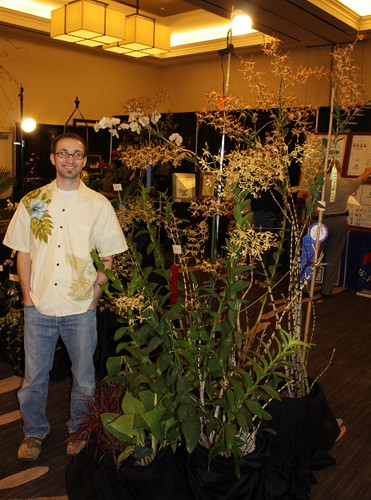
Me standing beside the really tall Dendrobium
Sarah Pratt is the owner of Timbucktoo Orchids and has come to speak to our Oklahoma Orchid Society in the past year.  She had a large, walk-through exhibit that featured four different very tall Dendrobiums from section Spatulata, which means they have the tall "antlers" or "antennae."  I know that I'm not a very tall guy, but still!  Those plants (above) are sitting on the ground and easily two or three feet taller than I am.  The sheer size of the plants can be overwhelming such that you miss how cool the individual blooms are.  But I took the time to stop and
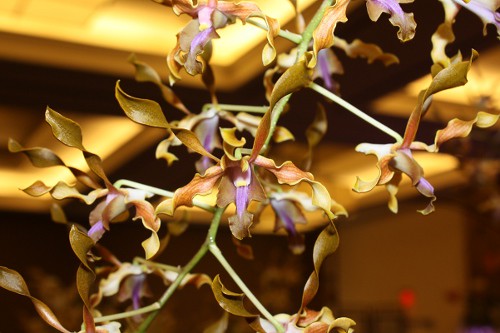
smell the rosesphotograph the flowers (below), for your enjoyment.
dend_spatulata1
Dendrobium Exotic's Spiral
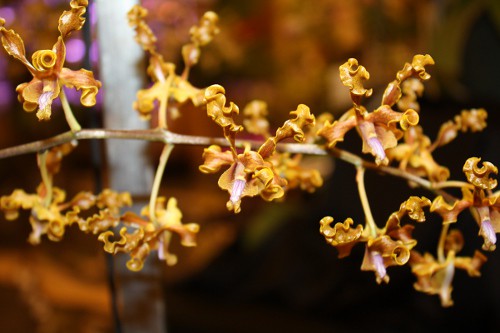
I didn't see the labels on these two orchids (below and above).  The one above could possibly be Dendrobium aries.  It might also be a hybrid with or without D. aries as a parent.  The one below is almost definitely the species Dendrobium discolor.  [Update: I contacted the owner of these plants and got both of the names.  The plant above is Dendrobium Exotic's Spiral, which is D. Palolo Rainbow x D. strebloceras.  The one below is what I was thinking, the species Dendrobium discolor.]
dend_spatulata2
Dendrobium discolor
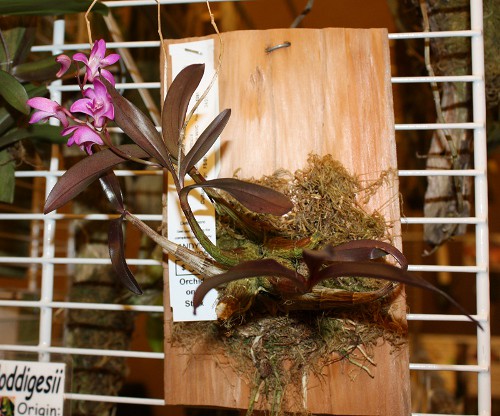
I recently bought a Dendrobium kingianum.  My plant is a little clump of green.  This one (below) that was for sale at the Andy's Orchids table has very dark leaves of a purple/red shade.  It is a really nice little plant.
dend_kingianum
Dendronium kingianum for sale at Andy's Orchids booth
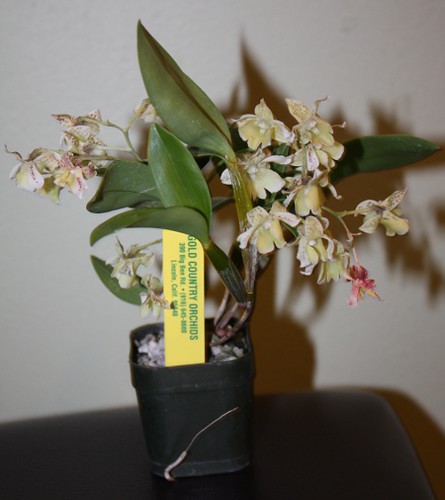
I purchased a really nice miniature Dendrobium Micro Chip,
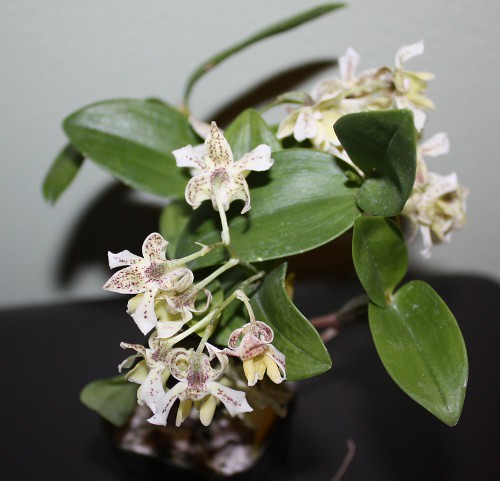
also known as Dendrobium Aussie Chip, because apparently there was something invalid about the name "Micro Chip."  [Correction: The hybrid Dendrobium Aussie Chip is a cross between Den. aberrans and Den. atroviolaceum.Micro Chip is a primary hybrid of Den. aberrans x Den. normanbyense.  It is covered in little white flowers that are peppered with black specks.
den_microchip
Dendrobium Micro Chip
den_microchip_birdseye
Dendrobium Micro Chip - Birdseye view so you can see the peppering
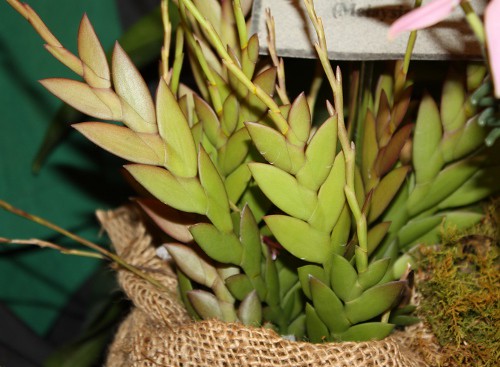
There are several species of Dendrobium that are similar to my Dendrobium anceps that bloomed recently.  One of these has dark pink blooms that are much more attractive than my little green blooms.  That species (Dendrobium rosellum) also has more coloration in the leaves themselves.  There was a nice specimen (shown above) in the gigantic display at the show.
dend_rosellum
Dendrobium rosellum
When I walk into an orchid show I am in shock for a couple of minutes.  I hope that as long as I live, and as many orchid shows that I attend, I never get to the point where I don't have that experience when I first walk into one of these shows.  When we got to this show, I paused momentarily and tried to get my bearings, before diving right in to look as closely as I could at the vendor tables, trying to not miss anything important.  On the first table we looked at there was a large and flowering Encyclia that smelled wonderful.  It was priced so reasonably we immediately agreed that it would be going home with us.  But seeing as it was the first table of plants, we were patient and decided to just keep an eye on it while we scoped out the other vendors.  We ended up going back to buy it not long after, before even finishing looking at the other vendors.

christie_with_anniversary_encyclia
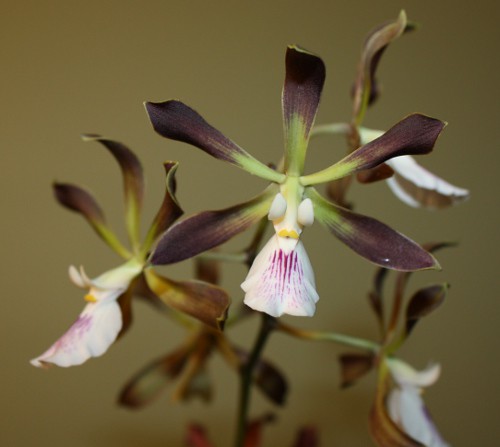
Christie with Encyclia Gay Rabbit
enc_gay_rabbit_flowers
Encyclia Gay Rabbit closeup (Do you see the rabbit ears?)
Christie carried this orchid around with us for most of the show.  It was a bit heavy since it was a large plant, potted in a clay pot, so I joked that she was my orchid pack mule.  She was a pretty happy pack mule though, because we had this awesome aroma following us around as we looked at the plants.  I would relieve her for a little bit and carry the plant while pointing at plants that I wanted her to photograph for me.  The plant is Encyclia Gay Rabbit, which is a 2nd generation hybrid, including E. cordigera and E. alata.
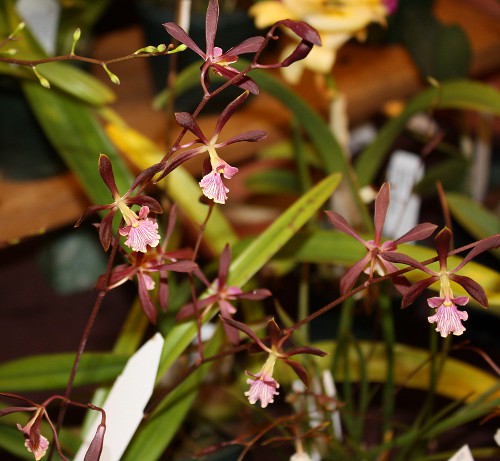
enc_bractescens_x
Encyclia primary hybrid, with Enc. bractescens as one parent.
I was tempted to purchase one of these hybrids with bractescens parentage, but I got another one from Michel (below).  It is Encyclia profusa x E. fowlei.  The species E. profusa has been on my want list and I also really like E. fowlei.  It should be neat to see what this plant looks like when it blooms, and I shouldn't have to wait too long since it is in bud.  E. profusa has dainty, creamy white flowers with a little bit of pink on the lip.  E. fowlei has a creamy yellow flower with some brown streaks.  The petals of fowlei flare out a little, so there will probably be some variation in the form of the flowers.  The color could be anything from white to brown, possibly with some pink on the column or lip.
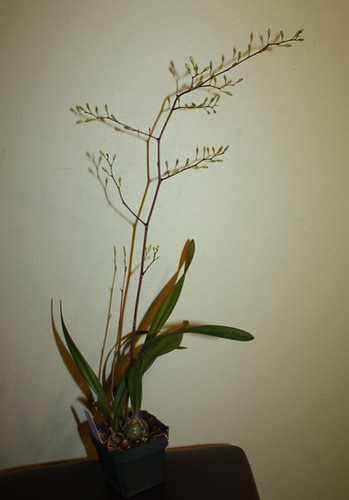
enc_profusa_x_fowlei
My Encyclia profusa x fowlei in bud
Michel Orchids had a lot of primary hybrids of Encyclias and other interesting plants.  The plant pictured above was one of these.  I can't remember what the other parent was for this particular hybrid, but the Enc. bractescens is pretty apparent with these tiny flowers and the thin leaves.
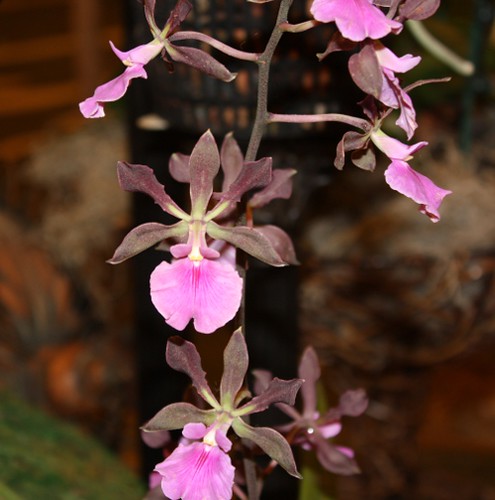
enc_hybrid_noid
Encyclia (possibly cordigera v. rosea)
The plant above is probably Encyclia cordigera v. rosea, but I didn't take a picture of the label so I can't be sure.  Either way, it's a nice orchid with fragrant flowers.

enc_hereford_jewel
Encyclia Hereford Jewel (Enc. cordigera x Enc. bractescens)
The plant above is another primary hybrid that was on display and had received several awards.  It is obviously being grown well considering the number of flowers.
* If you're curious about how closely related the Dendrobium and Encyclia genera are, they are both within the same subfamily, Epidendroideae.  That doesn't say too much though, considering there are only five subfamilies in the Orchid family, which is hugely diverse.  Also, the Epidendroideae subfamily is the largest with 576 genera and more than 15,000 species.