Showing posts with label Bauhinia. Show all posts

Monday, August 20, 2018

Trip Report: Exploring Austin, part 1

I spent two weeks in Austin this summer, taking a training course to be a Red Hat System Administrator. In the evenings I traipsed around the metro area, birding in local parks and natural areas and doing my normal thing - observing and logging everything new species (to me) using the iNaturalist app.

I visited 10 different parks during my two weeks and covered a lot of ground. I observed a few new species of birds (Black-crested Titmice, Least Grebe, Pectoral Sandpiper), several new dragon/damselflies (Swift Setwing, Marl Pennant, Kiowa Dancer, Dusky Dancer, Checkered Setwing, American Rubyspot), several new plants, and even found a nice gastropod fossil. But this is a plant blog, so let me dive in to more detail about some of the plants.

Small bilobed leaves of the Anacacho Orchid tree (Bauhinia lunarioides)

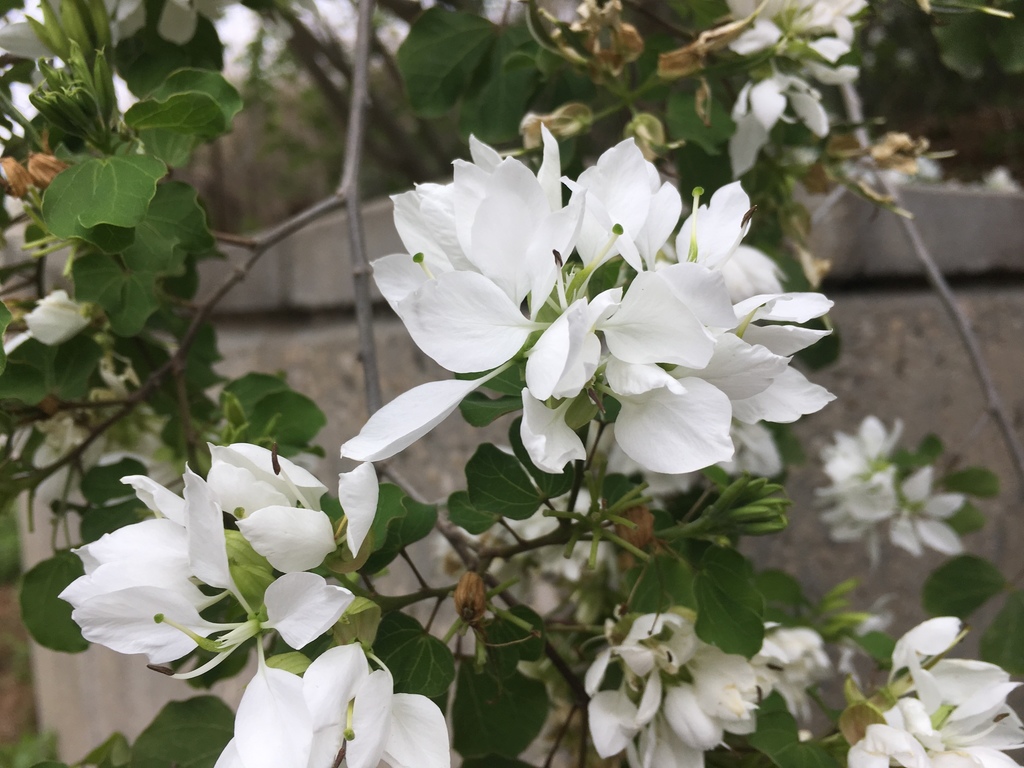
Along the Colorado River in Austin there is a nice walking trail that is well used by locals walking their dogs, cycling, and jogging, as well as to observe bats at the Congress Avenue Bridge. (I sort of stumbled along this myself and was treated to quite the spectacle around sunset.) Along this path I came across a couple of really neat plants. The first was a small shrubby tree (probably about 6' tall and about the same width that was covered in opened seed pods. There was nothing too remarkable about the tree except that the seed pods had all split open in a spiraling fashion and they were pretty conspicuous. Upon closer examination I realized the leaves were the distinct shape of a Bauhinia, which greatly excited me. I took some photos and uploaded the observation to iNaturalist, which suggested the name of Anacacho Orchid (Bauhinia lunarioides), a native of central and southern Texas into northern Mexico. This species has small and deeply split leaves, almost appearing as two leaves. The flowers (which appear in the spring) are white (or occasionally pink) and showy. I don't have any of my own photos of flowers to show, but the photos below are from iNaturalist observations (here and here).

Photo by iNaturalist user anschad.

Photo by iNaturalist user johnkarges.

Of course I collected a handful of seeds and brought them home for experimentation. I have started other species of Bauhinia from seed and they have germinated easily and been a fairly easy plant to grow, although they are tropical and cannot winter outdoors in my climate. This species appears to be a little more hardy, but not enough (zone 8) to overwinter in central Oklahoma (zone 7). It's not clear to me whether the tree was growing naturally along the path or had been planted there. I'm guessing the latter but who knows?

Part 2 coming later this week!

Thursday, April 26, 2018

Update: Plant all the seeds!

A little more than a month ago I planted a bunch of seeds and it looks like I've had good results with most, if not all, of them.

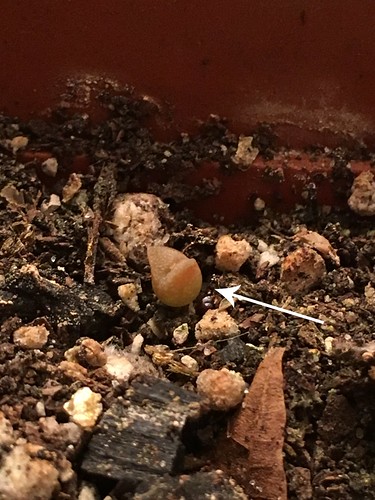
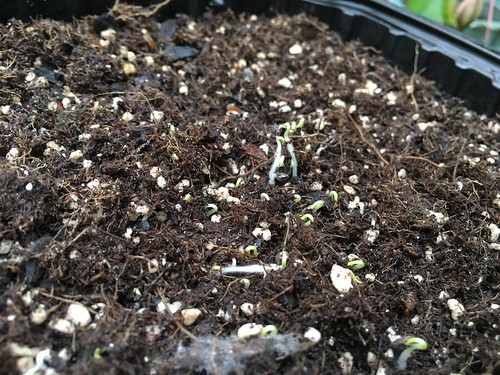
From the pots of mixed cacti seeds, I can see some funny little forms rising from the soil. The germination percentage is low at this point - just three little seedlings. It's quite possible that these three seedlings are just the species with the quickest germination period and others will come up over time. Hard to say for sure at this point. I wonder how long it will be before these little seedlings are recognizable.

Unknown cactus seedling
First signs of life in the mixed cacti pots.
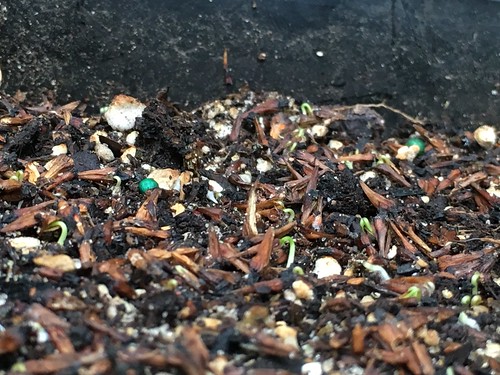
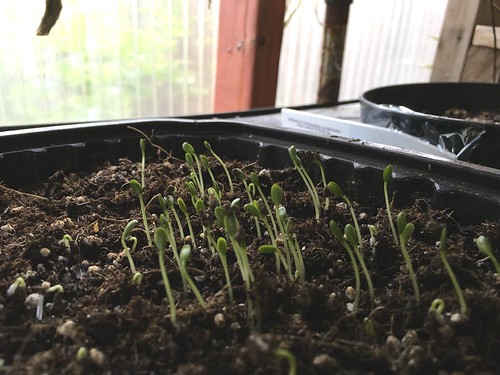
My native butterfly-attracting Common Buttonbush (Cephalanthus occidentalis) seeds are beginning to sprout!

Common Buttonbush (Cephalanthus occidentalis) seedlings

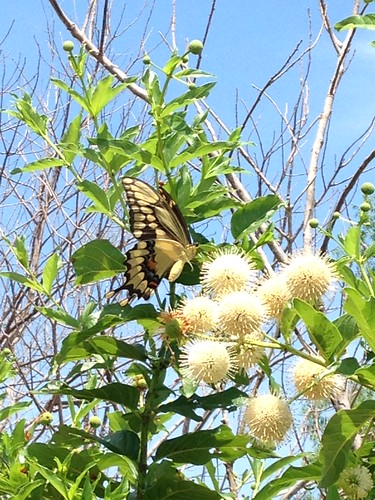
Eastern Giant Swallowtail (Papilio cresphontes) on Common Buttonbush (Cephalanthus occidentalis)
Eastern Giant Swallowtail (Papilio cresphontes)
on Common Buttonbush (Cephalanthus occidentalis)
at Lake Texoma (July 2016)
My non-native (south African) butterfly-attracting Hairy Balls (Gomphocarpus physocarpus) have sprouted and are off to the races! Check out the fast growth over just 30 hours!

Gomphocarpus physocarpus seedlings
Gomphocarpus physocarpus 6 days after planting

Gomphocarpus physocarpus seedlings
Gomphocarpus physocarpus 7 days after planting

The other seeds I planted were some Bauhinia (Orchid Tree) and Dietes (Fortnight Lily/Iris) that I collected in Los Angeles in March. I have had luck germinating each of these before, so I am hopeful in both cases, but haven't seen any action yet with this batch. The Bauhinia trees that I grew from seed previously are now about 5' tall and ready to be planted outdoors in an appropriate climate (not central Oklahoma). Unfortunately my previous encounter with Dietes didn't end well. After the two seeds germinated and sprouted tiny plants, they didn't survive long. I'm hoping to do better this time and, with luck, I'll have more seedlings and can experiment a little more with lighting, humidity, and soil moisture.

Wednesday, October 25, 2017

Plant Find: Bauhinia galpinii

From the moment I first saw one, I have loved Orchid Trees (Bauhinia).  Bauhinia is a genus of more than 500 species of tropical flowering plants, many of them trees, but some are more shrubs and some are even vines.  They are found throughout the world in tropical regions and I have seen them growing in the wild, as well as cultivated in yards in the southern US.  In Galveston, there are several Bauhinia variegata growing in front yards and flowering with their beautiful pink or white blooms.
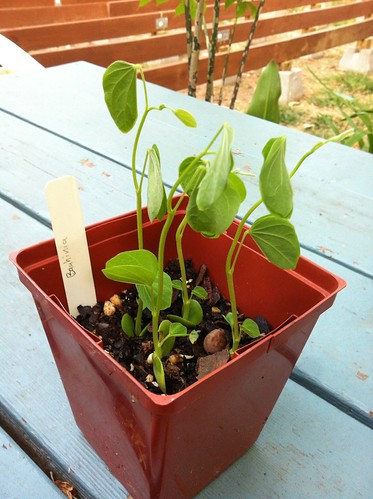
Bauhinia variegata seedlings
A few years ago I collected some seeds from a tree in Galveston and was able to germinate those seeds. I tried planting a few of the young seedlings to the Galveston yard, but they didn't make it. I don't know if their sunlight was choked out by their more aggressive neighbors, or something else happened. I have a few saplings now that have gotten to a decent size and I plan to plant in the Galveston yard when they get even a little bit larger.
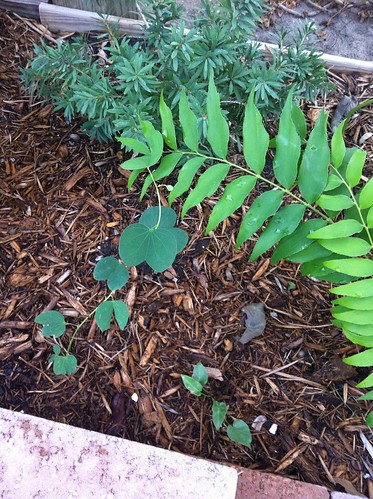
Bauhinia variegata (orchid tree)
Young Bauhinia variegata seedlings that I transplanted to Galveston garden.
As beautiful as the blooms are, the leaves are every bit as stunning.  They unfold like a set of hands asking for a piece of bread.  I read that Linnaeus named this genus after a set of twin botanists, which is fitting due to the symmetric, two lobed leaf.
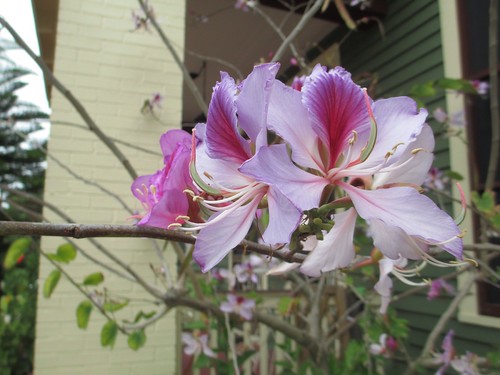
Bauhinia variegata
Bauhinia variegata flowers on a tree in Galveston

I mentioned that there are some species of Bauhinia that are vining.  I saw one of these species at the Singapore Botanic Gardens a few years ago (photo below).  The stems are woody and there is a fuzzy brown sheath that covers the new leaves as they emerge.  The emergent leaves are sort of red and bronze, turning to a medium green with dark veins. 
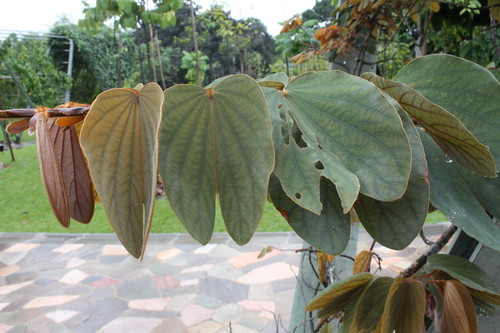
Bauhinia semibifida
Bauhinia semibifida at Singapore Botanic Gardens
On my most recent trip to Galveston I visited a nursery and came across a beautiful miniature Bauhinia in a pot that I assume is meant to stay a miniature.  It is Bauhinia galpinii and it is so cute. 
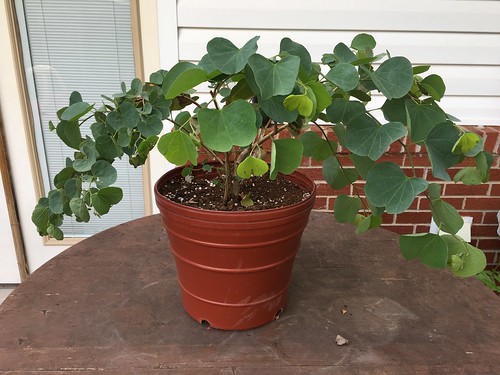
Bauhinia galpinii
Bauhinia galpinii

There are actually two small trees in the pot and one of them has much smaller leaves than the other.  Since I have grown Bauhinia variegata from seed and know that the leaves are large from a young age, I do believe this is actually going to retain the small leaves.
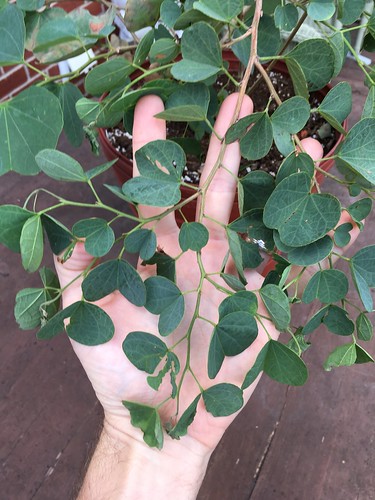
Bauhinia galpinii
Tiny leaves of Bauhinia galpinii

My plant is not yet blooming, but I found photos of the flowers online.  They are salmon red and petite compared to B. variegata, but of the same shape.  I hope I can keep this plant happy in the greenhouse over the winter and then I have the perfect place for it next spring when it is warm enough to move my plants outdoors.