Showing posts with label persimmon. Show all posts

Monday, October 22, 2018

A tree with a view

My good friend Steve gave me a couple of Paw-Paw trees (Asimina triloba) during the summer. I have kept them in the pot until now, wanting to make sure they were kept watered and healthy during the hot season.

Paw-Paw tree (Asimina triloba) with a view of a little pond
Last week I took them out to my in-law's land where there is plenty of room to plant trees and searched for a good spot. I also had some young Persimmon (Diospyros virginiana) trees to plant. My mother-in-law pointed me an area which already had a cluster of Persimmon trees growing. I don't know if the trees were planted together here many years ago (when my wife's ancestors settled the land), or if they grew here naturally. My mother-in-law had shown these to me in the past but I had never seen any fruit on them. This time around I saw a few fruits up on the tall skinny trees and I saw one smaller, squat tree that was absolutely covered in fruit.

Nearby Persimmon (Diospyros virginiana) tree loaded with fruit
We decided that we would go ahead and plant the Paw-Paw trees here with the Persimmon trees. I like that these little trees have such a nice view. By the way, I took advantage of the loaded Persimmon tree.

Persimmon fruits

Persimmon seeds removed from fruit.
There's actually more seed volume than fruit volume and it was a lot of work to separate the two.

Persimmon cookies
I brought about 30 fruits home and laboriously separated the small amount of fruit from the large amount of skin and seeds and made one batch of Persimmon cookies using the recipe I've shared before. I only got 1/3 cup of persimmon out of the fruits I collected, so I had to modify the recipe. The end result was 14 delicious cookies and 110 seeds that I can now plant. Johnny Appleseed, there's a new seed sower in town.

Friday, August 24, 2018

Trip Report: Exploring Austin, part 3

In my last two posts I talked about plants that I found along the Colorado River in downtown Austin.

On a different day I went to St. Edward's Park to do some birding and I noticed one tree had small green fruits on it - about the size of a pecan with it's outer green shell still attached. iNaturalist to the rescue again, I learned that this was a Texas Persimmon Tree (Diospyros texana). My admiration for native Persimmon trees is well known to readers of this blog, and I was very excited to learn that there is more than one species that grows natively in the United States. I saw a larger specimen of this tree when I visited Mayfield Park and Nature Preserve, this one marked with a placard.

Texas Persimmon at Mayfield Park and Nature Preserve


I also found this tree growing at Commons Ford Ranch Metropolitan Park. I collected a couple of fruits and harvested the seeds. Since I had good luck germinating some native persimmons last year, I am trying the same method: removing all fruit from the seeds, placing them in a pot of soil outdoors, and leaving them alone through the fall and winter. I may move this pot into a slightly warmer spot over the coldest part of the winter, just in case they aren't quite as hardy as I'm hoping, but I do want them to experience the cold they would naturally in the Austin area. Here are some photos of the fruits and flowers by other iNaturalist observers.

Photo by iNaturalist observer butterflies4fun.
Photo by iNaturalist observer manesalinas.

I've done some research on this species (good info here and here) and found that it is likely hardy where I live in central Oklahoma, so I plan to try growing in here. It is also a recommended species for greater landscaping use, being small, nicely formed, attractive bark, naturally feeding wildlife, and drought tolerant. As the placard mentions above, the fruit is small but edible. Hopefully I'll have a chance to try one some day.

Tuesday, May 22, 2018

Update: Native persimmons

You may recall that last year I collected a wild persimmon and planted the seeds. I put these in a pot outdoors and just let them be - no water, no attention whatsoever. I figured the less I messed with them, the more likely they would be to germinate.

Persimmon tree (Diospyros virginiana)
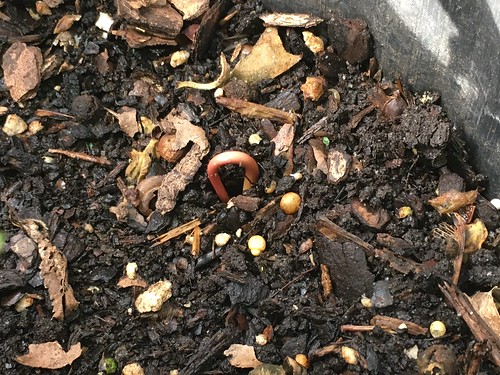
Persimmon tree (Diospyros virginiana) beginning to sprout from the soil.
It appears my gambit worked! I have one little tree that sprouted from the soil in late March or early April and another one is breaking through the soil now. (And I'm pretty sure it's not a pecan or oak tree planted by a neighborhood squirrel, which is what usually comes up in my pots that sit outdoors...)

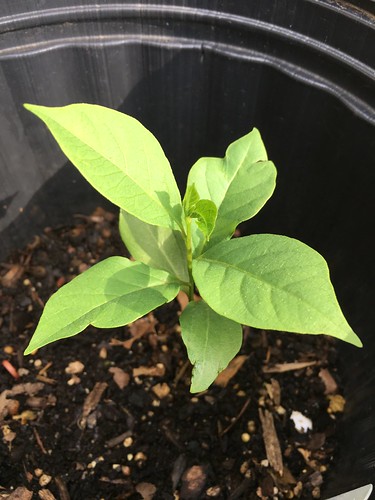
Persimmon tree (Diospyros virginiana)
Persimmon tree (Diospyros virginiana) growing quickly.
The funny thing is that just a week before the first tree sprouted I placed an order from a plant catalog and included two small persimmon trees, so it looks like I may soon have persimmon trees coming out my ears and I don't really have a plan for where to plant them!

I know my mom would love to be able to pick persimmons from her own yard, but I also know that these native persimmons are not the ideal candidates for cooking. And I also realize it will be years before the trees are large enough to bear fruit...

I do have access to land where I can plant these, so maybe I'll start a little grove there.

Wednesday, September 27, 2017

Native persimmons and a recipe!

I was walking around Lake Thunderbird on the east side of town recently and found a persimmon (Diospyros virginiana) tree growing in the riff-raff rocks piled right up near the water.  The tree was in bad shape with fall webworms all over the place, but it did have several fruit on it. 

native Persimmons (Diospyros virginiana)
Persimmon (Diospyros virginiana) growing near the lake shore
I plucked one fruit and found that it was still firm, a ways from ripening.  I have read that persimmons are ripe when they still hold their shape but the skin is just beginning to wrinkle a little.

native Persimmons (Diospyros virginiana)
Characteristic four petals at the top of the fruit.
Note: This fruit is not ripe and should not be eaten!
I decided to collect the seeds from this persimmon, so I had to stomp on it with my shoe to break open the hard fruit.  The single fruit contained 8 seeds that were large and covered in very sticky fruit. I'm going to try growing these by planting them outdoors and letting them overwinter outdoors.  Other than being picked a little early and me being a human rather than a squirrel, I should be following the most common way that these native persimmons are propagated.  If I am successful in growing some trees then I will transplant them to some areas where they can thrive and hopefully produce more!

native Persimmons (Diospyros virginiana)
Seeds removed from the sticky fruit
I am fascinated by persimmons because they are one of the only (maybe the only?) truly native and human-eatable fruiting trees in my area, and it seems like no one knows about them.  I grew up with my mom making Persimmon Cookies during the Christmas season every year.  They are a soft cookie made with warm holiday spices and a consistency sort of like a blueberry muffin.

My mom purchases the larger persimmons from the grocery store.  I think these are an Asian species, though I don't know for sure.  I'm curious what other people do with their persimmons.  I think I should set up a chair next to the persimmons in the produce section this holiday season and survey each person who buys them.  Maybe this year I can find a few native persimmon trees and pick some fresh local fruits for her cookies!  My mom agreed to share her recipe in case anyone would like to give them a try.

Persimmon Cookies

  • 1 c persimmon pulp (3 medium or 2 large fruits)
  • 2 c flour
  • 1 c sugar
  • 1/2 t cloves
  • 1/2 t cinnamon
  • 1/2 t nutmeg
  • 1 egg
  • 1/2 c oil
  • 1 t baking soda
  • pinch of salt
  • 1 c nuts (optional, my mom leaves these out)
  • 1 c raisins
Combine ingredients and drop onto cookie sheet with a spoon.  Bake at 350° for 9 minutes.