Thursday, September 30, 2010

Upcoming meeting at the Fort Worth Botanic Gardens

Plant lovers one and all-

On Saturday, October 30th the MidAmerica chapter of the International Aroid Society (IAS) will be hosting a meeting at the Fort Worth Botanic Gardens (FWBG) in Texas.  You don't need to be a member of the IAS or even know what an Aroid is to attend.  Everyone who likes plants is welcome to come join us!

The meeting will consist of several presentations, including information about:

  • how to identify your plants

  • growing temperate Aroids in this part of the country

  • Aroid anatomy

  • a rare blooming of the gigantic Titan Arum in Houston this year!

We will also be exchanging plants in a plant and cuttings swap.  All meeting attendees are encouraged to bring a cutting or plant to share with others.

After the presentations, lunch and the swap we will be touring the botanic gardens, including the tropical conservatory, which has a very nice collection of many different tropical plants.  The full meeting agenda can be found here.
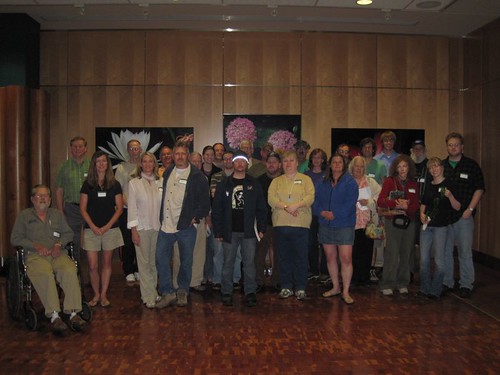

group_pic
Picture of those attending our last meeting in St. Louis

The meeting will be free of charge.  Lunches will be available for a minimal charge and FWBG charges a $1 admission to the tropical conservatory.

We are asking people to RSVP, so that we know how many chairs to set up and how many sandwiches to order.

If you have any questions about the meeting, please don't hesitate to ask me.

I visited the Fort Worth Botanic Gardens last year and had a great time.  Check out my blog post about that trip here.

Wednesday, September 29, 2010

Ficus destruens seedlings

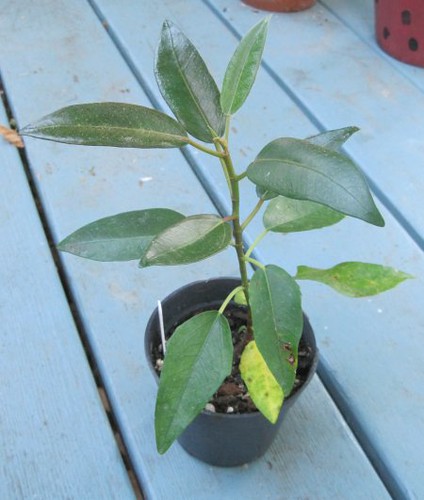
A friend of mine likes to grow plants from seed, especially Ficus trees.  She recently sent me two  Ficus destruens saplings.  This tree is sometimes called "Rusty Fig" for the color of it's new leaves and twigs, which emerge with an orangy hue.  The leaves are elliptic to lanceolate.  This tree is endemic to Australia, where it grows in wet tropical rainforest.  The figs on this tree are orange or red.

Here is one of my little saplings.

f_destruens
Ficus destruens
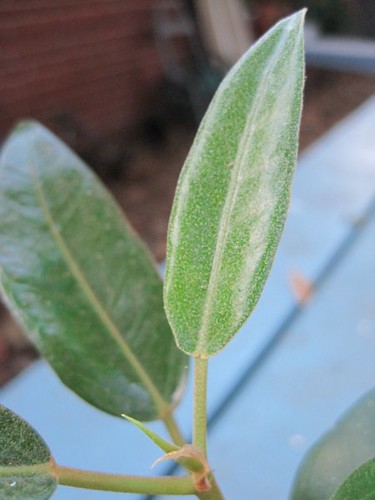
The leaves have a very unique look and leathery texture.  You can see the speckling in the picture below.

f_destruens_leaf
Ficus destruens leaf
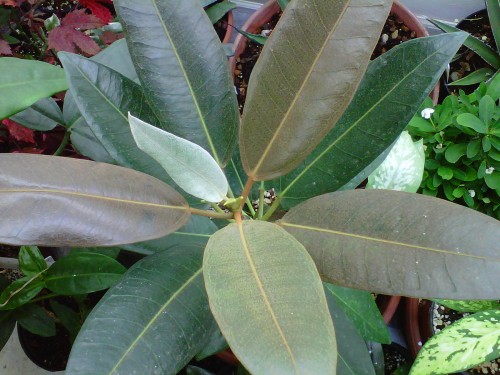
Update [2010-09-30]:  My friend who sent the seedlings just sent me a picture of a more mature Ficus destruens, which shows the colors even better than my little saplings.

f_destruens_mature
Older Ficus destruens, showing more color

Tuesday, September 28, 2010

International Aroid Society

I joined the International Aroid Society (IAS) a little over a year ago and began a local chapter, the MidAmerica chapter to meet with other Aroid growers in the central part of the country.  The IAS is full of people who are very knowledgeable about this very popular plant family.

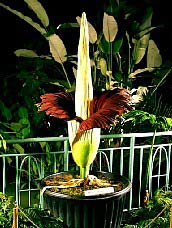
The Aroid family is huge, made up of many common houseplants, as well as some very rare and hard to find tropical plants.  In fact, many new Aroids are being discovered every year.  Some Aroids you are probably familiar with are the Peace Lily (Spathiphyllum), Chinese Evergreen (Aglaonema), Dumbcane (Dieffenbachia), Hawaiian Volcano Flower (Anthurium).  Some of the largest and some of the smallest plants in the world belong to the Aroid family.  The largest inflorescence (bloom) in the world belongs to an Aroid called the Titan Arum (Amorphophallus titanum), pictured below.

Titan Arum (Amorphophallus titanum)

The IAS disseminates the latest and greatest information about growing Aroids and identifying your plants.  The society is made up of professionals in botanical research, amateur growers and lots of people in between.

Recently there have been several regional chapters forming, which allow us to meet in person more often and do fun things like plant swaps, listen to talks about our plants and tour botanical gardens.  The next MidAmerica chapter meeting is being held at the Fort Worth Botanic Gardens on Saturday, October 30.  More to come on that soon!

I was just asked to serve on the Board of Directors for the IAS over the next 3 years.  We are hoping to encourage more members to join this wonderful group.  If you like growing Aroids, you should definitely consider joining.  Membership is only $25 annually, and it includes a very professional, high-quality and lengthy journal called Aroideana.  You can see the contents of past Aroideana issues on the website.  We also distribute quarterly newsletters with a lot of great information.

You can join online at http://aroid.org/society/joinias.php.

Monday, September 27, 2010

Bark Totem

A while back I posted pictures of a large piece of bark that I had come upon and mentioned that I wanted to do something creative with it.  I finally got around to doing something with it.

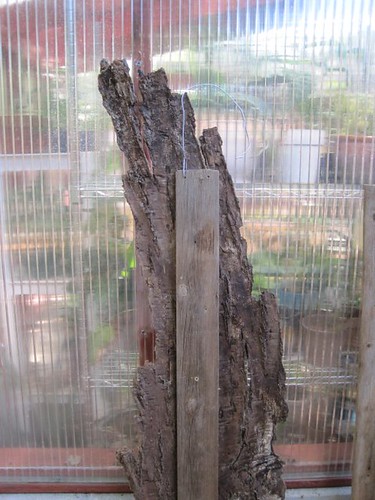
The bark has been outside, weathering the storms and all, so parts had broken away, but there was still a pretty good size piece holding together.  I found a piece of wood about the same length and fastened the bark to the plank in several locations along the length.

bark_backside
Rear view of my bark totem, showing the support board and hanging wire.
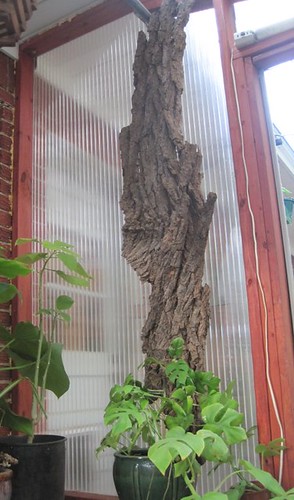
Then I used some heavy gauge wire to hang the bark from my rod in the greenhouse.

hanging_bark
My bark totem hanging in the greenhouse
I'm working on building a bench that will sit just below my bark wall where I can place more of my pots.  My plan is to allow my Rhaphidophora tetrasperma to climb up the bark wall.  I have leaned the growing stems up against the lower portion and will let the adventitious roots attach.

What do you think of my bark wall?

Thursday, September 23, 2010

Trip Report: Skunk Cabbage in the northwest

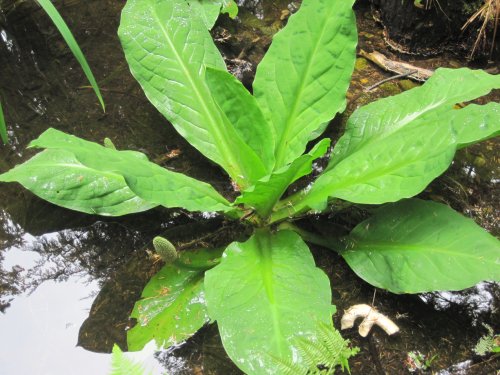
On our trip to the northwest back in June, Christie and I ran across the Western Skunk Cabbage (Lysichiton americanus) in several different locations.  I hadn't seem them in person before, so I didn't initially recognize them.  Actually I had a kind of hilarious encounter with one several days before realizing what it was.

skunk_cabbage
Skunk Cabbage (Lysichiton americanus) growing in a pond at the Capilano Suspension Bridge park
Here's the story:

I spend quite a bit of time around plants: at my own house, in plant stores, in nature.  I'm always pointing out different things to Christie: grabbing a leaf and pointing out something about the variegation or vein pattern or something else she probably is not too interested in.  Anyway, because I am used to dealing with plants, I can usually tell by looking at a plant what kind of care I need to take in handling it.  Well, for whatever reason this was not the case with the Skunk Cabbage.  We were walking along a hiking trail on this insanely long walk down to a beach from the road.  (The distance was not advertised, but we determined later it was approximately seven times longer than we would have preferred.)  I noticed something interesting about the plant along the side of the path (though I don't remember what was interesting now) and I called Christie's attention to it.  I grabbed the leaf, pulling it towards us and RIP!  This huge, beautiful leaf (about 3 feet long) just tore in half in my hand!  It wasn't a horrible loss considering there were hundreds of these plants within eyesight, but I felt horrible about it.  And it was pretty hilarious because I was like "Hey Christie, check out this - "  RIP! "Whoops!"

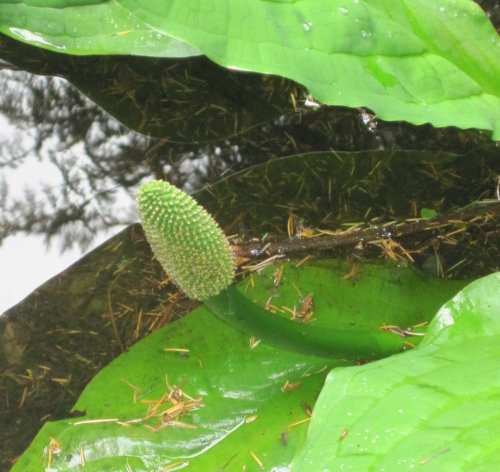
Anyway, that's the story.  It was several days later when we were in Vancouver at the Capilano Suspension Bridge park when I saw the spadix left over from an inflorescence on one of these plants.  That was when I realized what it was.  I think we got down close to it and could still smell the leftover stench of the bloom.  In the area where there were several of these plants it smelled like you were standing near a dumpster.  There wasn't an overwhelming smell, but you could definitely smell it.  We saw the spadices on several plants, but none still had the nice yellow spathe left.

skunk_cone
Skunk Cabbage inflorescence

Tuesday, September 21, 2010

A place for potting

Last year for Christmas my parents-in-law gave me an unusual gift: a mixing bowl.  I feigned gratitude until I opened my next gift: a box of bolts.  My mother-in-law was snickering, telling me that they went together.  Okay...

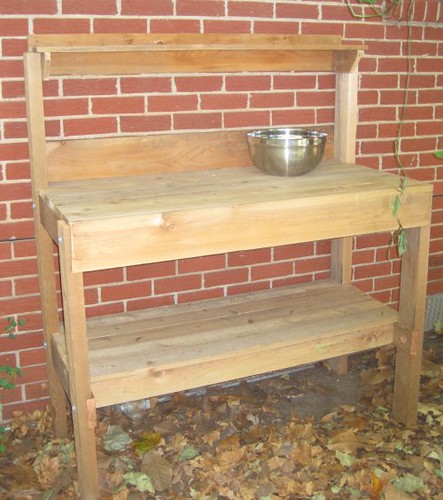
Next gift? Directions for building a potting bench!  Ah, now it makes sense.  My father-in-law told me he had bought the lumber and would deliver it to my house shortly.  They explained that the mixing bowl was for mixing my various soil ingredients and that I could cut a hole in the table top (if I wished) to hold the bowl recessed from the surface.

potting_bench
Completed potting bench
So, for the last 6 months or so I've had some really nice lumber piled up on the side of the house, and our picnic table has been covered in my plants so Christie hasn't been able to enjoy her lunch breaks outside like she likes to do.  I had a free weekend a couple of weeks ago, so I pulled out the circular saw and went to work.  Just a couple of hours into it, I had something resembling the components of a bunk bed.  Another day of work and I had a very nice looking potting bench!

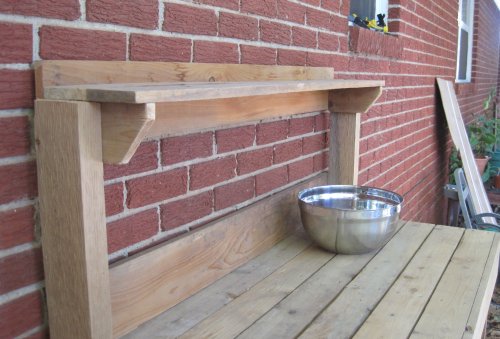
top_shelf
Top shelf of the potting bench
It fits very nicely along the wall of my greenhouse, right next to the door.  It also fits nicely under the eave of the house, where it gets a little more protection from the elements.

Now I have it loaded down with plants, leaving just enough room for repotting a plant or two on the work surface.  The lower shelf holds my bags of potting soil and extra pots.

I plan to stain it soon to protect the wood from long-term weathering.

What do you think!?!

Thursday, September 16, 2010

Native Orchid

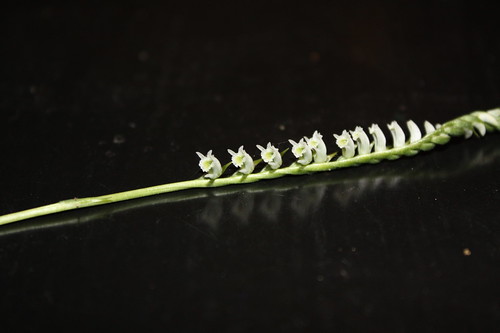
I was walking around my front yard talking on the phone this week and I reached down and plucked a flower stem off of a "weed" growing in my yard.  As I was walking around I started looking at the flower spike a little more closely and noticed that the flowers were very intricate and attractive, although very tiny.  In fact, they looked a lot like an orchid.

IMG_4144
Spiranthes lacera var. gracilis
The flowers spiral up the stem as they open and are all white, except for some yellow in the "throat."  I emailed a picture to my orchid friend, Steve, who lives in Arkansas.  He knows a lot about miniature orchids and natives, so I thought he might be able to give me some guidance.  He was familiar with my plant and told me it is called "Nodding Ladies' tresses" from the genus Spiranthes, possibly Spiranthes cernua.  There are a couple of other species that look very similar, as well.

[2010-09-24 Update:  I got a positive species identification on this plant.  It is Spiranthes lacera var. gracilis.  Thanks to the Native Orchid Conference mailing list for the ID help!]

Steve said that he has seen these in his yard before too and that he is amazed by their hardiness and survivability in mowed lawns.  Since I plucked mine before realizing what it was, I don't really know where I grabbed it or what the rest of the plant looks like, but Steve tells me it is a very non-descript grass like plant.  I'll keep my eyes peeled for more flower stems.

The USDA website shows that this plant is native to much of central and eastern North America.