A couple of weeks ago I mentioned the not-so-docile plants of the Volunteer Park Conservatory. Many people are familiar with the Venus fly trap, but there are several other types of carnivorous plants - and the conservatory had several. I know there were representatives from the popular
Sarracenia,
Dionaea (Venus fly trap), and
Nepenthes genera, and some others that I didn't know.
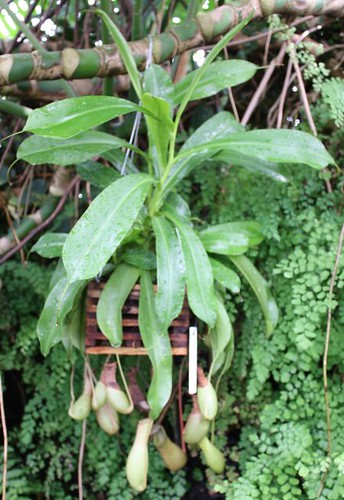 |
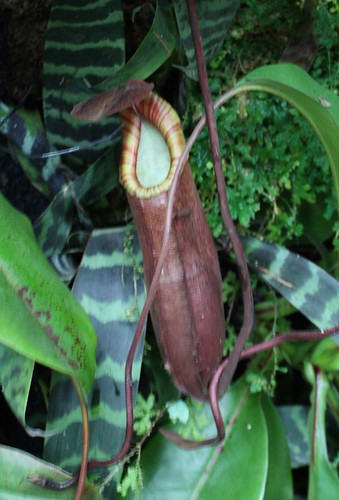
| Nepenthes sp. in hanging basket |
These plants are commonly called Pitcher plants. Apparently some people call them Monkey Cups, because monkeys have been observed drinking out of them. But I've never heard anyone call them that before. Maybe that is more common in the areas where they grow in the wild - and where there are actually monkeys in the wild to drink from them. These plants grow natively in tropical Asia and Australia.
The
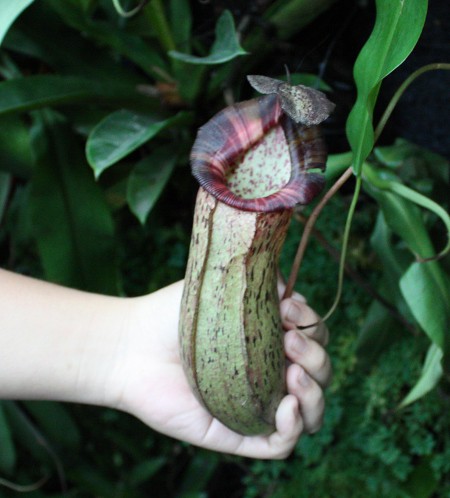
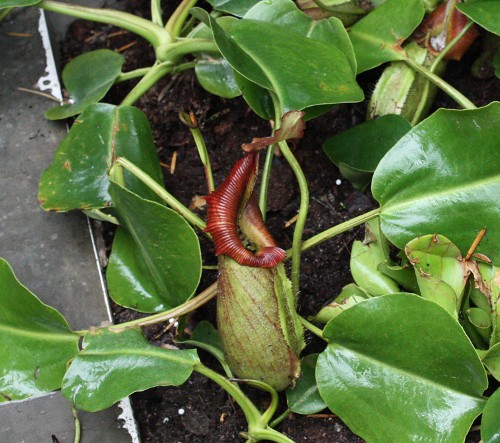
Nepenthes genus consists of plants that produce wide and deep pitchers for collecting bugs that are lured into the slick trap. The lures come in the form of smell, taste and/or color. The lure attracts the bugs, but the slick inner walls of the pitchers don't allow the insects to escape. Often the pitchers are filled with water and insects (or even small animals like rats and lizards) will drown in the pitcher.
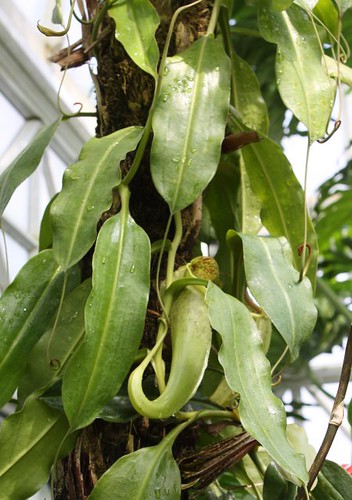 |
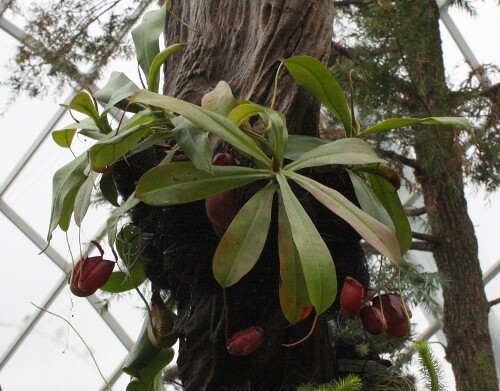
| Nepenthes climbing a totem |
Though carnivorous,
Nepenthes are not all about killing. The large pitchers actually support some insects in the rainforests where they grow. Flying insects like mosquitos will lay their eggs in the filled pitchers where they are safe until hatching and eventually flying away.
Other
Nepenthes have developed special relationships with specific animals in the rainforest. One particular
Nepenthes has a symbiotic relationship with termites which like to eat the "hair" on the lip of the pitcher. The colony doesn't mind too much when a couple of less careful termites fall into the pit. And the pitcher plant definitely doesn't mind.
Nepenthes lowii has a very interesting relationship with tree shrews. The pitcher serves as a stool where the shrews sit and sip the sugary exudate (think "nectar") that is excreted from the plant. Meanwhile, the pitcher serves as a toilet for the shrew's excrement. Apparently the excrement provides a large portion of the diet for this particular species of
Nepenthes.
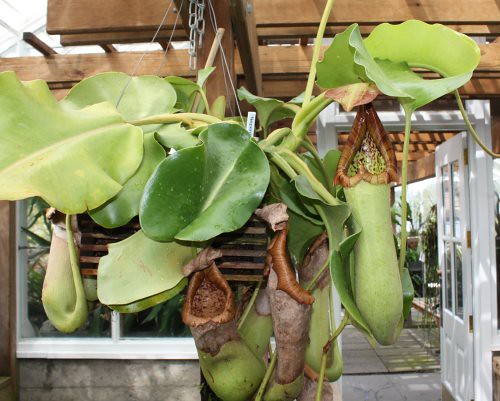 |
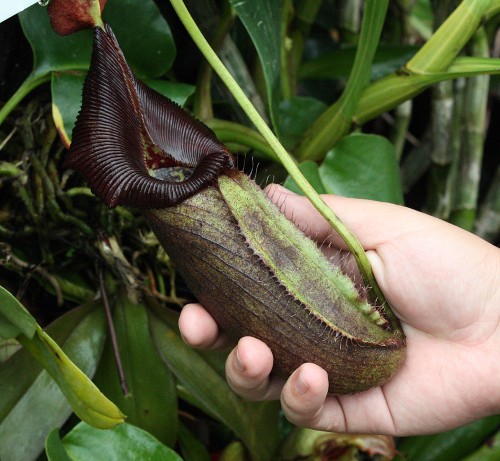
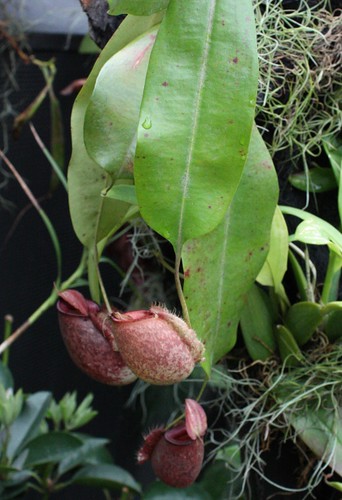
| Nepenthes truncata |
The
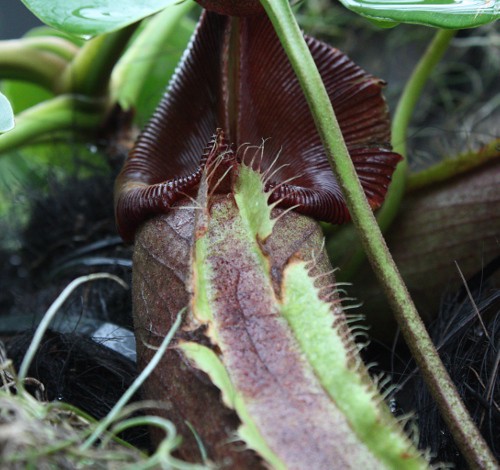
Nepenthes truncata plant had HUGE pitchers. I could have easily put my fist into one of them. And these pitchers were somewhat attractive, with lips that looked like wood. I assume this is an adaptation to attract some specific insect, though I don't know what.
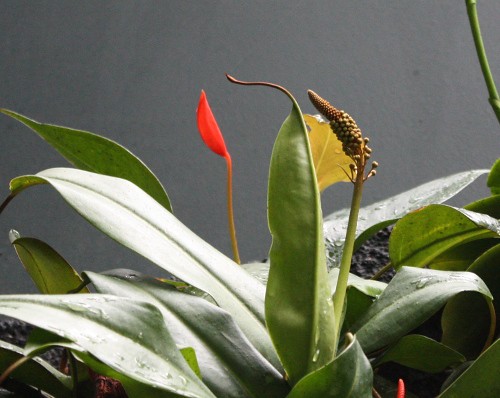
You might assume that the pitchers themselves are the blooms of the plant. Many other plants attract insects to their blooms for pollination. However,
Nepenthes produce blooms totally separate from their pitchers (as you can see below). In fact, the carnivorous parts of all of these plants are independent of their blooms. Strictly speaking, the carnivorous parts are actually just modified leaves.
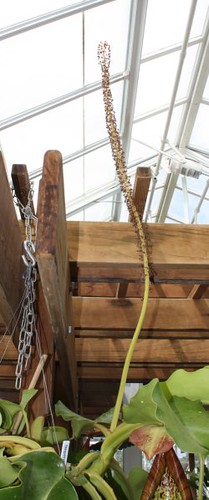 |
| Nepenthes truncate bloom stalk |
Another popular genus of carnivorous plants is the
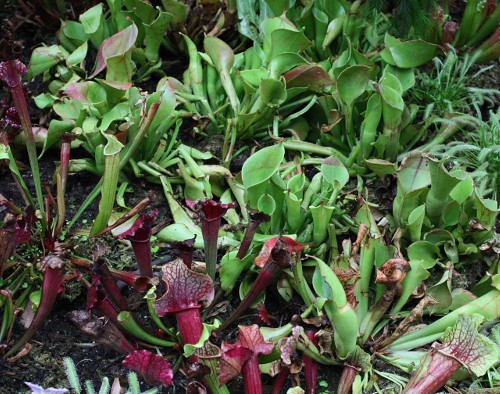
Sarracenia. The plants of this genus features a pitcher which grows upright from the base of the plant, unlike the hanging pitchers of
Nepenthes.
As a side note, I watched a movie last week with a character who carried a "Saracen sword," which made me wonder if there was anything to this name. I wondered if maybe the
Sarracenia genus - or even the larger family
Sarraceniaceae - was named after the sword, due to the similar shape of the prominent upright pitchers, which are wider at the lip than at the base. The other possibility is that the geographic locations of the Saracen people coincides with the habitat of these plants. But that doesn't work, because Romans coined the Saracen name in reference to the Muslims who lived near the Mediterranean and Arabia, while
Sarracenia are from the New World (western hemisphere). I haven't found any reference connecting the names of the plant and the sword, but that remains my theory.
[
Update 2010-09-01: A friend informed me that the Sarracenia genus is named after Dr. Michel Sarrazin, a 18th century physician and botanist in Quebec, Canada.]
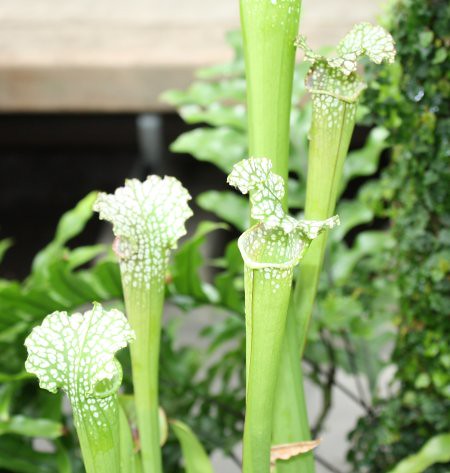 |
| The pitchers of Sarracenia suffrutic... |
Sarracenia are called The North American Pitcher Plants, to distinguish themselves from the the
Nepenthes genus. They are found in wetlands throughout the eastern US and Canada. The conservatory had several different
Sarracenia on display. The plant above was particularly attractive, with a blotchy white lip and lid of the pitcher. Also, I was able to see this plant in bloom, which was just bizarre. I hadn't ever seen a
Sarracenia in bloom, and I was in for a treat. I can only describe the bloom as looking like two flowers pressed together. It's really weird in that your eye is drawn to the center of most blooms, but the center of this bloom is covered. See what I mean below.
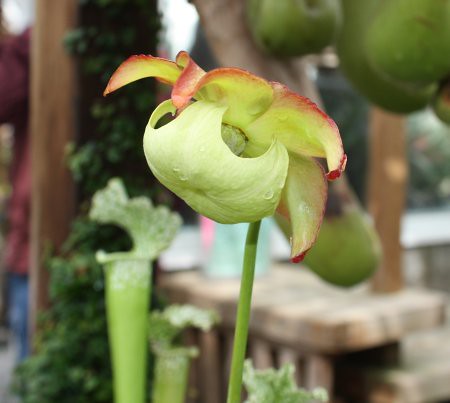 |
| The bloom of Sarracenia suffritic... |
I really like the red edges of the bloom above, which belongs to the same plant as the picture above that. I took a picture of the id tag on this plant, but the picture doesn't reveal the full name, and I couldn't find any similar names on the internet when searching for the full name. Does anyone know what
Sarracenia suffrutic...
could refer to? I think I'm just missing a couple of letters at the end of the species name. However, most reliable sources I have found on the internet describe the
Sarracenia genus as being fairly small, with just about 10 species, and none of the species have names like this one. I'm thinking that it is probably a hybrid, but I still haven't been able to find a hybrid with a name like this.
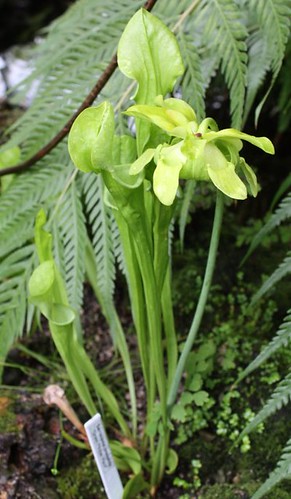 |
| Sarracenia oreophila |
I did manage to get the name of the plant pictured above, which was also displaying a really nice bloom. This one really looked like two blooms pushed into one another, hiding their centers. Considering the flower is the reproductive organ of the plant,
Sarracenias are one of the few modest plants out there in the world, covering up their parts like Adam and Eve.
There is one particularly bad
Sarracenia (
S. flava) which actually has a narcotic mixed in the nectar on the lip of its pitcher. Insects that partake of the nectar find themselves passing out and falling into the pitcher. Maybe it's ruthless, or maybe it's a more humane way of taking the insect's life. If only we could know what the plant was thinking...