Showing posts with label migrated. Show all posts

Friday, March 16, 2012

Trip Report: Garvan Gardens' Tulip Extravaganza

Last weekend, Christie and I drove over to Hot Springs, Arkansas for the weekend.  The town is aptly named after the natural springs that flow from the ground and have brought travelers here for hundreds of years.


Our trip to Hot Springs was inspired by the Tulip Extravaganza at the Garvan Woodland Gardens, but we also enjoyed the National Park focused on the hot springs.  (Ask the locals and they’ll tell you that it is the first US National Park.  In truth, it doesn’t have that official designation, but it was the first nature reserve set aside by the US government, before there was a national park system.)

img_6870_35496761995_o
Tulips at Garvan Woodland Gardens
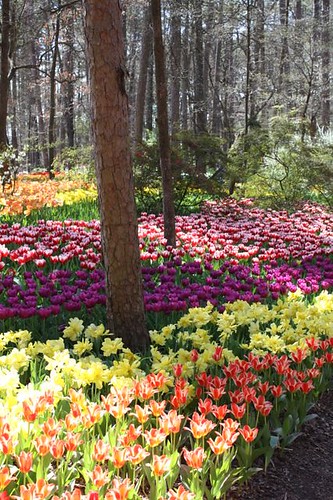
As you can see, the gardens were beautiful.  They are planted fresh each year so that they can create new swaths of color and have premium new bulbs from Holland.  We enjoyed the diverse palate of colors and tulip styles.

img_6849_35329665352_o
Tulips at Garvan Woodland Gardens
The gardens included lots of neat areas and we spent our whole afternoon wandering through the acres of carefully designed planting.  I have uploaded a photo album with tons of pictures, so feel free to peruse them all by clicking on the photo below.

Garvan Woodland Gardens 2012
Click for complete album

Thursday, May 12, 2011

Trip Report: Oklahoma Orchid Society show

I already told you about the orchid I purchased at the OOS show and sale a couple of weeks ago.  I promised pictures of the show, so here they are!  I wasn't quite as snap-happy as I can be sometimes, so the number of pictures is not overwhelming.  Just 64 decent pictures of some really nice orchids. Click on the image below.

Oklahoma Orchid Society show and sale 2011

I'm getting my photo album posted to the blog just days before attending my first OOS meeting.  When I was at the orchid show, I decided to join the OOS.  Hopefully I'll have something to post about the meeting next week.

Thursday, November 18, 2010

Trip Report: MidAmerica meeting photo album

I have created a photo album of my pictures from the 3rd meeting of the MidAmerica chapter of the IAS.  The meeting was held October 30 at the Fort Worth Botanic Gardens.

Enjoy!

photo album here

Monday, November 1, 2010

Trip Report: Conservatory highlights from the IAS meeting in Fort Worth

I could probably write dozens of posts about our meeting this last Saturday at the Fort Worth Botanic Gardens.  Instead, I think I'll write two or three posts, focusing on a couple of topics.  This post, is just some picture highlights from the conservatory.
img_4221_34655680044_o
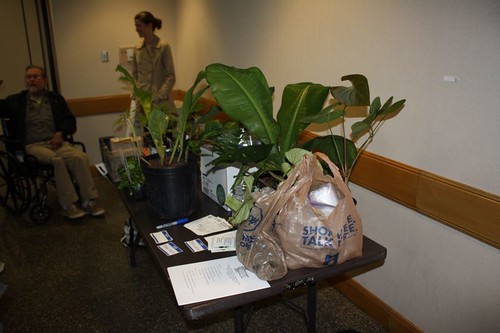
Plant swap table beginning to fill with plants
After a morning full of talks and a nice lunch from Jason's Deli, we held a plant swap among those who attended. There were so many plants that they overflowed the table and were spread out on the floor.  Philodendron, Monstera, Rhaphidophora, Anthurium, Amorphophallus, and even some Begonia and Orchids were available for trade.  It was a gigantic free-for-all and everyone benefited.
img_4235_34655674974_o
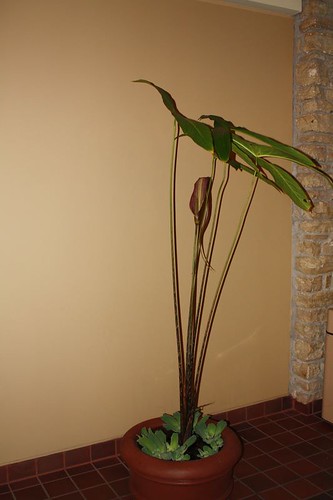
Urospatha in bloom
Out in the hallway by the entrance to our meeting room, the Fort Worth Botanic Gardens had on display a beautiful and tall (approximately 7 foot) Urospatha in bloom.   This was an incredible plant with uniquely marked stems and an amazing bloom, whose spathe curved away like in an elegant arc.
img_4245_35496829605_o
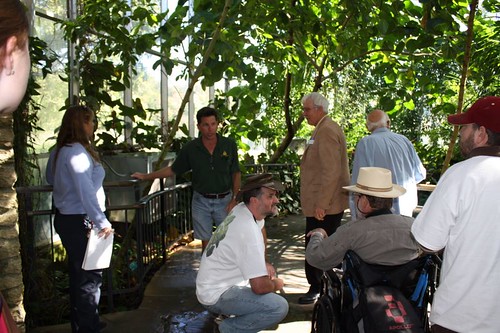
Great group of plant friends beginning a tour at the FWBG Conservatory
There were about 15 people in attendance and everyone really enjoyed themselves.  Some of us knew each other from previous meetings and email discussions and others were meeting for the first time.  There was even one long-time IAS member who has been a well-known figure in Aroids for 30 years or more.
img_4281_35366106771_o
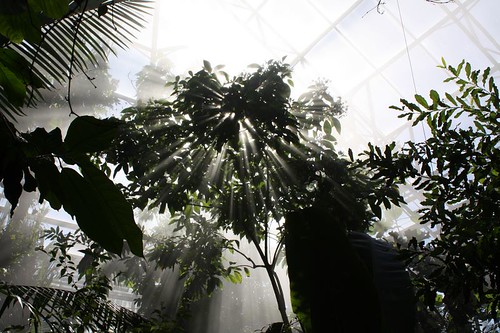
Crepuscular rays shining into the conservatory. It felt like the Garden of Eden.
The conservatory at the FWBG is very well kempt.  The plants are in great condition and there is a nice collection of Aroids, as well as several other families of plants that I like to grow (like Marantaceae).
img_4247_35496828675_o
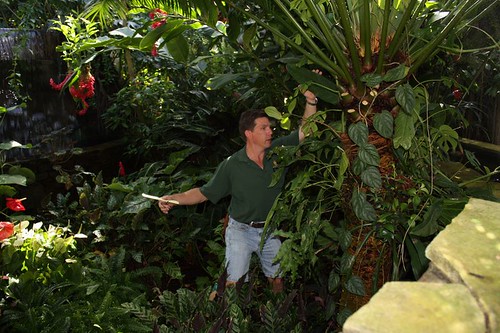
Our hands-on tour guide, John Langevin, showing off a plant
We were given a guided tour by John Langevin, who was generous enough to offer several of us cuttings or small plants from different parts of the collection, contributing lots of plants to our plant swap.  He was very knowledgeable about the collection and made the tour enjoyable.
img_4276_34655651844_o
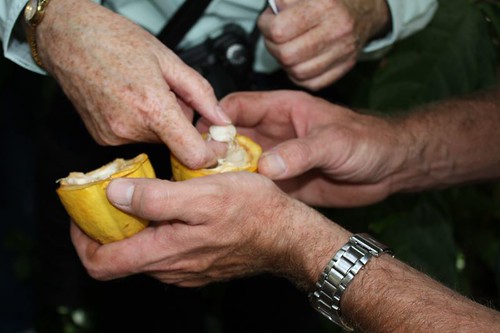
Fruit and seeds from Theobroma cacao
John removed one of the fruits from the chocolate tree (Theobroma cacao) and cut it open so that we could taste the pulp which surrounds the seeds.  I thought I smelled something resembling chocolate when he opened the fruit, but what I tasted was very different.  The pulp had more of a mild citrus taste with the texture of a slimy banana.   I brought two seeds home with me and will see if I can get them to germinate.
img_4263_35110287290_o
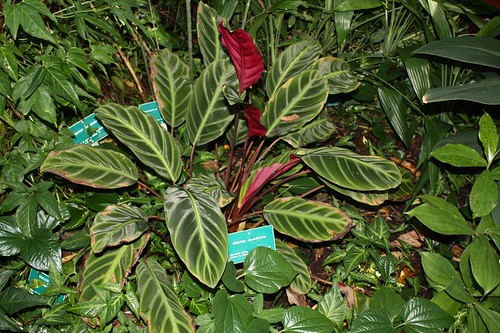
Calathea ecuadoriana
I knew from my previous visit that the conservatory has a really nice collection of Marantaceae, but I was surprised to see a species of Calathea that I hadn't seen before.  Calathea ecuadoriana looks very similar to Calathea zebrina and Calathea warscewiczii, which are already hard enough to separate!  They all have rich, deeply-colored, velvety leaves of green and purple.
img_4253_34686890613_o
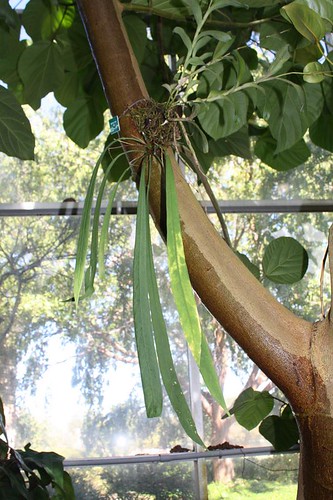
Beautiful pendant Anthurium
There were a number of nice Anthuriums growing in the conservatory.  One of my favorites was the simple pendant Anthurium pictured above.  I like the long, slender leaves of the pendant Anthuriums.
img_4252_34655666784_o
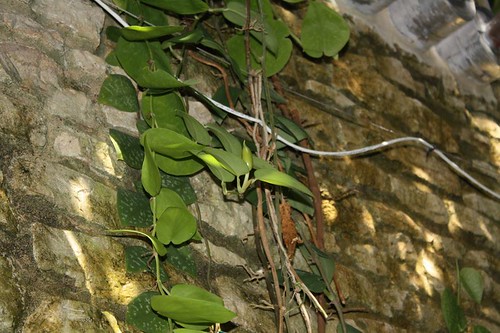
The rare inflorescence of Scindapsus pictus
Many people grow the Scindapsus pictus, sometimes called Satin Pothos vine, in their homes.  I have one on my desk at work and one in our dining room at home.  In most cases, these plants are grown in hanging baskets, or just in regular pots.  Rarely are they grown in a situation where they can scale a wall, as they like to do in nature.  This "shingling" habit is their preferred growth type.  Even in locations where they are grown shingling on a rock wall, they rarely bloom outside of their natural habitat.  However, the plants growing in the FWBG conservatory have bloomed regularly.  We got to see one of these early-stage inflorescences on Saturday.  What impressed me was the shape of the inflorescence, almost spherical in comparison to most other Aroid blooms.  It is also interesting that the plant blooms on pieces of the vine which have detached themselves from the wall where the rest of the plant is shingling.
img_4304_35457290416_o
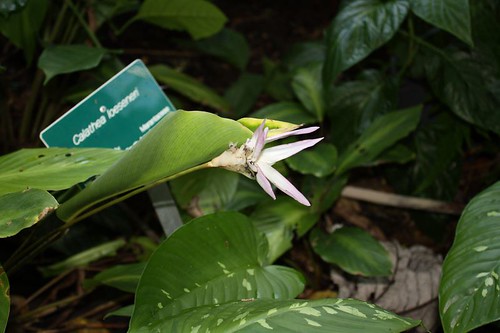
Calathea loesneri bloom
Calatheas are not known for their blooms, but for their foliage. However, there are a couple of Calatheas that have very nice blooms (and much less interesting foliage).  One of these is Calathea loeseneri, which was in bloom this Saturday on our visit.  I was lucky enough to get to take home one stem of this plant.
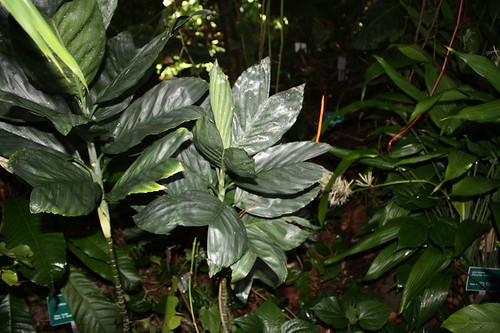
img_4335_35457383906_o
Metallic fishtail palm (Chamaedorea metallica)
The so-called Fishtail palms are given the common name designation because of the shape of their leaves.  Usually these palms are smaller than the more typical palm specimens which reach towering heights of 70-100 feet.  John told me that this particular palm (Chamaedorea metallica) stays smaller and has colorful fronds, making it a good specimen for a houseplant.  I really liked the silvery coloring of the leaves, no doubt the reason for it's species name of metallica.
img_4354_34686910813_o
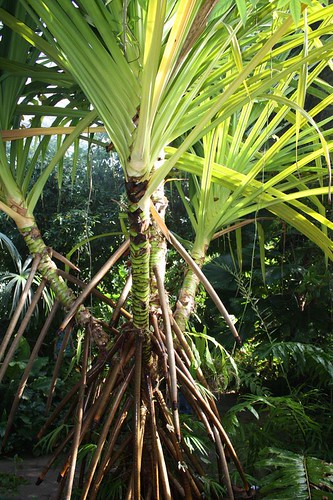
Screwpine Palm (Pandanus)
The Screwpine Palm (Pandanus sp.) is interesting because of the gigantic roots which are sent out in all directions to support the large tree.  The Screwpine growing in the FWBG conservatory was right next to the water and the roots which landed in water burst into thousands of smaller roots (below).  I imagine the roots which burrow into the ground do something similar.

img_4353_34686911743_o
Screwpine Palm (Pandanus) roots in water
One Alocasia caught many people's eyes as we passed on our tour.  Unfortunately, this plant did not have an ID tag anywhere in sight.   Maybe I'll be able to get an ID online.
img_4273_35110280650_o
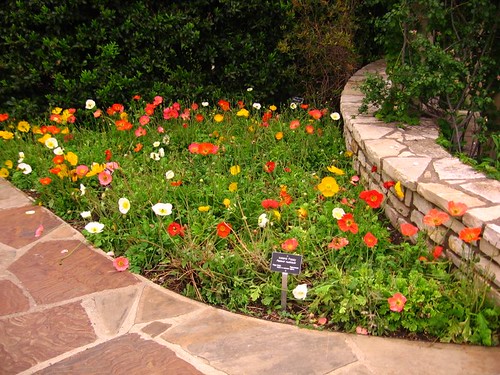
Unidentified Alocasia with unique coloration - Update: Caladium picturatum

Monday, June 15, 2009

Trip Report: Halifax Public Gardens

I was able to attend a meteorology conference in Halifax, Nova Scotia during the first week of June.  I had never been to Nova Scotia before and I needed to stay in the city for the week, but I was still able to get in a little sight-seeing.  Along with some historical sights, I visited the Public Gardens, which is a Victorian Garden originally established in 1867.
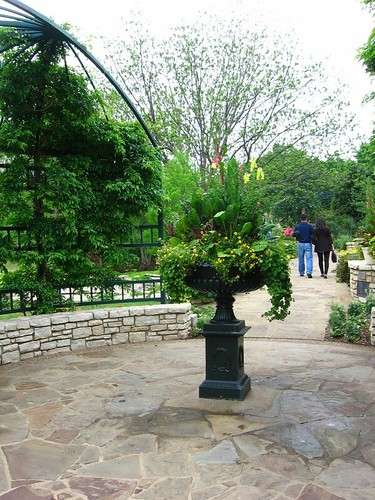
The gardens are well maintained and well used by locals.  I was surprised by the number of plants and trees in bloom while I was there.  As you can see in the map above, there is a large pond (including ducks) and a couple of smaller water features.  There is also a nice bandstand, which is a common music venue during the Summer.
img_1790_34686773023_o
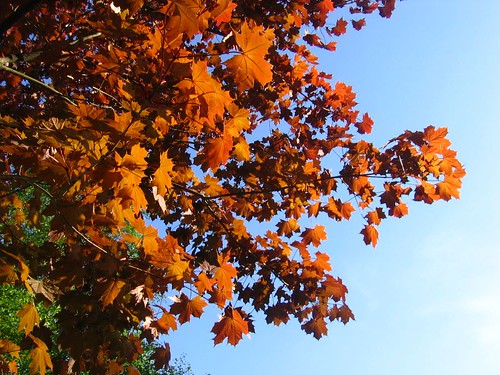
Maple tree (Acer sp.) in the Halifax Public Gardens
Apparently the gardens were badly damaged in September 2003 by Hurricane Juan.  Many large trees were destroyed.  When I was there, the signs had all been covered over with new growth.

img_1786_34655544304_o
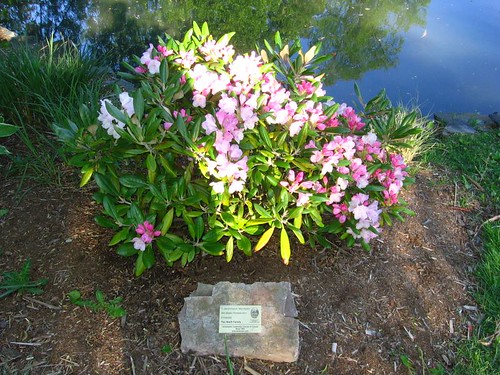
Rhododendron in the Halifax Public Gardens
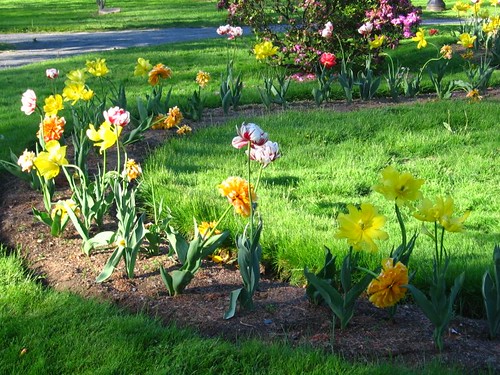
Some of my favorite plants were the orange Maple trees (pictured above), the rhododendrons (above) and the tulip beds (below).  I also saw a planting of neat Euphorbias, which might have been 'Tiny Tim.'

img_1797_34655528174_o
Wandering Tulip bed at the Halifax Public Gardens

See my photo album by clicking the image below.

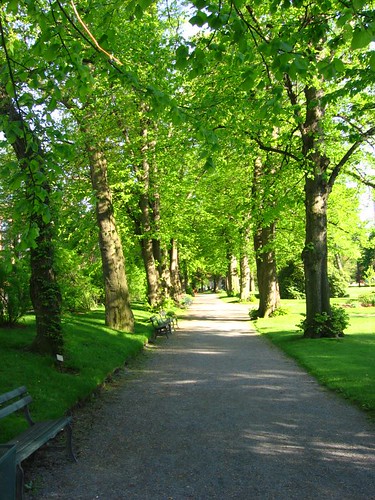
Halifax Garden

Tuesday, June 9, 2009

Trip Report: Foster Botanical Garden in Honolulu, Hawaii

While on vacation in Hawaii this May, my wife and I visited the Foster Botanical Garden in Honolulu.  In Oklahoma, a tropical botanical garden would necessarily reside in an enclosed structure.  Not so in Hawaii.  The only enclosed structure on the grounds of the Foster garden is to keep a group of hybrid orchids in a pristine environment, where they will not spread into the wild or cross with naturally occurring species.

The Foster Botanical Garden has a long history, dating back to 1853.  [You can read about the history here.]  The garden includes areas dedicated to orchids, hybrid orchids, Cycads, palms, bromeliads, Aroids, gingers, and Heliconias.  Unfortunately I wasn't able to see the Hybrid Orchid greenhouse because I took too long in other parts of the garden and the garden closed before I got there.

I would like to just give a run down of the specific sections of the garden and then point you to my photo album, which I'm sure you will enjoy! :)

Exceptional Trees

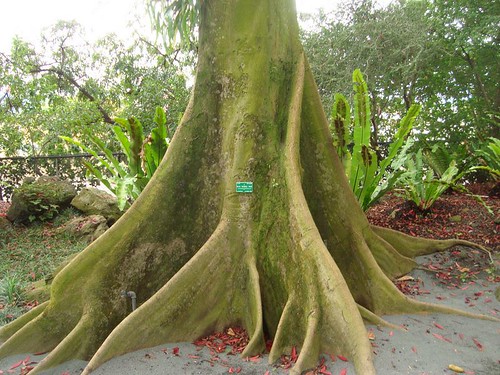
The Foster Botanical Garden has a wonderful collection of 24 "Exceptional Trees."  Exceptional Trees are those that have been designated as trees which are to be protected and cannot be cut down.  According to the legend, one of these trees is the offspring of the tree under which Buddha sat when he gained his knowledge.  You can see pictures of many of the very large trees in my photo album.  A couple of the exceptional trees are palms, of which the Foster BG has more than 100 different species.

Palms

There are literally hundreds, if not thousands, of palm trees in this relatively small botanical garden.  Not being a connoisseur of palm trees, many of them look the same to me.  However, there were about 10 different species that really stuck out, including the Double Coconut Palm and the Grugru Palm.  The palm trees ranged in size from about 8 feet tall to well over 80 feet tall.  Their trunks varied from smooth to covered in spines (the Grugru palm).

dsc03433_35329767132_o
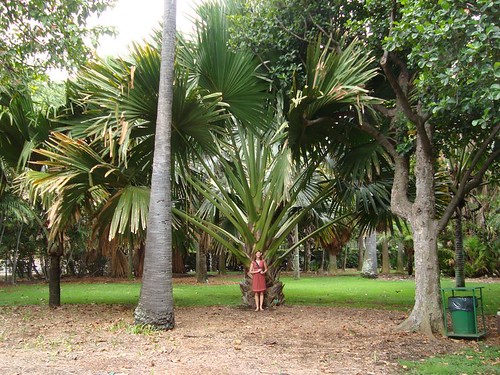
Christie standing in front of a huge palm tree with spreading fronds
Cycads

On first glance, many cycads look like members of the palm family.  But they are a very different family of plants, and can grown into the subtropical and temperate zones, including Oklahoma.  These plants are displayed in the "Prehistoric Glen" of the Foster Botanical Garden.  Cycads are among the oldest trees in the world.  The individual trees themselves are not the oldest plants, but the species have been found in the fossil records dating back to the age of the dinosaurs!

Heliconias, Gingers and Marantas

The botanical order Zingiberales contains the families Heliconiaceae, Zingiberaceae and Marantaceae - which were all featured in the center terraces of the Foster BG.  Of course, I am a huge fan of plants from the Marantaceae family.  I was surprised to find many plants from this family were labeled with incomplete signs, such as "Calathea plant, Calathea sp."  It was as if they had tried to determine the species and had been unable.  I have had this problem quite often with this family of plants.  It is surprising to me that for such a beautiful group of plants, the names are not more widely known.

dsc03529_34686860533_o
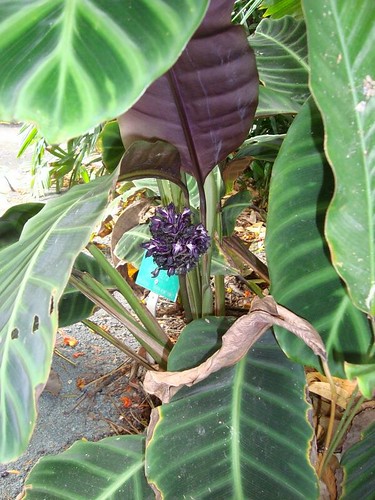
Calathea picturata inflorescence
There was a beautiful flowering specimen of Calathea picturata and many flowering Heliconia.  Unfortunately, many of the Gingers were not in bloom while I was there.  I did see them blooming in other parts of Hawaii though - and I brought back 5 different varieties to grow at home.

Orchids

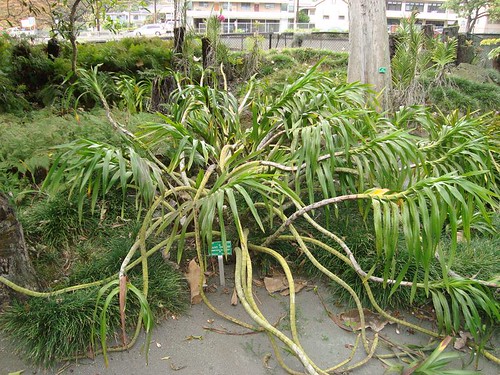
There is a great collection of orchids, mounted on stumps and tree trunks and planted in the ground.  One of them is appropriately named "The Giant Orchid" (Grammatophyllum speciosum).  It has long, wandering stems that arch towards the ground and was probably a good 8-10 feet in diameter!

dsc03410_34655723694_o
Giant orchid (Grammatophyllum speciosum)
It's simply amazing to see these plants growing outdoors.  I would never think of putting one of mine outdoors.

Odds and Ends

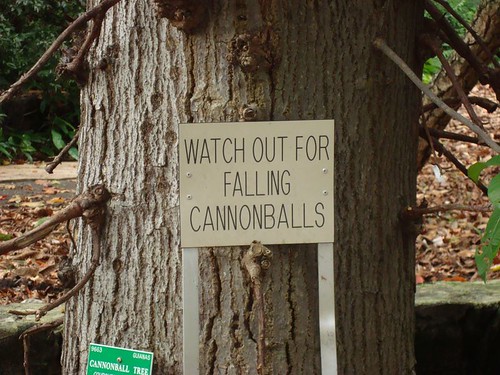
There are certainly some oddball plants at the Foster BG.  One of these was the Cannonball Tree (Couroupita guianensis), which has tendrils growing down it's trunk that are covered in blooms that look like orchids.  Later, very large nuts form on these tendrils that look like a large, round coconut (or a cannonball).  As they mature, they begin falling from the tree.  Weighing somewhere around 20 pounds, these large nuts can be dangerous to someone not paying attention!

dsc03560_35366022551_o
Warning sign under the Cannonball Tree (Couroupita guianensis)
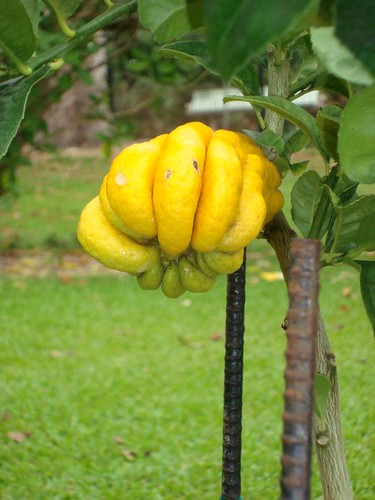
Another odd specimen at the garden was the Buddha's hand citrus tree (Citrus medica var. sarcodactylus).  I had seen pictures of these truly odd fruits before, but not seen one in person until I was here.

dsc03607_35110137400_o
Fruit of the Buddha's-hand Citron (Citrus medica var. sarcodactylus)
To see all of my pictures from the garden (289 of them) click on the image below. Enjoy!

Foster Botanic Gardens

Thursday, May 28, 2009

Trip Report: Akatsuka Orchid Gardens, Hawaii

Last week my wife and I went on vacation to Hawaii.  I wrote two posts before leaving and scheduled them to update while we were gone, so you never even knew I was out.

On our vacation, we were on the "Big" Island (Hawaii Island) for one day, in order to enjoy the Hawaii Volcanoes National Park.  Being the plant-obsessed person that I am, I did quite a bit of research before we left to find some plant landmarks to see along the way.  Hawaii is beautiful without having to stop by a botanical garden, but I wanted to make sure we visited a greenhouse or two while we there, as well as the natural roadside beauty I knew we would see.

Along the road from Hilo, Hawaii to the national park is a commercial orchid grower, Akatsuka Orchid Gardens.  I was really excited about stopping by this grower on our drive, because the website said that they have a showroom open during the day where you can view many of their orchids, and that they also allow you to wander around their greenhouses on a self-guided tour.  Frankly, I couldn't wait to do this!

And I was not disappointed.  Christie was pretty tired the morning that we flew into Hilo, so she leaned back the seat in the rental car and took a little nap while I wandered around snapping pictures of orchids for about 30 minutes or so.  Then she came in and walked around with me for another 30 minutes and helped me pick out the coolest and most affordable two plants to take home with me!

053_35365969081_o
Zygonisia Cynosure 'Blue Birds' - one of the plants I brought home with me.
The color of this Zygo really caught Christie and me both.  We picked out a very healthy looking plant that had about 15 buds on it - none of them open.  By the time we got home (6 days later) there were 5 or 6 buds open.  It is a gorgeous orchid.  Like nearly all orchids in captivity, it is a hybrid.  This particular orchid is an intergeneric hybrid, which means it is a cross between two different genera - Zygopetalum and Aganisia.

025_35457111486_o
Group of Masdevallias.  I took home a Masdevallia velifera x. deformis, which is one of the plants in the left center, with clumps of smaller and darker leaves.
The other plant I purchased is hard to pick out in this image.  It is one of the smaller plants, with darker leaves in the left half of the image, but near the center.  The blooms are born on shorter stalks than most of the blooms in the image, but they look much the same.  It is an interspecific hybrid, which means that it was created by crossing two species within the same genus - Masdevallia velifera and Masdevallia deformis.

The rest of my pictures can be found in my album, available by clicking the image below. Enjoy!

Akatsuka Orchid Gardens

Monday, April 20, 2009

Trip Report: Spring Festival at the Fort Worth Botanic Gardens

Last weekend my wife and I drove down to Fort Worth, Texas to visit the Fort Worth Botanic Gardens for their annual Spring Festival.  The festival is held in one of their prized gardens: The Japanese Gardens.

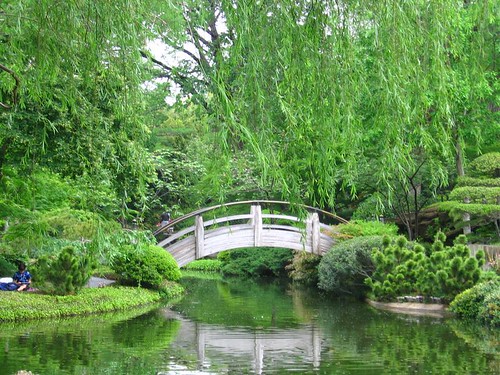
fwbg_09895_35329824652_o
Bridge in the Japanese Garden
For this post, I have chosen just a small selection of 21 pictures from the 300 photographs that I took on Saturday.  There is a link at the bottom of this post to my full photo album, which I hope you'll view, whenever you have time.

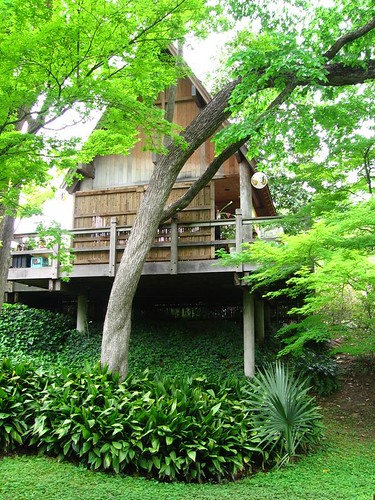
fwbg_10015_35457412426_o
One of about 8 structures in the Japanese gardens
The FWBG is a large complex of gardens, including a conservatory of tropical plants, rose gardens, tree groves, Texas natives, production and exhibition greenhouses, water gardens, a cactus garden and many others.  The Japanese Garden alone is 7 acres, while only being a small portion of the grounds.

fwbg_10008_35329818172_o
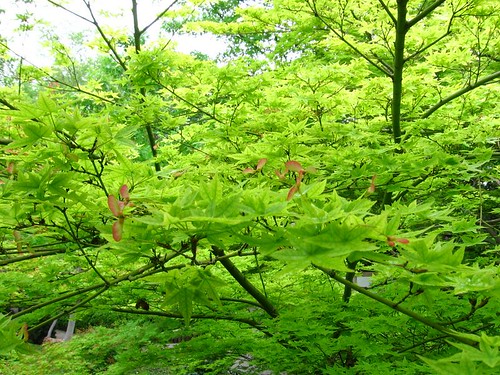
Japanese Maple (Acer palmatum) with pink seeds above branches
fwbg_10048_34655724874_o
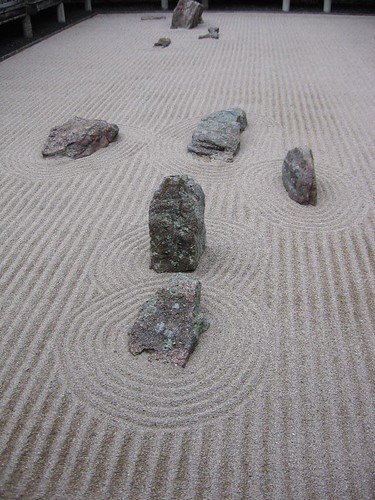
Rock garden in the Japanese Garden
The Japanese Gardens are kept by only 3 gardens and a host of volunteers.  I simply can't believe the amount of work that lies in front of those 3 workers everyday.  The grounds are well manicured and a wonderful place to stroll and relax.  I have to admit I spent the whole time snapping pictures, though.  I guess I'll have to go back for another visit.

fwbg_09890_35329825992_o
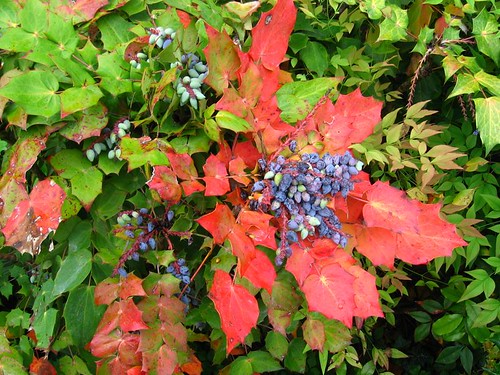
Striking foliage and berries of Japanese Mahonia in the Japanese Gardens

fwbg_10026_35110354000_o
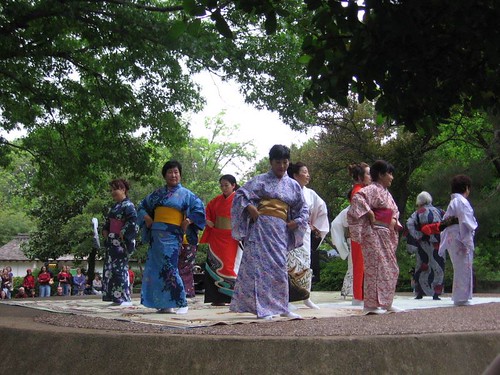
Traditional Japanese dancers performing at the Spring Festival
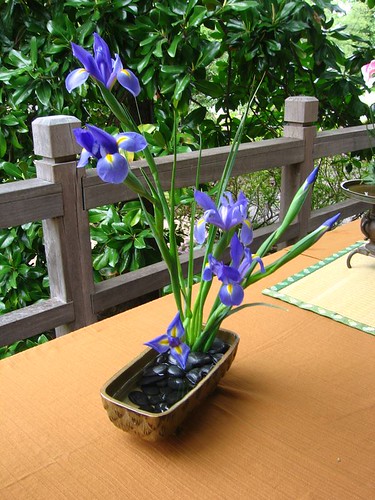
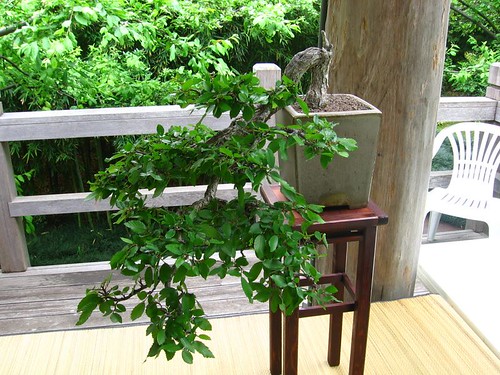
For the Spring Festival, there are events throughout the day, including traditional Japanese dancers, Japanese flower arranging, bonsai exhibits and other crafts (such as origami).

fwbg_10016_35457411946_o
Dutch Iris Ikebana - the art of Japanese flower arranging
fwbg_10012_35329814042_o
Drooping Bonsai tree on exhibit at the Spring Festival
I was most excited about seeing the Japanese Gardens, the Conservatory and one of the greenhouses - the Begonia Species Bank.

fwbg_10223_35457206766_o
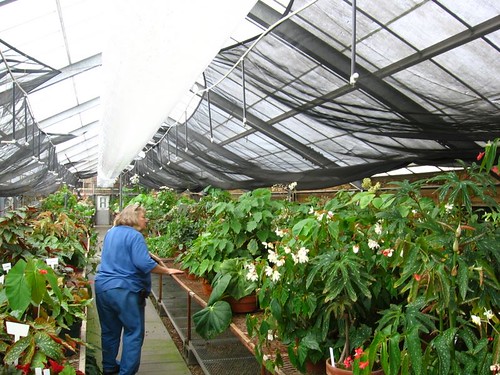
Curator and collection of the Begonia Species Bank at FW Botanic Gardens
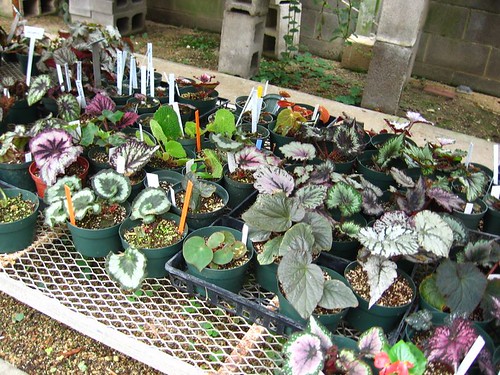
The Begonia Species Bank was created to prevent the loss of Begonia species.  Since Begonias are very common houseplants, the true, natural species are at risk of being lost to all of the hybrids that have been created for our viewing pleasure.  The FWBG Begonia Bank is a large collection of Begonias as well as a library and source of information on this very popular plant genus.

fwbg_10241_35110184830_o
Rex Begonia hybrids in the Begonia Bank collection
We timed our trip to the FW Botanical Gardens perfectly, arriving on the weekend of the Spring Festival, as well as the annual Forth Worth Orchid Society's Orchid Show and Sale!

fwbg_10102_34655697044_o
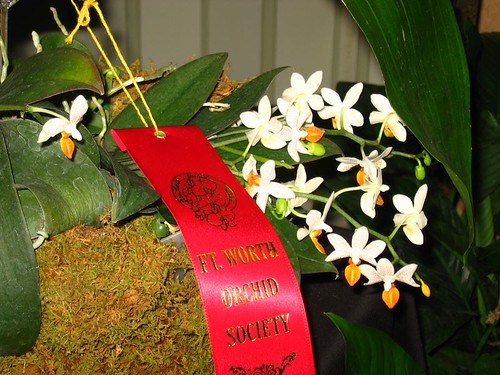
Prize-winning orchid at the annual Orchid Show and Sale
This event was held in the Garden Center, which is a very nice building in the center of the grounds, with rooms for meetings and events like this one.  There was one room setup with nice displays of orchids, including ribbons on those which had won prizes.  The range of sizes, colors, shapes and growth habits is just astounding.  I will never get over the diversity of the orchid family.

fwbg_10091_35110326690_o
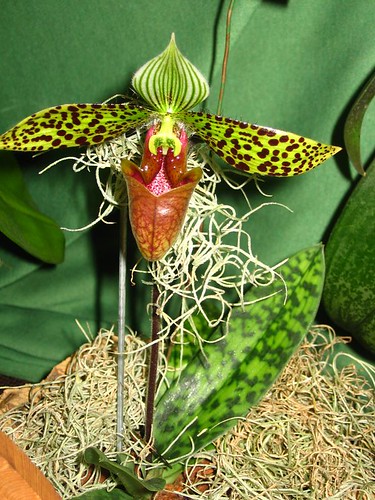
Another Orchid on display
In a larger neighboring room there were long rows of tables crowded full with orchids for sale.  The growers had come from as far as the Chicago-area and the plants were reasonably priced.  I found myself walking away with 4 plants - 1 full grown miniature and 3 seedlings.  I'll have to post on those orchids in the next week or so.

fwbg_10096_35457385286_o
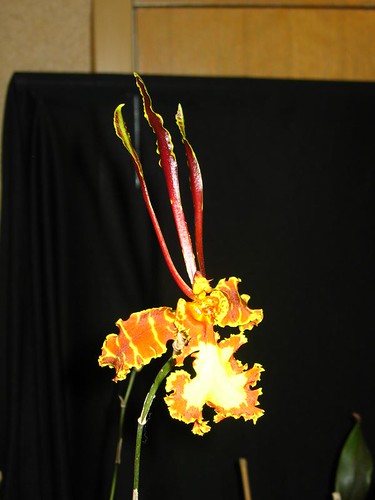
I love the tall petals of this orchid bloom.  It looks horned.
Attached to the Garden Center is a tropical Conservatory.  It is about 2/3 the size of the OKC Myriad Gardens, which I have visited several times and blogged about here, here and here.  The collection contains quite a few plants from the Marantaceae (Prayer Plant) and Araceae (Aroid) families, which made me very happy.

fwbg_10140_35329726432_o
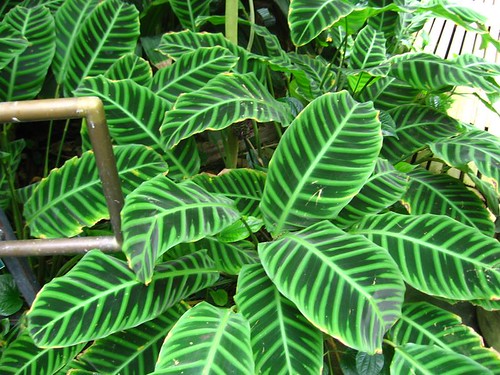
One of the many Calathea zebrina housed in the tropical Conservatory
fwbg_10161_35366112121_o
An Aroid that might be Epipremnum pinnatum 'Cebu Blue'
Most of the FW Botanic Gardens are free and open to the public during daylight hours.  The admission price for the Conservatory is only $1!  The Japanese Garden ordinarily costs $2 admission and the other gardens are free.

fwbg_10109_34686918403_o
Iceland Poppies (Papaver nudicaule) in one of the outdoor gardens
fwbg_10106_34686922543_o
Overflowing container in the outdoor gardens

fwbg_10123_35457360516_o
Waterfalls in one of the outdoor gardens
You could easily spend a full day exploring the outdoor gardens, or 2-3 days if you really wanted to be thorough.  We spent 6 hours at the FWBG on Saturday and most of that time was spent in the Japanese Gardens and the Conservatory.  We also enjoyed walking around the Perennial gardens and Rose gardens.  The Rose gardens are the oldest part of the FW Botanical Gardens, established by day workers during the Great Depression.

fwbg_10265_34655493524_o
The Rose Ramp at the Fort Worth Botanic Gardens
fwbg_10258_35365951151_o
Many different Iris in bloom in the Four Seasons Garden

fwbg_10129_34655677364_o
Lupine were one of my favorite displays of color in the outdoor gardens
I would highly recommend a trip to the Fort Worth Botanic Gardens if you are within driving distance or happen to be in the area for other reasons.  It is a wonderful place to explore and there are so many different things to see.

To see many more pictures from my trip to the FWBG click on the image below.

Fort Worth Botanic Garden 2009