Showing posts with label growth. Show all posts

Thursday, July 7, 2011

Alocasia appearing

Lately it seems my Alocasias are really taking off.  While many of them don't like direct sun, they sure do like the heat!  Some of my Alocasias kind of died back over the winter, but they have reemerged with new offsets after their dormancy.  First, I give you my Alocasia amazonica, also known as African Shield.  I like to call it the "pterodactyl plant" and I'm not sure why everyone else doesn't do the same.   This plant I have had for 2.5 years.  I know, because I blogged when I bought it (the second time).
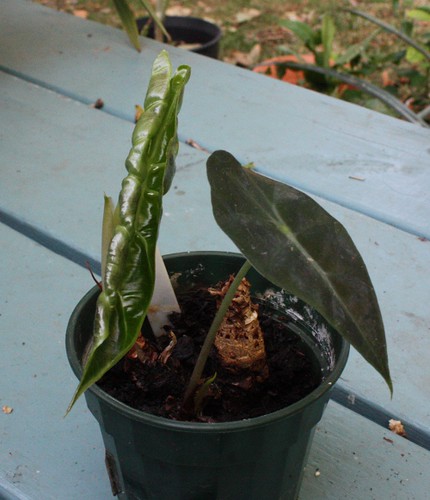
a_amazonica
Alocasia amazonica
Next, is Alocasia wentii, which is fairly new to me.  I just got it last fall, before it stopped growing.  It didn't go completely dormant, keeping one or two leaves through the winter, but it wasn't actively growing.  Now it is putting out a new, glossy leaf and the coloring is really nice.
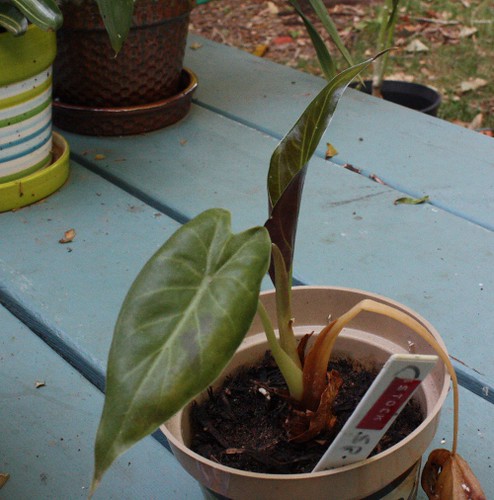
a_wentii
Alocasia wentii
This next Alocasia is my favorite.  I have had it for a couple of years.  It was big and mature when I bought it, but it went through spider mite and mealy bug infestations and lost a lot of leaves.  Now the original plant is doing pretty well and even has put out 4 offsets!  I have an Alocasia gageana, a gift from Steve Lucas, which constantly produces new offsets, but my others have been much slower to do this.  I'm looking forward to my little herd of Alocasia lauterbachiana.
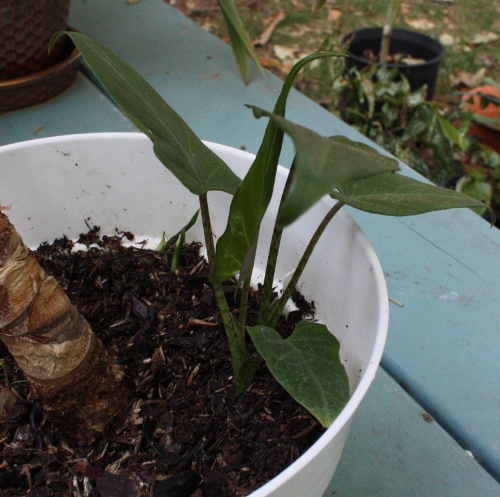
a_lauterbachiana_offsets
Alocasia lauterbachiana offsets
Another "Alocasia" I got in the fall went completely dormant through the winter.  I thought I had lost it.  But I cut back on watering, so as not to rot out the bulb.  Then I started watering again in the Spring and it has sprung to life!  I got the plant through a trade labeled Alocasia 'Hilo Beauty', as it has been called for many years.  It turns out the plant belongs in the Caladium genus and it is a true species, Caladium praetermissum.  I don't really know how it ever got the name Hilo connected with it, unless a grower in Hawaii started distributing it first.  Maybe someone just decided it looked like something that would grow in Hawaii...  Apparently the incorrect name started with Graf's Exotica, a book which is well known as a source of wonderful pictures and outdated names.
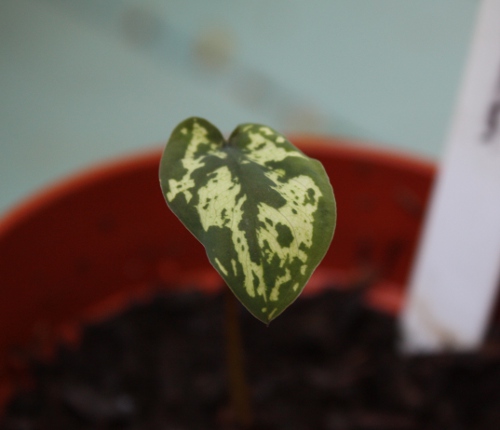
a_hilo_beauty
Alocasia 'Hilo Beauty'
Anyway, it is not surprising that this plant's genus was misappropriated for many years.  The Caladium, Alocasia, Colocasia, and Xanthosoma genera are the most often confused in the aroid family, as I've mentioned before.  Many people avoid this confusion by calling them all "elephant ears."  Score 1 for common names.
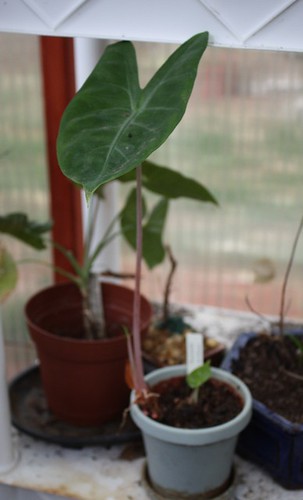
a_aurora
Alocasia aurora
The final plant is Alocasia aurora (Alocasia 'Pink Stem'). This one, as you can tell by that second name, has a very distinct pink petiole. This one also has a new pup forming.

Tuesday, July 5, 2011

A time for orchid growth

Many orchids bloom in the spring and subsequently start new growth.  This year my orchid collection grew quite a bit.  Some of the orchids I purchased while they were in bloom or just after they finished blooming.  It will be almost a year before I get to see if they will bloom for me.  In the meantime, there is a good sign in that many of my orchids are producing new growth.

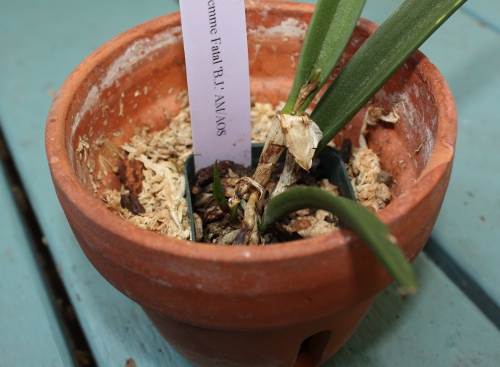
bepi_new_growth
Bepi 'Femme Fatale.'  New growth can be seen coming from the base on the left side.
I'm still holding out hope that the Bepi above will bloom for me.  The bloom spike is still present, just emerging from the center of the plant, but it is doing so ever so slowly.

blc_new_growth
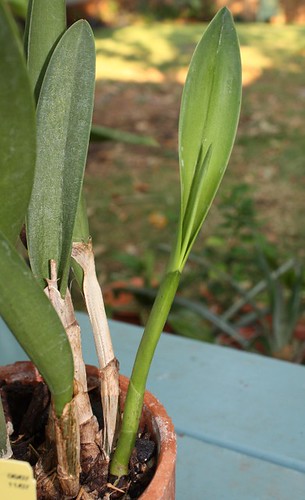
Blc 'Golden Tang.'  The bright green is new growth.
Most of my new orchids are sympodial, which means that they produce offshoots, rather than continuing on the original growth.  Above you can see a tall, new "lead" growing from the side of my Blc 'Golden Tang.' This is a Cattleya hybrid, more so that any of my other orchids, these hybrids really enjoy the heat.  They are growing like crazy right now.

polystachya_new_growth
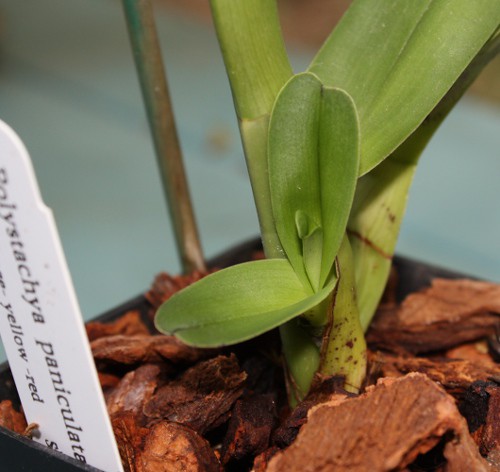
Polystachya paniculata new growth
One of my Ethiopian orchids, Polystachya paniculata, has a small offset that has been present since I bought the plant.  Now it is starting new growth from the original and tall stem.  I don't know if this is normal for this plant or not.  But it seems to be happy, so that makes me happy.

dend_new_growth
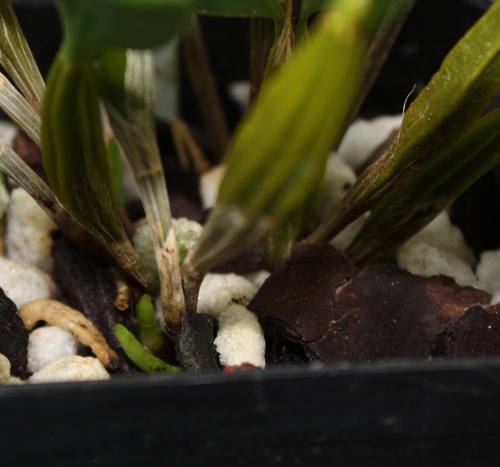
Dendrobium atroviolaceum new growth
I'm also holding out some hope that my Dendrobium atroviolaceum will bloom for me.  There is one large bud that has been on the plant since I received it over a month ago.  It still hasn't opened for me.  There are also several bloom spikes that are starting to emerge from the top of a couple of the stems, but they aren't really doing anything lately.  It might be the heat.  The good news is that there are 4 or 5 new growths starting from the base of the plant.

Thursday, March 31, 2011

Mammals of the Plant Kingdom

Some plants have a unique way of "giving birth" to their offspring that is called vivipary.  The difference between these viviparous plants and those that scatter seeds is that the new plant begins to grow while still attached to the parent plant.  Here are some examples:

iris_vivipary
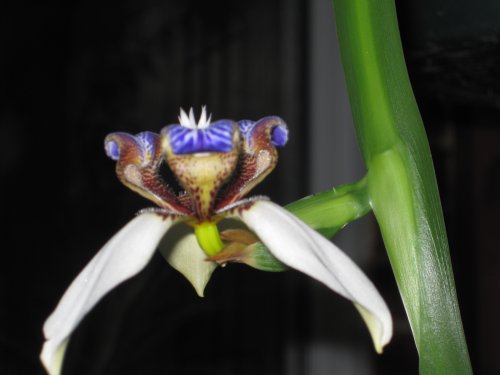
Walking Iris (Neomarica gracilis) bloom with plantlet forming

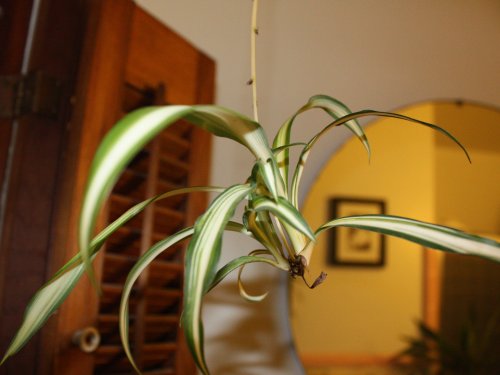
The Walking Iris Neomarica gracilis (pictured above) is so named because of it's propagation habit.  Most Iris bloom on stems that only include flowers.  The Walking Iris blooms from the ends of it's normal leaves.  Usually several blooms follow in succession over a period of a couple of weeks.  All the while, a new plant is forming at this junction.  The weight of the new plant at the end of this leaf blade will make contact with the ground, where the new plant will establish itself.  This is similar to the common houseplant called Airplane or Spider plant Chlorophytum comosum (pictured below).

chlorophytum_offset
Spider plant (Chlorophytum) plantlet
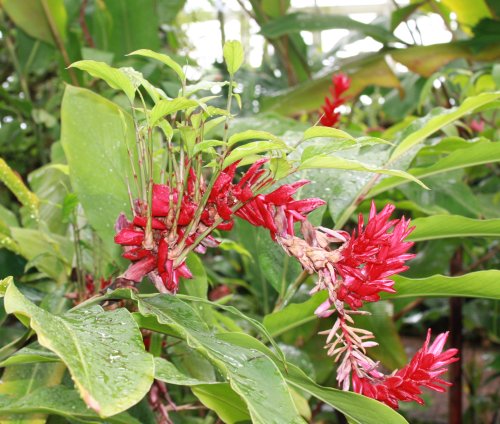
Some gingers (like the one pictured below) produce flowers that are pollinated and produce seed, which immediately germinates and begins to grow on the plant, weighing down the stem until it is upon the ground, where the new plants become established.  I have seen this same type of ginger demonstrating this behavior in the Oklahoma City Myriad Gardens and in Jamaica - a more natural habitat.

ginger_vivipary
Ginger at the OKC Myriad Gardens with new plantlets forming in the blooming bracts
Now true botanical (plant) vivipary (live-birth-ness), results from seeds germinating while still on the host plant.  In some of these cases, the plantlet that forms on the parent is not a result of seed germination, so it is not really true vivipary.  Plants can produce new offspring in just about every imaginable way - from the roots, from the leaves, from the junction of petioles and stems - pretty much every piece of plant anatomy is used for propagation by some plant species.  Surely not all of this is viviparous behavior, right?

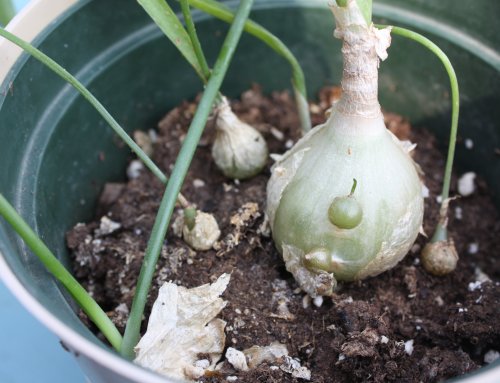
I'm not a botanist, but I try to understand some of the terminology.  There is a condition which is called pseudovivipary which is defined as "a condition in which vegetative propagules replace some or all of the normal sexual flowers in the inflorescence."  To me, this means that a plant is able to produce new plants without necessarily producing flowers, seed, etc.  A good example of this might be the Pregnant Onion, which produces new plants within the "skin" of it's bulb.  As the new plants mature, they will fall away from the parent plant become independent.  At which point the parent bulb cries "They grow up so fast!"

pregnant_onion_closeup
Pregnant Onion (Ornithogalum longibracteatum) with many baby plants

I had actually planned to write about this since I read this term in a book I read a couple of months ago.  Then I saw that Derek had posted about this same topic on Plantgasm.  He beat me to it, but it also gives me a good reason to link to his blog, which I really enjoy.  Derek has some great time lapse presentations of different plants producing new leaves (including aroids) or flowers opening.  I highly recommend you check them out!

Do you know of any other plants that demonstrate viviparious behavior?