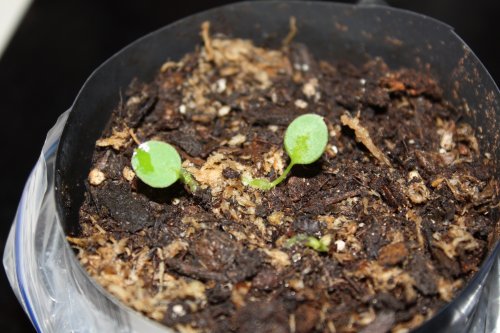
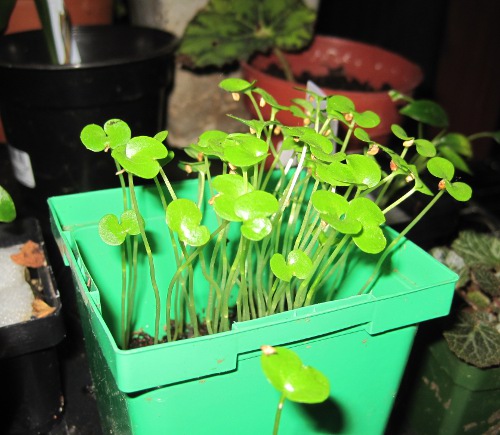
Showing posts with label Pinellia. Show all posts

Friday, May 18, 2012

My first Pinellias

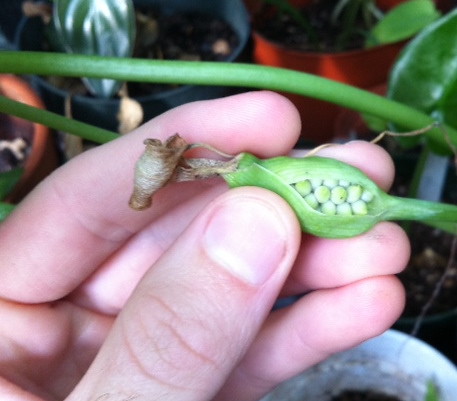
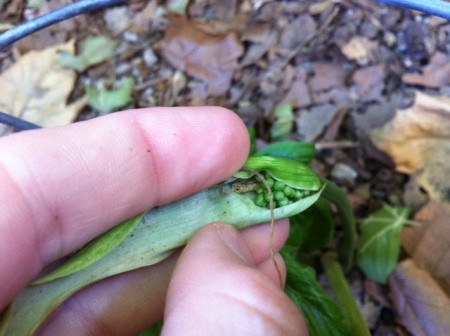
Last year, Derek got some great photos of his Pinellia tripartita in bloom, including one photo which was featured in the International Aroid Society calendar.  This plant is known to spread like crazy, since it offsets from the tubers, produces viable seed and also form bulbils at base of the petioles.  He shared some of his bulb offsets with me and then later some seeds, too.  I planted these in pots and kept them in my greenhouse over the winter.  The seeds sprouted shortly after I got them and stayed about the same over the winter.  The bulb offsets were dormant when I potted them up, but they have come up now and produced an inflorescence, which now has berries (infructescence).

pinellia_tripartita_20120413
Pinellia tripartita

I haven't planted this one outside yet and it performed so well for me in the pot this year that I don't know if I will.  However, since I have so many seeds, it looks like I could easily have enough to plant some outdoors and keep some in pots, which would be nice.

p_tripartita_infruct_20120514
Pinellia tripartita infructescence
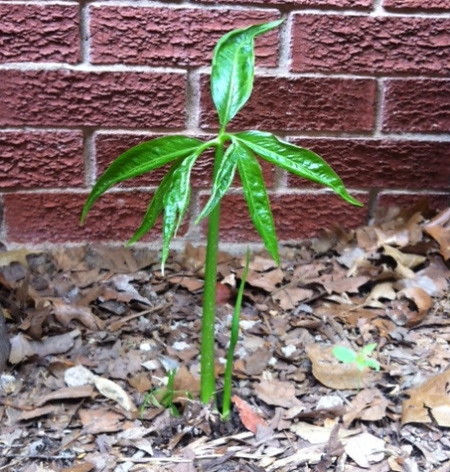
At the IAS show in September I picked up a Pinellia pedatisecta,  which Dr. Croat had pulled up from his own yard.  I planted that one outside and it has also come up and produced an inflorescence, and has now set berries.  Both of these plants are hardy in zones 5-10, so they shouldn't have any trouble with the extreme heat or freezing temperatures of my zone.

pinellia_pedatisecta
Pinellia pedatisecta
p_pedatisecta_infruct_20120515
Pinellia pedatisecta infructescence
At the Wichita orchid show I traded some plants with friends that I was meeting there.  I got a nice clump of Pinellia ternata from Steve and have planted those beside the Pinellia pedatisecta beside the greenhouse.  This plant also produces bulbils at the base of the petioles, so it spreads in a variety of methods.

p_ternata_20120515
Pinellia ternata
I know this plant doesn't look great right now, having just been transplanted, but it should perk up given a little time.  Hopefully next year the clump is just as big and has a couple of blooms to go along with it.  This little strip of garden along the back side of my greenhouse is becoming the hardy aroids area.

Friday, October 28, 2011

Plant Find: My Florida plant acquisitions

While in Florida I got a LOT of plants.  Most of these were either aroids or orchids.  First, let me show you the aroids I got.
anth_ottonis
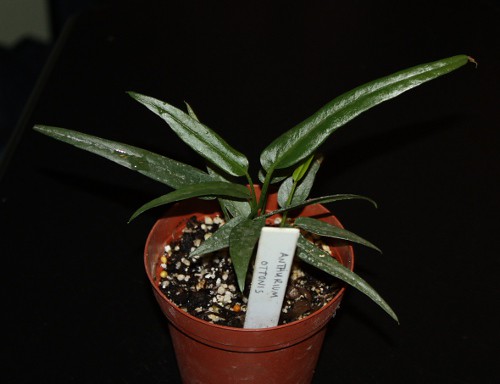
Anthurium ottonis
Anthurium ottonis

This little Anthurium attracted me with its lanceolate leaves.  It is a very healthy little plant and I look forward to seeing this grow into a mature specimen.
anth_crystallinum
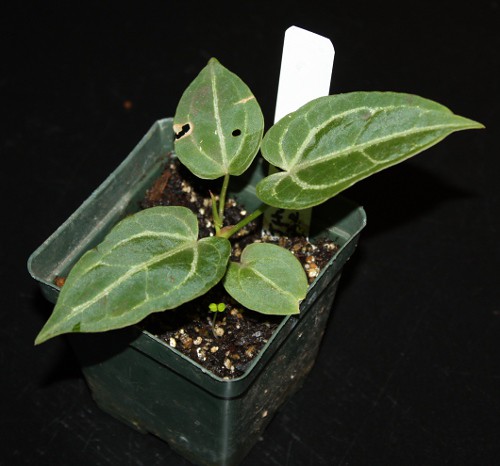
Anthurium crystallinum

This is one of the velvety Anthuriums with prominent iridescent veins.  Again, this is just a small plant, but if it likes my growing conditions then it will become a beautiful large plant within a year or two.
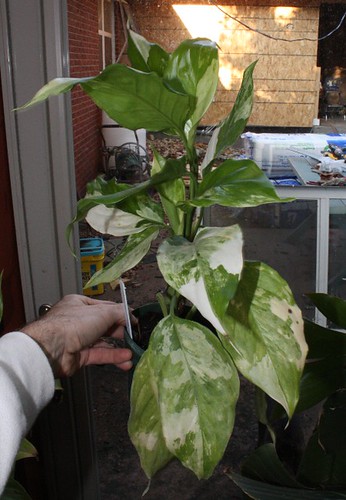
ag_modestum_variegated
Aglaonema modestum variegated

This is actually the only Aglaonema I purchased at the show.  There were a couple others that I eyed, but ultimately I ran out of packing room (and money), so I stopped with this one.  It is one of the few variegated Aglaonemas in cultivation.  Most Aglaonemas have interesting leaf patterns, with various shades of green and some silvers, but few have white patches like this one.
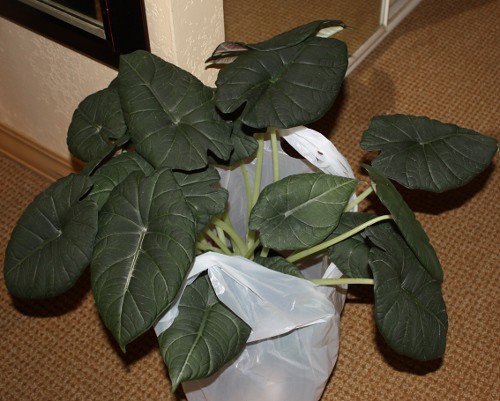
alo_maharani
Alocasia 'Maharani'
Alocasia 'Maharani'

This is one I had never seen before.  It is a beautiful Alocasia with dark leaves that have a rough texture and a rigidity unlike any of my other plants.  I'm really hoping this isn't a high maintenance plant, but it might be.  For now it seems pretty happy, sitting in a very shady spot on the floor of my greenhouse.

Dieffenbachia oerstedii - no picture


I hadn't heard of this Dieffenbachia before, but it was a species and it was from Dr. Croat, so how could I pass it up!?!  Dieffenbachias are a really neat genus of aroids that I enjoy, though I don't have too many in my collection.  This particular species develops a strong white midrib at maturity, which is striking in contrast to the otherwise dark green leaves.
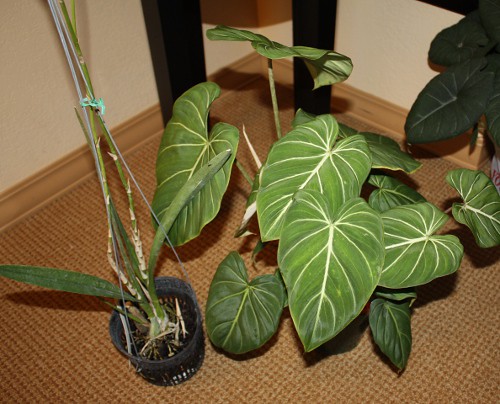
philo_gloriosum_enc_plicata
Encyclia plicata (in mesh basket) and Philodendron gloriosum

Philodendron gloriosum

Christie and I both fell in love with this Philodendron and decided to buy it out of our general budget, rather than my plant allowance.  Since then it has gone by the moniker of "family plant."

The IAS show and sale is set up with the show plants in the middle of the room.  Along one wall are vendors with plants for sale and along another wall are plants for sale that will benefit the IAS.  Dr. Croat brought a bunch of items from the Missouri Botanical Garden for sale at the IAS show.  These plants are either species that were wild collected or propagated from his wild collections.

Pinellia pinnatipartita (IAS show)

The one exception, I believe, was a big trash bag full of Pinellia pinnatipartitas, which I think Dr. Croat had yanked out of his yard to thin out his own crop.  There was a sign on the bag, boldly announcing "Guaranteed success!"  As if that weren't enticing enough, they were marked $1.  So, naturally, I got one.  Taylor picked through the bag for me and found a really nice, large tuber and it was one that had just fruited, so I have a bunch of seeds in addition to the healthy tuber.

tubers of Pinellia ternata (IAS show) - no picture

Pinellias are one of the aroid genera with several varieties hardy in my zone.  For now, I have potted these tubers of Pinellia ternata and put them in the greenhouse.  However, I plan to plant them outdoors next spring and then let them stay outside for good.  I want to develop a little garden of hardy aroids.
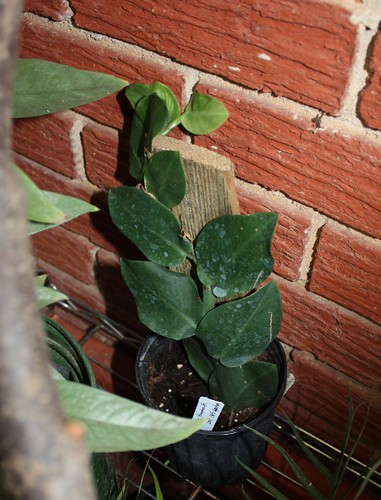
rhaph_hayi
Rhaphidophora hayi
Rhaphidophora hayi (IAS auction)

This is really my first shingling aroid.  I made up a tentative list of plants I would like to purchase at the IAS show before I left.  Not really knowing what I would find, it was just a wishlist of things I was hoping to find.  One of the items was "a shingling aroid."  There were some for sale, but I was overlooking them for other plants.  Then there was one available at the auction and I ended up getting an excellent deal on this little plant, donated by Palm Hammock.  It is now propped against the back wall of the greenhouse, where I am hoping it will start to shingle up on the brick wall of the house.

Now, here are the plants I purchased, which are not aroids.
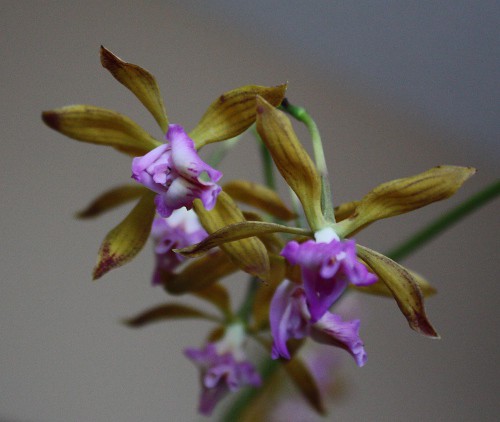

enc_plicata
Encyclia plicata blooms
Encyclia plicata (above) and Encyclia tampensis (below) - both from Ruben in Orchids

As mentioned in a previous post, I purchased two Encyclias at Ruben in Orchids.  One of them (Encyclia plicata) had a long bloom spike with these really neat flowers (above) and was growing in a mesh basket.  The other (below) was on my wishlist of plants to purchase in Florida.  It is the "Florida Butterfly Orchid" (Encyclia tampensis) and the plant that I kept seeing all over my everglades boardwalk.  It is a mature, mounted plant and had already finished blooming, with several dead bloom spikes on it when I purchased it.  Next year I hope to have as many spikes as it had this last summer.
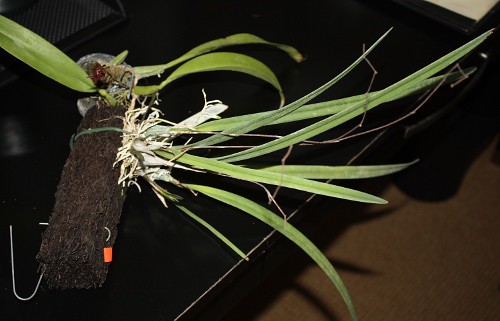
enc_tampensis
Encyclia tampensis


dend_nobile
Dendrobium nobile
Dendrobium nobile (from R.F. Orchids)

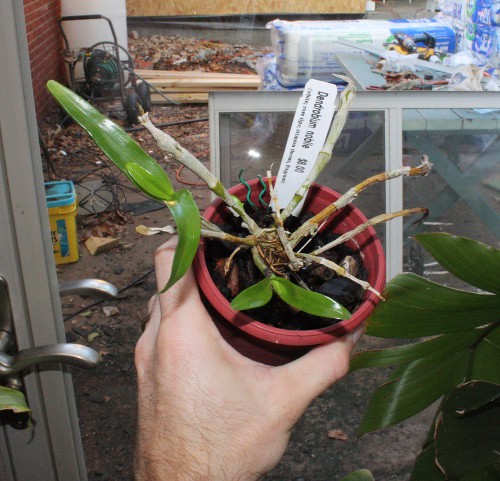
I purchased two cheap orchids at R.F. Orchids - one a species Dendrobium nobile (above) and the other a hybrid Vanda. The Dendrobium was a collection of keikis that had been cut off mature plants and bundled together for $8.   The Vanda is young now, but someday it should look like a mixture of the parents, which are pictured below.
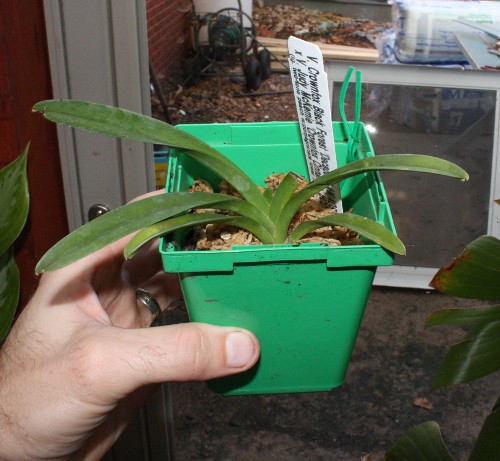
vanda_hybrid
Vanda hybrid
Vanda hybrid (V. Crownfox Black Forest x V. Judie McKemie) (from R.F. Orchids)
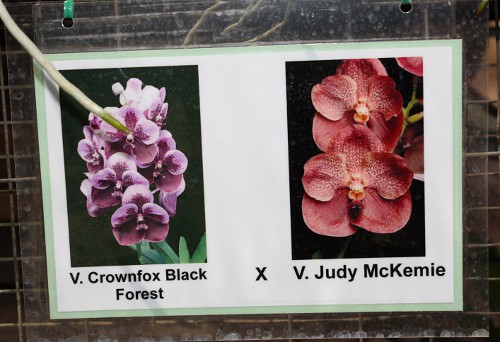
my_vanda_hybrid
Vanda hybrid parents
dendrobium_noid
A nice Dendrobium in bloom
Dendrobium in bloom (from The Banyan Garden in the Keys)

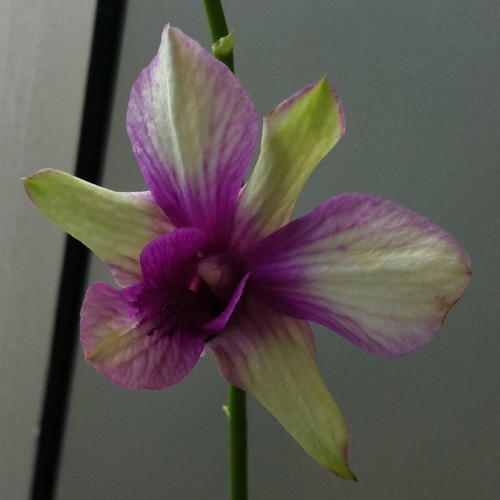
There are still a couple of "trip reports" I plan to write in the coming weeks about special planty places I visited while in Florida.  One of those places is called The Banyan Garden, which is located on the island of Islamorada in the Florida Keys.  I bought this cheap and beautiful blooming Dendrobium there.
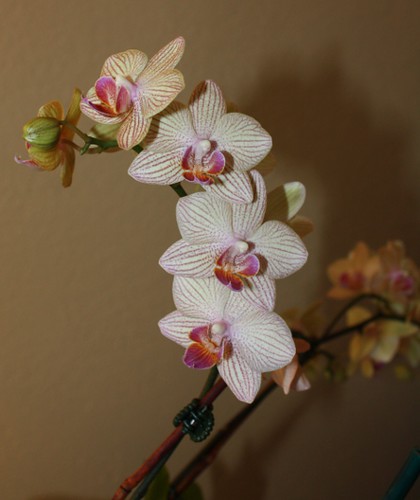
cheap_orchid
My favorite cheap Phalaenopsis
Phalaenopsis in bloom (from Redlands roadside stand)

I already told you about my steals in south Miami - orchid country.  Here are their pictures, again.
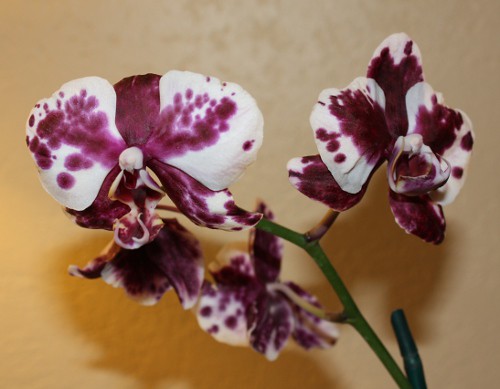
phal_harlequin
Harlequin Phalaenopsis
Phalaenopsis (harlequin) in bloom (from Redlands roadside stand)

Harlequin Phalaenopsis are the "in thing" right now.  The name refers to the spotting pattern on the flower petals.  I'm told this is a generic term applied to dog and horse breeds, as well.
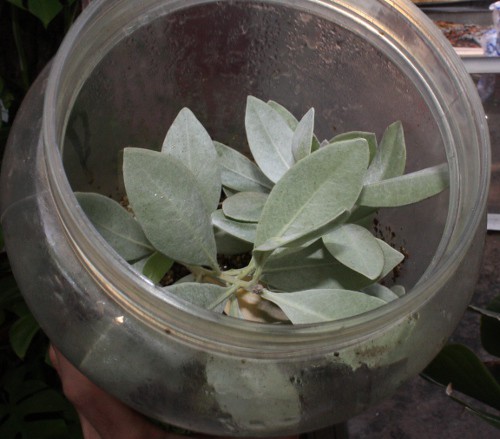
buttonwood_cuttings
Silver Buttonwood cuttings.  I really hope these are rooting, but I just don't know.
Silver Buttonwoods

There were Silver Buttonwoods (Conocarpus erectus var. sericeus) everywhere in Florida.  Most were trees, but quite a few were bushes or well-manicured hedges.  We stopped to admire this beautiful tree at our very first lunch stop in Miami - on our way to the Everglades.  On the last day of our trip, I took some cuttings from a couple trees in the Keys.  The cuttings are now in a jar of moist vermiculite, hopefully rooting.  I put some other cuttings directly in water and they quickly wilted.  Since the cuttings in vermiculite still look fresh and happy I have high hopes that good things are happening.  We'll see in a couple of months.
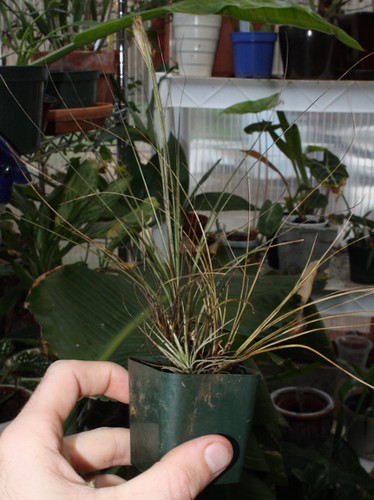
three_tillandsias
Three little Tillandsias
Tillandsias

Tillandias grow everywhere in southern Florida.  I have never grown any myself, but I am hoping I will have some luck with these.
cycad_seedlings
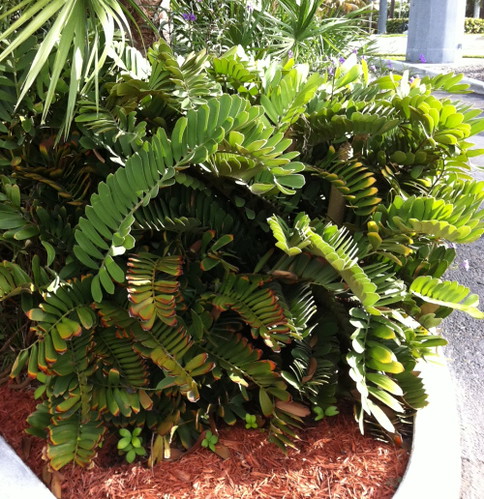
Zamia furfuraceae "hedge" with seedlings at the base
Zamia furfuraceae seedlings (from Key West, Florida)

Cycads are very common in southern Florida.  In many places they are grown so thick that they can be cut into hedges.  The above picture is from our hotel in Key West, where they were being trimmed into rectangular hedges.  These plants were "coning" like crazy and the seedlings were thick at their base.

Yes, I really did pack all of this in suitcases to bring home!
Friday, July 1, 2011

Correction: Pinellia seedlings

Yesterday I posted about my recent adventures into growing aroids from seed.  I told you that I've had luck with a couple of different species of Anthurium and Philodendron, but that the Pinellia seeds I got from Derek didn't germinate.  Boy was I wrong!

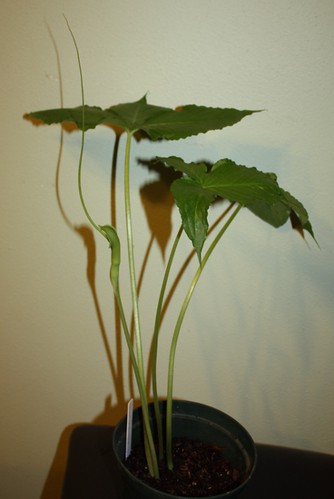
The Pinellia seeds hadn't done anything noticeable as of last week, so I started making use of those pots by thinning out my Philodendron seedlings and transplanting some in there.  Then, earlier this week I noticed there were some big (relatively-speaking) cordate leaves in the pots that originally housed the Pinellias.  I did consciously notice that those leaves were only in the pots where the Pinellia seed were, but I was thinking it might be some interesting phenomenon concerning my transplanting of the Philodendron seedlings.  I didn't think it could possibly be the Pinellias.

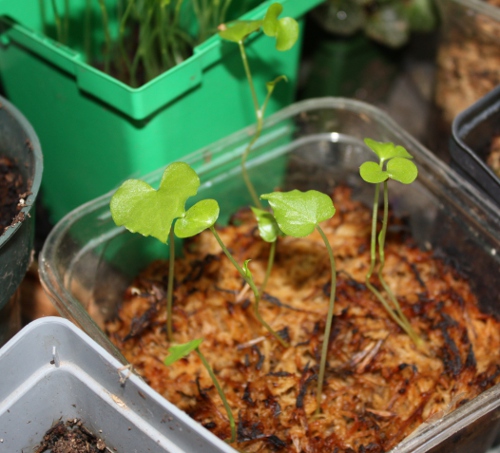
Pinellia seedlings
My now-community pot of Philodendron (small leaves) and Pinellia (large cordate leaves) seedlings.
Thankfully, Derek didn't put both in the same pot, so he knows for certain that the seedlings which came up for him this week are Pinellias.  And now I know, too!  So, I knew I had Philodendrons, and I thought I didn't have Pinellias.  So I used the Pinellia pots for my Philodendrons, then noticed some of my Philodendrons looked different, only to find that my different-looking Philodendrons were actually Pinellias!  Got that?

Thursday, June 30, 2011

Another aroid from seed

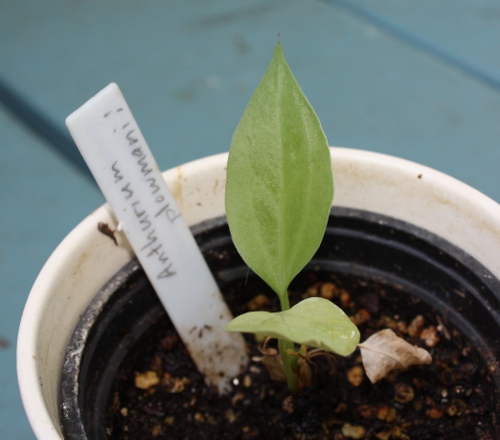
Growing plants from seed has never been my strong suit.  I'm not sure what I would say my strong suit has been, but seed has not been it.  My first encounter with seed grown aroids was more than a year ago, at the 2nd MidAmerica chapter meeting, when an IAS member, Danny, offered me a seedling Anthurium plowmanii he had grown from seed he collected at a Chicago botanic garden.  The plant was small, but seemed healthy.  For whatever reason it has stayed small and healthy looking.  Seriously, in the more than 15 months that I have had the thing, it hasn't done diddly squat.  That is, until about a week ago.  For some reason those stagnant, tiny leaves started to get bigger...

anth_plowmanii
Anthurium plowmanii seedling, finally starting to grow.
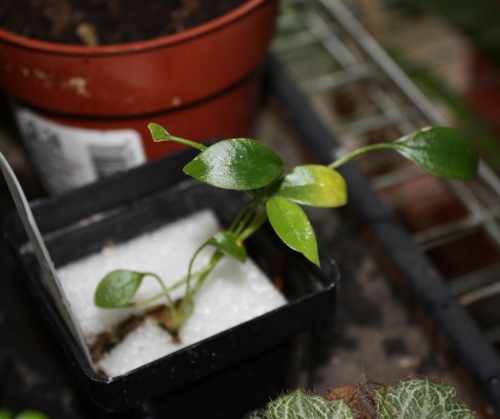
The same IAS member recently sent me three pots with seedlings he had started of Anthurium bakeri.  I put the little pots in a couple of different places and two of them got hammered by the hail a couple of weeks ago.  They have since been moved into the greenhouse, where they might get a little hotter, but will be more protected from the wind and elements.

anth_bakeri
Anthurium bakeri seedling also from Danny
I have recently had the opportunity to start a couple of different aroids from seed and had some success, so I thought I would share the pictures of my own little aroidlings (aroid seedlings).  The Anthurium pallidiflorum seeds I got from Albert and planted back in April are holding steady.  Not a lot of growth lately, but they seem to be doing okay.  Maybe they will burst forth after 15 months, like the A. plowmanii!

anth_pallidiflorum_seedlings_20110423
Anthurium pallidiflorum I started from seed - pictured on April 23.
My friend, Leland, sent me several hundred seeds from one of his hybrid meconostigma Philodendron that recently flowered and fruited.  I then sent a bunch of the seeds to 5 or 6 different people around the country that were interested in trying to grow these plants.  We all had very good germination rates.  I didn't count the number of seeds that I carelessly scattered over sphagnum moss, but I wouldn't be surprised if every one of them had germinated.  It certainly seems that way.

philo_seedlings
Hybrid Philodendron seedlings
The really cool thing about aroid seeds is how fast they germinate.  I mean, it was a matter of a day or two before they were popping open and showing their cotyledon leaves.  It was several more weeks before the first true leaf would arrive for me.  But even then, I had a small plant in very little time.

Pinellia seedlings
Hybrid Philodendron seedlings showing the first true leaves.  The true leaves are the cordate (heart-shaped) ones.  2011-07-01 Correction: Hybrid Philodendron seedlings, still not showing the true leaves.  Cordate leaves are Pinellia tripartita seedlings.
Leland doesn't know the exact parentage of these seeds, but we know that Philodendron stenolobum is involved.

Another IAS friend and fellow blogger, Derek, sent me some seeds from his Pinellia tripartita, which had bloomed and fruited recently.  Unfortunately, neither of us had any luck getting these to germinate, so perhaps they weren't viable. [2011-07-01 Update: I was wrong!  The cordate leaves above are actually the Pinellia seedlings!  So I got germination from those seeds after all, and my Philodendron seedlings are not as far progressed as I had thought.]

If my Aglaonema berries ever mature, maybe I'll finally get to give them a try.  They have been on the plant for several months now, but I am waiting until they start to fall off the plant to know they are ripe.