This is the fourth post in a 5 part series.
Part 1 focused on the exhibits;
part 2 on the Slippers and Vandas; and
part 3 on the Dendrobiums and Encyclias. This time around, I'm going to show some pictures of some nice orchids you just don't see every day.
Phalaenopsis is the most widely known orchid, the one that you can find for sale in grocery stores and hardware stores. So, I am kind of starting off this post of "uncommon orchids" with one of the most common orchids there is! They are so popular for a number of reasons, one being that they are not too hard to grow and to get to re-flower. Most orchid growers have some of these on hand in their collections because they know they bloom reliably each year.
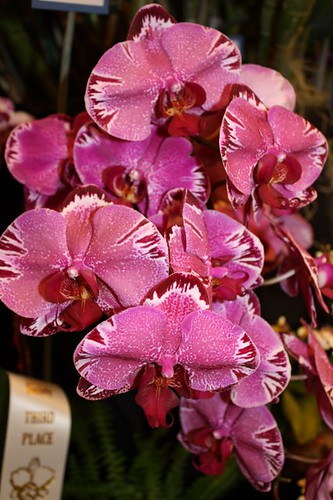 |
| Phalaenopsis with "brush strokes" |
Another reason they are so popular is because of the hybridization potential. It seems the hybridizers always have something a little new with these orchids - a new color combination or a new pattern. The
Phalaenopsis pictured above is a fairly new pattern, with what looks like brush strokes near the edges. I remember a year or two ago I saw my first
harlequin (patches of color)
Phalaenopsis. This year, the pattern that was new to me is kind of hard to describe. It looks like some drops of color have been splashed onto the flowers and repelled other colors. There is a sort of white halo around these dots.
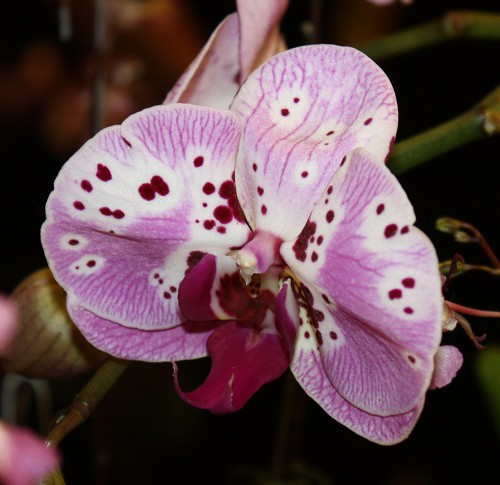 |
| Phalaenopsis with interesting color pattern |
There were other nice hybrid
Phalaenopsis with all sorts of different colors and patterns. There was a really neat specimen of
Phalaenopsis deceptrix cornu-cervi (below) on display, too. The blooms from this orchid emerge from a weird, zigzag spike. When the flowers are finished, it looks like this plant has two distinct types of leaves. I don't know what people normally do when they have this plant and it finishes flowering, but I would have trouble cutting off those weird spikes. I would want to leave them on the plant.
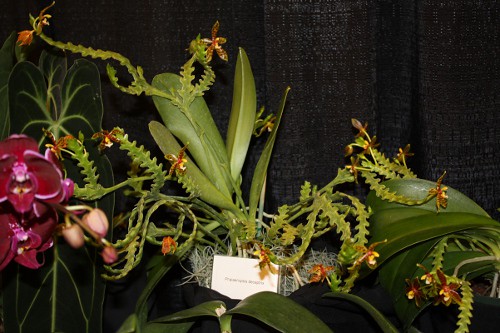 |
| Phalaenopsis cornu-cervi (labeled Phalaenopsis deceptrix) |
Eulophia guineensis is a really nice flower, which looks similar to some
Encyclias, except that the lip is much larger than the petals and sepals, which are always pointing upwards. Also, the plant is different morphologically and is terrestrial, whereas
Encyclias are epiphytic.
Eulophias are native to equatorial Africa and this species is probably one of the more common ones to find in someone's collection.
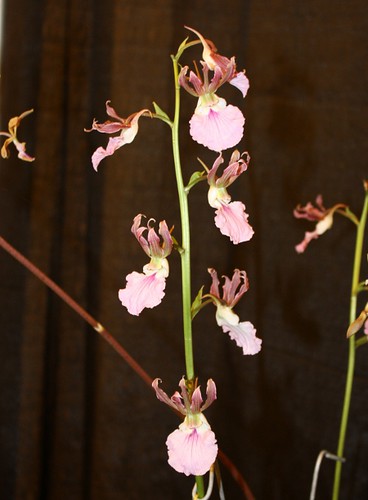 |
| Eulophia guineensis |
Grammatophyllum is the genus of "giant orchids." These plants get really large and can become very heavy with time. I like how their roots point upwards (not shown in this photo). They have very neat blooms of brown and yellow. Usually they are pretty spotted, like a leopard. This particular plant was named Leopard and yet, the blooms weren't really spotted. It was more like the brown had taken over all but the edge of the petals, which retained the yellow coloring.
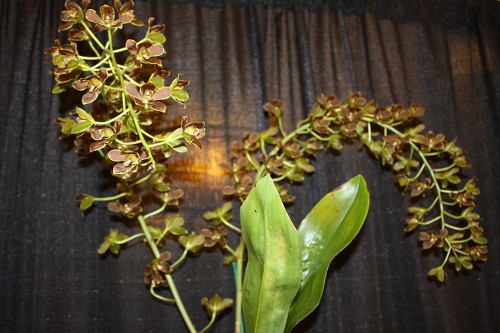 |
| Grammatophyllum Leopard |
The plant below belongs to the
Mexicoa genus, which I had never heard of. It was a nicely grown plant with some neat little yellow flowers. I think that
Mexicoa is a monotypic genus, because I can't find any references to a species other than this one. Apparently, it used to be
Oncidium ghiesbrechtiana, but has unique floral features that allowed it to be moved to its own genus.
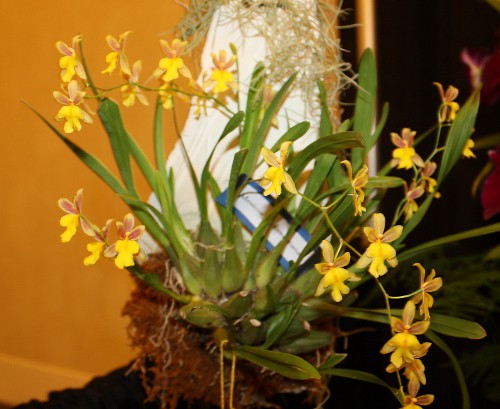 |
| Mexicoa ghiesbrechtiana |
My friend, Leland, who lives in Hawaii is on the brink of being sucked into the orchid vortex. The orchid of his dreams is
Bulbophyllum phalaenopsis. (Why did they let someone give a genus name in place of the specific epithet?) The species gets very large leaves that look like those of the
Phalaenopsis genus. You don't even notice the psuedobulbs much due to the large leaves. When this plant blooms, it creates this hanging purple tongue of flowers that smell like a thousand dead elephants. Prairie Orchids had this plant for sale for $75, which is not out of the ordinary for this species.
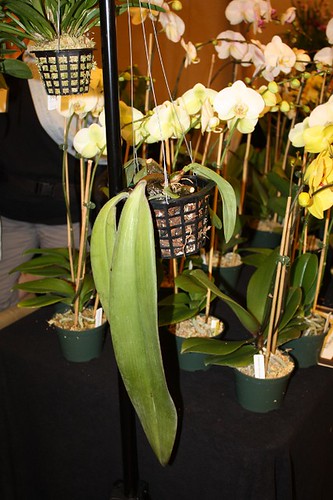 |
| Bulbophyllum phalaenopsis |
The final two orchids are both
Pleurothallis and were both for sale at vendor's booths. I just have one little
Pleurothallis and I really like it. They tend to be cool to intermediate growers and don't need much light. I keep mine on the kitchen windowsill inside and it has been growing well for me. I probably need to fertilize it because it was blooming this time last year when I bought it and it is bigger this year and not blooming.
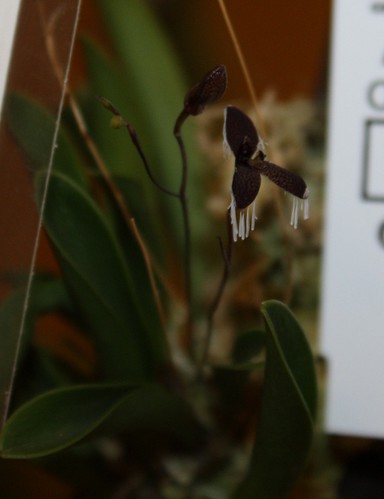 |
| Pleurothallis ornata for sale at Andy's Orchids booth |
Pleurothallis ornata (above) has these cool little icicles (not the technical term) hanging from the blooms. Now the photo above doesn't show scale, but these little flowers are smaller than a dime. Generally people that grow
Pleurothallis and related genera are interested in miniatures and oddballs. I'll be trying more of these in the future.
Now, prepare yourself. The photo you are about to see is amazing...
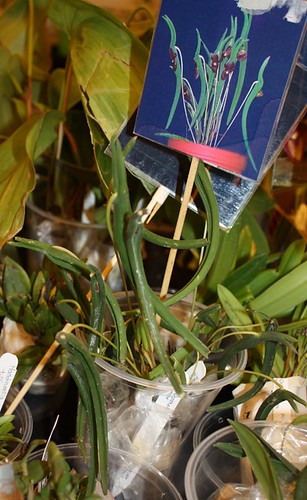 |
| Pleurothallis dilemma for sale at Ecuagenera booth |
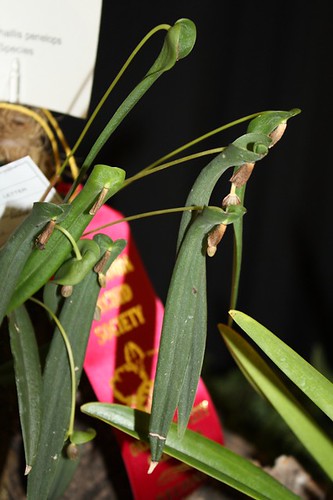
By far the most bizarre plant at the show was this
Pleurothallis dilemma (above). Eat your heart out, cucumber orchid! This thing is like the "conjoined twin green bean" orchid. It was for sale at the Ecuagenera table and I really wish I had bought it now. Of course, my allowance is better off, but
man, is this ever a neat little oddity! (There is a better photo
here.)